
Best Mariner ever deathmatch kick-off
Top ten advance to actual elimination polling. Feel free to debate criteria, make a case, stump for a guy, or suggest sadly overlooked alternates. This list was based on leaders in counting stats and outstanding season achievements (so Charlton’s on there as the saves leader). There’s no criteria by design: if you want to vote for Dan Wilson because you think he best exemplifies the qualities you want to see in a Mariner, so be it. If you want to vote for Harold Reynolds because he’s the sharpest-dressed, that’s fine too. I’m intersted to see how this sorts out.
You can vote for as many players as you want in this first round
Let the debate begin!
Position Roundtables: Right Field
Starting Rightfielder: Ichiro!
Dave
Context is a tricky thing. By pretty much every standard, Ichiro had a “down year” in 2005. His average dropped 69 points, and he posted the lowest BA, OBP, and OPS of his U.S. career. His .786 OPS was basically the same as Raul Ibanez’s, and we’re all upset that the M’s are giving Ibanez a contract extension. A cursory look at Ichiro’s numbers reveal a pretty mediocre season.
But, as usual, cursory looks at statistics can be misleading. During his down year of 2005, Ichiro was still one of the five best rightfielders in the game. Seriously.
He posted a .289 EqA, which ranks him 7th out of 25 right fielders who made at least 250 outs (basically, guys who play regularly). On a per at-bat basis, the only RFs who were more productive hitters were Vlad, Giles, Sheffield, Abreu, Jenkins, and Emil Brown (?!?).
EqA underrates Ichiro a bit, however, because he’s more durable than most players and stays in the line-up all the time. When you go to a counting statistic to incorporate playing time, such as runs above replacement, Ichiro moves up to 5th, passing Jenkins and Brown. He wasn’t in the offensive class of the Big Four, but he wasn’t leaps and bounds behind, either. Sheffield and Abreu were both worth about 10 runs more offensively than Ichiro, Sheffield about 20, and Vlad about 25.
Now, defense. Ichiro’s clearly the best defensive player of the group, even if he may not be quite as good as he was a few years ago. Sheffield is a legitimately horrible defender. Guerrero’s a little below average. Giles and Abreu are about average. Ichiro’s glove was worth at least 10-15 runs more than Sheffields. He’s probably 5-10 runs better than the other three.
Guess what? He basically catches Sheffield and Abreu in overall value. He’s still clearly behind Vlad and Giles, but the gap isn’t astronomical. He’s just not the best right fielder in the game. No big deal.
However, here’s the point no one seems to remember; he’s clearly in the top 5, and probably in the top 3. He was something like the 3rd-5th best right fielder in baseball in his worst season since coming over from Japan.
Yes, he only hit .300, he doesn’t walk a lot, and he lacks power. But he’s still every bit the star that Gary Sheffield or Bobby Abreu is. He’s a legitimately great player. Remember that the next time a national columnist tells you his sub-800 OPS makes him a liability.
Derek
It always amazes me that the same people who advocate looking for new
ways to solve problems and unconventional thinking like to tee off on
Ichiro because he’s not a prototypical right fielder. So what? It’s also
interesting that people seem to focus on what Ichiro doesn’t quite do:
he steals over 30 bases a year, but he needs to be more aggressive. He
hits for a high average, but he’d be better/worse if he went for more
power/took more pitches/whatever.
You touch on one of the most important things Ichiro offers that doesn’t
get enough credit: he plays and plays and plays. Maybe too much, but
having Ichiro means that every game a part of the problem’s pre-solved:
in right field, you have one of the best players in the game. Now work
out the rest of the lineup.
One of the reasons I’m optimistic is that we’ve seen Ichiro toy with the
power swing when he feels it’s appropriate. It clearly requires him to
take a different approach (he looks much more coiled) and he doesn’t
break it out that often, but I think that Ichiro’s well-equipped to
adapt to the effects of aging. The downside is that if being more
selective really does mess him up, then his aging path is going to be
really strange: where most players gain power and patience while their
average drops, if not swinging isn’t an option for him and he stops
being able to beat out infield hits, that’s a tough decline.
Fortunately, that’s not going to happen next year. Also, he could
switch-hit if he really wanted. I like mentioning that.
I won’t even bring up whether he’ll play a lot better on an improved and
more competitive team. If it happens, great.
While there are some excellent reasons to stay away from the park this
year, there are a couple – Felix, Johjima, Soriano, the development of
Lopez and Betancourt, for starters – but he’ll do something over the
course of the year that makes it all worthwhile.
On another note, why is Ibanez the annoited face of the team? Is it
because he’s more gregarious, has a family that photographs well (and
who he’ll let be photographed), and has a nice litttle storyline? Maybe
it’s me, but I recognize that even as there are different Ichiros:
– the private hermit
– the effortlessly competent and solemn star player
and that makes it hard to market, Ichiro is amazing, I have seen Ichiro
make plays I think back on and still send the tingles down my back. He
holds the single-season hits record. He’s so cool I had to put on a
parka just to write this and my hands are still getting numb. What’s
Ibanez ever done that’s made people stand up and applaud until their
hands hurt? If anyone on this team is an heir to the quiet dedication
and contributions of Edgar, it’s Ichiro.
Anyway, here’s my cool thing of the day: it’s the Ichiro outcome-o-matic.
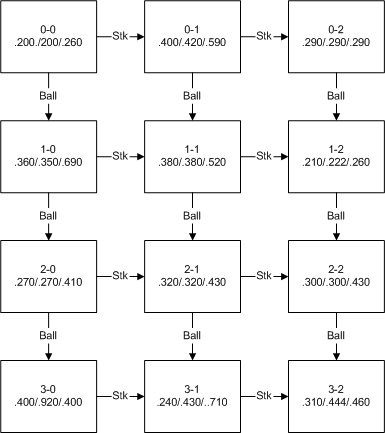
This is what happens when his at-bat ends on that count. Note that he can only walk on a 3-x count, and sometimes he sacrifices (argh) which explains the OBP thing.
Friday wheel of fun
Probably the most disturbing story is in the PI. “Healthy Foppert undeterred by solidity of M’s rotation”
Foppert — and every other aspiring starter in camp, including veterans Dave Burba and Kevin Appier — has to face the reality the Mariners rotation is as good as locked.
Jamie Moyer, Joel Pineiro and Jarrod Washburn are going to be in the rotation no matter what because of their salaries. Felix Hernandez is in no matter what because of his talent. With Gil Meche’s combination of salary and talent, his immediate future is secure, too.
A couple of things:
First, sunk costs. If the M’s can get more out of a rotation spot by releasing a guy making $100m and playing Foppert, then so be it. I know in reality the business side tends to tie hands, but really now.
Second, Meche’s combination of salary and talent has = diddly/squat over the last few years, so if Foppert can beat him out, so be it.
Hargrove:
“Foppert’s one of the guys who’s really impressed me,” manager Mike Hargrove said. “I would still have to say he’s a long shot to make the rotation. I think we’re pretty set.
“Seeing what he has, though, it wouldn’t be a shocker if he made the team. A surprise, yes. But not a shocker.”
You’re set. Really. Open of March, and you’re pretty set. Even though two of your pitchers have been inconsistent-to-crappy since before you even got here. Wow. Okay.
Or, to put this another way: that those two stink-bombs have been spreading the delicious scent of sulfur throughout American League parks for years while being well-paid to do so doesn’t mean we should be particularly eager to take another big whiff to see if the bouquet has changed any.
Also: Beltre is off to play in the WBC in the PI, and
Jeff Clement is in the Times.
Why I don’t like the WBC
I’ve been sitting on this post, but given that the games are starting up, now is as good a time as any.
I think the World Baseball Classic is a bad, bad idea. For starters, playing games that matter is a poor substitute for spring training, when the games don’t matter and you can gradually ease players into playing a full nine innings. The players, particularly the pitchers, aren’t in shape enough for this kind of thing, and it’s only a matter of time before some team’s star gets hurt and their pennant chances go out the window (we should thank our lucky stars Felix isn’t pitching, while at the same time crossing our fingers for Ichiro).
Even if you can get past that, the idea that this will determine anything is absurd because many of the best players in the world — wasn’t this the WBC’s #1 selling point? — aren’t even playing. Pedro? Out. Manny? Ditto. Vlad? Likewise. Japan’s top catcher, in camp with the M’s, isn’t playing. Melvin Mora, Billy Wagner, CC Sabathia, and Aramis Ramirez are among others who have pulled out of the tournament recently. Wagner and Sabathia were replaced on the US roster by — this isn’t a joke — Al “6.13 ERA” Leiter and Gary Majewski.
Throw in some far-fetched national eligibility — your great-grandfather once vacationed in Rome? Welcome to Team Italy! — and the whole thing is a sham, contrived by Bud Selig in an attempt to get us to care about the results of what amount to glorified spring training games.
For me, baseball started today because I heard Dave Neihaus on the radio, not because Korea beat Chinese Taipei in front of a mere 5,193 fans at the Tokyo Dome.
Fantasyland
A very short review of Fantasyland, a new book by Sam Walker.
Walker enters Tout Wars, which is one of two super-high-profile roto contests, as one of the “rookie” entries, against a set of expert roto players, and descends into madness in his pursuit of the title.
The good stuff: he goes crazy trying to win. He hires two advisors (one a NASA dude for the stats, one more on the scouting-and-intuition side), gets advice from a baseball astrologer, and gets an attractive actress to act as his “videographer” for the auction so she can flirt and distract the other male, geek-o-matic guys.
One by one, Christine slowly drains my opponents of their excess testosterone: complimenting Steve Moyer on his tan, asking Lawr Michaels if he’d like to play some air guitar, and panning in tightly on a visibly irritated Ron Shandler. “I like to think I know what I’m doing a little bit,” says a suddenly modest Matt Berry. “I certainly know I’m not one of the sharks today,” Joe Sheehan confesses. “I’m a little guppy swinning through the water, and I’m going to get eaten before the day’s out.”
“No, no,” Christine purrs. “Repeat after me: ‘I’m going to be a shark!'” Sheehan blushes, waits a few beats. “I’m going to be a shark!” he says.
“There you go!”
The draft (p151-153) is the funniest fantasy baseball anecdote I’ve ever read.
His attempts to talk to players about being on his team are awkward to the point of hilarity sometimes, and sometimes happily insightful. His writing’s easy and relaxed, and Walker’s self-critical and funny about his descent into madness.
The bad stuff: gets a little tedious in going over the mechanics of what’s happening when in the league, which today is really dry. Sure, whether or not Josh Phelps got benched was important then, but now? He tries to condense it down as much as possible, but it’s just sawdust in the Twinkie. And if you’re a serious baseball fan, you’ll probably notice that there are errors that slipped in on some niggling stuff (the Wade Boggs thing, for instance, p.28).
Also, there’s a baseball astrologer. Reallllly annoying, but I’m not going to get into that again.
He’s clearly got a huge crush on Ron Shandler, which is fine on its own. I’ve bought Baseball Forecaster before (I’ll spare you that review, too). And it makes for a weird/funny moment when Ron Shandler, who can be as insufferably arrogant as anyone, says of Baseball Prospectus “They’re so friggin’ arrogant. Joe Sheehan is one of the only guys over there that I have any respect for.”
That’s funny on maybe four, five levels.
If you’re a fantasy baseball fanatic, this is going to be a really good read. If, like me, you’re not that into roto, it’s fairly quick and entertaining as long as you start to skim when you feel your eyes glossing over when he talks about his horrible dilemma about what to do with his free agent budget.
Anyway– Fantasyland, Sam Walker. Check it out.
Felix Worship, circa 2006, Part 1 of Many
From John Hickey:
Felix Hernandez, the 19-year-old right-hander on whom the Mariners have rested many of their hopes, dazzled San Diego Thursday.
Throwing just the first inning of the annual Mariner-Padre charity game in Peoria Stadium, Hernandez struck out the side on just 13 pitches.
Dave Roberts, Mike Cameron and Brian Giles all went down on strikes against Hernandez, who was replaced by Kevin Appier to start the second inning.
Long Live The King.
Head Shaking
Okay, I know that a lot of people consider Pat Gillick to be baseball royalty, but man, this is incomprehendable.
From today’s times.
Imagine if Gillick hadn’t acceded to Ken Griffey Jr.’s trade request after the 1999 season and made the epic deal that sent the franchise icon to Cincinnati. Imagine, instead, if Gillick had dealt the Mariners’ other superstar, Alex Rodriguez, who later walked away from Seattle after the 2000 season to sign a $252 million contract with Texas.
Gillick dropped that provocative bombshell earlier this week on Dave Mahler’s KJR radio show, and he elaborated on Wednesday.
“I possibly traded the wrong guy,” he said. “If I had to do it over again, I should maybe have traded Alex.”
…
“Even though he was only one year away from free agency, I probably could have gotten more for Alex than we could for Griffey,” Gillick said.
…
“So I think if I had to do it over, I probably would have told Kenny, ‘Yeah, we’ll respect the fact you want to be traded, but we’re going to keep you.’ We probably should have moved the other guy.”
Looking back in retrospect, Gillick wishes he would have traded Rodriguez and kept Griffey. Despite the fact that trading Griffey was the single best move he made as the GM of the Mariners. Do you have any idea how bad we’d have been with Junior limping around center field in Safeco the past few seasons, pulling in $15+ million per season?
I mean, holy crap. I have no idea how you retroactively look at the Griffey deal from the M’s perspective and say “yea, I wish we could undo that one.”
Red hot Mariner news for Thursday
The Raul Ibanez signing is official. (Brock, TNT, Hickey , PI)
“There is really a very limited supply of left-handed hitters of Raul’s caliber,” Seattle general manager Bill Bavasi said. “He hits with men on base, hits both left-handers and right-handers and has a stroke that is a great fit for our ballpark. That’s before you even consider his leadership and character.”
(TNT)
The PI quotes the price at $5.5m each year for those two years, which is what was originally reported when Finnigan broke the story in the Times.
Meche is happy with his location. (Brock, TNT)
Jeff Harris wants to pitch. (also Brock, TNT)
Boone retires
As noted in comments for the day’s news thread, Boone has hung up his cleats. Picture here.
Boone’s career was quite the roller coaster ride, wasn’t it?
Future Forty, Update #1 for 2006
With spring training finally here, we’re back to monthly updates for the Future Forty, our version of a prospect “list”, so to speak. It’s quite a bit different in presentation from what you’ll get from Baseball America, and that’s on purpose. Here’s the nuts and bolts.
In my opinion, ranking prospects by numerical order, while entertaining in a friendly-argument kind of way, is essentially overanalyzing things. Trying to weed out the difference between the 13th and 24th best prospect in a given organization is going to be splitting hairs, for the most part, but their numerical differences appear quite large. In a lot of cases, there will be almost no appreciable difference between players who are slotted 15-20 spots apart, but the list creates the illusion of separation.
So, after several years of ranking the M’s prospects 1-40, I abandoned the list method and moved into a grouping analysis, which I personally find much more informative and less tedious. Players are separated into categories, based on their risk/reward levels as well as their proximity to the major leagues. Each player is a assigned a score from 1-10 in both Risk and Reward, and those are broken out to give you an idea of what type of player a prospect is, rather than simply where he ranks relative to other players in the system.
The other common complaint about prospect lists is eligibility; Felix Hernandez is no longer technically a prospect, by those who use rookie of the year status for their definition, but Kenji Johjima is. Does that make sense? The 19-year-old isn’t eligible for a list of players who may contribute to the team’s future, but the 30-year-old catcher is? So, rather than adhering to the standard rules for prospect status, I threw them out the window and created my own eligibility requirements; you can be on the Future Forty if you are either 25 years of age or less or have less than one full year of major league experience. And I reserve the right to refuse service to anyone, so while Johjima technically fits the bill, he’s obviously not part of the team’s long term future, so he doesn’t make the list.
So, on the Future Forty, you’ll find Felix, Reed, Betancourt, Lopez, Sherrill, Morse, and Jake Woods among the guys who have exhausted their prospect eligibility. They’re part of the organization’s future, and after all, that’s the whole point of this kind of exercise, right?
So, how do I evaluate prospects? Well, there’s no doubt this site is steeped in statistical analysis, and we’re never going to escape the label of statheads. That’s fine, but the connotation doesn’t necessarily fit here. On the subjective vs objective debate, I’d argue that I fall further to the subjective side of the tree. In other words, I agree with Baseball America more often than I agree with Baseball Prospectus.
Personally, I believe that statistical analysis at the minor league level is not best used as a predictor of future performance, but as an evaluator of individual skills. I’m not a fan of attempting to find out if a guy is a .260 hitter or a .290 hitter by adjusting for park, league, and age, simply because there are so many variables we don’t do a good job of accounting for, and the margin of error is just too high. However, that doesn’t mean we should ignore a player’s performance. They can be a great tool in evaluating what type of skills a player has, and once we know that, we can relatively easily figure out how well that particular skillset projects at the major league level.
Let’s take two players as an example; Asdrubal Cabrera and Matt Tuiasasopo. They’re both technically shortstops (but as I’ve stated many times, I think the odds that Tui plays short in the majors are about 1 in 100), they’re only 6 months apart in age, and they’re both 7/7 risk/reward players. Cabrera ran circles around Tui when they were teammates in Wisconsin, then held his own following a promotion to Inland Empire. He’s also the vastly superior defensive player.
From a purely statistical standpoint, Cabrera’s the clear winner. He can play shortstop in the majors and he outperformed Tui all year long. If you’re running statistical translations, you’re going to take Cabrera, and you don’t even think its particularly close.
However, that ignores the fact that Cabrera and Tui have wildly different skillsets, and are, in fact, vastly different players. An in depth analysis of their skillsets will reveal a lot more about the player’s abilities and future projection than simple minor league translations. Using the statistics to see the picture of Cabrera as a high average, aggressive, gap hitter and Tui as a power hitter who sacrifices some average for more walks and extra base hits gives a more accurate picture of their futures.
Cabrera’s certainly ahead of Tui at the moment, but his skillset type is unlikely to grow at anything close to the same rate that Tui will. In other words, Cabrera’s skillset matures faster and plateaus earlier, while Tuiasasopo may develop later and have more value further on in his career. Cabrera’s the better teenager, certainly, but Tui’s got a great chance to be the better 25-year-old.
Applying the same growth curve to each type of prospect is folly, but that’s essentially what minor league translations do. Breaking a player down by skillset is far more effective, and paints a more clear picture of what to expect in the future.
So thats the longwinded explanation of the Future Forty. As always, this thread is available for any minor league related questions, and I’ll try to answer as many as humanly possible.