Travel Schmavel

Conor · January 14, 2009 at 7:29 pm · Filed Under Mariners 

As Mariners fans, we often read quotes like this…

“With our travel schedule, tougher than anyone else in baseball at more than 50,000 miles a year, we have to have a bench, guys who can step in and do the job. If you don’t, you can’t rest regulars the way you have to and you pay a high price in the long run.”

-Bob Finnigan quoting Lou Piniella, Seattle Times, Sept. 27, 1998

 And this…

“Armstrong says 2008 features the worst schedule in club history, and while that’s largely because of travel inequities, the home schedule didn’t do them any favors, either.”

-David Andriesen paraphrasing Chuck Armstrong in the PI, Aug. 20, 2008

I always kind of brushed these types of comments off, thinking that it was just the Mariners crying in their coffee. I mean, I knew being in the Northwest somewhat secluded the M’s from the rest of baseball, but I figured that the claims were a bit overblown. It’s not like they’re the only team west of the Mississippi—there are other teams on the west coast that have to make road trips to Boston and Chicago and down to Tampa, just like the M’s. But just thinking it was hogwash wasn’t enough for me—I had to be sure. Since I had never actually seen travel distances for major league teams, I had to do the legwork myself…

I created a spreadsheet and started inputting travel distances based on teams’ 2009 schedules. As you may imagine, this is pretty time consuming, so I didn’t do every team, I just tried to get a sample of teams across the country. Obviously I started with the Mariners. In 2009, the M’s will fly approximately 47,183 miles. Not having anything to compare this to, I didn’t really know what to think, but I was glad that the number was close to the 50,000 Lou mentioned.

Next, I decided to see how the travel schedule of an east coast team compares to that of the Mariners. I chose to look at the Phillies and, not surprisingly I suppose, their schedule is a lot lighter. The World Champions will fly about 36,112 miles next season. That’s still a ton and I think about this every time I get off a plane.

But, with so many teams in close proximity, I thought perhaps the Phillies were an outlier and decided to look at a team in another corner of the country—the Tampa Rays. Turns out it wasn’t an outlier and their mileage is nearly identical at 37,685 miles next season. How about a team in the middle of the country? Well, they have it even easier. The Rockies will travel about 31,040 miles this season. I then thought that the only team that probably even had a shot at getting close to Seattle was another west coast team, and I was right. The Angels will travel approximately 43,407 miles next year—still about 4,000 miles shy of Seattle, but it’s a lot closer.

We all know that flying can result in sore joints and muscles, sickness and loss of sleep. Obviously the Mariners are taking more luxurious trips than me, sitting in a cramped coach seat, listening to people coax their whining pets while trying to avoid watching “The Longshots.” I’m serious about the pet thing by the way and, as a side rant, since when are dogs are cats allowed on planes? What if they end up sitting next to each other? And what other animals can you bring? Snakes?

Still, no matter how cushy the seats, how many songs on your iPod or how fun it is to listen to Jarrod Washburn’s ice fishing stories, flying takes it’s toll and a team flying 25% more than others certainly isn’t a prime selling point.

But is it really as bad as they make it out to be? Some quick Googling indicates that it’s only about an extra 20 hours in the air. Over the course of a season, that doesn’t seem like much (just a little over 3 extra hours a month?). Plus, I don’t know about everyone else, but for me the worst part about flying is taking off and landing and the M’s take the same number of trips as all the other teams.

Using the same quick math, the Angels only spend about 8 more hours in the sky than Seattle…over six months. Pretty negligible, if you ask me. Do California teams complain about travel schedules, or just us?

On top of that, what kind of impact, if any, does the extra travel even have? Although I would love to talk to players and coaches about it, signs point to “pretty much none.” One semi-bogus sleep study (from reputable source “e! Science News”) claims that teams with a three-hour circadian advantage win about 60% of the time (though I’d prefer to see if those numbers hold up over multiple seasons). The only other data I found was from Gary Huckabay several years ago at Baseball Prospectus and he found that hitters put up nearly identical numbers the first day of a road trip to those accumulated during the rest of the trip.

So, much like team chemistry, travel schedules seem like something losing teams tend to blame and winning teams simply don’t talk about. You only hear the M’s talking about the disadvantages to their geographical position, you don’t hear them saying, “You know, we really enjoy the longer flights because it gives our guys more time to bond  and build the chemistry necessary to win over the long haul.”

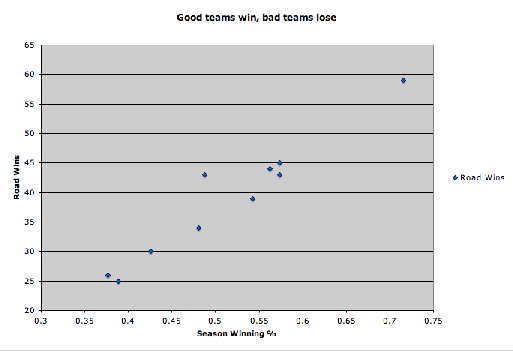
Here’s how the M’s have done on the road the past 10 seasons…picture-12
Comments

51 Responses to “Travel Schmavel”

  1. ChrisB on January 14th, 2009 7:42 pm

    The Canucks have been studying this, using sleep rythym timing watches and various other things, and what they are determining is that travel is most harmful in that it disrupts your bodies circadian rythym, and causes lost hours of sleep at the destination. So, the plane time is not the big deal, it is the number of times you cross time zones.

    Anyway, the new GM of the Canucks who is big on technology has tried to get the payers to adjust their sleep patterns to try and cope with this better.

  2. Conor on January 14th, 2009 7:47 pm

    That’s awesome. Thanks, Chris. Can you point me in the direction of any articles about that?

  3. pumpkinhead on January 14th, 2009 7:49 pm

    Wow… talk about consistency.

  4. metz123 on January 14th, 2009 7:54 pm

    The only times I’ve ever found travel to be taxing is traveling with babies and red eyes (because coach seats don’t recline enough for me to get comfortable enough to sleep). I find the actual flight time to be relaxing as it creates time to do stuff that normally gets brushed aside like reading and watching movies.

    I bet sleeping in hotels, eating out, hitting the bar and breaking the home routine is a bigger impact on performance than miles traveled. These guys just don’t go through the security hassles and wait times like the average traveler encounters.

    BTW – I agree that all animals should go with the luggage not the passengers.

  5. terry on January 14th, 2009 7:57 pm

    This is awesome stuff. BTW, on one cross-country flight from Seattle a few years ago I got to watch a national geographic documentary on the breaching great white sharks. Way cool (especially so since we didn’t have to fly over open water…screw the flotation device…i’ll take a tank of compressed oxygen and a rifle please).

  6. galaxieboi on January 14th, 2009 8:10 pm

    I’d venture to guess the low travel teams might have a harder time coming out here. Imagine the AL East teams making a trip out west after say, 2 weeks of playing within easy train rides of your home park? When the M’s go to New York, they usually get Boston and Toronto too, right? The Sox come here and then it’s all the way to Oakland and then all the way to Anaheim next. Just a thought.

  7. Steve Nelson on January 14th, 2009 8:16 pm

    In my travels across time zones, the most disruptive aspect has been landings, which includes the process of deplaning and getting to wherever I will be staying. While I can start relaxing on the plane, when I arrive at my destination I need to return to a high level of activity. Upn reaching my accommodations I need to restart the process of winding down.

    That disruption to my normal rhythms is by far the most taxing. The flight itself isn’t a very big deal. It’s certainly more disruptive when I travel to the Midwest as compared with southern California, even though the distances and flight times might be similar.

  8. terry on January 14th, 2009 8:27 pm

    Really, to me the worst part of flying is dealing with getting to the airport, sitting at and going through the airport (several times if you’re connecting) and dealing with getting your bags when leaving the airport before making your way to the hotel.

    I’m thinking those steps are all gravy for major league teams.

  9. philosofool on January 14th, 2009 8:29 pm

    I love the regression line through that graph: it turns out winning teams win more on the road!

  10. Conor on January 14th, 2009 8:33 pm

    I love the regression line through that graph: it turns out winning teams win more on the road!

    Shocking, huh?

  11. argh on January 14th, 2009 8:45 pm

    Small animals may be brought into the cabin on many airlines provided they fit under the seat in their travel cages. Alaska Airlines, for example, currently gets $125 each way, limit two critters to each cabin.

    Now back to hauling large animals around the country.

  12. Mike Honcho on January 14th, 2009 8:46 pm

    Any disadvantage the M’s have in travel might me made up for in weather. I don’t think there are any better places to play in the summer (other than in domes) than Seattle.

  13. Clueless in Seattle on January 14th, 2009 9:14 pm

    The one BIG issue you have not addressed is that MLB teams stay at any city on the road for 3 or 4 games. Very few series are a 2 game set, so the vast majority of series allows a team to settle in. Unlike NBA and NHL teams…they are in and out in one night.

    However, the WestCoast teams do loose 3 hours traveling to the east (something your spreadsheet does not reflect). Where ALL WestCoast teams suffer is: When you have a 7pm Pacific game that ends at 10pm get to the airport and depart at about 11pm, and then travel to the EastCoast you get into that city at about 3-4am Pacific…6-7am Eastern. Now add an afternoon business man special you could only get 3-4 hours of sleep.

  14. Sportszilla on January 14th, 2009 9:21 pm

    Plus let’s be honest, even if the Mariners are at a slight disadvantage by flying more miles than any other team, they derive a much larger organizational benefit from being the only team in the Pacific Northwest: a market that could conceivably stretch from Oregon to Alaska, out to Montana.

    Though I will say that after going to college in New York, flying out from west to east is much harder, especially if you have to fly overnight and do something the next day. However, as pointed out, that’s something that affects all West Coast teams equally.

  15. andoq on January 14th, 2009 9:27 pm

    A timely article on pro atheletes and sleep was recently written on oregonlive… it’s got lots of interesting stuff. Although it’s not as related to baseball, since it focuses on basketball players staying in their normal sleep patterns on the road. Probably a little harder with an MLB schedule when you have longer road trips and play every day. Plus, too be honest, basketball is a tad more physical…

    But, it does have some good examples of trip iteneraries that are pretty extreme and can take their toll.

  16. Willmore2000 on January 14th, 2009 10:09 pm

    About snakes, we should never forget:

    http://www.youtube.com/watch?v=PZ2QFmJ7h0A

  17. NODO Dweller on January 14th, 2009 10:23 pm

    I’ll take a small dog/cat in a carrier under the seat over a crying child any day of the week and twice on Sunday. At least the pet owners have the good sense to sedate the pets that don’t fly well…

  18. boomdonkey on January 14th, 2009 10:24 pm

    Wow, that regression line is so clear it could be used in intro stats courses. Great post conor!

  19. Roy Stuckey Weaver on January 14th, 2009 10:41 pm

    Are you using Minitab or Stata to make that graph? Or is it just excel?

  20. DaveValleDrinkNight on January 14th, 2009 11:17 pm

    Does anyone remember one single mention of travel woes when the team won 116 games?

    If there is any truth to that excuse, why don’t we leave Silva and Batista at home when were on the road?

    That’ll make ‘em Cy Young contenders!

  21. jro on January 14th, 2009 11:19 pm

    Travel schmavel.

    Exactly. As a point of reference, I looked up the details of the Houston Astros 26-road-games-in-28-days schedule from 1992. When they had to clear out of the Astrodome for the Republican National Convention.

    The trip started in Atlanta on 7/27 and ended in Philly on 8/23. Road trip record: 12-14. Season record: 81-81.

    Never mind the distance, that’s perpetual travel for a month with very little break. And the travel didn’t really affect their overall season outcome.

  22. wabbles on January 14th, 2009 11:20 pm

    SNAKES?! ON A PLANE?! (OK, I refuse to believe I’m the only one here who got that reference.)
    But seriously folks, I still think there’s something to the complaint. It’s one reason that the M’s demanded (and MLB complied) to have Monays off after weekend road trips. As somebody said, it’s not so much the cramped existence for extended periods as crossing time zones. After the M’s lost to the Rangers (Eastern Time Zone) on the last day of the 1995 season, they flew up to Seattle to play the Angels (Western Time Zone) and then out to play the Yankees (Eastern Time Zone) on THREE CONSECUTIVE DAYS! It beats long bus rides but, yeah, that’s why the M’s don’t play on Mondays.

  23. Benne on January 15th, 2009 12:12 am

    SNAKES?! ON A PLANE?! (OK, I refuse to believe I’m the only one here who got that reference.)

    You’re not. I actually have the DVD.

  24. PatLagreid on January 15th, 2009 1:43 am

    I saw Snakes On A Plane the day it came out. Never got the DVD, though. Don’t even think I’ve seen the DVD.

    But nevertheless – I think there is definitely merit to the points that the amount of travel disrupts the natural rhythms of the body.

    The other thing to remember – and try not to shed a tear over this – is that the Mariners went from using the Seahawks’ charter plane in 2007 and prior to a regular Alaska Airlines 737 for the majority of their West Coast flights, and a Delta charter for their cross-country trips.

    From what I’ve heard, there was no comparison between the two at all.

    Now then, I don’t buy the travel as an excuse for losing games. As mentioned above, do you think if the team won 100 games we’d hear how they did it despite having to travel as much as they do?

    If anything, being on a plane that much longer with a team that’s losing left and right might make situations worse, and vice versa if you’re winning – more time to celebrate before heading to the next hotel or home to the wife and kids.

  25. Breadbaker on January 15th, 2009 2:49 am

    Well, color me unconvinced. For one thing, using the 2009 schedule doesn’t prove anything, since the games haven’t been played yet. Moreover, the 2009 schedule has the M’s playing the NL West, which cuts out a whole series of cross-time-zone trips. And we were told the schedulemakers were going to try to give the M’s a break this year, and if you look at the schedule, they have a number of trips just to the midwest and only a couple weird corner trips (LA-NY-BOS and TB-TOR).

    I am not saying I agree or disagree with the conclusion, but I don’t think the use of 2009 is the appropriate measure (just like jro’s example of the Astros long road trip comes down to “small sample size”).

    Finally, I would point out that the Angels and A’s each get essentially 84 home games in terms of travel, because of the annual series with the Dodgers and Giants, which sends the M’s to San Diego. I’ve long believed that the economic advantages for the New York, LA and Chicago teams in particular of these guaranteed interleague series are so acute that the revenue and expense should be shared (the M’s have to pay to fly to San Diego and pay for a hotel while the Angels drive from their homes) by all the clubs. But the travel advantage, if there is one, cannot be shared.

  26. ChrisB on January 15th, 2009 5:20 am

    Conor,
    Here is one story

    http://tinyurl.com/8ns8mf

  27. Paul B on January 15th, 2009 6:53 am

    However, the WestCoast teams do loose 3 hours traveling to the east

    Many years ago, I wrote an article for a little Mariner Fanzine on this topic. I looked at the Mariner record when traveling East. I discovered, looking at several years worth of data, that the M’s lost more than expected when it was the first game of a trip where they traveled East and changed time zones. I didn’t see any differences on the rest of the road trip, just that first game after traveling east. Which made sense to me.

    To get a large enough sample size, you need to look at quite a few years, and compare the record in those select first games to the overall team road record for the remaining road games that season, if anyone wants to do it and see if it is still true over a decade later.

  28. pshmidget on January 15th, 2009 9:15 am

    I guess it’s not the number of hours – it’s jet lag from Time Zones, yeah?

  29. HerseyChris on January 15th, 2009 9:16 am

    We got swept at home by the Nationals… It’s a small sample size, but I don’t think traveling or sleeping patterns had much to do with that.

  30. LA M's Fan on January 15th, 2009 9:58 am

    Don’t forget one other thing: if the Mariners truly suffer because they have longer to travel on the road, they should also similarly benefit when they play at home, since presumably the away team is travelling farther to play in Seattle.

    This is another nonsensical old baseball adage, that I rank just below “free agent x struggled because they went from the NL to the AL” — if such an effect really existed, wouldn’t interleague games routinely be 1-0, 16 inning affairs?

  31. xeifrank on January 15th, 2009 10:23 am

    Studying the effects of travel on a team like the Mariners who are in an isolated area (MLB wise) is a good excercise. On the flip side, the reverse effects should also be studied. Teams playing road games in Seattle have in general travelled quite a long distance. You should also add up all the travel miles of teams coming into Seattle. Non Oak/LAA teams have in general travelled many miles too, on their way to Seattle. Not sure what the best way to measure it would be.
    vr, Xei

  32. Paul B on January 15th, 2009 10:29 am

    However, if someone checks it out, it is possible that traveling west is not as difficult as traveling east.

    I know when I travel it is a lot easier adjusting to the time difference when going west than it is when going east.

  33. Mike Snow on January 15th, 2009 11:05 am

    Still, while an east coast team may have it easier going west, it will eventually have to go back east as well. That might be an interesting test, actually. Is an eastern time zone team disadvantaged, in the first game of a homestand after a west coast road trip, if its opponent has no such time differential?

  34. LennyBody on January 15th, 2009 11:16 am

    They have identified that travel distance is factor in win-loss record.
    Zero travel (home teams) win much more often, however determining the weight that this travel factor has is the challenge.
    Travel totals could be reduced by taking fewer road trips but making each of them longer. I have seen more complaints about longer trips.
    As to whether their is more of a disparity for the first game of a series brings up other factors also. The first game of a series usually comes after a day off, so a bad pitcher gets skipped in the rotation. Facing better pitchers is not conducive to winning either.
    The early (businessman special) games are also not played to open a series (they usually end a series with them on Wednesday.

  35. Buckj64 on January 15th, 2009 11:52 am

    [ot]

  36. nadingo on January 15th, 2009 1:08 pm

    I may be wrong about this, but I think your chart is a bit misleading. You’re showing a strong correlation between road wins and winning % for the entire season, correct? In that case, winning % is the same as taking (road wins + home wins) / (total games), so a large part of the correlation you’re showing is really just road wins correlating with itself. If you were to show road wins vs. home wins, you’d still see a similar pattern, but the correlation wouldn’t be quite as strong.

    Also, if you want to support your argument that travel isn’t a big factor in team performance, wouldn’t it be more useful to compare the road wins vs. home wins relationship for the Mariners to the same relationship for other teams that don’t have to travel as far?

  37. feingarden on January 15th, 2009 1:14 pm

    Conor, you say

    We all know that flying can result in sore joints and muscles, sickness and loss of sleep.

    yet galaxiboi raises an interesting point. When the Phillies travel to, say, Pittsburgh do they actually get on a plane? Or do they take the train? I’m sure that buses are right out, but still…

    Having recently experienced train travel during winter storms I’m not sure if taking the train would be more or less tiring than flying the same relatively short distance but I can assure you they are much different experiences.

  38. Mike Snow on January 15th, 2009 1:59 pm

    I can’t imagine teams using the train anymore, that sounds like a relic of the days before the Dodgers and Giants moved west. And no, they don’t use buses for anything longer than your average spring training trip.

    Philadelphia and Pittsburgh aren’t super-close, it’s like Seattle to Spokane, and no way the Mariners would drive that. The one I would actually wonder about is the travel arrangements when the Nationals play the Orioles.

  39. Breadbaker on January 15th, 2009 2:08 pm

    Still, while an east coast team may have it easier going west, it will eventually have to go back east as well. That might be an interesting test, actually. Is an eastern time zone team disadvantaged, in the first game of a homestand after a west coast road trip, if its opponent has no such time differential?

    I also wonder about how often that first game back is indeed a home game. There are possible advantages to coming home (familiarity with surroundings, back with family, etc.), as opposed to, say, having the Yankees play a SEA/OAK/BAL road trip before returning to New York.

    The one I would actually wonder about is the travel arrangements when the Nationals play the Orioles.

    There is no way they would fly that; the Baltimore airport is about a third of the way to Washington and the other Washington airports are in the wrong direction.

  40. Mike Snow on January 15th, 2009 2:49 pm

    Well, I didn’t figure they would fly, but what do they do, I wonder? Bus together from the other city? Have everyone get there on their own, like it was a home game?

  41. appleshampoo on January 15th, 2009 5:01 pm

    I have traveled with 2 cats one-way each. It’s usually 100 bucks to keep them under the seat and they have to have had all their shots and carry a health certificate. Most airlines have a total limit on the number of pets per cabin, I’ve heard 2 to 5.

    Apropos to your comment “What if they end up sitting next to each other?”, the last time there was a dog sitting across the aisle from me – he perked up when he saw my cat and stared at her for a few minutes but that was it. They’re supposed to stay in their carriers throughout the whole flight anyway, so it shouldn’t be a problem.

    I don’t know how they would deal with someone who has severe allergies though…seems like it could be a serious problem.

  42. Conor on January 15th, 2009 5:14 pm

    I e-mailed Jeff Zrebiec at the Baltimore Sun to get an answer to the Orioles-Nats travel question and here is what he said…

    Some take the team bus, but there also is a good portion of the team that drives on their own to the games. Really depends on the players preference.

    So there you have it!

  43. JoeintheClutch on January 15th, 2009 5:43 pm

    That little dot in the upper right hand corner is making me nostalgic. It’s been nearly a decade and I still can’t believe the Mariners were 70 games over .500 that season.

    Thank goodness the team chemistry generated by long flights caused them to win 116 games, or they wouldn’t have been able to overcome the 46 games they lost due to fatigue from their rigorous travel schedule.

  44. Red Apple on January 15th, 2009 6:10 pm

    The one I would actually wonder about is the travel arrangements when the Nationals play the Orioles.

    Of course, the Nats catch the Metro green line at the Navy Yard, transfer to the red line, disembark at Union Station, and take Amtrak to Baltimore!

  45. MKT on January 15th, 2009 7:43 pm

    I may be wrong about this, but I think your chart is a bit misleading. You’re showing a strong correlation between road wins and winning % for the entire season, correct? In that case, winning % is the same as taking (road wins + home wins) / (total games), so a large part of the correlation you’re showing is really just road wins correlating with itself. If you were to show road wins vs. home wins, you’d still see a similar pattern, but the correlation wouldn’t be quite as strong.

    I agree, I don’t see what the point of the graph is. Graphing “road wins” against “winning percent” is like graphing “number of hits” against “batting average”. It’s guaranteed to show a strong positive correlation, for the reasons that you mentioned. Actually even stronger, because some players with good batting averages have few hits, if they’re parttimers or missed games due to injury. Whereas almost all teams play exactly 162 games.

    Also, if you want to support your argument that travel isn’t a big factor in team performance, wouldn’t it be more useful to compare the road wins vs. home wins relationship for the Mariners to the same relationship for other teams that don’t have to travel as far?

    Another good point. THAT might’ve been an interesting and useful graph.

  46. Breadbaker on January 15th, 2009 8:26 pm

    Thanks for checking that, Conor. I must have spent an hour on Google trying to see if it had ever been reported. I mean, it’s not like it’s a huge thing, but I would think it’s a bit of a human interest story, driving to a road game.

    The cost, then, to the clubs is about the same as a road game in spring training. If I’m the Rockies having to fly to Toronto to play a sparsely attended game for the benefit of the sellout crowds for the “natural pairings” series, I’m not just a little ticked.

  47. Conor on January 15th, 2009 9:06 pm

    The graph wasn’t meant to knock anyone’s socks off. It was mostly just a fun little tongue-in-cheek way to end the post. Good teams win. They win at home, they win on the road, they win because they’re good. Bad teams lose. The teams’ travel schedules don’t change too drastically from year to year.

  48. TomTuttle on January 15th, 2009 11:35 pm

    OT, I know, but. . . [ot]

  49. Breadbaker on January 16th, 2009 1:39 am

    The teams’ travel schedules don’t change too drastically from year to year.

    Well, unless you’re stuck in Cleveland for a week snowbound and get to fly back at random points in the season.

    I must admit I loved the schedule we had in 2001 and a few years after where we started the season playing 19 games in division, and pretty much followed the A’s around the league and interleague. I loved it because the season had a shape to it I could see and understand and anticipate. “Okay, now it’s time to play the East.” The current schedule makers seem to make a virtue out of near random combinations of teams. “Okay, now it’s time to play KC at home, having last seen them in their place three months ago.”

  50. eric on January 16th, 2009 6:53 pm

    I’ve traveled a lot on business and it isn’t the time in the air, it is the changing time zones, I fidn that even the 3 hour difference to the east coast takes a week to really adjust, really not much different than going to Europe, even goign to Boise and changng an hour takes a couple days.

    The Trailblazers consulted with a sleep expert in the offseason and he recommneded that they stay on west coast time, so for example on the east coast stay up til 3:00 local time and sleep until 11:00 am, have your 9:00 am team meeting at noon and so on.

    Annecdotally, small sample size caveats and so on, so far it seems to be working great as the Blazers have an outstanding record on east coast road games.

  51. Dobbs on January 19th, 2009 10:03 pm

    We took our 2 dogs (without sedating them) on a cross-country flight where they then put two cats a row directly behind us while the owners sat in first class.

    After the flight, we got a ton of comments from people that they didn’t even know dogs were on the plane.

    The cats didn’t shut up for two hours :(

Leave a Reply

You must be logged in to post a comment.