The Problem With The Right-Handed Line-Up
As you’ve heard me talk about incessantly since the season started, the Mariners line-up is too right-handed. With Wladimir Balentien replacing Endy Chavez as the regular left fielder, the M’s normal line-up now includes six right handed bats (Beltre, Lopez, Betancourt, Johjima/Johnson, Gutierrez, and Balentien) and three left-handed bats (Ichiro, Griffey, and Branyan). Exacerbating the problem is that the six RH bats are very similar types of hitters. Gutierrez is the only one who won’t actively get himself out chasing pitches out of the strike zone, and all of them prefer to pull the ball when hitting for power. There are no Edgar Martinez’s in that group – it’s a bunch of aggressive bats who can hit something straight but struggle with pitches that move.
Not surprisingly, the M’s offense goes to sleep pretty much any time the opposing team throws a right-handed starter. The quality level hasn’t mattered – whether it was Jered Weaver, Josh Beckett, Scott Feldman, Bartolo Colon, Vicente Padilla, Shane Loux, Trevor Cahill, Nick Blackburn.. they all look like aces against the M’s.
But why?
To answer that question, I’ve turned to Dave Allen, one of the newest and best Pitch F/x analysts out there today. He’s doing yeoman’s work over at The Baseball Analysts, helping take Pitch F/x analysis to another level. I asked Dave to use the Pitch F/x data to help reveal some of the issues that the M’s line-up currently has against RHPs. We also get into the pitching of Felix and Shawn Kelley. The transcript of our conversation is below.
Me:
You recently wrote a really interesting piece about fastball movement and the different run value zones based on handedness of the batter. For those who missed it, the conclusion was basically that two-seam fastballs are extremely effective against same handed batters and not effective at all against opposite handed hitters. The Mariners have a roster that requires them to start at least five right-handed batters (sometimes six or seven) every single game, even when the opposing team is throwing a right-handed pitcher who features a two-seam fastball. Can you explain for our readers just how bad a match-up right-handed bats are against two-seam fastball pitchers, and why the pitch is so much less effective against left-handed bats?
Dave Allen:
Here is the image from that post. It shows the average (over pitch speed and locations) run value of a two-seam fastball from a RHP to RHB versus LHB based on the pitch’s movement. Negative horizontal movement is in to RHBs and positive is in to LHBs.
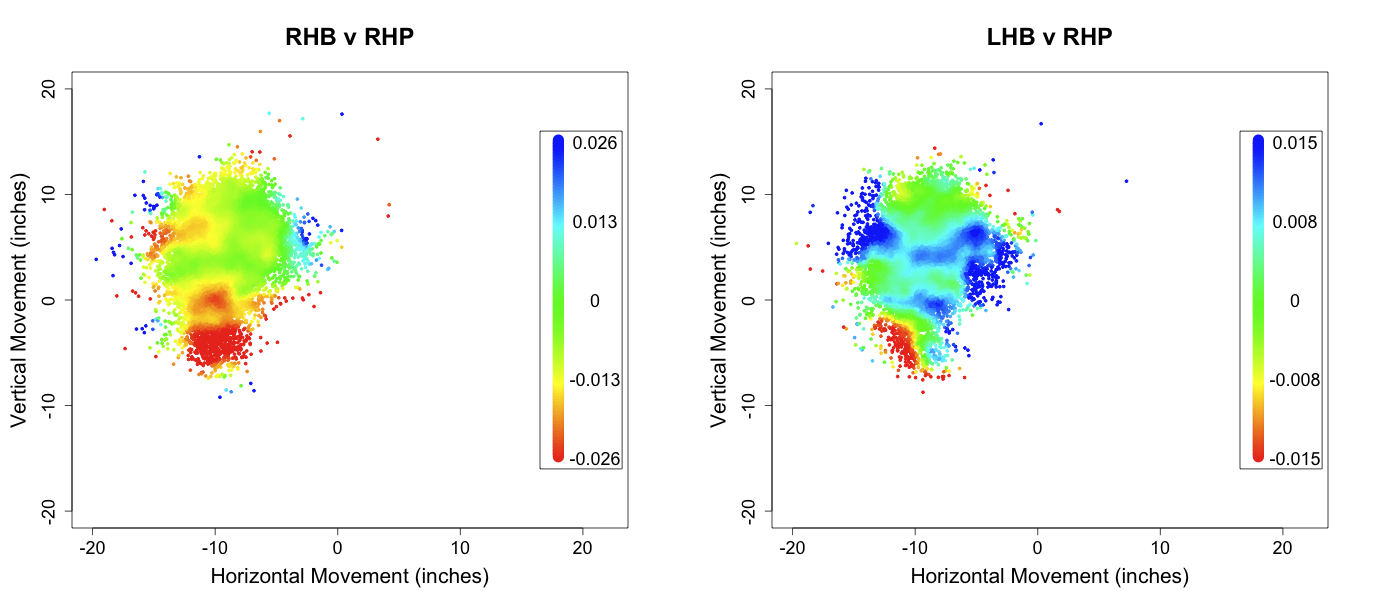
The difference is huge. Against RHBs the average run value of a two-seam fastball is -0.01 and against LHB it is 0.005. Although these numbers seem small they add up quickly over the course of a many two-seam fastballs in a game. This is the largest platoon split of any pitch, twice as large as the slider platoon split and three time larger than the four-seam fastball platoon split.
Here is a breakdown of how RHBs and LHBs perform against RHP’s two-seam fastballs by a number of metrics that are a little bit more intuitive than run value:
+-----------------+--------+--------+ | | RHB | LHB | +-----------------+--------+--------+ | Swinging Strike | 0.058 | 0.044 | | O-Swing Rate | 0.288 | 0.237 | | GB per BIP | 0.688 | 0.626 | | BABIP | 0.280 | 0.331 | +-----------------+--------+--------+
This analysis includes two-seam fastballs and sinkers, which are hard to differentiate with the pitchf/x data. These fastballs are typically low in the zone, rise less than other fastballs (so the appear to ‘sink’ to batters) and tail in to same-handed batters 10 inches on average, more than any other pitch type. I am not sure why they show such a large platoon split, but I think the large horizontal movement probably plays a big role.
No matter the reason, as you have said before righty dominated lineups make mediocre two-seam throwing pitchers look amazing.
Me:
So, basically, what you’re saying is that there’s no reason to expect the Mariners offense to do significantly better against right-handed pitching, especially guys who feature two seam fastballs, while they’re running out a lineup that includes Lopez, Betancourt, Johjima, Beltre, and Gutierrez? There’s really very little hope for those guys to do much against that kind of pitcher on a regular basis? The only way to fix this problem is to be able to start a left-handed bat in place of one or two of these guys?
Dave Allen:
This is bad news. As a group these guys hit RHP’s two-seam fastballs to the tune of -0.021 runs per pitch. Twice as bad as the average RHB. Here is their composite run value by pitch movement graph for two-seam fastballs from RHPs.
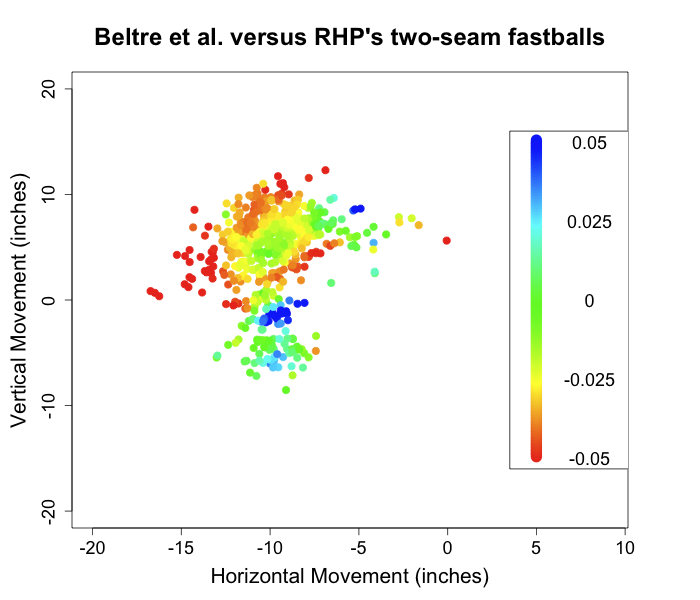
It seems these guys don’t have as much problem with heavy sinking fastballs (the bottom group of pitches with a negative vertical movement come from submarine-style delivery pitchers), but rather with fastballs that tail in to them heavily.
Say you could replace one of these guys with a league average lefty who hits two-seam fastballs for a run value of 0.005 per pitch. That is a swing of 0.025 runs per two-seamer. In a game against a two-seam throwing righty let’s say this putative replacement gets up 4 times and sees about 2 two-seamers per at-bat. During just the one game that is a swing of about 0.2 runs. This is the type of small shift that adds up quickly over if a team faces lots of two-seam throwing righties.
Me:
.2 runs per right-handed batter per game? That’s nutty. If the M’s swapped out two of these right-handed bats for just league average lefty’s, they could add nearly half a run per game to their vs RHP offense? That’s huge. Huge. Hopefully they’re looking at similar data and make the necessary moves.
Let’s talk about something else, though staying in the same realm of discussion. Felix Hernandez is obviously a very talented kid. His stuff is among the best in baseball, and he’s shown glimpses of actual ability to command his fastball this year. But, as is the case every year, he’s really struggled against line-ups that have good left-handed bats, recently giving up home runs to Chris Davis, Joe Mauer, and Justin Morneau. Can you give us a glimpse of why he has such a large platoon split, despite throwing four different pitches?
Dave Allen:
As you and your readers are aware Hernandez has an enorourms platoon split. Over his career righties have an OPS of .627 against him, that is about the level of worst regular in baseball last year. On the other hand lefties hit him for an OPS of .790, that is the level of BJ Upton, Adrian Beltre or Alexei Ramirez last year. A pitcher with four quality pitches should not have such an exreme platoon split. Here are the run value per pitch broken up by pitch type and handedness of the batter for Hernandez and for the average RHP. In parathenses is the proportion of at-bats the pitch is thrown.
+------------+-------------------------------+-------------------------------+ | | Felix Hernandez | Average RHP | +------------+-------------------------------+-------------------------------+ | | RHB | LHB | RHB | LHB | +------------+---------------+---------------+---------------+---------------+ | Fastballs | -0.013 (0.70) | 0.010 (0.71) | -0.003 (0.61) | 0.003 (0.62) | | Changeups | -0.021 (0.02) | -0.009 (0.07) | 0.001 (0.07) | 0.001 (0.16) | | Sliders | -0.006 (0.20) | 0.008 (0.11) | -0.006 (0.23) | 0.001 (0.12) | | Curves | 0.001 (0.08) | 0.005 (0.11) | -0.001 (0.10) | -0.001 (0.10) | +------------+---------------+---------------+---------------+---------------+
His fastball to RHBs is just amazing. He throws it alot, but it is still four times better than the average RHP’s. Against LHBs his fastball is bad, three times worse than the average RHP’s fastball to LHBs. That is an amazing platoon split for a fastball (Safeco probably plays a small part in this split), but he throws the fastball just as much to LHBs as he does to RHBs.
In black below I indicate the movement of his fastballs. I plotted that over the run value for all fastballs from RHPs to LHBs based on movement.
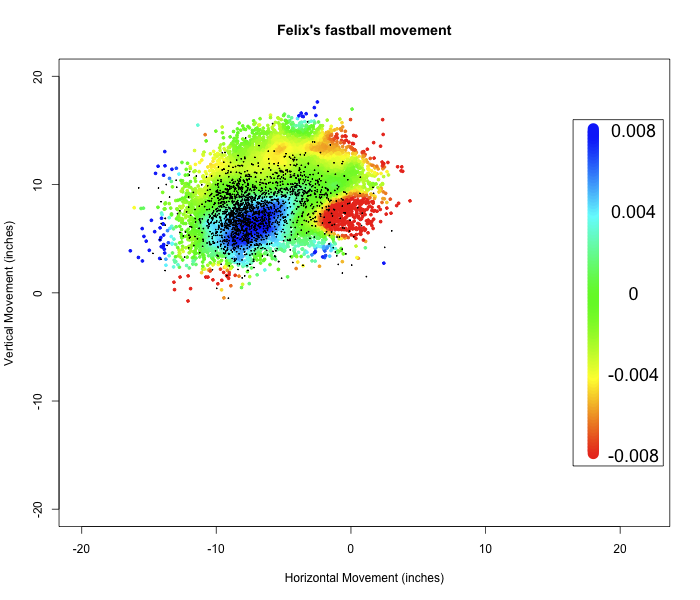
Felix’s fastball has exactly the type of movement that is crushed by lefties. He really should not be throwing it so often to them, and he doesn’t need to because he has other viable pitches. His change up is amazing versus lefties, but the throws it less than half as often as the average RHP. If he threw it more often it might lose some of its effectiveness as batters get more used to it. Still, it seems, he should be throwing change-ups at least at league average rate against lefties, if not more, and these pitches should come at the expense of his fastballs.
Me:
We’ve also noticed that Felix’s change-up has steadily been gaining velocity over the last couple of years. He used to throw it at 85, but now it’s regularly 88-89, giving it very little separation in speed from his fastball. Can you talk about how a power change-up effects the movement he’s getting and how this will effect his development going forward?
Dave Allen:
It does look like Hernedez’s changeup has gained speed over the years. The pitchf/x system was phased into parks during 2007 so the data is spotty for the year, but here are histograms of his changeup velocity from 2007 to 2009.
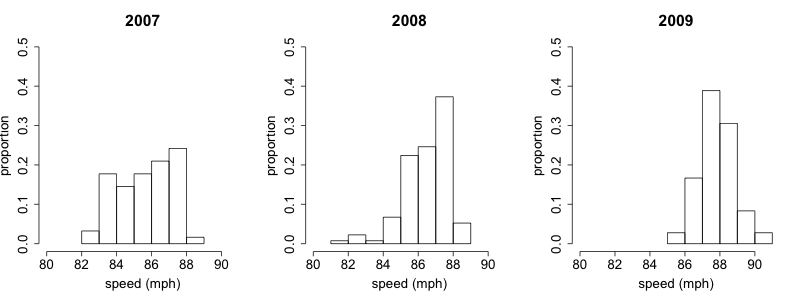
The changeups are definitely getting faster and they might be getting less variable in speed as well. Generally as the speed of RHP’s changeup increases it has more rise and more tail into RHBs. It looks like Hernadez’s show the opposite pattern. So far this year his changeups have had less rise and less tail, but the change is subtle.
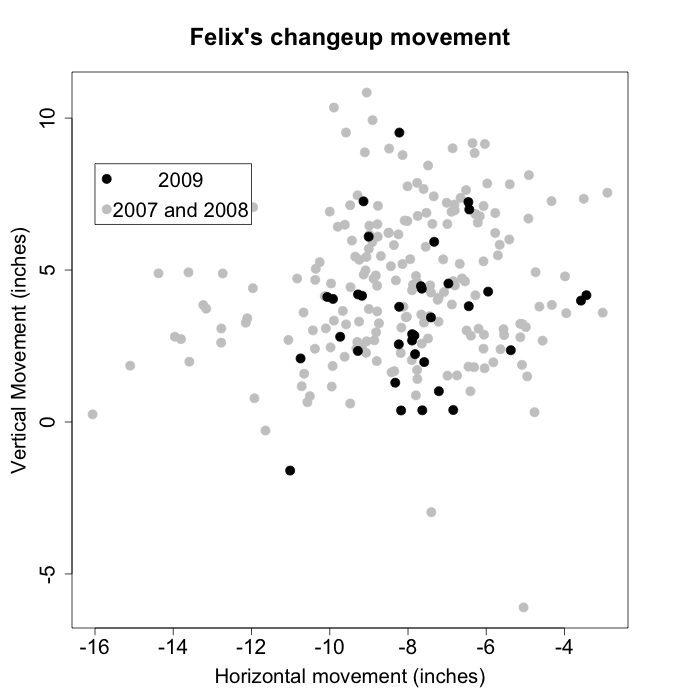
At this point it has not influenced the outcome. In 2007/2008 his changeup was worth -0.009 runs per pitch to lefties and so far this year has been worth the same. I don’t really know what to say about his change-up other than it remains a very effective pitch against lefties even as it increases in speed, gets less separation from his fastball and is the smallest bit flatter.
Me:
Let’s finish with some good news. Shawn Kelley was the biggest reason for optimism the M’s got in the first month of the season, as the rookie dominated by pounding the strike zone with his fastball/slider combination. Usually, guys with just those two pitches don’t do very well against opposite handed batters, but Kelley was brilliant against lefties, striking out six of the 19 he faced without walking anyone. Can you give us some insight into why his stuff worked against LHBs, when a guy like Mark Lowe, who has similar velocities to the same two pitches, can’t get lefties out to save his life?
Dave Allen
Aardsma and Kelley both throw a four-seam fastball and a slider. These are pitches with sizable platoon splits (although not as large as the two-seam fastball), and neither pitcher throws a changeups or curves that are effective pitches against lefties. Both throw predominately their fastballs to lefties, although Kelley mixes in his slider a little bit more often. First we will check in on fastball movement, again I show the movement of their fastballs over run value of the average RHPs four-seam fastball to lefties:
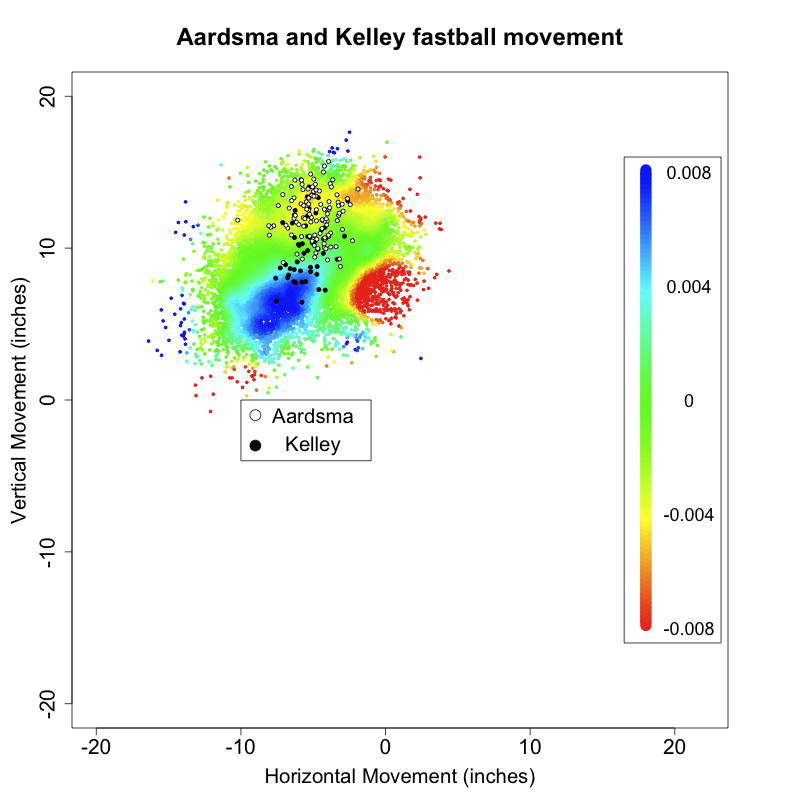
Aardsma’s fourseam fastball has a little bit more rise than Kelley’s. Based only on fastball movement we would exect Aardsma to have more success against lefties. Clearly there is somethign else going on:
+-----------------+-----------------+-----------------+ | | Kelley | Aardsma | +-----------------+--------+--------+--------+--------+ | | RHB | LHB | RHB | LHB | +-----------------+--------+--------+--------+--------+ | In Zone Percent | 0.657 | 0.662 | 0.519 | 0.491 | | O-Swing Rate | 0.257 | 0.417 | 0.297 | 0.268 | | Swinging Strike | 0.058 | 0.052 | 0.100 | 0.082 | +-----------------+--------+--------+--------+--------+
Kelley is able to get the same fraction and his pitches in the zone against LHBs and RHBs, while Aardmsa already low zone% is even worse against LHBs. Somehow Kelley also induces more swings at pitches outside the zone (O-swing rate) against LHBs than RHBs. I am not convicnced this is sustainable, but is the big reason for his success so far this season. Here are the locations of their pitches:
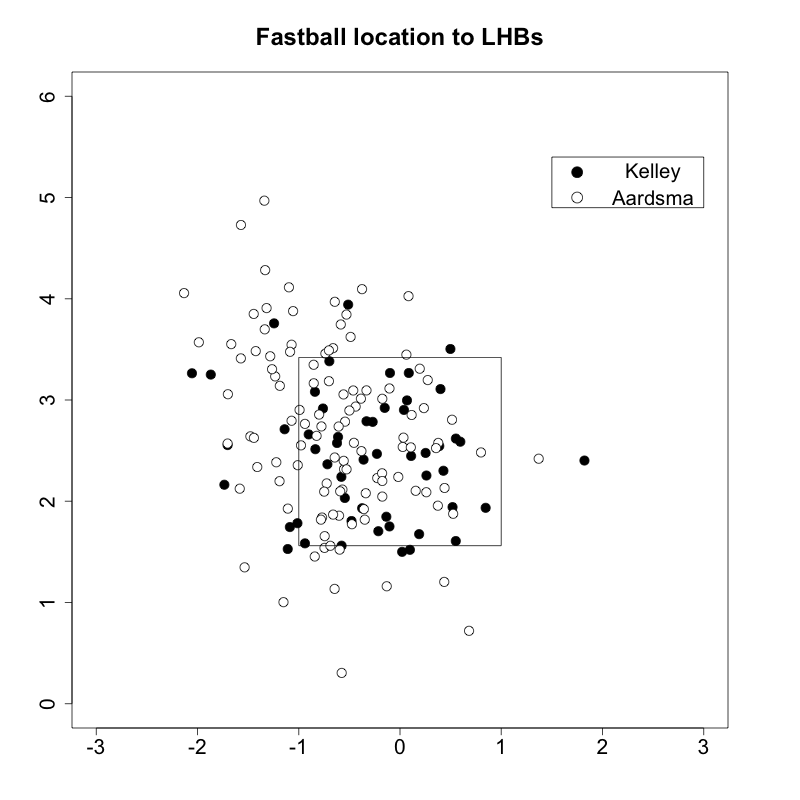
Kelley doesn’t miss by much, which is probably why he has such a high O-swing rate. If he can keep hitting his spots on the outside edge of the zone, even with some O-swing regression he should be effective against LHBs going forward. Aardsma, like Kelley, pitches mostly away to LHBs, but is outside the zone too frequently and when he misses he misses by too much to be effective.
Me:
This is great, great stuff Dave. Thanks so much for being willing to spend some time on this. We look forward to reading more of your stuff over at The Baseball Analysts for however long you last there before you become the next guy hired from the web into Major League Baseball.
Comments
56 Responses to “The Problem With The Right-Handed Line-Up”
Leave a Reply
You must be logged in to post a comment.


Not gonna lie, I didn’t understand everything, but that’s on me, not Dave or Dave…very interesting stuff…
Very cool. Thanks.
If there’s something you don’t understand, ask – we’ll try to clarify it.
Hopefully someone in the M’s front office is looking at this, or similar analysis and making adjustments accordingly. It would be great if Felix (and the catchers) saw these numbers and changed his approach against lefties. I guess only time will tell if this front office will be better and using this kind of analysis to make intelligent decisions to improve the team.
This isn’t news to the M’s.
I think I got the general gist of it. This is mind bogglingly awesome research.
Wow. That’s a ton to think about and it’s scary that it’s really just the tip of the iceberg.
If the M’s can manage to stay in contention this year, I would think it would be relatively easy to land a lefty bat or two. Guys like Chris Dickerson or Seth Smith or even another corner infielder like Jeff Larish would be valuable. Maybe even Travis Buck?
The run value for Felix’s changeup is even better against righthanders than lefties, which is counterintuitive, but he hardly ever throws it to them, which is a fairly normal pitching pattern. Should he be using it much more often against righties as well, or will it lose effectiveness if used more that way? Also, to what extent is this data point, or for that matter the reliever evaluations, subject to small sample size caveats?
The pre-season rumors of the Mariners going after Craig Counsell make more sense in this context. While Counsell isn’t a league average hitter, he does hit left handed and draw walks, while being a nice fielder.
How are the run values calculated?
This is awesome stuff. Those graphs are amazing.
Classic Cameron. Nice, nice.
Neat.
Run value is calculated with respect to what? If a pitch has -0.021 run value on average, what exactly does that mean?
How passable or problematic is Branyan’s fielding at third? Obviously, he’d never replace Beltre’s golden glove, but if we traded Beltre and had Branyan at third and Carp or Clement at first, I’d think that would add some significant left handed patience and power.
Seriously…my head asploded.
Nice work.
Soul – sample sizes are small, but Branyan appears to be anywhere between miserable and barely passable as a 3b defender. No UZR from his 72 games at 3b in Cleveland back in 2001, but with 11 errors over that span, it wouldn’t be good.
He seemed to play ok the last couple of years in limited action over there, but I’m sure folks that are way smarter than me will present some kind of metric that blasts holes in that assessment.
http://www.fangraphs.com/statss.aspx?playerid=370&position=3B/OF#fielding
[ot]
I read Baseball Analysts daily was trying to make a correllation to the M’s and their fastball approaches. Nice job snagging him to look at the M’s lineup. The article today shows that one of the best fastball hitters for this season (still small sample size) is Shin-Soo Choo.
This is absolutely jaw-dropping, make ya drool awesomeness.
So basically Felix has a clear roadmap to the HOF (just stop throwing his fastball so much to lefties) and the Ms could pick up maybe 50 runs by just employing a less righty lineup.
Playoffs here we come.
[ot]
“Hello…It’s me, Jeff Clement calling from Tacoma. Can you hear me?”
I’m going to start trimming rosterbation comments.
[irrelevant]
This is awwwwwweeesoooooome. Could spend as much time thinking up adjectives for this study as I did reading it.
The numbers and calcs don’t impress me as much as thinking up the questions. A lot of us NOTICE things…but not everyone can articulate it in such a way as to be able to quantify it and allow us to do follow up research and number crunching to find even more interesting things.
Stubborness, then, on the part of Felix?
I am now convinced that major league teams have to be STUPID to not use the sabermetric blogging community as a resource. Maybe I’ve been spoiled, but the stuff that goes up on this site and LL in particular is really in depth, relevant, and it all makes a ton of sense. It’s as well written and thoughtful, I’d have to think, as any of the statistical analysis going on within the team. Love the work, keep it coming.
Interesting that Felix talked about throwing his two-seamer more often. Intuitively, his (4 seam) FB is already brutal on RHB, so throwing more 2-seamers wouldn’t help. On the other hand, is that chart on his FB movement 4-seamers, 2-seamers, or both?
If it’s his 4-seamer, then maybe he’s an exception who would get better results with a 2-seamer to LHBs because it would move differently and stay out of their crush-it zone.
As far as the M’s hitters, ugh. Make’s Clement’s knee issues all the more frustrating. If he could physically play Catcher, even with sketchy defense (and frankly, neither Joh nor Johnson remind me of Dan Wilson behind the plate as it is), it would be a nice upgrade against mediocre RHPs.
The crazy thing is that throwing change-ups to opposite-handed pitchers is exactly how Johan Santana turned himself into one of the best pitchers in baseball. And we know Felix admires his fellow Venezuelan. So why doesn’t he try to pitch more like him?
[Dave], if the M’s have this data, why aren’t we seeing a change in Felix? Or the RHB’s approach? I just wonder what the contact with the front office and the players looks like…
Do they have daily meetings with players where they show them these results? If not daily, then weekly? Monthly? Do they instead meet with Wak regularly? How often does Wak talk with the players about statistics?
I think I read in an MLB column that Yuni–at one point–took 10 straight pitches during the series against Boston. Did Wak or Z show him data about his approach and how it’s hurting him or did Wak just talk [verbally] to him?
I know we may never know the answer to these questions, but do we know anything about this process?
I knew this wasn’t going to stick to just a discussion on the lineup… which isn’t to say that I’m not glad the Felix dilemma came up… i’m just saying it was predictable.
That part of the discussion was very interesting and informative, but came with a major flaw… the whole thing does, really.
If the King is going to stop throwing so many fastballs to LHBs, he’s got to throw something else. It can’t be just the changeup, because that risks exposing it and making it less effective. So what is he supposed to throw against LHBs that will be more effective than his fastball… or how is he supposed to make his fastball more effective against LHBs?
My contention has always been that his fastball will get much more effective if he returns to throwing the changeup he had both in the minors and when he first came up… no matter who’s in the batter’s box.
This whole thread is about rosterbation… well, maybe it’s about how to effectively rosterbate. It seems like the middle-infield and catcher are the two areas to effectively improve in this area. This team gets a lot better if they acquire a catcher who can hit RHPs to replace Rob Johnson, whether it’s Clement or someone outside of the organization, and acquire a middle-infielder who can hit RHPs to replace the growing more useless Mike Sweeney.
I admittedly have no idea who that would be outside of Kelly Johnson with ATL… and he ain’t hitting worth crap right now.
Continuing to play Chavez against RHPs and pulling up Clement are the only remarkable improvements the team has available, and Clement would only play at most twice a week until he proves he can actually catch. I would not approve moving Branyan to third and benching Beltre.
Felix does not equal Johan Santana. Felix is his own brand of awesomeness… or potential awesomeness.
This is like saying why doesn’t every tall left-hander take up pitching, star in a commercial where you throw knives at a lovely female assistant on a play off your former wildness and win 5 Cy Young Awards.
Dave,
Do you think that Felix’s last start was an indication of things starting to change in the direction that would be indicated by these numbers? I didn’t see it, but saw a good portion of the MLB gamecast, and he seemed to throwing signifcantly more changeups, right from the get-go. Is this an indication of things to come? If so, we could have a pretty fun summer, at least once every five days.
If the King is going to stop throwing so many fastballs to LHBs, he’s got to throw something else.
Based on the data more change ups would probably be good.
It can’t be just the changeup, because that risks exposing it and making it less effective.
The fastball is already ineffective, so what’s the risk?
So what is he supposed to throw against LHBs that will be more effective than his fastball…
His change up
Felix does not equal Johan Santana. Felix is his own brand of awesomeness… or potential awesomeness.
Nobody said he did. Watching what a successful pitcher does, and seeing how you can incorporate that into your game seems like a good idea to me.
This is like saying why doesn’t every tall left-hander take up pitching, star in a commercial where you throw knives at a lovely female assistant on a play off your former wildness and win 5 Cy Young Awards.
It’s nothing like this at all.
So this is great stuff. Thanks for all the hard work Dave and Dave.
If all this information is so straight forward and all the logic makes so much sense. Then why do the Mariners not make the necessary changes?
If I understand this correctly if Z and Wak would bring up a two avergage lefties bats umm…Clement and Carp anyone. We could pick up an extra 4 or 5 wins?
Or am I missing something?
Great, an MLB team that can’t hit right-handers. Isn’t that like having an NFL team full of players whose religion prevents them from playing on Sunday?
Yet another negative consequence of years of mismanagement. This mess will take a couple of years to clean up.
[deleted, be less obnoxious]
Yet another negative consequence of years of mismanagement. This mess will take a couple of years to clean up.
It’s getting REALLY old to keep hearing this, because it’s simply not true. The Mariners were able to adequately patch CF and 1B (as well as the entire OF defense) from last year’s team in the space of ONE offseason, and it didn’t take exorbitant contracts to do it, either. It is not going to take Fort Knox and every prospect in the minor league system to add a LHB middle infielder or LHB OF, and replacing the SS and C with simply decent 2 WAR players will help move the team strongly forward, plus there’s something close to 40-45 million in salary moving off the books next year in the form of Beltre, Bedard, Washburn, Batista and Griffey, so it’s really not like Zdurencik won’t have resources to make intelligent FA signings OR take on salary in a trade.
This team is not that far away from being able to contend, and the doom and gloom needs to stop.
Congratulations. This is some of the best baseball journalism I’ve read. I heft my glass in your honor.
I think the idea of Felix improving as the team tries to use this data is incredibly exciting. If he can improve against lefties his crown will shine forever.
But making these changes generally is more difficult than just saying “do this,” especially for hitters. They’ve been training their reflexes for years using a certain approach, and it’s hard to change over a short time. I’m actually impressed with Yuni, except for his errors…
First, let me say this is the most comprehensive and understandable explanation of something one can see with one’s own eyes without necessarily understanding why that I’ve ever read. Really great job.
Second, there’s one data point which I didn’t see but which is essentially self-evident: every team is going to face a plurality of pitchers who are right handers who throw two-seam fastballs. So the need to be able to hit those pitchers is an important part of any roster’s construction. You don’t find players specifically to hit knuckleballers, but you should (and as we have seen by the lineups Felix faces, many do) construct your roster to beat these pitchers.
Third, and worst, this situation was in many respects a matter of choice: keeping Lopez and Betancourt instead of Cabrera and Valbuena; signing and extending Johjima and giving up on Clement, trading Choo, not signing a single switch-hitter for the bench. A bunch of single decisions that add up to a bad strategy (and note not all those were Bavasi decisions). I personally don’t fault anyone for the Beltre signing (even with his faults, he is worth having on your club and we had zero other options for his position until Tui is ready), but the others were actions taken in full view of the consequences.
I’m a little more optimistic about whether it’s going to take years for this to get cleaned up. The current management seems to get that you can improve the team in different ways beyond whether a guy is a LHB or a RHB. If a guy plays great defense (Gutierrez), he’s going to play. They proved with Silva and Morrow they’ll demote players who aren’t performing… Beltre would be the next one if they had a suitable replacement. Sometimes they’re going to miss on guys like Griffey, but it’s not because they weren’t trying or don’t have some kind of plan in place.
Derek… and his response wasn’t?
I’ll state it again… two much-smarter men than me named Dave say he needs to elevate throwing his changeup to a league-average percentage, but not more than that. So to bring his ineffective fastball down even further, what should he throw? Which of his pitches would be most effective as a third pitch against LHBs under the above analysis?
As great as it would be to have a player such as Mike Carp on the roster, the Mariners don’t have a place for him unless they move Branyan off of first base or completely bench Ken Griffey, Jr.
Could someone please define “run value”.
So to bring his ineffective fastball down even further, what should he throw?
Sliders, curves, and four-seamers.
Is that really such a tough nut to crack?
Where would Clement and Carp play? DH and 1B? If so, then they replace Griffey and Branyan, for a net gain of zero lefthanded bats in the lineup.
The players that need to be replaced by lefties against marginal RH two-seamers are:
Johjima
Lopez
Betancourt
Beltre
Balentien
Carp and Clement can’t play any of those positions very well (Clement’s knee precludes him catching, apparently).
…but the whole point of this article is putting a value on each of those pitches when thrown to different batters… so which one of those pitches would be most effective for Felix to throw? I’m assuming it would the curveball since the slider doesn’t look that much more effective than the fastball… but i might not be reading the data right.
Also… I think it would be interesting to look at whether it’s a problem with Johjima as well… or is the preference for fastballs no matter who is at the plate the same no matter who is catching him?
I think that there are too few pitches to reach any conclusion about his changeup to RHBs. I think there were only about sixty in the past three years. There might also be a selection bias of the types of hitters he throws them to.
I am going to do a post at fangraphs in the next week explaining how to calculate run values.
The run value is the change in run expectancy. For each out and base runner state (e.g. one out runners on the corners) we know the average runs scored for the rest of the inning. Let’s say it is x. Now say a RHP throws a two-seam fastball to Johjima, on average after that pitch the number of runs score in rest of the inning will be x-0.021.
The fastball movement chart for Felix is all four-seam fastballs. He does throw both, but at least by my and the pitchf/x classification algorithm most of them are four-seamers. For his run value chart I grouped all the fastballs.
I don’t know specifically which they’re using but I would presume some form of Linear Wights system such as Batting Runs.
Did it hurt your fingers to write something that dumb? Beltre could get a day or two off at the most, but he’ll get demoted if and only if he falls off the planet defensively, or the trade market for him completely evaporates.
For what its worth NorthOfWrigleyField, I wasn’t trying to be obnoxious in my response to you (and in rereading my comments I don’t think I was). I was just trying to offer a straightforward rebuttal of your posts, because I disagree with some of the points you made.
Here’s a crazy question. Could Beltre possibly be a plus defensive 2b? how bad is Branyan at 3b? Since we have lefty hitting 1b/dh at AAA could this be an option. Beltre would actually be a good hitting 2b and maybe he wouldn’t feel the need to try so hard.
So in the Felix fastball to lefties location chart.
What does this mean? Are these the fastball locations for every fastball to both righties and lefties that Felix has thrown this year?
Also, if Felix’s fastball stayed mainly in the happy red area instead of the sad blue area, would that make his fastball dominating to both lefties and righties, or one of the two? Or are the red areas red because they’re out of the strike zone and you hitters can’t reach them?
Outstanding write up and analysis. Thanks so much!
This is exactly why I read this blog, every time I learn something new. This post shows how hardcore you guys are, I just hope your expertise is one day rewarded.
Sorry I was not 100% clear. The black dots show the movement of Felix’s fastballs. The heat map shows the run value based on movement of ALL RHPs fastballs to LHBs. Just because Felix’s fastballs are in the blue region doesn’t necessarily mean his will be unsuccessful. Since I am averaging over all RHPs it does not take into account speed or location. All it shows is that based solely on movement you would expect him to be unsuccessful versus LHBs.
That figure is not the location of the ball but its movement. The movement of a pitch is the difference (broken up into vertical and horizontal components) from where the ball ends up and where you would expect a spinless ball to end up. So it measures how much rise or sink and break in or out a pitch has.
And, less than a year later, the votes are in: eponymous coward wins.
Also, Felix in 2009 didn’t throw appreciably more changeups (13.6% in ’09; 13.3% in ’08) or significantly fewer fastballs (63.2% in ’09; 65.9% in ’08)… he just threw better ones. And was rewarded. Don’t spend the $78M all in one place, kid.