
Game 30, Athletics at Mariners
Wade LeBlanc vs. Sean Manaea, 7:10pm
It’s tough to focus on the game after the past 12-20 hours we’ve had. James Paxton just twirled one of the best games I’ve seen, and then the bullpen blew it. That game was also, we now know, Ichiro’s last in an M’s uniform. Maybe. Probably. Perhaps.
But this is what baseball demands of us. Our need to let something breathe, to consider it, to just wonder – it can all still happen, it’s just jammed into a few hours. Sure, it spills out beyond that time limit, and I’m going to be thinking about both Big Maple and Ichiro while watching today’s game.
Wade LeBlanc is starting because he’s already on the roster, and because the team didn’t want to watch Erasmo Ramirez start again. Guillermo Heredia is back as the M’s face a tough lefty, one who’s already thrown a no-hitter this year and a pitcher who’s off to a brilliant start in general, seemingly fulfilling years of hope since he first grabbed national attention as an Indiana State sophomore in the Cape Cod league.
1: Gordon, CF
2: Segura, SS
3: Cano, 2B
4: Cruz, DH
5: Haniger, RF
6: Seager, 3B
7: Healy, 1B
8: Zunino, C
9: Heredia, LF
SP: LeBlanc
Jeff Sullivan had a similar reaction to Paxton’s game and the importance of a high fastball in an article today for Fangraphs.
The Rainiers got destroyed last night 12-4, as Roenis Elias had a very forgettable start. Similar situated Cuban lefty SP depth piece Ariel Miranda starts for Tacoma tonight up at Cheney.
The Travelers face Tulsa again, with Andrew Moore taking on #10 Dodgers prospect Dennis Santana.
2017 Cal League all-star Reggie McClain makes his 2nd appearance of the year tonight, leading Modesto against another Dodger affiliate, the Rancho Cucamonga Quakes, and LA’s #11 prospect, Dustin May.
Clinton faces Bowling Green, a Rays affiliate. The Lumberkings Raymond Kerr starts opposite Austin Franklin, who ranks as the Rays #14 prospect.
Goodbye Again, Ichiro
Ichiro spent nearly 12 years with this franchise, beginning at the franchise’s short peak, and sticking around to see a series of missteps, from developmental to scouting to trades, cripple the team. For several years, he was the M’s greatest player, and his ten year run at the beginning of his career is clearly Hall of Fame worthy. He clearly loved playing here, which is what made the M’s decision to trade him back in 2012 both a necessary act of compassion and heartbreaking at the same time. It’s what made the M’s decision to bring him back this season both an obvious feel-good story and also fraught with danger on how to handle things if his skills had eroded too much.
Today, the M’s announced that Ichiro will become a special assistant to the Chairman, effective immediately. Ichiro is stepping away from the field – for now, his agent hastens to add – and into the front office. It’s an odd move that prevents the team from announcing a final game, one final announcement, one final at-bat against Shohei Ohtani, say. That may be part of the calculus, of course, along with keeping Ichiro in the org to work with the young players who might listen to him more than the ones who foolishly spurned his advice a decade or more ago.
I think it also highlights one of the many mysteries about Ichiro: who actually made this decision? Ichiro may not want a big send-off with on-field announcements and ceremonial first pitches and stirring video tributes. The M’s have every reason to want one, but they’ve opted to keep the focus on their remaining players and on Ichiro’s new role. For all we’ve been through with Ichiro, and for how many miles Ichiro’s logged with the M’s, I love that there’s still so much we don’t know. I don’t know that I’ve ever encountered a superstar so different, so apart, from the dominant culture. I both can’t imagine an Ichiro twitter account, and would love to try to imagine an Ichiro twitter account. His lack of traditional athlete cliche-speak was partially due to the language barrier, but also I think a testament to how different his mind works. For a variety of reasons, including a simple desire for privacy, we got fleeting glimpses of how his mind worked, and it always left us wanting more.
There are so many ways to talk about Ichiro’s tenure in the org, from the clear story of the M’s failing to capitalize on their acquisition of his singular services to the old saw that he was just a complementary player, and not capable of carrying the team on his back. But that just diminishes Ichiro, by referring to him only in relation to the mediocrity the team often put around him. I just want to say how lucky I feel to have been an M’s fan for his career. He played like a brilliant anachronism, spoke like a philosopher, dressed like Russell Westbrook, and essentially embodied the know-it-when-I-see-it term “cool.”
He’s confounded fans and writers and teammates and opponents. He broke projection systems, broke a tacit, racist embargo on Asian ballplayers playing here, and was the engine behind the greatest team in M’s history. At a time when sabermetrics was fighting a number of battles – the irrelevance of strikeouts, the importance of walks, HRs, etc. – here was a living, dominating challenge. There was more than one way to dominate. It’s a lesson I think about often, and a reminder not to let one way of doing things blind you to other, stranger, cooler options.
Thank you again, Ichiro.
Something Just Clicked
In yesterday’s post about James Paxton’s spin rate improvements, I said that while he’s been pretty good, “he just hasn’t gone nova the way [Gerrit] Cole has,” and that he may need to learn to utilize his fastball differently as its shape and movement change. Hours later, he went out and did exactly that, and the results were extraordinary.
Gerrit Cole’s fastball not only started spinning more when he joined the Astros, but he started throwing it higher. His average fastball elevation with the Pirates was dead on the middle of the strikezone; he clearly liked to throw some low fastballs that were so beloved of his old pitching coach, Ray Searage. But with Houston, that average fastball elevation was 0.2 feet above the midpoint of the zone. Paxton’s fastball had seen even *more* dramatic spin improvements, but as I wrote yesterday, he still liked to throw it down in the zone. It had an average height a few inches below the zone in 2016, and it did in 2018, too.
Until last night. Paxton’s average FB height was 0.3 feet above the center of the zone, and he used a blizzard of high fastballs to utterly dominate a good hitting team in Oakland. Sure, the A’s have plenty of swing and miss in their line-up, and yes, Paxton’s command of the pitch had a lot to do with his stunning performance, but it was amazing to see how an adjustment in approach could produce such immediate dividends. I said yesterday that if he fully incorporated his new spin into his approach, look out league. It looks like he may have done so. Good luck, AL.
This isn’t to say that he’s already the best pitcher in the league. He essentially beat the A’s with 1 pitch, or maybe 1.5. His cutter worked well as a pitch that moved lower in the zone, and it allowed him to get called strikes and whiffs as batters got used to to the rise on his fastball. More worrying, even during a career-best, career-defining performance like this, his curveball is still lagging behind. The A’s recognized it and put some good swings on it, and he only threw it 12-13 times. It *should* be more of a weapon, but it hasn’t been this year, and wasn’t last night. That’s both a thing to work on, and a testament to what Paxton’s fastball can be when it’s on like that: it can be so dominant that Oakland looked helpless against it even when they knew it was coming.
Keep doing this, James:
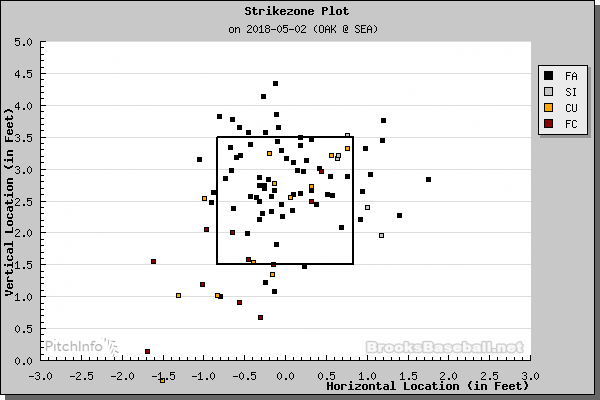
Fastballs with a lot of rise at the top of the zone become whiffs. Fastballs with a lot of rise near the bottom of the zone don’t turn into whiffs *or* ground balls. As Paxton’s seen, they actively help batters elevate the ball. It’s why Paxton’s expected wOBA on fastballs was nothing special coming into last night’s game, and why the pitch looked completely different once he started pitching up. Even last night, A’s hitters went 2-3 on fastballs below the midpoint of the zone. On fastballs above that point, they were 1-15. There’s a lesson here.
James Paxton’s Continuing Evolution
Yesterday, the baseballing internets focused on a Twitter exchange between Cleveland’s Trevor Bauer and Houston’s Lance McCullers and many, many fans, coaches, etc. The argument Bauer made is summarized in this article by Eno Sarris in the Athletic ($). The TL/DNR summary is that pine tar or other substances not only increase grip, but allow a pitcher to dramatically increase their spin rate, making them more effective. A team could teach them this technically-forbidden but undeniably useful skill and improve pitchers they acquire. Not everyone on the Astros has improved his spin rate, and McCullers’ spin rate remains low. The unspoken target of this accusation was Gerrit Cole, the former Pirate who’s presently dismantling the AL with his new, high-spin fastball.
So pitchers are jawing, and accusations of cheating and jealousy are flying around. This is clearly not simply a Houston issue, as Jeff Sullivan tweeted – the Brewers have had a larger year over year increase. There’s a wide spectrum of possible causes, too, from pine tar (not permitted) to sun screen (permitted) to some training hack. As a blogger, I’m not in a good position to figure out what could be causing it. Doctoring the ball can make it do funny things, a fact I learned very early in my baseball education, watching the M’s Gaylord Perry. I’m not going to talk about that today. I just want to talk about this:
| Pitcher | V. 2016 | Spin 2016 | V. 2018 | Spin 2018 |
|---|---|---|---|---|
| Cole | 95.9 | 2171 | 96 | 2,325 |
| Paxton | 97.5 | 2133 | 95.3 | 2,356 |
The v. 2016 is the pitcher’s four-seam fastball velocity in 2016; V.-2018 is thus their FB velocity in 2018.
James Paxton’s evolution in spin rate has been more gradual, but the picture here is striking. Both of these pitchers were super high velocity pitchers in 2016 despite lower-than-average spin rates. That helped them both post average or better ground ball rates, and but it may have reduced their bat-missing capability, particularly in Cole’s case. But by this year, both are now well above the league average spin rate of 2,264 RPM.
And what a difference it’s made:
| Pitcher | K% – 2016 | BB% – 2016 | GB% -2016 |
|---|---|---|---|
| Cole | 19.4 | 7.1 | 45.6 |
| Paxton | 22.9 | 4.7 | 48.1 |
| Pitcher | K% – 2018 | BB% – 2018 | GB% -2018 |
| Cole | 39.4 | 5.2 | 31.7 |
| Paxton | 31.2 | 10.6 | 31.6 |
Cole’s K% has *doubled* since 2016, and he’s done that while reducing his walk rate. The only trade-off, if you can even call it that, is a reduction in ground ball rate; he’s now an extreme fly ball pitcher. The results for Paxton are somewhat less dramatic, except for the GB% drop. His K% has grown, too, and it’s now over 30%. But his walk rate’s spiking, and all of those fly balls can hurt, as his 5 HRs-allowed show. Paxton’s change in spin rate has been even more extreme than Cole’s – it just doesn’t show up on year-over-year lists because he had an intermediate step in 2017. It’s pushed his FB whiff rate up, while simultaneously making the pitch an extreme fly ball pitch. Meanwhile, Paxton’s curveball isn’t getting the results it once did. He’s struggling to command it, as batters are laying off, and doing more damage when they swing. Has ITS spin rate improved too? No – it’s actually dropped a tiny bit, but it’s essentially unchanged. (Cole’s is up slightly, while Paxton’s dropped).
The point here is that spin rate by itself is not some miracle cure. Even if the Astros have developed easy-to-hide grippy goop and instructed their pitchers how to apply it, it wouldn’t fundamentally change them *by itself*. Spin rate can change movement, and pitchers have always monkeyed around with pitch movement – a different grip on a slider making it slower and sweepier, which is too a baseball word. A sinker grip to take away spin and induce drop. All of those changes can be either beneficial or not; more movement on a slider is not automatically “better.” Or rather, even if it’s better in a hypothetical in which every other variable stays the same, it’s damned difficult to keep every other variable the same when dealing with human beings. Gerrit Cole is doing a number of things differently in Houston, and a high spin rate is one of them. It’s working really well. James Paxton is doing a number of things differently in Seattle, and it’s working…uh…the results are different. Paxton’s striking out more than he ever has, but he’s giving up more fly balls and thus HRs AND walking more.
Paxton’s been effective this year, despite the ERA – he just hasn’t gone nova the way Cole has. I wonder if coaching needs to adapt as these changes in spin rate/motion/whatever unfold. Like, how are they *using* their new, spinnier, fastballs? Gerrit Cole’s throwing it much higher now, as you might expect. Paxton’s throwing his a bit higher, too, though the average height at which it crosses the plate is lower than the midpoint. Cole’s used to be right at it, and is now a few inches higher:
| Pitcher | 2016 V Loc | 2018 V Loc |
|---|---|---|
| Cole | 0 | 0.21 |
| Paxton | -0.23 | -0.11 |
Paxton’s slower evolution, with spin increasing (even when accounting for velocity) over the course of two years, is fascinating. It’s happened *only* on his fastball, which I would argue makes pine tar a bit less likely. It may have been the result of a mechanical change, which would be really interesting. It’s done what it’s supposed to, in a way. But I feel like Paxton’s not quite done incorporating the changes into his overall approach. If and when he does, look out league.
His opponent in tonight’s game is veteran lefty Brett Anderson, the oft-injured hurler who came up with the A’s and then moved to various clubs, from Rockies to Dodgers to Cubs. He’s topped 180 innings once, and has seen time in the bullpen in an effort to keep him healthy (it didn’t work). The A’s re-signed him this year, and he’s been lights out in 4 starts for Nashville. When last we saw him, he mixed 5 pitches – a four-seam fastball, a sinker, a slider, a curve, and a change. He’s always been an elite ground ball pitcher, which makes up for more pedestrian pure stuff. A lefty who can command a bunch of pitches is a solid opponent, but then, the M’s have actually hit slightly better against lefties this year.
1: Gordon, CF
2: Segura, SS
3: Cano, 2B
4: Cruz, DH
5: Haniger, RF
6: Seager, 3B
7: Zunino, C
8: Healy, 1B
9: Ichiro, LF
SP: Paxton
Casey Lawrence would’ve taken the mound for Tacoma tonight against Albuquerque, but he’s been recalled along with Guillermo Heredia. Dan Altavilla and Erasmo Ramirez have both been placed on the disabled list for what I’m 100% positive are real injuries and not just an attempt to bring in other players for a short while.
It was getaway day for much of the minors, so the affiliates have all played, except for Tacoma. Tommy Romero had his first tough outing, going only 2 IP in Clinton’s 10-5 loss to Bowling Green. Modesto banged out 15 hits in an 11-4 win over Rancho Cucamonga, with Ljay Newsome getting the win. Arkansas beat Tulsa 5-3 behind Nathan Bannister. Roenis Elias starts for Tacoma tonight.
Yesterday’s games featured a bunch of low-scoring nail-biters. Tacoma lost 3-1, and were nearly no-hit by Jeff Hoffman and some Albuquerque relievers – Ian Miller broke it up in the 9th. Modesto and Clinton both lost 2-1, with Clinton’s loss coming in the 10th on one of those newfangled “runner starts the inning on 2B” jobs. Arkansas lost 1-0 to Tulsa.
On Expectations
The M’s enter May riding high, 2nd in the AL West and neck and neck with the Yankees and Angels. Especially given their injury woes centered around opening day, I’m not sure that April could’ve gone much better. Not only have the M’s fared better than expected, particularly against Cleveland, but a few of the M’s rivals have face-planted in the early going. Minnesota apparently read my “Upside” post and have watched as Lance Lynn has been absolutely awful, sunk by a blizzard of dingers. And then there’s the fact that the M’s themselves have walked the talk that their own front office (and essentially nobody else) put out.
Mitch Haniger has been one of the game’s best hitters in April, and he’s changing one of the team’s key weaknesses from last year. In 2017, the M’s – led by Nelson Cruz, Robbie Cano and others – hit fastballs pretty well, but struggled a bit against breaking stuff and sliders in particular. In itself, that’s not all that surprising. Sliders are typically thrown when the pitcher has the platoon advantage, and often when he’s got an advantage in the count. But it was still an issue: guys like Ben Gamel raked when pitchers threw them a bunch of FBs, but sunk when pitchers adjusted and gave them breaking balls. Gamel was the worst offender, but he wasn’t alone: Jean Segura, Nelson Cruz, Robbie Cano and (especially) Danny Valencia all exhibited this trait to one degree or another. Haniger didn’t, and this year, he’s been even better against sliders/curves. What’s critical is that he’s no longer alone. Cano’s change in approach has coincided with improved performance on sliders; my guess is that his increased patience means that he’s simply swinging less at sliders and breaking balls that move out of the zone – his O-swing rate has dropped and his overall swing rate is down by about 9 percentage points. This has pushed his walk rate up sharply, and helped balance things a bit from bringing in free-swingers like Ryon Healy and Dee Gordon.
This is all well and good, but, as is my nature, I’m still a bit worried. The M’s seem to be better than expected, but then, so do the Angels, Yankees and tonight’s opponent, the A’s. It sucks that just as the M’s address some nagging weaknesses, the AL West is suddenly a much more difficult environment. The M’s offense has been good, but the A’s are showing that last year’s debuts from guys like Matt Chapman and Matt Olson weren’t flukes. Sure, their pitching staff is kind of a mess behind Sean Manaea, but damn it, why did Sean Manaea have to pick *this* year to break out?
The nice thing about this start, though, is that I don’t have the kind of dread regarding their rivals. The A’s are a low-key kind of terrifying, but I certainly don’t think they’re better than the M’s…only that I can envision a few scenarios in which they beat out the M’s for a wild card. Same with the Blue Jays, who’ve overachieved, and perhaps even the Yankees, possessors of one of the most fearsome line-ups in the game. They match up really, really well with the M’s, and I think they’re better on paper, but I can easily see how the M’s could get past them. This isn’t even bringing up a team like the Twins, who’re now so far behind that they’d need to play out of their minds in the remaining months. Yes, I know they did so last year, but prior results are not a guarantee of future returns. I’m not saying that a one-month record papers over all of the problems the M’s had and still clearly have. They still give up more HRs than they hit *despite employing Mitch Haniger* and their bullpen’s been so-so despite a dream start from Edwin Diaz. That’s all still relevant, but with the offense playing at this level, those flaws aren’t exactly fatal.
The M’s haven’t won anything yet, but they exceeded expectations in April, and showed that there’s enough upside potential to stay relevant throughout the summer. Whether they actually do so is going to depend on how they address some of their remaining holes, from the back of the rotation to the 6th-7th innings in relief. In a system largely devoid of impact talent, those are holes the M’s are shockingly well positioned to address internally. We’ll have to see what happens at 1B, but a Ryon Healy breakout would be a pretty nice bonus.
So, with all of that as prelude, let me wish you and yours a very happy Felix Day. The M’s welcome the wrecking crew that is the A’s offense, but also look forward to dealing with the A’s rotation. Andrew Triggs is still limiting HRs thanks to a great GB%, but he’s still not as effective as he could (should?) be given a persistently bad strand rate. Triggs throws a sinker, and then a slider and curve. It’s odd that his two big secondary pitches are similar, but they allow him to modify the horizontal movement a bit, given his low 3/4, nearly sidearm, mechanics. That curve’s been especially hard on lefties, and help counter what you’d expect would be devilishly high platoon splits. To be fair, his slider’s effective against them too, so he’s clearly got some deception in his delivery.
1: Gordon, CF
2: Segura, SS
3: Cano, 2B
4: Cruz, DH
5: Seager, 3B
6: Haniger, RF
7: Zunino, C
8: Gamel, LF
9: Healy, 1B
SP: Felix.
From Mike Curto comes the odd story of the end of the Arkansas Travelers’ game last night in Springfield. The Travs were down 8-4 in the 9th, but had the bases loaded with nobody outs when Chuck Taylor hit a low line drive to second baseman Luke Dykstra. It wasn’t exactly clear whether he caught the ball on the fly or played it on a hop, but apparently, the 1B umpire signaled that he’d made the catch. Dyskstra flipped it to SS, who then fired to 1B for what they thought was a 4-6-3 DP, but the Travs runners all went back to their bags, as they thought it’d been ruled a catch. In all of the confusion, the runner on 3rd, Joe DeCarlo, ran home. The umpires got together and ruled that it was a 4-6-3 double play, but that DeCarlo’s run counted, as he’d essentially tagged up and scored (on a LD on the IF). The game resumed, but the pitcher threw to 3B, arguing that DeCarlo had left early. That appeal was upheld, meaning that the game technically ended on a triple play. The Travs now head to Tulsa to face the Drillers, though the same umpiring crew will work the game. Travs manager Daren Brown got tossed last night after everything went down, and as Curto notes, might try to get a word in as he turns in his line-up card tonight. Johendi Jiminian starts for Arkansas.
Tacoma lost 5-3 after a somewhat encouraging start from the scuffling Max Povse. The tall righty went 6 2/3, but gave up 2 HRs that proved decisive. Tonight, Christian Bergman takes the mound opposite longtime prospect Jeff Hoffman, who’s still trying to put it all together after missing his draft year with TJ surgery a few years ago.
Modesto had *almost* as interesting an ending to their game last night as Arkansas. Up 8-3 entering the bottom of the 9th, Rancho Cucamonga loaded the bases with one out, then got a run on a fielder’s choice. So, just as with the Travs game, it was an 8-4 score with the bases juiced. The Nuts went to their bullpen and brought in Gonzaga product Wyatt Mills, who’s been great this year. Batter Omar Estevez lined the ball into the RF gap, and Nick Zamarelli couldn’t make the play. 3 runs scored, and Omar steamed around 3rd trying for a 2-out-in-the-9th-game-tying-inside-the-park-grand-slam. He quickly realized that was a fool’s errand, tried to go back to 3rd, but was caught by the catcher, who threw to 3B to end the game and preserve an 8-7 Nuts win. Randy Bell takes the hill tonight.
Clinton was off yesterday, but they kick off a series with Bowling Green tonight behind lefty Nick Wells, who’s opposed by Dean Strotman, a 4th round pick last year by the Rays who laid waste to the NY-Penn league, but is finding the MWL a tad trickier this season.
Game 25, Mariners at Indians
Erasmo Ramirez vs. Corey Kluber, 4:10pm
On paper, we have ourselves a bit of a mismatch here, and Fangraphs’ odds gives the Indians a 70% chance to win today’s game. Corey Kluber’s K rate is down slightly from last year’s memorably great year, but he’s been pretty much the same guy: brilliant control, a slurve-of-death breaking ball that no one can hit, and excellent durability. There’s a reason he’s compared to a robot, after all. This year, he’s given up 4 HRs already, but thanks to an improved (!) strand rate, he’s again the ace of one of the best staffs in baseball.
In many ways, Kluber embodies the way the game and its best teams have developed. His K rate moved sharply higher since 2012, and he’s given up steadily fewer base hits. His BABIP in his first half-year with Cleveland was .342; it’s declined 6 straight years, and now sits at just over .200. That’s meant that one of the only ways to score on him is to hit a home run,* which is kind of like the game of baseball writ large in 2018. Finally, there’s his unassuming backstory – a fair-to-middling starter in the San Diego system, and then a live arm with serious control problems in the Cleveland system. Corey Kluber looked for all the world like a AAA pitcher, and then, suddenly, he was the Klubot, sentient robot and destroyer of line-ups. I’ve written a lot about this, but while there’ve always been overlooked players who come out of nowhere and succeed, my sense is that many were Mike Piazza types, guys who never got much of a look from scouts, but produced at every step along the way. What seems new, or maybe the scale of it is new, is that teams are succeeding in radically transforming what had once been thought to be a player’s innate ability level. They’re not maximizing ability, they’re fundamentally changing it. Jose Altuve’s perhaps the best example for hitters, but I kind of think Kluber is that kind of where-did-this-come-from case for pitchers.
The M’s have had some issues with the players that’ve successfully navigated the route from DL to rehab to the active roster. Ben Gamel’s season hasn’t quite gotten on track, and Nelson Cruz was slumping a bit after his DL stint. Erasmo Ramirez is another guy who looked a little…rusty? Off?… in his first start back. That needs to change, and hopefully tonight’s the beginning of a run of quality starts. Clearly, the M’s bullpen can use it – they faltered in yesterday’s game before being rescued by Kyle Seager and then their own closer, Edwin Diaz, who’s been untouchable. But the set-up guys have been hot and cold, which, I suppose, is sort of the nature of the beast. Dan Altavilla always seems like a slight adjustment from making the leap, and it seems like Nick Vincent may be all out of magic pixie dust, but at least Juan Nicasio is looking like an asset.
1: Gordon, CF
2: Segura, SS
3: Cano, 2B
4: Cruz, DH
5: Seager, 3B
6: Haniger, RF
7: Gamel, LF
8: Zunino, C
9: Healy, 1B
SP: Erasmoooo
I think there are a few sabermetric ideas that are both true and that took hold in the game that’ve had deleterious side effects. An example is the importance of the defensive spectrum, and that a SS who hits 25 HRs is perhaps more valuable than a 1B who hits 28. We all get this now, and thus it’s rare that baseball writers will ignore a SS having an amazing year in order to hand the MVP to whoever hit the most HRs/had the most RBIs. The offensive floor for 1B is, and should be, higher than that for SS or CFs or Cs. We all get that, but it seems like baseball’s now swung so far the other way, and has decided there’s no such thing as a first base prospect. The best example of this was Paul Goldschmidt, who destroyed the minors all the way up the chain, and had talent evaluators just sort of shrug their shoulders. Cody Bellinger was a top 100 prospect, but more towards the back end of it, and *instantly* became an offensive force as soon as he made contact with big league pitching.
I say all of this not, sadly, because the M’s have an unfairly overlooked 1B prospect, but because the acquisition of Ryon Healy was so atypical. Here was a team that saw an underrated player in precisely the sort of guy who’d been OVERrated a generation before: a low OBP slugging 1B. Had the pendulum again swung too far? Is he more valuable than his surface numbers might suggest? I’m…I’m betting not, but even if the FO thinks there’s something there, Servais clearly doesn’t, as he’s had him batting 9th for a few games now. Emilio Pagan is not lighting it up, and it’s ultimately a minor deal, but it’s one I’m still quite confused about. I’d love to understand it better, and I’d love for Healy to demonstrate some previously hidden level of plate discipline and consistency.
Starters in the minors tonight include Casey Lawrence for Tacoma, Nathan Bannister for Arkansas, Ljay Newsome in Modesto, and Raymond Kerr for Clinton. The big story of last night in the M’s system was the debut of Jayson Werth, who doubled in 4 ABs for Tacoma in their 4-3 loss to Fresno.
* – Corey Kluber has allowed 8 runs on the year, and given up 4 HRs, so half of all of the runs he’s allowed have come from HRs (and technically, he’s given up 2 2-R HRs, so it’s more like 6 of the 8), which seems comically high. But hey, it’s 2018, and sample sizes are still small, so you can see this sort of thing around the league. Jakob Junis has given up 8 dingers on the year, most in MLB, but only allowed 12 total runs. Justin Verlander’s given up 4 HRs and only 7 total runs. But most extreme is the A’s Sean Manaea, who’s given up just 5 total runs on the year…and 4 HRs.
Game 24, Mariners at Indians
James Paxton vs. Mike Clevinger, 3:10pm
Another day, another really odd start time for a baseball game.
After yet another series win, the M’s head into Cleveland with a bit of confidence. They’ve won every series save one, and they’ve already beaten Cleveland 2 of 3 to open the season. For most of the first month, Cleveland’s offense was undetectable. Their pitching was clear, and still amazing, but they were having scoring, and so they languished below .500 for a while. They’re up at 13-9 now, a reflection, in part, on the first stirrings of life from that offense, and the weakening of the almost comical BABIP woes they had. To be clear: they still have woes, and their offense is still something of an anchor on another historically good staff, but it’s a weakness they can work with. Sort by BABIP and the Indians are still dead last, and last by a mile; the gap between the Indians in 30th and the Orioles in 29th is the same as the gap between the Orioles and the White Sox in 12th. They’re dealing with slow starts from everyone from Yonder Alonso to Francisco Lindor to Edwin Encarnacion to Jason Kipnis (whose slump is particularly virulent), but they still lead the Central.
Part of that has to do with the relative weakness of the Central, but a part of it is their brilliant pitching staff. The Indians are famous for missing bats, and they’re still doing that. But with guys like Trevor Bauer and today’s starter, Mike Clevinger, the rotation behind Corey Kluber seemed to allow too many walks. They seem to have fixed that; they’re now tied with the A’s for the lowest walk rate in baseball. Meanwhile, Clevinger’s the poster boy for improved contact management. I’m always a bit hesitant to ascribe skill to this, but he was middle of the pack in terms of his contact-allowed last year, and is now clearly in the top echelon, with a low average exit velocity and low velocities for fly balls/line drives. That’s helped the staff make up for the loss of the injured Danny Salazar, and the expected regression from Corey Kluber, who pitched most of the second half of 2017 on a historically great run.
Clevinger’s always been a four pitch guy, with a fastball around 93-94, a good change-up, and then a slider and curve. The righties see a bunch of sliders, while the lefties get the change. Add it up, and he’s essentially the same guy against both – he has essentially no platoon splits. Even by FIP, there’s essentially no change at all. The M’s need to focus on putting out their best line-up, and not tailoring it to Clevinger’s weaknesses….and that’s what they can now do, as Ryon Healy’s been activated from the DL, while the M’s optioned Dan Vogelbach to AAA.
That move, like the Heredia option, removes the ability (temptation?) to platoon, as the M’s now don’t have a lefty behind the right-handed Healy, just like they don’t have a righty behind their two lefty OFs, Ichiro and Ben Gamel. They sent Heredia down because they were facing a bunch of righties in a row, but curiously, that reasoning didn’t come up today. Instead, they’re giving the job over to Healy (which, admittedly, was the original plan), and instructing him he needs to produce to keep it. Vogelbach’s struggles probably made the decision easier, too.
1: Gordon, CF
2: Segura, SS
3: Cano, 2B
4: Cruz, DH
5: Seager, 3B
6: Haniger, RF
7: Zunino, C
8: Gamel, LF
9: Healy, 1B
SP: Paxton
Paxton’s been giving up a bit more hard contact this year, as reflected in his slightly elevated HR rate and the fact he’s given up 11 extra-base hits in 25 2/3 IP. He’s alternated between really good outings, and some forgettable ones, and of course, one of those not-so-hot games came against this line-up in Seattle. This’d be a good time for an ace-level start.
Game 25, Mariners at White Sox – Marco Gonzales is Figuring Things Out
King Felix vs. James Shields, 11:10am
Happy Felix Day. It’s always a little happier when the M’s are coming off of a great pitching performance, and are not looking to Felix to staunch some bleeding. Yesterday’s start from Marco Gonzales – especially on the heels of a successful game 5 days earlier – couldn’t have come at a better time. After a disastrous start from Mike Leake, the M’s team numbers were atrocious, and with a tired bullpen, a short start yesterday could’ve snowballed on the M’s. Frankly, short starts are pretty much the norm from Gonzales since the trade, as he’s struggled the 2nd and 3rd time through a line-up. Instead, Marco mixed pitches masterfully, worked out of a first-inning jam, and then pretty much dominated an overmatched White Sox line-up.
Against Houston on the 19th, Gonzales tried to go away from the scouting report on him, and relied heavily on his curve ball, throwing it more than any of his other pitches. Yesterday, against a more free-swinging, fastball-hunting club, he went back to the change, throwing it 28 times against 31 sinkers. Mixing pitches and tailoring the mix to a specific line-up is great, but traditionally, it hasn’t been enough for Gonzales. As great as his change-up *looks*, visually, it’s produced mediocre results for years. He’s needed something to keep right-handers honest, and as I’ve talked about a bit, he needs a pitch that comes between his fastball and change, which have had dangerously distinct release points. Gonzales’ cutter seems to have transformed him, and it’s a pitch that right-handers can’t seem to figure out.
Platoon splits have always been a problem for Gonzales, going back to his Cardinals days. Dropping his arm angle, which mostly seems to have happened before he got to Seattle (though it’s dropped a tiny bit this year), shouldn’t really help with that – combined with a new sinker, that should *exacerbate* his splits, not solve them. But that’s why the cutter’s so interesting: his new arm angle and new sinker produce a lot of arm-side run. His change-up always had that, but with the new angle, it’s got even more – often over 10″. Years ago, his old slider didn’t have the bite you’d want, and so it still had minimal armside run, not true glove side movement. His cutter spins enough that it can get to 0 or even an inch or two glove side despite being thrown harder than his old slider. From the new angle, at that speed, that’s an intriguing pitch – it’d be more slider-y than his old slider if it wasn’t thrown with fastball velocity. Anyway, that horizontal movement gives him tremendous separation between sinker/fastball and the cutter, and since it’s thrown from a release point in between his change and fastball. If you’re a righty and you read change-up on it, the cutter’s speed, while unremarkable in a vacuum, will mess up your timing. If you’re swinging at a pitch you expect to move a foot armside that then doesn’t, even if you DO hit it, you’re likely to need a new bat.
Gonzales is still learning, and we need to seem him do this consistently, but these last two starts have been revelatory. I’d assumed that even a really good version of Gonzales wouldn’t include a lot of missed bats. I’m not so sure about that anymore.
Today, the M’s face veteran James Shields. Shields was something of a canary in the coal mine for the home run explosion, as he got destroyed by the long ball back in 2015, just before the entire league did in 2016. Shields came up with the Rays as a fastball/change-up guy, and his change was his outpitch for a decade. Until last year. Perhaps tired of seeing its results drop, or tired of batters looking for it, because hey, it’s James Shields’ outpitch, he started throwing it much, much less last year. It’s now his fourth pitch by usage, behind his fastball, cutter, and especially his curveball. His curve has maybe been overlooked a bit, as it’s been a solid pitch for years. The cutter *should* be good – it’s got slider-like movement, and while BrooksBaseball lists a cutter and a slider, they certainly look like one pitch to me. It’s thrown a bit softer than Gonzales’ cutter, but it’s got that same wide gap in horizontal movement that Marco’s developed. The problem is, batters see it really well. Since the start of last year, he’s thrown it over 500 times, and batters are slugging .564 on it. It’s not the cause of his suddenly concerning platoon splits (this is a good day for the M’s lefties), but it’s not helping solve that problem.
1: Gordon, CF
2: Segura, SS
3: Cano, 2B
4: Cruz, DH
5: Seager, 3B
6: Haniger, RF
7: Gamel, LF
8: Zunino, C
9: Vogelbach, 1B
SP: FELIX!
I watched the end of the Modesto Nuts 6-0 loss to Inland Empire, and while it wasn’t good to see them get shut out yet again by the Angels affiliate, Wyatt Mills looked great in the 9th. His funky sidearm angle produced tons of armside run on his fastball, and that fastball got as high as 94. As a senior-sign who took a massive discount when he signed his contract, I guess I kind of assumed he’d top out as org depth. It doesn’t look like it at this point. 91-94 isn’t quite Carson Smith-level velocity, but I was struck by just how much the arsenal *looked* like Smith’s. It’s been a solid start for Mills, and he’s definitely one to watch.
Hector Santiago and Dipoto’s Fly Ball Obsession
I heard national baseball scribe Jeff Passan on Brock and Salk this morning talking about the over-the-top anger about the M’s optioning Guillermo Heredia in order to keep Ichiro. I’m paraphrasing here, but Passan’s point was that this anger isn’t really related to the case at hand – the delta in performance over a 10-20 day period between two non-starting OFs – but had been building up for some time, and this was just an excuse to let it out.
I think this is clearly true, and while Heredia’s had a great start, he wasn’t going to play a whole lot over the next couple of series. He could add value as a defensive replacement or pinch hitter (which he showed in Arlington), but his contributions would be pretty marginal. Even if you believe Ichiro is 100% cooked as a big league player, the same is true of Ichiro’s negative contributions; he’s not going to get a chance to do serious damage. This is a pretty meaningless move in the abstraact. What it does, and what gets people fired up, is that it highlights that the M’s aren’t yet in a position to care about marginal differences. And this goes against what the M’s FO has been arguing: that the M’s are in the thick of a tough competition for a wild card spot.
Despite their good start, the M’s don’t seem to match up well with the Angels and Yankees, though of course they’ve yet to play either. The Astros just demonstrated that they’re in another class. When I first heard about the move, it seemed like either the result of a handshake agreement they’d made with Ichiro or a directive from ownership to keep a beloved player on the roster, and neither of those things was aligned with the goal of putting the best possible roster on the field. Now, though, I’m a bit more ambivalent. I’d argue, and have argued, that the M’s aren’t quite a playoff team, and the reason for THAT has essentially nothing to do with their 4th outfielder. What I want is for the M’s to make decisions about the 4th OF really, really hard. I want the M’s to be in a position where every 10th of a win might matter, and every decision – from the manager, the general manager, and ownership – feels critical. Until that happens, decisions can and probably should involve factors other than how to squeeze every last possible fractional improvement out of the 40-man roster.
So if the M’s problem isn’t with the OF, where are they falling short? Uh, no points for correct guesses here, it’s the pitching staff. M’s pitchers enter today’s game with an ERA of 5.14 and a FIP of 4.81, good for a fWAR of exactly nothing. They have put up a replacement-level month or so by fielding-independent measures, and despite a good start in BABIP, they’re now even worse than that by ERA/RA-9. The reason for *that* is another familiar one, if you’ve read this blog at all for the past few years: home runs. The M’s currently sport a HR/9 of 1.52, second-worst in the game behind the Reds who are hurtling towards a historically bad record at this point. And why is THAT? Why are the M’s so bad at HR prevention, worse than teams like the White Sox who have an abysmal pitching staff AND who play in a HR-friendly park? Hector Santiago, that’s why.
Ok, that’s a bit hyperbolic. Let’s back up. In late 2011, Jerry Dipoto took over as GM of the Angels. The club finished 2nd in the AL West, and had just seen Mike Trout’s debut. Their pitching staff was solid thanks to the combination of Dan Haren (whom Dipoto had traded to Anaheim as interim GM of Arizona) and Jered Weaver. The next year, Weaver was great, and they were supplemented with CJ Wilson and Albert Pujols, two of the biggest free agents on the market. That, and Trout’s mind-blowing rookie season, pushed their win total up to 89 – but they finished 3rd in the division and missed the playoffs, even after the deadline acquisition of Zack Greinke. Haren regressed along with the bullpen, and suddenly the Angels’ staff ranked 23rd by fWAR, or 19th by RA9-based WAR. Their line-up was now far and away the best in the game, but their pitching staff held them back. They’d committed millions in back-loaded deals to Pujols and others, and so ideally, the improvements on the mound would come cheaply.
If there was any doubt about the importance of improving the staff, it was erased in 2013, as the pitchers regressed further and even the line-up took a step back. Still, 2013 was another step in Dipoto’s long game. In 2011, the Angels ranked 9th in team ground ball rate. In 2012, Dipoto’s first year at the helm, they fell to 20th. In 2013, they dipped further to 27th. And then, in that off-season, the Angels went all-in on their plan, swapping free-swinging 1B Mark Trumbo for Tyler Skaggs and today’s starter, Hector Santiago.
Santiago had been a decent starter for the White Sox, putting up OK runs-allowed numbers that FIP never bought into. As an extreme fly-ball guy, Santiago gave up too many HRs for FIP’s liking, even if his overall ERA was consistently under 4. If that sounds familiar, this was essentially Jered Weaver’s MO, though of course Weaver was a bit better at it. Santiago was no Weaver, but then, he was cheap and undervalued. In 2014, with Santiago in the fold, the Angels GB% fell yet again, and with it went the club’s BABIP-allowed. Led by young phenom Garrett Richards and bearded-opposite-of-phenom Matt Shoemaker, the Angels missed plenty of bats to go along with their low BABIP, and lo and behold, Jerry Dipoto had constructed a good pitching staff with guys like Santiago and Shoemaker, while CJ Wilson -expensive GB% pitcher- struggled. The club won 98 games, most in the majors, and finally had a complete team to build around Mike Trout. In 2015, the Angels had the lowest GB% in the game.
I get why Dipoto loves this plan. Hell, it *worked* once, and that’s a pretty good sign. The only problem is that 2014 is gone, and the game looks vastly different now. In 2014, one AL team hit a *total* of 95 HRs. They won the pennant. Only one team in the game hit over 200. Last year, 17 teams hit 200 dingers, including the M’s. The team with the fewest HRs in the league wasn’t a pennant-contender, but one of the worst teams in the league. The two teams with the lowest GB% rates, the Mariners and Tigers, weren’t benefitting from undervalued arms, they were hemorrhaging runs all year (injuries and the end of a competitive window played a role, too). The Angels were still among the league leaders in fly balls, and they too were paying a high price in terms of HRs-allowed; their BABIP was better than average, but it didn’t matter any more.
I get the sense that Jerry’s never quite gotten over the euphoria of 2014, of Hector Santiago and FIP-defying ERAs. Of Matt Shoemaker being a better value (and just a better pitcher) than CJ Wilson. I can’t imagine how it feels when a long process starts to bear spectacular fruit; the Angels player development staff must’ve been high-fiving each other non stop as Trout laid waste to the game, and then Dipoto cracked the code on pitching. It seemed so sustainable. It wasn’t, and unless something pretty radical changes, the M’s can’t Hector Santiago their way to success. Hell, Santiago himself has become a journeyman, and is making his first start of the year after being relegated to the Sox (bad) bullpen. I lament this state of affairs, but I’m sympathetic, too. I don’t think Dipoto was stupid to follow the same path back in 2016. I’m getting worried that the M’s aren’t making more adjustments, though.
Today, the M’s face Hector Santiago and the White Sox at 2:10pm. Here’s their line-up:
1: Gordon, CF
2: Segura, SS
3: Cano, 2B
4: Cruz, DH
5: Seager, 3B
6: Haniger, RF
7: Gamel, LF
8: Zunino, C
9: Vogelbach, 1B
SP: Gonzales
Sounds like Kyle Lewis is in extended spring training , and may get to a full-season MiLB club next month.
Speaking of extended, Eric Longenhagen reported that the M’s have been pissing off other clubs by running out of pitchers in the not-really-reported on/not official extended spring training “league” and having to stop games before they’ve concluded.
One person who’s graduated from extended to a full-season roster? Jayson Werth, who’s just been added to the Rainiers roster along with Roenis Elias. Matt Hague and Josh Smith have been released.
The M’s Make Some Minor Personnel Moves That No One Cares Much About
What could possibly take away from the M’s winning a road series against a divisional rival?
The M’s spent yesterday trying to explain that optioning Guillermo Heredia to AAA while keeping left-handed Ichiro backing up left-handed Ben Gamel was made for baseball reasons. Many M’s fans, and many M’s beat writers, disagreed, saying instead that the move was made to appease ownership’s desire to hold on to a franchise icon, on-field results be damned. At this stage in their respective careers, there’s essentially no getting around the fact that Heredia is a better ballplayer than Ichiro. I say that as an unabashed Ichiro fanboy, the kind of person that, if the motives attributed to ownership are true, would be the target market for this nostalgic-if-self-defeating move. Ichiro’s power, always limited, is all but gone, and you’re left hoping for singles.
Ichiro has clearly changed since he was traded, but so has Safeco Field. The alleys that once helped turn line drives into extra base hits have been chopped down across the board, and it’s now much more of an all-or-nothing park: hit it over the fence, or suffer. Ichiro is not a guy who does a whole lot of the former, and is now doing more of the latter than any of us are comfortable with. This log jam was coming, and the result illustrates how difficult it can be to juggle position player battles now that pitchers make up so much of the roster – Scott Servais seemed to indicate they may have sent a pitcher down when Erasmo Ramirez was recalled, but decided not to when James Paxton had a short start; this suggests that Heredia’s active roster spot could’ve been saved by Paxton going a few more IPs, or a few balls in play getting converted to outs, which is kind of ridiculous when you think about it. But of course *all* of this is ridiculous. Whatever the reason, the M’s have now made their team a bit worse: they’ve reduced platoon advantages on the bench, and the club’s defensive ability is lower as a result of banishing a solid glove.
I can imagine Ichiro (and the club) arguing that he hasn’t been given enough of an opportunity to perform, and thus pointing to his small sample performance gap vis a vis Heredia shouldn’t count for much. I can imagine the M’s FO wanting to believe that, but struggling to fully commit. They may have made some sort of commitment to Ichiro when he signed, too; at the very least, I doubt they came out and said that unless X or Y happens, you’ll be released when Ben Gamel is healthy. Whatever they agreed to, the M’s are now in the position of having to defend keeping a former superstar to fans who both love said superstar and also see it as a questionable move. The parallels to 2010 are getting harder to ignore.
What’s also harder to ignore is that the club simply isn’t quite built to compete in the new AL West, and while the Heredia move certainly doesn’t help, keeping Heredia wouldn’t change that sad fact. The M’s have played about as well as any of us could expect, yet find themselves not only behind the juggernaut that is the Houston Astros, but comfortably behind the Angels, too. The M’s have had a better start than Oakland, but they’re going to have to worry about holding off the upstart A’s as well, particularly if they get their starting pitching sorted out.
The M’s are in a soft part of their schedule, with a series kicking off tonight in Chicago. They handled the Texas Rangers, and now get to face the reeling White Sox, whose in-full-swing rebuild is taking perhaps a bit longer than fans looking across town at the Cubs would like. To take full advantage, and to remove protecting the bullpen as an excuse for some self-inflicted wounding, the M’s starting pitchers need to step up. Mike Leake’s been one of the most dependable, but his peripherals have gone crazy this year. Leake was so effective in Seattle last September because he essentially walked nobody – just 2 in 5 starts. He’s walked 10 in his 4 starts this year, and his K rates haven’t increased. Perhaps more bizarrely, Mike Leake – sinkerballing ground ball guy – is now a fly-ball pitcher, with a FB% that’s soared by 16 percentage points in the early going.
Leake has essentially remade himself, with a vastly different pitch mix featuring far fewer sinkers and more cutters, change-ups and a few more curves. Given that, you might expect some differences in batted ball and swing profiles, but they’re simply not what you’d expect. His change and cutter have traditionally been ground ball pitches too, and they remain so. The problem is that his sinker – now 1 MPH slower than last year – isn’t generating grounders anymore. It’s weird. Batters have responded to his blizzard of non-sinkers by swinging much less. They still swing at his sinker, and as usual, they make contact with it. It’s just that it’s now getting elevated. This hasn’t really hurt him; his strand rate is high and his HR rate is normal. He’s logged some good innings for the M’s. It’s just that he looks nothing like the guy who came in last season.
Today’s line-up for a 5:10pm start:
1: Gordon, CF
2: Segura, SS
3: Cano, 2B
4: Cruz, DH
5: Seager, 3B
6: Haniger, RF
7: Vogelbach, 1B
8: Zunino, C
9: Gamel, LF
SP: Leake
To give themselves more RP depth, the M’s re-acquired lefty Roenis Elias from Boston for a PTBNL or cash. Elias was the throw-in in the Carson Smith/Wade Miley deal that pretty much all parties would like to disavow, though the Sox could still benefit from a healthy Smith. Elias and Boston never clicked, and he pitched just 8 IP total for them in the two years since the trade. He’s largely pitched for Pawtucket, and not terribly well. That said, this was a guy who gave the M’s two very solid seasons as the 5th starter, and gives the M’s some needed depth.
Clinton has won 6 in a row, and lead their division in the MWL; they’ve got the 2nd best record in the 16-team league. Oliver Jaskie faces off with Wisconsin’s Alec Bettinger tonight.
Modesto, on the other end of things, is currently 8th in the 8-team California League. The Nuts are off tonight.
Arkansas is 2nd in their division, and 5th overall in the 10-team Texas League. Chase de Jong leads the Travs against Tulsa tonight.
Tacoma is 2nd in their division, and 7th in the 16-team Pacific Coast League. The Rainiers beat Sacramento 4-1 today in the third battle (already) between Rob Whalen and ex-M’s prospect Tyler Herb. Whalen K’d 9 in 6 1/3 solid innings