
What’s Wrong with Carson Smith?
Carson Smith suffered another blown save yesterday, his 3rd of the year. As of mid-July, Smith was a nearly unhittable force of nature. His swerving, tumbling sinker and big slider combined to make life exceedingly difficult on lefties as well as righties, and, crucially, he had enough control that he wouldn’t give up many free passes. From the beginning of the year through July 12th, Smith allowed a triple slash line of . 169/.223/.262. His K:BB ratio was 47:6 in 36 1/3 IP, and while he had 3 HBPs, that’s still over 5 punchouts for every free baserunner. Because of the sink on all of his pitches, he was a ground-ball machine which made it next to impossible for batters to drive pitches in the air.
Since that date, however, his slash line is .265/.419/.347. His BABIP in that stretch is a mind-boggling .433, and worse, his K:BB ratio is just 19:11. Obviously, we’re talking about a relief pitcher and we’re divvying up his season into little chunks; sample-size is a pretty big concern here. It’s possible, maybe likely, that a bit of regression in control coupled with a BABIP fluke explains essentially all of Smith’s struggles. But that’s true of just about anything, especially within-season. I know a lot of fans and others have been asking the same question as Sky Kalkman did on twitter yesterday:
So, what's up with Carson Smith?
— Sky Kalkman (@Sky_Kalkman) August 16, 2015
. Let’s take it as a given that regression and luck play a role, and then forge ahead to see if we can find other potential culprits.
At this point in the season, and with someone without a ton of big league experience, it’s probably a good idea to start with velocity. Some fans perceive a drop, and his overall yearly fastball average velo isn’t what it was in 2014. Unfortunately (uh, make that *fortunately*), I don’t see any evidence of a big drop here. His month-by-month averages for 2015 are quite stable. He had some extra oomph in June, but his stats in July/August aren’t appreciably different from his stats in May…when he was untouchable:
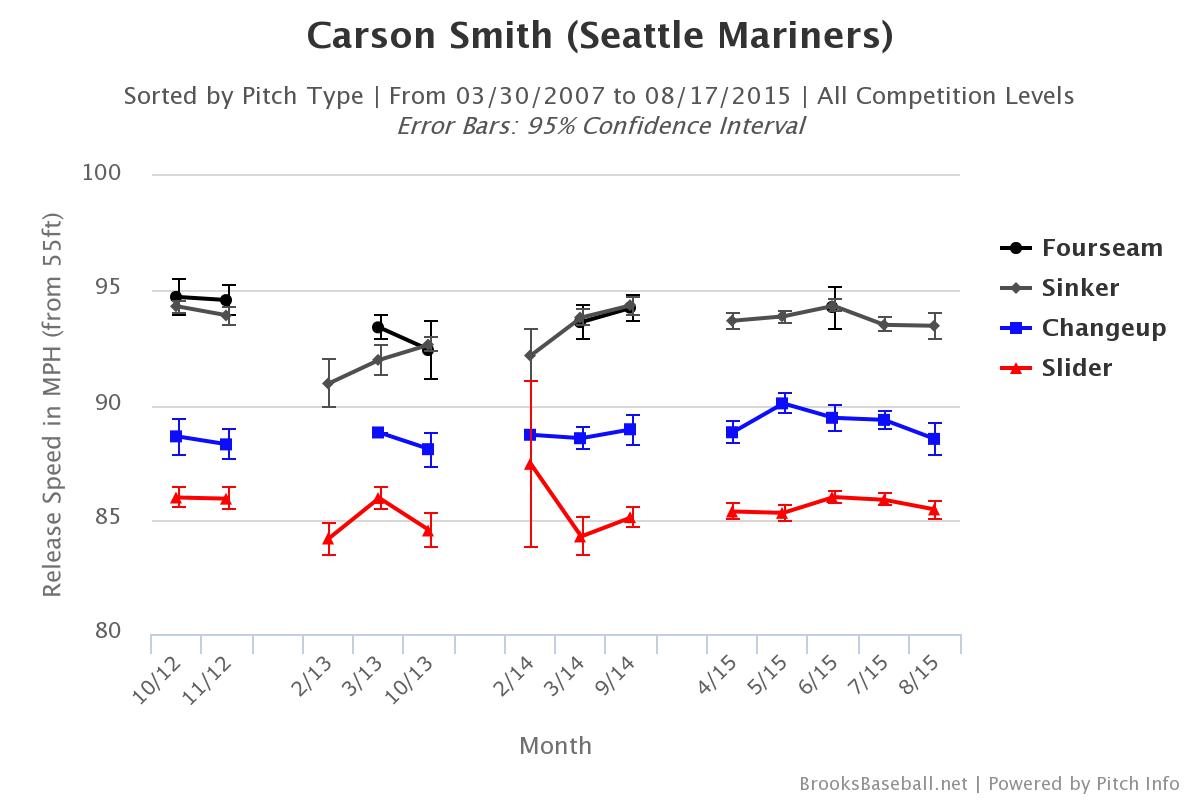
I’ll say that it is mildly surprising that Smith’s recent velo is “only” the same as it was in May. Typically, pitchers gain velocity as the weather heats up – April and May averages are below their own yearly average, which July/August are above. The fact that Smith’s line moved up in June but then back down in July is interesting, but again, we don’t see any evidence that he’s suddenly lost 1-2mph on his pitches.
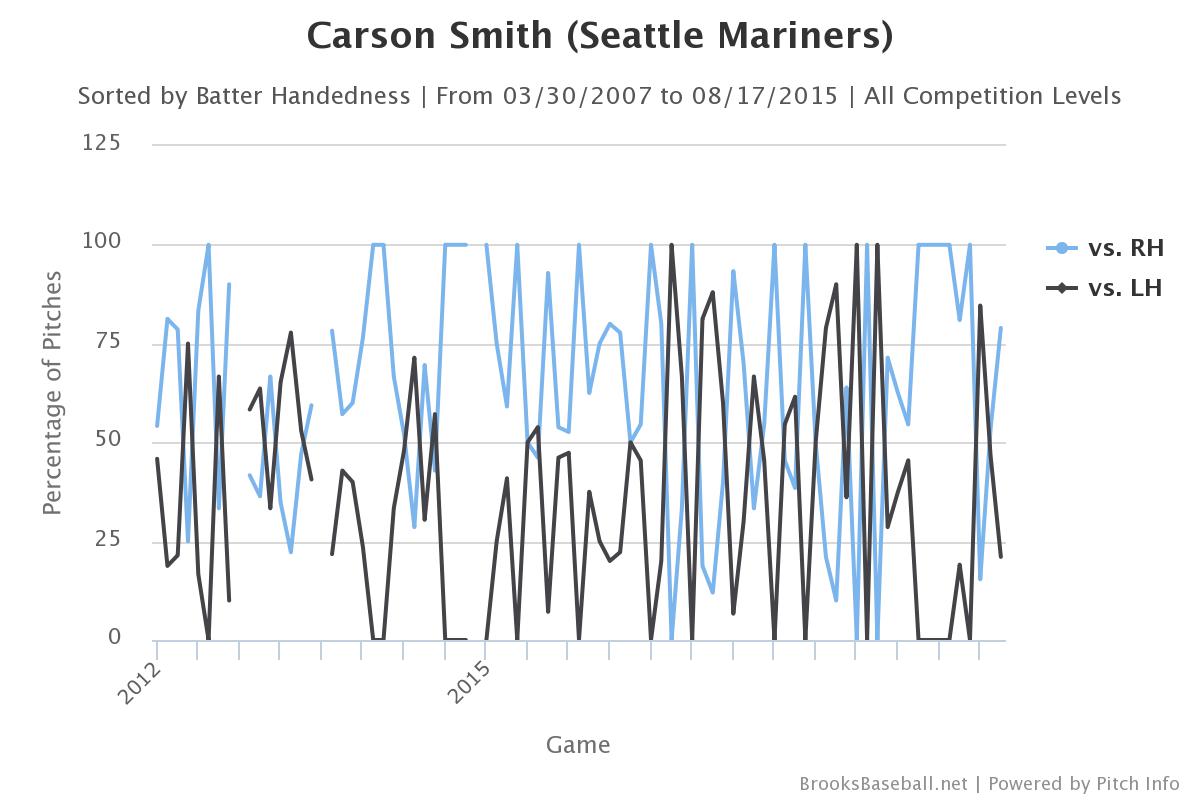
Another guess was that he’s been facing a lot more left-handed hitters. While he’s been excellent against them overall, he’s still got large platoon splits – it just hasn’t mattered because righties have had no chance, so anything lefties do looks decent by comparison. Again, though, I don’t think that’s what’s happened. There’s quite obviously a ton of noise here – we’re looking at the percentage of pitches thrown to lefties and righties by game. If anything, he’s seen a few more righties recently, but if you think the entire chart is noise, I wouldn’t argue. What we DON’T see is some clear, distinct change in batters-faced that would account for the performance drop.
So what IS going on here? I’ve got three observations that may play a part in this, particularly in combination. On their own, they all seem a bit too subtle, but remember that the luck component of Smith’s struggles is probably pretty big, especially given the starring role BABIP has played. First: Smith is throwing a few more balls in recent games. From July on, he’s thrown balls on 37% of his sinkers and a bit over 40% of his sliders. From April through June, those figures were 35% and 26%, respectively. His slider’s fallen markedly, and it’s not just that batters are suddenly taking it whereas they were chasing them in the early going: batters typically swing much less often against Smith than the league average. When he was great, batters swung at around 41% of his pitches. Now, it’s 40% or so. This suggests that the increasing ball rate is a product of pitch location and not a batter’s willingness to chase.
Second, he’s using his slider much more often. Through the end of June, Smith threw 56% sinkers and 38% sliders, including 43% sliders to right-handed bats. Since then, he’s thrown a bit under 41% sinkers and a whopping 51% sliders. To righties, he’s at nearly 2/3 sliders to 1/3 sinkers. He’s throwing a whole lot more of the pitch he’s struggling to command, and that may be making him more predictable. To righties, he’ll only throw a fastball when he’s behind. Lefties can count on fastballs very early, and they can count on sliders if Smith’s ahead. Given the fact that he’s throwing the slider for a ball more often, it’s likely he’s pitching from behind a bit more.
Third, he’s shown a tendency for separation between the release points of his sinker and slider. That is, from time to time, Smith will release his sinker 4-6″ below where he releases his slider. At other times, the two points are nearly identical. Recently, the two have diverged a bit, as you can see here:
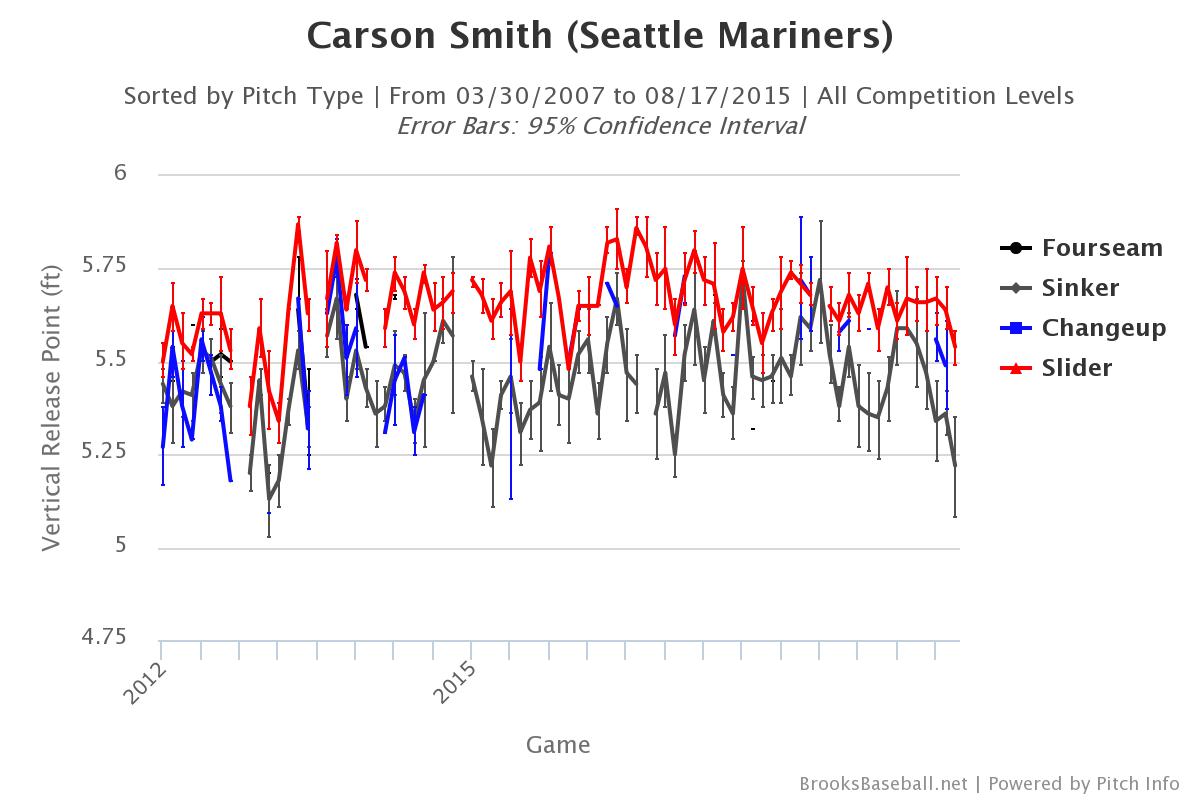
Now, as you can *also* see, they were pretty far apart at the beginning of 2015; it’s not like this has never happened before. Still, there are probably things you can get away with as a relative unknown that are harder to get away with as an MLB closer. Pro scouting presumably pays a lot of attention to things like this, as we discussed earlier regarding Tai Walker. If one team spots a subtle tell, word may get around. And all of these things could be interrelated: if batters have a good idea a slider is coming, they may be more likely to take it (they haven’t fared any better when they DO swing at sliders), and if his slider location is off a bit, that means more hitter’s counts. As a guy who depends on getting batters to take or swing through pitches *in the strikezone*, if batters have a decent idea what’s coming – whether because they can recognize the release point or they’re counting on a 2-0 sinker – Smith’s job becomes doubly difficult.
I think it may be worthwhile for Smith to move back to a pitch mix that features more sinkers, even if that’s the pitch that’s getting hit the hardest recently. Instead of looking for out-of-zone swings and punchouts, I think it might be good to focus on ground balls for a while, and see how his slider responds to being a putaway pitch as opposed to his primary offering. So if you’ve seen him throughout the year, what have you noticed? Is there a Fernando Rodney-style tell? Velo drops *within* outings, as he’s now seeing a few more 2IP appearances? Something else?
Game 117, Mariners at Red Sox
King Felix vs. Wade Miley, 10:05am
Happy Felix Day!
Unlike Rick Porcello and Joe Kelly, the Red Sox didn’t do a whole lot to left-hander Wade Miley, who they got from Arizona in exchange for two still-sorta-prospects in Rubby de la Rosa and Allen Webster. He still throws about 92, still has a four-seam, a sinker, a change and a slider (and the odd curve ball), and he still has some issues with right-handed bats. If they thought a change of scenery would help Miley, it hasn’t to date – instead, he’s clashed with his manager and has the same odd ERA-way-higher-than-his-FIP problem that’s plagued Joe Kelly. It’s been a lost season for Boston, with their rotation clearly the primary reason why. Miley hasn’t been quite as bad (or unlucky?) as Kelly, but that’s not saying a whole lot.
1: Marte, SS
2: Seager, 3B
3: Cruz, RF
4: Cano, 2B
5: Gutierrez, LF
6: Jackson, CF
7: Trumbo, DH
8: Montero, 1B
9: Zunino, C
SP: THE KING
Game 116, Mariners at Red Sox
Mike Montgomery vs. Joe Kelly, 4:10pm
The Red Sox were coming off of a disappointing 2014 and knew they needed pitching. They’d picked up Eduardo Rodriguez and today’s starter Joe Kelly at the 2014 deadline, and then they spent the off-season on a trade spree – they got Robbie Ross from Texas in exchange for Anthony Ranaudo. They picked up Wade Miley from Arizona for two prospects. Finally, they signed Rick Porcello for an eye-popping 82.5 million deal over 4 years. This year -after all of that – their pitching is worse.
What makes their overhaul so interesting is that the Sox didn’t appear to select pitchers based on their current traits or strengths. Rather, they brought them in and tried to re-mold them into something new. Like many of these guys (notably Porcello), Joe Kelly really is different. But “new” Joe Kelly is pretty clearly worse than the one they traded for. With St. Louis, Kelly used an extremely fast sinker to rack up ground balls, and while he didn’t have the control to limit walks or the breaking stuff to rack up K’s, Kelly fared OK. The Sox saw the velo and wanted to trade some contact for whiffs; after throwing 3 sinkers for every 4-seamer with the Cards, that ratio’s down to 55:45 with Boston. As you’d expect, that’s pushed Kelly’s GB down from over 50% to the low 40’s. While Kelly’s been a touch unlucky on HR/FB, you have to figure at least SOME of those “extra” fly balls would creep over the fence. To make matters worse, after years of “beating” his FIP in St. Louis, his ERA is scraping 6, over 1.6 full runs higher than his 4.29 FIP.
His BABIP is high, especially against righties, but a part of that could be the result of moving away from his bread-and-butter sinker. More worryingly, his breaking balls are getting hit hard by righties, who’ve posted a .383 wOBA against him this season. Like Porcello, perhaps, Kelly *looks* like he should be good – he’s among the tougher hurlers the M’s will see among pitchers with replacement-level fielding-dependent stats.
1: Jackson, CF
2: Seager, 3B
3: Cruz, DH
4: Cano, 2B
5: Smith, RF
6: Montero, 1B
7: Morrison, LF
8: Miller, SS
9: Sucre, C
SP: Montgomery
Adrian Sampson leads Tacoma against ex-Angel/Brave pitcher Tommy Hanson of Sacramento today (if it’s playable).
Jimmy Gilheeney, Tyler Pike, Eddie Campbell and Luiz Gohara take the mound for the other M’s affiliates.
Kuma/Sucre and Learning How to Be a Junkballer
Hisashi Iwakuma’s no-hitter was a perfect example of a pitcher using unpredictability as a weapon. As Jeff’s great post at fangraphs shows, Kuma essentially used three different approaches – a fastball/slider-heavy look in the early-going, then splitters/breaking balls in the middle innings, followed by fastballs and splitters exclusively down the stretch. In the postgame show, Shannon Drayer asked Hisashi about his slider usage, noting that he threw more of them than normal. And many on twitter pointed out that he threw more *splitters* than normal. Both are true, but it was *how* and *when* he used them that set this new, junkballing version of Iwakuma apart.
Hisashi Iwakuma’s splitter is, of course, his best pitch. The split is exceedingly difficult to lay off of, as evidenced by Iwakuma’s career 60%+ swing rate on the pitch. But because of its movement, he doesn’t need to throw it in the zone to get strikes, and that’s how you get this:
Threw season-high 33% splitters today (38 total). 35 of 38 in lower third of zone or below. Via @ESPNStatsInfo https://t.co/EK0OkQjdsb
— David Schoenfield (@dschoenfield) August 13, 2015
The lower a pitch comes in, the more likely it’ll be put on the ground (if it’s put in play). And as you’d expect, Iwakuma has a GB/FB ratio on his splitter over 7:1 for his career. Iwakuma isn’t the only guy with a good split, of course. Matt Shoemaker of the Angels gets an even higher swing rate. Masahiro Tanaka gets a very high swing rate and a better-than-Kuma whiff rate. Nate Eovaldi gets a ridiculous GB/FB ratio. But Iwakuma’s combined these attributes extremely well, and it’s allowed him to be consistently effective even in his mid-30s.
In addition, because the pitch does what it does, it allows Iwakuma to be remarkably consistent *within games*. As you know, the “times through the order penalty” is fairly large, and it’s consistent; really good pitchers face it, as do AAAA scrubs – it’s there in day games as well as night games, etc. Throughout his career, Iwakuma has a .666 OPS-against the first time through the order, and that drops to .643 the second time through, and stays at .648 the third (the OPS-against plummets the 4th time through, but he hasn’t done that much). FIP is not the only sabermetric “rule” that Iwakuma flouts.
Hisashi Iwakuma has been pitching here for years now, and you’d expect to see batters make some adjustments. What we’ve seen, though, is that batters haven’t needed to thanks to the weakness of Iwakuma’s breaking balls. His slider stood out as his worst pitch of all, but instead of scrapping it, he’s made some minute tweaks (as in: I can’t discern anything in its velo/movement). What’s different is that he’s controlling the pitch a bit better. He’d back-door lefties with it and occasionally try and sneak a strike to righties, but hitters by and large destroyed the pitch, particularly if it was thrown within the zone. Over the past month or so, he’s thrown it for a ball less than 1/4 of the time compared to over 1/3 of the time in 2015 overall and 32% for his career. The ratio of called strikes to called balls on the pitch is now 2nd highest in the league, behind Felix – another guy who uses his change-up as his chase pitch.
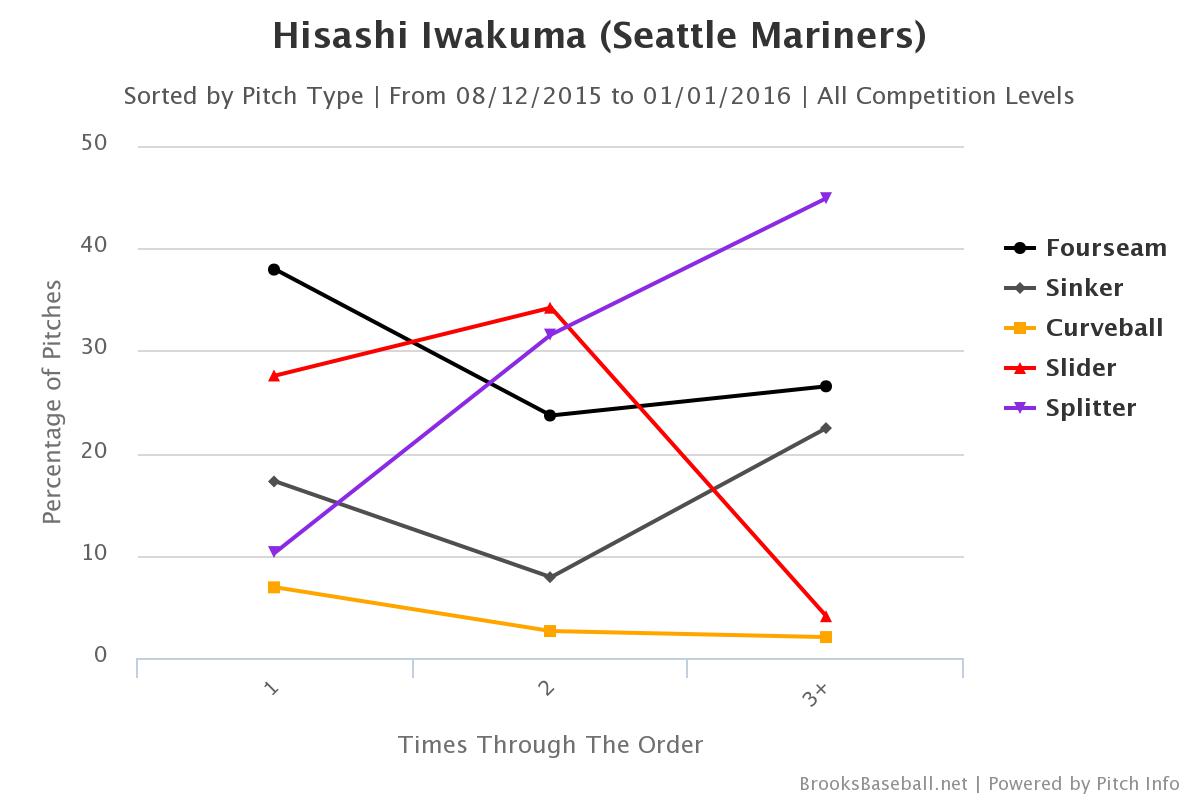
So the tweaks to his mechanics, if he’s made any, may have helped. But they seem too subtle to turn a pitch’s results from utter garbage to useful, nearly overnight. This seems like a case where sequencing is playing a role, and that’s why the pattern Jeff pointed out is so interesting. In the early part of the game Wednesday, Kuma threw tons of sliders, then replaced them with splitters late. Both pitches have very similar vertical movement, but the slider is, for whatever reason, easier for batters to identify. Thus, in the early going, Iwakuma was giving up plenty of contact. 4 of the first 6 batters put sliders into play, and batters put sliders into play more often than any other pitch on the day. It may – may, this is speculation – also have helped Iwakuma’s splitter play up in the late innings – after seeing another pitch with drop thrown *in* the zone early, it may have made the splitter even harder to lay off than normal.
Here’s what Hisashi’s pitch mix looked like on Wednesday:
And here’s what it looked like the other day against the Twins – a game which was *nearly* Iwakuma’s first ever CG.
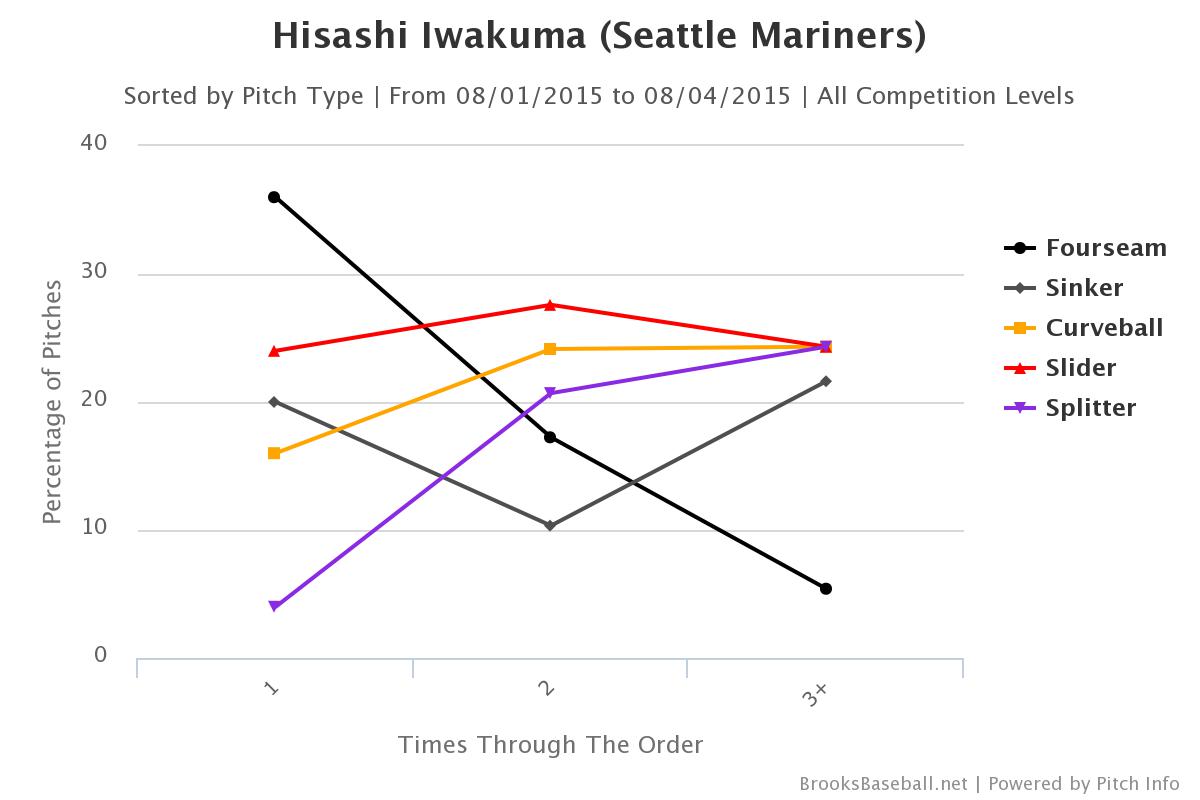
It’s a slightly different pattern, as in that case he used his four seam early, before swapping it out for sinkers and splitters late, but you get something of the same pattern – using the splitter later and trying to confound the scouting report early on.
That contrasts with something like this, which was his game against Texas in between the two games above:
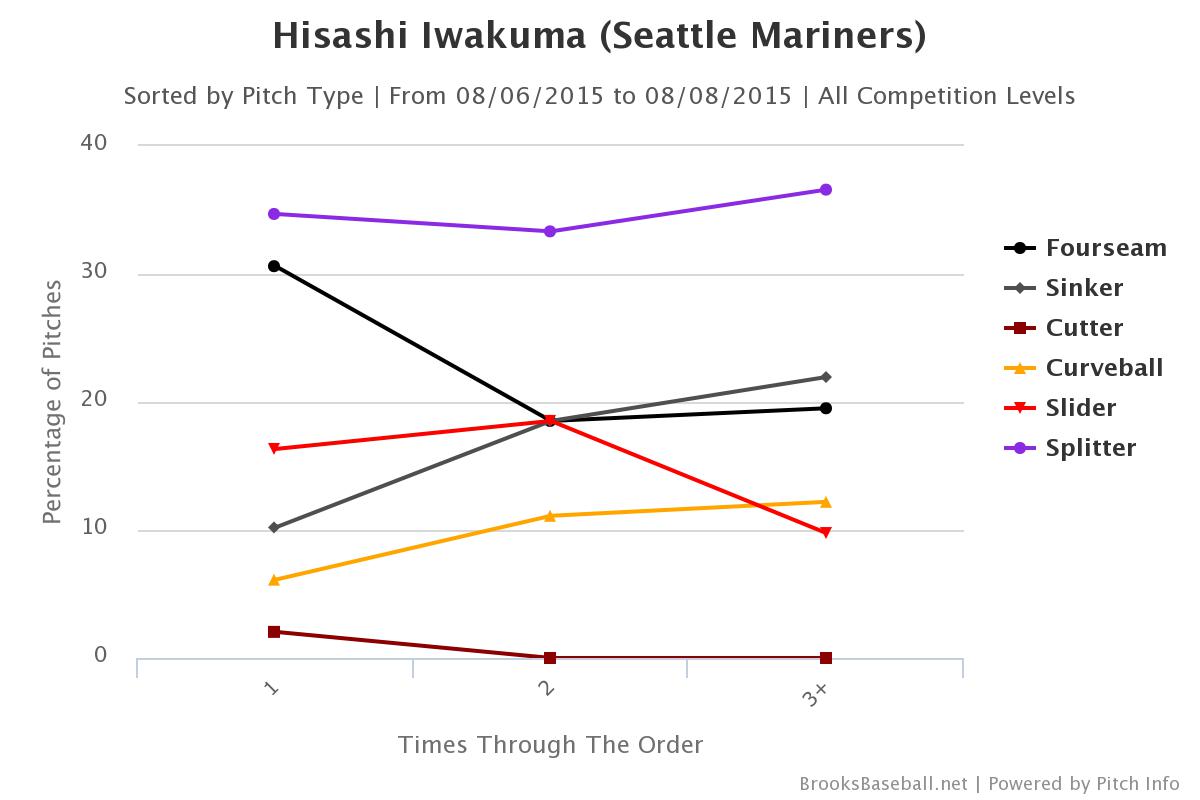
Here, the splitter usage is a constant. There’s some change going on with four- and two-seamers, but it doesn’t jump off the page. So what’s the difference here? Well, there are many – different opponents, different day (maybe his slider was garbage during warm-ups), lots of things. But one difference was his catcher. For the Twins and O’s games, Sucre caught Iwakuma, while Zunino handled the game in between. This is really, really tentative and I’m hesitant to even bring it up given Zunino’s offensive struggles, but thus far, Iwakuma has fared much better when Sucre’s calling the pitches. Over Iwakuma’s career, he has the highest K:BB ratio when Zunino’s behind the plate. But he’s also given up HRs on over 3.5% of his PAs, leading to a high SLG%-against. Sucre’s caught Kuma far, far less, but batters are slugging .259 against Kuma in those games, as opposed to the .423 they’re slugging when Zunino’s calling pitches.
This would just be noise if we didn’t see some kind of evidence that they call games *differently*. Even that is complicated by the fact that Sucre’s caught so few, and he’s been behind the plate for some shaky starts – and starts in which the pitch mix doesn’t move the way it has this month. It’s possible this is a fluke, and it’s possible Sucre’s figured something out. If he has, there’s nothing preventing the M’s (or Sucre) from telling Zunino. It’s also possible that this is *Iwakuma’s* doing – that he’s told his catchers he’d like to throw the slider early to get a feel for it. In any event, it’ll be interesting to see if Iwakuma stays with Sucre the rest of the way, and if his pitch mix strategy evolves. For now, though, Sucre and Iwakuma seem to have come up with a way to confuse hitters and scouting reports all without throwing fewer splitters.
Game 115, Orioles at Mariners
Hisashi Iwakuma vs. Kevin Gausman, 12:40pm
Early one in Seattle as well as in Tacoma.
The M’s walk-off win was a lot of fun, in that it prevented more anguish at the M’s bullpen, which blew a 3 run lead. But it was also a measure of brightness in a dark, dark campaign. I can’t have been alone in thinking Zunino’s at-bat in the 10th was headed for disaster, and had only marginally more faith in Austin Jackson. But all’s well that ends with Felix kicks.
Today, the M’s face Kevin Gausman, the young righty the Orioles selected 4th overall in 2012. Dominant at times in the minors, Gausman hasn’t been able to pitch well consistently in the majors despite a 97mph fastball, a visually stunning slider that he’s since abandoned for a curveball, and a good splitter. Despite the top-shelf stuff, Gausman’s K% is slightly below league average, while his HR% remains above average. In addition, he’s struggled out of the stretch, particularly this year. Some is luck, but essentially every peripheral stat goes to hell as soon as someone’s on base. Gausman has nearly 5 Ks per walk with no one on – but his K:BB ratio plummets to below 2 with men on. Maybe he’s trading some walks for really hard contact? No; his HR rate spikes with men on, too. All of this means that his strand rate is below 70% for his career, and that’s left him with some uninspiring fielding-dependent WAR figures.
Of course, there’s another confounding variable here: health. Gausman was on the DL this year with shoulder tendinitis, and then he spent some time in the minors getting stretched out. He began the year in the O’s bullpen, so some of his struggles may be related to the change in role – though of course he started in 2014. Clearly, using him in the pen didn’t prevent soreness from developing, but it might tighten the leash with him – I can’t imagine they’d want him racking up high-stress pitches the rest of 2015.
This year, Gausman’s worked on pitching up in the zone with his fastball, presumably to hide his new curve a bit better. Since April, though, the picture’s a bit more muddled. He’s still throwing some four-seamers at or above the top of the zone, but the heatmap doesn’t look radically different from 2014’s: last year, a bit over 18% of his fastballs were “up” – the top third of the zone or above. This year, it’s 24%. After talking so much about pitching up, why is he doing so only sporadically? This may be the result of continued worries about HRs, or it may be the byproduct of pitching to contact to keep his pitch-count lower – he’s dropped his pitches per PA from 4.1 to 3.9 this year. In any event, Gausman has plenty of time to put it together, and avoid the fate of so many Orioles pitching prospects before him. Jake Arrieta was great in the minors, then struggled for the O’s before becoming an elite starter with the Cubs. Brian Matusz, another #4 overall pick, was untouchable in the minors before regressing from “disappointing” to “make it stop” in the O’s rotation. He’s a decent bullpen arm now, but that’s not what the O’s thought they had. Zach Britton was another guy with a great MiLB track record who stalled out in the rotation, though at least he’s been an elite reliever. And that’s not even counting Dylan Bundy, one of the better prospects in baseball in 2012 who missed all of 2013 with TJ surgery and is now “shut down indefinitely” with tendinitis, which doesn’t sound terribly encouraging.
1: Marte, SS
2: Seager, 3B
3: Gutierrez, DH
4: Cano, 2B
5: Smith, RF
6: Jackson, CF
7: Trumbo, 1B
8: Miller, SS
9: Sucre, C
SP: Iwakuma
Nelson Cruz came out of the game last night with neck spasms, hence the off-day today.
Tacoma lost to Sacramento 9-4 after holding a 4-0 lead through 5. After Edgar Olmos’ 5 shutout IP were up, the RiverCats feasted on the R’s bullpen, including Forrest Snow and especially Tony Zych. Jose Ramirez couldn’t stop the bleeding either, and thus Sacto scored the final 9 runs of the game. Ramon Flores homered again and continues to impress at the plate. He’s also playing a lot of CF for Tacoma. Today, Jordan Pries takes the hill (at 11:35am!) against Ty Blach of Sacramento.
Jackson blanked Tennessee 8-0 behind Stephen Landazuri and Andrew Kittredge. Guillermo Pimentel homered and doubled in his first AA game – he was just called up from high-A Bakersfield. The Generals face the Jacksonville Suns today in West Tennessee – no word on the starter at this point.
Speaking of Bakersfield, the Blaze won their 6th consecutive game, which is pretty impressive for a club that’s spent much of the year 20+ games under .500. Yesterday, they scorched struggling Lake Elsinore 11-1 behind a solid start from Brett Ash and 4 hits from lead-off man Nelson Ward. Scott DeCecco’s scheduled to get the start today in Game 2 of the series.
Clinton dropped the first game of their series to the Lansing Lugnuts 6-4. SP Ryan Yarbrough continues to struggle, as he went just 2/3 of an inning, giving up 5 runs on 5 hits and 2 walks. It’s been a lost season for the Old Dominion product. Gianfranco Wawoe doubled for the Lumberkings. No word on today’s starter.
Vancouver walked-off Everett 7-6 despite HRs from Alex Jackson and C Adam Martin. Drew Jackson’s 2 hits and a walk brought his line up to .395/.453/.500 on the year. The AquaSox head down to Eugene today for a series against the Emeralds.
Friend of the blog Jonah Keri has a depressing read on the M’s inability to develop prospects today at Grantland. From Ackley to Zunino to Smoak, the M’s have certainly not gotten much production out of prospects that were universally regarded as MLB-ready. And he’s absolutely right to contrast this dubious record with Cardinals, who plug in unknown guys most people pegged for org depth and get solid production from them. You can probably mention the Astros as well as another team that’s turned some high draft picks and some also-rans into a solid young core. So player development has absolutely been a problem for the M’s, and it’s an area where other clubs are clearly doing something better. But the frustrating thing about the M’s is how multi-faceted their struggles are. A year ago, we lamented that in addition to player development, their eye for *pro* talent was equally bad. The complementary players brought in to stabilize the club for the youngsters were pretty much universally awful – from vets like Joe Saunders, Mike Morse and Miguel Olivo to MLB-ready youngsters like Hector Noesi and Trayvon Robinson. After an off-season in which the M’s signed Seth Smith and Nelson Cruz, that pro-scouting problem looks a whole lot different, but it hasn’t mattered.
Game 114, Orioles at Mariners
Taijuan Walker vs. Chris Tillman, 7:10pm
A day after Adam Jones homers against his ex-team, the other big part of the infamous Bedard trade takes the hill against the M’s – the team he’s had the most success against of any team in baseball. In 7 starts, Tillman is 6-0 and has given up just 26 hits in 43 innings pitched. The M’s have *slugged* .272 against Tillman, and that includes Tillman’s early years in baseball, when he was ineffective on the whole.
As I mentioned yesterday, the Orioles have done well in assembling a staff of pitchers who are a bit more effective than their FIPs would suggest. Wei-Yin Chen, Miguel Gonzalez and Tillman have all traditionally given up a lot of HRs, but have tended to post better RA/9 numbers than their FIP. By fielding-dependent WAR, Tillman posted a pair of 4-WAR seasons in 2013 and 2014. By fWAR – which is FIP-based – he was a bit over 4 for both years combined. This season, Tillman’s even reduced his HR rate, down just below 0.8/9, which is remarkable improvement for a guy who seemed to live at 1.2/9 and higher. Unfortunately for Tillman, while FIP *still* doesn’t accurately describe his runs-allowed this season, it’s now UNDERestimating it. A disastrous start to the campaign left Tillman sporting a 4.41 FIP and a *5.40* ERA.
Since then, though, Tillman’s transformed himself a bit. As this great interview with Eno Sarris demonstrates, he’s made a series of adjustments that’ve been rewarded with a series of excellent starts. Tillman’s four-seam fastball gets more vertical rise than any other FB in baseball, and that’s been the key both to Tillman’s low ground ball rate, but also – once his command improved a bit – his low BABIP. When that wasn’t working, Tillman began mixing in more of his rarely-used sinker. Some of the changes Sarris documents – a spike in GB%, a drop in BB% – might be directly influenced by that alteration in his repertoire. But even while he’s made other changes – a shift on the rubber, and taking a bit of steam off of his change-up – the overall picture seems out of whack. It’s not like he’s suddenly throwing the sinker a ton; he’s still under 20% with it since July 1. And while the change has a bit more drop, he’s thrown fewer than 100 in that time. But in the 2nd half, the fly-balling, HR-absorbing, control-challenged pitcher who was bailed out through a low BABIP and consequently high strand rate has put up the numbers of a control-artist sinkerballer. Tillman has allowed no HRs in the 2nd half, put up a GB% of 54% in July and nearly halved his walk rate. Thanks to a minor ankle injury, this is his first start in the month of August, and I for one am kind of curious to see if any of these changes are immediately apparent. If not, I have a hard time believing Tillman’s magic transformation based on a month of data. I have no trouble believing that he’s successfully hexed the Mariners, however. That’s practically irrefutable.
1: Jackson, CF
2: Seager, 3B
3: Cruz, RF
4: Cano, 2B
5: Smith, LF
6: Trumbo, DH
7: Morrison, 1B
8: Miller, SS
9: Zunino, C
SP: Walker
Another baseball GM has been let go. First came the surprising news about Detroit’s Dave Dombrowski, who Ryan Divish wrote about as a potential M’s target a while ago. Today, the Brewers GM Doug Melvin stepped down, and the owner announced he’d retained a search firm to help locate a candidate with an analytical background.
Tacoma had an off day yesterday, and welcome Sacramento to town. The opener tonight sees Edgar Olmos making a spot-start for the Rainiers while Nik Turley – a one-time Yankees farmhand the Giants org picked up last year – starts for the RiverCats.
Jackson scored the game’s final 5 runs but still came up short in a 6-5 loss to Tennessee yesterday. Jabari Henry hit his 5th HR, but it wasn’t enough. Edwin Diaz took the loss. Today, Steven Landazuri starts opposite Jeffry Antigua.
Bakersfield was also off yesterday, and they open a series against the one team in the league with a worse record: Lake Elsinore. Brett Ash starts for the Blaze.
Clinton must regretfully return to the baseball diamond today after a blessed off-day. They’ll host Lansing behind returning starter Ryan Yarbrough. Yarbrough shot into the M’s top-10 prospect lists after a brilliant campaign in Everett, but has struggled this year and went back to Peoria for a stay in extended spring training for a while.
Everett beat Vancouver 4-2 as Drew Jackson notched another 3 hits, taking his OPS on the year to .942. Ryan Uhl homered, and the AquaSox bullpen surrendered no runs and 1 hit in 6 IP in relief of starter Andrew Moore. Jose Santiago starts tonight in Vancouver.
Game 113, Orioles at Mariners
Vidal Nuno vs. Wei-Yin Chen, 7:10pm
The Orioles head to Seattle today, and the first game features a battle of fly-balling left-handers with rising – but not exactly blazing – fastballs. When these two clubs met back in May, I talked a lot about the Orioles predilection for fly-ball starters – guys whose FIPs might look pretty bad (thanks to the fact that some of those fly balls will turn into HRs), but who might post better runs-allowed numbers for a variety of reasons. I seriously don’t understand how they DIDN’T end up with Chris Young, but hey, they’ve got Chris Tillman, Miguel Gonzalez and tonight’s starter, Wei-Yin Chen.
To refresh your memory, Chen’s got a 4-seam fastball at about 90-92 that gets more horizontal run than most, and a lot more vertical rise. His best overall pitch is probably his slider, a two-plane breaking ball that helps him shut down left-handers. To righties, he’ll throw a splitter, though the pitch has oddly little drop. Despite the lack of movement, there’s enough separation from the four-seamer that it still functions as a GB pitch, and that helps him try and keep righties in the ballpark, something that’s traditionally been a problem for him. He’s given up 22 HRs on the year, 9th most in baseball, and that’s the biggest reason why his FIP sits at an ugly 4.45 thus far. His ERA is over a full run better, though. As a guy with platoon splits and a low BABIP, this would normally scream fluke, and that would be that. But it’s worth thinking about how FIP could underestimate guys like this.
First, as a lefty and a fly-ball pitcher, it’s possible Chen might run a lower BABIP than normal, and thus have fewer baserunners-against. He already limits baserunners thanks to excellent control, but FIP’s already accounting for that. Second, there seem to be some pitchers – and Hisashi Iwakuma is probably the best example – of guys who clearly pitch differently with men on base. Iwakuma has given up a lot of home runs, and thus FIP undersells him, but not because of Chris-Young-style HR/FB ratio magic. Instead, it’s because Iwakuma pitches differently from the stretch and gives up far fewer HRs. With no one on, he’ll groove a fastball. With men on, he’s much less likely to do that. In 2015, *18* of Chen’s 22 HRs have come with no one on. The league as a whole gives up HRs at a rate of 1.05 with no one on and 0.88 with men on. For Chen, those ratios are 2.03 and 0.72, respectively.
Chen’s also sporting a remarkable strand rate of over 80% this year – his career rate’s good, but it’s not THAT good, and that highlights the volatility in these supposed skills. I think Chen’s is *better* than his FIP shows, and that given his park, he’s been an above-average pitcher. But his true-talent probably isn’t all the way down at this year’s 83 ERA-. The ability to give up HRs only when no one’s on? He’s shown that over his career, but not to this extent. The lefty/fly-ball BABIP-suppressing combo? Well, his career BABIP isn’t remarkable or anything. And no matter what, 1.52 HR/9 – Chen’s overall rate this year – is scary enough that he should make some adjustments. Still: Chen’s an example of someone FIP might miss on.
Kind of like Vidal Nuno – a lefty who throws even slower, but with a similar four-seam fastball with tons of rise. Nuno’s four-seamer has much less run than Chen’s, but his change has similar movement to Chen’s split. Nuno also has a good slider, which has made him quite effective against lefties over his career – but with the same sorts of platoon issues Chen faces. Like Chen, Nuno’s currently running a vertiginously high strand rate, which, combined with the fact that he’s been in the bullpen, helps explain why his ERA is so much better than his FIP. They’ve even got nearly identical GB and FB% numbers. Nuno’s fastball has actually fared a bit better overall, which is odd. For Nuno, his problem’s been what to throw to back it up. Righties have struggled against his slider this year, but killed it in 2014. His change has never produced great results. Chen’s *fastball* is his big problem to righties, but Nuno needs good command of his slider – a pitch he still throws frequently, even to righties. We’ll have to see how many sliders Nuno throws overall. Working out of the pen for most of 2015, Nuno’s thrown an amazing 66% sliders to left-handers – he’s essentially been Sergio Romo. As a starter, that pattern may not be advisable.
1:
2:
3:
4:
5:
6:
7:
8:
9:
SP: Nuno
Tacoma blasted Reno 13-6 behind four HRs yesterday. Chien-Ming Wang wasn’t great, but the offense bailed him out. Chris Taylor homered and doubled, while Jabari Blash continues his hot August. The native of St. Thomas blasted by far the longest HR of the day, giving him four in his last 4 games, but he also sprayed some line drives around on his way to a 3-5 day. I’d essentially given up on him as a prospect, and at 26, the odds are not favorable. But his swing no longer looks as out-of-control as it did last year, and his K% has settled in under 30%. Paired with a solid walk rate, that’s down into “concerning” territory from “noooope” territory. He’s struck out only 1 time in his past four games, too. The pure hit tool is never going to allow him to hit for average, but this is a guy the Astros would stash on their bench. In a year without much to cheer about in the minors, Blash is a bit of a bright spot.
Tennessee handled Jackson easily, 8-3. Edwin Diaz starts today for Jackson as they finish up their intra-state series.
Bakersfield beat Modesto behind 6 solid innings from Tyler Pike. Tyler O’Neill hit his 26th HR, which leads the Cal League by 3.
Clinton scored 4 in the 8th to beat South Bend 9-5. Gianfranco Wawoe and Joe DeCarlo homered for the Lumberkings, who seriously needed a win. Their winning percentage of .313 is the lowest of any full-season club, and is much lower than we typically see in the affiliated minors. There have been some remarkably bad seasons in the long history of the minors, including Portland’s miserable 1921 team and perhaps the worst ever PCL club, the Sacramento Solons, who posted a .265 WP% in 1943. Salt Lake and rookie manager Don Zimmer had a sub-.300 WP% back in the early 70s. But these days, we don’t tend to see teams lose this often. In recent history that I’ve been able to scrounge through, there are a couple of clubs that have gone through what Clinton’s going through now. In 2006, the Kannapolis Intimidators intimidated no one on their way to a 42-94 record, for a WP of .309. Future Mariners Dan Cortes and Kanekoa Texiera, as did current Astros DH Chris Carter. The very next year, the Mets affiliate, the Savannah Sand-Gnats did slightly worse, at 41-94, or a WP% of .304 (current Met Juan Lagares was on that club). Those marks are in jeopardy this year.
Everett beat Vancouver 6-3, with Joey Strain pitching 3 solid innings for the win. Drew Jackson had the day off, but Alex Jackson pitched in with 2 hits and Braden Bishop added 4 of his own. Andrew Moore takes his 29:1 K:BB ratio into Vancouver tonight against lefty Evan Smith.
Game 112, Rangers at Mariners
King Felix vs. Colby Lewis, 1:10pm
Happy Felix Day to you all.
The M’s surrendered 8 runs in the 11th to well and truly lose to the Rangers yesterday. Worse, their inability to advance a runner after getting the lead-off runner to second on an error made it feel even worse. Today, the M’s have a decided edge in starting pitching, with Felix facing veteran junkballer Colby Lewis, a fly-ball pitcher with platoon split and gopher-ball problems. Lewis has a sparkling W/L record despite some shaky appearances – he gave up 7 runs on 3 HRs in 6 IP in his last start, but picked up the win, which tells you so much more about the usefulness of the stat than it does about the usefulness of Mr. Lewis.
Lewis’ FB is now in the high-80s, and it still has tons of vertical rise which helps explain his very high fly ball rates. His best pitch is his slider, which is fairly hard at 84 and helps him miss a fair number of bats. However, if he isn’t able to put it down and out of the zone, it can get hit fairly hard: he’s given up 6 home runs on the pitch this year. But Lewis’ bigger problem has been his inability to deal with left-handers. He’s developed a change-up that’s occasionally a good pitch, but lefties apparently see his fastball quite well. Over Lewis’ career, lefties are slugging .531 on his four-seamer and .535 on his sinker.
1: Marte, CF
2: Seager, 3B
3: Cruz, RF
4: Cano, 2B
5: Smith, LF
6: Montero, 1B
7: Trumbo, DH
8: Miller, SS
9: Zunino, C
SP: El Rey
Trumbo is presumably starting because he’s 4-13 in his career against Lewis, but really, this slightly odd line-up is the result of LoMo’s debilitating slump. The M’s are facing a pitcher who struggles against lefties, but they don’t want to give LoMo ABs right now. The M’s have instead used LoMo as a late-game defensive replacement in the OF, where he hadn’t played all year. This is the team we follow.
Ketel Marte gets a start in CF today. We’ll see how he fares, given his very limited experience in the OF.
The Rainiers lost to Reno yesterday 6-3, scoring all 3 runs in the first off of Jhoulys Chacin. Local kid Adrian Sampson – who came to the M’s in the JA Happ deal – took the loss. Today, Chien-Ming Wang faces off against Gabriel Arias in the series finale – the whole league has a day off tomorrow.
Jackson was obliterated by the Tennessee Smokies 14-1. The Generals surrendered a 10-run inning, and Moises Hernandez went 3 innings and gave up 12 earned runs. IF Luis Caballero pitched the final inning and gave up 1 run. Jimmy Gilheeney – just back from a stint in AAA – starts today for Jackson.
Bakersfield got another walk-off win yesterday, beating Modesto 5-4 on a walk-off error. Hey, they can’t all be walk-off 3-run homers. Dan Altavilla was effective for the Blaze and Tim Lopes had 3 hits. The beastmaster Tyler Pike takes the hill for Bakersfield today.
Clinton lost again, this time 5-1 to South Bend. Zack Litell’s on the hill for the L-Kings today.
Everett beat Tri-Cities 7-5. CF Luis Liberato homered and Drew Jackson had a hit and another walk – his OBP is now .441. Lane Ratliff gets the ball as the AquaSox travel to Vancouver today.
Game 111, Rangers at Mariners
Mike Montgomery vs. Martin Perez, 1:10pm
The M’s officially induct Jamie Moyer into the club’s Hall of Fame today, a fitting tribute for the most unlikely star in M’s history. Acquired for Darren Bragg in 1996 in a trade I absolutely hated at the time, Moyer went on to throw over 2,000 innings in 323 starts for the M’s. Larry Stone’s article about Moyer and the M’s tribute is worth a read, as usual.
After grabbing a win against the Rangers new ace, the M’s face lefty Martin Perez, another hurler featuring a solid change-up. Perez is clearly no Cole Hamels, and he’s struggled throughout his career with his control and a strange inability to get strikeouts despite good velocity from the left side. In recent years, his arm hasn’t held up, as he’s making just his fourth start in the big leagues in his return from TJ surgery. Since the start of 2014, the 24 year old has made only 12 starts. One thing he hasn’t struggled with, though, is the Mariners. In 6 games against Seattle, he’s been surprisingly tough.
Perez’s change has traditionally been a swing-and-miss pitch, which helps balance the fact that his fastball seems surprisingly easy to hit. In his first few games back, his whiff rate is down markedly, but he’s getting a flurry of ground balls. He’s shifted between four- and two-seam fastballs at times, and is throwing them almost equally thus far in 2015. He’s also got a slider and curve, both of which are thrown surprisingly hard. The change helps him ameliorate his platoon splits, but command of the pitch seems to come and go for him. That inconsistency has been a major issue for Perez since his days as a hyped prospect in Texas’ stocked system. Hopefully this is one of his off days.
1: Marte, SS
2: Seager, 3B
3: Cruz, DH
4: Cano, 2B
5: Montero, 1B
6: Jackson, CF
7: Trumbo, RF
8: Miller, LF
9: Sucre, C
SP: Montgomery
Tacoma beat Reno 7-6 in 10 innings last night, scoring 5 runs in the 9th to tie it, then walking off in the 10th on a bases-loaded walk. Jabari Blash hit 2 HRs in the game, and Jose Ramirez pitched two scoreless innings for the win. The Rainiers will face ex-Rockies hurler Jhoulys Chacin today – no word on the R’s starter.
Jackson lost to Tennessee 6-5 on a walk-off hit from ex-A’s prospect Billy McKinney. Marcus Littlewood hit his 5th HR, but the Generals were in trouble early as Misael Siverio gave up 5 runs in just 2/3 of an inning to start the game. Moises Hernandez starts today against Pierce Johnson, who’s been very tough in 10 AA starts this year.
Bakersfield beat Modesto 5-2, getting three runs in the 9th on a walk-off 3-run jack from Kyle Petty. Dan Altavilla starts today for Bakersfield against Antonio Senzatela
Clinton lost to South Bend 4-1, sending the L-Kings to an astonishing 42 games under .500. Clinton struggled in the first half of the year, but since the break, they’ve utterly collapsed – they’ve got an 8-33 record, and they’ve fallen to the worst record of any full-season team in all of the minors. Lukas Schiraldi starts today.
Everett beat Tri-Cities 3-2 in 10 innings on a walk-off single by Corey Simpson. SS Drew Jackson continues to rake, but the star of the game was reliever Nick Wells who threw 5 scoreless innings, yielding just 1 hit, walking none and striking out 8. It was the lefty’s first appearance for the M’s since being acquired from Toronto in the Mark Lowe deal. Luiz Gohara starts tonight for the AquaSox.
Game 110, Rangers at Mariners
Hisashi Iwakuma vs. Cole Hamels, 7:10pm
Sorry for the break there – I wandered around Oregon with my family, camping near Newberry Caldera, checking out the coast, and checking out plenty of breweries/wineries. It was a wonderful break from what’s become another difficult M’s season, though it was ill-timed in that I missed Ketel Marte’s first MLB at-bats, as well as Jesus Montero looking like a big-leaguer again. As in most seasons, the M’s are a fascinating blend of hide-your-eyes and realized potential. Nelson Cruz can’t be an MVP candidate in a league that employees Mike Trout, but he’s having an amazing season. Brad Miller’s plate discipline is helping overcome a stubbornly low BABIP, Seth Smith has been fantastic and even Franklin Gutierrez is contributing. And yet the M’s are out of it, 9 games below .500 and with their playoff odds in the very low single-digits.
This isn’t new – you know how the M’s got here. Jeff Sullivan did a great job summarizing their plight for a national audience here, but what’s interesting is how much churn there’s been in terms of where the blame lies. Hisashi Iwakuma was bad and then hurt-and-bad, but he’s returned to form and become a contributor. Robinson Cano was an anchor on the offense until he suddenly became its engine again. Fernando Rodney was terrible, and then…ok, yeah, he’s still terrible. The M’s offense has been better of late, but it’s amazing how little these mini-streaks by some component of the team matters in the win column. The starting pitching began the year in a slump thanks to Iwakuma, Taijuan Walker and James Paxton, then turned it around. The non-Cruz offense was terrible, and then had a torrid month, but the M’s record has actually dropped over that time.
Worse, the Rangers rebuild seems to have taken much less time than we would’ve assumed. After sinking a ton of money into Shin-Soo Choo, Elvis Andrus, Prince Fielder and Yu Darvish, they’ve been able to re-tool thanks to a farm system that continues to be excellent at developing talent. Cole Hamels fetched three of Texas’ top 10 prospects, though the Rangers were able to protect 3B Joey Gallo and OF Nomar Mazara, meaning they’ve got offensive depth in the high-minors. The development of Chi Chi Gonzalez has been fairly remarkable, and CF Delino DeShields has been solid after Leonys Martin’s development stalled and then went into a nosedive. To be sure, this is still a team that’s overperforming to a degree: their pythagorean record is 50-57, and their pitching staff was among the worst in baseball prior to acquiring tonight’s starter, Cole Hamels.
They’ve relied on sequencing, and they have the best record in one-run games in the AL West. You could argue that they should’ve sold on Gallardo rather than buying on Hamels, but that’s obviously not what they decided to do. Instead, they’re positioned fairly well for 2016 – they should have a healthy Martin Perez and, at some point, Yu Darvish, meaning they won’t need Colby freaking Lewis to anchor the rotation. SS is still a problem, and it’s not clear how much money they’d have to spend after taking on Hamels contract, but the M’s came into this season looking like a team that was far superior in every way to Texas, and that’s not going to be the case next year. Of course, Oakland was supposed to be the well-positioned, slightly-above-.500 team coming into this year, and Texas’ push could backfire if they don’t figure out why none of their players can stay healthy. But while the M’s window hasn’t completely closed, it’s really hard to see out of it these days.
I take it we all know enough about Cole Hamels not to go into too much detail. You know, guy with really good change-up – 4th most innings-pitched since end of 2007. Coming up, Hamels was a four-seam/change up guy who also threw a curve. After struggling against lefties a bit in 2008 and 2009, he developed a cutter which has become a big part of his arsenal (especially to lefties) and a sinker, which may help ameliorate his HR issues. He started throwing the curve a lot in 2013, and he’s kept his HR/9 under 1 in each year since. The confounding variable here is velocity. Like a number of hurlers, Hamels is now throwing significantly harder than he was as a youngster. In 2008, Hamels four-seam was 90-91. Now, at age 31, he’s throwing 93-94.
1: Marte, SS
2: Seager, 3B
3: Cruz, RF
4: Cano, 2B
5: Montero, DH
6: Jackson, CF
7: Trumbo, LF
8: Morrison, 1B
9: Zunino, C
SP: Iwakuma
Soooo, Ketel Marte, underrated prospect? This may be the first time in recent memory that the national writers seem to be higher on a prospect than the team’s fans. Marte’s calling card has been his hit tool, as he’s posted sterling K% numbers despite being very young for his league at every stop in the minors. As the Chris Mitchell article linked above attests, contact is a very good sign for a prospect, and his ability to make contact from both sides of the plate adds to the high-ceiling that many people see. Personally though, I’m still quite wary. His lack of power means that his hit tool has to be great, and more importantly, it has to be great consistently. Kiley McDaniel mentioned Luis Castillo as an upside comp, but reaching that would require Marte to walk much, much more often than he’s shown a predilection for in the minors. Castillo had a .368 career OBP, and that’s probably the 99th percentile forecast for Marte. To me, the best case is something like Dee Gordon, another player overlooked because of a low ISO coupled with a non-SS, non-C position. When a player like that is hitting really well, they’re great. But unless either Marte’s gap-power or patience develops, he can’t really contribute if he isn’t hitting over .290 or so.
The PCL has seen a raft of young players who hit AAA at 20-22 and posted solid averages. Most of them were great hitters, from Kris Bryant to Wil Myers to Anthony Rizzo to Joc Pederson. Several of the middle infielders have shown more pop as well, like Wilmer Flores, Dilson Herrera and Kolten Wong. The remainder are a mix of tweener-types who hang on in the big leagues but come off the bench (Joaquin Arias, Chris Owings, Luis Sardinas). It’s too soon to tell with Hanser Alberto or Christhian Adames, and it’s still a bit early with Chris Taylor, too. But those three could play SS, and even there, as could Alcides Escobar, the top MIF comp in Mitchell’s study. If Escobar, Dee Gordon and Scooter Gennett are top comps, it highlights the fact that batting-average-reliant players can be remarkably volatile. Gennett was a .300 hitter who proved the stat-heads wrong, and then was quietly demoted weeks later. Escobar put together a very good 2012 when he hit .297 with little power, but his 2013 was disastrous, putting up a wRC+ of 50 despite playing every day. Gordon’s been great this year, but had a 58 wRC+ in 330 plate appearances in 2012. All of this isn’t a huge problem if Marte’s hit tool is categorically better than these guys, and I’m just not sure that it is. If he plays good defense, there are worse guys to have on your bench, but I still think he may have more value on another team. Prove me wrong, Ketel!
After spending some quality time out of cell-phone range, I’m actually looking forward to watching a ball game tonight. Go M’s.