
Rule 5 Draft Caps Off Frenzied Winter Meetings
The Rule 5 Draft took place this morning in San Diego, with teams looking to glean a useful player from the pile of former-can’t-miss-prospects, injured pitchers, and org guys. Of course, it’s tough to focus on the draft when teams have made so many moves over the past few days. The M’s added a new lefty today, but the story of the past week has been how much the division landscape has changed since late November.
First, let’s do some due diligence about the Rule 5 draft. The M’s selected lefty David Rollins, a pitcher in the Astros organization. This was actually the third time they’d drafted Rollins, tabbing him in the 23rd round of the 2009 draft, and then the 46th round a year later (this after he turned the Dodgers down out of high school). He eventually signed with Toronto, and then moved to Houston in a 10-player trade that sent new Mariner JA Happ to the Jays. Rollins’ splits against lefties are impressive, so the thought process makes some sense here – the M’s did well in grabbing Lucas Luetge a few years back, and they probably see Rollins in that role. He’ll probably compete with Edgar Olmos, the lefty the M’s grabbed from the Marlins, for a LOOGY role in the 2015 bullpen. The M’s didn’t lose anyone in the draft this year. The only M’s name that BA’s Rule 5 guru JJ Cooper had mentioned in the run-up to today’s draft was Steven Baron, so….yeah, not a huge shock there. Some teams may have thought about Jabari Blash, but the power-hitting OF would be tough to keep on a roster, and isn’t realistically ready to contribute now.
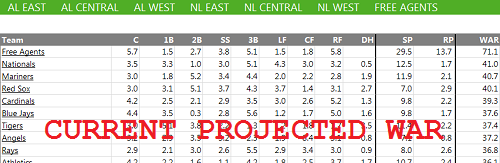
So the M’s 40-man is once again full, and Fangraphs’ depth charts give us the first, hazy glimpse of how the AL stacks up. By this measure, the M’s have the best team (on paper) in the AL, fractionally ahead of the Tigers and Red Sox. So the projection systems must really be high on Nelson Cruz, right? Not so much. Instead, the story of the off-season is how much the M’s have benefited from their rivals’ roster moves. The A’s, again, on paper, were an elite team. By run differential, they were the clear #1 team in baseball. By base runs, they were neck and neck with the Angels, Nationals and Dodgers, but still a 94-95 win behemoth. As Dave has said many times, you can’t simply take last year’s *results*, add/subtract for player movement, and come up with a new expected winning percentage. Clearly, the team wasn’t “starting” from a 95-win base, not with Jon Lester and Jason Hammel on their way out the door. Still, the point is that the core of their roster was very good, maybe even excellent, heading into 2015. With Josh Donaldson, Brandon Moss, and Jeff Samardzija earning arbitration salaries, that core wasn’t terribly expensive, either (it was clearly more expensive for the A’s than it would be for the M’s or other teams, but these were not guys making market-rate salaries by any stretch). Between Nov. 29th and December 9th, the A’s essentially dumped that core, for a collection of pieces that replenish a farm system depleted by last summer’s trades and cost-controlled young players to fill out the 2015 roster. That helps balance their ability to compete now with their ability to compete going forward, but let’s be clear – an AL West favorite as of late November has voluntarily sunk their playoff odds for 2015.
Maybe this is what they had to do, given that their roster wasn’t necessarily improving. Maybe the A’s are especially loathe to lose a player like Samardzija to free agency instead of dealing him with a year left on his deal. Maybe Joey Wendle will shock the world, the way the A’s did the last time they did something like this, back in the winter of 2011. Clearly, the A’s aren’t done with their shopping, either. At this time in 2011, they didn’t have several of the players that would star on their 2012 division winner, notably Yoenis Cespedes and Josh Reddick. Still, the A’s appeared to have a team that would’ve been running with the Angels and M’s for AL West supremacy, and have instead settled for a team that looks – right now – to be a bit better than .500. They’ve been very public in saying that they didn’t believe that they could compete with their 2014 core, but look at any projection system you want, and that claim looks…odd. Steamer/ZiPS have been optimistic about the players they’ve added, notably Marcus Semien, Ike Davis and Brett Lawrie. But the drop from Moss, Donaldson and Samardzija is still too much to overcome. Whatever the gap between what they gave and what they got really is – and personally I think it’s a bit more than the projections show – the *direction* of the gap shouldn’t be in doubt. The A’s got worse for 2015, the year that the M’s have pushed their chips in the middle and decided to go for it.
This may make a lot of sense for the A’s, who have constraints the rest of the division doesn’t have. They may see the fangraphs projections for the Angels as too pessimistic; David Forst and Billy Beane have both talked about an “eleven win gap” between the A’s and Halos in justifying their activity, breaking sabermetric orthodoxy and giving a roundabout vote of confidence to Matt Shoemaker and the rest of the Angels’ staff. Whatever the reason, and however you personally rate Shoemaker, CJ Wilson and Garrett Richards’ chances, the M’s have been given something of a gift here. The M’s have added through the subtraction of others. For years, we’ve been looking at an M’s window that always seemed at least two years away. The gap between the M’s and the other teams was just too big in the short term, and then you had the perpetually loaded system of the Rangers to deal with as well. I always worried that the M’s would hit their window only to find a 98-win monster in Arlington or Anaheim waiting for them. The A’s had what looked like an elite team last year, a team that wouldn’t be as good for 2015, but that had enough talent to challenge the M’s at a minimum, and they’ve cashed it all in. It’s impossible to know now how the teams will stack up in March, but man the M’s look better today than they did a few weeks ago.
What’s interesting to me as that, as is so often the case, the A’s seem to be moving in the opposite direction as everyone else. The talk in baseball for the past year has been that thanks to the second wild card, almost no teams are ever clearly out of the running. The number of “selling” teams at the deadline was limited to the truly down-and-out. The M’s would’ve been sellers in years past thanks to a massive gap between 2nd and 3rd, but now could exchange Nick Franklin for a CF and continue their run. This offseason, we’ve seen that last-place teams can make a run at the next season’s pennant if they have some money. The Cubs and White Sox each won 73 games last year, but have been incredibly active, trading young players for stars and making a splash in free agency. The Cubs have perhaps passed the A’s on paper at this point, while the White Sox still need a few more moves (or a breakout), but both have clearly ditched the old conventional wisdom about building over a period of years, and identifying a young core. The Sox grabbed Samardzija for a single year; this is not a long-term play. The Padres [edit] *tried to grab* Cuban free agent Yasmani Tomas,* and just completed a trade with the Dodgers to land OF Matt Kemp, despite a lackluster 2014, and a chasm between their club and the Dodgers/Giants at the top. All of this speaks to the value these clubs put on contention and making the postseason. So why have the A’s hacked away at their chances in 2015? Sure, they may have helped their chances in 2017 or so, but every other move suggests that the A’s don’t value 2015 playoff odds the way other teams do.
One possibility is that, given the state of the game, the best place to be on the win curve for a team without a ton of money, is right at that 82-83 win mark, and with a young club. Sure, you know you’re starting the year a step behind the division leaders, but you have several months to see who steps up, and you go into the trade deadline knowing what you need – or knowing that you have assets to sell. In this scenario, the marginal cost to move from, say, a 25% chance of a postseason berth to 50% far outstrips the marginal utility. The error bars on all of these projections are wide enough that maybe the A’s are right, and that from, say, 81-87 wins, it’s all more or less the same – that the smart play is to either go big (pushing to 91 or so projected wins), or go nimble by sticking at a cheap 82. I have no idea if any of this is right. I’m just happy that we’re dissecting the A’s decision to get worse (for now) and not the M’s. The A’s may be right about the economics of it all, but the M’s organization could use a playoff push, economics be damned.
* Initially said that the Pads got him, which of course they didn’t – the D-Backs did. The Padres surprised a lot of people by hanging in that particular bidding war, but ultimately it was another disappointing NL West team that came out with Tomas.
Why You Don’t Trade Brad Miller
Oh, you can trade Brad Miller for Steven Souza. That’s fine. That’s filling a need. You can trade Brad Miller in a good trade. A good trade probably involves a long-term piece coming back. I don’t like the idea of discarding Miller for a year or two of a guy. I’ll go on to explain! This post is not over.
Right now there are two Mariner trade pieces that get talked about. You’ve got the Mariners trading Taijuan Walker, or you’ve got the Mariners trading Brad Miller. Maybe you’ve got the Mariners trading them both! But those are the two, as rumors circle that the M’s want a right fielder or something else. There are six team-controlled years of Taijuan Walker to look forward to. Brad Miller, five years. That’s one fewer year, but then Walker’s more likely to miss a full year because something got achy. And I don’t want to trade either one.
It isn’t true that Miller is redundant. Chris Taylor hasn’t proven anything. He certainly hasn’t proven more than Brad Miller has. And while Baseball America is apparently pretty high on Ketel Marte, I wouldn’t bet five dollars on Ketel Marte ever hitting, so what appears like three upper-level shortstops is really maybe one or none combined. If the season were to start today, you’d probably have Taylor starting at short most games. What do you do with Miller? That’s where the fun begins.
Shannon wrote the other day about how the Mariners and some other teams occasionally see Miller as an outfielder. He has a tiny bit of practice experience out there and the reviews were generally positive. We all know he can run, and while there are concerns about both his throwing accuracy and his footwork, it’s funny what happens when you move to the lawn. You don’t have to switch so much between long strides and choppy steps, and when you’re throwing, you get to set your feet without throwing off balance or while moving in the other direction. Brad Miller could very well be a big-league shortstop, but he also has the tools to be a big-league outfielder. And because of his speed, he has the tools to be a big-league center fielder.
So now let’s think about this. The Mariners don’t just need one outfielder. They need two outfielders, unless you believe in James Jones or Stefen Romero. And it’s by no means a sure thing that Willie Bloomquist will be 100% around the start of the year, given what he went through. If the Mariners were to trade Miller for an outfielder, they need an outfielder. If they were to end up with an outfielder, Miller could work as another one. Or Miller could even be the main guy.
The Mariners say they want a righty or a switch-hitter, and that’s why they’re focused, apparently, on Melky Cabrera. That’s all fine. If they don’t trade for Justin Upton or Yoenis Cespedes, they could just sign Cabrera. Or they could sign Alex Rios. Or they could swing a little trade for, say, Justin Ruggiano or Marlon Byrd or Drew Stubbs or, god help us, Dayan Viciedo. Depending on the ability of the outfielder brought in, you’d determine how much outfield time Miller could get. But Miller can serve in a useful, versatile role in 2015, and then he could be of great use down the road.
For next year, if the Mariners found a right fielder without trading Miller, Miller could be a dual fourth outfielder and backup to the infield backup. It helps to have Nelson Cruz at least not literally incapable of handling an outfield corner. Miller would make for good depth and also valuable Taylor insurance in case he has a rough go of things. Crucially, Miller will cost barely more than the league minimum. As you pile up contracts like Felix’s, Cano’s, and Cruz’s, you have an increasing need for cheap regulars, even if they aren’t particularly great.
And at issue here isn’t just 2015. The Mariners’ center fielder is Austin Jackson. Jackson is lined up to be not the Mariners’ center fielder in 2016. Which is a problem, because the Mariners don’t have a center fielder in the system. Alex Jackson is super neat, but he’s probably not a center fielder. Austin Wilson is only a little less neat, but he’s not a center fielder. James Jones might be a center fielder, but he isn’t and won’t be a good one. There’s no reason for me to bring up Jesus Montero in this paragraph but boy has that guy sucked. The Mariners absolutely aren’t making moves right now for the sake of 2016 and beyond, but there’s a compelling argument to be made that the Mariners’ long-term center fielder, after Jackson, could be Brad Miller. I have to think he’s good enough to handle the responsibilities, and so, how eager should one be to see Miller get dealt?
If you take Miller away from short, for the most part, it will do a number on his trade value, but at the same time, not everyone is convinced that Miller is a long-term shortstop anyhow. And if Miller were to end up in center field, he’d preserve a lot of that value, because that’s a crucial up-the-middle position. You groom him for a Zobrist kind of role in 2015, and then from there you groom him to move into the middle. That is, if he’s hitting. And that is, if Chris Taylor is good enough. You like Miller as short-term insurance, and you like Miller as a long-term solution to a looming problem.
There are long-term young assets here. Taijuan Walker. James Paxton. Roenis Elias. Mike Zunino. Miller and Taylor. Others, maybe. One hopes that D.J. Peterson will shortly join them, as well as Patrick Kivlehan and so on and so forth. But Nelson Cruz is going to get worse as he stays just as expensive. Robinson Cano isn’t getting any better, probably. There’s a truth about Felix Hernandez I’d prefer not to acknowledge. The Mariners seem to have more money than ever, but they still have limitations, so if you have a player with five controlled years left who can help you now and who could conceivably help you at a position of need a year down the road, is that really a player to lose? Is that really a player to lose for, say, a three-win player for one year, when Miller himself might be something like a two-win player?
It’s great to see the Mariners building for the season just ahead. They’re good, and they could do great things. What you don’t do, though, is borrow too heavily from the future for the sake of loading up for one or two runs. If you can trade Miller for a Miller-like asset somewhere else, I can take it. But why would you want to trade him for something else? Brad Miller might not be the Mariners’ shortstop, but the thing about an athletic young shortstop like him is he can be an athletic young whatever you want.*
* maybe even a shortstop
JA Happ and Why Velocity Matters
J.A. Happ’s Fangraphs page does not make for encouraging reading. A fly-balling left-hander sounds like a good fit for the park,* but ideally the M’s would want a bit more than a generic label in exchange for a good cost-controlled OF, whatever his injury history. Happ’s home parks have hurt, no doubt, but it’s the combination of high walk rate and high home run rate that have really made his career FIP a mess. Unlike, say, Chris Young, Happ doesn’t have a history of beating the fielding-independent stats – he did, rather famously, back in 2009, but that looked like a fluke, and at this point, I think it’s pretty safe to call it one.
There is something worth talking about here – a reason for hope beyond the generic “lefty in Safeco” tag. Happ’s throwing a lot harder than he used to. This is something I talked about when he faced the M’s last year, and it’s something Jeff’s mentioned in his analysis of the deal over at Fangraphs. When he debuted with the Phillies, Happ’s fastball averaged around 89-90. Last year, it was around 93, well above average among qualified starters. Just to be clear, Happ is 32 (he played last year at age 31). This isn’t supposed to happen, but it keeps happening – Brandon McCarthy threw 89-90 in 2008, then 91 with Oakland, and last year, at the age of 30-31, started sitting at 93, and touched 95 occasionally.
But so what? Happ used to throw 89 and was bad. Last year, he threw 93 and was still pretty bad. Is this another case of people overrating velocity? Well, it matters because hitters, as a group, fare much worse against fastballs thrown faster than 92. This isn’t earth-shattering research or anything. But it’s not just whiff rates – batters slugging percentage drops when velocity increases.** Here’s a table of league-wide slugging percentages off of hard pitched (four- and two-seam fastballs, plus cutters) both faster than 92 and slower than 92 (data from BaseballSavant):
| League Ave | SLG% on FB> 92 | SLG% on FB<92 |
|---|---|---|
| 2009 | 0.410 | 0.477 |
| 2010 | 0.402 | 0.459 |
| 2011 | 0.389 | 0.456 |
| 2012 | 0.402 | 0.472 |
| 2013 | 0.393 | 0.459 |
| 2014 | 0.382 | 0.442 |
That’s an average gap of about 65 points of slugging, and as you can see, the trend is downward, especially for the faster fastballs. Despite league-wide velocity rising a bit, hitters are still having more trouble with plus-velo, or what used to be plus-velo and is now a shade above average velo.
Ah, but that’s cheating, you say. By slicing it that way, you add in all of the high-octane relievers and elite power arms like Strasburg, Fernandez, Richards and Harvey. Let’s look at some pitchers whose fastball averages around 92 and see what THEY look like with the same criteria – slugging percentage on fastballs above and below that 92mph mark:
| Player | SLG% on FB> 92 | SLG% on FB<92 |
|---|---|---|
| JA Happ | 0.361 | 0.459 |
| Roenis Elias | 0.39 | 0.626 |
| Phil Hughes | 0.395 | 0.495 |
| James Shields | 0.477 | 0.482 |
| Felix Hernandez | 0.349 | 0.396 |
| Clayton Kershaw | 0.349 | 0.409 |
| Sonny Gray | 0.344 | 0.508 |
| Henderson Alvarez | 0.420 | 0.414 |
| Brandon McCarthy | 0.277 | 0.433 |
| Greinke | 0.383 | 0.468 |
Same thing. The range is a lot higher, but the pattern is very consistent (except for Henderson Alvarez, who remains baffling to me). Happ and McCarthy fit the pattern, though obviously the sample size differences are huge (they just recently became capable of throwing 92). Felix is awesome in every context, which is why we love him. But look at Sonny Gray and Phil Hughes! Elias’ splits are hilarious, but again, the sample is tiny. Or look at Kershaw, whose splits here mirror the league-wide numbers, albeit shifted lower. This is not a hard-and-fast rule, but maintaining good FB velo should help Happ.
So why didn’t it help him last year? In part, it’s because he had some bad luck on his other pitches. In part, it’s because he pitched in the AL East, home to a number of good hitters’ parks (his road stats were worse than his home line). In part, it’s because, despite the velocity, he’s not a great pitcher. Still, given the overall numbers, you can see why the M’s might see Happ as a good fit. The value of the pick-up is still, uh, debatable given salary, control and Saunders, but Happ may be better than he’s looked.
* So, about those park differences. You all know that Toronto inflates HRs to LF while Seattle suppresses them, but Tony Blengino’s granular batted ball park factors – something we get glimpses of in his articles at FG, are still something to behold. In this piece on Michael Cuddyer, Blengino includes a table of the park factors for fly balls to left center field. Toronto inflates production on such fly balls by just shy of 30%, as fly balls produced about 130% more runs than expected, given velocity and angle. Safeco? Safeco annihilates such balls in play, as actual production was just *36%* of expected given their launch angle and initial speed. 36%! To be fair, Happ’s HRs came more down the line than in the alley, but Safeco *also* suppresses doubles, which Happ also struggled with.
** This makes some sense, but may be counterintuitive to those who grew up on people saying the “pitcher supplies the power” and watching replays of Mark McGwire’s 500’+ HR off of Randy Johnson.
The M’s Put a Premium on Certainty
Soooo, welcome Nelson Cruz. Thanks for everything, Michael Saunders. Enjoy playing in that ballpark in which you’ve hit your longest career HR, and hit more HRs than you did in Texas, Anaheim or Oakland. The M’s seemed desperate to improve their offense, and thus they didn’t balk at four years for a 34-year old slugger. Despite this, they took some public shots at their 3rd best hitter – on a rate basis – last year, and all but hung a “make an offer” sign around his neck. How do we interpret these moves? What’s the pattern here?
First of all, we need to address the M’s very public infatuation with “right handed power.” As every sabermetric fan reminds them, production is production, and it doesn’t matter how you get it. That’s true for most every team, but if any team can make the case that they’re falling short *because* of a specific offensive hole, it’s probably Seattle. From 2012-2014, the M’s have been in a dead heat with the Marlins for the worst offense against left-handed pitchers. Limit it to the last two seasons, and the M’s have been the worst offense in baseball. The M’s wRC+ keeps dropping, and they were saved from last place in 2014 thanks only to a truly horrific showing by the Padres. Now, wRC+ is park adjusted, but perhaps it’s not adequately accounting for the marine layer, and 2014’s stats include Kendrys Morales’ weird collapse, and remember that Morse was hurt in 2013, and…. You can quibble with the numbers, but only at the margins. What’s worse is that all of baseball knows it, and thus they know how to attack the M’s. Over the last three years, no team has had more plate appearances AGAINST left-handed pitching than the M’s, and it’s not particularly close.
Moreover, the M’s have tried remedying this situation in several ways. Morse was acquired in a (bad) trade as an arb-eligible player. Corey Hart was a low-cost bargain-bin pick-up after a year off due to injury. Casper Wells came in trade, as did Franklin Gutierrez. They tried marginal prospects of their own (Liddi); they tried other teams’ marginal prospects (Wily Mo Pena. They tried switch-hitters from Justin Smoak to Milton Bradley to Chone Figgins, and all of it has blown up in their face. The M’s have apparently decided that they’d rather buy some line-up balancing right-handed production at full price rather than continue to try to cobble it together on the cheap. And frankly, given what we’ve seen of the market thus far, that may be understandable. I’m not thrilled that the M’s are so dead set on such a limited player, but that doesn’t mean they should’ve given MORE money for a Pablo Sandoval or Hanley Ramirez, two players with defensive ability, but a particular kind of defensive ability the M’s don’t need. You could theoretically play them in an OF corner or 1B, but their prices are determined by where they COULD play, not where you’ll actually play them.
Thanks to their position on the win curve*, the M’s didn’t want to turn their pitching prospects or Saunders into prospects, and for a number of reasons (including what sounds like LA’s asking price) they haven’t made a move for Matt Kemp, who’d cost plenty in dollars and talent. So, hey, Nelson Cruz. The M’s – and fans – don’t seem to care about the “value” of the deal; I think everyone essentially agrees it’s dead money in years 3-4, but for the first time in a long while, the M’s can focus on the short term.
So what does this have to do with Michael Saunders? The M’s pretty clearly hated the fact that he was hurt several times. That sounds petulant or uncaring, but teams obviously put a very high premium on durability – on the ability to play every day. Nick Markakis just signed a four-year, $44m deal with Atlanta that can only make sense if teams are willing to pay for durability (even then, I’m not sure this deal will ever make sense). Ryan Divish of the Times talked about this on twitter last night, saying that durability is something teams and managers focus on, and pointing out that it’s something arbitrators look at in salary hearings. Michael Saunders played less than 100 games in 2011 and 2014, and missed time in 2012 and 2013 as well. While on the field, his production was great – he put up more batting runs in 2014 than Dustin Ackley has in his entire career, but the M’s were frustrated with Saunders. WAR incorporates playing time, and replacement level’s utility rests, in part, on its ability to highlight the *value* of playing every day, even at a below-average level. But it’s pretty apparent that at least some teams assessment of the value of part-time production and health don’t line up with our publicly available stats. That’s interesting, if only because the implied premium looks so high.
Both of these deals seem like a way to gain certainty, or lower variance. The M’s got the top HR hitter because they were tired of trying to patch a long-term problem with home-grown talent, trade pieces and lower-tier free agents. They were tired of not knowing when they could write Saunders’ name in a line-up, and decided instead to bolster their rotation. So were the M’s…right? Does this make a kind of sense? Well, sure, but it doesn’t answer the question everyone’s asking: “were these good moves? Do they make the team better?” The premium teams place on durability seems like one piece of a larger puzzle of how teams’ own valuation of players *has to be* different than ours. I don’t say that to suggest Fangraphs/BP/whoever have the right numbers in every case. I’d hope the teams could do better. But the gap is so large that it’s worth wondering if teams (or maybe managers) don’t OVERvalue health.** Still, the M’s have to be encouraged by what they’ve seen from their investment in Felix and Robinson Cano. Felix’s greatness comes in part from his remarkable durability, and Cano showed the value of buying premium production if you haven’t been able to develop it yourself.
Ultimately, however you frame the moves, it all comes down to talent, and developing talent. The M’s are in a position where they absolutely needed to upgrade their DH slot, and balance their line-up a bit more. The M’s are in this position because they failed, spectacularly, to develop a half-decent right-handed hitter, and their attempts to buy or trade for one haven’t gone much better. It’s not that the M’s haven’t tried other ways to fill this need, it’s that they keep trying to fill this need with limited, flawed and out and out bad players. That they cast out Saunders, a guy who M’s fans may be overrating but at least has shown the ability to hit at the big league level, puts the Figgins/Hart/Morse/Tui/Mangini/Bradley/etc. history in even starker contrast.
Nelson Cruz has far more pull power, and more power overall (5th highest ISO on fastballs in MLB last year) than Morse or Hart. The M’s in-house options at DH included Carlos Rivero and Stefen Romero, both of whom own career minor league slugging percentages below .400, and Jesus Montero, who…yeah, not an option. You can see why the M’s think they’ve plugged the hole, and honestly, I think the team’s got a better chance at the playoffs with Cruz than they did with either Romero, Billy Butler, or Michael Cuddyer. Moreover, I think taking on more of Kemp’s contract or signing Hanley Ramirez would have been more likely to hamstring the team’s finance in 2017-19 than the deal Cruz signed. But at the end of the day, the M’s signed an aging, one-dimensional player to a contract that everyone agrees is too long. The M’s traded a good, cost-controlled young hitter despite having serious issues with outfield depth. The M’s value certainty, but they haven’t proven they can identify it yet.
* I wonder what effect the Josh Donaldson deal had on the M’s. Maybe none, but the M’s chief rival for the 2014 wild card just traded their best player, and will lose their best pitcher in FA. The M’s were going to upgrade anyway, but maaaan, the A’s certainly made it easy for the M’s to justify an overpay.
** To make this pencil out, you’d essentially have to reject the concept of replacement level – the idea that Saunders+Player X might give you more in total than a healthy-but-bad Player Y. Incidentally, the M’s have been burned on this both ways. They dealt with Erik Bedard’s injury woes and Milton Bradley’s existential ones, and watched as some of their most durable players posted lackluster batting lines. Mariners!
Go Team
According to recent chatter, even from the front office itself, the Mariners are in pursuit of a pretty talented corner outfielder. In related news, the Mariners just traded a pretty talented corner outfielder, for a year of J.A. Happ.
This one is beyond easy to analyze. It’s almost too easy. Which player is better? Statistically, it’s Michael Saunders. Which player is younger? Michael Saunders. Which player is cheaper? Michael Saunders. Which player is under control longer? Michael Saunders. Over the next two years, Saunders will cost roughly what Happ will cost for this upcoming one year. Saunders was born late in 1986, while Happ was born late in 1982. Happ does address a team need for better starting-rotation depth. That’s been a concern we’ve all had. Problem is, now the Mariners’ outfield is Dustin Ackley and Austin Jackson. As clear as it was that Saunders was on his way out, he wasn’t out until a little while ago, and he sure looked good where he was.
I offer only two bits of consolation. One is that we’ll get over this. I got over the John Jaso trade. I got over the Jose Vidro trade. I got over the Erik Bedard trade. We’ve gotten over everything, and those who haven’t are no longer with us (on a baseball blog). It is about laundry, and it is always about the team over its players, and while it’s frustrating to think deeply about that and realize that we all agree, this is sports, we’ll all shut up and keep watching the sport. You know who the Mariners have? Felix Hernandez. Who could turn their back on a team that’s paying Felix Hernandez?
Also, it was apparent to the whole world that Michael Saunders could be had. The Mariners shopped the hell out of him, dating back at least to the GM meetings. Everyone paying attention heard about what the Mariners said about Saunders at the end of the year. It was no secret that Saunders has frustrated the team in some ways. Saunders’ value wasn’t determined by how the Mariners valued him — it’s always about the market, and I guess it should be clear that Saunders didn’t have a strong market. This wasn’t a trade that came out of nowhere. If anyone out there really badly wanted Michael Saunders, they didn’t offer much. I don’t know if Happ is the absolute best the Mariners could’ve done, but this is information. This is some indication that other teams don’t like Saunders as much as some of us do.
Yet, a team just gave four years to Nick Markakis. This team just gave four years to Nelson Cruz. Saunders’ numbers have been pretty good when he’s played. There shouldn’t have been urgency here. This team actually needs two outfielders, not one. Saunders would’ve made a hell of a fourth-outfielder type, able to step in in case Dustin Ackley were to bomb or something. Saunders could’ve had a role here, but the front office wasn’t interested.
I’m coming at this with a bias. I have to be honest. I’ve always liked Michael Saunders, from the beginning. I liked him as a prospect and I liked him as a big-leaguer. Some years ago I actually hung out with him once in a bar. We got drunk and talked about hockey and he swore that the next year the Mariners would make the playoffs. So I guess it turns out Michael Saunders is a liar. Maybe that’s why the Mariners stopped liking him.
So I can’t process this completely objectively. I can’t process anything completely objectively, but this one even more so. I like Michael Saunders, and it’s more fun when the team you root for has players you like. I guess I also liked Ryan Rowland-Smith. And Munenori Kawasaki. At some point their performances no longer justified their presences. Wasn’t the case with Saunders. The stakes are different now, with the Mariners actually poised to contend, but it’s not like they just dumped some utility player or seventh reliever. Am I going crazy? Saunders did just slug .450, right?
From that perspective, I guess it’s good for Saunders that he’s headed to Toronto. He’s going to like playing in Canada, and he’s going to like having an opportunity to play every day. Loving things and letting them go, or something. Let’s pretend like the Mariners are a good friend, and Saunders was a partner. Let’s say you like Saunders, but he and your friend were just having a lot of problems. Somewhat irreconcilable problems. From a selfish standpoint, you want them to stay together, but you realize Saunders would be happier in a different relationship. I guess if we’re talking about people, you can still try to maintain some form of friendly contact. With teams and players, that’s tampering. This was a stretch from the start.
Saunders was pretty good. Still is. Got hurt some, and that’s too bad, because if it hadn’t happened that way, maybe Saunders would still be a Mariner, and maybe last year’s Mariners would’ve gotten to the playoffs. Ultimately we’ll get past this because Saunders wasn’t a star and we forgive and forget a lot of things when a sports team is winning. Happ should play a role on the team, and he’s a decent starter, and he’s a good fit for the park, as a fly-balling lefty. Shades of Jason Vargas. But. I have to dwell on this frustration now, because I know I won’t be doing so in a few days or weeks. I want to embrace the opportunity to be upset. This was something we all saw coming, in general if not in specific, and objectively I don’t know how one could twist this as anything but a downgrade for a team in Seattle trying to upgrade.
It’s the upgrade I’m really afraid of. It’s so easy to see. The Mariners traded an outfielder for a pitcher, as the Braves signed an outfielder. Rumors have linked a Mariners pitcher to a Braves outfielder, and now it’s so, so very easy to see Taijuan Walker on the move for Justin Upton. I mean, it’s happened before, hasn’t it? I don’t want that. I’d at least hope for more coming from Atlanta’s side. But I can see it happening. Go big or go home. I know that trade could happen, and I know I’d come to terms with it, too. You know who’s good? Justin Upton. And young pitchers bust all the time, and Walker needs a lot of work, and flags fly forever, and the Mariners are so close and can you imagine what the lineup would look like if-
The Mariners are mostly done building a heck of a baseball team for 2015. In some ways, they’re doing this via routes I approve of. In some ways, they’re doing this via routes I don’t like. It’s pretty easy to see how it could all come apart, because we’ve lived that reality, but what’s done is done, and what becomes done becomes done, and we’re left with a choice: support what we’re given, or opt to sit out. Go team, no matter what, I guess. I’m sure there are things the Mariners could do that would cause me to abandon them for good, but we’ve gone through some real depths together. What’s a Michael Saunders trade? What’s a Justin Upton trade? The Mariners next year could win the World Series. If nothing else, I’m sure they’ll play baseball.
Podcast: Dealing with Cruz’s Deal
The Mariners signed Nelson Cruz. To a lot of money for a lot of days to come. So Jeff and I discussed it.
Podcast with Jeff (@based_ball) and Matthew (@msea1): Direct link! || iTunes link! || RSS/XML link!
Thanks again to those that helped support the show and/or StatCorner in general last week, and in the past, and hopefully in the future. It’s truly appreciated. And thank you to our sponsor for this episode, TodayIFoundOut!
The Day That They Signed Nelson Cruz
I don’t mean to exaggerate, but it’s kind of like being sick. If you’re like me, you’re a bit of a worrier, and you have a tendency to worry about symptoms. You worry less upon receiving a diagnosis, even if it turns out something is wrong. It’s just better to know how to focus your worry — it’s the mystery that’s terrifying. When you don’t know what’s going on, anything could be going on, and there’s no defending yourself against that. When you have an answer, you develop a plan. You’re able to think more clearly, and you see the upside in whatever is happening. Mystery is important when it comes to the good things, but when something’s bad, there’s comfort in certainty.
Many have been afraid of the Nelson Cruz contract for more than a year. Almost exactly this Nelson Cruz contract, as a matter of fact. More recently, there was also reason to be afraid of the other rumors, rumors involving names like Taijuan Walker and James Paxton and Justin Upton who’s almost a free agent. It was clear the Mariners were going to do something about their right-handed deficiency, and we just weren’t sure what that something would be. Could involve money. Could involve youth. Could involve money and youth. Last night I almost sat here and wrote about this, but I couldn’t find a thesis. Doesn’t matter now, we have the answer. It involves money. The Mariners are giving a lot of it to the Cruz family.
It also involves youth, in that the Mariners are losing a draft pick, which isn’t worth nothing. But it’s a lot easier to stomach losing something you didn’t yet feel like you had, and that draft pick didn’t have a name. It didn’t have a position and a height and a weight and a projectable body. It didn’t have a girlfriend and family members watching along in the living room waiting for a familiar name to be announced. The Mariners are trading a prospect for Cruz, but it’s a prospect they never started to mold, so the focus is on the four years and the $57 million. That overwhelms the value of the prospect anyway. Justifiably, the story is the commitment.
It’s too big. The Mariners are overpaying for Cruz. The team that loves him most — the team that just saw him lead the league in dingers — didn’t want to go past three years. So the Mariners are doing it, and they’re getting their guy, the guy they almost had a year ago before ownership reportedly nixed the deal because of a policy it must no longer have. To explain the $57-million expense, no one’s talking about what Cruz will be worth in the back half; the hope is what happens this year or next year will make it okay. The hope is Cruz will be a big help immediately, and then the future will sort itself out, and you can work around a Nelson Cruz overpay if you’re able to see it coming.
Cruz’s average salary is $14.25 million. I don’t know how it breaks down year to year, but toward the end, that’ll represent at least 10% or so of the Mariners’ payroll. Cruz probably isn’t going to be very good when he’s 37 or something. This is an example of how that can matter:
Hart pointed out the bad contracts they have to carry in Dan Uggla and B.J. Upton and how much that affects what they’re trying to do XM 89
— Jim Bowden (@JimBowden_ESPN) November 30, 2014
Dead money gets in the way of things. It renders your payroll a lower effective payroll. It would be silly to suggest the Mariners will be somehow immune to feeling Cruz’s decline, because they can spend only so much, and Cruz will be guaranteed a big chunk of the money, but the future’s a mystery, right? What we care about most is what we understand most, and that’s the single season ahead. In 2015, the Mariners project to be quite good. Cruz projects to be the best he will be from now on. He’s right-handed. He fills a position of absolute, inarguable need. I don’t think the Mariners acted out of desperation; I think they just saw a shining example of something, and they decided to click on Buy It Now instead of participate in an auction. They’ve been left out before, waiting until there was nothing good available. There’s some value in knowing you’ve plugged a hole on the first of December.
The Mariners were blessed with Edgar Martinez. Between 1995 – 2004, the Mariners had the best DH slot in the American League, and they were the best by a lot. Then, of course, Edgar retired, and while there was nothing wrong with his retirement, one could say he didn’t do much to help the team to identify a worthy replacement. Between 2005 – 2014, the Mariners had the worst DH slot in the American League, and they were the worst by a lot. You know the stat wRC+? It’s a measure of offense, where 100 is league-average. Over the past decade, the second-worst team DH slot has had a wRC+ of 100. The Mariners came in at 84.
Now here’s the part you really won’t believe. Red Sox DHs — David Ortiz — have led the way, with 32 WAR. Then you’ve got the Indians, at 15.6. The Blue Jays, at 10.4. The Yankees, at 9.0. Keep going down. The Orioles, at 1.0. The Astros, at 0.2. The Mariners, at -11.7. Read that again. The Mariners, at -11.7. Over the past ten years, since Edgar called it a career, Mariner designated hitters have been worth a combined dozen wins below replacement level. This might be the most incredible thing I’ve seen all year. I can’t tell. I objectively recognize it as incredible, but it doesn’t pack the same punch to me since it’s not really a surprise. We’ve all lived it. We just didn’t look at it so cumulatively.
It’s amazing how bad the Mariners have been there. At what’s supposed to be the very easiest spot to put a hitter, the Mariners have posted the same collective positional wRC+ as Ben Revere. That’s why it’s okay to feel some sense of relief. Cruz should at least hit, and hit at a not-embarrassing level, and while we’ve said that about various Mariner DH candidates before, this one feels better. Partly explains why, in the poll below, three times as many people have positive opinions as negative. Some of that’s also just bias, but we’ve lived a nightmare within a nightmare. Cruz might one day decline into a nightmare, but he should at least allow us to rest easy in 2015. And then after that, who knows? Maybe we’ll be dead.
Watch this. You’ve seen it before. It’s stupid.
That’s a stupid home run. Nelson Cruz hit it at Safeco Field against maybe the best pitcher in the American League. It’s also practically an impossible home run. Only a handful of players in baseball could do that, feels like. According to the ESPN Home Run Tracker, that home run was never more than 41 feet off the ground. Which means it was the lowest home run of the season that actually flew over a fence.
Cruz also hits the other kind of impressive home run:
He’s a pure power hitter. The alarming thing is that he’s very similar to what Michael Morse was supposed to be, and that’s a valid observation. This has gone tits up before, and Morse wasn’t signed for four whole years. But Cruz has actually been quite healthy lately, missing time in the last three years only for that pesky suspension, and it seems like Cruz won’t see much of the outfield. Cruz is also kind of what Corey Hart was supposed to be, which is another valid observation, but Hart was coming off a whole year lost. This past season, he couldn’t find his legs, so he didn’t have his swing. Nelson Cruz, to my knowledge, has his legs. Probably the kind of thing that gets noted on a physical.
Nelson Cruz is going to have what one might refer to as visceral at-bats. When he hits a pitch, he’ll really hit it, and you’ll know it immediately. Some of his home runs, you’re going to feel coming; others are going to come completely out of nowhere. You’re going to look forward to his spot in the lineup, even though he’s going to make his share of easy outs. In the short term, there should be enough productivity to make it all worthwhile. In the short term, the Mariners are trying to make the 2015 playoffs, and if they pull that off, what might be possible with the additional revenue in the seasons ahead? The ultimate message is that the team just signed last year’s league leader in home runs. That’s as matter-of-fact as it gets. The Mariners got what they wanted, and we’ll worry about the future when the future knows how 2015 went.
Here’s what could conceivably happen. Over a stretch of 255 plate appearances last June through last August, Cruz hit .203/.267/.388. It’s obvious when he’s not hitting, and when he’s not hitting, he’s pointless. Before that stretch, though, his OPS was in almost the four digits. Afterward, it was north of four digits. If Cruz falls apart, we can’t say it came without warning, because he was just bad for a couple months. But the story of Cruz’s whole career is that he makes up for his outs with his homers. There are a lot more outs than homers, but homers are a lot more positive than outs are negative. As he declines, the ratio will get worse. Cruz is the kind of guy who can pick his overall numbers up overnight. His decline will just look like slightly longer slumps.
Richie Sexson might be a data point here. His wRC+ after signing with the Mariners:
- 144
- 117
- 84
- 92
Then his career was over. Sexson provided one great year, and one fine year, and then he was dreadful. The last two years, he was a complete waste of money. But now bring that into the current circumstances. Would that be an acceptable trajectory, given where the Mariners presently stand? I think a lot of people would argue it would. People are pretty tired of finding something else to do in October.
Here’s one other way you can think about this. As long as we’re rationalizing, let’s rationalize. There’s no such thing in baseball as an obviously brilliant move, or an obviously terrible move. At least, there’s almost no such thing. Moves, mostly, have about a 50% chance of going well and a 50% chance of not going well. Some moves might be more like 60/40, and others might be more like 40/60. Let’s say that Cruz and the Mariners is more like 40/60. Let’s say it’s probably more bad than good.
What are the chances Cruz goes as projected? Like, exactly as he’s projected to go? There’s a good chance Cruz out-plays his projections, in which case, he’s basically worth the commitment. And there’s a good chance Cruz badly under-performs, in which case, he’s not worth the money, but we could write it off as an unforeseen and sudden decline. If Cruz falls apart overnight, we couldn’t say the Mariners should’ve seen that coming. It would be kind of like Chone Figgins, except that Figgins looked smarter at the outset. But, if Cruz goes badly enough, people will blame Cruz more than the front office. It’ll just be bad luck. The Mariners aren’t investing in a probable disaster, they’re just investing in a possible disaster, and the odds favor Cruz being, at worst, overpaid. Especially in four years, but the Mariners are giving four years to one Nelson Cruz, not a whole team of them.
2,000 words to say, it’s better than trading Taijuan Walker. The Mariners are a good team, and Nelson Cruz makes them a better team, and they paid more than anyone else would pay, but the need was also greater than anyone else’s, and the Mariners look to be right there among the contenders. So the Mariners, on paper, dealt damage to their own future to try to improve the present, and if it works out, benefits from the present will help to erase the future damage. Nelson Cruz wasn’t the only move the Mariners could’ve made. Other, more creative routes might’ve been possible that would require less of a commitment. For that reason, signing Nelson Cruz isn’t a brilliant move. But an acceptable move? I think we can accept it. Sometimes a man wants a double cheeseburger. Sometimes a double cheeseburger is the best god-damned thing you’ve ever eaten.
Nelson Cruz Poll
On the one hand,
On the other hand,
On the mutant third hand,
On the fourth hand??,

I want your overall opinion. Not your opinion on 2015, not your opinion on Nelson Cruz, not your opinion on images of numbers wearing festive birthday hats — I want your overall opinion on the Mariners, today, signing Nelson Cruz for four years and $57 million, and in so doing giving up a draft pick. You by now have had plenty of time to come to terms with whatever your feelings might be! Share said feelings, by clicking a little circle on the internet.
A Lukewarm Take on the Nelson Cruz Signing
Given the timing, the weather, and my own sentiments, “lukewarm” is about all that I could muster at this point. Unless you have been hiding under a hole in the ground for the last several hours, you are probably aware at this point that the Mariners have made an offering to free agent Nelson Cruz of four years and $57 million. Not an offering of blood sacrifice on a flaming pyre. Different kind of offering. Except we did lose the #19 draft pick to the Orioles, so there’s that.
Nelson Cruz is cashing in on an age-33 season in which he led the American League in home runs for the Baltimore Orioles. He took that one-year contract in order to build up some credibility as to his general health and well-being as an offensive producer and has succeeded. He is now, presumably, financially secure through his age-37 season although he’ll turn 38 that July. From there, who knows, except that he’ll be $57 million dollars richer. Plenty of smart people have already analyzed this move, in terms of the money offered and in terms of the Mariners player archetypes and the risks involved.
My schtick is more attuned to the minor league side of things and with that I have this much to say. The Mariners have long had a depth issue in the realm of outfielders. We have tried patching this with the likes of Abraham Almonte, Eric Thames, Trayvon Robinson, and Casper Wells (miss u) with little success over the years. It wasn’t until two Junes ago that the Mariners began to start addressing this matter through the draft with Austin Wilson and Tyler O’Neill, but as we all well know, development is something that takes time due to player adjustments and unforeseen circumstances. Sometimes, for example, players try to punch holes through walls.
Of our various bits of outfield depth at the moment, Gabriel Guerrero is probably at least two years away from being a viable contributor to the team in the outfield. Julio Morban remains an enigma for his inability to play more than 90 games annually, ever. James Jones is James Jones. It’s unlikely that we’ll have to worry about a declining Nelson Cruz so much as blocking anyone until late in the contract, barring an improbable meteoric rise by Alex Jackson. By then, we’ll shift him into DH anyway and continue batting him fourth just like Kendrys Morales because it’s the principle of the matter.
Here’s the other consideration. Had the Mariners not invested the four years and mucho dinero in Sr. Cruz, they would have likely gone into further talks on the trade market for Justin Upton, Matt Kemp, and the like. Using past rumors as template, the deals probably would have been for Walker+ and would have provided little long-term security on the investment. We presently have Cruz coming off one of his best seasons and have retained our trade chips. The core now includes Seager, Cano, and Cruz on offense, and likely Felix, Paxton, and Walker in the rotation, with a couple of those guys being pretty cheap. That’s not a bad starting point looking forward in the next few years and gets us into the conversation when projecting the top of the AL West standings.
The Nelson Cruz contract will last us four years. My reckoning has that as two years longer than I would have liked and one year longer than I was personally comfortable with. But the Cano contract has already pushed us into “win now” territory and we have done so without blocking prospects or significantly jeopardizing the team’s future. This is probably our big signing, and we may not do much more other than gather incidental pieces for the rotation, outfield, and first base/DH. That’s probably okay. The Mariners project pretty well at least through the next couple of years as it stands.
P.S. Please DH Cruz/don’t trade Saunders oh please oh please oh please
Podcast: Seager Yes But No Tomas
I had time on my hands so idle playthings happened and the podcast got some experimentation to it. In the meat of the episode, Jeff and I comment on the various RH power bats that the Mariners have been linked to, enjoy Kyle Seager briefly, and then keep the hot stove off in favor of some slow cooking.
Alas, left unaddressed is how we are all now in a different reality from the one(s) in which Felix Hernandez was (rightfully) awarded a Cy Young for his 2014 opus. Alas.
Podcast with Jeff (@based_ball) and Matthew (@msea1): Direct link! || iTunes link! || RSS/XML link!
Thanks again to those that helped support the show and/or StatCorner in general last week, and in the past, and hopefully in the future. It’s truly appreciated. And thank you to our sponsor for this episode, TodayIFoundOut!