
Podcast: The Mariners “Swept” the Yankees?
Monday morning podcast(s) continues/begins.
We are sorry for needlessly arguing about the semantics of a sweep. We are sorry for offering you the chance to listen to that. We are sorry for everything. Sorry.
Podcast with Jeff and Matthew: Direct link! || iTunes link! || RSS/XML link!
Thanks again to those that helped support the show and/or StatCorner work in general last week, and in the past, and hopefully in the future. It’s truly appreciated.
Sorry.
Game 29, Mariners at Astros
Brandon Maurer vs. Collin McHugh, 11:10am
At least this series has been interesting. The back-to-back bullpen collapses yesterday turned a pitchers duel into a laugher into a nail-biting save situation, but all’s well that ends in archery practice.
Collin McHugh made his Astros debut 10 days ago, during the M’s long losing streak. A journeyman who’d knocked around the minors, racking up the miles on his old Toyota Corolla, he’d signed with the Astros and pitched terribly in Spring Training. So he headed to Oklahoma City and pitched unremarkably there. There’s a reason no one anticipated McHugh: he looked like the very definition of a replacement level player. Beyond the generic repertoire, he’d been knocked around a bit by a few of the M’s in that game’s line-up. Last April, McHugh started for Las Vegas, the Mets AAA affiliate, against Tacoma. He faced Michael Saunders and Mike Zunino that day in 2013 – Saunders led off with a booming triple, and Zunino singled and walked (!). So of course McHugh went out and dominated, striking out 12 in 6 2/3 IP. He then backed it up by shutting down the A’s – nearly managing a shutout, but giving up a run in the 9th on a HBP, catcher’s indifference, and a single. He’s pitched back to back games with game scores of 80, a mark Felix hasn’t touched this year.
It’s a great story, and the fact that McHugh managed a second great start separates him a bit from the legions of Doug Waechters who can only do it once, and only against the M’s. It’s a small sample and while it’s changed his projections *some* it hasn’t completely overwritten them. It’s not like he was struggling in the minors years ago…it was last month. No one saw this coming, probably not even McHugh (I’m looking forward to the blog post he’ll write about it). It’s the sort of thing that defies probabilities, and thus much of sabermetrics. It defies scouting, too. If the Astros saw that he’d changed something or picked up an unhittable new pitch, it probably wouldn’t have taken an injury to bring him up. We think of genius as an attribute, like brown eyes or right-handedness. It can be honed and developed or it can be ignored and make a sudden appearance later, maybe on accident. But McHugh’s a case story in another kind of genius – genius as free-floating, itinerant wanderer, alighting on people seemingly at random. Sometimes it stays for years, sometimes its gone within hours. I don’t want to go too far with this, as it’s not like McHugh had no talent or anything. His MLB debut was excellent, after all. But this run is one of the more unlikely, unforecastable things I’ve seen in a while, maybe since Danny Farquhar turned into a hard-throwing, excellent reliever. There’s basically nothing in the pitch fx data to pick out (though Mark Simon notes he’s leading batters off with breaking balls/change-ups much more than he used to), and, as I’ve noted, nothing in his minor league record. Nothing’s different except the results, only that implies luck or something. McHugh just turned really, really good. How long he stays awesome is impossible to know.
Brandon Maurer could use some of that random, unaligned, unaffiliated genius.
1: Saunders, CF
2: Bloomquist, SS
3: Cano, 2B
4: Hart, DH
5: Seager, 3B
6: Smoak, 1B
7: Romero, RF
8: Ackley, LF
9: Buck, C
SP: Maurer
Ooookay.
Tacoma’s got a double-header today after last night’s torrential rains. Mark Rogers starts game 1 and Andrew Carraway gets the call for the nightcap. Lefty Tyler Olson makes his first start in AA thanks to some injuries.
The MiLB game of the day yesterday was the slugfest in Appleton, WI, where the M’s current MWL affiliate beat their ex-affiliate (the host Timber Rattlers) 16-13. After a bullpen meltdown, the Lumberkings trailed 12-4, before scoring 11 runs in the final three innings.
I was curious to check out hittracker’s estimate of the distance on Justin Smoak’s absolute bomb off of Raul Valdes yesterday. As it turns out, it was only 403 feet, though it certainly felt much further because it was pulled down the line in a park without much depth beyond the left field wall, and because it was hit so high. So while it wasn’t the longest HR of the day, or of Smoak’s career, it was one of the highest. That’s…well, that’s much less cool, but it’s something.
Game 28, Mariners at Astros
Hisashi Iwakuma (!) vs. Dallas Keuchel, 1:10pm
Great to see Iwakuma return to the big club; the M’s got very solid starting pitching from the fill-ins while Iwakuma (and then James Paxton) was out, but this offense needs some help if they’re going to contend. The M’s aren’t going to slug their way to 81 wins unless something changes fairly dramatically. Adding an elite pitcher is still going to help their chances, though. Iwakuma wasn’t throwing any splitters in his simulated game, and apparently used it very sparingly in his rehab start with Tacoma, but it’s obviously an important pitch for him. I think that’s the most important thing to look for today: is he able to get the same sharp break on it, or will the pressure it puts on his finger noticeably alter the pitch?
Dallas Keuchel. I’ve said before that his name sounds like some sort of regional dessert, so now we need to figure out what a “Dallas Keuchel” should be. A blueberry danish, battered and deep fried, then drizzled with honey.
Keuchel’s had a solid year, and Adam Lewis hints at one reason why: he dropped his big slow curve and picked up a slider (Lewis calls it a slurve) that’s on a similar plane as his change-up. The curve ball was apparently easy for batters to identify, as they hit .370 off of it and posted a better-than-.600 slugging percentage. He’ll use the slider against righties and lefties alike, so the fact that he’s had better results with it isn’t just a platoon advantage artifact. Keuchel’s K rate is up a bit this year, but fundamentally, he’s a ground-ball guy with a good sinker and a sinking change-up. The change is an important pitch for him – he only throws it to righties, but it gets swinging strikes and ground balls. Keuchel’s struggled against righties in his career, as you might expect from a sinker/slider pitcher throwing 90mph, so developing the change-up – and disguising it with his slurve – has been critical to Keuchel’s improvement.
1: Saunders, CF
2: Romero, RF
3: Cano, 2B
4: Hart, DH
5: Seager, 3B
6: Smoak, 1B
7: Gillespie, LF
8: Miller, SS
9: Zunino, C
SP: Iwakuma
The story of the game last night was the bullpen usage, as McClendon went to Yoervis Medina in the 8th, up a run, instead of turning to Danny Farquhar (who eventually did pitch the 9th and 10th). I mentioned it on twitter last night, but in terms of leverage index – who pitches the most important innings – Farquhar’s clearly the 5th righty in the pen, and essentially the #7 guy overall. The bullpen has 7 pitchers. With Luetge’s demotion (to make room for Iwakuma), Farquhar’s got the lowest leverage index upon entering the game (gmLI) on the team. And it’s not even close – Medina and especially Wilhelmsen are the righty set-up men, with Furbush also getting important innings. Dom Leone’s a step behind those two righties, and Rodney’s obviously the closer. That means Farquhar’s pitched some garbage time innings. He got some important innings last night, but it’s not just hindsight that makes the M’s usage look odd.
The Angels are in some tough negotiations with the city of Anaheim over the lease on Angels stadium. To get some leverage, or just to explore all of their options, the Angels have approached other cities in Orange County to talk about a new development. The A’s are famous for trying to get out of their mixed-use facility and into Fremont; it’s kind of odd to see the Angels -the team with an owner willing to spend lavishly and refurbished baseball-only park – thinking about a similar move.
Game 27, Mariners at Astros
King Felix vs. Brad Peacock, 5:10pm
Happy Felix Day! For the first time in a while, M’s fans are probably capable of happiness coming into a Felix start. We’re not stuck in a long losing streak, and nothing puts a spring in your step like beating the Yankees. If anything DID, it would probably be a rookie pitcher striking out 10 in 7 effective innings.
Brad Peacock’s the spot-starter the Astros got from Oakland as part of the Jed Lowrie deal – a deal that looked balanced at the time, but has turned out to be something of a steal for Oakland. Peacock was lousy in the PCL for Oakland in 2012, then lousy in 80-odd innings for Houston last year, and he’s been differently lousy so far this year. Peacock throws a 93mph fastball with 10″ of rise and gets a fair number of whiffs on it, but that also generates a lot of loud contact and free baseballs for fans sitting in outfield bleachers. This year, he’s only made two starts and a handful of relief appearances – his HR rate is down, whatever that means, but it looks like it’s down because he’s been scared right out of the zone. His zone% cratered, and he’s now walking nearly 8 men per 9 innings.
He’s also got a slider/change and his primary breaking ball, a slow curve. Interestingly, these pitches actually can generate ground-ball outs, and the slider in particular looks like it could be a good pitch for him. He didn’t throw one when he came up (briefly) with the Nats, and he didn’t throw that many in 2013, but it’s now his go-to pitch against righties. That said, it’s not righties he has to worry about. Last year, lefties posted nearly a .400 wOBA off of him, and his career wOBA allowed isn’t much prettier. The M’s have seven lefties in tonight line-up, so this won’t be easy for Peacock. Of course, there were seven lefties in the M’s line-up the last time he faced Seattle, in September of last year, and he threw 6 innings of 3H, 1R ball and walked away with his second win of the year against them.
Felix’s last two games haven’t been up to the ridiculous standard of his first four, but Felix’s 2014 numbers are still pretty breathtaking. Fangraphs’ daily odds show this game as the biggest statistical miss-match of the day, with the M’s given nearly 2/3 chance of winning.
1: Saunders, RF
2: Miller, SS
3: Cano, 2B
4: Hart, DH
5: Seager, 3B
6: Smoak, 1B
7: Ackley, LF
8: Zunino, C
9: Almonte, CF
SP: Felix.
You may have seen this, and I enjoyed this piece of Dave’s at the Hardball Times on baseball economics.
And hey, if I’m going to link to the boss, I may as well get a few more in. This article at Fangraphs on run differentials is awesome. Essentially, this is a better way of looking at luck/true-talent than comparing actual won/loss records to pythagorean formulas. By stripping out sequencing, you’re left with a better overall estimate of a team’s real ability to score runs. I understand many believe certain teams are just inherently better at hitting with RISP, for example, but the change in the Cardinals fortunes from 2013 to 2014 may be instructive. Same with the Orioles incredible bullpen of 2012 that somehow wasn’t able to apply their real and totally-not-made-up skill in sequencing and strand rate the following year. Dave’s work shows that the M’s have been pretty fortunate to have amassed 101 runs already, which makes sense given their low team OBP or the performance of their ex-leadoff hitter. That said, the pitching staff looks pretty good for a team that hasn’t started two of their best pitchers at all yet. On the other hand, the M’s divisional opponents, especially the A’s, look incredible by this measure. We said before the season started that the M’s needed to stay close through April and not get buried while they waited for Iwakuma/Walker and then Paxton to heal. They’ve largely done that, and that’s great. But the M’s still need to keep their eye on a couple of specific teams if they want to be relevant later in the summer, and this measure shows that they’ve got their work cut out for them. So does that old-fashioned measure called the division standings, of course.
Erasmo Ramirez makes his first start for Tacoma tonight as they welcome Las Vegas to town. Lars Huijer starts for Clinton. Top-10 prospect Tyler Pike starts for High Desert in Adelanto against Visalia. Pike’s avoided HR trouble (one on the year so far), and he’s been tough to hit, but it’s odd to see him with 16 walks and 14 Ks on the year. His walk rate was a bit higher than it should’ve been last year in Clinton, though he didn’t really pay for it in runs allowed. That’s been the case thus far, but it’s something to keep an eye on. Frankly, it’s such an odd environment to pitch in that I’d give him a lot of latitude with it, but it’s something to watch, particularly if it persisted into AA. He’s got some stability in coaching, at least, as his pitching coach this year – ex-M’s/Rainiers pitcher Andrew Lorraine – was also his PC in Clinton last season.
Game 26, Mariners at Yankees
Roenis Elias vs. Hiroki Kuroda, 4:05pm
After yesterday’s rain-out (and you know you’re a baseball blogger when you kind of look forward to talking about David Phelps), the Yankees reshuffled their rotation, so the M’s face righty Hiroki Kuroda. Before Tanaka, before Iwakuma, before Uehara turned unhittable, there was Hiroki Kuroda. He’s by no means the first pitcher to feature a splitter, and he’s not even the first Japanese pitcher to find success in MLB in part thanks to his split-finger. But Kuroda’s success and, importantly, his evolution in the majors probably contributed to the bidding war around Tanaka.
To review, Kuroda signed with the Dodgers before the 2008 season, and spent four solid, almost insanely consistent seasons in LA. He moved to New York in 2012 and continued to post FIPs in the mid-3s despite the small park. Kuroda’s been one of the best free agent acquisitions in a long time for an organization known mostly for free agent acquisitions. His splitter’s helped him against lefties, and it’s helped avoid serious home run issued in hitter-friendly new Yankee stadium. What’s interesting, though, is that he wasn’t always a fastball/splitter pitcher. Only in his last season in LA did Kuroda throw appreciably more splitters than sliders…to left-handed hitters. To righties, he’s still a fastball/slider guy.
It’s worth noting that the splitters that Kuroda/Iwakuma/Tanaka/Alex Cobb throw are quite a bit different from the pitch that Dan Haren and Ubaldo Jimenez call a splitter. You can read Dan Haren describe his pitch to Eno Sarris here, but from a movement perspective, it’s more similar to a change-up, with arm-side run compared to the four-seam and moderate sink. It’s also slower – it’s around 8-10mph slower than the FB. Kuroda/Iwakuma/Tanaka/Cobb throw a pitch that’s maybe 4-6mph slower than a four-seam (Kuroda’s is 87, Iwakuma’s is 86), with no more arm-side run than the four-seam and a more pronounced downward dive. That means they can use it in different ways – whereas Dan Haren talks about being able to use it within the strike zone, and get *called* strikes with it, Kuroda/Iwakuma essentially avoid the strikezone completely, but rack up swinging strikes anyway.
So does Kuroda have Iwakuma’s reverse splits? No, he doesn’t – they’re completely normal. I do wonder, though, what they’d look like if he wasn’t so enamored with his slider, especially early on. In his career, lefties have hit five times as many HRs on Kuroda’s slider as his split, despite the fact that he’s thrown them about the same number of each. Technically, Iwakuma’s given up more HRs to lefties with HIS slider too, despite the fact that he rarely throws it to them.
Still, Kuroda’s nearing in on 40, and he’s not been as sharp this year. He’s been worse against lefties, but significantly worse against righties, though it’s obviously too soon to know if that means anything. The M’s have something of a re-jiggered line-up as they try to take this series and keep themselves on the periphery of the chase.
1: Saunders, CF
2: Romero, RF
3: Cano, 2B
4: Hart, DH
5: Seager, 3B
6: Smoak, 1B
7: Ackley, LF
8: Zunino, C
9: Miller, SS
SP: Elias
Chance Ruffin, Jochi Ogando, Jake Zokan, Carlos Misell and Matt Anderson start tonight for the M’s affiliates.
Game 25, Mariners at Yankees
Chris Young vs. CC Sabathia, 4:10pm
Thanks to the Late Night segment featuring Robinson Cano, today’s M’s game is one of the more anticipated match-ups on the daily schedule. Can’t think of the last time that would’ve been true; maybe Felix’s first post-perfection start? Ichiro’s first game in pinstripes would qualify as well.
One of the stories of the pre-season was CC Sabathia’s dramatic weight loss. The formerly hefty lefty had lost at least one MPH in average fastball velocity in the last two years (from 2011-2012, and from 2012-2013), so re-focusing on stamina, core strength and the like seemed to make sense. But the early returns aren’t great, at least if velocity was the target of CC”s program. Instead of halting the decline, it’s picked up speed, and Sabathia’s average fastball today barely cracks 90mph.
The formidable slider that used to destroy lefties doesn’t have quite the same bite, so he’s a bit less effective against lefties in recent years. That said, he’s faced righty-dominant lineups routinely, and to the degree he’s slipped, it’s really been a function of right-handers hitting him a lot harder than they did in 2010 and before. Still, this an experienced and extremely talented pitcher, so Sabathia’s not a pushover at all. His K% is up this year, and his GB% is suddenly at a career high – over 10 percentage points above his career average. He’s using a sinker much more than he did in the past – basically doubling the percentage he throws to righties, and as righties make up 3/4 of the batters he sees, that’s a lot of sinkers.
Chris Young’s superficially the same pitcher he always was – he’s got a very low BABIP and a sky-high strand rate, and thus his FIP is atrocious but his ERA’s more than adequate. Sure, he’s faced Houston and Miami, but he’s also faced Oakland twice, and that’s a much better offensive club than New York is. That said, Oakland/Seattle are much, much better parks to pitch in than new Yankee stadium with its inviting right-field fence.
1: Almonte, CF
2: Romero, RF
3: Cano, 2B
4: Hart, DH
5: Smoak, 1B
6: Gillespie, LF
7: Seager, 3B
8: Zunino, C
9: Bloomquist, :sigh:
SP: Young
Andrew Carraway and Scott DeCecco make the only two starts in the M’s system today, as Clinton’s double-header was postponed.
Podcast: It got better?
Monday morning podcast(s) continues/begins.
Jeff is sick and so the plan was to pack the podcast and make it a shorter one than usual — because who likes to hear Jeff sniffling all the time? — and then we went for an hour. We are just terrible at planning.
Podcast with Jeff and Matthew: Direct link! || iTunes link! || RSS/XML link!
Thanks again to those that helped support the show and/or StatCorner work in general last week, and in the past, and hopefully in the future. It’s truly appreciated.
Game 24, Rangers at Mariners
Brandon Maurer vs. Matt Harrison, 1:10pm
Back when Maurer first came up, I thought he reminded me a bit of Harrison in terms of pitch movement and repertoire. To be sure, Maurer was much more of a fastball/slider guy (sometimes moving towards a slider/fastball guy), and obviously Maurer’s a righty and Harrison’s not. Then there’s the fact that Harrison’s had some MLB success while Maurer’s…shown flashes, or something. Today, they’ll face off against each other – Maurer getting a second start after an extremely encouraging game in Miami, while Harrison makes his first start of the year after back surgery.
Harrison pitched in spring training, but his velocity was down significantly from prior years – around 90-91 from 93 or so (though the Rangers think he made some progress towards the end of the spring). He’s made a rehab start or two, but even there, it’s not clear his velocity’s all the way back.
Harrison uses a sinker, a four-seamer, a good change, and a curve and occasional cutter. He’s faced mostly righties in his Texas career, as he’s got fairly standard platoon splits – this is part of the reason why he hasn’t thrown as many cutter/curves. The M’s can actually throw out quite a few right-handed bats right now, but they’re still not hitting lefties terribly well. Some of this may be due to the quality of the lefties they’ve faced, and some of it is just luck. In fact, the M’s biggest problem on offense has been their production against right-handed pitchers. Against lefties, the M’s haven’t been great, and they’ve not hit for power, but they clear the low bar of a .300 OBP. Against righties, the M’s *have* hit for power, but that’s about the only semi-positive thing you can say about them.
1: Saunders, CF
2: Romero, RF
3: Cano, 2B
4: Hart, DH
5: Smoak, 1B
6: Gillespie, LF
7: Seager, 3B
8: Buck, C
9: Bloomquist, SS
SP: Maurer
Maurer’s emergence was sorely needed, as the M’s pitching depth has taken a big hit. But Hisashi Iwakuma’s getting closer to returning too – he’s starting today for Tacoma as they take on Las Vegas at Cashman Field. Steven Landazuri, who’s had a very good start for AA Jackson, takes the hill against Mobile, and top prospect Edwin Diaz starts for Clinton against Cedar Rapids.
The Rangers think they’ve solved Felix Hernandez. That nasty inning last night was the 3rd or 4th time they’ve BABIP’d him to death, so I’m not sure that’s quite the same as figuring a guy out, but the results have been solid. There’s something to be said for making lots of contact against a swing-and-miss pitcher. It’s interesting that it’s the banter between Felix and Adrian Beltre that the Rangers point to as evidence of their ability to get in Felix’s head and get him off his game. I wonder if the M’s would ask him to stop doing it, and, if they did ask, what he’d say. (Hat Tip: Bob Dutton)
Game 23, Rangers at Mariners
King Felix vs. Colby Lewis, 6:10pm
Happy Felix Day!
Sort of odd that it took Justin Smoak of all people to help pull us off the ledge, even as Fernando Rodney tried to shove us closer. The M’s desperately needed a few wins, and they got them, albeit barely.
I saw several Felix jerseys today at the Sounders game; to those about to pull a personal double-header, I hereby salute you.
Lewis has been better than I would’ve expected, especially early on. He’s been a bit unlucky, thanks to a sky-high BABIP – which, come to think of it, is pretty hard to do for a guy who gets so many fly outs. That said, his platoon splits – which were always something of an issue – have widened, hence the M’s lefty-heavy line-up. I’m still struck by Lewis’ ability to avoid the HR problems that plague Blake Beavan (and Erasmo Ramirez) while throwing 89mph fastballs in the zone. As he’s lost some zip on his slider, and as managers stack their line-ups with more lefties, he’s naturally getting fewer K’s. But he’s simply stopped walking anyone to compensate. That sounds good in practice, but I’m just not sure how he can do it without HR/9 rates approaching 2. Whatever he’s doing, Blake Beavan, would love to know how to do it too.
Line-up:
1: Saunders, RF, Holy Crap
2: Almonte, CF, awww, never mind
3: Cano, 2B
4: Hart, DH
5: Seager, 3B
6: Smoak, 1B
7: Ackley, LF
8: Zunino, C
9: Miller, SS
SP: El Rey
I wondered if the M’s might have been trying to stack their line-up with fly-ball hitters against the groundballing Robbie Ross, but if they were, it obviously didn’t matter. Here’s to Neal Cotts for bailing them out with one of the worst half-innings vs. the M’s in recent memory, though to be fair, it would essentially IDENTICAL to Rodney’s if Smoak hadn’t flown to his left to snare that line drive. The M’s are really, really struggling against ground-ball pitchers, and while a good chunk of that is two games against Ross, the problem looks like it runs deeper than that. It’s not an issue tonight, but it’s something to keep an eye on over the course of the year.
Fernando Rodney, Relief Pitcher
Fernando Rodney got a save last night. The usual convention is to say that a guy earned a save, but the usual convention doesn’t apply in this case, as the only thing Rodney earned was mass contempt. We can laugh about the game because of the way it ended, and because of the way it ended, people are less down on Rodney than they would be otherwise. Things would be worse if the Mariners had lost. But, Rodney got the last two outs while trying to give up the tying and go-ahead runs. The guy who really earned the save was Justin Smoak, who was worth more WAR in one game than he had been worth in his entire big-league career before.
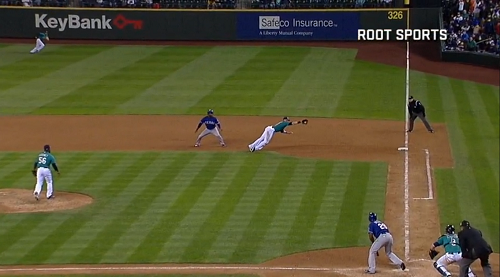
With that said, in fairness to Rodney, if last night was a lucky successful save, then last week had an unlucky blown save. So for Rodney, it’s evened out, in no time.
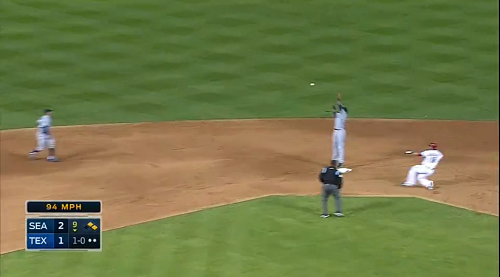
There are a few points to make here. Already, people can’t stand having Fernando Rodney closing games. He hasn’t been throwing nearly enough strikes, and given that he occupies the most high-leverage role on the team, fans are going to be less patient with him than they are with other players, since his mistakes are magnified. Fans of most teams find their closer uncomfortable. Fans of most teams think their closer has a nasty habit of making things interesting. Rodney’s no different, and while an ability to make games interesting is something the Mariners have sorely lacked for basically a decade, his ride has been especially frightening. When a pitcher in the ninth can’t find the zone, as a fan you feel completely helpless. As a fan you’re always helpless, but wild closers are slow torture. At least dinger closers are abrupt, surprising torture.
There’s something important to understand about Rodney, though. The walks have always been there, and the walks are always going to be there. But he doesn’t get hit. He lets too many batters get one base, but few have managed to get more.
Going back to 2000, 372 pitchers have thrown at least 500 innings. Rodney’s .342 slugging percentage against ranks 14th-lowest. Somewhat appropriately, he’s tied with Jose Valverde, and Chris Sale’s at .347. Felix is at .356. And since 2010, 309 pitchers have thrown at least 200 innings. Rodney’s .300 slugging percentage against ranks ninth-lowest. He’s between Koji Uehara and Greg Holland, a few points in front of Clayton Kershaw. Rodney can’t keep walking batters like this, but he manufactures his own trouble. Hitters are frequently on the defensive, and this is a credit to Rodney’s stuff. His walks don’t come with a league-average rest of the profile. His walks come with a relatively unhittable rest of the profile.
More generally, as another point, Rodney is sort of an illustration of the stereotypes of relief pitchers. Rodney is not the stereotypical relief pitcher, exactly, but he captures the volatility. We’ve all seen him, now. Some would say they’ve seen enough of him. We always had some concept of Fernando Rodney, but now that he’s our own, we’re more able to really feel the experience. Not a single one of us trusts Fernando Rodney to throw a strike when he needs to. A lot of Mariners fans already prefer the idea of promoting Danny Farquhar and demoting Rodney to setup, or something lesser.
So, consider how Rodney makes you feel. Now consider that, as recently as 2012, Rodney posted the lowest ERA in baseball history. Consider that, as recently as 2012, Rodney posted a top-20 walk rate. Two out of every three pitches were strikes. A few years ago, Rodney was a closer who didn’t even make things interesting. That made him interesting.
It has to be one of the miracles of our times. In Rodney’s career, before that, he threw 62% strikes, with 12% walks. In Rodney’s career, since that, he’s thrown 62% strikes, with 13% walks. There’s just a one-year anomaly, and it’s not even like it was a Tampa Bay-specific epiphany since the next year, still in Tampa Bay, most of the numbers returned closer to average. For absolutely no reason at all, Fernando Rodney ripped off 75 innings of being consistently amazing.
The Mariners have their own other example in Tom Wilhelmsen. Wilhelmsen, like Rodney, throws super hard with a quality second pitch, and Wilhelmsen, like Rodney, didn’t used to be thought of as a strike-thrower. Then, suddenly, the strikes arrived, then, suddenly, the strikes disappeared. Currently they occupy the same bullpen, sometimes slated to pitch back-to-back. A major difference is that, when wild, Rodney still gets his whiffs. So he can still get himself out of trouble. Wilhelmsen’s not getting strikeouts anymore, and that makes him an intriguing unknown. It’s obvious what he can be, because he’s been it. It’s also obvious you can never predict when things might click, if they click ever again.
That guy you don’t trust in the Mariners bullpen — just a few years ago, he was virtually perfect. That other guy you don’t trust in the Mariners bullpen — just a few years ago, he was also outstanding. The only sense you can make of it is that things don’t have to make sense when you’re dealing with relievers, that sometimes you just get 50-odd innings a few standard deviations above or below the mean. It’s for that reason teams have been willing to pay a premium for relievers they perceive as reliable, and it’s for that reason teams have regretted a lot of those investments. On average, relievers are as predictable as anyone else. But because of the sample sizes, they scatter all over the place around the mean, and sometimes you end up with Fernando Rodney, and sometimes you end up with Fernando Rodney. I hope you’ve been taking good care of your heart.