
Felix Hernandez: Man Who Gets It
On April 19, 2012, the Mariners played a game against the Indians I wish I didn’t remember, and that I hope I never forget. The Mariners were, I don’t know, whatever record they were, and it was too early to think they’d be any good and it was too early to think they would suck. It was, in other words, a typical Mariners April, and in this game they turned to Felix Hernandez on the mound. In classic Mariners form, Felix’s teammates didn’t provide him with much in the way of support, but they did give him a run. In classic Felix form, the King let it hold up. Over eight shutout innings, Felix whiffed a dozen batters, and pitching with one out and the bases loaded in the top of the eighth, Felix escaped by striking out consecutive Indians on eight pitches. First, he made Jason Kipnis go away. Then he made Shin-Soo Choo go away, just like Bill Bavasi did. Felix was approaching 130 pitches, so in the ninth he’d turn the ball over to the bullpen, but he left the mound in the eighth with a roar. Choo’s swing and miss wrapped up one of the most utterly dominant outings of Felix’s big-league career. It was, somehow, an outing that stood out from most of the others.
Then in the top of the ninth, that stupid son of a bitch Brandon League coughed it up. Two walks and a single loaded the bases, and another single un-loaded them, and the Mariners lost 2-1. In the bigger picture, League’s meltdown was independent of Felix’s dominance, but that night, because of League, we couldn’t feel the same about Felix. We didn’t get that last taste of sweet closure, and to this day I can’t think of the first eight innings without thinking of the ninth. On too many occasions, Felix has been let down by his offense. On too many other occasions, Felix has been let down by his bullpen. Too much of Felix’s ability has been wasted, and Felix is a guy who really likes to win. Everybody likes to win, but Felix can usually do more on his own to that end.
Now keep all of that in mind as you read this. You might’ve missed it, but yesterday, Felix was amazing! Against a lineup that isn’t good, but against a lineup that’d scored 20 runs in two games. The Mariners’ offense, meanwhile, was not amazing, but it did provide Felix with two runs to protect, which he did. The top of the eighth ended with Felix striking out Martin Maldonado, and the score then was 2-0 Mariners with Felix at 108 pitches. His last pitch had been a fastball at 94.
For Robby Thompson, there’d be options. He could stick with Felix, or he could give the ball to new closer Danny Farquhar. As all managers would, Thompson asked Felix how he felt. Ryan Divish notes the response.
[Felix] admitted to Thompson in between innings that he was done for day.
“He was pretty much at the end of his rope,” Thompson said. “He’d basically had enough. He was honest with me.”
Normally Hernandez puts up a contentious fight about coming out of games. This time he didn’t. Of course, he could have and would have pitched if they needed him to.
“I was a little tired,” Hernandez said. “They asked me if I wanted to go back in. I said I’m alright, but I’ve had enough. I was just being honest. I want to go out there, but if I’m tired, I don’t want to blow the game.”
For Felix, this would’ve been a perfectly understandable thought process:
- I’m tired
- but if I come out someone else comes in
- the score is close because this offense is the Mariners’ offense
- whoever comes in could blow it
- lots of leads have been blown and the closer has an ERA near 5
- if they blow it I don’t win and the team doesn’t win
- I should probably do this by myself
- “I’m good to go”
But this seems to have been the actual thought process:
- I’m tired
- fatigue leads to reduced effectiveness
- probably better, then, to use a fresh reliever
- another guy could provide a better chance to win than I could
- “I’m tired”
A little while ago, I wrote about a Kyle Seager bunt against the shift, and I noted how weird it is that we think of obvious baseball as smart baseball. Felix, on Sunday, made what’s probably a pretty obvious decision, and I’m praising him for being smart. But there’s smart smart and baseball smart, and baseball is a game of egos and over-confidence. Smartness is relative, and many pitchers probably would’ve preferred to stay in the game. Rarely do you observe this blend of competitiveness and honesty, and Felix should be celebrated for being different from the others. He should be celebrated for being different from how he used to be. Based on his own testosterone and memory, Felix had every reason to deny his own fatigue, but in that moment he understood what would be best for all parties involved. He understood his own level, he understood the level of the fresh bullpen, and he forgave prior letdowns. In that moment, there was no hubris, there were no grudges.
Say what you will about Erik Bedard, but at least he doesn’t try to over-push it. Bedard knows that pitching tired means under-performance and increased injury risk. Felix gets that. Felix didn’t used to get that, but Felix gets that now, and it’s maybe more important than ever with Felix occupying a leadership role in the clubhouse. Younger pitchers are going to be learning from the Felix example, and the reason things are the way they are is because that’s how it’s always been. Pitchers have forever been too stubborn, and following the Felix example, Mariners pitchers might not be afraid to be honest. Felix isn’t, despite all the times he’s been burned.
Felix has the talent. Felix has the loyalty. Felix has the emotional maturity and brains. Felix has it all. Felix Hernandez has everything, and we have Felix Hernandez.
Game 117, Brewers at Mariners
King Felix vs. Wily Peralta, 1:10pm
So this series could’ve gone better.
Today’s game pits King Felix against hard-throwing righty Wily Peralta. Peralta’s four- and two-seam fastballs average 95mph; his sinker’s the third-fastest in MLB behind Matt Harvey and Stephen Strasburg. His four-seamer’s in the top 10 as well, surrounded by flame-throwers like Jose Fernandez, Homer Bailey, Justin Verlander and Andrew Cashner. He pairs it with a sharp slider and the occasional change-up against lefties. His slider’s useful against lefties and righties alike, though he’s able to get righties to hit it on the ground, while lefties are able to elevate it a bit better. All in all, a mid-90s fastball and a good breaking ball along with a developing change up should be plenty, but Peralta’s K% looks nothing like Verlander’s/Harvey’s/Fernandez’s. His 15% mark is actually 81st out of 90 qualified starters, surrounded by Eric Stultz, Jhoulys Chacin, Bronson Arroyo and Mark Buehrle.
Great velocity, solid movement, and well below average contact rates. Part of the problem is that his command isn’t quite there yet. His walk rate’s a tad high, generated in part by the fact that he throws fewer pitches in the zone than average. Thus, he’s pitching from behind more than average, and 95mph can’t overcome that kind of disadvantage. In addition to some issues with command, he’s struggled a bit against lefties, as they’re more apt to drive his slider as opposed to rolling it over. Now, none of this makes him an awful pitcher. He’s just a work in progress. 95mph with great ground ball rates is a great place to start, and if his command improves, he could be excellent.
1: Miller, 2B
2: Chavez, RF
3: Seager, 3B
4: Morales, DH
5: Ibanez, LF
6: Smoak, 1B
7: Ackley, CF
8: Ryan, SS
9: Blanco, C
SP: El Cartelua
Stephen Pryor had surgery to repair his torn lat, which is a new one for me. It’s not a ligament/tendon issue, it just sounds like a torn muscle is re-joined surgically. Jake Peavy is among the very few players to have had this procedure.
Blake Beavan, Charles Kaalekahi and Anthony Vasquez start today in the M’s minors.
Game 116, Brewers at Mariners
Hisashi Iwakuma vs. Tom Gorzelanny, 6:10pm
Happy Griffey Day. The M’s are honoring Ken Griffey Jr. today by inducting him into the team’s Hall of Fame, which is an idea Griffey made possible, or at least not completely laughable. For those that remember 1989* – the double, the HR in his first Kingdome AB, the chocalate bars (I’ve still got one), the impossible ease with which he did everything (hitting, fielding, talking to strange old men in the press, smiling) is still imprinted on your mind. There are a number of reasons his exit(s) weren’t ripped from fairy-tale style children’s sports books, but an underrated one is that many people never really came to grips with the fact that he’s human. Our first impression was this impossible combination of homespun gee-whizishness overlaid on some futuristic cyborg skeleton. How can that – I mean he- feel depressed? Why does he want to talk about money? Junior deserves this. Some times, the rhetoric about the team not being in Seattle if it weren’t for him can get a bit overblown, but I seriously doubt they’d be holding this ceremony in Safeco Field without Junior.
I’m going to go from talking about Ken Griffey Jr. to talking about Tom Gorzelanny, which sounds bizarre and wrong, and which is also not Gorzelanny’s fault. No one grew up mimicking Tom Gorzelanny’s wind-up. The ex-Pirate and National is making his seventh start, as he doubles as a swing man and a very effective lefty reliever. The sinker/slider combo’s the centerpiece of his repertoire, but he’s also got a change that he throws to righties. He struggled against righties in the rotation, but he’s been effective in the bullpen. His put-away pitch is the slider, which he throws to righties and lefties alike, at least when ahead in the count. Like a lot of pitchers, he’ll use a four-seamer to same-handed hitters, but stick to the sinker against opposite-handed hitters; this isn’t unique, but it seems counterproductive, given the platoon splits of two-seam/sinking fastballs. Hey, he’s the pitcher, and I’m just the guy hanging on to a 25 year old candy bar with a picture of a teenager on it.
Beyond trouble with righties, Gorzelanny struggled with his command as a starter. It wasn’t awful, but he threw a fair number of balls, and so-so stuff and slightly below average control meant that he was pitching from behind more than average. If fly balls stayed in the yard, or if he got out of trouble with a groundball, he’d look OK. If the fly balls crept over the fence, and if batters stopped swinging at low 3-1 sinkers, his walk rate would spike and, well, that’s why he’s a reliever now. And this year, for the first time in his career, he’s pitching from ahead in the count, enabling him to use his best pitch more. A lefty starter who throws sliders like they’re going to be banned in a month sounds like a terrible match up, but it’s only his seventh start, and his last start lasted all of one inning before he came out with elbow issues. Work counts, Mariners. Or honor Griffey by peppering the cafe in right field; that’d work too.
1: Miller, SS
2: Franklin, 2B
3: Seager, 3B
4: Morales, DH
5: Morse, RF
6: Saunders, CF
7: Smoak, 1B
8: Ackley, :sigh:
9: Quintero, C
SP: Iwakuma
Griffey’s induction starts at 5:30pm, and the M’s are streaming it live on their website.
Whenever I think of Griffey, I think of the story from Spring Training in 2009 and of how awed Greg Halman was to be shagging flies with his childhood idol. Wish you could see this ceremony, Greg.
Taijuan Walker leads the M’s affiliates into battle today, as he starts for Tacoma against Albuquerque. Lefty Roenis Elias takes the hill for Jackson in Game 1 of a doubleheader, while Forrest Snow starts game 2. Fresh off of hanging 30 on Lancaster, High Desert gives the ball to Matt Anderson for today’s game in Adelanto.
* What a year. Junior debuts, then a few months in, the franchise trades its most famous player for a 7′ freak from Walnut Creek. Two of the most iconic, unearthly players of their generation, crossing paths for the first time in Milwaukee, one with an easy smile for everyone, the other mis-labeled a sullen, introverted jerk. It all still looked like losing, but *man* it felt different. Then, of course, the earthquake during the World Series in Oakland and about two weeks later, the fall of the Berlin Wall. That was some kind of year.
Just For The Sake Of Reference
These days, both Alex Rodriguez and Ken Griffey Jr. are in the news, like the legendary athletic icons they are. Rodriguez is in the news due to further evidence that he’s missing…something, something critical, something the rest of us have that makes us all human. Alex Rodriguez, basically, is Bart after selling Milhouse his soul, except A-Rod lost his soul a few decades ago, and these days he’s more like a human-ish entity occupying the uncanny valley, leaving the rest of us unsettled. Griffey’s in the news for more positive reasons — he’s being formally inducted into the Mariners’ Hall of Fame, which sounds like a comical institution but which is not, at least not anymore, not now that it’s going to have Ken Griffey Jr. in it. Griffey grants any institution immediate legitimacy.
It’s an interesting contrast — Griffey, in some small way, is cementing his baseball immortality, while Rodriguez fights against professional excommunication. The Mariners want to make sure no one ever forgets about Ken Griffey Jr. If Bud Selig had his druthers, he’d make sure no one ever remembers Alex Rodriguez. Griffey promoted the game while Rodriguez tried to hurt it, and while Griffey had his own dark side, his issues were more that he was kind of an asshole sometimes. On occasion, Griffey could be standoffish. On occasion, Alex Rodriguez has told the truth, maybe. The darkness beneath Rodriguez flows deeper, flows faster, and while I used to think Rodriguez didn’t get enough credit for his Mariner accomplishments, it’s become easier and easier to understand why people don’t go out of their way to remember the good times. There was always something off about A-Rod, and now we’re finding out that something is A-Rod himself, the whole of who or what he is.
That’s all the commentary part, and people are perfectly justified to cheer Griffey on while booing Rodriguez away. There’s a reason Griffey and Rodriguez drew such disparate responses upon their initial returns to Seattle. Beyond the commentary, though, I’m just here to quickly highlight one thing. I don’t know why I was looking this up, but I looked it up anyway and now I’m going to share it. We can’t erase what Griffey and Rodriguez did on the field, nor should we want to. Regardless of how we feel about the players, the players generated their statistics, and for a time they did so in Mariners uniforms. Maybe there was some chemical influence, but there was chemical influence everywhere back then, so it’s probably safest to just assume everything more or less balanced out. Look at the Mariners in 1996.
That team finished second in its division, and Randy Johnson missed a lot of time with injuries. Those Mariners were famously loaded with talent, and they played 161 games. Had they played 162, they might’ve reached a total of 1,000 runs scored. Edgar was the DH, with a four-digit OPS. Jay Buhner was the right fielder, with a .926 OPS. But the standouts, of course, were Rodriguez at short and Griffey in center, the two combining to miss a few dozen games but the two also combining for an unthinkable level of performance.
According to Baseball-Reference, here are all the teams in baseball history to have two position players reach or exceed 9 WAR:
- 1996 Mariners
- 1930 Yankees
- 1928 Yankees
- 1927 Yankees
- 1906 Naps
The players:
- Griffey/Rodriguez
- Gehrig/Ruth
- Gehrig/Ruth
- Gehrig/Ruth
- Lajoie/Turner
Griffey was amazing in every single facet. Rodriguez, too, was amazing in every single facet, actually out-hitting Griffey while playing the toughest infield position. Griffey, that year, turned 27 years old. Rodriguez turned 21.
Juan Gonzalez won the 1996 American League MVP while posting a WAR under 4. That’s laughable, but that’s also not the point. Here’s the point I really wanted to get to: remember last year’s MVP debate about Mike Trout versus Miguel Cabrera? Remember how Trout had the WAR, and Cabrera had the Triple Crown and the playoff berth? Last year, Trout and Cabrera played for different teams. The 1996 Mariners basically had Trout and Cabrera. Everyone knows those Mariners were stacked, but I think it’s helpful to bring up more current examples to help shed light on what they really had. Last year, Trout was amazing. Last year, Cabrera was amazing. The Mariners essentially had both. They also managed to miss the playoffs.
It’s been a long time since Griffey’s peak. After the Mariners traded him, he had only one more season with a WAR over 3. It’s been less time since Rodriguez’s peak, but no one thinks about that A-Rod anymore, and certainly few people still think about his days with the Mariners. It’s incredible, however, how blessed those Mariners were. These days, it’s clear that one of those superstars isn’t quite human. Back in the 90s, neither of them were.
Game 115, Zombie-Mariners at Mariners
Joe Saunders vs. Kyle Lohse, 7:10pm
Ah, the Brewers. For a team that’s been in the National League since 1998, and (thanks to the M’s incompetence) never really figured in playoff races during the time both teams played in the AL West, the Brewers are easy to mock. It all starts with the Pilots, of course, and Bud Selig’s acquisition of the bankrupt Seattle team, which he quickly moved to Milwaukee.* Then, the late 80s and early 90s saw a series of violent (for baseball) brawls between these two teams, including a day game that is forever imprinted on my memory. On May 28th, 1989, the Mariners were in Milwaukee, and they took a 4-0 lead into the bottom of the 3rd behind Bill Swift. The Brewers got a run back behind an error and two singles, and had the bases loaded with no one out. Swift got Gary Sheffield to pop out, then induced a comebacker from Rob Deer. Swift threw home to get Billy Speiers, and Dave Valle had enough time to pivot and get Deer at 1st. After the throw, however, Speiers took out Valle’s legs, injuring the catcher’s knee. Valle couldn’t walk on it, so the M’s trainers worked on Valle as he lie in the dirt of the batter’s box. After 10 minutes or so, Milwaukee pitcher Chris Bosio decided he was tired of waiting and, with his catcher crouching about three feat from Valle, started his warm up tosses. Valle was displeased, miffed even.
The resulting brawl was significant, though it may have been upstaged by the brawl the two clubs had a bit over a year later. Still, the image I’ll never forget as the crowd panned over the chaotic scene was an extremely tall man with an unidentified Brewer clasped in a headlock. Welcome to the Mariners, Randy Johnson. RJ had been acquired in the big Mark Langston deal three days earlier, on the 25th, and wouldn’t make his first appearance for the M’s, er, in a playing capacity, until the 30th. In the days before cable contracts, only a few games were on TV. In my mind, this was RJ’s introduction to Seattle – a tall, gangly man running in from the bullpen to put a chokehold on Terry Francona. It’s possible that the M’s had another game televised between on the 26th and 27th; I have no idea. I just knew I was having some trouble believing that Langston was gone, and the M’s acquired three guys I’d never heard of. For whatever reason, that scene helped me get over not only the trade but Langston’s less-than-pretty exit. Both Langston and the M’s seemed annoyed they couldn’t agree on a deal to stay, so Langston made some disparaging comments about the team on his way out. The M’s were weighing on offer from the Mets that would’ve brought in Sid Fernandez and Rick Aguilera, and I think many in Seattle saw the Expos’ prospect haul as a much worse return. I don’t think Johnson brawling for Valle’s honor and knee tendons changed that equation, but I decided to stop worrying and learn to love the freak in the #51 shirt.
Ok, enough of that. These are the present day Brewers, the team that fancied itself a contender in the NL Central this spring, and whose dreadful 2013 includes compiling the 2nd worst record in the NL behind the not-really-trying Marlins, the suspension of Ryan Braun (just a reminder, his big contract extension kicks in for the *2016* season), and injuries to Aramis Ramirez and Corey Hart.** Like the M’s, the Brewers aren’t, in 2013, a high payroll club. But look where their money’s going. The highest paid Brewer in 2013 is today’s starter, Kyle Lohse. the 2nd through 6th spots go to Rickie Weeks (victim of an Ackley-like collapse; -0.2 fWAR), Hart (out for the year with a knee injury, free agent in 2014), Aramis Ramirez (injured, power mysteriously missing, 0.4 fWAR), Braun (suspended, had 9 HRs on the year), Yovani Gallardo (frustrating, bad RA, Brewers apparently tried to move him at the deadline), and John Axford (team’s star closer in 2011, then collapsed in 2012 and hasn’t yet recovered; -0.4 fWAR). There’s a lot of luck in there, and there’s the big suspension caveat of course, but the Brewers’ highest paid guys are giving them less than stellar production. It’s reminiscent of the M’s teams of the Bavasi years, with Carlos Silva, Miguel Batista and, to be fair, Ichiro, earning the big bucks while King Felix was paid like a journeyman 4th OF.
Lohse has actually been pretty good this year, with a so-so fWAR offset by a solid ERA. He’s still the same guy he was most of the time in St. Louis: a sinker/slider/change/curve guy with absolutely no eye-popping stuff who just seems to generate outs. Many people assumed that pitching to Yadier Molina (he of the pitch framing Molina brothers, and incredible defense overall) and working with Dave Duncan combined to make his fWAR and W/L records much better than his true talent, and thus bidding for Lohse’s services this year was surprisingly muted. The Brewers walked away with him for a three-year, $33m contract. Lohse still relies on a located 89mph sinker, a change and curve to lefties and a slider to righties. He’s not afraid to the throw his slider to lefties as well, however; he throws it about as much as his change-up to them. While this strategy was pretty successful in St Louis, it hasn’t worked as well this year. His change has been effective, however, and thus his splits are essentially even overall. As a result, this isn’t a great match-up overall for the M’s, but it’s still good to face a righty. It’s also nice that the Brewers have been one of the worst teams in the league against lefties overall, thanks to the worst HR/9 against them.
1: Miller, SS
2: Franklin, 2B
3: Seager, 3B
4: Morales, DH
5: Morse, RF
6: Ibanez, LF
7: Smoak, 1B
8: Saunders, CF
9: Quintero, C
SP: J. Saunders
The big name prospect starting in the M’s minors today is Edwin Diaz for Pulaski. Jordan Shipers has had a miserable, injury-riddled season for High Desert, but he’s talented and could help his stock with a good final month. He’s starting for High Desert. Hector Noesi has had a miserable season for multiple teams, but he too is talented, and…honestly, I’m not sure what to make of his stock at this point, but he’s starting for Tacoma in wild, wondrous Albuquerque. Lefty Anthony Fernandez gets the ball for AA Jackson.
The Rangers completed their slow-motion acquisition of ex-White Sox OF Alex Rios today, supposedly for IF Leury Garcia.
* Wikipedia tells me Selig had tried to keep the Braves in Milwaukee, and then worked tirelessly to “prove” Milwaukee could support a team, including hosting White Sox games at County Stadium in the 60s. This whole “so hurt by his hometown franchise moving, he devoted himself to moving someone else’s franchise” dynamic has at least some similarities with the Sonics saga of the past five years, a comparison that sounds much more damning than I mean it to.
** Somewhere on the East side, Dave Valle has a spring in his step as a feeling of contentment washes over him. He flashes that wide smile as he realizes his knee hasn’t felt so good in years.
Just Some Carter Capps Stuff, Whatever, Forget About It
WHAT
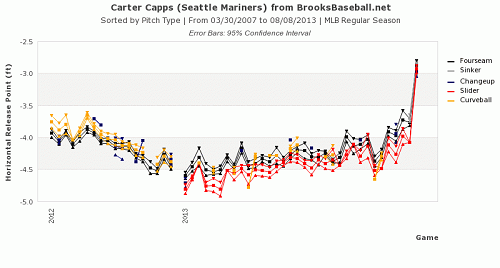
Courtesy of Brooks Baseball, here’s a graph of Carter Capps’ horizontal release points over time. Negative numbers on the y axis refer to distance from the middle of the rubber toward third base, in feet. The graph is complicated, but it’s not, really.
Updated Thoughts on Justin Smoak
It’s an off day, so let’s talk about Justin Smoak again. Last summer, I gave up on Justin Smoak as a core building block for the future, noting that his performance put him in the company of a bunch of guys who represented a pretty mediocre upside. Then Smoak came back from Tacoma and had a monster September, earning him One Last Chance (TM), but his slow April start resulted in yet another post pointing out his lack of power for a first baseman, and why it was going to be hard for him to produce without that skill. Even a month ago, when Jeff wrote about Smoak’s latest hot streak, I remained skeptical.
But he hasn’t really cooled off since that post, and now, Justin Smoak’s productive sample size is more than a hot month here and a hot month there. You’ve always been able to selectively pick dates based on his hot streaks that made him look decent, but it was never intellectually honest. It was always based on creating constraints specifically designed to exclude his bad performances while including all of his good ones. You can make anyone look good by doing that, and it’s a lousy way to project future performance.
At this point, though, we can look back at non-arbitrary cutoffs, like “past 365 days”, that do not require us to bias things in Smoak’s favor. And over those last 365 days, Smoak has 503 plate appearances and a 132 wRC+, putting himself just ahead of Prince Fielder. During that stretch, his .172 ISO is a match for Adrian Gonzalez. His 12.7% BB% puts him right there with Paul Goldschmidt, the Diamondbacks 2013 MVP candidate. His strikeout rate is basically league average. This is what Justin Smoak was supposed to be. He’s only hit 17 home runs, but everything else has been good enough that the overall production level has made him an above average player.
If Smoak’s last 365 day line was Smoak’s projection, then the Mariners should have no problem penciling him in as their first baseman for the next several years, at least while he’s under team control through arbitration. It’s not star performance, but good teams have useful average players instead of gaping holes, and it’s especially helpful when those average players make hardly any money.
So, yeah, thumbs up for the current version of Justin Smoak. He finally looks like what we thought he’d turn into, and is justifying the Mariners continued faith in his abilities. Their patience has paid off, and now Smoak looks like he might have played himself back into the discussion of the team’s young core, especially since there aren’t any other first baseman in the organization pushing for playing time.
That said, I’m still a bit of a Smoak pessimist going forward. It is always tempting to look at a player’s recent performance and judge him only on that and not everything that came before it, but it is almost never better to make a projection of future performance by throwing out older data. You should not weigh it as heavily as recent performance, but it’s still useful data, and forecasts based on a larger sample almost always trounce forecasts based on recent performance only. There are exceptions to the rule — Danny Farquhar is probably a good one right now, given that he’s throwing 96 over-the-top rather than 91 side-arm — but those exceptions are best identified by some kind of drastic physical change rather than just a performance fluctuation.
Smoak’s made some changes to his swing, but these are tweaks, not a total overhaul. He’s still basically the same guy who had 1,250 lousy plate appearances before his monster September last year. We now have 1,250 PAs of bad performance and 500 PAs of good performance. The fact that those 500 PAs are the most recent matters, as does the fact that Smoak is 26 and headed into what should be his peak years. But we can’t just ignore the older data now that we have more recent data that we like more.
If we look at the projections for Smoak’s future performance based on the entirety of his data — with recent data weighted more heavily — we see that ZIPS is projecting Smoak to post a 106 wRC+ for the rest of the year, while Steamer comes in at 104. In both cases, ZIPS and Steamer look at Smoak’s walk rates, strikeout rates, and isolated slugging and think that his current performance is almost exactly what he’s going to keep doing going forward. These core skills are not expected to regress much if at all.
Instead, the entirety of the drop in performance comes from a big projected drop in Smoak’s BABIP. His 2013 BABIP is .335, while ZIPS is projecting .291 and Steamer is at .273. I think Steamer’s probably too low, and would side more towards ZIPS projection, but even with a .291 BABIP, a lot of Smoak’s offensive value goes away. Over the past year, here are the first baseman that posted a wRC+ close to the 106 that ZIPS is projecting: Adam Dunn (109), James Loney (108), Chris Carter (107), Mark Reynolds (107), Eric Hosmer (105), Adam LaRoche (105), Ryan Howard (102). That isn’t exactly great company, and of that group, Loney is the only one who has been an above average player, as his defense is legitimately excellent.
ZIPS and Steamer aren’t infallible. That they both are somewhat pessimistic about Smoak’s rest-of-season production doesn’t mean that he can’t keep proving them wrong. Players improve at different rates, and Smoak may very well be an outlier who took a big leap forward, where it will take the projections a while to catch up. But I’d be more sold on this idea if there was a clear and obvious core skill where Smoak had shown a drastic change.
On one hand, you can argue that he’s just hitting the ball harder, except his HR/FB ratio is 12%, exactly in line with his career numbers, and his .165 ISO is just barely above his career .156 mark. His contact rate is 79.5%, almost exactly what it was last year, and his contact rate on pitches in the strike zone — generally the ones that get whacked the hardest — is right in line with his career averages. He’s swinging at the same rate he always has, and at the same proportion of pitches in and out of the strike zone.
The results are better, but it’s not immediately obvious as to why. The “he’s hitting the ball harder” argument is a bit circular, as the evidence for the harder hit balls is that his BABIP is higher, which is the thing we’re trying to explain to begin with. You can go round and round in that circle all day without actually proving anything. His line drive rate is up, but line drive rate is highly variable from year to year, and it might just be that his balls are being labeled as line drives because they’re going for hits rather than outs. It’s not clear where the causation lies, basically.
So right now, Justin Smoak is better, but he’s better almost entirely due to the one variable that fluctuates the most. And that’s a little scary. It’s the same reason James Loney is having a career year in Tampa Bay, and I’d imagine we’re probably all a little skeptical of Loney as a high quality first baseman going forward. The Rays got Loney for $2 million as a free agent, by the way. Underpowered first baseman who are average or slightly above average when their BABIP spikes aren’t all that highly valued in the market.
I’m glad to see Smoak hitting, and I hope he keeps hitting. He’s hit well enough for long enough that he’s earned a job in 2014, barring some kind of huge late season collapse anyway. But I still think the Mariners should be looking for an alternate first baseman of the future. Smoak has moved himself out of the high priority replacement list, and the Mariners should keep riding his success as long as it lasts, but at the same time, they should at least prepare for the fact that this might not last much longer.
Justin Smoak has earned himself a longer leash. He’s played himself back into the team’s plans, and should be penciled in as the starting first baseman on the 2014 team. But we should not yet be convinced that he’s going to keep this up. It’s great that he’s done it for 500 plate appearances, but bad players have 500 PA stretches of good performance. I’m not saying Smoak is definitely still a bad player, but we don’t yet know that he’s a good one.
Be encouraged. The fact that he’s hitting is good news. But be cautiously encouraged, and don’t be too shocked if this doesn’t last. Smoak would hardly be the first player to ride a BABIP wave to an unsustainable performance, only to have it end out of nowhere. If you need an example, Michael Morse is right over there.
Game 114, Blue Jays at Mariners
Aaron Harang vs. JA Happ, 12:40pm
JA Happ was activated off of the 60 day DL to make this start; you may remember the scary incident in Toronto when he was struck in the face by a Desmond Jennings line drive in May. That injury fractured his skull, and then to add injury to injury, he sprained his knee falling to the ground. The lefty made a few rehab starts for AAA Buffalo, and while he wasn’t terribly effective, he showed his stamina was mostly back (he threw 95 pitches in his last start).
Happ has one of the most distinctive fastballs in the big leagues. In 2011, he had the most vertical movement of anyone who pitched at least 100 innings. In 2012, he was #2, just a bit behind Clayton Kershaw. Unlike Kershaw or Josh Collmenter (#2 in 2011), Happ gets a more-or-less-normal amount of horizontal movement. This differentiates him a bit from the pure over-the-top guys, though to be fair, it doesn’t make the pitch particularly good either. He generates a few more whiffs than a 90-91mph fastball should, but the vertical movement means he gives up quite a few fly balls, and thus some home runs.
While a ton of vertical movement can occasionally negate platoon splits, Happ’s splits are pretty traditional. While his fastball’s generated exactly the same whiff percentage (8.92%) to both lefties and righties, righties get a few more HRs, and that’s enough to push his career FIP vs. righties a full run higher than his career FIP to lefties. So far this year (remember, that’s a tiny sample for him), he’s thrown quite a bit more sinkers (which have more v-mov than most anyone’s four-seamers, but do sink a bit compared to Happ’s four-seam), and a cutter to lefties and a change-up to righties. He’s also got a curve ball that he uses infrequently, in part because he struggles to keep it in the zone. The change-up/cutter actually generate some grounders, but he’s given up HRs and extra-base hits on them as well. In short, Happ’s a pretty good example for why DIPS and peripheral analysis exists. By FIP, he’s pretty much the same guy, year after year. FIP in the mid-4’s, decent number of Ks, few too many walks, average-ish HRs. BABIP swings (and the occasional HR spike) can make him look like a great #3 or a hanging-on-to-#5 starter by ERA.
To be fair, Aaron Harang’s another good example of this, as his BABIP and especially his HR/FB cause large swings in his ERA, while his FIP moves in a much narrower band.* But because HRs are such a driver of FIP, Harang’s career can really be broken into two halves – the first half (through 2007), when his FIP was always under 4, and the second half (2008-13) when his FIP’s generally been in the mid 4’s due to a persistent HR problem. Harang has probably pitched better than it seems like, and he may be a decent buy-very-very-low candidate for someone, but I’m pretty much done. The M’s looked to be swimming in pitching depth in March and then for a brief, shining moment in early July, but Paxton’s recent struggles and Hultzen’s second injury have eliminated much of it. The M’s will be looking for another Harang this off-season, whether it’s the actual Harang or someone else we’ll slowly grow to hate watching more than is strictly deserved.
1: Miller, SS
2: Franklin, 2B
3: Seager, 3B
4: Morales, DH
5: Morse, RF
6: Saunders, CF
7: Smoak, 1B
8: Ackley, LF
9: Quintero, C
SP: Harang
Victor Sanchez starts for Clinton today, with Trevor Miller getting the ball for Jackson.
* Yes, yes, that’s sort of the point of FIP. Not looking at BABIP/sequencing by definition produces a narrower range, and this helps reduce FIP’s error in predicting next year’s ERA. But still, some players see a lot more variance in their ERA than others – generally those hurlers who don’t rack up a ton of strikeouts and thus have more balls in play.
Pinpointing The Moment At Which It All Went Wrong For Raul Ibanez
Featuring screenshots, remarks, and things Tom Emanski might have said, if Emanski liked to speak in advisory rhymes. To be honest I never watched those videos beyond the minute-long TV commercial.
Remark
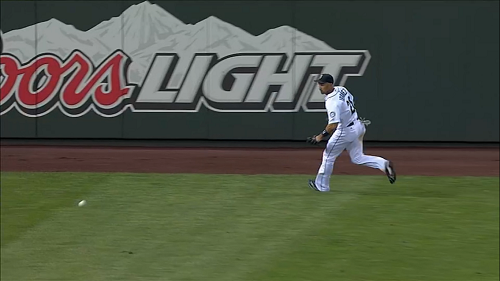
Raul properly approaches the ball, taking a good angle to make sure it wouldn’t get to the wall. At the moment of contact, there was a runner on first, and Ibanez would’ve wanted to prevent him from scoring. Failing that, maybe Ibanez could keep the hitter to a single.
Emanski
Run the right line, you’re doing just fine.
Remark
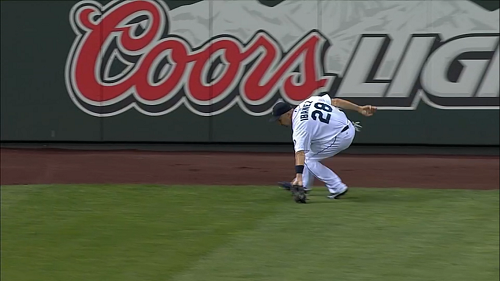
Raul backhands the ball, successfully cutting it off. He’s low to the ground and in good position to get his feet set and throw.
Emanski
Cut the ball off and the watchers won’t scoff.
Remark
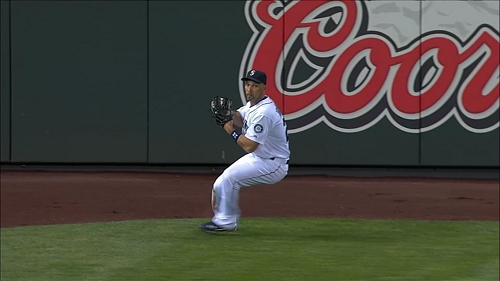
Right away, Raul gets himself into good throwing position. He’s stopped his forward momentum, and he’s turned to face the infield, with his feet locked and his free hand retrieving the baseball.
Emanski
With smooth stopping and turning, your knees won’t be burning.
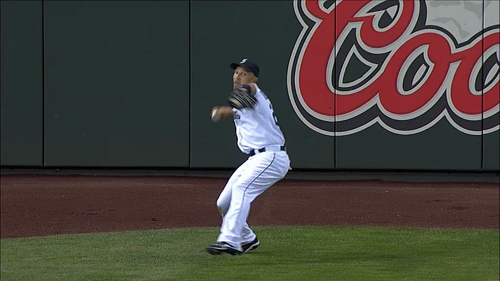
Remark
Raul looks like a pitcher, with his glove arm extended, his front foot in the air, and his back leg bent. He’s channeling momentum in a line toward an infielder, and he has his eyes on the target.
Emanski
To make a good throw, you need to have mo’.
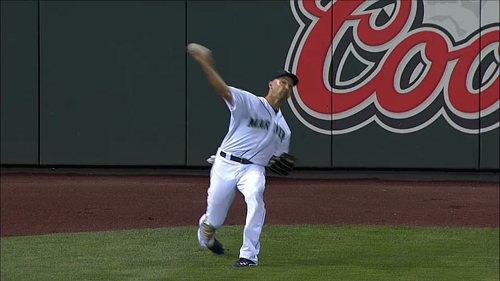
Remark
Raul prepares to release, with his glove over his front knee and his back foot shifting forward. His eyes are still locked, and though his left foot is closed, pointing inward, we’ve seen pitchers like Ian Snell get by despite this. Still, it’s a troubling indicator in an otherwise picture-perfect screengrab.
Emanski
With feet closed at release, success will decrease.
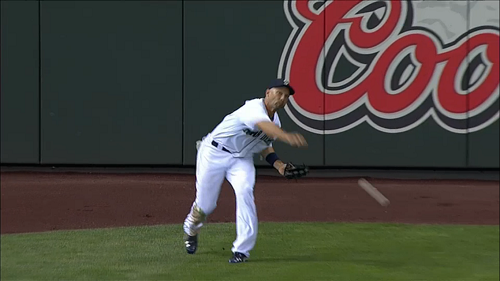
Remark
Raul forgets to let go of the baseball at the right moment during his throwing motion, instead spiking it into the ground nearby. This is pretty much nothing short of a humiliating catastrophe, and it’s not the first time Raul has done this, and everybody is watching, and these are the moments in which you’re thankful Raul still gets to play the outfield despite all the evidence suggesting declaring such strategy is a mistake. Raul basically had it all down except for the last bit where you let the baseball go, i.e. throw it. This played out as if there were a throwing-motion sequel to QWOP.
Emanski
If you forget to let go, your throw’s gonna blow.
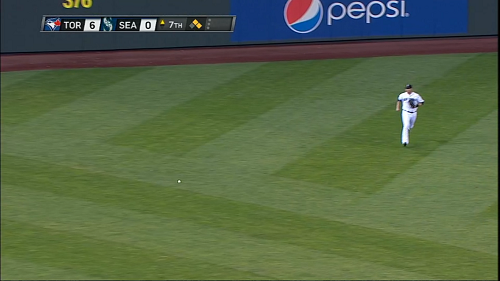
Remark
A different outfielder jogs to retrieve Raul’s throw attempt, which crash-landed shortly after takeoff. In this sequence, Raul treated the center fielder like a cut-off man, and then he missed him.
Emanski
A thrower to center’s a problem inventor.
Remark
Raul temporarily takes no pride in his defense.
Emanski
When your throw isn’t aces, be sure to make faces.
Game 113, Mariners at Blue Jays
King Felix vs. Josh Johnson, 7:10
This was supposed to be one of the most anticipated pitching match-ups of the year. Yes, the Jays had last year’s NL Cy Young winner, but Josh Johnson was perhaps the most talented new Blue Jay. He’s been beset by injuries, but he also put up a 6 WAR season in 2010, a year after a 5.5 WAR campaign. His fastball was down 1-2 MPH since returning from injury, but he’s still got plus velocity, as well as a curve, a change and a slider he throws to righties and lefties.
His big fastball didn’t have the natural sink of Yoervis Medina’s, but Johnson located it fairly well and in doing so maintained very low HR rates over the course of several seasons. His career high in any year was 14, a figure he hit three times throwing between ~160-210 innings. You can imagine Jays fans surprise then that Johnson’s yielded 15 already in just 76 innings pitched. Something’s gone terribly wrong with Johnson, and it’s not clear exactly what. Optimists will point out that his xFIP is actually better than it was in 2012, when he amassed 3.5 WAR. It’s essentially right at his career average. Sure, he’s not the dominant, untouchable force he was in 2010, but he’s a contributor whose been wrecked by terrible luck, much of it related to his inability to stay healthy. Pessimists will say that when a pitcher who’s famous for limiting home runs suddenly starts giving up lots of home runs, writing it off as “luck” and betting on regression may not work. As we’ve all discussed today, some times pitchers really do need to change something.
Johnson’s fastball movement and release point aren’t quite what they were before his 2011 shoulder injury, but it doesn’t look noticeably different than it did in 2012. He’s given up most of his HRs at home, like RA Dickey, but his overall results have been worse on the road, thanks in part to a comical BABIP and strand rate; HRs account for only a portion of his misfortune. He’s been destroyed by righties, which is so incongruous that it seems to benefit the “optimists” who’d point to luck and injury to explain why a Cy Young contender’s sporting an RA of 7.58. The BABIP stuff looks bizarre, and it’s definitely possible it’s inflated by a few games when he tried to pitch through injuries (he missed several weeks in May/June with a triceps injury). I just wonder why the Blue Jays have given up so many HRs, with guys like Dickey and Johnson seeing HR/FB increase and giving up more fly balls in general to boot. Is it related to Rogers Centre itself? Is it particularly homer-friendly with the roof closed (Safeco’s noticeably friendlier closed? Is it just a few pitchers having bad years? Whatever it is, this match-up reminds me of how rare and incredible it is for a pitcher to combine talent with durability. If you compared Felix to Johnson strictly on tools, I think Johnson might *might* come out ahead. Unless, of course, you view health as a tool.
1: Miller, SS
2: Franklin, 2B
3: Seager, 3B
4: Morales, DH
5: Ibanez, LF
6: Morse, RF
7: Smoak, 1B
8: Saunders, CF
9: Blanco, C
SP: King Felix
The big story in the minors was Wilhelmsen’s start, but James Paxton followed and pitched poorly as well. Not a great day in Tacoma, as the Rainiers lost 10-3. Charles Kaalekahi starts for Clinton while Anthony Vasquez pitches for Jackson.
Shannon Drayee recently tweeted that, according to Carl Willis, Wilhelmsen is NOT transitioning to the rotation, but is just getting slightly longer appearances (like today’s 2IP start) to work on his other pitches and his mechanics.