
Game 96, Mariners at Astros
Joe Saunders vs. Bud Norris, 5:10pm
The Mariners begin the 2nd half (sic) of the season tonight in Houston against the woeful Astros. There’ve been a few points in the season at which fan opinion swung from typical cynicism to palpable optimism. The M’s had a hot spell to get up to about .500 in May and many fans, desperate for something to cheer about, bought in. As you know, the M’s promptly tanked and haven’t been terribly close to .500 since. This time’s slightly different, though, in that the personnel have changed and because the M’s are actually hitting. As Jeff’s mentioned, it feels different tuning in to watch the team these days, and if they’re all but eliminated, that just takes some pressure off of Miller, Zunino and Franklin. That’s great. But how different is this, really? Weren’t we here in 2011, when Dustin Ackley came up and looked like a perennial all-star at his new position? Kyle Seager shot through the minors and made his MLB debut. Justin Smoak, who’d looked lost for a few months, had come back from AAA Tacoma and looked like a different player. Their 2nd half record was marred by a bad September, but they looked almost good in August, and at least the team was getting production from guys who’d be around in a few years.
In 2012, the team fell out of the race early, but they’d made some changes and looked like a completely different team in the second half. Hisashi Iwakuma moved to the starting rotation and was brilliant in that role. Kyle Seager became a very good player at age 24. Michael Saunders…MICHAEL SAUNDERS…finally looked like he could play at the big league level. It was easy to spot some glaring problems that they wouldn’t have to deal with going forward: Miguel Olivo wouldn’t tempt Eric Wedge with his veteranness. John Jaso could get more playing time, and Chone Figgins would finally just go away. Jesus Montero held his own, and if he wasn’t much of a catcher, some improvement at DH would come in handy in the years to come. Justin Smoak, who’d looked lost for a few months, had come back from AAA Tacoma and looked like a different player. Their 2nd half record was legitimately good, and the team was getting production from guys who’d be around in a few years.
I point this out NOT to engage in needless cynicism. I blog about this team almost daily. Cynicism is essentially hard-wired, but indulging in it – wallowing in it- isn’t helpful to anyone and it’s often harmful to any attempt at analysis. The point is that optimism in the second half isn’t new, though – it’s what we do. The M’s haven’t been good enough to seriously challenge the top teams in the division, and at some point mid-year, the team realizes this and at least makes the team interesting and/or fun to watch. For the moment, I’m not terribly upset about this pattern. We never thought the M’s would contend this year anyway. What we’ve seen is that the first “franchise core” the M’s tried to build around failed them, and that cost them big time in the first half. But they’ve got another shot now with a completely different franchise core, and at least this time, the players they’re trying to build around play premium defensive positions (and actually play them, not what Jesus Montero was doing with the catcher’s gear on). So while these optimistic feelings are nothing terribly new, and while the signs of life we’ve spotted in years past haven’t been enough to get this franchise out of critical condition, they’re welcome and encouraging all the same.
I mentioned it when Bud Norris faced the M’s in June, but the Astros righty’s been a very different pitcher than he has been in the past. He’s always had an above-average K%, but he gave up too many home runs. This year, his K% is down substantially, but he’s given up far fewer HRs. Norris is primarily a fastball/slider pitcher; against righties, he’s basically at a 50:50 split. He throws a change and a sinker as well, both of them primarily to left-handed batters. While he has the pitches to succeed against lefties, his sinker and change haven’t worked at all against them, and both his four-seam fastball and slider haven’t been good enough against them that he could ditch the sinker/change entirely. Against righties, his fastballs have been excellent (even the sinker, which he hardly ever throws to them), and his slider’s functioned as a real wipeout pitch. He’s a flyballing pitcher (thanks to his rising four-seamer) in Houston, so he’s given up too many HRs to righties, but he’d been effective overall against them.
This year, lefties are still troubling him, with a .376 wOBA and a slugging percentage near .500, but he’s kept the ball in the ballpark against righties. There been no observable change, at least to a guy looking at BrooksBaseball and the two games he’s thrown against Seattle this year. He still throws righties a four-seamer and a slider, it’s just that no righties have homered on Norris’ fastball this year. None. It’s the same speed it was in 2011, he throws it in the same location (down and away from righties). To be fair to Norris, righties are hitting the ball on the ground more than they have in the past, but you’d never guess that from looking at the pitch’s movement. If the Astros coaching staff (or Mike Fast; to any saber-inclined observer, anything good the Astros do seems like it could be the product of some Mike Fast discovery) has made a tweak to Norris’ fastball, it’s a subtle one. If this is great luck, well, congratulations Bud Norris. Now knock him around the park, M’s.
The M’s don’t really need luck – they’ve got left-handers. Today’s line-up includes the best stories from the first half, like Brad Miller and Raul Ibanez – guys who can tee off on Norris’ sub-par sinker/change. The M’s have faced Norris twice – the first time, Norris was so-so, but kept the team in it and they beat a red-hot Hisashi Iwakuma in a close game. The second time, Norris was *still* so-so, but didn’t have much of a chance when Aaron Harang threw a CG shutout. Still, this is a much tougher test for a righty with platoon splits. In June, Norris saw an M’s line-up that included righties Alex Liddi, Kelly Shoppach, Brendan Ryan and Mike Morse. Those guys aren’t here tonight; instead, only Zunino will bat from the right side against Norris.
1: Miller, SS
2: Franklin, 2B
3: Ibanez, LF
4: Morales, DH
5: Seager, 3B
6: Smoak, 1B
7: Saunders, RF
8: Zunino, C
9: Ackley, 2B
SP: Joe Saunders
The big news from the minors over the break was the first 9-inning no-hitter of the year for the M’s system, thanks to teenager Victor Sanchez. Sanchez’s linebacker (some might say nose-tackle) body doesn’t set scouting hearts aflutter, and his lack of strikeouts in the pitcher-friendly MWL has been something to watch, but there are plenty of positives, too. Sanchez was born in 1995, and just threw a CG no-no against a college-heavy line-up, with no walks (though he did hit a batter) and 8 Ks. The Venezuelan doesn’t have top-flight stuff, but he’s walked only 8 on the year in 60+ innings. He’s battled injuries and fitness issues, but he’s succeeding at the level, and he’s more than proven that his eye-opening debut for Everett last year (at age 17) wasn’t a fluke.
Jesus Montero (remember him?) had been playing in the AZL, but he’s back with Tacoma. Franklin Gutierrez began his 58th rehab assignment for Tacoma last night as well, and Stephen Pryor joined the team after two successful simulated games with Seattle. Fittingly, Montero tripled in his return to AAA because nothing makes any sense.
Brandon Maurer made an important start for Tacoma yesterday in Fresno. He’d been awful in recent games, and thus his merely mediocre performance was something of a step up. Still, this is starting to get concerning. He’s got a new pitching coach to talk to, as the M’s flipped the AAA and AA PCs. This allows Tai Walker to work with the same guy he started 2013 with in Jackson, and may help Chance Ruffin stay on track in his first year of starting. And, it may be time for a different set of eyes on Maurer. None of this is to put the blame for Maurer’s struggles on Dwight Bernard; the M’s made it clear this move was more about getting Terry Clark to AAA to work with guys he’d spent half a year developing. But it couldn’t hurt to see if he notices something in Maurer’s mechanics.
Taijuan Walker starts tonight – so flip over to MiLB.tv when the M’s game’s over. Anthony Vasquez starts for Jackson, trying to build on a brilliant outing a week ago.
Mike Curto asks a legitimate question when he wonders if the pitching coach swap mentioned above might make it harder for the Rainiers to attract and keep quality coaches if they know they could get moved mid-season. He also points out that Tai Walker’s numbers were better in AAA than in AA, in an admittedly small sample.
First Half In Review: Passing Out The Grades
As we wait out the remainder of the MLB All-Star Break, the Seattle Mariners sit at 43-52, 13 games out of first place but just two games behind the Angels, which would be encouraging to someone who’s been out of touch since being deployed overseas by the military in the middle of spring training. People like to think of the break as the season’s halfway point, and for the Mariners that’s exactly true as they’ll shortly resume their ordinary 190-game campaign. But before we all focus on what’s to come, we have here an opportunity to reflect on what’s already happened, and for purposes of providing a quick summary, below you’re going to find a completely subjective and arbitrary team report card, broken down player by player.
One thing you could do is go to FanGraphs or Baseball-Reference and look up how the team’s players have done, in case you don’t know and are curious. There’s no reason at all to trust these assigned letter grades, because the grades are just lousy inconsistent substitutes for the meaningful statistics themselves, but I’ve done this every year for as long as I can remember and when you have traditions you can’t just up and buck them, if I’ve learned anything from Major League Baseball. You need to do things the way you’ve always done them, and I’ve always done stupid midseason report cards, so here’s a stupid midseason report card, featuring every player who’s played on the 2013 Mariners. It’s split between position players and pitchers, and if you want to argue any of these grades, be my guest, metaphorically. Don’t be my guest, literally, because I don’t want to have you. It’s nothing against you. Well yeah it is. I don’t know why I said it isn’t. Stay away from my apartment!
Report card to follow. The methodology behind each grade can be best summarized as “sure, why not.” Seriously though please don’t argue, if you want to argue take the time instead to think about what you were going to do. To think about what you were going to argue. Why? Just, why? We’re all dying.
What We’ve Seen Lately
In July, the Mariners have been scoring runs. Maybe you’ve noticed this directly, by observing them score runs and taking down notes. Maybe you’ve noticed this indirectly, by looking back and realizing that lately watching the Mariners hasn’t been a godawful chore. People are actually enjoying the Mariners. They’re actually looking forward to the Mariners. The Mariners, at least for a little while, have featured a real offense, and the real offense has driven real wins, and the Mariners just swept the Angels who I refuse to believe are as bad as their record. The Mariners aren’t going anywhere in 2013, at least not anywhere with playoff bedsheets, but with recent roster turnover and with recent performance, I think the general fan mood is unusually positive.
It’s a consequence of having such a young roster. It becomes easy to believe. And the good mood might come to an abrupt halt on the other side of the break, I don’t know. The month is only halfway over, but if you allow me to use OPS, regular OPS, non-park-adjusted OPS, I’ll inform you that, in July, the Mariners have posted an .853 OPS. That’s as a team. Kyle Seager has an .846 OPS. Said OPS, so far, ranks first in the American League in the month. In July, the Mariners have had the AL’s best team offense.
To look at this differently: the Mariners have played 13 July games. In all but one, they’ve scored at least four runs. In that one, they scored three, and beat the Reds, in a National League ballpark. Back in 2010, between August 27 and September 6, the Mariners played 11 games, and never reached as many as four runs once. We’re unaccustomed to seeing the Mariners put out this kind of offensive productivity, and maybe an image will help drive that point home, as if it actually needs to be driven.
Below, a chart. We’re going month by month, from 2008 to the present day, and we’re looking at the Mariners’ OPS rank in the AL. It’s telling. Over the course of things, at least we know we probably built character. But I could stand to have a little less character, and a little more positive association with my favorite baseball team. If ifs and buts…
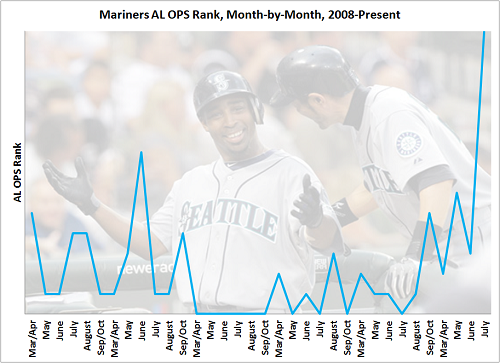
This month isn’t over — it’s only half over! — but right now, the Mariners have the month’s best OPS in the league. Last month, they were 12th. The month before, ninth. The month before that, 13th. That covers 2013. I don’t want to cover the years before. I already lived them once, and once is once too much.
It’s not just that the Mariners hadn’t had a league-leading offense for a month since the start of 2008. That’s covering 33 months. It’s that they hadn’t even ranked in the top five. In June 2009, they were sixth, and that’s the previous high. Next-best? Three months, tied at ninth. I know this is just OPS, and Safeco makes the Mariners look worse than they are, but this isn’t a time when we need to be perfectly scientific. The point gets across, no matter if you use OPS or wRC+. The Mariners have sucked at scoring, consistently.
The last time the Mariners ranked in the top five was August 2007. The last time they had the AL’s best OPS for a month was June 2006. I’m just going to guess that, this month, they won’t be able to hold off the Tigers, but the difference between the Mariners’ July OPS and the sixth-place July OPS is 103 points, so we could be well on our way to a top-five finish. This is the first time in a very, very long time that we’ve gotten to feel like the Mariners have a legitimate offensive attack. There’ve been flashes before, but this has been sustained, even if it won’t sustain much longer.
What’s helped? This month, the Mariners have led the AL in dingers. Kyle Seager and Raul Ibanez have slugged in the .700s. Justin Smoak and Kendrys Morales have slugged in the .600s. Michael Saunders has almost joined them, and then Brad Miller has held his own. Others, like Nick Franklin, Mike Zunino, and Dustin Ackley have struggled, but maybe they’ll get better and somewhat offset the other guys getting worse. With a young team, everyone’s got promise. Every success feels like a potential indicator; every failure can be written off as a growing pain. A young team lets you lie to yourself, convincingly, and that’s kind of one of the keys to enduring sports-fan happiness. Happiness when you’re not on the verge of a title.
What I’m not saying is that the Mariners have one of the league’s best offensive units. What I am saying is that the Mariners have recently had one of the league’s best offensive units, and we just haven’t seen that from them in god-damned forever. So it’s a different feeling, a new feeling, a fresh feeling, where we get to watch these Mariners and separate them from the Mariners of months and seasons past. It’s re-energizing, because we’ve been able to feel like we’re fans of a whole different ballclub.
No idea what happens now. Maybe the Mariners revert to themselves and this positivity deteriorates in a week. There’s no such thing as a feeling that lasts, not in the realm of fandom. But maybe they keep hitting and scoring. Maybe they keep providing entertainment. Maybe they keep feeling worthwhile, which I can tell you hasn’t been like them. There are things about this team to grip onto, things that aren’t just Felix Hernandez. If nothing else, the Mariners are capable of making us feel the way that we’ve felt. It’s been nice.
Game 95, Angels at Mariners
Hisashi Iwakuma vs. Cupcakes Blanton, 1:10pm
Today’s starting pitchers are actually pretty similar. Iwakuma’s got a sparkling 7.67 K/9, while Blanton’s at 7.56. Both have walk rates under 5%. And both have FIPs far, far higher than you’d guess if all you saw was their K/BB ratio. Iwakuma’s given up 20 HRs on the year so far, while Blanton’s given up 22 despite the fact both pitch in HR-suppressing home ballparks.
The similarities don’t end there. Both pitchers are actually pretty good with men on, and particularly with RISP. Blanton’s HR/9 is 2.33 with the bases empty this year and about half that with men on; 15 of his 22 HRs have come with no one on. Iwakuma’s very similar, with a career HR/9 of 1.63 with no one on and 0.89 with men on. Both pitchers out-pitch is a change-up (Iwakuma’s split functions like a change), so their platoon splits are even or even reversed…and they’ve given up more HRs to righties, despite both being right-handed themselves.
We know HR rate, or HR/FB at least, is much more variable than Ks or walks. Would you instruct Blanton or Iwakuma to make fundamental changes, or would you just wait and hope for some HR regression? Blanton’s rate is so high, you’d have to expect that his coaches might be telling him to stop challenging quite so many hitters, and that they’d trade a few walks for HRs. Of course, nothing’s that easy – if he was capable of making such a trade, I’m sure he would. With Iwakuma, it’s potentially more interesting. It’s not that uncommon for a pitcher to post lower HR rates with men on, as pitchers tread carefully around sluggers. In this case, the trade off actually is as simple as trading walks for HRs. But everything in Iwakuma’s line looks better – he’s got a better K:BB AND a better HR rate. Iwakuma’s only been pitching in MLB for about a year, so it’s way too early to know, but Iwakuma certainly looks like a pitcher who likes pitching from the stretch.
Doug Thorburn at BP wrote a couple of pieces recently that involved, among others, Iwakuma. In his mind (keep in mind this is the pitching mechanics expert; these aren’t stat-heavy articles), Iwakuma’s prone to these streaks of HRs (he’s given up a staggering 10 HRs in his last four starts) because his wind-up is so complicated – a pause before he starts, another pause with his left leg in the air, etc. By contrast, from the stretch, his delivery is clean and simple, and may- MAY -help him with his timing. I don’t really know anything about mechanics, but that wind-up certainly *looks* like it could produce some timing problems. It’s something to watch, anyway.
Line-up
1: Miller, SS
2: Franklin, 2B
3: Ibanez, LF
4: Morales, DH
5: Seager, 3B
6: Smoak, 1B
7: Saunders, RF
8: Zunino, C
9: Ackley, CF
SP: Iwakuma
That’s it for the season’s first half. Hasn’t exactly gone as we’d hoped, but it could at least be a lot more watchable, more compelling, in the second. We haven’t seen enough wins, but we’ve been treated to one of the most bizarre half-seasons on record thanks to Raul Ibanez. It’s not contention, but it was something, all right.
Today’s starters in the minors include the Dutchman, Lars Huijer, for Everett, top-10 prospect Tyler Pike for Clinton, cerebral righty Andrew Carraway for Tacoma and righty Trevor Miller making his AA debut for Jackson.
Game 94, Angels at Mariners
King Felix vs. Jered Weaver, 7:10pm
This is one of the better pitching match-ups in the American League, and despite Weaver’s injury this year, despite both hurlers losing a few ticks on their fastball and despite each of them suffering a few bad games against the Angels/Mariners, respectively, this is still compelling stuff.
Weaver missed a few months with an elbow fracture, and looked to be throwing in the mid/high 80s upon his return. But he’s touched 92 recently, and he’s getting great results: he’s allowed two runs in his last 20 2/3 innings, with 17 Ks and just 4 BBs. Unlike with Felix, velocity never really played much of a role in Weaver’s success. He uses a deceptive, funky low 3/4 delivery to hide the ball and a rising fastball that generates a ton of pop-ups and lazy fly balls. His fastball has essentially no horizontal movement, but the vertical movement’s nearly unparalleled. These kind of movement stats commonly belong to the truly over-the-top hurlers, from Clayton Kershaw to Josh Collmenter. That Weaver’s able to do it with a delivery that verges on side-arm is freakish, and it’s probably helped him post consistently low BABIPs. It makes sense, when you think about it – most all balls in play are in the air, and fly balls have a lower BABIP, and pop-flies have a BABIP approaching .000. This skillset should have a trade off in the form of home runs, but whether it’s a park effect, crazy movement or several years and several thousand innings of luck, that hasn’t troubled Weaver. Look at his HR/FB on fangraphs or his expected home runs on statcorner – he should be allowing way more dingers, and he simply hasn’t.
For years, he was seen as a regression candidate by some segments of the stathead community, and while he hasn’t always posted absurd strand rates, he also improved markedly from his first year or two through 2010, his best season. Since then though, he’s fallen back. Injuries have had something to do with that, and lower velocity may be playing a role as well. But again, this hasn’t made him a bad pitcher. Thanks to his infield fly balls, his BABIP’s been low, and that means he’s given up fewer earned runs than his FIP would expect. Not each and every year, but the odd years are balanced with 2006 and 2012, when his ERA was over a full run lower. He’s posted nearly 30 WAR in his career, and if you included IFFB% in FIP, that number would rise.
Unlike the Red Sox pitchers, Weaver’s been effective by throwing almost exactly what you’d expect. Versus righties, he’s a four-seam/slider guy. The fastball may be his best pitch, as it’s generated better results on contact than just about anyone’s. Against lefties, he uses a sinker and a change-up. The sinker has more horizontal movement than his four-seam, and while sinkers often have *higher* platoon splits, Weaver’s been doing this for years and it’s clearly working for him. His career splits are fairly even, and his success against lefties plays a huge role in his overall value.
Line-up:
1: Miller, SS
2: Franklin, yay!
3: Ibanez, LF
4: Morales, DH
5: Seager, 3B
6: Smoak, 1B
7: Saunders, RF
8: Zunino, C
9: Ackley, CF
SP: El Cartelua
Luiz Gohara’s pitching for Pulaski at the moment. James Paxton gets the nod for Tacoma tonight as they host Reno. Rigoberto Garcia goes for his fifth straight win in Eugene tonight for Everett.
Game 93, Angels at Mariners
Joe Saunders vs. Jerome Williams, 7:10pm
Even in a losing season, there are games you look forward to – interesting tests for young prospects, for example, or Felix Day. Then there are games started by Joe Saunders and Jerome Williams on a Friday night. C’mon, uh, Brad Miller! More hits! Hope your knee feels better, Mr. Franklin!
I’ve wasted far too many pixels on Jerome Williams over the years, but I wouldn’t be my charmed-by-subpar-starters self if I didn’t point out that his velocity has indeed continued to rise. The first time the M’s faced Williams, I noted that his velocity has crept upwards since reappearing, miraculously, from long stints of injury, the Taiwanese league, and just being awful. His FB velocity may hit 94mph by the end of the year, which isn’t bad. It also hasn’t stopped him from regressing a bit. His K% has fallen from last year, and his nice run of, er, run prevention has stopped too. His ERA and FIP are looking more like replacement level than average. Again though, he’s been the Angels pitching depth – they keep turning to him not because they’ve really wanted to, but because Plan A and Plan B keep turning out so poorly. And, because Angels, he was pretty successful there for a while.
A year after having losing out on a playoff spot in large part due to a crappy rotation, the Angels have made wholesale changes and…have a crappy rotation. Most of this has nothing to do with Williams, who is more like their Blake Beavan than their Joe Saunders. But while their Joe Saunders (Cupcakes Blanton) has been awful, and well-remunerated to boot, their Blake Beavan is still a perfectly acceptable 5th starter. Still, that’s not quite what he was last year, or even early this season – what’s changed?
Not much, really. He’s still a fastball/sinker/cutter guy, who’ll throw a change and a rare curve as well. The cutter makes up about 1/3 of his total pitches to righties, and over 1/5 to lefties as well, and it’s this pitch that’s given him problems recently. He’s yielded 5 HRs on the cutter, 4 to righties. The numbers are so small, it could be a complete fluke of course, but it’s not like the pitch generated materially better outcomes the year before. He’s still quite effective against righties – and he’s given up more dingers than doubles, so he may be both effective and unlucky against them. But lefties are still hitting him, and they feast on his sinker and change. The numbers bounce around, but I think what we see is what we get with Williams: his stuff isn’t really good enough to get lefties, and he’s made a few bad pitches to righties. When the ball stays in the yard, he can be effective.
Joe Saunders is an odd one. Can anyone else thing of pitchers who’ve hung on this long and had a modicum of success despite not being able to get out opposite-handed hitters? I mean, this is Saunders thing, and it’s not going away. He’s been lights-out against lefties again this year, which is critical, because righties have a .387 wOBA against him. Adrian Beltre has a .387 wOBA. Josh Donaldson and Matt Carpenter are in that neighborhood. Charlie Morton was going down that path, but his splits are preventing him from becoming a dependable SP. I suppose Justin Masterson would be the poster boy for this, which isn’t surprising given his arm angle.
1: Miller, 2B
2: Saunders, RF
3: Ibanez, LF
4: Morales, DH
5: Seager, 3B
6: Smoak, 1B
7: Zunino, C
8: Ackley, CF
9: Ryan, SS
SP: Joe Saunders
The M’s today sent Erasmo Ramirez to Everett and Blake Beavan to AAA Tacoma, while recalling Hector Noesi and Bobby LaFromboise. This is one of those classic pre-All-Star Game moves, which should allow Erasmo to stay in his current rotation slot when play resumes (as the M’s won’t need a 5th starter for a while, he could’ve been sitting on the bench for some time), and getting more bullpen help after Boston bulldozed the M’s starters in the past three games.
Ramirez’s lackluster debut may have been a blip, just a one-off bad outing. But while I’ve been encouraged by the M’s pitching depth improving, it must be said that it’s looking shaky once you get past Erasmo. James Paxton’s improvements in the past month are great, but Brandon Maurer’s taking the opposite path. He started last night’s game in Tacoma, and left after allowing all seven batters he faced to reach. All told, he pitched 0 IP, giving up four runs, three hits, two walks and a hit batsmen. In his last five games, he’s thrown 17 1/3 IP and yielded 24 hits, 12 walks and 18 runs. Danny Hultzen would actually be a great mentor in this situation, having experienced a similar run for Tacoma last year. If he wasn’t shut down with shoulder pain. C’mon Erasmo! Taijuan Walker’s amazing, and I’m excited to see him in his 2nd MLB futures game, but it’s kind of bizarre how far up the depth chart he is right now.
Not The Last Word On Justin Smoak
Yesterday was a decent day for Justin Smoak, against the Red Sox. Yeah, he finished just 1-for-4 with a line-drive single, but he also drew a walk, and in the seventh inning he flew out to the track in center, and in the fourth inning he hit a bullet that Dustin Pedroia somehow managed to pick, and in the second inning he took Jonny Gomes to the fence the other way. Smoak, basically, walked, and made solid contact four times out of four tries. He didn’t leave the yard, but he easily could’ve.
The big problem with arbitrary endpoints is that they’re arbitrary. It’s right there in the term. You can hand-select various endpoints to try to make whatever argument it is that you’re making. It’s not that they’re necessarily completely without substance, but they’re misleading and it’s just a bad practice, if you can avoid it. Now, I want to look at Justin Smoak since last August 14. That reads as an arbitrary endpoint, but it’s not, and here’s why: that’s when Smoak came back last season from a stint in Tacoma. During that stint in Tacoma, Smoak worked on changing his swing mechanics, and if I were doing this to try to make a biased case in favor of Smoak, I’d probably leave out that Smoak’s half-August was terrible. But it counts, because that’s when Smoak returned, and it seems reasonable to look at numbers since a point at which a given player changed.
The stats:
- .274/.369/.438
- .322 BABIP
- 100 starts
How about the stats from the window right before the above stat window? From 9/13/2011 – 7/23/2012:
- .197/.263/.327
- .222 BABIP
- 100 starts
People have asked what’s different about Justin Smoak. Well, his swing is visibly different, at least and especially from the left side. Since being recalled, Smoak’s numbers are virtually identical from both sides of the plate, even though I’ll grant that only shaves the samples even further. Between the two stat windows above, Smoak’s home runs stayed the same, but his double power has increased, his walks have increased, and his strikeouts have decreased. And, of course, there’s the 100-point leap in batting average on balls in play.
If you’re familiar with stats, you’re immediately skeptical of anything related to a BABIP boost, and that’s perfectly fair. But over Smoak’s career until his 2012 demotion, his BABIP was .248. That was over a significant sample, and it seemed to be a problem of his, stemming from inadequate quality of contact. Smoak didn’t really seem to make a habit of barreling up, as it were. Now, it subjectively feels as if the quality of his contact has improved, and the numbers support the assertion. With better contact quality, you get more hits, and Smoak’s registered a lot more hits.
Line-drive percentage is a thing that’s available, but I don’t like it, because I don’t like how line drives are scored. There’s way too much subjectivity and way too little year-to-year consistency. But line drives are important, because line drives are good contact, and I personally feel like the best measure we have available is BABIP. A guy will get more hits if he’s hitting the ball better, and Smoak’s been hitting the ball better, hence all the hits. And, whatever, his line-drive rate is up too, rather substantially, if that’s your jam. Before, it seemed like there was a flaw in Smoak’s process, and he didn’t quite have the right timing. He hit too many lazy fly balls. That was an issue that he most certainly had. He still hits lazy fly balls, but in between those, he’s hitting more rockets.
This is getting to be interesting. Smoak’s probably never going to reach the 30-dinger plateau, but his other improvements have made him look like an actually reasonable starter. Just as a reminder, here’s Smoak’s slash line since coming back:
- .274/.369/.438
And here’s Nick Swisher since the start of 2011:
- .262/.367/.450
Swisher, of course, adds value from his defensive versatility, but he also spent a lot of time in Yankee Stadium instead of Safeco Field, so. Swisher and Smoak are looking like similar offensive players, but where Swisher is 32 and Smoak’s 26. Maybe Smoak will grow into a little more power. Maybe Smoak will get only more comfortable with his new swing mechanics. Maybe Smoak won’t hit a whole bunch of dingers, but maybe he’ll still be all right anyway, because he gets on base and adequately fields his position.
Over the last calendar year, Chris Davis has a .367 OBP. Edwin Encarnacion, .367. Allen Craig, .358. Adrian Gonzalez, .357. Smoak is never going to match Davis’ inconceivable power, but getting on base is the best thing you can do consistently, and this is how Smoak’s made himself into a contributor. His swing has allowed him to drill the ball more often, while also allowing him to get a better look at the pitches. So there’s been an effect on both discipline and contact.
Ultimately, what we don’t have is a superstar first baseman. Smoak’s not a great fielder, he’s not a good runner, and he’s not a great slugger. Power would be great. Lots of first basemen have power. Smoak would be better with more power. But, a lot of us, on many occasions, have gotten close to just giving up on Smoak completely. There were times he looked absolutely, utterly hopeless. He’s showing now why it’s so hard to deal with struggling young players, because sometimes they never come out of it, but sometimes they do, and you can always look back and say “well he was still young.” Smoak doesn’t look like a star, but he looks like a guy a good team can play at first base, and he looks like he’s not a problem. We don’t know for sure whether that’s actually true, at this point, but we can at least have the discussion. Justin Smoak doesn’t suck. All right.
Mariners End Disappointing First Half
| MARINERS (40-52) | ΔMs | ANGELS (44-46) | EDGE | |
| HITTING (wOBA*) | 4.0 (11th) | 13.0 | 56.3 (3rd) | Angels |
| FIELDING (RBBIP) | -16.7 (23rd) | -2.5 | -7.6 (19th) | Angels |
| ROTATION (xRA) | 5.6 (13th) | -3.5 | -31.0 (27th) | Mariners |
| BULLPEN (xRA) | 2.2 (14th) | -3.4 | -9.0 (26th) | Mariners |
| OVERALL (RAA) | -5.0 (12th) | 3.5 | 8.6 (11th) | ANGELS |
The final series before the All-Star Break begins today and despite actually being about 57-58% through the season, it’s considered the mid season mark. The record is a disappointment for sure but a lot of the underlying factors are trending positive.
For the first time in a long while, the offense ranks as above average. Sure, a lot of that is Raul Ibanez and Kendrys Morales, but Smoak, Seager, Franklin and Miller are producing and after a stint in Tacoma, perhaps Ackley will get back on track as well.
That the Mariners’ -5 overall run mark ranks 12th shows a bit how the teams are slightly lopsided this season, tilted toward some legit powerhouses like Detroit, Boston, St. Louis and, somehow, Pittsburgh.
I’m out and about again this weekend so this is yet another abbreviated commentary preview. Here are some bullet points. This series I’m feeling:
Most optimistic about Kyle Seager. There’s nothing to pick out as a problem.
Most pessimistic about Nick Franklin. Franklin’s one walk and 19 strikeouts in the past two weeks is a blaring klaxon PTSD’ing me to Ackley.
Mariner I’m most looking for to not being a Mariner is Raul Ibanez. At this point, it’s actually about the potential return in a trade than anything else, but I’m also not sure who takes his playing time in the outfield. Which is itself a horrible and predictable result of this winter’s terrible roster planning.
Rainier I’m most looking forward to being a Mariner is no longer Erasmo Ramirez so, I don’t know, Brian Moran?
Game 92, Red Sox at Mariners
Erasmo Ramirez vs. Ryan Dempster, 12:40pm
Early game today for getaway day. This series was looking so good a few innings into the game on Tuesday. Oh well.
The M’s are bringing up Erasmo Ramirez to start today’s game, as we expected. Because they DFA’d Jeremy Bonderman, the M’s still have an open spot, and it’s looking like they’ll let Lucas Luetge stick around until Stephen Pryor’s done with his rehab, which should be soon. That’s good news, because, as expected, the M’s sent down Carter Capps following last night’s game. Pryor pitched a simulated game yesterday, so he’s obviously getting close. Capps clearly has some mechanical things to work on, but I figure we’ll see him again at some point this year.
Ryan Dempster’s a familiar face, and though his walk rate’s slipped this year, he’s still capable of getting strikeouts and whiffs thanks to a pair of breaking balls. He throws an 90mph fastball and backs it up with a slider and a splitter that functions a lot like a change. Like Doubront last night, Dempster doesn’t limit the slider to righties and the split to lefties; he’ll throw any pitch to any hitter. To me, the split’s his best pitch, as it generates quite a few whiffs, and while his slider can miss bats, he’s hung quite a few of them. Since the start of 2012, he’s given up 15 homers on sliders. The split’s also helped him to post even or even reverse splits in recent years, and he’s struck out a higher percentage of lefties than righties over his (long) career. Like just about any pitcher, he likes to pitch away, and gets hurt when he misses his spots and leaves a pitch middle-in.
Erasmo Ramirez tantalized with a brilliant 2012 season, but missed several months with forearm tightness/elbow pain. Just when we thought it was all but inevitable he’d have to have TJ surgery, he was back in Tacoma, mowing down PCL line-ups. In recent starts, he’s been a lot less exciting, yielding more runs on a lot more walks. But his velocity appears to be back, and at least *some* of those struggles may have been because the M’s wanted him to work on certain things. In his most recent start, a rather ugly game in Salt Lake in which he walked six in 5+ innings, he used his change-up sparingly, if at all. It may have been because he wasn’t commanding it, but he wasn’t commanding much of anything on the night. It wouldn’t be the first time a pitcher in the minors has had specific instruction to focus on a particular pitch – Danny Hultzen’s thrown fewer change-ups at times than I’m sure he’d like to in AAA so the M’s can assess the progress of his slider. Ramirez’s change was stunningly good in 2012, and getting a pitcher who can pitch to righties and lefties and get whiffs from both is a boon to the M’s rotation.
Line-up:
1: Miller, 2B
2: Chavez, RF
3: Ibanez, LF
4: Morales, DH
5: Seager, 3B
6: Smoak, 1B
7: Zunino, C
8: Saunders, CF
9: Ryan, SS
SP: Erasmoooooo
Chance Ruffin looks like he’s headed up to AAA Tacoma to take Erasmo’s spot in the rotation. The reliever-turned-starter has had an up and down season in AA – he started off well, limiting runs despite not many Ks, but he may be tiring. That wouldn’t be a big shock given that he hasn’t started since early in his college career.
Nick Franklin was pulled from yesterday’s game in the 7th due to knee pain, and he’ll sit out today’s game as well. I know, I know: at the time, it was 9-0, so there was no point in keeping him out there, but this lingering injury’s annoying because there’s at least a chance that Franklin would be feeling better if he was pulled from the game when it happened. Instead of icing it to reduce swelling, Wedge ran him out there, thinking that it was a good test of character and a chance to get experience playing through pain. Great.
Game 91, Red Sox at Mariners
Aaron Harang vs. Felix Doubront, 7:10pm
For all the talk of the M’s rotten luck – injuries to Morse, Morales, Hultzen, Erasmo, the abysmal hitting of Ryan/Andino/Ackley, etc. – it’s worth remembering how much has gone *right* for this team. I feel like we, or baseball in general, isn’t paying enough attention to just how bonkers Raul Ibanez’s season has been, and what it would look like if he didn’t stumble his way to a 43 wRC+ plus atrocious defense through April. The fact that his season numbers look great – and they do – is astonishing given how little time he’s had to essentially make up for a lost month.
Dave hits on the other pleasant surprise of the year so far with his Brad Miller post below. Miller’s (tiny sample) success on defense has logical explanations, and we talked about them before his debut, but the fact is that he could’ve come up and booted enough balls that Wedge would feel compelled to bring back Ryan. In Miller and Franklin, the M’s had two competent defenders with a penchant for missing easy chances, and they’ve both come up to Seattle and improved defensively. One could quibble with these improvements being talked about in the context of “good luck” but it’s certainly something that could’ve gone wrong and didn’t.
The M’s have had good luck and bad, and they’re in 4th place, 10 games under .500. I’m not going to lie and say that the past month or so hasn’t been encouraging, or that scoring 19 runs in two games against Boston hasn’t been fun. It’s exciting to see the outlines of the 2014 team coming together, and how the M’s shopping list has shifted from “good luck” positions like SS/C to places where they may be able to comparison shop (COF). But the team’s still *4th* and the gap between them and Oakland/Texas looks somewhat daunting, despite Texas’ even-worse luck and Oakland not having household names. Things can change in a hurry, though, and you can envision a much better pitching staff for ’14, but the M’s have quite a hill to climb.
Felix Doubront is a lefty with a 91mph fastball and a fairly standard array of pitches: change, slider, curve. He’s somewhat interesting to me though in that 1) he gets more strikeouts than you’d think (21-23%), and 2) he doesn’t materially alter his pitch mix to RHB/LHB. With a change and a slider, he’s got the tools to do so, but he throws the change over 10% of the time to lefties and gives righties a dollop of sliders. This hasn’t hurt him too much, if it all, and I’m not sure whether it’s just a coincidence or a consequence of a somewhat different strategy that he’s posted essentially no platoon splits in his career. Take out BABIP and they’re a touch more normal, as his worse walk rate and a tiny bit higher HR rate to righties give his FIP splits a more traditional look. But this is a guy who’s faced overwhelmingly righty line-ups this year, and I’m not sure that there’s a huge advantage to rejiggering a line-up like that. Of course, the M’s can’t do much of that, but they won’t mind that this is a pretty good match-up, given that they’re going to be throwing a lefty-heavy line-up at a lefty pitcher.
Line-up:
1: Miller, SS
2: Franklin, 2B
3: Ibanez, LF
4: Morales, DH
5: Seager, 3B
6: Bay, RF
7: Smoak, 1B
8: Saunders, CF
9: Blanco, C
SP: Harang
Greg Johns reports that Stephen Pryor’s throwing a simulated game today against Mike Morse, Franklin Gutierrez and Dustin Ackley. I wonder if Pryor will be spooked by the sight of batters running at full speed when he comes back.
Sad news from Trenton, where the AA Thunder’s beloved “bat dog” Chase died after a battle with cancer. The Thunder honored Chase’s service with a retirement party three days ago. Chase’s puppy, Derby, will take over the duty of actually grabbing bats and balls and passing water to umpires, while another of his offspring, Ollie, serves in the same capacity with AA New Hampshire.
Not much of note in the minors today. Brian Sweeney vs. Sean O’Sullivan in AAA, which is one of the most AAA-ist possible match-ups. Sweeney will pitch to Mike Wilson, and O’Sullivan will face Carlos Peguero and the lights of Tucson will seem to say, “PCL 4 Life.”
Carter Capps is not right, and he may be looking at a trip back to AAA Tacoma sooner than later. His awful numbers against lefties are well known, and at the very least partially explained by his arm angle, but he’s getting hit hard by righties too, and that shouldn’t be happening. His velocity’s down nearly 3mph vs. last year, though of course that’s not a perfect comparison given when he was promoted in 2012, but 96mph from a foot behind your head should be death on a stick against righties, and instead Jose Iglesias looked comfy and confident in pulling a line-drive RBI single against Capps yesterday. Someone mentioned on twitter that he’s getting more of the plate this year, but it’s hard to see that consistently – his zone percentage is down, fractionally, though looking at his zone profile at Brooks Baseball, he looks to be leaving more pitches centered. Whatever the case, it may be time to work on fixing him somewhere else. Logan Bawcom and Brian Moran are pitching well for Tacoma but aren’t on the 40-man (though there’s an open spot on the roster now), and Josh Kinney’s familiar, at least. Carson Smith figures to get a long look at the MLB bullpen next year, so he’s someone who could get a chance later on in 2013.