
Fun Fact of the Day
Opposing batters when John Jaso is catching for the Mariners: .191/.263/.326
Opposing batters when Jesus Montero is catching for the Mariners: .220/.293/.348
Opposing batters when Miguel Olivo is catching for the Mariners: .248/.307/.409
Percentage of total PAs caught by John Jaso when Felix Hernandez was pitching: 0.0%
Percentage of total PAs caught by Jesus Montero when Felix Hernandez was pitching: 10.3%
Percentage of total PAs caught by Miguel Olivo when Felix Hernandez was pitching: 21.4%
Remember all those comments you heard about how the pitching staff was going to really miss Miguel Olivo’s veteran leadership and game calling skills? Notice how you’re not hearing any of those comments right now?
In reality, none of those numbers prove anything. It’s all just small sample and biased selection data that has no real predictive value. There are way too many problems with looking at split-by-catcher data for it to have much value even over large samples, and over a a few weeks, these numbers are entirely worthless. Don’t use the numbers above to claim that Jaso or Montero are better game-callers than Olivo.
However, the reality continues to be that there is absolutely no evidence that the team’s pitching has suffered in any way from Olivo’s absence. Despite all the talk about his presence behind the plate and how guys like Montero and Jaso couldn’t be trusted to handle a staff, the pitchers have performed just as well without Olivo in the mix over the last 10 games. Even though the gap in handling a staff between Olivo and Montero/Jaso was supposedly so large that Montero couldn’t be trusted to catch more than once per week and Jaso could never be trusted to don the gear, removing Olivo from the catching position hasn’t had any adverse effects on the team’s run prevention.
Proving something doesn’t exist is extremely hard, and I’m not one who believes that there’s no variation between catchers in their ability to impact a pitcher’s performance. That said, if you want me to believe that you have an invisible dragon in your back yard, you better be prepared to at least show me footprints or something that he burned to a crisp for you. If there is no evidence of a thing’s existence, and then we take that thing away and see no change in its surroundings, the best conclusion we can draw is either that the thing does not exist or that its existence has a minimal effect at best.
I have no doubt that the Mariners really like Miguel Olivo as a teammate. However, respect for your teammates doesn’t win games, outscoring your opponents does.
Game 33, Tigers at Mariners
Vargas vs. Smyly, 7:10pm
Marc and I both put up game threads, so I’m just copying the contents of mine over here. His contents are below.
All season long, we’ve been advocating for Eric Wedge to deploy John Jaso more often. We hailed his contact rate and ability to hit from the left side as positives that the team needed from the catching position, and we pointed out that Jaso’s on base skills actually convinced Joe Maddon to use him in the leadoff spot while he was in Tampa Bay. As he’s gotten more playing time since Olivo’s injury, Jaso has continued to show that he can be a useful offensive piece.
So, I’m thrilled to see Eric Wedge promote Jaso to the leadoff spot for tonight’s game, acknowledging that on base skills should trump speed at the top of the line-up. I want to applaud him from the rooftops and tell the world what a great thing he’s done.
There’s only one small problem – the Tigers starting pitcher tonight is Drew Smyly. Drew Smyly is left-handed. John Jaso is also left-handed, and he’s been pretty awful against southpaws during his big league career. While 101 plate appearances isn’t a huge sample, Jaso’s .183/.320/.268 line against lefties isn’t exactly encouraging, and his primary skill against RHPs – contact ability – hasn’t been present against lefties, as he’s struck out in 19.8% of his PAs against LHPs. He’s managed to draw 17 walks, so he hasn’t been totally helpless, but he’s not a guy who is likely to have much success against quality left-handed pitching.
So, hooray for Jaso hitting leadoff. I just hope that if Jaso looks awful in that spot tonight against a lefty, it won’t preclude him from hitting near the top of the order against a right-hander in the future, since that’s the role where Jaso is actually capable of providing real value.
You may remember the name Drew Smyly, as he was one of a few potential “players to be named later” to complete the Doug Fister trade. As it turned out, Chance Ruffin headed west, and Smyly resumed rocketing through the Tigers minor league system. The 6’3″ lefty made his MLB debut on April 12th, and he’s reeled off four quality starts in a row from 4/17 to 5/4. His primary pitches are a four-seam fastball at about 92mph, a cutter at around 87 and a slider at 80. He’s got a change-up, but he hasn’t used it all that often. Thus far in his month-long MLB career, he’s been excellent, with a K% over 25% and a walk rate of just over 7%. At this point, it’s probably better to just say that he’s got 29 Ks to 8 free passes. Given his arsenal, it’s probably not a big surprise that he’s tough on lefties. He’s struck out 10 of the 31 lefties to face him and hasn’t walked any of them (though he plunked one). He’s been surprisingly tough on righties, though, thanks to a better-than-average strikeout rate. Some look at his shiny ERA and ridiculous strand rate (94%!) and see a guy who’s lucked his way into the rotation. But while he’s certainly benefited from luck, he’s been a very effective pitcher from the moment he got to Detroit.
The most interesting thing about him isn’t his arsenal – it’s the way his pitches move. As we all remember from hearing the M’s (and, briefly, the Yankees) discuss Michael Pineda, baseball folks think it’s important to have pitches that move in on same-handed hitters as well as pitches that move away from same-handed hitters. Pineda had a great slider, and the M’s wanted him to develop a change-up with arm-side run that could move away from lefties. His slider was great against righties, but the M’s worried about left-handers teeing off on the pitch. Jason Vargas is a classic example – he came up with a good slider, but then worked on his change-up so much that it’s now his best pitch, and so his K:BB ratio is as good or better versus righties. Developing pitches with very different horizontal movement is so ingrained, so routine, that it seems like a truism. The only exceptions have been guys with nuclear-grade stuff – the young Randy Johnson who used a 100mph fastball and a slider so good, to complain about the fact that it broke in on right-handers was to miss the point entirely. But even RJ developed a splitter/change-up later on (and he became one of the greatest pitchers in history). Pineda was successful last year despite not having an MLB-quality change-up, but many thought the lack of the pitch would hamper his development.
You can probably guess where I’m going with this. Here’s Smyly’s horizontal movement graphed against velocity, thanks to Brooks Baseball:
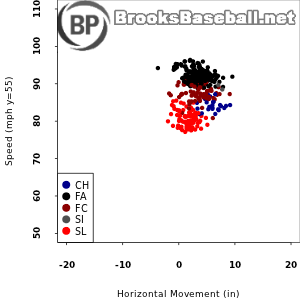
Only speed changes, not horiz. movement
Compare that to his opponent tonight, Jason Vargas:
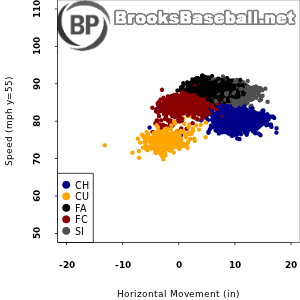
Lots of variation in horizontal movement between pitch types
Vargas’s horizontal movement stretches quite far, from pitches like his curve that break away from lefties to his change-up that break surprisingly far from righties. Compare that to Smyly’s movement; nearly all of the variation in Smyly’s graph is in velocity. Both pitchers throw a cutter, but while Vargas uses the pitch to get a different break from his fastball (the horizontal movement is 8″ different), Smyly’s cutter’s movement is indistinguishable from his fastball. It’s a bit slower and has different vertical movement, but fundamentally, he throws a cut-less cutter. Lucas Apostoleris brought this up on twitter and it touched off an interesting conversation.
My question is still: why? Is there an advantage in this approach (everything looks the same until after batter’s begun his swing?), or is it purely the result of his delivery? Looking for comparable pitchers, Harry Pavlidis of Brooks Baseball came up with another guy with an over-the-top delivery, Josh Collmenter. Collmenter throws a curve ball, which is so different from a cutter that there’s no way he’d get similar horizontal break on a curve and his fastball, but I’d guess that if he threw a cutter, it’d move like Smyly’s. Collmenter was one of the better stories of 2011 for Arizona, coming out of nowhere to win the #5 starter job and putting up a sub-4.0 FIP and over 2 wins. This year, he’s been crushed and he’s lost his starting job already. A “different” delivery is often effective for a pitcher – until the league learns how to read it. Smyly’s been great, and he’ll probably have a successful season, but he’s probably already working to improve his change-up in preparation for next year. Funky delivery mirage or intriguing prospect who gets more out of his talent than most, I just wish the M’s got him last year.
The line-up features several interesting twists – not only has Wedge “freed” John Jaso, he’s batting him lead-off. In addition, with the M’s throwing out their RH line-up, Ackley gets the day off with Seager at 2B and Alex Liddi at 3B. Chone Figgins gets a spot start in CF and Mike Saunders had the day off.
1: Jaso (C)
2: Ryan (SS)
3: Ichiro (RF)
4: Montero (DH)
5: Seager (2B)
6: Smoak (1B)
7: Liddi (3B)
8: Wells (LF)
9: Figgins (CF)
Sp: Vargas
Go M’s!
Taijuan Walker had a shortened, somewhat mixed outing today, going 4 IP and giving up 2 R and 2 BB against 4 Ks. Jackson lost to Huntsville, 4-2.
The Rainiers were undone by long balls today in their game against Albuquerque, but Forrest Snow still had one of his better starts of the young season, getting 8 Ks in 6+. Chance Ruffin still doesn’t look quite right, giving up 2 runs in the 7th and picking up the loss in a 9-7 defeat. Vinnie Catricala showed some tentative signs of life on the R’s recent road trip, but went 1-5 with a single and a GIDP. Still only 6 XBH on the season.
The Sac Bunt: The Real Rally Killer
I just finished up an 1,800 word post on the foibles of the sacrifice bunt from last night’s games over at FanGraphs. I spend more time on the Dodgers-Giants game than the M’s-Tigers affair, but the point is all the same – the decision making on this issue from the field level continues to be staggeringly uneducated.
The Sacrifice Bunt Is a Scourge
The worst. Bunting is just the worst.
Game 32, Tigers at Mariners
Millwood vs Verlander, 7:10 pm.
When people talk about potential rotation changes, inevitably we end up hearing someone talk about how Millwood should be the first guy to go. After all, he’s 37-years-old, so he’s not any kind of long term solution, and his 5.34 ERA shows that he’s washed up. Really, though, only the first part of that sentence is true.
Millwood’s relevant stats to date: 7.9% BB%, 15.0% K%, 45.4% GB%. AL averages for starting pitchers in 2012: 7.9% BB%, 17.6% K%, 43.9% GB%. Millwood’s stuff has declined to the point where his strikeout rate is just south of league average, but he’s right in line with the norms in both walk rate and ground ball rate. Look at his career line, and this is what Millwood is – an average BB/GB guy and a slightly below average K guy. He is essentially the classic #5 starter.
His ERA is bloated by a .344 BABIP and a 59.2% strand rate, neither of which are going to continue. There’s nothing wrong with Kevin Millwood, and he’s a decent enough guy to have as an innings eater at the back of the rotation to let the kids develop down in the minors so the organization doesn’t have to rush them before they’re ready. He’s better than Blake Beavan, and at this point, he’s better than Hector Noesi, though at least Noesi has the upside to become something more than what he is now. Don’t be so quick to throw Millwood to the curb – he’s still a useful piece for this team.
Ackley, 2B
Ryan, SS
Ichiro, RF
Montero, C
Seager, 3B
Jaso, DH
Smoak, 1B
Carp, LF
Saunders, CF
Ichiro Being Ichiro
Ichiro Suzuki, 2012: .298/.343/.411, .334 wOBA
Ichiro Suzuki, 2001-2011: .326/.370/.421, .348 wOBA
If you look at Ichiro’s performance this year in comparison to the first 11 years of his career, you can see some signs of age-related decline. His batting average is down 28 points, his on base percentage is down 27 points, and his slugging percentage is down 10 points compared to his career averages prior to 2012. As the season goes on and the question of whether or not to re-sign Ichiro becomes more frequent, you’re almost certainly going to have people pointing out numbers just like the ones above.
Only, there’s one serious problem with those numbers – they don’t adjust for the changing offensive performances in baseball over the last decade. When Ichiro broke into the Majors, the average American Leaguer hit .267/.334/.428 and the average team scored 4.86 runs per game. In 2012, the average American Leaguer is hitting .250/.317/.406, and the average team is scoring 4.34 runs per game. Offense has been trending downwards for several years, and the pattern has continued again this season with offensive levels reaching their lowest point since 1989.
That’s why players should be evaluated by their performance relative to the context they’re playing in, and why park and league adjusted metrics such as wRC+ are so useful to compare performances over time. wRC+ puts everything on the same scale, where 100 is league average, and each point above or below that represents how far from average a player has performed offensively.
So far this year, Ichiro’s wRC+ is 116. From 2001-2011, Ichiro’s wRC+ was 116. He’s had five seasons where he’s posted a wRC+ over 116, and six seasons where he’s posted a wRC+ lower than 116. This season is both the average and the median. In other words, he’s performing in a way that fits in perfectly with his career up to this point.
Given his age, you’d actually expect him to be performing a little worse than his career averages, and his more recent performances (113 in 2010, 82 last year) suggest that he might not keep this up all year. However, if you thought 2011 represented the end of Ichiro as a productive big leaguer, his start to 2012 should have convinced you that it may have been more fluke than significant loss of skills.
Just Saying
Hisashi Iwakuma: 32 batters faced, 9 strikeouts
Blake Beavan: 143 batters faced, 14 strikeouts
I hope Blake Beavan’s elbow is okay and he didn’t sustain any kind of serious injury. That said, if he ends up missing a start or two, not only would the team not miss a beat, they’d likely be better off. Iwakuma has been banished to mop-up work because Eric Wedge is a bad talent evaluator who thinks spring training statistics matter (see also Jaso, John), but the team is simply better off with Iwakuma starting and Beavan pitching in relief. It’s where they both belong.
Game 31, Tigers at Mariners
The M’s continue their brief homestand with a series against Detroit, the team that the M’s seem to love playing for whatever reason. Tonight’s opener features ex-Mariner Doug Fister, who’s making his first start since coming off of the DL for a costochondral strain (an injury to the cartilage in his ribs). Fister’s injury occurred in his season debut, so it’s hard to know what to expect from the guy.
As you remember, Fister rose from #5 stop-gap to solid deadline acquisition when his velocity increased, he tweaked his slider/cutter and when he went to a sinker in place of his old four-seam fastball. His velocity wasn’t terribly consistent with the M’s – rising in May, then falling in July, but he was pretty much league average in that regard with Detroit. Now, coming off a chest injury, it’ll be interesting to see what he looks like. The move to the 2-seam/sinker in 2010 transformed his ground-ball rates, as you might imagine, but now he’s got to deal with Tigers putrid infield defense.
Opposing him is Blake Beavan, a guy who was in many ways quite similar to Fister. Both are very tall control artists without a lot of swing-and-miss stuff. Fister’s two-seamer was, by linear weights, the most effective pitch by any Mariner in 2011. Blake Beavan’s four-seamer’s been solid in his MLB career as well, and for similar reasons, I’d guess: he throws it for strikes and has enough command to keep it out of the center of the strike zone. I’m not saying Beavan’s as good as Fister; the lack of a (good) two-seamer is a problem, and Beavan’s pitch-to-contact tendencies make Fister look like Pedro Martinez. Without grounders, Beavan’s value is a bit too reliant on keeping fly balls in the park. In his first few starts this season (and last season too), he did, but he’s given up 3 HRs in his last 11 innings, and now his FIP looks bad. I’m still fairly encouraged by what we’ve seen of Beavan, but the Tigers present a pretty big challenge. On the plus side, this is their first time facing him, so novelty may be on his side.
Erasmo Ramirez went 3 IP for Tacoma today in Reno, giving up 2 R on 6 hits (one of them a missed IF pop-up that Triunfel lost in the sun), 0BB and no strikeouts. Honestly, it was something of a sub-par outing, as he didn’t miss many bats, but he got a lot of ground balls. He had a pitch count of 50 that the M’s will be increasing over time.
Today’s lineup:
1: Ackley (2B)
2: Ryan (SS)
3: Ichiro (RF)
4: Montero (C)
5: Seager (3B)
6: Jaso (DH)
7: Smoak (1B)
8: Carp (LF)
9: Saunders (CF)
Sp: Beavan
Game time’s 7:10; Go M’s!
Minor League Wrap (4/30-5/6/12)
This week, Brad Miller scored on an at-bat in which he struck out swinging. There were other interesting things that happened this week, positive signs for players that may end up being significant pieces in the Mariners future development, but nothing I tell you will be more interesting than that.
To the jump!
Read more
Game 29, Twins at Mariners
Oops, Felix Day comes an hour early on Saturday evening. Hernandez vs. Marquis.
Montero and Jaso are both in there, so hope there are no catcher injuries. Especially since Montero’s the one doing the catching. Shawn Kelley has been called up, by the way, and Erasmo Ramirez goes to Tacoma to resume starting. That means that a) Noesi needs to step it up, and b) Iwakuma might actually get a chance to pitch once in a while.