
Game 159, Mariners at Rangers
Charlie Furbush vs. Derek Holland, 12:05pm (ROOT sports tv, and the local radio broadcast is on 770AM, as KIRO 710 is broadcasting the Seahawks game)
Today’s game promises to be better than the game preceding it, if only because yesterday’s game was one of the worst games I’ve ever seen. The Rangers strung together a number of swinging bunts, watched the M’s cough up runs on questionable defensive plays, and then knocked Felix out of the game with a line-drive to his right forearm. If the Rangers hit 5 HRs off of Furbush tonight, at least it’ll look like a proper beating. Even better: today’s the final road game of the season. The end really is nigh!
And the 5 HR thing isn’t out of the question with the way Charlie Furbush has looked recently. His velocity’s down noticeably from a month or so ago. Whereas he was able to hit 93 MPH with one of his final pitches against Boston in mid-August, he barely hit 91 in his last start against Cleveland, and was under 90 for much of the game. The game before that, he started normally, but had trouble maintaining his velocity in the middle innings. Furbush has been inconsistent and frustrating in his time with Seattle, but at least he’s been moderately intriguing. He’s had good velocity and the makings of a good breaking ball. Homers and righties have killed him, but he’s looked like someone with enough stuff to make some adjustments. The Furbush of the past few weeks? The one without great stuff, who relies on a weird delivery to fool a few hitters? That’s not intriguing.
I don’t put a ton of stock in ending a season on a high note, but Furbush (and many of the rookies in the line-up) could use a quality start today. There are a couple of lefties with much, much better stuff in the system behind him and his platoon splits have always made a bullpen role a possibility. It’s late September, Furbush has played for two different organization and two different levels. It’s ultimately not all that shocking that he’s tiring a bit. Today’s meaningless game isn’t a referendum on Furbush as a major-league starter, but it’d be a good time to show the organization that he’s got the repertoire and strength to succeed in the role.
The line-up:
1: Ichiro
2: Robinson
3: Ackley
4: Carp
5: Smoak(1B!)
6: Pena (DH)
7: Liddi
8: Seager (SS)
9: Gimenez
Game 158, Mariners at Rangers
King Felix vs. Alexi Ogando, 1:11pm
Happy (final) Felix Day!
This season hasn’t gone according to plan, unless the plan itself is terrible. Only Felix and Pineda have had full seasons and lived up to expectations. Everyone else has battled inconsistency, injury, and general lack of skill. I’m really glad that we get to watch Felix every five days, and I’m glad he seem to really like playing for this team, and while it’s trite to wish that we had a better supporting cast around him, it’s also not wrong. I want to skip ahead and see Felix playing for a contending M’s team, but on days like this, it’s sort of hard to see how to get from here to there.
The M’s face Alexi Ogando, the Rangers rookie, and a compact version of Michael Pineda. Both Ogando and Pineda feature plus fastballs from the right side, and also throw a slider. Both have a change that’s a work in progress which they go to rarely, and both are fly ballers. Ogando’s done exceptionally well against righties, but has struggled with HRs to lefties. It’s a tiny sample for both, but in some sense Ogando’s season is what we thought a great Pineda season would look like. Instead, Pineda FIP’s about the same against both lefties and righties, while Ogando’s got the big platoon splits many feared we’d see from Pineda. Pineda’s been more dominant – his K%, contact rate and K:BB ratio easily beat Ogando’s. But Ogando’s been just as valuable by limiting walks and by being tougher on righties than Pineda.
The M’s have attempted to stack their line-up with lefties to take advantage of Ogando’s relative weakness, but that means we get more Adam Kennedy. Hmmm.
1: Ichiro
2: Seager (SS)
3: Ackley
4: Carp (LF)
5: Smoak (DH)
6: Olivo
7: Kennedy (1B)
8: Robinson (CF)
9: Liddi
Game 157, Mariners at Rangers
Anthony Vasquez vs. Matt Harrison, 5:05pm
I talked about Matt Harrison the other day and he went out and dominated a toothless M’s line-up. That game featured Felix Hernandez in his final home start of the year. This game features Anthony Vasquez’s debut in Arlington. I’ve got a bad feeling here.
Vasquez hasn’t pitched like a major leaguer thus far; that’s not exactly news, and it’s also not all that damning. As exciting as he’s been, Trayvon Robinson has been below replacement-level too. The M’s are playing out the string – these games are more about development than anything. But I think it’s time for Vasquez to give us some reason to expect that, with experience, he’ll be more than a punching bag. Yes, he’s had one solid start, but he’s also giving up HRs like it’s 1999 and missing bats like it’s 1949.
In fact, Vasquez could make some history this year. As you can probably imagine, the list of pitchers who’ve given up more HRs than strike-outs isn’t a long one. If you restrict it to a minimum of 30 innings, only 7 pitchers have managed this feat. If you have a minimum of 10 HRs, only one pitcher qualifies: Bill Hubbell in 1923 (perhaps thankfully, Bill is no relation to HOFer Carl Hubbell who also pitched in the ’20s). Vasquez, heading into Arlington, has given up 9 HRs and has racked up 11 Ks in 24 innings.
Ex-Mariner hurler Glenn Abbott appears on the list – he gave up 9 HRs and got only 8 Ks in 44 innings (!) for Detroit in 1984, but his 1979 with the M’s was remarkable too. He gave up 19 HRs to only 25 Ks in over 116 innings. We talk about how much baseball’s changed since the steroid-addled 1990s, but baseball in the 1980s was basically unrecognizable. I say that as someone who watched the Argyros-M’s from the Kingdome quite often; everyone talked about HRs, and we missed the fact that (perhaps) the bigger change was the increasing importance of the K.
The line-up that’ll be
1: Ichiro
2: Robinson (CF)
3: Ackley
4: Olivo
5: Carp (LF)
6: Smoak (DH)
7: Seager (SS)
8: Liddi
9: Gimenez (1B)
Hoooo boy. The major changes from the last time the M’s faced Harrison is Robinson hitting second and Gimenez playing 1B. Sure, Smoak replaces Wily Mo at DH, but this is… wow.
If you need a laugh, check out Grant Brisbee’s article at SBN on possible follow-ups to the new Moneyball movie.
Game 156, Mariners at Twins
Blake Beavan vs. Anthony Swarzak, 10:10am
The M’s go for a rare road sweep this morning in Minnesota with Blake Beavan matching up against Anthony Swarzak in a dream match-up for fans who find strike-outs too showy or selfish. Swarzak, like his brothers in the Twins’ cloning program Nick Blackburn and Liam Hendriks, is the epitome of a pitch-to-contact guy. In fact, this is one of the rare games where Blake Beavan has a better contact/swinging strike rate than his opposite number. If you’re tuning in to watch whoever those people are in Twins uniforms play defense, you’re in luck. Of course, he IS facing the Mariners today, so a career-high in K’s isn’t out of the question.
The line-up:
1: Ichiro (RF)
2: Rodriguez (SS)
3: Ackley (2B)
4: Carp (1B)
5: Smoak (DH)
6: Seager (3B)
7: Robinson (LF)
8: Gimenez (C)
9: Saunders (CF)
A couple of great sabermetric articles while you wait:
First, Mike Fast’s look at pitch-framing has garnered a lot of well-deserved praise. It goes beyond refining how we measure pitch framing and gets to HOW catchers might influence an umpire’s call. For M’s fans, it also highlights just how bad our catchers have been in recent years. That’s not news or anything, but Kenji Johjima was amongst the worst in baseball and Rob Johnson wasn’t much better. Miguel Olivo is quite close to average, but when none of these guys is elite in pitch-blocking, and they range from “meh” to “amongst the worst in baseball” in pitch-framing, you better hope they bring a lot of offense to the table. Kenji did for a while; the others are Rob Johnson, Adam Moore and Miguel Olivo. I know it’s unfair to put the blame squarely on the M’s catching coach Roger Hansen, but while we heard a lot about how much these guys improved under his tutelage, the M’s have had a hell of a time developing catchers who could catch. Maybe the M’s thought so much of him that they gave him guys spectacularly ill-suited to the job (this may be the case with Rob Johnson, who was an OF in college). I love baseball articles that make you think, but beware: this one will might make you reevaluate/pine for the Rene Rivera era.
Second, Josh Weinstock’s got a great article at THT on how a pitcher’s repertoire might impact his BABIP. It focuses on my favorite pitch, the change-up. The takeaway is that throwing a lot of change-ups may lower a pitcher’s BABIP. We’ve seen a few articles breaking down BABIP, HR/FB or batted-ball rates by pitch, but I think we can learn a whole lot more about how pitchers might influence what happens after they release the ball. We’ve known for a while that while their influence isn’t huge and tends to be pretty volatile, it’s not zero either. How we apportion credit/blame is one of those things that divides the saber camp, particularly when it comes to awards. The one-sentence summary of DIPS theory works reasonably well in most cases, but if we can refine the theory based on repertoire, we’re going to alter the way we evaluate pitchers.
Game 155, Mariners at Twins
Michael Pineda vs. Kevin Slowey, 5:10pm
This will be Michael Pineda’s final start of 2011. The hulking righty is comfortably among the top 10 pitchers in baseball in fastball velocity, K rate, and batting average against and he’s among the most valuable rookie pitchers in baseball. He’s been remarkable despite being so obviously raw. He still doesn’t throw his work-in-progress change-up all that much. He’ll miss spots significantly – throwing 4 consecutive fastballs out of the zone, or throw a slider in the middle of the plate. But, in general, he’s so talented that he’s not hurt in the way that other pitchers are. When your fastball is so good, hitters are more vulnerable to offspeed pitches – even the occasional *bad* offspeed pitch.
Michael Pineda has been an absolute joy to watch, and his development is a joy to dream about. You’re not supposed to be raw AND YET a good control pitcher. You’re not supposed to work on your offspeed stuff in the majors and get away with it. Get a win for him, M’s.
1: Ichiro
2: Seager
3: Ackley
4: Carp (LF)
5: Smoak (DH)
6: Olivo
7: Kennedy (1B)
8: Liddi
9: Robinson (CF)
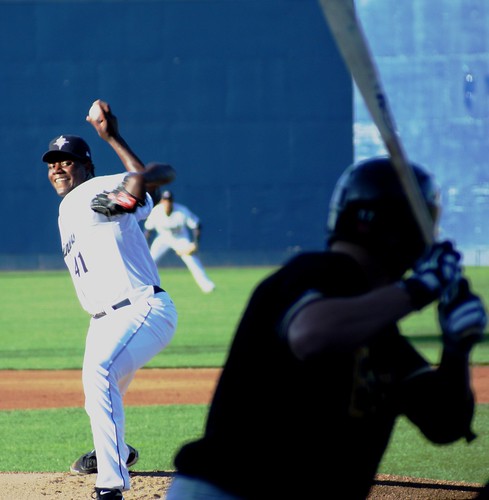
Pineda!
A Quick Note On Chemistry
By nearly any account you read from someone who spent significant time in the Mariners clubhouse last year, the place was a disaster. The Ken Griffey Jr fiasco turned a significant portion of the roster against the manager, and it was apparently quite a toxic environment. The Mariners ended up firing Don Wakamatsu and replaced him with Eric Wedge, and this spring, we heard numerous reports about the significant change in culture in the clubhouse. People were getting along again. The tension had been removed. According to almost anyone you talk to, the atmosphere in 2011 has been drastically improved over last year’s debacle.
So, given that we’re often told how important team chemistry is to creating an atmosphere where players can succeed, we’d expect to see some players taking a step forward now that the clubhouse had been cleaned up from the poisonous waste of 2010, right?
Err, no. Here are the players who have had significant roles on the team the last two years, and their performance in each year, with 2010 WAR first and then 2011 WAR second.
Felix: +6.2, +5.5
Ichiro: +4.5, +0.3
Fister: +2.9, +3.2
Vargas: +2.6, +1.9
Gutierrez: +1.9, +1.2
Figgins: +1.1, -1.2
League: +0.4, +1.3
Pauley: +0.1, +0.6
Bradley: -0.1, -0.6
Total: +19.6, +12.2
The holdovers from last year’s team performed dramatically worse this year than last year. In fact, the only guys you could say performed substantially better is Brandon League – it’s hard to argue that Doug Fister’s slight improvement is related to the great clubhouse in Seattle when he took it to another level upon being traded to Detroit, after all.
Now, there are certainly extenuating factors that have nothing to do with clubhouse atmosphere or team chemistry – Gutierrez got sick and Ichiro got bad, neither of which you can chalk up to having any kind of causation rooted in how well they like their teammates. However, it is worth noting that there’s just no evidence that anyone on the roster last year benefited at all from the team’s improved clubhouse atmosphere or better culture.
The improvements the team have made this year have everything to do with adding more talented players to the roster. If you take away the likes of Pineda, Ackley, and Bedard, this team is even worse than it was a year ago, good chemistry and all.
I’m glad the guys like each other more, and I’m sure it’s great for everyone that there’s not serious conflict between the coaching staff and the players on the team. But, once again, we’ve seen that an improvement in team chemistry just doesn’t seem to have any effect whatsoever on performance on the field. Good clubhouse, bad clubhouse, it doesn’t really seem to matter. Guys play well or poorly for a variety of reasons, but how well everyone gets along off the field just doesn’t seem to be one of those reasons.
Game 154, Mariners at Twins
Jason Vargas vs. Liam Hendriks, 5:10pm
The M’s scored 12 runs yesterday to post one of the more unlikely blowout wins in recent memory. Now they head to Minnesota to face the abysmal Twins in a match-up of the two worst offenses in baseball. I’m getting a bit tired of chronicling the M’s offensive futility (which is why yesterday’s win was so welcome) just as we’re all a bit tired of watching it. So I wanted to talk about the fielding column on the WAR chart I linked above – the one with the M’s at -3 runs and the Twins at +9.5.
The M’s position players, not content with sub-replacement-level batting had been below average fielders as well? Even the replacement-level player’s supposed to be able to catch. But then I checked the team Defensive Efficiency, which is basically the percentage of balls in play the team turns into out. The M’s are 5th in baseball, and way down in 29th, in a dead heat with the Alex-Rios-in-CF White Sox. This isn’t a post about competing methodologies in assigning blame/credit to fielders, or about the limitations of UZR or team-level defensive metrics. It just mirrors my own thinking about the M’s fielders. At times, they look amazing – and not just Franklin Gutierrez. Brendan Ryan’s capable of some great plays, Ackley’s been better than pretty much anyone expected, Ichiro’s been much improved after some early season issues. But that -3 in UZR doesn’t seem ludicrous either. This is a team that started Milton Bradley, that saw Ichiro have, er, early season issues, and that’s seen Mike Carp, Mike Wilson, Carlos Peguero and Chris Gimenez play LF. I’ve done Tango’s fans’ scouting report, I’ve looked at DER, UZR, and I don’t really know what I think of the M’s defense this year.
If there’s one thing I *do* know, it’s that the Twins will feature a bunch of interchangeable pitchers with very good control and not much stuff. So, hey, meet Liam Hendriks! He’s a righty with a fastball in the 90-91 range, a curve that’s he’s had some trouble locating, and a change-up. You’re probably going to need to sit down for this: he doesn’t miss a ton of bats and he had minor league walk rates under 6%! Liam Hendriks is apparently Australian for “Nick Blackburn.” They have a commitment to a certain pitcher type, and they’re going to find guys that fit the template wherever they can. Someone in Minnesota really, REALLY liked Brad Radke.
The Twins have the worst record in baseball and have lost 9 in a row. The Mariners are better than someone!
Line-up:
1: Ichiro
2: Seager
3: Ackley
4: Carp (LF)
5: Pena (DH)
6: Kennedy (1B)
7: Olivo
8: Liddi
9: Robinson
Forget Prince Fielder – Target Joey Votto Instead
A lot of people want the Mariners to make a big move to upgrade the offense this winter. Given the ineptitude of the team’s ability to score runs the last two years, it’s an understandable sentiment – no one really wants to see the team struggle to put up three runs a game again next year. Most of the focus on the offense’s weaknesses has been on the team’s relative lack of power, so in general, the expectation has been that the team would go for a guy who can hit the ball to the moon; specifically, Prince Fielder.
He fits a need. Jack drafted him when he was in Milwaukee. With the Red Sox and Yankees unlikely to be in the bidding, this is one of the few off-seasons where the M’s could probably win a bidding war for a coveted free agent hitter. There are reasons why you can make a case for the M’s blowing their budget to bring Fielder to Seattle, but if they do decide to make a big splash this winter (and I’m not sure that it’s the right path, but that’s another post), I’d rather they target another NL Central first baseman. No, not fellow free agent Albert Pujols – Reds first baseman Joey Votto.
Votto is what Fielder is hyped as but is not actually – one of the very best players in all of baseball. Their career WAR totals are actually very similar (22.7 for Fielder, 23.0 for Votto), except Fielder has an extra 1,600 plate appearances in his career. While they are pretty similar types of hitters, Votto is just better, and the comparison becomes somewhat comical when we look at areas like defense and baserunning. While Fielder is a good bat, Votto is an all-around superstar, providing value at every aspect of the game.
Of course, the Reds realize all of this too, and they won’t be in any hurry to move their franchise player. However, they have to see that the writing is on the wall, and Votto’s career in Cincinnati almost certainly won’t extend beyond 2013, as they just won’t be able to pay the market rate for a guy like Votto once he reaches free agency. He’s under contract for the next two seasons, but a talent like Votto is simply too valuable to let walk away for draft picks (which might not even exist by the time Votto hits FA), so at some point in the next 18 months, the Reds are probably going to have to trade him. They don’t have to trade him this winter, but with promising prospect Yonder Alonso looking capable of filling a potential void at first base, they could probably be talked into moving him for the right return.
Now, for a player like Votto, you’re not talking about a collection of prospects – to get him, you’d have to give up significant pieces off your Major League roster. For the Mariners to have any chance of landing Votto in trade, they’d almost certainly have to build a package around Michael Pineda.
I know, the last time I suggested that the M’s look into trading Pineda, a lot of you weren’t big fans of the proposal. He’s a quality starting pitcher making the league minimum, under team control for five more seasons, and is one of the few bright spots in the organization right now. He’s the kind of guy that most organizations won’t part with. And that’s exactly why the M’s could land Votto this winter.
You put Pineda on the table (and realistically, to get a deal done, you’d probably have to include a couple more players as well) and the Reds will listen. There aren’t many other teams out there who could offer up that kind of high ceiling talent who could also be a difference maker for the 2012 Reds. They lack high-end talent at the front of their rotation, and you could make a pretty decent case to Walt Jocketty that he wouldn’t be that much worse off with Pineda in the rotation, Alonso at first base, and $10 million extra to spend in free agency than with the configuration he has now, and Pineda would give the Reds the kind of long term value that two more years of Votto just can’t offer.
At the least, the Reds would be forced to consider a deal. Maybe you have to put Brandon League in the package as well. Maybe you have to add in a prospect or two. But if Jack Z calls and says Pineda is in play if they’ll talk about Votto, Jocketty isn’t hanging up.
I know many of you will say that giving up five years of Pineda is too high a cost to pay to acquire Votto when you can just sign Fielder as a free agent. But, in reality, I’d argue that the cost to acquiring and keeping Votto might very well be lower than signing Fielder.
Fielder is a Scott Boras client, and they’ve made no secret of the fact that they are looking for a contract that would pay Fielder like he’s one of the game’s elite. The Brewers reportedly offered a five year, $100 million extension and were told that they weren’t even in the ballpark, at which time negotiations ended and haven’t resumed since. Boras has instead made comparisons to guys like Mark Teixeira, who got $180 million over eight years from the Yankees, and given that he was able to get $126 million for Jayson Werth, it’s not hard to see Boras getting into the Teixeira/Gonzalez neighborhood for Fielder. In other words, you’re looking at something in the range of $25 million per year for the next 6-7 years.
Votto, on the other hand, is scheduled to make just $9 million next year and then $17 million in 2013 before he reaches free agency. Retaining him beyond those years will take a Fielder-sized contract (the differences between the two are primarily in things that the market doesn’t value, so Votto probably won’t get a significantly larger deal than Fielder as an FA), but having an MVP-caliber player at significantly discounted rates for two years gives the Mariners an opportunity to do something they probably wouldn’t be able to do if they just signed Fielder – potentially contend in 2012.
Yes, they’d lose Pineda, but they’d save $10 to $15 million in 2012 salary by paying Votto instead of Fielder, and that money could then be allocated to upgrading the rest of the roster. Yes, you’d have to use some of it to acquire a starting pitcher to replace Pineda, but Safeco Field gives the Mariners a huge advantage in acquiring useful pitchers for below market rates. Maybe you won’t get a power arm who racks up the strikeouts, but the M’s could replace Pineda’s actual on field production without blowing all of the cost savings and have enough left over to upgrade several of the other holes on the roster.
With Ichiro’s contract coming off the books after 2012, the M’s could afford to give Votto a monster extension next winter without having to massively expand the payroll. They aren’t in that position this off-season, as signing Fielder would essentially be the only thing they could afford to do, and they might even have to cut payroll in other places in order to fit him into the budget. By himself, Prince Fielder doesn’t make the M’s a good team next year, so just adding him to the current talent in the organization isn’t enough, but it probably is all they could realistically do this winter.
Votto, though, opens the door for real substantial improvement. By bringing in a lower priced superstar, the team would give themselves the flexibility to make real substantial improvements across the roster. They probably can’t catch up to Texas in one off-season, but there’s enough young talent in place that a few key upgrades along with Votto would give the team a chance to win next year.
And, in reality, this organization needs to start winning sooner than later. The fans continue to avoid Safeco Field (they’re down 200,000 in attendance compared to 2010), and engaging in another non-competitive season is likely to cut into revenues to an even greater degree. The M’s just aren’t in a position to bet the farm on the most unreliable asset in the sport – young pitching – but right now, that’s the area that the team has gathered the most talent. It might be fun to dream of a Felix/Pineda/Hultzen/Paxton rotation, but that’s the kind of dream that can blow up really fast, and an arm injury here or regression there, and all of the sudden, the team is in both short term and long term trouble.
The cost of acquiring Votto might be a prized young arm, but the cost of signing Fielder and hoping all the young pitching pans out is even greater – if the guy who is already too big to play an adequate first base begins to have health issues, or if any of the young pitchers feel pain in their arms, there’s no safety net in place, and it’s organizational suicide for the next decade or so. The Mariners can’t survive Fielder turning into Mo Vaughn – they don’t have the kind of budget that would let them build a winner around that kind of busted contract.
Betting on a 300 pound DH and a bunch of young arms to develop is a strategy fraught with risk – even more risk than trading Pineda away and watching him develop into an ace somewhere else. Yes, you might be giving up some long term potential by moving Pineda, but getting a true superstar in Votto would be enough to justify pulling the trigger.
If this team decides the 2012 roster needs a big shot in the arm, I’d suggest that Fielder isn’t a big enough boost. He’s a nice player, but he’s not really a superstar, and he’s going to be drastically overpaid this winter. If the M’s are in the mood to make a big splash, they’d be better off paying the price to acquire Joey Votto, and then using the money they saved to build out a competitive roster and make a real run at winning in 2012. Give Votto a good experience in his first year in Seattle, let him play with Felix Hernandez and Dustin Ackley, show him how beautiful the area can be in the summer, and you might even be able to extend him next winter for less than what Fielder would cost you this winter.
Prince Fielder would make the M’s offense better, but he wouldn’t make the M’s contenders. If they want to really push this organization forward in a hurry, Joey Votto is the man to target this off-season.
Game 153, Mariners at Indians
Charlie Furbush vs. David Huff, 1:05pm
The M’s final road trip kicks off with a make-up game in Cleveland; the M’s and Indians were rained out a couple times in May, and while they made up one with a double-header, they’re making up the other one today.
Shifting a game from May to September seems like an easy upgrade in watchability; the M’s in May were often difficult to watch. Carlos Peguero and Mike Wilson job-sharing left field. Jack Cust’s DH death-rattle. Chone Figgins. The M’s position players, collectively, put up -0.3 fWAR in May, with a wOBA of .271 and below-average fielding. Their strikeout rate was the worst in the AL, and their walk rate was below average, and they had the worst ISO in baseball.
Flash forward to August/September, and the team looks a lot different. Dustin Ackley, Mike Carp, Trayvon Robinson, Casper Wells are the rookies now, and the team’s ISO’s up substantially from May. But while this team is better, it’s got a long ways to go to get to something like “decent.” Over the past 30 days, over 1,000 plate appearances, the M’s team wOBA is .292. Their strikeout rate is the worst in baseball, easily worse than every NL team. Their walk rate’s gotten worse, and while their ISO’s better than it was in May, it’s still terrible.
This isn’t to say that they’ve made no progress. Their fielding certainly looks a bit better, but let’s be honest: the move that helped the M’s defense the most was DFA’ing Milton Bradley. It’s also completely true that bad young/developing players are preferable to bad aging players. I’d much rather watch Mike Carp at DH than Jack Cust (or Adam Kennedy). But this is the insidious thing about the M’s of 2010-2011: they’ve been so bad, they make you conflate incremental improvement with radical transformation. This team is much, much better to watch, and they’re better in an absolute sense. They’re also baaaaaad.
The strikeout issue is significant. It was easy to explain away the whiff problems when Carlos Peguero was an everyday player, but all of the non-Ackley newcomers have major contact issues as well. This isn’t news; Dave’s mentioned it, and everyone identified contact as a problem for guys like Trayvon Robinson and Casper Wells before they played an inning for the M’s. But what to make of Mike Carp’s transformation from patient, unexciting gap hitter to a free-swinging slugger? Mike Carp’s contact rate is well below league average; it’s almost as bad as Wily Mo Pena’s. Sure, Carp is much, much better at laying off pitches out of the zone, but he’s also worse at making contact with strikes. What problem’s ‘better?’
In the end, I think the M’s are now much more talented than they were (though I admit that the team’s relative youth might be skewing my perception of their talent), but to become an average baseball team, they need to develop. That is, the player development group now has the responsibility to turn a group of players with horrific approaches at the plate into a true major league offense. Jack Zduriencik did what he could to improve the org’s talent, but it won’t mean anything unless Pedro Grifol’s staff and the M’s coaches can transform the hitters.
That’s fine; that’s what they’re paid to do, but from here, the task looks monumental. Part of the problem is that I don’t have a good sense of what’s reasonable to expect from a player development group. How much of a player’s approach is teachable? When is it too late? What’s an ‘average’ level of improvement? Who are the major success stories? I don’t know. I just know it’s imperative that they have some success, because the M’s don’t have anywhere near enough money to patch their holes through free agency, and counting on Zduriencik to make organization-changing trades yearly seems like asking a lot. Please get better, Trayvon, Casper, Mike, Justin, Kyle, Alex.
Today’s line-up features Chris Gimenez in left field because why the hell not? It doesn’t feature Dustin Ackley, so if you were worried that you couldn’t catch this one, well, don’t.
1: Ichiro
2: Rodriguez
3: Carp
4: Olivo
5: Seager
6: Pena (DH)
7: Liddi
8: Robinson (CF)
9: Gimenez (LF)
Wow.
Game 152, Rangers at Mariners
Felix Hernandez vs. Matt Harrison, 1:10pm
Happy Felix Day!
The rubber match of this game series features the Rangers’ Matt Harrison, a lefty with a plus fastball, a curve, change and cutter. Harrison’s the latest in a string of Ranger players to suffer from thoracic outlet syndrome, in which the nerves leading from the arm (or the subclavian artery/vein) are compressed by the rib and collar bone leading to numbness and pain. Like Kenny Rogers, Hank Blalock and others, Harrison had his first rib removed in 2009. And, like Rogers, when he came back, he’s had noticeably better velocity. He averaged around 91 before the surgery, and he’s up to 93 now.
He came back in 2010, and while his velocity was better, his command was terrible – his K% was 12.9% and his BB% was 11%. This year, he’s greatly improved his walk rate, and that’s helped him post a 3.64 FIP and 3.4 WAR so far. He’s still not a guy who misses a lot of bats; he’s got a below-average contact rate and swinging-strike rate. But he’s got enough stuff that he’s not just grooving fastballs. His two-seamer and change-up help him post solid GB rates (and keep his HRs under control). Add it up, and he’s an exceptional 3rd starter by pretty much any metric you want to look at.
Felix is better, though.
Today’s line-up:
1: Ichiro
2: Rodriguez (SS)
3: Ackley
4: Olivo
5: Carp
6: Pena (DH)
7: Robinson
8: Liddi
9: Saunders