
Pitch FX View of Spring Training II: Shawn Kelley
Last week, many of the beat reporters talked about two developments regarding Shawn Kelley. First, he’d be throwing more pitches/innings in his next few outings to stretch him out a bit, and second, he was going to revive the change-up he used as a starter for the Austin Peay Governors (a pitch he’d shelved after turning pro). He threw ten of them in his abbreviated start against Kansas City – how’d it look?
Pretty darn good. The pitch averaged 83 MPH, or about 7 MPH less than his fastball. Second, its vertical break isn’t all that different from his fastball, which is normal for change-ups, but it still distinguishes the pitch from the ‘change-ups’ with splitter-like sink like Tim Lincecum’s or Zach Greinke’s. His control with the pitch is already exceptional – he’s always around the plate with it (9/10 strikes), and he kept the ball from the top portion of the zone. He gave up one hit on a change, a single to Billy Butler.
Here’s a chart of his location with the change-up, with the strikezone in red (Pitch fx strikezone, not the ‘rulebook’ strike zone). There are some exceptional pitches on the black away from lefties, and there are a few scarier looking pitches in the heart of the plate. To be fair, most of these came against hitters who can’t hit change-ups (Jose Guillen and Josh Fields, I’m looking at you). So the optimistic view is that he was pitching to the scouting report; the negative view is that he made some bad pitches against the right team.
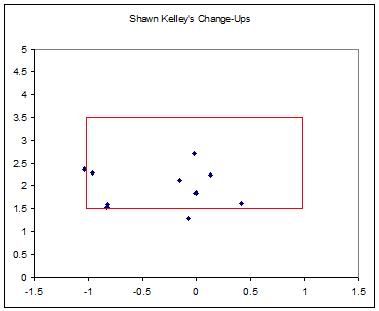
Remember though, this is ten (10) pitches. This means nothing. If you like Kelley, this is encouraging stuff – mostly down in the zone, not hit hard at all, etc. If you think it’s a bit late in the spring to be adding new pitches, you can point to what look like some mistakes. This isn’t all that meaningful, but it’s fun to look at and to speculate about. So far, the quotes from Kelley about having a lot of confidence in the pitch are borne out in his control. We’ll have to see about the results, but so far so good. Incidentally, why on earth did the M’s ever tell him to abandon this pitch?
Cactus League Game Thread, 3/26/2010
Last time out, French has been working on his change-up, and ran a 11/1 ground/fly ratio, which is kind of absurd considering that his ratio was at 0.37 in Detroit last year, 0.60 in Seattle, and about 0.71 before Sunday’s game in spring training. More groundballs makes French pretty interesting.
Geoff Baker also suggests that Tuiasosopo has made the team as a back-up infielder and that the team can live with him at short one or two times a week. I’m not really in agreement with the latter part of that assessment.
Lineup:
RF Ichiro!
2B Figgins
3B Lopez
DH Griffey
LF Byrnes
CF Gutierrez
1B Garko
C Johnson
SS Jack Wilson
LHP Luke French
Bad News, Meet More Bad News
Baker and others have the news of the day, and it ain’t great. Cliff Lee is going to take five days off before throwing again, so realistically, his entire spring training is gone. He’s definitely going to need a DL stint, and by the time he gets stretched out enough to pitch in a big league game, it’s going to be the end of April or early May.
Beyond that, Wak comes pretty close to confirming the growing suspicion that the Mariners are going to make room on the team for Mike Sweeney because of how he’s hit this spring. Sweeney will displace Ryan Garko on the 25 man roster and serve as a part-time DH against lefties and play first base sparingly, as Kotchman will not be platooned.
Put chemistry and feeling goodness aside for a minute – this creates all kinds roster problems for the M’s. Now, against LHPs, you’ve got Sweeney, Bradley, and Byrnes for two spots – DH/LF. Bradley kills lefties, so you don’t want to take him out of the line-up against southpaws, but Byrnes’ role on the team is lefty mashing outfielder, and pushing Bradley to LF against LHPs takes away his playing time.
So, not only is Sweeney going to remove Garko from the roster, he also is going to take playing time away from Eric Byrnes and force Milton Bradley to play the field more often. Neither of those are positives. Plain and simple, Mike Sweeney makes this team worse.
Now, if you want to argue that the pies in the face and the jokes and all that stuff make up for it, fine, make that argument. But remember, Mike Sweeney’s been the best guy in baseball forever, and teams he’s been on have finished over .500 twice in his 15 year career. Last year’s 85 win Mariner team posted the best record of any team that Sweeney has ever played for. If his personality was vital to a winning team, don’t you think he may have actually played on one or two of them?
Of course, it’s not fair to blame Sweeney for having lousy teammates in Kansas City, but I’ll still suggest that you can’t make an argument that having Sweeney on the roster leads to lots of wins that we can’t measure when there’s no history of teams he’s been on playing better than you’d expect. He might be a lot of fun to be around and great for the clubhouse, but in the end, good teams win and bad teams lose. Mike Sweeney hasn’t made any bad teams good by hitting his teammates in the face with pies.
The Mariners have already wasted one roster spot on Griffey in the name of clubhouse chemistry. Now, it sounds like they’re going to waste two roster spots on clubhouse chemistry. When Kotchman is facing a tough lefty in a high leverage situation or the team can’t pinch hit for Jack Wilson with the bases loaded, you can thank the team’s desire to have both Griffey and Sweeney around. There are consequences to carrying these guys, and you’ll see them play out on the field.
Let’s hope the M’s can win a lot of games in spite of Sweeney’s presence, because otherwise, we may look back at the way the end of this roster was put together with an awful lot of regret.
3/24 News/Links
1: Ken Rosenthal writes a fairly level-headed piece on why the M’s might face some trouble in 2010. This won’t be a shock to anyone here (Bedard is hurt? Wha?), but the article seems designed as a response to some of the plaudits the M’s have received in the national print media. Mind you, this article now finds its place amongst an equally voluminous collection of “the M’s haven’t won anything yet” pieces – like this one. I don’t think anyone here had the idea that the M’s are a 100-win true-talent team, so the article is fine as far as it goes.
One thing that caught my eye though was the quote from an unnamed scout about Milton Bradley. According to whoever it was who talked to Rosenthal, Milton Bradley doesn’t look so hot this spring. “I’m afraid he can’t play anymore,” says Scout X. This is the spring training yin to “He’s in the best shape of his life”‘s yang. For every hot-shot pitcher turbo-charged by some unexplained mechanical tweak (which scouts think will make him unhittable) you’ve got the guy with a hole in his swing, who fights what seems to scouts like a quixotic battle. Someone needs to track these assertions. I don’t mean to suggest that the scouts are wrong – if they’re right, this is really important info. If you can always find one guy who thinks he’s found a flaw in Pujols’ swing, well, that’s interesting too, but I’ll take these reports with a grain of salt. In this case, the scout is helpfully specific: Bradley apparently has trouble with pitches up in the zone (“above his hands’). It’ll be fun to see if this holds true.
2: How can fans keep track of something like that? Well, you could make heat maps with MySQL and R. That’s laudable. Alternatively, you could outsource that work to Craig Glaser and friends. Sabometrics has a new iPhone app that gives you a heat map for every player in baseball using 2009 pitch fx data. It’s called Batting Goggles, and it just came out this week. So, how does that scout’s observation about Bradley look through Batting Goggles? Actually, it looks pretty good – Bradley struggled with pitches up in the zone in 2009 (but killed pitches anywhere in the middle third). What does Ichiro look like in this view? Still amazing!
Read more
How Good Will The M’s Defense Be?
Last year, we saw the power of what a great defense can do for a team. Led by Death To Flying Things, the M’s ran out an historically great defense, catching everything that was put in play, and leading the league in ERA despite a so-so pitching staff. It is no secret that the M’s have put an emphasis on defensive value, and their off-season acquisition of Casey Kotchman, as well as the re-signing of Jack Wilson, continue to push that trend forward.
A year ago, the Mariners had the best UZR in baseball, at +85.5. Here’s how that broke down by position:
First Base: +3.4
Second Base: +2.4
Shortstop: -3.0
Third Base: +20.9
Left Field: +17.0
Center Field: +33.3
Right Field: +11.7
The M’s outfield defense was one of the best of all time. The infield was carried by Beltre/Hannahan, while the other three spots were just about average. The team made upgrading the infield defense a big part of their off-season, so can we expect the team to be even better defensively in 2010?
No. Realistically, we probably can’t even expect them to come close to matching last year’s totals.
We talked about this with regards to Gutierrez at the end of last year, but regression to the mean is a powerful force, and history shows that it is almost impossible to have the kind of season that he just had two years in a row. Gutierrez is a great center fielder, but he’s not a +30 center fielder. They simply can’t expect to get the same kind of value out of his glove as they did a year ago.
It’s not just Gutierrez, either. The Mariners won’t be getting +21 defense from third base again (the dropoff from Beltre to Lopez is going to be hard to watch, honestly), nor should we expect the Bradley/Byrnes platoon to put up anything near a +17 in left field. Here is how I would project the M’s expected defensive value in 2010, position by position:
1B: +5: Garko drags Kotchman down a bit
2B: +5: Figgins will eventually adjust to 2B and play well, but it might take a few months
SS: +5: Wilson’s a really good glove guy, but he doesn’t play 150 games a year.
3B: -5: Lopez will be okay at third, but probably a bit below average.
LF: +5: Bradley’s okay, but nothing special. Byrnes should be pretty decent.
CF: +20: The best projection we can give anyone. +30 won’t happen again.
RF: +10: Ichiro will eventually slow down. I don’t think it’s going to happen this year.
The total for those positions: +45. The Mariners, after adding Kotchman and bringing back Wilson, should be expected to lose nearly 40 runs of defensive value from their 2009 squad. You can quibble with some of the numbers if you want, but you’re not going to be able to come up with a projection much different – maybe you’d have them at +30 or +60 if you’re really optimistic or pessimistic, but it’s going to be in that range.
The M’s are going to be a really good defensive team, but last year, they were historically great. You can’t expect that again, even with a revamped infield. Don’t consider it a letdown if the M’s don’t match last year’s amazing UZR numbers – it’s just not a realistic expectation.
Kevin Frandsen
Sometimes, the timing of stuff like this is hilarious. You know that I’m in favor of acquiring a new utility infielder while Hannahan is on the shelf, rather than just giving the job to Tui or Josh Wilson. And, as we mentioned, the move to 12 pitchers means that it would be very helpful if that guy could also play some outfield. Additionally, since Hannahan’s injury isn’t likely to keep him out forever, you’d ideally like to get a guy with who could be optioned to the minors after the team gets healthy again, providing depth and a short term fill-in without forcing them to make a move for a guy they might lose in a month.
Enter the Giants, and their willingness to trade Kevin Frandsen. Frandsen fits every aspect of what the M’s should be looking for to a tee. He’s a middle infielder who has played everywhere, including the outfield, and can handle himself defensively all around the diamond. He’s a high contact hitter who has flashed some potential in the minors, and was a pretty good prospect before he tore his ACL in 2008. He’s got some gap power, so he’s not totally useless at the plate. He makes the league minimum, he’s 28, and he has an option remaining. And the Giants are actively shopping him around the league.
Sseriously, this is a no-brainer. Frandsen is an upgrade over the current options while waiting for Hannahan to recover. He gives the team a legitimate reserve middle infielder, something they don’t really have right now, and if you want to give Hannahan the job back when he’s healthy, Frandsen can go to Tacoma and serve as depth while waiting for Jack Wilson to get hurt. He is the ideal candidate for the job, and the Giants are trying to trade him.
Seems like the most obvious move ever. Let’s hope it happens.
The Pitch f/x View of Spring Training
We’ve talked about the cliches you hear every spring training – player X is in the best shape of his life, player Y has new-found focus, etc. One that’s actually useful (if only occasionally) is hearing that a pitcher’s learning a new pitch. Jeff Sullivan gives a quick run-down on all of the AL West pitchers trying something new here, and I thought it might be useful to take a look at some of the new pitches Mariner hurlers are testing out in Peoria through pitch fx. It’s all well and good to hear that a pitcher’s trying something new, but it’s much more interesting when you can see if the new pitch actually moves differently.
There are a number of huge caveats here. First, pitch fx is only in use in two ballparks in Arizona, which takes the already minuscule samples of spring baseball and then halves them. Second, this doesn’t really help us get to results, which is ultimately what matters; the samples can only tell us about movement, not if the pitches are actually, you know, good. Third, there’s an awful lot of guesswork involved here. No pitcher throws each pitch consistently; each pitch has a range of possible breaks, so picking out the pitch types isn’t a foolproof process. Fourth, pitch fx has been a little…weird at times. It may not be calibrated quite right, but personally, I’ll take what I can get.
First up is Ryan Rowland-Smith:
Shannon Drayer tips us off that the Aussie’s working on a cutter to help get righties out (his xFIP versus righties was nearly a full run higher in 2009 than his xFIP versus lefties, which makes sense given that his best pitches are a curve and slider). How’s it going? Well, this is tougher – RRS’s fastball movement has been a bit more variable, and that makes separating the cutters from FBs (the velocities are quite similar) more art than science. Basically, I’m looking for horizontal movement that’s *significantly* different from his FB’s horizontal movement – that’s the point of the pitch after all. In this case, I’m looking at pitches with negative horizontal movement, meaning a ball that breaks in to a righty. His normal fastball tails a bit away from righties (most all pitchers’ fastball tail a bit away from same-handed batters). You can visualize this by looking at the first graph here; from the top view, the cutter should move like his slider, albeit with fastball-like vertical break.
Well, so far, he’s thrown a handful of cutters to show that he can generate that slider-like horizontal movement. Unfortunately, his FB movement’s all over the place, so I could definitely be excluding a lot of less-successful cutters. Still, it’s nice to see that he’s actually able to generate distinct movement with the pitch without sacrificing a lot of velocity – and though the sample is pretty meaningless, his results in that ugly start against Colorado last Thursday were comparatively solid. As the samples increase, it’ll be great to see if his platoon splits improve. We’ll get a bit more data today, as Rowland-Smith gets the start for the M’s against the Angels.
As an aside, RRS was clearly working on his cutter and slider in that start against the Rockies, as he essentially abandoned his curve ball. He threw a grand total of two of them in his 2 and 2/3 IP, 66-pitch outing. *This* is why people say that spring training stats don’t matter. The curve has been Rowland-Smith’s best pitch (according to fangraphs pitch-type linear weights), and he just didn’t use it – that colors the way I look at his line. And in this case, it’s much less likely that pitch fx botched the pitch classification – RRS’s curve looks totally unlike his other pitches from a velocity or break standpoint.
Hannahan To Start Year On DL
No big surprise here, as we talked about this last week, but Geoff Baker reports on Twitter that Jack Hannahan won’t be healthy enough to start the year on the team. That leaves the M’s with a few options:
1. Go with either Tui or Josh Wilson as the utility infielder until Hannahan is healthy enough to return. There are problems with both, as Tui can’t play shortstop in any reasonable fashion that resembles a major leaguer, and Josh Wilson can’t hit while also just being okay defensively. Given Jack Wilson’s lack of durability, the M’s would have to be willing to start these guys at least once a week and probably more until Hannahan was healthy, and so you’d be essentially going with a replacement level SS when Wilson isn’t in the line-up.
This also would essentially eliminate any chance Wak would ever pinch hit for Wilson, as the defensive downgrade caused by removing him from the game would probably outweigh any offensive gain by subbing in a bench bat in any inning besides the 9th. Wak is already a bit shy about pinch-hitting, but not having a legitimate backup SS on the roster would basically rule out pinch hitting for Wilson as a strategy. That may prove frustrating.
2. Make a trade. I advocated for this last week, and I still think it’s the best idea. Hannahan lost his entire spring training opportunity to prove to the coaching staff that he could play short, and I don’t know that Wak is going to want to just throw him out there at a position he’s rarely played during the season. I just don’t see the M’s being willing to take a gamble on his defense at a position they haven’t seen him play more than a handful of innings at. Fair or not, this injury may have torpedoed Hannahan’s shot at being the sole reserve 3B/SS/2B. There’s no one else in the organization capable of handling that role at an acceptable level for a contender. So, the M’s need to go get someone who can.
And, to throw an extra wrinkle into the mix, it would be great if that guy could play the outfield too. Given that the team will now probably end up carrying 12 pitchers to start the season, Langerhans is probably off the team as well. Especially if they lose him on waivers, outfield depth in the reserve role becomes a bit of a problem (you don’t want Saunders serving as a defensive replacement in the big leagues). So, now, not only do the M’s need a utility infielder who can play short, they probably need that guy to be able to at least fake it in left field from time to time.
23 players in MLB played at least one game at SS/3B/OF last year, and besides Ben Zobrist, it’s a pretty uninspiring list. As expected, it’s mostly a bunch of no-bat scrubs who wouldn’t be any kind of real improvement over either Tui or Wilson. The guys who do hold some appeal, such as Jerry Hairston Jr or Omar Infante, aren’t available.
There is one interesting guy on the list who you may be able to get – Jayson Nix. He’s fighting Brent Lillibridge for the 25th roster spot on the White Sox, and he’s not Ozzie Guillen’s kind of player at all, but he’s got his uses. He’s got power for a little guy, can run a bit, experience all over the field, and wouldn’t embarrass himself defensively. Just 27 and cheap, he’s kind of like a right-handed Hannahan, just without the terrific 3B defense.
If the M’s could pick him up relatively cheap, much like they did with Hannahan and Langerhans a year ago, he could be a useful stopgap and part time player until they figure out how the roster is going to shake out once everyone’s healthy. This team isn’t currently built to withstand a whole bunch of injuries, and adding a guy like Nix could help them make it through April with a four man bench.
If the White Sox asking price is outrageous, it may not be worth it, but it’s a tire worth kicking. I wouldn’t settle for either Tui or Josh Wilson unless I absolutely had to.
Should You Worry About Cliff Lee?
Short answer: Yes.
Long answer – pitchers are really unpredictable. Two years ago, Lee was a back-end flyball guy coming off a terrible year that saw him end up in Triple-A. He was fighting for a rotation spot – he added a cut fastball, improved his command and velocity, and won the Cy Young. The moral of the story with projecting pitchers is you just don’t know what they’re going to do, no matter how well or poorly they pitched before.
But there a few things we do know about pitchers, and one of them is that they don’t do particularly well when they’re less than 100 percent. Even a minor injury to some non-arm part of their body can cause them to change their mechanics, lose velocity, screw up command… remember Felix after he came back from his DL stint in 2007? He was tentative, he didn’t have very good location, and he got hit pretty hard for the first month after he came back.
So, what does this abdominal injury mean for our expectations of Cliff Lee’s season? Well, first off, there’s a good chance that this could be a problem beyond the day he’s activated from the disabled list (assuming he goes on it, which I think is a pretty decent assumption). If he misses a couple of weeks, there’s still going to be an issue of potential lingering effects. I wouldn’t count on seeing the dominant Cliff Lee at any point in April. Our expectations for what he’s going to produce in the first month of the season have to be scaled back quite a bit, even if he only misses a start or two.
I don’t mean to be Mr. Doom And Gloom here, but this is a pretty big deal. Any time a pitcher gets hurt, it isn’t standard operating procedure. He’s going to miss basically all of spring training between this and the foot thing surgery earlier, and pitchers are unpredictable anyway. The M’s built a team that basically has to lead the league in run prevention in order to win, and one of their main assets at keeping hitters off the board now comes with a red flag.
This isn’t a death knell or anything, but it has the chance to be a real problem. If the M’s are going to win the west, they need Cliff Lee to pitch like an All-Star, and if he’s pitching through a lingering injury, that just became a little less likely…
Cactus League Game Thread, 3/21/2010
Other news and notes besides the big one this morning:
Stone: Kotchman the probable #3 hitter for the M’s? Suddenly, I am very curious about what Elliott says about his horizontal versus vertical strength.
Baker: Hill, Fields, Vega, Esquibel, Merry (Jorden, not Jon) combine for double-A no-hitter. Washburn not in touch.
LaRue: M’s win after Wakamatsu preaches focus, and Felix decides to be Felix.
Arnold: Kelley credits regained confidence in change-up for recent strikeouts.
Lineup, from the News Tribune Blog
RF Ichiro
2B Figgins
1B Kotchman
LF Bradley
DH Sweeney
3B Lopez
CF Byrnes
C Moore
SS Wilson
“Probably not in the fifth starter race” LHP Luke French against RHP Jared Weaver.