
2019 Tacoma Rainiers Preview
Writing what amounts to 14,000+ words of previews over a short period of time ends up being rather draining on me, to say nothing of the deletions that are needed to streamline reading. I say this as a flimsy apology for free and detailed content. The Rainiers are really a team worth heading down I-5 to see, I just end up loopy and more prone to digressions.
The rotation features two potential major league starters, one MLB vet, and two guys who haven’t made it yet but seemingly could with the right improvements. The bullpen will become more or less familiar depending on the needs of the parent club and has quite a few arms that are viable or near viable major leaguers. Catching, I think is geared more towards pitching development, which again, isn’t bad at this level. There are a few exciting infield starters and the outfield is really, really fast and thus will be limiting the variables there for the flyball pitchers on the roster. So go visit Cheney Stadium, unless the Mariners continue their absurd run, in which case, do it anyway but wait for an off-day or a road trip.
2019 Arkansas Travelers Preview
Here we go for a third season in Arkansas with the Travelers. They have a possum and a horse for mascots. Big fan. More of the possum than the horse. Big on hissing at stuff and playing dead to avoid threats. What were we talking about?
This team is, like the West Virginia squad, a rather talented group and so I found myself with a bit to say. Sure, the catching is a repeat of last year, but that may bring with it some added polish with which to direct the pitchers. For the rotation we have two, two-and-a-half guys who could be strong contributors if things break right for them, though the others are nothing to dismiss. The bullpen has a few standouts and is certainly a diverse bunch of velocities, angles, and ways of getting results. The infield has Evan White plus some likely producers, but the outfield could feature three viable major leaguers in any given day and that’s exciting. Potential and aptitude make for some entertaining baseball.
2019 Modesto Nuts Preview
This roster is… uh… familiar? Of the twenty-five players listed for opening day, fourteen of them had already played on the 2018 Modesto squad, which went 62-78. The Mariners have restocked parts of the system and look to be fairly talented throughout, but this one looks to be filled with miscellany.
The rotation appears to be a blend of “consistency” and “baffling inconsistency,” which I’d expect to lead to lots of ups and downs. The bullpen, when good, has a chance to be quite good, so leads if gained could be retained. Catching, or at least the starting catcher, is probably the biggest star on the roster. The outfield is full of guys who were formerly well-regarded. The infield is cool if you like Gritty Dudes with Dirty Uniforms and Intangibles and less so if you don’t.
2019 West Virginia Power Preview
This was not an offseason move that I was anticipating. Sure, I had been goading the Mariners for years to buy a Cal League franchise and stop with all this High Desert nonsense, but the quirks of the Midwestern League, with its routine early-season snow-outs, had become the price of doing business for me. Moreover, I liked the Midwest League, and had been friends with the Wisconsin Timber Rattlers broadcaster since back when they were an affiliate. Now we’re operating a full-season affiliate in a part of the country unfamiliar to me outside of our brief dalliance as the parent club of the Pulaski franchise in the Appalachian League. Now I have to commit to memory a whole new set of park factors.
The West Virginia Power will be among the more exciting teams in a system that can now use that adjective without a smirking irony. Even without Stowers, the outfield is poised to be a star attraction the likes of which we haven’t had in a while. The rotation has some high potential in spots and is competent overall. For catching, we might have the second-best starter on the farm, or one of the more interesting ones. Bullpen could be good, but has a few question marks. The infield looks to be defensively solid and offensively hit or miss. Overall, the look is that of a competitive team with a few fun top prospects.
Game 8, Angels at Mariners
Marco Gonzales vs. Trevor Cahill, 7:10pm
The M’s are 6-1 and deservedly so. Sure, their bullpen is, uh, a work in progress, and their rotation doesn’t look great, but none of that matters when opposing teams step into the launchpad that is T-Mobile park and face a line-up that leads MLB in WAR. This is fun, and this is a great time to not worry about the sustainability of the performance and just revel in the pure weirdness of it all.
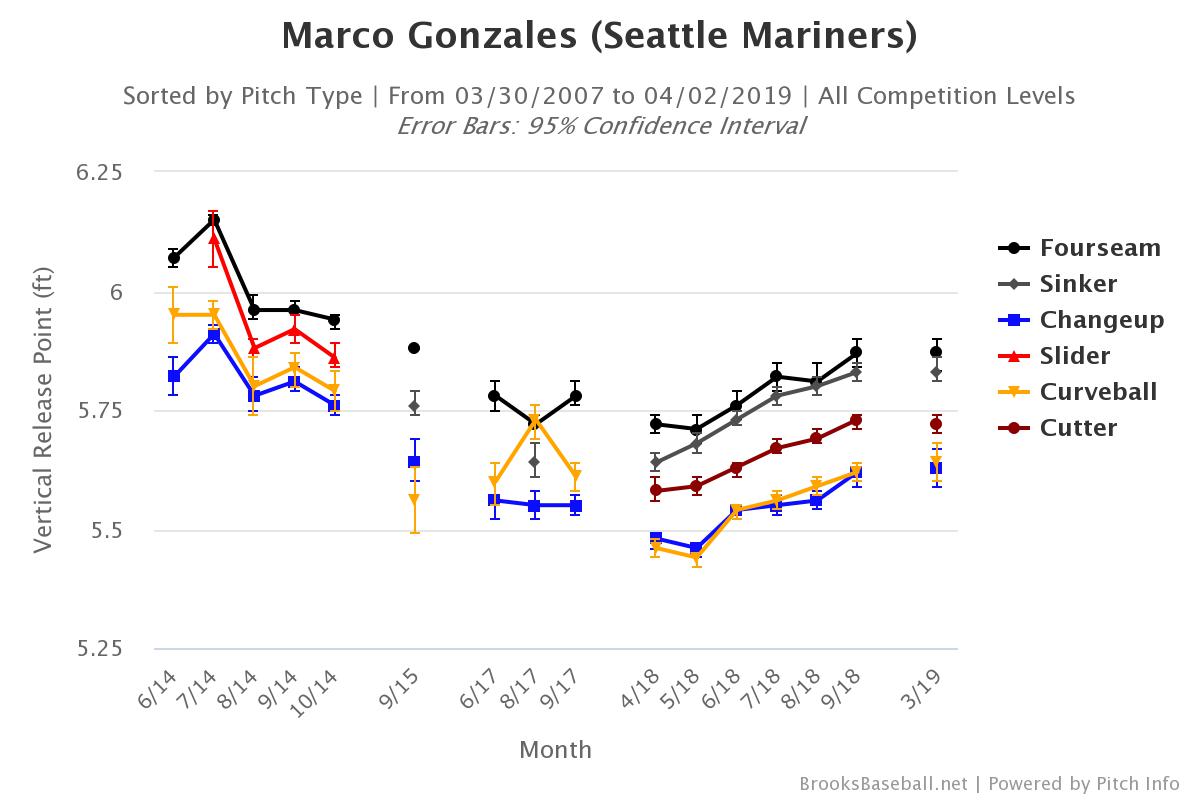
The M’s are fun, but you know what’s even more fun? When you’re good on both sides of the ball. I remember 2000-2001; I know it can be done. To do that, the rotation’s going to have to get better, and that means some improvement from the M’s Marco Gonzales…who’s 2-0. I don’t want these posts to just be a drum-beat of negativity about his velocity, but in my defense, have you seen his velocity these days? This brings up something when we talk about the M’s development of Marco. So many of the specific changes/improvements given for his success have turned out to be baseballing red herrings. There was his supposedly lower arm-slot, but here, look at his vertical release over time:
There was the matter of his improved velocity, which was legitimately true in 2017, but since then…well…:
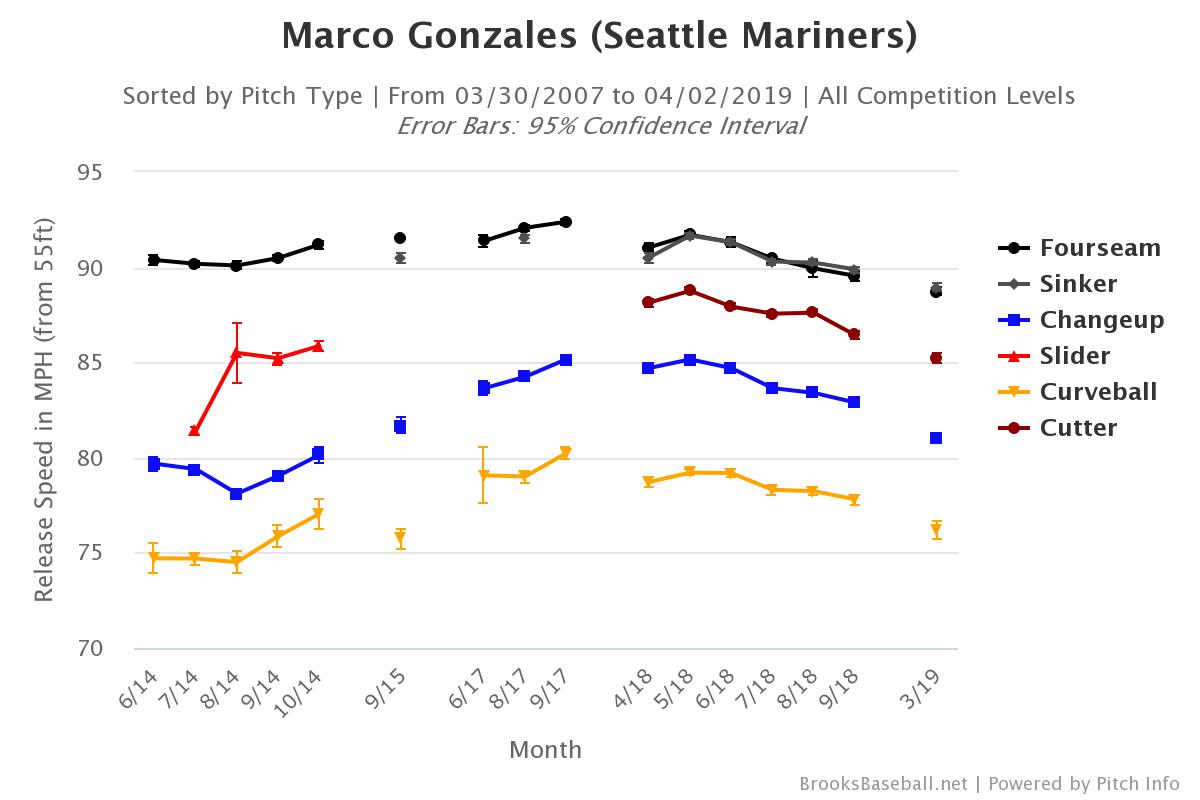
His new cutter was going to be the key to his success, and that’s *partially* true, but much of his improvement came from two other changes. First, he bifurcated his fastball into a more traditional four-seamer – much straighter than anything he’d thrown before – and tried to accentuate the run on his old fastball to create a sinker. That led to fewer HRs-allowed on FBs in 2018 than in his abbreviated 2017 campaign. Second, his curveball really did look like a new/better pitch, and it was critical to his 2018. Until it stopped being as effective around the middle of the year. HRs will be an issue, but he’s addressed a lot of it, and if he can maintain some of the gains he’s made, he won’t be another Wade LeBlanc – someone whose HR problems keep him perpetually on the edge of playability. Instead, the bigger issue is that batters are swinging and making contact on pitches they used to watch, and that’s driving up his hits-allowed.
Years ago, the M’s had an unheralded prospect who threw 89 but didn’t walk anyone. Some thought this would make him a viable #4-5, whereas others saw an inflated hits-allowed total and thought that the low walk rate was driven by the fact that he’d just throw fastballs down the middle. Both ended up being right some of the time. His name was Doug Fister, and while a good strand rate got him through his first half-season, he gave up a ton of hits early in his career. In 2010, at the peak of the deadball era in Safeco, that was OK, as he didn’t give up HRs and was thus a perfectly fine #5 starter. But something clicked in 2011, and his hits-allowed dropped (it didn’t hurt that his velo ticked up a bit), and he took his talents to Detroit and became a minor star for a while, only faltering when his stuff faded just a bit and the hits kept on piling up.
As a first-round, college-trained hitter, Gonzales kept his hits below his IP on his way up the chain with the Cardinals, and kept it that way in his initial call-up in 2014. But something happened in 2015 and that ratio flipped big time, sending his runs-allowed sky high. The same thing happened in 2017; while the HRs were the proximate cause of his poor season, the wider context was that he allowed a lot of baserunners, and that made each HR (and each successive hit) more damaging. That wave subsided a bit in 2018, as he posted more IPs than hits thanks to a reduction in his BABIP from “ridiculously high” to merely “high.” The problem is that he’s got to bring that BABIP down, and he’s not going to have a lot of help from his defense this year. If he’s going to give up this many baserunners, he’s going to be vastly overrated by, say, Fangraphs WAR. He’s given up 16 hits in just under 12 innings, and I’d like to see evidence that his old curve is back or that he can halt his velo declines. It sounds weird to say about a pitcher who’s won both of his starts thus far (though 21 runs scored in those two games helps a ton), but I feel like Gonzales could go south in a hurry if some of these peripherals don’t change.
The Angels Trevor Cahill was one of the A’s utterly improbable successful starting pitchers last year, but he was only so-so in his first start for the Halos. Meanwhile, the A’s are doing it again, as even Aaron Brooks – SERIOUSLY, Aaron Brooks – was great for them the other night and Mike Fiers and company shook off their Tokyo shellacking and have pitched well. But back to Cahill: he boasts a true starter’s repertoire with two fastballs, a cutter, a curve and a change-up. None of them are all that eye-popping, and he’ll top out at 92-93, sitting 91. When he’s on, he can get a lot of ground balls thanks to his sinker (his primary fastball) and the natural movement of his other pitches. He seems to be going with a cutter this year, which he hadn’t thrown in a few years (he used a slower slider instead). That’s not a new pitch for him – he picked it up with the D-Backs in 2012-13 – but it’s been a while. More importantly, that pitch does NOT have the movement profile of a pitch that’s going to get grounders. His GB% may drop if he maintains this pitch mix, though maybe that’s what the Angels want seeing as their home park suppresses HRs. It may not be what you want tonight, when you’re facing the Seattle DingerMen in a park that’s playing remarkably HR-friendly for some reason.
1: Smith, CF
2: Haniger, RF
3: Santana, LF
4: Bruce, 1B
5: Encarnacion, DH
6: Narvaez, C
7: Beckham, SS
8: Healy, 3B
9: Gordon, 2B
SP: Gonzales
Game 7, Angels at Mariners
King Felix vs. Chris Stratton, 7:10pm
I don’t know how many more times I’ll get to say it, so to all of you, a very happy Felix day. The M’s rotation has settled in as probably the lowest-velo group in the game, just as they did last year. When Marco Gonzales was acquired, there was a lot of talk about his improved velocity, but that’s all gone now. Mike Leake’s throwing softer, too. Wade LeBlanc never really threw hard to begin with. It hasn’t hurt them per se, Leake is pretty much always Leake, and Marco broke out last year despite that troubling drop.
Felix, though, simply couldn’t adapt to life at 90-91. It’s too bad, because the great high point of his career came AFTER a huge drop in velo, when he slid from 97 to 94-ish. The further drop reduced his margin for error and sapped the effectiveness of his change (though it’s really his FB that’s been tattooed the past few years). The M’s have tried working with him on pitch mix, on different fastballs, and maybe developing a cutter. That’s been…not terribly successful, and as much as I love him, Felix probably shares a modicum of blame there. But the bigger thing that I’m not sure has been tried is just reversing the velo drop. That would’ve sounded like alchemy a few years ago, but it is very much a commmonplace practice now. Brandon McCarthy reversed his regular old age-related velo declines and gained several MPH later in his career. Charlie Morton, too. This isn’t crazy, and it’s possible it’d be more in line with how Felix wants to compete, and to be fair, maybe they’ve tried. But on a staff where velo drops are common and the team seems to put less value on pure miles-per-hour than others, I’m not sure it’s going to happen. Prove me wrong, M’s!
Chris Stratton has been a member of the Angels for roughly 10 days, having come over from the Giants late in spring training after losing his rotation spot. He was traded for a fairly fungible middle-inning reliever, which says a lot about how back-end starters with MLB experience are valued right now. Stratton throws 91 or so with a straight four-seamer, but he’s attracted some attention due to a freakishly high spin-rate curve ball, his best pitch. It’s generally been effective, or at least MORE effective than his other offerings, but that was a low bar in 2018. He wasn’t bad in 2017, so it’s a great pick-up by Anaheim who saw SF with a roster crunch and offered to help them out by sending a pitcher who had MiLB options remaining. A young-ish no-name reliever with options swapped for a #5 starter… that about sums up 2019 baseball, right?
1: Smith, CF
2: Haniger, RF
3: Santana, LF
4: Bruce, 1B
5: Encarnacion, DH
6: Narvaez, C
7: Beckham, SS
8: Healy, 3B
9: Gordon, 2B
SP: El Cartelua
Game 6, Red Sox at Mariners
Wade LeBlanc vs. Rick Porcello, 1:10pm
The M’s go for a big 3-1 series win today against Boston behind lefty Wade LeBlanc. LeBlanc’s velocity was down below 87mph last season, and despite a brilliant change, there’s going to be a lower limit to how far that fastball speed can fall. He was fairly consistent last year, though he’d have games where he’d allow multiple HRs, and if they came with runners on base, then his line looked fairly ugly, while if they came with the bases empty (or didn’t show up at all), then he’d put together a quality start.
I was just watching Wade Miley for the Astros a minute ago, another pitcher who looked to be cooked at the MLB level, but developed a decent cutter and saw it breathe new life into their arsenal. LeBlanc always had one, but his usage of it – and especially using it instead of his four-seam “fast”ball – seemed to really help last year. Wade is now mostly a three-pitch guy: sinker, cutter, and cambio, and when the sinker isn’t working, he can lean on the cutter a lot. Batters didn’t swing at it as much as his change, so he could steal a called strike at times, or get a foul ball.
Still, if he’s going to be effective, he needs to have a good change-up working. The M’s have thrown the Sox quite a few in the early going, with Marco Gonzales and Mike Leake throwing quite a few. And it’s worked well, as the starters have been mostly solid thus far. Leake in particular was sharp, and while the results weren’t great on the change, they got batters off of his sinker and cutter…kind of like Wade’s looking to do today.
Was thinking about Brendan Brennan, whom I mentioned in yesterday’s write-up, and then I came across a pitch movement doppleganger who just happens to be one of my favorites. Let’s go to a classic comparison template!
| Sinker Velo | Sinker H Mov | Sinker V Mov | Change Velo | Change H Mov | Change V Mov | |
|---|---|---|---|---|---|---|
| Player A | 94.77 | -11.65 | 2.39 | 85.31 | -10.67 | 1.87 |
| Player B | 95.01 | -10.85 | 2.67 | 85.12 | -10.5 | 1.38 |
Like any comparison of this type, I’ve taken some liberties that make it closer than it really is. Player A is a starter, while Player B’s pitched in relief. I used 2019 data for sinkers, but needed to grab 2018+2019 for the change-ups, which makes things closer, as Player A seems to have had a slight arm angle change this year. Ok, enough suspense. Player A is Charlie Morton, now with the Rays, and B is Brennan.
The M’s face Rick Porcello today, a recent Cy Young winner whose K rate and K:BB ratio continue to climb. All of that said, he hasn’t been as effective as you might think given the improvement in those peripherals, and there’s an important reason why. He’s always had trouble stranding runners, and that’s interesting given that we’d expect his strand rate to improve as his K rate does. Instead, it’s staying around 70%, where it’s been for his career. And in his lengthy career, he’s had fairly consistent splits. His career wOBA with the bases empty is .312, and it’s .339 with men on (and even higher with men in scoring position).
Today’s line-up:
1: Smith, CF
2: Haniger, RF
3: Santana, LF
4: Bruce, 1B
5: Narvaez, C
6: Beckham, SS
7: Healy, 3B
8: Vogelbach, DH
9: Gordon, 2B
SP: LeBlanc
Game 5, Red Sox at Mariners in Dingerville
Mike Leake vs. Eduardo Rodriguez, 6:10pm
The Mariners will finally send someone other than Marco Gonzales and Yusei Kikuchi to the hill today when Mike Leake takes the mound. He’ll look to put that…unfortunate start at T-Mobile against the Padres the other day behind him and keep the Red Sox in the yard.
Leake turned in yet another remarkably consistent season last year, although he ended up with a similar line despite remarkably variable game-by-game performances. And he did it despite some concerning declines in peripheral stats. 2018 marked the veteran sinkerballer’s lowest K% since 2013, and given the growth in Ks league wide, that pushes him further down vis a vis his peers. His velocity sunk as well, losing over a full MPH. All of this pushed his ground ball rate – you know, his calling card – below 50% for the first time since 2013 as well, and that pushed his HRs-allowed up; his HR/9 was as high as it’d been since 2012. A part of the problem was a decline in the effectiveness of Leake’s slider, his primary breaking ball against righties. That gave righties a bit of an advantage, which they hadn’t had before.
We haven’t seen a lot of variety in SPs thus far, but we’ve now seen most members of the M’s bullpen, and that’s meant an absolute blizzard of sliders. That’s kind of Cory Gearrin’s deal, but it’s interesting to see Matt Festa and Zac Rosscup follow suit. Of the new guys, the one who looked the most interesting was the one with the least MLB experience: Brendan Brennan. The Rule 5 guy (from the White Sox org) has a really interesting sinker with tons of armside run. It’s got Leake’s sink and Carson Smith’s/Cory Gearrin’s run, but it’s thrown harder than any of them at 95. His change didn’t really move all that differently, but at least it had a 9-10mph velo difference.
1: Haniger, RF
2: Santana, LF
3: Encarnacion, DH
4: Bruce, 1B
5: Beckham, SS
6: Healy, 3B
7: Murphy, C
8: Moore, 3B
9: Gordon, 2B
SP: Leake
So who’s the new C? That’s Tom Murphy, whom the M’s acquired from San Francisco last night in exchange for MiLB pitcher Jesus Ozoria. David Freitas has been optioned back to Tacoma. Murphy’s played a bit with Colorado over the past few years, and while he put up some decent power numbers early on in his MLB career, he’s had a problem with strikeouts. He’s out of options, and thus he’s was DFA’d by Colorado and then made available by SF.
Closer Hunter Strickland not only blew a save last night, but he blew out a lat muscle. He’ll hit the DL with a strained right latissimus dorsi.
The M’s lead all of baseball with 12 HRs, and while, sure, they’ve played more ball games, they’re still up 3 on their closest competitor (the Dodgers). Don’t know how long it’s going to last, but it’s fun to watch. I couldn’t really get too mad about last night’s tough loss, as the M’s have been fun to watch essentially the whole season. They were by no means the biggest acquisitions of the offseason, but Domingo Santana and Tim Beckham have been revelatory thus far.
Game 4, Red Sox at Mariners: Kikuchi Time
Yusei Kikuchi vs. Nate Eovaldi, 7:10pm
Kikuchi’s home debut! M’s are 3-0! I’m at a play with my kids! More later…
1: Smith, CF
2: Haniger, RF
3: Santana, LF
4: Bruce, 1B
5: Encarnacion, DH
6: Beckham, SS
7: Narváez, C
8: Healy, 3B
9: Gordon, 2B
SO: Kikuchi
Game 3 – Home Opener: Red Sox at Mariners
Marco Gonzales vs. Chris Sale, 4:10pm
Baseball is back, and not just for two extremely late nights. The regular regular season begins today, and thus it’s time for a bit of optimism and joy. You may have seen the furor over the Sports Illustrated baseball preview, and the quotes they got from rival scouts. It’s a cool idea, but the scouts they rounded up did not…uh…just look at this. And this. And this. I get that you can’t just have nice quotes, and that asking people to name names when they think of guys who aren’t working hard or getting the most out of their talent will drive clicks, but it’s too bad that there are people in the game who seem to despise certain players or can’t see “different” as anything other than “wrong.” But it’s (kind of) opening day, so we won’t dwell on that. Instead, let’s talk about Dee Gordon’s open letter to Ichiro in the Times today. Dee Gordon was awful last year, and as flexible as he was to jump into CF, and as kind as he was to innumerable kids, his production on the field left a bit to be desired. He hasn’t sulked about it, at least that we can see. Returned to 2B where he’s been a defensive asset, a bounce-back season from Dee would really help lift this team and avoid a morale-killing slog to 95 losses.
I’m not sure how to value his off-field contributions and what all he does in the clubhouse. I just think that his presence could be helpful for a young team that will shortly get even younger. His pathway to elder statesman or team leader gets a hell of a lot easier if he can resume hitting, or at least keeping an OBP over .300, but in what might be a heretical statement around here, I think his total value might not be summed up in his WAR.
Similarly, I’m not convinced that the guys the M’s have nominated as the new core of the franchise can fulfill that kind of role, and what’s more, I’m not sure that even the front office actually believes it. But I’m absolutely fascinated to see how Marco Gonzales and Mitch Haniger react to their new status and the new expectations thrust on them. I’ll be fascinated to see Haniger work with some of the younger players who’ll probably show up at some point in 2019, be they Jake Fraley or Braden Bishop or both. I’d love to see Marco work with Justus Sheffield and/or Erik Swanson if they hit Seattle. And of course, I’m curious to see how their own game adjusts, and if they’re able to make the leap from “promising” or “really great…for the Mariners” to plain old great.
That challenge begins today when the M’s take on…uh oh. Chris Sale was, on a rate basis, *impossibly* good last year. It was only a late injury that kept him from a Cy Young, as he K’d 237 in just 158 innings pitched. It’s not for nothing that one new measure on a pitcher’s quality of repertoire ranked him as the 3rd best starting pitcher, and it’s easy to see why. He combines a funky, low arm-slot with plus velocity. The arm slot gives his fastball tons of armside run, which he can accentuate with a sinker or change, or ease off with his four-seam. His slider has extreme glove side break, and it’s effective against righties as well as lefties. To top it off, he has pinpoint control, which keeps his walk rate in the 5% neighborhood, which just seems unfair given the movement on his pitches. Last year, he really seemed to be able to utilize that movement to keep the ball off of barrels, and he posted a very, very low HR rate. Despite debuting in 2010, his average velocity continued an upward trajectory last year, and he had as high a velocity as he did in 2011…when he was a reliever. They haven’t done it with David Price, but the Red Sox deserve some credit for taking a great pitcher like Sale and making him even better, and for the way they brought pretty good but frustrating Rick Porcello to the kind of level everyone expected when he was drafted.
1: Haniger, RF
2: Santana, LF
3: Encarnacion, 1B
4: Bruce, DH
5: Healy, 3B
6: Beckham, SS
7: Smith, CF
8: Freitas, C
9: Gordon, 2B
SP: Gonzales
This team may not be great, but they’ll be better defensively than they were in Japan, and hopefully, they’ll be a lot less lost at the plate compared to the two-game stint against the Padres this week.
GO MARINERS.