
Food For Thought
Here’s two pretty similar players with slightly different approaches at bat, but overall, basically the same skills – you pick the one you would rather have. The differences aren’t huge, but they are there.
Player A:
3.0% BB%, 8.5% K%, 52.6% Swing%, 32.1% O-Swing%, 85.5% Contact%, 20.1% LD%, 3.40 Pitches Per PA
Player B:
4.8% BB%, 8.7% K%, 49.4% Swing%, 28.65% O-Swing%, 88.5% Contact%, 21.1% LD%, 3.61 Pitchers Per PA
Player A walks a little less, swing a little more often, swings at a few more pitches out of the strike zone (that’s O-Swing%), makes a little less contact, and swings a bit earlier in the count. Player B is a bit more patient, does a better job of not chasing balls, and puts the bat on the ball more often, while hitting a few more line drives.
Player A is 2007 Kenji Johjima. Player B is 2008 Kenji Johjima.
Yes, Kenji just had a terrible year, and yes, the contract is a pretty big albatross. But as the Mariners prepare for 2009, they had better recognize that if they’re looking for evidence that Johjima’s skills as a hitter disappeared for good in 2008, it’s not there. The only real difference between 2007 Johjima and 2008 Johjima was in his batting average on balls in play – .291 in ’07 versus .233 last year.
Based on his batted ball data, we would have projected his 2007 OPS to be close to .785 – it was .755. Based on his batted ball data, we would have projected his 2008 OPS to be close to .765 – it was .609.
Because he’s slow, he’ll probably never match his batted ball projected OPS, but you’d have to be nuts to think there wasn’t a pretty significant amount of non-skill noise in Johjima’s 2008 results. Filter out that noise, and the 2009 expectation of Johjima’s performance suddenly looks quite a bit better. Let’s not give up on him yet, okay?
Avila, Hart off the board
David Andriesen reports that the Tigers have denied permission to speak to Al Avila and that the M’s have not pursued permission to interview John Hart.
Avila, who has interviewed for at least three other general manager jobs, was a finalist five years ago when the Mariners hired Bill Bavasi. After the 2006 season, Tigers owner Mike Ilitch made an effort to lock up his top executives, including signing Avila to a new deal that runs through 2009.
Also Tuesday, it was confirmed that John Hart, the former general manager of the Cleveland Indians and Texas Rangers and a member of several lists of potential Mariners candidates, has not been contacted by the team. Hart is a senior adviser to the Rangers, and the Mariners would have had to seek permission from the Rangers to interview him. No such permission has been sought.
Experience isn’t everything
Geoff Baker is back from vacation and chimed in today with his thoughts on the GM search. While I agree with most of what he wrote, one sentence really left a bad taste in my mouth, as he seems to be writing off Woodfork because of a perceived lack of experience.
From here, one of those picks will get their shot. It may even be Woodfork, though, as I said, all else being equal, I don’t see why the M’s would take him when the other three candidates offer the same fresh look with added experience.
First of all, all else isn’t equal. The candidates have different educations, different backgrounds, different strengths and weaknesses, different philosophies, ideas and contacts. If all else were equal, there’d be no need for interviews.
Secondly, knocking Woodfork’s experience isn’t fair. LaCava and Ng have more experience than Woodfork, yes. But DiPoto’s basically a toss up. Woodfork has spent six years in major league front offices (three with Boston, three with Arizona) and another three years in MLB’s Labor Relations department. DiPoto played professionally from 1989 to 2000, then spent 2003 and 2004 in Boston’s front office, joined the Rockies front office in 2005 and has been with the Diamondbacks since 2006. I would argue that Woodfork’s time in the MLB office actually gives him the edge over DiPoto, experience-wise.
But that’s not the point. The point is that experience only counts for so much. Any idea how much front-office experience Theo Epstein had when he took over at general manager for the Red Sox? About six years. Billy Beane was an assistant GM for only five years before he was promoted to general manager in 1997. And how about Andrew Friedman? Just three years before he was GM for the Rays, laying the groundwork for one of the most well-run franchises in baseball, he was an investment analyst for Bear, Stearns & Co.
Experience is what got us in to this mess, remember? It’s time for change.
Woodfork in ’09.
WTF?
If you’re not reading UniWatch, you’re missing out on one of the best sports sites on the Internet. I actually don’t read it every day, but every time I go there I get lost for hours and ask myself, “Damn, why don’t I read this every day?” Anyway, I got lost in it again the other night and found this photo from the 1979 All Star Game…
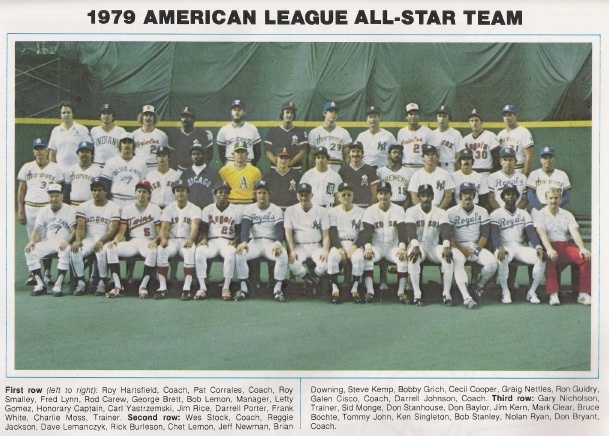
Reggie Jackson is in the second row, second from the left … in a Mariners uniform. WTF?!? Anyone know the story behind this?
So, What Did I Miss?
I’m back, unpacked, and amazingly, didn’t receive a single toaster. Apparently, while I was away, the Cubs decided to throw away their season, the Rays and Red Sox proved that the 2008 AL East is the best division we’ve seen in a long, long time, and lots of people told the M’s “thanks but no thanks”. I know seeing good candidates turn away is frustrating, but despair not – the Pirates ran into this same thing last year, getting turned down by several of their top choices before settling on the other Cleveland Asst. GM, Neil Huntington. He clearly wasn’t their first choice, but since taking over, he’s completely reshaped the way the Pirates were run, even hiring Dan Fox to run their statistical analysis department.
To be honest, in catching up on what happened in the last 10 days, I’m encouraged. The list of people the M’s have wanted to interview reads like a who’s-who of USSM approved thinkers. The M’s didn’t even bother to talk to the guys who were holding the Forst-Hahn-Hoyer-Depo roles the last time around, but this time, an older school guy like Bernazard stands out as unique among the candidates. The M’s are clearly looking at the young analytical types as the group they’d like to hire from, and I don’t see how anyone can take that as a bad sign. Even though we’re not going to get Antonetti, it looks very unlikely that we’re going to get a guy who will continue the current practices of the organization. It’s quite probable that the M’s are going to hire a GM who is much more in tune with how baseball teams should be operating in the 21st century.
Of the guys we know they’ve interviewed (thanks to Larry Stone, who has done great work covering this so far), I’m throwing my hat behind Peter Woodfork. From talking with a couple friends who have interacted with Woodfork, the consensus seems to be that he knows his strengths and weaknesses well and is more interested in organization building than legacy building. Due to his time in labor relations with the commissioner’s office and his various duties in Boston and Arizona, he’s become quite proficient in the contract/arbitration/rules aspect of the game, and he has a good grasp on real analytical processes. His degree from Harvard is in Psychology, however, and his perceptions of players as people instead of numbers helps him in his interactions with scouts and player evaluation types.
More than anything else, Woodfork has developed a reputation as a team guy – he’s not the Billy Beane from Moneyball, a one man show who does it all, but instead, he’s much more like Theo Epstein, who built a management group with perspectives varying from Bill James to Allard Baird. While Theo’s in charge, the Red Sox have a heavily involved ownership, not that different from the Mariners structure. Epstein has figured out how to leverage that involvement into a positive, building a team that can work well in such an environment, and that’s what’s needed in Seattle as well.
Woodfork has essentially grown up in baseball in two organizations that are running their teams the right way. He’s the mix of an analytical mind with the personality to integrate with Bob Engle and Bob Fontaine that the organization could really use. There need to be significant changes in how the baseball operations department is ran, but the amateur talent evaluators are a strength, not a weakness, and Woodfork’s ability to work with them is a real positive on his resume.
The Mariners need a GM that is willing to build a team of decision makers that focus on finding the right answer as often as possible, and Woodfork comes with the reputation of a guy who will do exactly that. For that reason, he’s my candidate, and the guy I’m hoping they hire.
Woodfork in ’09.
Hahn off the board
Larry Stone reports we can cross another name off the list of potential GMs: White Sox assistant Rick Hahn.Â
There may be more preliminary interviews next week before a handful of candidates are brought back for a second round.
Essential problems with the interview process
Whether or not a candidate understands the implications of DIPS theory and modern defensive analysis will make a huge difference in their ability to correctly value players, and they’ll be hired by people who think they understand baseball stats but have clearly demonstrated they know nothing.
A candidate will have to sell Armstrong and Lincoln on a course of action that does not offend or put them off, even though they apparently have returned to viewing the 2001 season and its surrounding years as the apex of the franchise, when previously fixating on what they thought were the lessons of those years proved disastrous.
Lincoln and Armstrong are supposedly asking candidates detailed questions about how they would rebuild the team, deal with certain situations, and so on. This is a huge improvement over the last go-round. But the interviewers have no ability to evaluate whether or not an answer is right — and from what we know of their baseball opinions, are often disastrously wrong. So we’re left to hope that they will pay attention to how the candidate solves the problem… except that Armstrong’s recently stated that what they really want to see is a return to consensus-building and consultation, which would mean that the candidate who says he’d rely on the good advice of his interviewers will meet the stated criteria to get a job in which relying on those people will result in extremely poor decision making.
An extremely brief GM recap
Every time I post the odds or anything, we get requests to add a ranking of who we’d prefer, or who’s the most stat-friendly, or whatnot.
So here’s an extremely short version of that.
LaCava’s an upgrade, and he and Woodfork are the two who would probably be able to come in and improve the franchise without a lot of turmoil. He’s well-regarded in the same way Bavasi was, and he’ll probably sail through the interviews. He’d get on great with the press.
Woodfork’s much the same – he’s definitely a step towards modern, savvy baseball management. And all accounts of his work with the Diamondbacks are good, and his time there may make him a good fit for trying to rework the Mariners. And he too would likely do well bringing the whole organization forward, forging relationships, and so on.
Rick Hahn’s sort of generically the same too: you got the leadership and get-along check box, plus we know he does things like figure out the value of a win and who contributes what to that (though not how, which could be troubling).
Call those “good hires” and I’ll talk about my reservations in a second.
Kim Ng’s more of a cipher. We know she’s really smart, likely to dramatically improve the team’s ability to work the margins of the roster and make great waiver pickups. She’s said to have come a long way in her player evaluation on the scouting side, but it’s hard to gauge that. I worry that given her career-long proclivity for dodging the press there’s the risk of a DePodesta-style rift with the local ink-stained wretches that could impair her ability to run the team. We also don’t know where she is on, say, advances in defense evaluation. That kind of thing can be sassed out in the interview process, but we don’t know.
Here I shrug. I don’t know. I was once a full Ng supporter and then the more I realized that we could throw our nominal cheering behind someone we knew was on the cutting edge of GM-dom, like Antonetti (or DePodesta, or…)
Tony Bernazard… it looks like Bavasi 2. That’s too mean, but there it is. Bad hire. If anyone wants to throw exculpatory evidence in here, I’d love to see it.
And I’m skipping DiPoto because I’m on a 1hr timer (seriously, there’s a window at the upper-left that reads “You can use Internet now!” with a ticking countdown).
Here’s my worry, though — take LaCava or Woodfork. They may be good, but is that enough? I don’t want to be disparaging, but the AL West already has a lot of good and well-funded competition. A GM who’s on the top of the traditional, good-interview, gets-along, knows everyone pile might keep the team’s head above water but that’s not going to win championships. What makes them potentially one of the best GMs in the game, not just now but in a few years when the next crop of super-hybrid GMs arise, along with the next batch of best-of-the-old ones?
Still, all of this is easy to write on the outside. The M’s, if they’re asking the right questions and there’s no reason to believe they will, could easily figure out whether or not the things we don’t see on their resumes adds up to something more than we know.
Forst off the board
Hickey reported this morning that the Mariners received permission from Oakland to interview assistant GM David Forst. But Buster Olney just reported that Forst said, “Thanks, but no thanks.”
Strasburg Alternative No. 1: Grant Green
Stephen Strasburg is the consensus No. 1 pick in next year’s draft. Now, as Dave mentioned in the comments here, history shows that the top guy heading into the season rarely ends up being drafted first overall. Still, the Nationals face a PR nightmare if they don’t draft the player *perceived* to be the best after failing to sign the ninth-overall pick this year, Aaron Crow. So, let’s begin to take a look at some of the alternatives to Strasburg that could be an option for the Mariners with the second-overall pick. In part one of this series, we’ll start with Grant Green…

Southern California shortstop Grant Green has been on the prospect radar for a long time.Â
He grew up in Anaheim Hills, Calif. and went to Canyon High School. In the fall of 2004, he began playing in wood-bat showcases and the summer after his junior year of high school he played for Team USA’s Junior National Team that also included Clayton Kershaw, Brett Anderson, Lars Anderson and Adrian Cardenas, among others. During his senior season, he was one of the top high school prospects in the country and Baseball America projected him to be a third-round pick in 2006. However, signability concerns caused him to slip and the Padres took a chance on him in the 14th round. He reportedly wanted $1.4 million to sign, which the Padres wouldn’t give him, so he headed to USC where he became the Trojans’ first true freshman to start at shortstop since Seth Davidson in 1998.