
Ichiro Returns
The news on Ben Gamel wasn’t good – his oblique issue that kept him out of the game a few days back would sideline him for 4 weeks or more. Even a grade 1 strain, the mildest form of the injury, averages 27 days or so for position players to return from. The M’s now know they’ll be without a player they’d penciled into their starting line-up. Meanwhile, Mitch Haniger’s hand problems have prevented him from practicing, let alone participating in Cactus League games. The M’s clearly saw their young OF as a potential strength coming into 2018, particularly with Dee Gordon adapting well to CF. But as of this morning, it had become a glaring need.
Ichiro Suzuki is now a part-time player, and at 44, it looked like his MLB career was over. The rebuilding Marlins jettisoned the three players ahead of him on the OF depth charts, but they didn’t want him back. I’m not sure what I would’ve expected from the tail end of Ichiro’s completely unique career, but I have to admit, I didn’t really see this coming. As someone so particular about every aspect of his practice to his pre-pitch routine, I would’ve imagined that a year like 2015 would’ve absolutely destroyed him. He hit .229/.282/.279 in over 400 PAs, playing for a go-nowhere club in Miami. Perhaps wanting to show that not even age could destroy his finely-wrought skill, he rebounded to hit .291/.354/.376 the next year. There – he’d proven his point. But he was back again in 2017, slumping to a mid-70s wRC+ and getting far fewer PAs. He still wasn’t done. He wanted a big league deal, and now he’ll get one: Ichiro signed a 1-year contract with the M’s today.
I’ll be clear: I think Ichiro is one of the coolest players I’ve ever seen, and cheering for him for a decade – though the absolute peaks of the franchise’s existence as well as the nadir – has been a privilege. I’m going to enjoy watching him for the M’s again, if only because he’s now doubly unique/inscrutable: he’s *Ichiro* and he’s *44 years old*. More than at any time in his career, he’ll be flanked by similar players – players trying to survive the home run boom through contact ability and defense. Thankfully, no one’s looking at him to carry the team, or even be a full-time player. That said, that Ichiro kind of makes sense here is something of a bad sign.
Ben Gamel’s ZiPS projection has a slash line of .250/.303/.384, not all that different from Ichiro’s .264/.323/.344, or from Guillermo Heredia’s .242/.323/.324. All are fractionally better than the projections of the other OFs in camp/on the 40-man, like Cam Perkins or John Andreoli. Even those who demand the M’s sign a free agent on the right side of 40 have to admit, the pickings have grown slim: CF John Jay would cost quite a bit more, and his own projections are only slightly better. No one should pay money to play Jon Jay in an OF corner. You could get Melky Cabrera, who’d be better at the plate, but with defensive metrics showing he’s been at least a full win below average every year since 2013, it would clearly go against one of Jerry Dipoto’s roster-building strategies. The best bet may be Seth Smith, but as a platoon player with defensive shortcomings, I can’t see Dipoto wanting to bring him back. Ichiro’s a glove-first guy who makes a lot of contact, so Dipoto was probably predisposed to at least kick the tires, even before you get to the whole franchise-icon thing.
So those fans who are stoked to have Ichiro back around are right to be excited: it’s ICHIRO. And those fans who see this as a move that doesn’t move the needle at all are right too. The M’s don’t look like they’ve done enough to capitalize on their decent position on the win curve, and seem to have been passed by teams from Anaheim to Minnesota, and they’ve acquired some outfielders, like Perkins, who they clearly don’t trust with even part-time fill-in duty (Perkins is older than Heredia, Haniger and Gamel, by the way). But how we, as fans, deal with this situation is up to us. I’ve seen Ichiro on good M’s teams, awful M’s teams, and middle-of-the-pack M’s teams. Ichiro made things a bit better in each situation, and watching Ichiro do Ichiro things on a frustrating M’s team is something I’ve done a hell of a lot of. I’m in for another round of it.
Cactus League: M’s at Brewers; Bloggers vs. Information Gap
Marco Gonzales vs. Junior Guerra, 12:05 (radio on 710, delayed until 7)
The M’s head to Maryvale to take on one of the most intriguing teams of 2018, the Milwaukee Brewers. After getting a jump-start on their rebuild by swapping current M’s SS Jean Segura, the Brewers made a series of deals in 2016 and have turned themselves into a contending team faster than anyone would’ve hoped. After a near miss last year, they’ve added CF Lorenzo Cain and traded for OF Christian Yelich. Their offense was solid last year, and looks to be even better now. The key is going to be pitching. While they were excellent last year, the projection systems simply aren’t buying the impressive seasons of guys like Chase Anderson and Jimmy Nelson. That they’ve now got Yovani Gallardo and Wade Miley for depth doesn’t help their projections, either.
Today’s starter, Junion Guerra, may help pitch the innings that went to Matt Garza last year (who’s left in free agency), and may prevent the Brewers from needing to squeeze serious innings out of Gallardo. Guerra’s an interesting story, having been drafted as a catcher and not starting to pitch until he was in his early 20s. Even from that point, it took him years to reach the majors, getting 4 innings with the White Sox in 2015. Claimed off of waivers, the Brewers made him a starter, and after a solid half-year with them in 2016, became the club’s opening day starter last year at age 32. 2017 was a rough one, however, as he logged just 70 IP, and lost his starting job. Plagued by shoulder injuries for a few years, Guerra’s velo was off noticeably in 2017, with his four-seam fastball down about 2 full MPH from 2016.
It’d be cool for Brewers fans to see how he’s doing, and as a Mariner fan, I’m really intrigued by the cutter Marco Gonzales is re-introducing this spring. The problem is that one of the key information sources for things like this – pitch fx – has been switched off. No longer can we get real-time data on what pitchers are throwing and how it’s working. Mike Leake’s tweaked his changeup to increase the velocity gap between it and his fastball, as this great Ryan Divish piece details. I’d love to see more stats on how many times he’s thrown it and what batters have done, but in 2018, that’s no longer possible. It’s tough to complain about access to data now that every game has statcast and gobs and gobs more data than we could ever really use. But getting information on pitchers in the spring was awesome – a great way to see who might be on the verge of a breakout and who might be slowing down.
To be clear, reporters are notifying everyone of these pitch/repertoire changes, and you can see snippets of them in highlight clips, but it’s still really, really useful to get a record of what batters do against a pitch. Leake and Gonzales are absolutely critical to the M’s playoff chances this year, and any kind of change to their arsenal may make it more likely that they can contribute the way Jerry Dipoto believes they’re capable. But every spring is full of stories like this, and many of them are left behind in Peoria when the season starts; not sure how many years we’ve heard about Felix experimenting with a cutter, for example.
Leake’s change is a fascinating example. It’s always been thrown extremely hard – it’s averaged 85-86 since Leake entered the majors, and his fastball’s been around 91. That small gap in velocity should lead to very low whiff/swinging strike rates, and that’s indeed what we’ve seen. That said, it’s been his best groundball pitch, better even than his sinker. Early in his career, it was hit quite hard, with batters often slugging over .500 against him on cambios. In recent years, Leake’s results on his change have improved markedly. It’s a nice weapon to have to pair with his cutter, especially against lefties, who’ve troubled him from time to time over his career (not too surprising for a sinkerballing righty). So Leake was already doing something with his change; some adjustment between 2015 and 2016 generated much more drop at more or less the same velocity. Will the new, larger, velocity gap make Leake more of a strikeout pitcher? I guess we’ll see – it’d be cool to see his whiff rates on it thus far, but I guess that’s not in the cards.
1: Gamel, LF
2: Romine, SS
3: Zunino, DH
4: Vogelbach, 1B
5: Lake, LF
6: Motter, 3B
7: Beckham, 2B
8: Marjama, C
9: Bishop, CF
SP: Gonzales
Vogelbach’s, uh, back in the field and starts at 1B. The M’s have been oddly consistent in where their utility-IF candidates play – Romine’s essentially only been at SS, while Motter’s played 3B. Huh.
2018 Baseball Prospectus Annual
Hey, a non-game post here for a second. I was going to mention this earlier, but I never actually believed it would happen until I actually held the thing in my hands, but I’ve written the Mariners essay in the 2018 Baseball Prospectus Annual. More importantly, they’ve actually gone and published it.
This blog and BP go way back, as Derek and Dave wrote for BP 15-20 years ago, helping to build that site from offshoot of particularly fecund online forums to what it is now, a breeding ground for MLB team analysts and a place to find some of the best baseball writing anywhere. As a fan of BP for years, it’s a surreal feeling to see something I wrote in a BP annual, and while the essay itself may feel familiar for those 3-4 of you who religiously read each game past, I think M’s fans will get something out of it.
It’s on sale at your neighborhood book store, and it’s also at Amazon (and it’s on sale). Other M’s-blogosphere people who’ve got essays in the book include the inimitable Patrick Dubuque of BP (formerly of Lookout Landing), who wrote the Diamondbacks essay and Meg Rowley of The Hardball Times (formerly of BP and Lookout Landing) who wrote about the Astros. It’s all worth reading, and I’d be grateful if you picked one up.
Cactus League Game 7, Royals at Mariners
Mike Leake vs. Burch Smith, 12:10pm
The M’s lost to Cleveland yesterday, dropping their Cactus League record to 2-4, which is about as meaningless a thing as you’re liable to run across today. The M’s starting pitching – a disastrous start by Andrew Moore aside – has been excellent, and Mike Leake looks to continue that today. The rebuilding Royals are undefeated thus far, which just reinforces the fact that wins/losses in Arizona don’t really matter – this is where Munenori Kawasaki was a batting star, where Mike Zunino couldn’t make an out if he tried right before one of the worst seasons in Mariners history. Some things, some stats, some indicators matter. Wins and losses are not among those indicators.
Opposing Leake today is the fascinating ex-Ray/ex-Padre righty Burch Smith. Smith was utterly dominant in the Pads system in 2013, rising from AA to the majors thanks to solid control of a plus fastball and change. He throws from a low 3/4 slot, making him especially tough on right-handed bats. That said, his 10-game cup of coffee with San Diego was a frustrating one, as he hemorrhaged runs and while his K rate was nice, it didn’t make up for newfound control woes and a complete inability to deal with lefties. As Carson Cistulli (an early fan) noted at Fangraphs many years ago, one of the big issues he had was maintaining his good velocity. He averaged 93 on his four-seam fastball, but that average was the result of a much wider range than most starters. Early in the game, Smith would touch 98, and Brooks has him throwing at least one pitch at 99 in May of 2013. For a starter, that’s pretty remarkable. The problem was that by the end of his outing, he’d be at 91.
Something to work on for Smith, then, and at just 23 years old in 2013, he had plenty of time. Unfortunately, injuries got in the way. Just after he was traded to Tampa in the huge Wil Myers/Steven Souza/Trea Turner 3-way swap (what I call the Rene Rivera deal for short), he started feeling arm pain, which limited him to a handful of minor league innings in 2014. After all that rest, he was ready to make a run at the Rays rotation in 2015, but his elbow gave out and he underwent Tommy John surgery in April of 2015. After a setback with he rehab in 2016, he didn’t throw a pitch in 2015 or 2016, and had thrown all of 5+ innings in three full years. He made it back on the field for the Rays system in 2017, tossing less than 60 IP across three levels. He’s still racking up strikeouts, but you can tell he’s been Rays-ified: his fly ball rate spiked after being something of a ground ball guy in the Pads system. The Royals – desperate for pitching – swooped in and made a deal to acquire him in the Rule 5 draft this year.
It’ll be interesting to see if he’s gone full Tampa and raised his arm slot, or if he’s back in his old low, low 3/4 slot. While he won’t pitch enough to see if he’s learned to maintain his velocity, I’m kind of curious if he’s capable of touching the mid-upper-90s anymore, or if that premium velo was left on the operating table back in 2015.
1: Gordon, CF
2: Segura, SS
3: Cano, 2B
4: Cruz, DH
5: Seager, 3B
6: Zunino, C
7: Nieuwenhuis, RF
8: Hague, 1B
9: Miller, LF
SP: Leake
Matt Hague’s getting some good looks at 1B with the injury to Ryon Healy. Mike Ford – the lefty-swinging 1B the M’s got in the Rule 5 draft – has had a slow start, but he’s really competing with Vogelbach anyway. Hague still has a steep uphill climb to make the opening day roster (assuming Healy’s ready), but if Healy has a setback, you never know. The M’s wouldn’t want to just send Ford back to NY, but they presumably wouldn’t want two LHH 1Bs, either.
Felix sounds like he’ll only miss one start, which would be about the best possible outcome following his (terrifying) run-in with a line drive. To really beat their projections, the M’s need a return to form of the King.
I mentioned Seth Elledge the other day, but he didn’t make it into a game. He’s in the bullpen today, so we’ll see if he gets a look. Also available is ex-Gonzaga reliever Wyatt Mills, the underslot 3rd rounder who tore through the low-minors with his funky sidearm delivery and good command. Jack Anderson, the submariner who got touched up a bit in the Cubs game, is also in the pen.
Cactus League Split Squad Day – M’s vs. Royals and Padres
James Paxton vs. Clayton Richard, 12:10 (audio on Mariners.com) and also
Andrew Moore vs. Wily Peralta, 12:05 (audio on Mariners Radio Network)
The first split squad day features two moderately interesting pitching battles. Or at least, as interesting as it gets in February in which both starters will go 2 IP at most.
At one point early in last season, Clayton Richard and James Paxton were neck and neck in Baseball Prospectus’ DRA value metric. They got there in very different ways, of course: Paxton struck everyone out and held a very good Astros line-up in check. Richard had a great opening start of 2017, then got hit hard in his next two. FIP loved – and loves – Paxton, while DRA seemed enamored of Richard’s sinker and general contact-limiting approach. Richard’s sinking FB runs about 91, with heavy, heavy sink and tailing action. He throws from off near 1B, and features a change and so-so curve at 81. All in all, this is kind of a LOOGY-ish repertoire, and indeed, platoon splits have been his undoing with the Padres. One of the key values of plus velocity is the ability to neutralize platoon splits, as we see with James Paxton. Paxton’s career splits are actually reversed, and even after lowering his arm slot (which would help righties pick up the ball), he’s still dominating opposite-handed hitters. Sure, lefties fare even worse, but the point is righties are not some sort of unsolvable problem the way they were for Richard.
The key issue with Richard, as with so many pitchers last year, is the long ball. Since lowering his own arm slot, Richard has bumped his GB rate to near 60% or even above, limiting the number of fly balls he allows. The problem is that those fly balls seem to be particularly well struck – so well that even Petco Park couldn’t contain them. Normally, a 19% HR/FB ratio screams out for regression, but going into year 3.5 of the new HR era, it’s not clear where we should regress that number towards. Plus, there’s the issue that Richard’s average exit velocity on fly balls/liners was above average.
Andrew Moore and Wily Peralta is another match-up of opposites. Moore came through the system needing to prove he had just enough stuff to be a #5 starter, something many evaluators thought he’d struggle to accomplish. He’s closer than many would’ve thought, in large part due to impeccable control. Unlike Richard, Moore’s an extreme fly-ball guy, so he’s also going to run a low BABIP (Richard’s was over .350 last year, while Moore’s was under .250), but like Richard, Moore was utterly undone by home runs. That’s going to be his top priority this year – to figure out what he needs to do to avoid dingers and give his team a chance. Lefties were a particular challenge, as he gave up 8 HRs to them in just over 100 plate appearances, for a ratio of not-close-to-acceptable.
His counterpart today is former Brewer Wily Peralta, who despite minor league K:BB ratios that pale in comparison to Moore’s, got a chance to start and put together a very solid 2014. Peralta averages 96-97 with his fastball and sinker, giving him one of the best starter velocities in the game. He’s never limited walks, and he’s had a problem with home runs, platoon splits, AND stranding runners, all of which snowballed last year, leading to an ERA nearing 8 and a replacement-level FIP. He signed a one-year deal with the rebuilding Royals because as long as he still throws 97, he’s going to get chances. Every pitching coach in baseball wants a project like Wily Peralta, and you can see why: if he ever figures it out, he’s going to be really, really tough to hit. His slider features some solid downward movement, and has been a solid pitch for him over his career.
The issue is why his fastballs simply don’t get past hitters. Since the rabbit-ball era really took hold in 2016, Peralta’s giving up a SLG% of about .550 on his four-seam and nearly .500 on his sinker. He’s done this despite adding velocity through this time period, and the pitch’s results have deteriorated as it’s gained speed. It’s pretty odd.
Line-ups:
In Peoria:
1: Gordon, CF
2: Segura, SS
3: Cano, 2B
4: Cruz, DH
5: Seager, 3b
6: Zunino, C
7: Ford, 1B
8: Andreoli, RF
9: Miller, LF
SP: PAXTON!
Three CFs!
In Surprise:
1: Bishop, CF
2: Romine, SS
3: Gamel, LF
4: Vogelbach, DH
5: Perkins, RF
6: Motter, 3B
7: Hague, 1B
8: Beckham, 3B
9: Gosewisch, C
SP: Moore
Felix was struck by a line drive in his forearm/elbow area, but x-rays were negative, and so he’ll just take some time off while his contusion subsides. Scary, scary moment in the 2nd of yesterday’s game. Speaking of contusions/good results from x-rays, Dan Vogelbach’s foot is good enough that he’s been given the start today at DH; Junior Lake was originally supposed to start there, but it’s good to see Vogelbach’s ready to hit again…and he should get a game at 1B in the next few days.
Cactus League Game 4: M’s at Cubs
King Felix vs. Tyler Chatwood, 12:05pm
Happy First Felix Day of 2018.
The M’s blanked the Dodgers yesterday, and so far, their pitching’s been decent. I’d love to dive into it a bit more, but after years of odd, surrealist pitch fx data from Peoria stadium, MLB’s turned off the tap, and we’ve got to go by TV and radio notes on what pitchers are throwing and how hard. It’s not the end of the world or anything, but it’s kind of frustrating. I do kind of wonder if last year’s Hisashi Iwakuma experience may have influenced the decision to just turn off a system that pretty much nobody used and one that was clearly never calibrated. I’m still bummed about it. Onward! We will find new ways to nerd out, friends.
Today the M’s head on the road to take on the Cubs and their new FA acquisition, former Rockies sinkerballer Tyler Chatwood. I say sinkerballer because he runs a great ground ball rate and has very little rise on his fastball, but, like everyone else on the Rockies last year, Chatwood actually threw a bunch of four-seamers. He came up with the Angels before getting traded by GM Jerry Dipoto in one of his first moves after taking the reins in Anaheim (in one of the many, many times Dipoto has acquired Chris Iannetta), and initially he really WAS a sinkerballer. He threw very hard, but lacked anything like an out pitch, and thus put up abysmal K rates and K:BB numbers (you can see why Dipoto wasn’t buying it). But beginning in mid 2016, he’s made his four-seamer his primary fastball. It’s arrow straight, and averaged over 95mph last year – pretty exceptional for a starting pitcher. It’s got a decent amount of rise, but Chatwood’s placement and velocity combine to give him far, far more ground balls than you’d expect. In fact, since switching over to a much more four-seam-heavy approach, his ground ball rate has gone *up* and he’s now an elite GB guy.
It’ll be interesting to see what the Cubs do with him. All of those grounders didn’t make him more effective last year. The poor HR/FB ratio figures to get better now that he’s not pitching at altitude, but he’s also never figured out how to avoid walks, either. Chatwood’s breaking balls help boost his GB rates, too, and there again, Chatwood’s made some changes. He now throws a ton of sliders to righties, after coming up as a sinker/curve/change guy.
More importantly for the M’s, there are some intriguing pitchers who’ll get some time once King Felix leaves the field. Shawn Armstrong, the reliever the M’s got from the Indians earlier in the offseason, makes his second appearance. Later on, we may get to see Seth Elledge, a 4th round pick out of Dallas Baptist last year. Elledge is a hard-throwing reliever who figures to get lots of closing opportunities in the minors this year, and who could move pretty rapidly this year. I don’t know how much it matters, given the state of the M’s system, but I think he’s being overlooked a bit, and would probably be in my system top 10, though he isn’t in BA’s or Fangraphs’. If you’ve listened to the M’s Wheelhouse podcast, you may have heard about the competition the M’s run, in which the pitcher and hitter with the best “control the zone” stats (generally K:BB ratio) get some time in big league camp in spring training. I believe Ljay Newsome won that award this year, and he figures to get in a game today as well. The youngster out of a Maryland high school was drafted in 2015, and has walked just 31 in 201 professional innings since, with 179 Ks. He’s not going to blow anyone away, and he’s struggled with HRs as an extreme fly ball guy, but he’s clearly on board with the M’s approach, and has been pretty young for his league.
Lineup:
1: Gordon, CF
2: Romine, SS
3: Perkins, DH
4: Lake, LF
5: Nieuwenhuis, RF
6: Motter, 3B
7: Hague, 1B
8: Freitas, C
9: Beckham, 2B
SP: FELIX. HERNANDEZ.
A 3-4-5 of Perkins/Lake/Nieuwenhuis (all waiver claims/MiLB signings) is peak spring training. We’ll see a few more of them coming up, as the M’s have their first split-squad day tomorrow.
M’s vs. Kershaw, Seager vs. Seager: Cactus League Game 3
Marco Gonzales vs. Clayton Kershaw, 12:10pm
Yesterday’s game featured very few players who’ll start games for the M’s this year, and the go-ahead run scored on a wild pitch. Today’s game features the best pitcher of his generation, and marks the very first time the Seager brothers – Kyle and Corey – will face off on a professional field. Oh, and for good measure, Nelson Cruz and Robbie Cano are back in the line-up. It’s a good one to watch.
Gonzales is essentially a microcosm of the tension between the M’s front office and the projection systems. The M’s viewed Gonzales as a huge get last year, sending one of their top prospects in Tyler O’Neill for the lefty who was coming off of TJ surgery. In his comments about him, Jerry Dipoto essentially laughed off his recent (and even career) numbers, saying that sometimes you see a guy return after injury and he’s simply not the same any more. Uh, in a good way, though.
One reason is velocity. Gonzales was throwing harder than he had in his initial call-ups in St. Louis down the stretch for Seattle, and of course velo matters. It didn’t help his results, but it’s the kind of indicator that helps explain why the M’s might see a breakout coming. Second, as John Trupin explains in a detailed article at LL, is a change in mechanics. He’s dropped his release point, and moved it out towards 1B a bit, lowering his arm slot in general, and giving his fastball (and his secondaries) more horizontal movement as well as, perhaps, unlocking some velocity.
Here’s his vertical release point – it’s subtle, but it’s pretty clear:
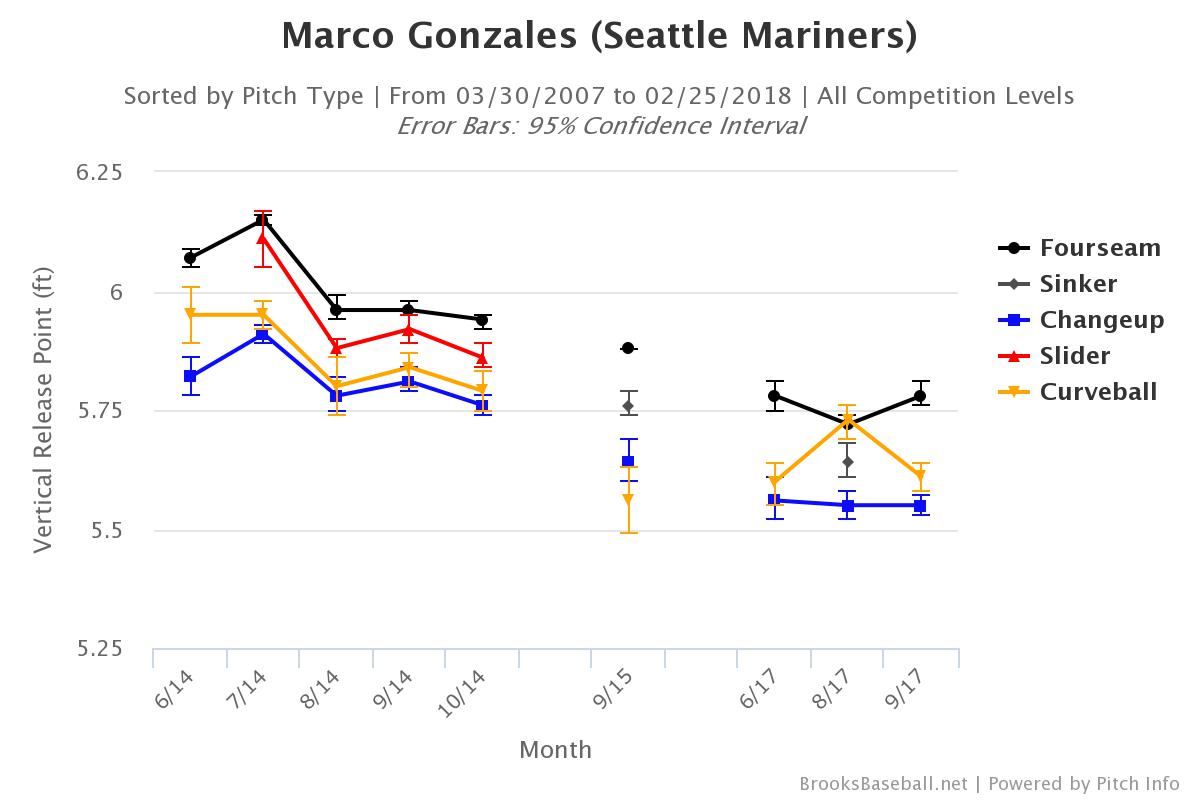
Finally, as Shannon Drayer’s article this morning explains, he’s attempting to bring back another pitch – a cutter – that he’d shelved since his arm troubles began several years ago. When he came up, Gonzales used a hard slider/cutter, especially to lefties, fairly often. He hasn’t thrown it since 2014, though, as he was up and down and then shelved with TJ surgery and rehab. The Cards told him to scrap the pitch, which is a bit harder on the elbow than fastballs/change-ups that allow the arm to pronate more, until he’d built up enough healthy innings, and he kept to that plan last year. Still healthy, it’s about time for him to start using it in games (he’s throwing it in bullpen sessions), though, interestingly, he tells Drayer he sees it as a weapon against *righties* this time.
All of those adjustments are critical, because as last year showed, he needs to make some changes. Despite the improved velocity, his fastball wasn’t an effective pitch overall. It got more whiffs, but much, much harder contact. As Trupin notes, part of that may be that the velocity gap between his FB and change dropped, making his change less effective (and it’s true, it WAS less effective). Finally, he pretty clearly needs something else to throw at righties, who’ve hit him especially hard, solid change-up or not. In summary, there are plenty of reasons to think Gonzales has plenty more in the tank than M’s fans have seen, and that he’s close to making the leap from frustrating prospect to solid #3/4 starter. None of those reasons are found anywhere in his statistical record, but they’re found in what we would’ve called scouting reports years ago. This is not 2003, and sabermetric fans are, to put it mildly, nowhere near as anti-scouting as we once were, or as Michael Lewis wrote. It’s too early to see if those scouting indicators are going to start showing up in Gonzales’ results, but I’d like to see more evidence that they’re real and developing. Let’s see him use that slider/cutter, and let’s see how his velo’s doing.
Today’s line-up:
1: Gamel, LF
2: Segura, SS
3: Cano, 2B
4: Cruz, DH
5: Seager, 3B
6: Zunino, C
7: Perkins, RF
8: Ford, 1B
9: Miller, CF
SP: Gonzales
A largely “real” line-up, plus a couple of intriguing additions. Ian Miller is the speedburning CF prospect NOT named Braden Bishop. Miller’s another very good defender, and is perhaps even more deficient in power/isolate slugging. On the plus side, he’s a brilliant baserunner, stealing 43 bags last year and 49 the year before while being caught just 8 times *in 2016-17 combined*. That’s a 92:8 ratio, which is good.
Logan Morrison hit 38 bombs last year and just signed a 1 year, $6.5 M deal with Minnesota, leading to this barbed tweet from national writer Matthew Pouliot:
Realistic scenario: Twins beat out Mariners for wild card by one game while Morrison has 50-100 points of OPS on Ryon Healy. https://t.co/IRrjbYyvWr
— Matthew Pouliot (@matthewpouliot) February 25, 2018
In good news about the 1B position, the x-rays on Dan Vogelbach’s foot were negative – no broken bones, just a deep bruise. He should be ready to play in a few days. Nick Rumbelow came out of yesterday’s game with the trainers, seemingly due to a small cut. Hopefully that too’s a day-to-day situation and nothing serious.
The M’s Versus the Projections – Oh, and uh, the White Sox
It’s a game! There’s baseball on today!
Mike Leake vs. Hector Santiago, 12:10pm
The M’s embark on the 2018 season sounding supremely confident. Free agent pitching? No need – there’s already plenty of talent on board, they say. Go for a big-time position player like Lorenzo Cain? Ehhh, we like to roll our own over here – we’ll just take Dee Gordon, a handful of outfield drills and we’ll the same total production for less. Meanwhile, the projection systems all have the M’s pegged for 81-83 wins, just short of playoff position…and at a time when the talent that could conceivably get them over the hump remains available. Someone’s going to look a bit silly here come September.
It’s not just the M’s, to be clear. Fangraphs thinks the Brewers lucked into a wildcard chase last year, and that when their pitchers regress, even their improved offense won’t be enough to get them to .500, let alone contention. Meanwhile, PECOTA (Baseball Prospectus’ projection engine) scoffs at the Angels busy offseason, thinking that their pitching will collapse, giving up more runs than they have since 2000-2001 *despite* picking up Shohei Ohtani and despite remaking their offense. The Angels and Brewers, perhaps unsurprisingly, have pretty big gaps between their projections; no one really knows what to make of them. Both had players who looked pretty different last year – Chase Anderson wasn’t supposed to be THAT good, while the Angels reminded Andrelton Simmons how to hit. Both have young players who can confound the projection systems’ math: what do you do with Ohtani, who not only is coming over from Japan, but barely played last year due to injury? All of this to say, there are often perfectly decent reasons to laugh in the face of your own projections, and act counter to whatever ossified sabermetric dogma would tell you to do. Are the M’s another such team?
Ehhhhh, probably not. The problem is that we simply don’t see the variance that we do in their projections. Everyone, from the betting markets to BP to Fangraphs agree on what and where the M’s are. They differ on what that means, but they don’t really differ on how good they are. The M’s are betting the crowd is just plain wrong, and that players from Ryon Healy to Andrew Moore to Mitch Haniger are much, much better than their projections. They’re also betting that the injuries that decimated the team last year either won’t happen again, or won’t impact the future performance of guys like Haniger and King Felix. Felix, in particular, seems crucial to the club, and as many have pointed out, it seems kind of unfair to put that kind of pressure on the King, who’s been both hurt and at best sporadically dominant for a few years. Instead of bringing in an arm to take the pressure off of Felix/Paxton/Leake, the M’s have to hope that his down time will result in better – and healthier – play in 2018.
Regression alone won’t cut it. It’s not just that Marco Gonzales and Andrew Moore are probably better than they appeared last year (low bar), but regression may also mean Mike Leake isn’t the efficient #2/#3 he looked like for the M’s – it was so out of character with his career norms, of *course* the projection systems aren’t buying it. And that’s really the main reason why the M’s feel confident ignoring PECOTA and Fangraphs: they believe they’re elite at coaching and teaching. This is why they angrily dismiss the consensus that their farm system is the sport’s worst. It’s why they brought in Dr. Lorena Martin to add new dimensions to their development process, and it’s why they actually give up real talent to acquire Healy, Shawn Armstrong, Nick Rumbelow and others whose projections are…uh…not encouraging. They’re betting that there’s untapped potential there that has never shown itself, and they believe they’re the org to uncover it. This approach, it must be said, hasn’t been all that successful, isolated wins like Nick Vincent aside. Confidence like this is what’s dividing the M’s fanbase, I think. To the saber-inclined, this is pure hubris- the team that’s burned its farm system to the ground now thinks they can teach up other teams’ cast-offs, their own meager talent reserves, turn Dee Gordon into a gold-glove CF, teach Ryon Healy patience, and turn Ariel Miranda back into an effective starter. To others, this is simply confidence, confidence borne of watching a development-focused plan come together, changing everything from how they train, what they eat, to how they look for and acquire talent. I so desperately want that view to be right, and I realize completely that Dipoto’s only had two years, but last year should knock some of the confidence off of anyone. Not everything that happened last year was the result of bad luck, and seeing every bad result as luck spoiling your pristine, brilliant plans is pretty much the definition of hubris.
But enough of that. Let’s watch the M’s play baseball, shall we? Today, Mike Leake takes on re-acquired White Sox SP Hector Santiago. Santiago came up with Chicago as an underpowered screwballer, but ditched the trick pitch and formulated a shockingly useful series of seasons on the south sideand then in Anaheim by pitching up in the zone, and pitching around HRs by running a low BABIP. Santiago was the personification of the M’s pitching philosophy in 2017, and like the M’s pitching philosophy in 2017, Santiago was utterly undone by the long ball. His troubles really began in 2016, when not even HR-suppressing Anaheim could bail him out. 90 MPH fastballs that once resulted in cans of corn or whiffs suddenly started turning into HRs. Whether this was due to a springier baseball or the subtly vital loss of a single MPH on his FB wasn’t clear. But nothing got better after a move to Minnesota, whose ballpark – like Detroit’s – is shockingly good at producing very good contact. For a pitcher whose MLB career rests on avoiding such contact, Minnesota proved to be a poor fit for Santiago’s skillset, such as it is now that Santiago’s on the wrong side of 30. He signed a minor league deal with the rebuilding Sox, hoping a reunion with pitching coach Don Cooper will help.
Meanwhile, Mike Leake figures to be one of the most-watched players in camp this year. As I mentioned above, his five M’s starts were his best stretch in a long, long while (I found one in 2013 that may have been better, but even that one was worse from a K:BB perspective), and it was driven by pinpoint control. Leake walked two batters in an M’s uniform, good for a BB/9 of 0.56. There’s good control, great control, and a BB/9 of 0.56. Sure, the sample was tiny, but Leake can regress from there and still be effective. It went beyond avoiding walks, though. Leake’s never been a strikeout pitcher, and after pitching in the NL central, where pitchers bat and the Milwaukee Brewers seemed intent on setting whiff records, his modest K rates seemed likely to collapse upon moving to the AL West. Instead, they improved. Maybe this was getting out of a weird situation in St. Louis, maybe this was Leake just enjoying a five game hot streak, or maybe this was that coaching stuff that the M’s are so dead set on. There wasn’t a whole lot different about his arsenal or his pitch mix (a few less cutters, maybe), but he did start using his sinker a bit differently, throwing the odd one in to righties instead of keeping it away most of the time. If he can keep his walk rate vanishingly low while keeping his GB rate up, he can be critical in anchoring the M’s suspect rotation.
1: Gordon, CF
2: Romine, SS
3: Andreoli, LF
4: Ford, DH
5: Hague, 1B
6: Motter, 3B
7: Nieuwenhuis, RF
8: Beckham, 2B
9: Marjama, C
SP: Leake
That’s…that’s a Cactus League line-up for you. I’m actually interested in seeing Pat Andreoli and his revamped swing. Ford would appear to have an easier time of sticking on the roster as a Rule 5 as the 1Bs are dropping like flies. Ryon Healy just had hand surgery for bone spurs, and now, apparently, Dan Vogelbach is in a walking boot after taking a Brett Kennedy fastball off his foot yesterday. A hand injury is holding Mitch Haniger out for a week or so, too, so that bad luck is getting an early start with the M’s.
The Siren’s Song of Competitive Balance
This off-season’s will be remembered for years as the winter in which analysts/writers/commentators discussed labor law and bargaining at least as much as we discussed players moving teams. To some, that’s a good sign that owners have colluded to depress the free agent market. To others, it’s a sign that the Moneyballization of the fanbase has reached its apogee, or at least has crossed some critical threshold: fans now care more about being “smart” than hoping their team signs a bunch of good players. To still others, it’s a sign of an end to the recent period of closely-bunched teams and the beginning of a new era of super-teams – teams who are so far ahead of their rivals that they have no use for a so-so free agent market at all. And, for a high percentage of remaining fans, there’s a growing frustration that economics has dominated the hot stove league. For such a dry topic or set of topics, it’s actually produced some fascinating baseball writing – so much so that I hesitate to post this, but here goes anyway.
To me, this offseason’s biggest story is not that Eric Hosmer has yet to sign a $100M+ contract. It’s not even that, following several years of what looked like labor peace, we’re now clearly looking at the possibility of a strike within the next five years. The MLBPA and MLB Owners have fought their carefully-limited battles over a variety of issues, but both have couched their position in terms of preserving or enhancing “competitive balance.” A league in which the team with the most money wins every year would bore fans, so the thinking goes, and it would prevent the kind of healthy competition among teams that would drive up salaries. The league’s framed its support for luxury taxes, revenue sharing, and the various mechanisms that make up what now looks more like a soft salary cap in the same terms: this preserves balance, and ensures that even small market teams can compete on an equal footing with the Yankees of the league. This framing allows both to the claim the mantle of representing the fans’ interests.
It’s also why they’ve been able to come to agreement so easily. In recent CBAs, players have noted that some teams were flouting the ostensible point of the June amateur draft, in which draft order is in reverse order of the previous year’s standings. The entire point of the draft is to boost competitive balance, and the whole “bad teams pick first” is just another thumb on that scale. But as many have pointed out, what it’s really done is to depress the amount of money that goes to young players. When the Detroit Tigers were able to sign a number of consensus “best player available” guys whose draft stock slid based solely on their bonus demands, the MLBPA and Owners instituted bonus pools to restrict a team’s ability to Dombrowski their way around the seeding. In the last CBA, the Players and owners tweaked the system for international bonus pools – opting not for an international draft, but instead for “hard” caps on international free agent bonuses, along with further restrictions on the posting process. The CBA also included more stringent penalties for exceeding the luxury tax threshold, right when league revenues were growing thanks to MLB Advanced Media’s breakaway success and subsequent sale as well as the market for live sports in general. So, to review, owners and the MLBPA have fundamentally agreed on the need for competitive balance, and thus the recent CBAs have sought to enhance that balance by ratcheting up the penalties for any behavior that runs afoul of it.
Why would the players care? The idea has been that if you restrict spending on amateurs, and also restrict the ability of one or two teams to corner the free agent market, teams would have no choice but to spend their MLBAM profits on free agents. The MLBPA has had an interest in preventing teams from signing a top collegiate player *as a replacement for* a mid-tier free agent, so you’ve seen major league deals to draft picks (which used to be routine for the top picks) abolished. Further restrictions on international spending was supposed to do the same thing. Now imagine that you’re an owner, and thanks to the brilliant framing of “competitive balance,” you’ve got the MLBPA coming to YOU and demanding that you spend *less* on certain classes of employees. I wonder if they made even an attempt at pretending that the agreement was a difficult one to accept, and gosh-could-we-get-some-more-movement-on-pace-of-play-in-exchange hemming and hawing, or if they signed it in a nanosecond, trying to stifle a chuckle.
This structure wasn’t just a boon to owners in the short term. By changing the relative value of a “prospect” and a free agent, it set the stage for the kind of impasse we’ve seen this winter. The problem with the balloon theory – the idea that squeezing the amateur side would produce a transfer of money to MLB players – is that it made pre-arb players even more attractive to teams. With the free agent value of a win rising rapidly, and with league minimums rising with inflation, mid-tier free agents became less and less attractive. If you arbitrarily lower the cost to acquire amateur talent, this discrepancy gets magnified. If this theory were true, you’d expect to see teams spend more on player development, as the benefit of having a player “make it” and contribute what a free agent would have is even more valuable than before. That’s hard to verify empirically, but the emphasis on mental skills, “high performance” specialists and the like suggests that teams are doing some of this. Maybe they would’ve anyway – they should – but I think at least some of the trend in PD spending is a result of the increasing awareness that the draft is now a screaming bargain, and you can hire a cadre of people to get more out of the pool of players you spent less on. The MLBPA fought for competitive balance, and now they’re watching it blow up in their faces.
Who could’ve foreseen this, beyond owners? Agents, that’s who. They’re the only group who represent both MLB veterans as well as college draft picks, AAA veterans and 19 year old Dominicans in the Northwest League. Clearly, they’re self-interested, but there’s a reason that Scott Boras was sounding the alarm for years at the bonus pools, and he’s one of several agents that are taking the fight to MLB Owners, even as MLBPA head Tony Clark has sought to quash the idea of a spring training boycott. Boras correctly foresaw this problem developing, and I’d guess he’s told many of his players that their labor strategy may backfire. If more players agree with Brandon Moss that they negotiated their way into this mess, then you can see the agents’ calls for solidarity and action to be the first step in a return to a more active union leadership – one led by an agent, perhaps.
All the talk about the relative value of a draft pick versus a free agent versus an arb-eligible player would seem to make the case that fans have grown too fond of general managers, or rather, that fans now identify more with maximizing surplus value in a trade than they do the prospect of watching dingers soar through the summer evening air. I get that concern, but feel it’s a bit overblown. Fangraphs and BP are influential sites, and led many to internalize rubrics for evaluating contracts and trades that put a premium on avoiding an “overpay” or “paying for a decline.” But as big as they’ve become, they’re still niche sites, and I’ve NOT seen a groundswell of fans outright opposing their favorite teams from spending money. Maybe it’s just because I’m an M’s fan, but I’ve actually heard the opposite: that M’s ownership standing pat at a time when making modest upgrades could potentially do the most good looks foolish. Pace Rian Watt, I don’t think any fan actually wants to watch Brian Cashman on the phone more than watching an Aaron Judge moonshot. I think fans are perfectly fine with an “overpay” if it means they can beat their hated rivals, but I think fans want to see their teams build a championship-capable roster, and not just a pleasant 78-83 win quasi-contender. The problem right now is that the model for building that championship team is so limited – and it’s limited in part by the balance-obsessed CBA.
If fans aren’t opposed to spending, they ARE increasingly comfortable with a team losing for a while. The success of the Astros and Cubs in painful but ultimately successful rebuilds has taught many that a few seasons in which a team stops trying to win big league games can be a good thing. With the growing importance of TV (and MLBAM) revenue to teams, the year-to-year benefit of winning games has also diminished. Owners don’t need to win to make money, and fans are OK with some lost seasons if they build to contention. It’s all perfectly logical, especially given the focus on competitive balance. If you want to win these days, get yourself a Carlos Correa, a Kris Bryant, an Aaron Judge, and develop them along with a few complementary pieces. Then add in a trade or two or a free agent pitcher, and boom, you’re ready to go. The MLBPA hates tanking, but helped make it an attractive proposition.
All of this argues for a very, very different CBA next time (2021, I believe). The MLBPA should fight hard – as in, be willing to strike – to get a big increase in the minimum salary as well as higher arbitration awards. The bigger the discrepancy between free agent salaries and all other salaries, the fewer free agents will be seen as worth the risk. They should fight for fewer, not more, restrictions on draft or international spending. That’s a tough sell, I realize, as that means watching more money flow to non-members, but the alternative is watching owners opt for draft-and-develop over picking up MLB-ready skills in free agency. The next CBA needs to change the incentives that drive GMs and teams, and watch teams alter their strategies to react. I’m all for *multiple* paths to championship, beyond the Astros-style teardown. I’m even more in favor of the Mariners finding one and following it.*
In general, I’m sympathetic to the players. I watch the game to watch great baseball, not an efficient allocation of resources. I understand that this particular year is something of a black swan, especially given the Shohei Ohtani situation – one created almost entirely by the last CBA itself. The changes to the posting system seemed designed to keep Ohtani out of MLB for another few years, but when he decided to come anyone, he instantly became the biggest bargain in the game by an order of magnitude. Couple that with the looming FA class *next* year, and this year’s crop was probably going to struggle. Unlike Nellie Cruz, production from players over 30 has dropped in recent years as young players have been increasingly important to teams (a result of investment in PD?). But the players need to think about how to move forward, and part of that is going to mean changing the narrative around competitive balance. Make it about fighting to ensure all teams actually try: a salary floor might help, along with reduced penalties on “over” spending. Penalize teams that tank (reduced or no revenue sharing proceeds) and eliminate free agent compensation (no draft picks attached to FA signings). Push to expand rosters. As much as fans have traditionally sided with ownership in labor disputes, I’ve heard a lot more anger directed at Derek Jeter this offseason than at Hosmer or JD Martinez. Build on that.
* The pick-ups of Dee Gordon and Mike Leake may indicate a new way to navigate this. If mid-tier free agents have been the most impacted by the CBA, then you’ll see teams either not signing future contracts, or trying to get out of the ones they’d already signed. Leake came at a relatively low cost in talent AND he came with some money. Gordon cost more, but you can see why the M’s thought he might be a decent third way between handing the position to, say, Braden Bishop and pursuing Lorenzo Cain in free agency. If 10-12 teams really don’t care about winning, the M’s should be looking over their roster for just the kind of contracts that Fangraphs may dislike but that’d offer an upgrade on the M’s current rotation. To be clear, I don’t think this strategy is the only way forward, and I think it retains a bunch of the risks of regular free agent contracts and it also costs MiLB talent – something the M’s are in extremely short supply of. Longer term, the M’s absolutely need a restocked farm system to compete, and unless they want their contention window to slam shut, they’ll need a savvy FA pickup or two after this year.
On Edgar’s Near Miss
It was always going to be close. In his 9th time on the ballot, Edgar Martinez had 77% of the ballots that had been made public, just barely ahead of the 75% needed for induction into the Hall of Fame. Once you include the ballots made public *after* MLB’s announcement, Edgar was included on about 80% of all of the public ballots. It wasn’t enough. Edgar fell 20 votes short, as he was selected on under 60% of the private ballots. He has one more shot with the Baseball Writers Association, and, if past trends hold, he’ll make it in next year.
Random thoughts:
1: There’s some irony in the fact that it’s taking Edgar so long despite being eminently qualified. Part of the reason why Edgar’s in this situation at all is that he simply doesn’t have the career length some voters want – a fact created by the Mariners’ bizarre refusal to give him a real shot at their line-up until Edgar was 27.
2: The gap between public and private ballots was larger for Edgar than it is for many other potential inductees, and it fits a pattern that we’ve seen for several years – one we can see thanks to the tireless work of Ryan Thibodaux and his awesome HOF ballot tracker. This gap is higher among certain player types than it is with others. The PED guys, Barry Bonds and Roger Clemens, were selected on far fewer private ballots, while Omar Vizquel and Trevor Hoffman actually did *better* on the private ballots. Edgar’s not a PED guy, so why does this same pattern hold?
If there’s a comparable player on the ballot, I’d say it’s Mike Mussina, another player who was overlooked by writers at the time, and whose value outstrips his name recognition or, to put it another way, his fame. Mussina, whose fWAR/bWAR would seem to make him an easy choice, got about 70% of the public ballots released before today. He got just 54% of private ballots, and thus fell well short. If your case rests on WAR – or any other newfangled metric – you’re going to struggle with the private ballots. As campaigns for deserving players take hold, and they’ve been emboldened by the successful campaigns for Bert Blyleven and Tim Raines, voters who see this as weakening the hall have dug in their heels – and refused to make their ballots public.
In short, Edgar’s a case that highlights a fundamental disagreement among voters regarding what a HOF player is, and thus what the Hall’s supposed to be. You’ve got those for whom overall career value is key, and then you’ve got those who vote for something more like impact; on how memorable a player was. You’ve got voters who’ll never vote for a designated hitter, two generations after the AL brought the position in. And you’ve got voters who’ll reliably vote for elite closers, a similarly recent development. You’ve got small-hall people who voted against Jeff Bagwell or Larry Walker, and you’ve got people who vote for Omar, Andruw Jones (or Kirby Puckett or Jim Rice) whose overall value would seem to fall short of the voters’ own standards. At the end of the day, the group favoring Edgar and Edgar-like players is winning, and Edgar will be enshrined next year. If you can get past your anger at how Edgar’s been overlooked, it’s actually a really interesting dynamic to watch play out.
3: That dynamic doesn’t map perfectly to the age of the voters, but the Venn diagram is pretty close. The Hall’s recognized that this sort of thing might happen, hence the various Veteran’s Committees that go through and elect some other worthies that the writers may have overlooked. In general – and this is something that’s been discussed in more detail and better style by other writers – the Vets have fundamentally different standards, and thus have elected far more “marginal” cases. It’s generally fallen to the Vets to select among the specialists – glove-first guys like Bill Mazeroski or, even more controversially, High Pockets Kelly.
As the game grows more specialized, the Writers Association’s now dealing with a lot of specialists. They weighed the merits of glove-first players like Omar Vizquel and Andruw Jones this year, and they’ve now had plenty of time to weigh the merits of designated hitters in time to ignore their own misgivings and usher David Ortiz.
The growth of relief pitching means that starters are pitching fewer and fewer innings. The Writers clearly don’t mind closers, implying that specialists who come with their own theme music are A-OK, but their standards for starters may need to adjust. As their barometer adjusts for starters, it’s also clearly adjusting to account for a more holistic view of position players, too. Adrian Beltre seemed like a marginal case a few years ago, but a brilliant late-career surge along with writers’ increasing fluency in WAR frameworks and defensive metrics would seem to make him an easy selection. The voting’s getting better, and while it’ll take a long time, the massive gap between the Writers and the VC may start to close.
4: All of that said, I find myself caring less and less about the Hall. That’s not a pose as a cynical blogger, or a protest at voters who vote for two strange candidates and call it a ballot, or who return blank ballots to make a point. The larger issue is that so many people have very different ideas about what the Hall is, and my own view (Large Hall) is in the distinct minority.
It’s ludicrous that Trevor Hoffman or Omar got votes while Edgar didn’t, but I don’t really have the desire to trash their candidacies. If it was me, I’d let Omar in, actually. Sure, he’s not quite at Ozzie Smith’s level, but in part that’s due to the fact that Ozzie played at a time in which strike outs were comparatively rare, meaning he got tons and tons more chances. Omar spanned several eras of the game, and his statistics suffer for it. He predates the steroid era, but gets penalized for playing through it. Was Edgar a better, more valuable baseball player? Yeah, sure. But if we only induct the *best defensive shortstop of his generation* every few generations, then I think we’re getting a bit picky. Others disagree; it’s not enough to be a brilliant SS, you’ve got to do SOMETHING with the bat as well. I get that argument, and I recognize that it’s winning and will continue to win. I just don’t agree with it.
That’s been one of the frustrating things about Edgar’s 9-year odyssey on the ballot. Dealing with counter-arguments feels like playing whack-a-mole, and arguing that Edgar Martinez was great seems like arguing that the sky is blue. This isn’t the Hall’s fault, but this is what the Hall makes us *do* every winter. It’s…not fun. The downside here is that I’m not going to feel as joyous as others next year. I’ll be happy for Edgar, the M’s, the Hall, and baseball itself, but the disengagement I’ve felt this year will come back to bite me next year.