
Kirby Puckett (1960-2006)
Puckett died today after suffering a stroke over the weekened. I know you guys are going to talk about this regardless, so rather than have it take over the comments, here’s a place to keep it on topic.
Crasnick on Johjima
ESPN’s Jerry Crasnick has a feature on Kenji Johjima’s transition to American baseball.
Speaking of Japanese players, how about Japan losing to Korea in the World Baseball Classic? Ichiro made the final out, no less. Japan still makes the second round, so let the fretting about potential fatigue in the Mariners’ star right fielder continue.
Not a lot to read on Monday
TNT: Meche’s injury puts him behind others in trying to get into the rotation.
“At this point it’s not a major injury, but with a baseball player, and particularly a pitcher, anything with an oblique or an intercostals muscle (which allows inner flexing of the chest wall), you’ve got to be very cautious and very conservative,†trainer Rick Griffin said.
“We’re not going to let him pick a ball up for three days, and then we’ll re-evaluate him. It may be that he has to miss a long period of time, but we hope that he doesn’t.â€Â
PI: Washburn pitched yesterday.
Baseball Between the Numbers review
Disclaimer: while I haven’t been involved with Baseball Prospectus for a year and change, I used to be. I know some of the people who wrote chapters. Jonah Keri, who edited this book, is a friend of USSM (and mine). So this review is totally biased and unreliable. More than usual.

For instance, “How much is a player worth?†is discussed in “Is Alex Rodriguez Overpaid?†by Nate Silver. In it, Silver goes through what a win is worth to a team, how a win can be worth more or less to one franchise compared to another, and how a win can be worth more or less to the same franchise depending on where they are, why it can make sense for a team to overpay, how the Winner’s Curse effects player valuation, finally wrapping back around to “yeah, that was way too much money.â€Â
That, of course, ignores the scarcity argument, which is odd, since the chapters on replacement level do a good job of explaining that there are many scrubs and only one Alex Rodriguez. It’s a glaring omission, but as a straight “how much is so many wins worth to a team?†discussion, it’s informative and interesting.
Silver has three other really good chapters. The introductory “Is Barry Bonds Better Than Babe Ruth†is a long walk down how we can use performance metrics to compare players across wildly different eras. “Is David Ortiz a clutch hitter?†features a novel way to think about what clutch means. “What Do Statistics Tell Us About Steroids?†treads carefully, and we find:
– unexpected performance changes are historically common
– overall, steroid use seems to have a small, noticeable performance impact
To go along with things we knew (few players are or were steroid users, it’s much more marginal players using than stars).
The other chapters are a lot like those. If you’ve read the Baseball Prospectus annuals, it’s like having 400 pages of the back-of-the-book essays. There’s a ton of meat to chew on. Or if you remember the “Baseball Prospectus Basics†series of articles they (well, me too) wrote attempting to answer basic questions, it’s many of those issues blown up and done in great depth. For example I did “How to run a bullpen†and here Woolner writes a far better chapter on “Are Teams Letting Their Closer Go to Waste?†which goes so far as to attempt to answer the question of when it’s worth taking the risk of putting a pitcher in, not knowing what’ll happen later or tomorrow.
The book does a good job of attacking these topics in chunks that are substantial but not too weighty.
Other standout chapters from my first reading:
“Is Joe Torre a Hall of Fame Manager?†James Click attempts to define how a manager can help (or, as it turns out, least hurt) his team. The results are a little shocking. Lou Piniella, for instance, turns up in the “Best Manager Seasons by Strategic Decisions, 1972-2004†table (for 2001 with Seattle, and 2003 with Tampa) and in the “Worst†table (Seattle 1993).
Neil deMause has three in a row (“Do High Salaries Lead to High Ticket Prices?†“Are New Stadiums a Good Deal?†and “Does Baseball Need a Salary Cap?â€Â) that make me want to take this book with me when I go watch games in local watering holes (“Here, read 207-214 and get back to me. Don’t leave with the book.â€Â).
“Do Players Perform Better in Contract Years?†by Dayn Perry comes to the conclusion that yeah, they do, but the perception also stems from age-related decline, as most free agents are in their thirties. That there is an effect, though, raises a whole other issue – if we accept it’s true that players can have better years for reasons unrelated to normal influences like park, age, and so on, isn’t this the best argument to look into chemistry ever? If a player can perform significantly better through better focus, or workouts, or whatever they’re doing that year, shouldn’t teams hunt this down and spend whatever it takes to figure out how to better motivate their players, be that the manager, the coaches, the color of the clubhouse, even the psychological profiles of their teammates? That’s huge!
James Click’s chapter on when one-run strategies make sense (almost never, and certainly not when we’ve been told they do), “When Is One Run Worth More Than Two?†shocked me a little when I finally got far enough into it.
There’s also a really nice glossary of stat terms in the back that runs about twenty pages. People ask me all the time to point them to a good explanation of this stuff, and generally I point them to ESPN, or BP’s increasingly comprehensive one, but if you want something to keep by the desk for clear, readable explanations, it’s your book.
There are only two serious downsides to the book:
– A lot of it’s dry. You may wish to get some decent coffee before you sit down for some of these chapters. There’s a lot of stats talk in some chapters that’ll weigh heavily on your eyelids. A couple times in reading it, I said “I’ll take your word for it, Keith, I trust you,†and skimmed ahead (or whoever). Now, it’s necessary to get you to the fairly shocking stuff, but I want to be clear: you’re not going to read this in one sitting.
– If you’ve obsessively kept up on baseball research over the last couple of years, there’s not a great deal here that’s new or shocking. But if that’s you, the stuff that’s going to seem dry to the newly introduced is, and even when they walk through the current view on pitcher effects on balls in play it’s well-down as it follows the evolution of an argument into a better understanding of the way baseball works.
Rob Neyer’s “Rob Neyer’s Big Book of Baseball Lineups
Check it out.
Sunday spring training news
Gil Meche is out indefinately with a strained oblique muscle.
News Tribune goodness:
Dobbs, Morse getting into swing of things
Ichiro auditions for lead role
Sunday is the Seattle Times day, as the PI guys (I presume) get to relax under the terms of the joint publishing agreement:
– Foppert!
– Kazu Sasaki’s a baseball analyst now
Update: M’s got stomped by the Padres again.
Saturday Spring Training haps
Blackley looked good.
M’s lose to the Padres, their hated rivals.
Choo wants to stick with the team (Times)
Pineiro had a couple good innings ahead of his participation in the WBC (Times)
Larry Stone admits he’s having trouble being enthusiastic about the WBC (Times)
The PI’s got a bunch of boring stuff on the WBC. Bleah.
Best Mariner ever deathmatch kick-off
Top ten advance to actual elimination polling. Feel free to debate criteria, make a case, stump for a guy, or suggest sadly overlooked alternates. This list was based on leaders in counting stats and outstanding season achievements (so Charlton’s on there as the saves leader). There’s no criteria by design: if you want to vote for Dan Wilson because you think he best exemplifies the qualities you want to see in a Mariner, so be it. If you want to vote for Harold Reynolds because he’s the sharpest-dressed, that’s fine too. I’m intersted to see how this sorts out.
You can vote for as many players as you want in this first round
Let the debate begin!
Position Roundtables: Right Field
Starting Rightfielder: Ichiro!
Dave
Context is a tricky thing. By pretty much every standard, Ichiro had a “down year” in 2005. His average dropped 69 points, and he posted the lowest BA, OBP, and OPS of his U.S. career. His .786 OPS was basically the same as Raul Ibanez’s, and we’re all upset that the M’s are giving Ibanez a contract extension. A cursory look at Ichiro’s numbers reveal a pretty mediocre season.
But, as usual, cursory looks at statistics can be misleading. During his down year of 2005, Ichiro was still one of the five best rightfielders in the game. Seriously.
He posted a .289 EqA, which ranks him 7th out of 25 right fielders who made at least 250 outs (basically, guys who play regularly). On a per at-bat basis, the only RFs who were more productive hitters were Vlad, Giles, Sheffield, Abreu, Jenkins, and Emil Brown (?!?).
EqA underrates Ichiro a bit, however, because he’s more durable than most players and stays in the line-up all the time. When you go to a counting statistic to incorporate playing time, such as runs above replacement, Ichiro moves up to 5th, passing Jenkins and Brown. He wasn’t in the offensive class of the Big Four, but he wasn’t leaps and bounds behind, either. Sheffield and Abreu were both worth about 10 runs more offensively than Ichiro, Sheffield about 20, and Vlad about 25.
Now, defense. Ichiro’s clearly the best defensive player of the group, even if he may not be quite as good as he was a few years ago. Sheffield is a legitimately horrible defender. Guerrero’s a little below average. Giles and Abreu are about average. Ichiro’s glove was worth at least 10-15 runs more than Sheffields. He’s probably 5-10 runs better than the other three.
Guess what? He basically catches Sheffield and Abreu in overall value. He’s still clearly behind Vlad and Giles, but the gap isn’t astronomical. He’s just not the best right fielder in the game. No big deal.
However, here’s the point no one seems to remember; he’s clearly in the top 5, and probably in the top 3. He was something like the 3rd-5th best right fielder in baseball in his worst season since coming over from Japan.
Yes, he only hit .300, he doesn’t walk a lot, and he lacks power. But he’s still every bit the star that Gary Sheffield or Bobby Abreu is. He’s a legitimately great player. Remember that the next time a national columnist tells you his sub-800 OPS makes him a liability.
Derek
It always amazes me that the same people who advocate looking for new
ways to solve problems and unconventional thinking like to tee off on
Ichiro because he’s not a prototypical right fielder. So what? It’s also
interesting that people seem to focus on what Ichiro doesn’t quite do:
he steals over 30 bases a year, but he needs to be more aggressive. He
hits for a high average, but he’d be better/worse if he went for more
power/took more pitches/whatever.
You touch on one of the most important things Ichiro offers that doesn’t
get enough credit: he plays and plays and plays. Maybe too much, but
having Ichiro means that every game a part of the problem’s pre-solved:
in right field, you have one of the best players in the game. Now work
out the rest of the lineup.
One of the reasons I’m optimistic is that we’ve seen Ichiro toy with the
power swing when he feels it’s appropriate. It clearly requires him to
take a different approach (he looks much more coiled) and he doesn’t
break it out that often, but I think that Ichiro’s well-equipped to
adapt to the effects of aging. The downside is that if being more
selective really does mess him up, then his aging path is going to be
really strange: where most players gain power and patience while their
average drops, if not swinging isn’t an option for him and he stops
being able to beat out infield hits, that’s a tough decline.
Fortunately, that’s not going to happen next year. Also, he could
switch-hit if he really wanted. I like mentioning that.
I won’t even bring up whether he’ll play a lot better on an improved and
more competitive team. If it happens, great.
While there are some excellent reasons to stay away from the park this
year, there are a couple – Felix, Johjima, Soriano, the development of
Lopez and Betancourt, for starters – but he’ll do something over the
course of the year that makes it all worthwhile.
On another note, why is Ibanez the annoited face of the team? Is it
because he’s more gregarious, has a family that photographs well (and
who he’ll let be photographed), and has a nice litttle storyline? Maybe
it’s me, but I recognize that even as there are different Ichiros:
– the private hermit
– the effortlessly competent and solemn star player
and that makes it hard to market, Ichiro is amazing, I have seen Ichiro
make plays I think back on and still send the tingles down my back. He
holds the single-season hits record. He’s so cool I had to put on a
parka just to write this and my hands are still getting numb. What’s
Ibanez ever done that’s made people stand up and applaud until their
hands hurt? If anyone on this team is an heir to the quiet dedication
and contributions of Edgar, it’s Ichiro.
Anyway, here’s my cool thing of the day: it’s the Ichiro outcome-o-matic.
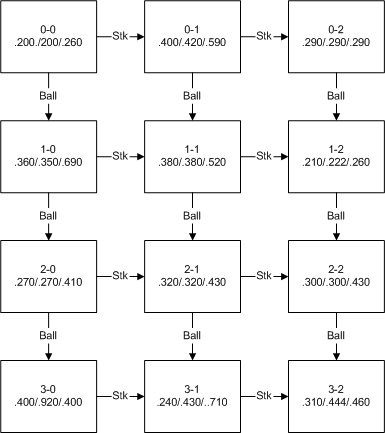
This is what happens when his at-bat ends on that count. Note that he can only walk on a 3-x count, and sometimes he sacrifices (argh) which explains the OBP thing.
Friday wheel of fun
Probably the most disturbing story is in the PI. “Healthy Foppert undeterred by solidity of M’s rotation”
Foppert — and every other aspiring starter in camp, including veterans Dave Burba and Kevin Appier — has to face the reality the Mariners rotation is as good as locked.
Jamie Moyer, Joel Pineiro and Jarrod Washburn are going to be in the rotation no matter what because of their salaries. Felix Hernandez is in no matter what because of his talent. With Gil Meche’s combination of salary and talent, his immediate future is secure, too.
A couple of things:
First, sunk costs. If the M’s can get more out of a rotation spot by releasing a guy making $100m and playing Foppert, then so be it. I know in reality the business side tends to tie hands, but really now.
Second, Meche’s combination of salary and talent has = diddly/squat over the last few years, so if Foppert can beat him out, so be it.
Hargrove:
“Foppert’s one of the guys who’s really impressed me,” manager Mike Hargrove said. “I would still have to say he’s a long shot to make the rotation. I think we’re pretty set.
“Seeing what he has, though, it wouldn’t be a shocker if he made the team. A surprise, yes. But not a shocker.”
You’re set. Really. Open of March, and you’re pretty set. Even though two of your pitchers have been inconsistent-to-crappy since before you even got here. Wow. Okay.
Or, to put this another way: that those two stink-bombs have been spreading the delicious scent of sulfur throughout American League parks for years while being well-paid to do so doesn’t mean we should be particularly eager to take another big whiff to see if the bouquet has changed any.
Also: Beltre is off to play in the WBC in the PI, and
Jeff Clement is in the Times.
Why I don’t like the WBC
I’ve been sitting on this post, but given that the games are starting up, now is as good a time as any.
I think the World Baseball Classic is a bad, bad idea. For starters, playing games that matter is a poor substitute for spring training, when the games don’t matter and you can gradually ease players into playing a full nine innings. The players, particularly the pitchers, aren’t in shape enough for this kind of thing, and it’s only a matter of time before some team’s star gets hurt and their pennant chances go out the window (we should thank our lucky stars Felix isn’t pitching, while at the same time crossing our fingers for Ichiro).
Even if you can get past that, the idea that this will determine anything is absurd because many of the best players in the world — wasn’t this the WBC’s #1 selling point? — aren’t even playing. Pedro? Out. Manny? Ditto. Vlad? Likewise. Japan’s top catcher, in camp with the M’s, isn’t playing. Melvin Mora, Billy Wagner, CC Sabathia, and Aramis Ramirez are among others who have pulled out of the tournament recently. Wagner and Sabathia were replaced on the US roster by — this isn’t a joke — Al “6.13 ERA” Leiter and Gary Majewski.
Throw in some far-fetched national eligibility — your great-grandfather once vacationed in Rome? Welcome to Team Italy! — and the whole thing is a sham, contrived by Bud Selig in an attempt to get us to care about the results of what amount to glorified spring training games.
For me, baseball started today because I heard Dave Neihaus on the radio, not because Korea beat Chinese Taipei in front of a mere 5,193 fans at the Tokyo Dome.