
Game 2: Mariners at Astros
Hisashi Iwakuma vs. Lance McCullers, 5:10pm
Hmmm. It’s one game, and the M’s faced a recent Cy Young winner last night, but it’s tough given the excitement of the day to see the M’s throttled so thoroughly by Dallas Keuchel et al. And it doesn’t get any easier tonight, with the M’s facing another elite ground ball pitcher, righty Lance McCullers.
Dave had a great article on the guy last week at Fangraphs, noting why he was picking him to win the AL Cy Young this season. He’s struggled to stay healthy, and missed time last year with various arm ailments, but has been incredible when he’s able to take the ball. He’s got a sinking 94-96 MPH fastball that gets plenty of ground balls thanks to his low 3/4 arm slot and natural armside run, but his bread and butter is a borderline-unfair curve/slider thing that’s thrown very hard (around 85-86). This would seem to make him susceptible to platoon splits, as sinker/slider guys are often torched by opposite-handed hitters, but McCullers has, thus far at least, run reverse splits. The credit for that goes to his high-spin curve that has the horizontal break and velocity of a great slider, but the vertical depth of a curve. It essentially checks every box: batters swing and miss it all the time, when they DO contact it, it goes for ground balls (as Dave mentioned, McCullers gave up just 5 HRs in 14 starts last year), and he’s able to control it fairly well. Batters have *slugged* .209 off of it in McCullers’ two-year career, but lefties have fared even worse, with just a .186 SLG% against the thing.
You might think that after recurring arm troubles have cropped up, he’d throw less of it. Instead, when he came back from early-season shoulder problems (!), he started throwing his breaking ball all the time. He ended up using it more than his fastball – a full half of his pitches last year were curves. Batters have squared up his fastball reasonably well, and his change looks good but hasn’t been effective as of yet. So he responded by throwing a blizzard of a pitch that no one’s figured out. Makes some sense to me.
Besides health, the big red flag with McCullers has been control. Maybe it’s the swerving run on it, but McCullers’ command of his fastball trails his curve command, and thus he’s posted high walk rates both in the majors and on the farm. If the M’s can be patient and work their way into good counts, they’re more likely to get his fastball, and obviously more likely to get on base. That’s going to be important, as we didn’t get to see too much of the M’s new-and-improved baserunning last night.
Soooo, this is Hisashi Iwakuma’s first start since…whatever that was happened in Peoria the other day. I think I’m more nervous about Iwakuma right now than Yovani Gallardo, and I’m not exactly confident in the newcomer. A healthy Iwakuma becomes one of the better middle-of-the-rotation arms in the league. An unhealthy Iwakuma is going to try to face this Astros line-up with 86 MPH “fastballs” and a lot of guile. No one combines command, competitiveness and pitching smarts like Iwakuma, but there’s a velocity floor below which no one can be effective in today’s major leagues. Iwakuma is getting really, really close to it. If it’s not health and just mechanical foibles, that’s not a whole lot better: Iwakuma minus command would actually be worse than Iwakuma WITH command and an 84-85 MPH fastball. He’s at the point in his career where everything has to be working, and on every pitch. Fingers crossed.
1: Segura, SS
2: Haniger, RF
3: Cano, 2B
4: Cruz, DH
5: Seager, 3B
6: Valencia, 1B
7: Martin, CF
8: Zunino, C
9: Dyson, LF
SP: Iwakuma
The M’s have, as expected, moved Drew Smyly to the 60-day DL and with a spot open on the roster, have picked up Evan Marshall off of waivers. Marshall’s pitched in portions of three seasons with the Diamondbacks, and throws a good 95 MPH sinker along with a splitter-style change-up and slider/cutter (both around 86). Despite the velocity, he’s not been a strikeout guy – he’s a ground ball machine. It’s an intriguing arsenal, albeit one that hasn’t been sufficient to allow him to reliably stay on anyone’s active roster. Walks are a big part of the reason why, and that’s something he’ll work on down in Tacoma for a while.
Game 1, Mariners at Astros
Felix Hernandez vs. Dallas Kuechel, 5:10pm
Happy Felix Day, and a felicitous Felix New Year to all of you.
The M’s have playoff expectations this year, but that’s not actually new: they were *supposed* to win back in 2015, and while they weren’t favored in 2016, they were clearly in the wild card picture both in the projections and, as it turned out, in real life. This year feels different, somehow, and it’s not just because they’re coming off a good year and made a series of trades to improve the roster. The difference this year is that the club reflects the goals and strategy of the GM much more. We’ve talked at length about how the core of this team was put in place by Jack Zduriencik (and even Bill Bavasi – love you, Felix), and so Jerry Dipoto’s job was to do a better job of filling in the complementary pieces either through player development or through trade. In his first year on the job, Dipoto really focused on the trade market to bring in guys we now see as more marginal. This year, from the Walker/Segura trade to the acquisitions of Jarrod Dyson and Drew Smyly, fans have a sense not only of what the M’s are trying to do, but how they want to do it.
The M’s want to lead the world in OF defense and greatly improve their baserunning. They won’t be trying to out-slug the Astros or Red Sox, but, the idea is that they’ll have easily enough offense to win with their current pitching staff. There are a number of key assumptions that drive that simple-sounding summary, and the M’s have actually been pretty open about what they are (another notable difference from their predecessors in the M’s FO): they want their pitchers to yield fly balls and thus drive down their opponent’s expected batting average. They hope Safeco reverts to form and helps hold down opponent HRs. They assume improvements in the top of the order will help the middle of the order drive in more runs. They believe improvements on the basepaths add up to an easy win or two. And, crucially, they believe all of this adds up to a team that can compete with Houston, tonight’s opponent.
The M’s need to see how they stack up against an opponent whose projected batting lines exceed the M’s at 8 of the 9 line-up spots (OK, technically Cruz/Correa are tied in the clean-up spot). They need to see if Felix is prepared to make the adjustments he needs to make to give the team its ace back. Felix has struggled mightily against the Astros in the past two seasons, and that can’t continue if the M’s want to hold off Houston. With the depth the Astros have at their disposal, the M’s will need to be both healthy and creative to either reduce their need for depth or to gin up solutions to roster holes.
All of this makes it sound like a nearly impossible challenge, and that’s going too far. We know the Astros can fritter away an “on paper” advantage: they did it last year! But the M’s are going to be fascinating to watch this year, and could do something much better than just compete for a division title: they could extend their competitive window. If Mitch Haniger and Jean Segura live up to a fraction of M’s fans hopes, the trade that brought them north will be seen as a franchise-changing one. Dyson/Valencia/Cruz even Martin and Cano won’t be around long term, but a core involving Seager/Segura/Haniger with lion-in-winter contributions from Cano and whoever else the M’s assemble is a decent starting point. It’s not enough, not on its own, so that’s where the team’s player development group comes in. As it stands now, the M’s farm system looks somewhat weak, especially after Tyler O’Neill and the rehabbing Kyle Lewis. That won’t cut it, and so as important as it is to see Segura in 2017, it’ll be critical for the M’s to develop another complementary big league piece or two. A comeback from DJ Peterson? A leap forward from one of the low-minors arms? Dan Vogelbach making some key adjustments? None of this is far fetched, and it’ll be fun to see who steps up and pushes their way into contention for a big league job.
But for the 9th time, today is mostly about Felix. His struggles not only doomed the M’s playoff push, but made the entire season less enjoyable than it otherwise would have been. Quite obviously, we can handle not making the playoffs – we’re well-versed in finding value in other elements of the regular season. But there’s something jarring about watching Felix stumble, even as we know he can’t pitch forever. I want to see another big adjustment and a comeback player of the year award for the big righty. I tell myself that I’d rather have Felix play a minor role on a playoff team than a starring role for a loser, and I think even Felix would agree with that, but ace-level-Felix is one of the most compelling things I’ve seen in decades of being a fan, and I’m really glad to have seen it. A part of me wants that back more than anything team-related. I’ll try to keep that part of myself away from the keyboard this year, but he may make a few appearances.
1: Segura, SS
2: Haniger, RF
3: Cano, 2B
4: Cruz, DH
5: Seager, 3B
6: Valencia, 1B
7: Martin, CF
8: Zunino, C
9: Dyson, LF
SP: King. Felix.
I think Houston holds off the M’s this year. I think the M’s compete for a wild card and end up getting the 2nd one. I think run scoring continues to climb, and that Safeco continues to see record numbers of home runs. I think Tampa’s a contender, that Texas looks much better than people think, but that their weird base runs devil magic runs out.
The 2017 M’s: The Risks
The M’s improbably built a club that gets to talk about playoff expectations just two years after the franchise-altering failure of 2015. The M’s of 2017 boast a formidable defense, a well-regarded bullpen, and an offense that’s helped turn Safeco Field into a home run haven. But we’ve seen this too many times to really believe; there are innumerable monsters out there, and they seem drawn, inexorably, to the M’s.
The past two years saw the projection systems forecast an extremely tight spread between the American League clubs, a fact that help foster some optimism in the northwest. “We’re a few games back of the best team in the AL!” “Parity+an owner willing to spend+a GM willing to trade anything that’s not bolted down=playoffs.” The problem is that real seasons generally don’t look like that: SOME team or teams will win 93-95 games, and some teams will be bad, not just a-bit-below-.500. The projections were a complicated mathematical shrug, an acknowledgment that the error bars were wide enough to swamp true talent. That’s essentially what we got – in 2015, the Astros were just better than anyone thought, and in 2016, the Rangers…ok, I have no idea what’s going on there. The point is that the M’s had reasonably similar projections in both years. What’s changed now is that we all have a better idea of the spread in talent, and we’re more assured that the Astros/Red Sox/Indians are good teams. 84 wins wasn’t good enough when 84 wins was supposed to keep you in it. 84 wins is almost assuredly not going to cut it now.
So what might prevent the M’s from passing Houston? I was looking at Ryan Divish’s answers to that question in the Seattle Times’ Baseball Preview section and agree with all of them. Drew Smyly may be out 2 months and Hisashi Iwakuma’s fastballs may reach Jered Weaver speeds soon, so I’m very concerned about the rotation and the team’s overall health. But what struck me was that some major risks overlap with what Divish (correctly) ID’d as potential strengths.
1: The OF can’t hit, and the embrace of a glove-first OF is negated by another flurry of dingers at Safeco.
I like Mitch Haniger. I think he’ll hit…probably. But he’ll have to beat his projections soundly to be a league average bat, and he’s – by far – the best hitter in the M’s OF. Leonys Martin brought a good glove to CF, and showed flashes of upside last year, tapping into his long-dormant power. But when the season ended, he remained a well-below-average hitter, and one who’s projected to decline from there in 2017.
Flanking him in LF is Jarrod Dyson, a speed-merchant who’ll turn 33 this season and is already nursing a hamstring issue. Never a great hitter, he’s coming off of his best season, but is being asked to play every day. That means facing more left-handed pitching, and he’s *slugging* .285 against them for his career.
Guillermo Heredia and Taylor Motter are capable back-ups, but not yet starting-caliber players for a club in contention. Ben Gamel will start in AAA, and top prospect Tyler O’Neill likely needs seasoning as well. Haniger is the key to this group hitting enough to make use of the middle-of-the-order’s ability, and he’s got all of 123 big league plate appearances to his name. If Martin, Dyson, or both collapse offensively, the offense may struggle.
But defense doesn’t slump, right? The M’s were unquestionably better defenders last year, but even with a fly-ball pitching staff in front of them, they struggled to make up for their lackluster batting lines.
The culprit here may have been as much meteorological as it was anything baseball related: Safeco Field yielded a ton of HRs, meaning there were fewer well-struck balls that remained fieldable by the OFs. That spike in HRs doesn’t seem to be related to a noticeable change in approach, so it may have had something to do with the marine layer in the atmosphere that’s reliably knocked down balls hit in the air. If that doesn’t change in 2017, the M’s may have brought incredible defenders to high-scoring slugfests. If the M’s pitching approach targeting high strikes works to perfection, they’ll produce more high-launch-angle contact: pop flies and shallow fly balls with lots of hang time. Even if scoring is low, that kind of contact can be fielded by anyone, not just the Dysons of the world. The M’s OF defense really should be great, but they require opportunities to demonstrate it if they hope to make up for some mediocre offense.
2: The vaunted middle-of-the-order can’t maintain last year’s production.
Robinson Cano and Nelson Cruz have become franchise cornerstones and clubhouse leaders. Kyle Seager made the leap from ‘good’ to ‘great’ at the plate last year, and remains remarkably durable. This group of hitters remains Seattle’s greatest strength, but they may need to recapture their 2016 form if the M’s want to hold off Houston. And that’s going to be hard.
Cruz set a personal best in isolated slugging in a full season in 2016. Robinson Cano narrowly missed his own record, set in 2012 in the bandbox that is new Yankee Stadium. Kyle Seager blew his previous level of performance out of the water, and again, much of the gains came in the form of increased power. Seager will play his age-29 season this year, but given the age of Cruz/Cano, some significant regression seems likely.* If it comes, this puts a lot of pressure on the supplementary pieces to meet or exceed their projections, and as we just discussed above, requiring Dyson and Martin to help out on offense may be asking too much.
The M’s projections already incorporate a noticeable jump in runs scored. It’s easy to say that Jean Segura will add much more at the plate than Ketel Marte – that’s (essentially) a given, and it’s also already factored in. The question is: will the gains from adding Segura/Haniger/Valencia counter the regression from Cruz/Cano after what look like career seasons. The durability of the core three has been remarkable, and it’s a key reason why the 2016 M’s scored so many runs. As with any team, remove a middle-of-the-order bat from the line-up, and the entire run scoring outlook changes dramatically. No one has “good” alternatives for their best players (being irreplaceable is a decent definition of a great player), but given the pitching staff’s expected runs allowed (particularly now with Drew Smyly out), the M’s can’t really afford a down year from their middle-of-the-order stars.
3: The Astros may run away with this.
In last year’s “upside” post, I noted that the Astros (like now, the putative favorite) had some serious issues, especially at first base. (Please don’t read any of the other “upsides” I identified. Focus, please.) While they didn’t go out and grab an Edwin Encarnacion or Jose Bautista, their line-up still looks formidable. Similarly, while they don’t (yet) employ Jose Quintana, their pitching staff looks better thanks to more playing time for Lance McCullers, the emergence of Chris Devenski, and further development by Joe Musgrove. The M’s have amassed some laudable rotation depth, but it simply isn’t in the same league in terms of upside and 2017 ability.
If everyone in the M’s staff stays healthy from this point on (ha!), they can hang around with the Astros. The larger problem is that the Astros are projected to outscore the M’s by over 0.4 runs per game. The M’s core group of Cano/Cruz/Seager now includes Jean Segura, who had a brilliant season for Arizona last year. But the Astros’ group of Carlos Correa, Jose Altuve, George Springer, Alex Bregman and Josh Reddick is deeper, better, and significantly younger. There are weaknesses in the OF for both teams, so it’s not like Houston’s put together a 1927-Yankees style juggernaut. But they would seem to have a significant edge in true talent, and thus the M’s margin for error is much less than it was a year ago.
The Astros got off to a terrible start in 2016, but came back in the second half. They were never going to catch the Rangers, but they played well enough to push the M’s for 2nd down the stretch. With more time for Bregman, with Brian McCann replacing Jason Castro, and with role players like Carlos Beltran and Yunliesky Gurriel, they have a projected advantage at 6 of the 9 positions, and the superior pitching staff as well. It’s easy to argue for flipping a few of these – a big year from Haniger can overcome the Astros’ perceived advantage, for example. But the Astros have been building for a while, and now seem like a team that’s built to compete and win the division for the next few years. The M’s last best shot is in 2017, and that unfortunately coincides with Houston’s FIRST best shot.
* Potentially interesting side-note: if Cruz/Cano ARE able to maintain something close to what they did in 2016, it may mean Safeco is once again playing like a home-run park, which, while it takes pressure off of the offense, makes the run-prevention group’s job that much harder.
Hisashi Iwakuma’s Outing Today
It’s easy to be paranoid on a day when we’ve just learned that Drew Smyly may not be ready to pitch when the season starts. I look forward to laughing about this in a month after Hisashi Iwakuma twirls a few gems against Houston, Texas and Miami. It may be premature, given that there are questions about the Pitch FX calibration in Peoria, so maybe the velocity readings aren’t as bad as they look.
But here, look at this:
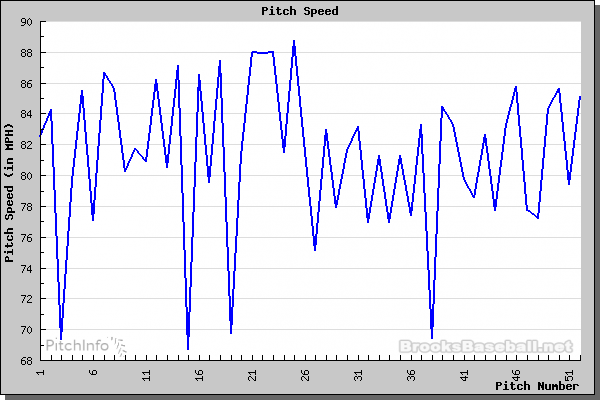
This was Hisashi Iwakuma’s velocity today in his abbreviated start against the Dodgers. This is from BrooksBaseball, who’ve taken the raw MLBAM Gameday data and adjusted it to measure the speed at 55′ from the plate as opposed to 50′. That means that these readings are actually faster than what you’d see in the Gameday app, where Iwakuma appeared to throw a blizzard of 82 MPH “change ups.”
The first inning looks OK (through pitch 27 in the chart), with a couple of sprightly 88 MPH fastballs to Tyler Holt, followed by an oddly slow slider that Holt singled on. But look at the stubbornly low velocity immediately after that. He begins the 2nd inning with a walk of ex-Mariner Chris Taylor, and none of the pitches exceed 84, leading Gameday to call them changeups. The problem is that they very clearly aren’t. His velocity gets slightly better towards the end of his outing, but it’s still far below where it was in the first inning.
Clayton Kershaw’s velocity was slightly lower than usual today too, so it may be that after further adjustments, Iwakuma’s 83 MPH fastballs were really 85-86 MPH sinkers – something low, but not THAT low. The problem is that while the M’s are saying there’s nothing physically wrong with him, and Iwakuma himself blames mechanical issues for his wildness, that picture is exactly what an injury looks like.
There are, of course, other explanations. This spring, Iwakuma’s been a little slow out of the gate with his fastball. Here’s a velo chart from a few outings ago, where we started off 85-86 and then worked up to 88.
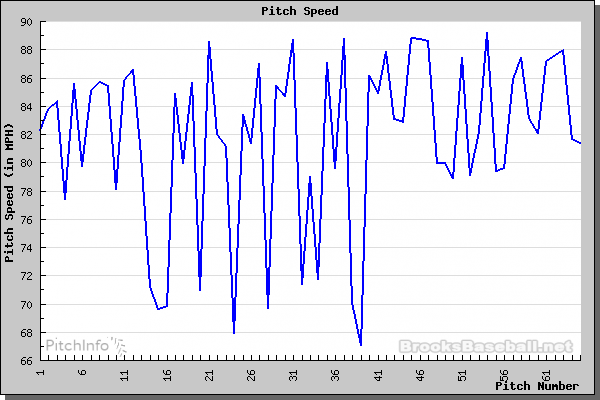
Since his outing ended in the 2nd, maybe he just never got loose. That might explain the velo and the wildness (four walks? From Hisashi Iwakuma?), but is a warning sign of its own.
Still, it’s scary to see such a drop after a frankly odd-looking slider; it’s not good to be able to look at the chart and instantly spot where…something happened. Iwakuma’s thrown a few sliders this spring, but none as slow as that 75 MPH hanger to Holt. It’s 5 MPH slower than he averaged last year, and it appears to be the only slider he threw in today’s game. I sincerely hope Iwakuma just tried to work on his mechanics in the 2nd, and, for whatever reason, it didn’t work. But this is now something to watch, in between watching for news on Drew Smyly’s health.
Please stay healthy, M’s.
Felix and the Low Fastball
I should probably be writing about Drew Smyly, who’s suddenly sidelined with what he called a “soggy” arm, and may not be ready for opening day. But I’m going to write about Felix, and I will attempt to make it topical by saying that Felix is suddenly even more important to the M’s 2017. With the bottom of the M’s rotation in a bit of flux, and as we all wait to hear why Drew Smyly’s arm is suddenly taking on water, the M’s need a bounce-back season from Felix more than ever. The M’s were never supposed to be a dominant run-prevention group, but the return of Good Felix makes the M’s path to contention a whole lot easier.
The M’s attempts to restore Felix’s regality took two paths, as detailed in this great Ryan Divish piece from late last year. First, Felix had mechanical problems which impacted his command, and second, he targeted the bottom of the zone almost exclusively, allowing hitters to either take low fastballs and draw walks (his 2016 walk rate was the highest of his career) or wait for him to throw a get-it-over strike higher up. The theory, as described by Jerry Dipoto in that Divish article, is that hitters got comfortable against him knowing where he was going to spot his fastball.
An objection I’ve heard on Twitter and one I talked about back in June is that it’s dangerous to so completely change a pitcher’s plan of attack; Felix is Felix because of his great sinking fastball/change – if you try to force him to elevate four-seamers, something he hasn’t done much of since he threw 97, he could really struggle. Well, in this case, I’m fully on board with the M’s change of strategy. Felix’s 2013-14 peak (by fWAR) and his 2015-16 struggles have coincided with some fairly large-scale changes in how the league attacks low fastballs, and batters have made adjustments that make them much better against low fastballs than they were even a couple of years ago.
Jeff Sullivan pointed this out at FG a while back, but the spike in home runs last year did not come from batters driving more high fastballs. Instead, it was largely the result of a sea change in how they attacked *low* fastballs. Jeff compared 2008-2015 with 2016, while I’m going to focus on the past four years. Here’s a graph showing the league’s slugging percentage on fastballs in the lower third of the zone (and below/to the side of the zone) and on fastballs up (and out of) the zone. Batters fared better on low FBs – barely – in 2013, but the gap has grown thanks to a jump in results on low FBs in 2015 and 2016.
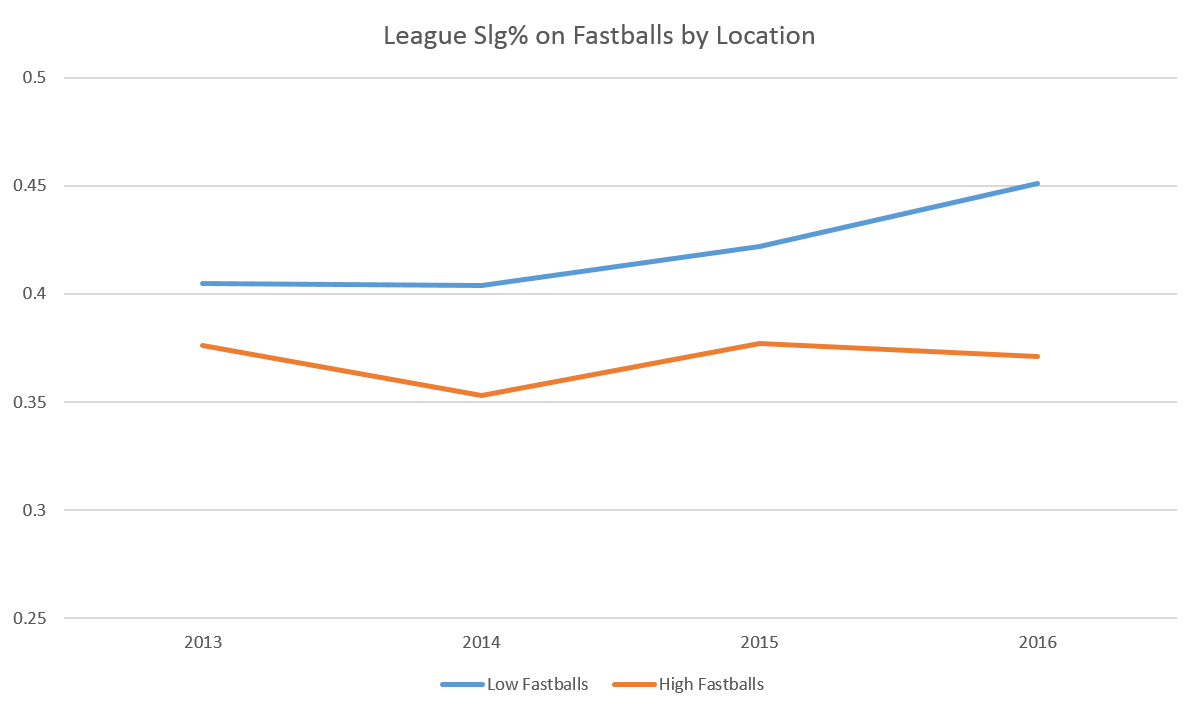
I’m using SLG% because it incorporates both batting average AND power; it makes sense that low FBs have a surprisingly high SLG% because there are a lot of singles and ground-ball hits in there. IF we focus just on home runs, the change is even more evident:
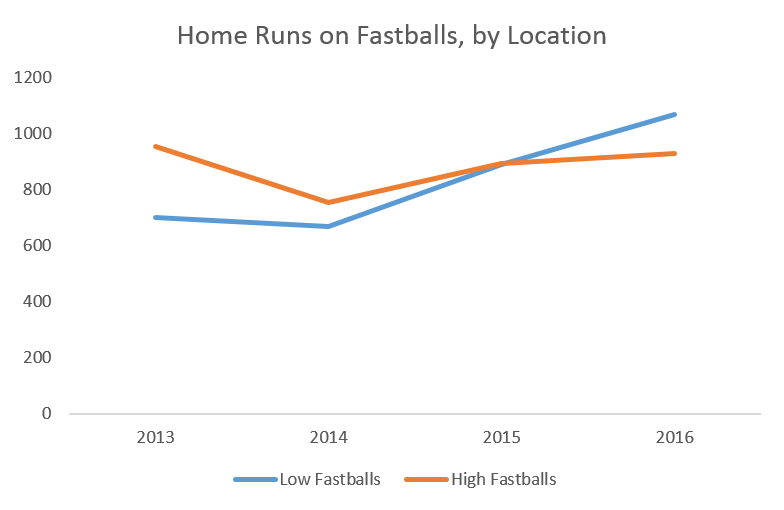
HRs on low FBs overtook HRs on high FBs in 2015, and while HRs were up everywhere in 2016, low FBs were much more likely to go for HRs in 2016. Batters have adjusted not just to low pitches, but to low FBs. It’s not about putting more of them in play (balls in play rates continue to drop), they are doing far more damage on these pitches than batters did (many of the SAME batters, remember) in 2014.
The strike zone grew dramatically in the early part of this decade, with nearly all of the growth in the actual, as-called-by-umpires zone coming through expansion downward, below the batters’ knees. This helped all pitchers, but two kinds in particular: those with great command of sinkers and low pitches, and those with catchers who could make low pitches more likely to be called strikes. Felix was obviously a great example of the former, while anyone who pitched to Jonathan Lucroy fit the latter category. Scoring dropped, as pitchers got ahead of more hitters – hitters who weren’t used to seeing those pitches called strikes. And pitch framing took off, as the Lucroys of the world made throwing down more profitable. Pitchers responded by following the money, and changed where they put their fastballs:
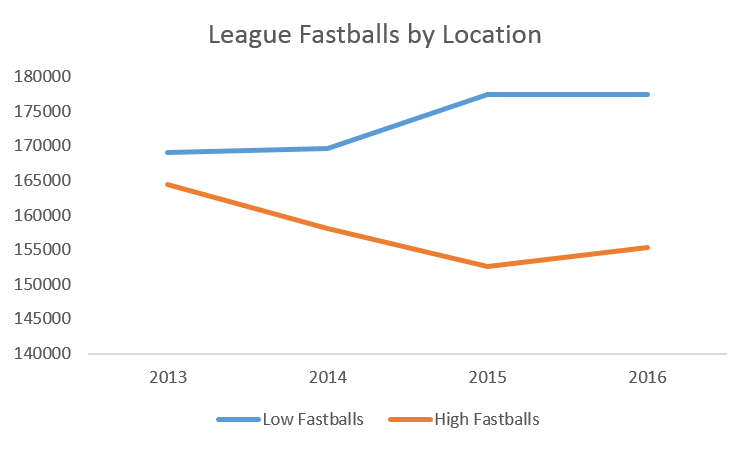
Now we’re seeing the counter-adjustments. The strike zone’s expansion slowed and then, ever so slightly, reversed. Hitters like Josh Donaldson and others learned to elevate low fastballs, and now hit low fastballs for power. The league as a whole first changed in a direction that seemed tailor-made for Felix to take advantage of, and he responded with two of his best seasons. The league as a whole has now changed in ways that seem perfectly designed to hurt Felix, and they’ve done so. Whereas Felix used to make his living on low fastballs, his advantage is essentially gone now.
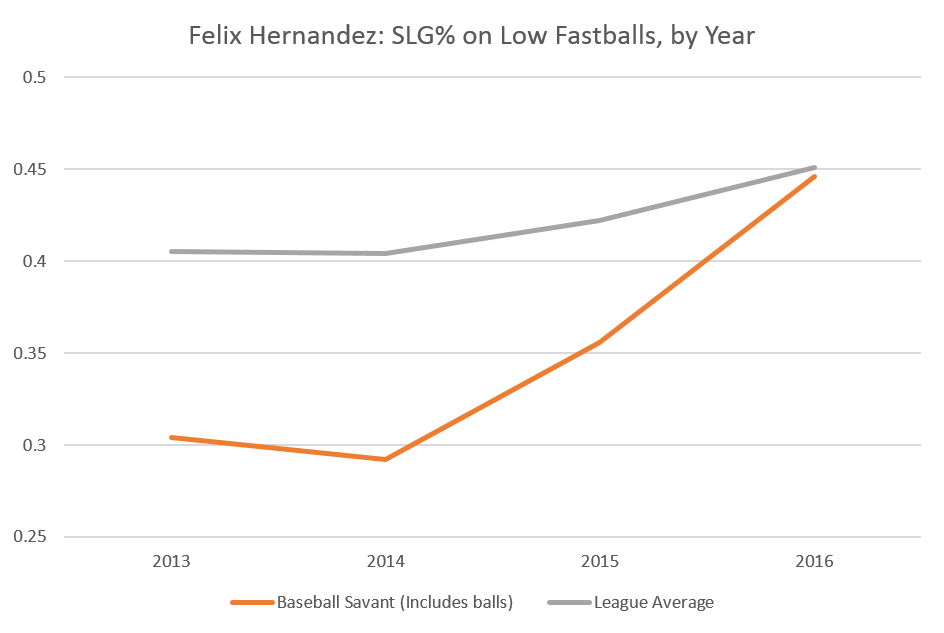
Felix is now league average when he throws a low FB, which is terrible, because almost by definition, any elevated fastball from Felix is a mistake. These data come from BaseballSavant.com, but the change is even starker if you focus on the bottom third of the zone in Brooks Baseball’s charts. Excluding the out-of-zone contact and focusing just on low strikes, they show Felix’s SLG%-against on fastballs as going from .448 in 2013+2014 to .661 in 2015+2016.
Felix needs to change. Here’s a chart of his vertical pitch locations throughout his career. 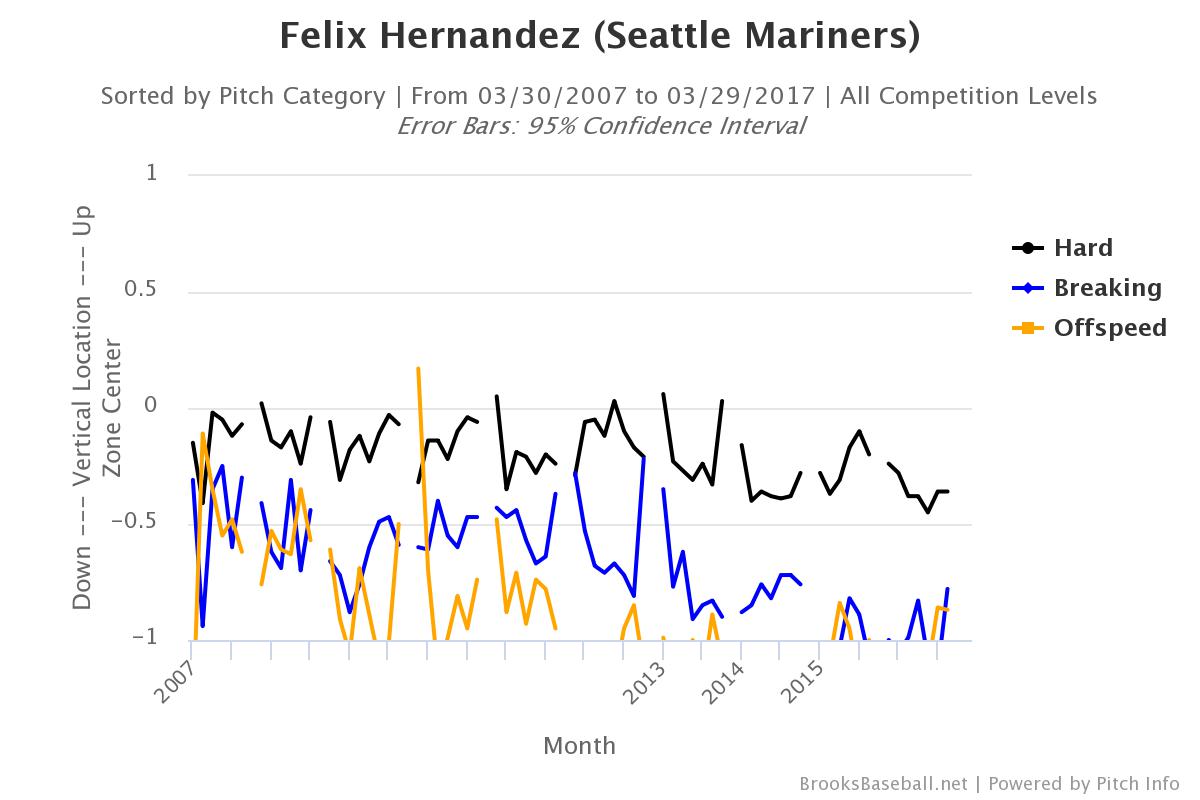 As Felix has lost velocity, he’s increasingly targeted the bottom of the zone (below the midpoint of the zone). He could learn something by looking at what Justin Verlander’s done, as shown below. Verlander was struggling for a few years, and his return to form has coincided with what looks like an intentional move UP in the zone.
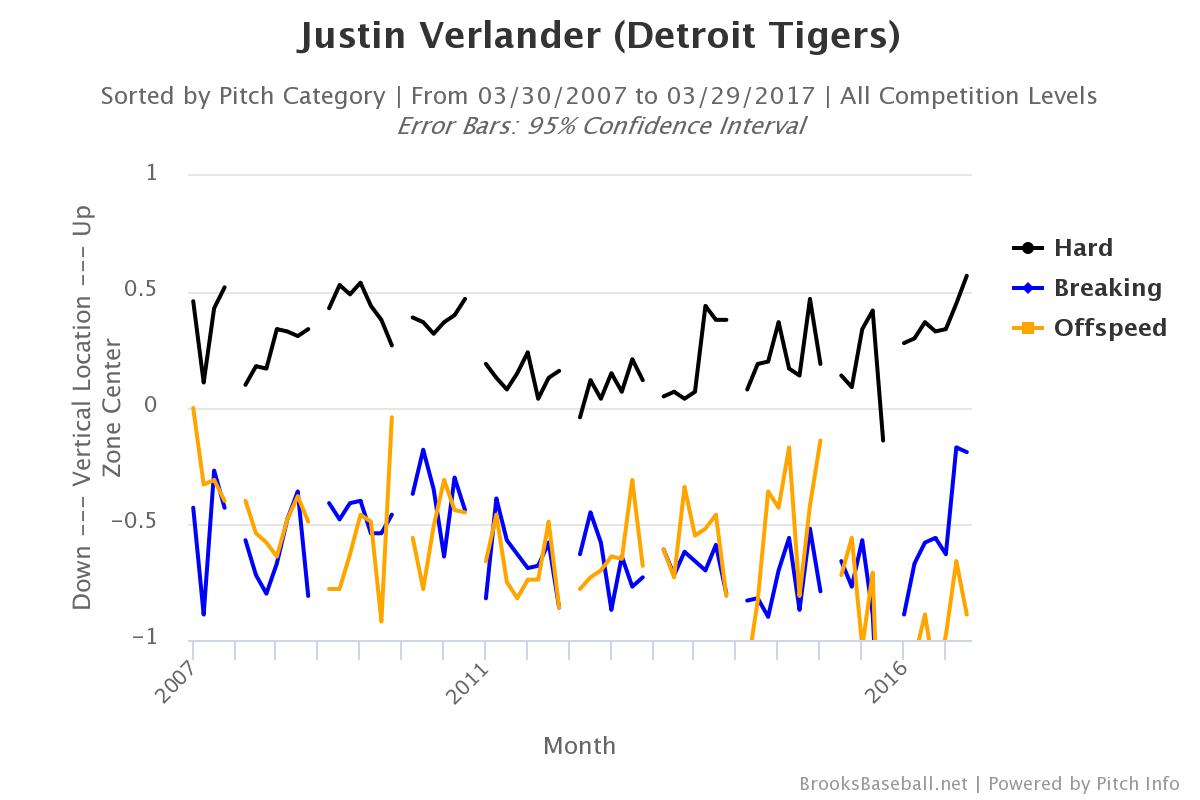
This may be uncomfortable, but the benefits are significant. A counter-adjustment is warranted, and ANY change from Felix seems like it’d make it harder for batters, especially those intra-divisional hitters who have seen him often. Felix’s command may not be what it once was, but that’s why targeting something other than the low strike might help: predictability plus so-so command is worse than unpredictable and so-so command.
So how’s it going? What meager data we have from the WBC and Spring training show that he’s already making some adjustments. His average FB height seems to be up this spring, especially in the WBC, where he used high FBs repeatedly to get weak contact, whiffs, and to set up his change/breaking balls. Unfortunately, he’s done this before – he’s thrown significantly higher FBs in the spring several times before, only to pitch differently once the regular season started. Felix doesn’t get enough credit for his pitching smarts, and it’s time for him to put them to use. More than FB velocity, more than command, Felix needs to rediscover the high FB. This isn’t a quick fix, as we saw with Brandon Drury’s HR on a high FB yesterday. They’re risk in changing a successful approach, and there may be bumps in the road as Felix learns how/when to go high. Still, he can’t rely on last year’s game plan, and using the entire zone offers his best chance of retaking his throne.
:Note: This post is similar to a lot of what Jake Mailhot had to say at LL a week or so ago, and both of us pointed to Jeff’s article at FG. Sorry to harp on this subject, but I wanted to talk about Felix’s adjustments specifically, and I wanted to get back to this topic after raising it (not just about FBs) midway through last year in one of my “what’s going on with Safeco?” posts.
With Vogelbach Demotion, M’s Roster Nearly Set
Didn’t see this one coming. For the past several months, the expectation has been that the M’s would give Dan Vogelbach the starting 1B job, either on his own or in a platoon with Danny Valencia. Today, though, the M’s optioned Vogelbach to Tacoma, handing the 1B job to Valencia and opening up a roster spot – presumably for a reliever.
Vogelbach has struggled in recent weeks, and leads the team in strikeouts with 19 in just 57 at-bats. For a team focused on controlling the strike zone, Vogelbach’s slump in precisely that area was going to draw attention. After opening the season with 8 Ks and 4 BBs in his first 26 ABs, he’s had 11 Ks and 3 BBs in his last 28. Overall, his K rate is 30%, not what the M’s wanted out of a bat-first position. Dipoto referenced the temporary demotions last year of James Paxton and Mike Zunino, with the thinking that he can get more work in for the Rainiers instead of playing sporadically as a bench bat in Seattle. That’s probably a good thing. He dominated the strike zone for Tacoma, but his SLG% of .422 probably wasn’t ideal for the position. Sure, the OBP was amazing, but I wonder if he made some adjustments looking to tap into more power and threw his swing (and process at the plate) out of whack a bit.
The final utility roster spot seems decided as well: Shawn O’Malley’s imminent appendectomy will require a few weeks of recovery time, so the job is essentially Taylor Motter’s by default. As with Vogelbach, I’d imagine we’ll see O’Malley at some point this season, but Motter will get the first crack at the job.
Cactus League Grinds On: M’s Host Giants
Given that a good chunk of their best players are currently in the WBC or flying back from it, it probably shouldn’t come as a big surprise that the M’s have frittered away some of their impressive strike zone stat advantage. They’re still pretty good, mind you, but they’re no longer among the top teams on either offense or defense. The pitching staff in particular has been unimpressive in recent days, thanks to some ugly lines put up by guys who are not realistically going to play for Seattle this year; the M’s now lead MLB in spring training HRs given up.
Hisashi Iwakuma will try to rebound from an ugly start in that 24-3 drubbing at the hands of the Brewers. I know it’s early, and that his game isn’t based on velocity, but Iwakuma’s averaged 86 MPH on his fastball in his first start of the spring, according to BrooksBaseball (so MLB would have it even slower). That was very early, and he got good outcomes, but after the Milwaukee unpleasantness, it might be worth watching. Iwakuma’s critical to this team, as one potential advantage people have ascribed to the M’s vis a vis the Astros is their rotation’s depth. If Iwakuma stumbles, or pitches more like a #4/5 starter, that advantage starts to look pretty shaky.
I’m not convinced that Collin McHugh is much more than a #3 or 4 at this point, and the Astros might need to ask a lot of their rookies Francis Martes/David Paulino, so I understand the point. But to me, the M’s rotation has as many question marks. A bounce-back season from Iwakuma would answer a big one, and a stretch of good health from James Paxton would answer another. The pieces are there for the M’s to have a better run prevention unit than the Astros, but a lot needs to go right. The M’s depth looks better today than it did a month ago thanks to strong springs from Andrew Moore and Max Povse, but the Astros still have secret weapon Chris Devenski, who had one of the best years for a swingman in recent memory, behind their starting 5.
Today against the Giants, the depleted M’s (day game after a day/night split squad day yesterday) have several back-ups starting and ready to come on later. Steve Baron starts at C, and ex-Indy Leaguer/ex-position-player-pitcher-hybrid Micah Owings’ may make an appearance out of the pen.
1: Martin, CF
2: Motter, 2B
3: Seager, 3B
4: Valencia, DH
5: Vogelbach, 1B
6: Heredia, LF
7: Gamel, RF
8: Smith, SS
9: Baron, C
Statcast’s New Defensive Metrics and Seattle’s Glove-First Outfield
I don’t want to write about yesterday’s Cactus League debacle any more than you want to read about it, and I’m loathe to look at more spring stats to see if the M’s early lead in K:BB ratio’s been frittered away the past few days. So instead, let’s look at one of the biggest stories of the offseason: the M’s remade outfield defense. You may have seen this Eno Sarris article at Fangraphs that says the 2017 M’s may be the first since the 2003 M’s/2013 Indians to field three true-talent CFs at the same time. It’s great, even if it does include video of that awful Mike Cameron injury. Importantly, it includes some quotes from Jerry Dipoto about how important defense was to their offseason plan, and how it complements the kind of pitchers they targeted – guys like extreme fly-baller Drew Smyly. Fortuitously, MLB’s Statcast group just released brand new data on outfield defense, breaking plays into 5 (with an implied 6th) buckets ranging from “nearly impossible to catch” to “nearly impossible to miss.” These new measures might help us get a handle on what the M’s baseline level of fielding was in 2016, and whether or not there’s anything about Safeco Field that will make the job easier.
The new statcast data includes 5 buckets, each given 1-5 stars. The 5 star buckets are converted into outs less than 10% of the time, and 1 stars are converted into outs about 90-95% of the time. Jeff’s got a great post on the new Statcast data today at Fangraphs, and he’s helpfully calculated the average conversion rate for the Statcast era, or 2015+2016. With that, we can compare each player’s catches to what we think a league average OF would make, given the same opportunities. I used his averages and calculated plays made above average for each player in 2015 and 2016, and then I looked at how their chances were distributed. That is, some players (Jackie Bradley, Jr.) saw proportionally more extremely difficult opportunities, while others (Kevin Kiermaier) saw fewer. The plays on the Statcast leaderboards apparently don’t include the absolutely never missed, can of corn, 100% probability balls. At least, that’s my guess just from noting that the sum of each players chances across all 5 buckets totals a fraction of their overall chances/putouts as reported elsewhere. If true, that means that the plays that really separate defenders are in a few not-terribly-large buckets in the ranges where catches are made 25-50% of the time or so. Given THAT, I’m pretty impressed with how reliable these numbers look. Kiermaier, Lorenzo Cain, Ender Inciarte, etc. look great both years despite varying playing time, opportunities, etc.
Let’s take a Mariner-centric view of this, and attempt to answer a few questions. First, how good was the M’s defense last year, and second, how much better was it than 2015’s? Third, does anything stand out about the distribution of the M’s outfield opportunities? Finally, what would replacing Nori Aoki with Jarrod Dyson and Seth Smith with Mitch Haniger do in terms of additional plays made?
Jeff mentioned it in his piece, but one of the first big takeaways is that Leonys Martin looks quite good in the Statcast-based metrics – better than he did in UZR/DRS, where he graded out as a dead-on average CF last year. Martin made 11+ plays more than expected, a bit better than the 4 runs saved by UZR, and a far sight better than DRS’s 2 runs *below* average. That edges out Lorenzo Cain, who ranked 2nd in all of baseball in 2015. On the other hand, it essentially ties him with the 11 runs saved by the M’s 2015 CF, Austin Jackson (yes, Jackson split time that year with the Cubs, but the bulk of it was in Seattle). Seth Smith and Norichika Aoki both graded out a bit below average (probably not a shock to most M’s fans), while Nelson Cruz and Guillermo Heredia kind of cancelled each other out. Interestingly, the corner OF picture wasn’t all that different in 2015. It was worse, clearly, thanks to many more innings from Nelson Cruz, the Mark Trumbo experience, and Brad Miller’s disastrous trial in the OF. That said, Seth Smith graded out as a perfectly average OF, and he played more defensive innings than Cruz, and more than Trumbo and Miller combined.
One striking thing about the distribution of chances the M’s have handled is that nearly every M’s OF has faced slightly more “midrange” opportunities, and *every* M’s OF has faced fewer 5 star opportunities. I combined the middle three Statcast buckets into one group, and compared that to the hard/easy outliers. Across the league, about 23-24% of balls are in the 5 star bucket, and 32% are in the 1 star; this was remarkably consistent in both years. Combining the rest into one larger group, you’d expect players to get about 44-45% of their chances in this maybe/maybe not zone. In general, the M’s were higher than that, with the CFs (Martin in 2016 and Jackson in 2015) at 50% or so. A few of the corner OFs had fewer opportunities in this midrange zone, but in those cases, the extra chances went to the “easy” bucket, NOT to the hardest one. Seth Smith and Mark Trumbo had a lot more “easy” chances in 2015, so every M’s player season in the list faced fewer 5 star chances than we’d expect. I’m biased, of course, but I think that adds some credence to the hypothesis in my last post on OF defense that Safeco gives OFs a higher defensive floor than most parks.
That parks could change the distribution of fly balls makes some sense, as Colorado’s massive OF would mean balls hit a hundred feet from an OF might still be in play instead of in the 8th row of seats. Boston’s huge CF might account for why, say, Jackie Bradley and Mookie Betts had so many MORE 5 star opportunities (but it wouldn’t explain why they didn’t in 2015). That said, I’m pleased to see that getting a bunch of 5 star opportunities isn’t correlated with high defensive rankings. There are many ways to succeed here, as Adam Eaton got a lot more 5 star and 1 star plays and graded out brilliantly, while Kevin Kiermaier had the opposite distribution (lower on the tails, big in the middle) and did well, too.
It’s a tiny sample, but Mitch Haniger looks really good by Statcast, and it’ll probably come as no shock that Jarrod Dyson does, too. I think what we’ve seen here is that the M’s OF defense wasn’t the historically awful group that, say, DRS thought they were in 2015 and they weren’t bad in 2016, either. That said, there’s still plenty of room for improvement, and in Dyson and Haniger, the M’s acquired two players who will almost certainly get to more balls in 2017. Quantifying it is difficult, but 20 additional plays seems like a very conservative number to start with, assuming 5 plays below average for Aoki/Smith and 15 above for Dyson/Haniger. Decent positioning should help the M’s get to more of the tougher “midrange” chances, and the post-2012 dimensions means the M’s don’t have to worry about as many of the nearly-impossible ones. To get the biggest bang for their trading buck, the M’s would presumably hope for more opportunities overall, and that brings us back to the weird HR effects Safeco Field saw in 2016. Regression *there* would produce big savings in runs allowed, as you’d take HRs off the board (duh) and turn more of the resulting balls in play into outs.
Other random items that come to mind after staring at a spreadsheet:
1: I left the minimum balls in play threshold at 50, the same as the default setting at Baseballsavant.com. You can play around with it, but what it does is exclude some defensive experiments that might pull down the overall average. That means that the group who gets rated was the group entrusted with fielding a few games, and not just a few innings in an emergency. Thus, the league-wide plays above expected level isn’t zero – it’s quite a bit higher. Interestingly, that was much less of an issue in 2016 than 2015, when the cutoff meant the league appeared to make 200+ plays more than expected.
2: Jeff also mentioned this (damn him), but the Angels OF defense takes a hit when comparing these new Statcast metrics to UZR/DRS. Mike Trout goes to just below average, while Kole Kalhoun goes from unheralded defensive star to solidly below average in both years. No point to this, just some Statcast schadenfreude.
3: One hypothesis I’ve had is that fly ball staffs (and the M’s have been one under Jerry Dipoto) might produce easier balls in play. That is, that Marco Estrada, for example, gives up a lot of home runs (which aren’t in play) on well-struck balls, but then a lot of pop-ups on poorly-struck balls, producing a consistently-low BABIP. These buckets exclude pop-ups, I think, so there’s no real way to tell. The M’s don’t look like they saw MORE “easy” chances, but then, we’re not seeing the easiest of the easy. It might help to compare the total opportunities in Statcast versus total chances in BBREF and see what proportion of total chances are ranked in Statcast. My assumption would be that a higher percentage of Statcasted-balls would mean a more difficult group of balls in play. Someone (not me) should do that.
4: It’s really interesting to see how bad fielders drop off precipitously around 2-3 stars. Matt Kemp can’t make any plays in the 3-4 range, and neither can Trumbo or Cruz. Like you’d expect, they’re perfectly capable of making the easiest plays, and they’re not penalized too harshly for not making highlight-reel catches. But their plays made just fall off a cliff once the expected catch rate gets to 50% or so.
Control the ‘Zona
I understand the limited utility of spring training stats. Small samples, lots of plate appearances by A-ball prospects no one’s heard of, different environment, unbalanced schedule, etc. I get it, and you can add to that the fact that I’m using only half of the cactus league “season” for this. This may mean nothing, but I thought I’d check in on how well the M’s have managed to “control the zone” given how central that message seems to be in their player development strategy.
A further objection might be: “Spring Training is a biased sample of the organization as a whole, because the team might only let certain prospects into games.” This is valid, of course, and a decent reason why the stats might not represent the org’s “true talent” for, say, K:BB ratio, but it’s also the mechanism by which the organization reinforces the importance they place on certain skills.
I grabbed some batting/pitching team stats from MLB.com and calculated walk rates, K rates and ratios for batting and pitching. The M’s currently lead the league in OPS/Average etc., but a key to their success has been a very high ratio of walks to strikeouts. Their walk rate of 10.3% ranks 7th, while their K rate is 3rd lowest – this produces a K:BB ratio of 0.62, a ways behind the Angels’ leading mark of 0.76, but 2nd in baseball. The M’s z scores (standard deviations from the league mean) are about 1.5 for each stat: walk rate, K rate and ratio.
How about pitching? The M’s as a team have produced a league-average K rate, but they’ve been remarkably stingy with walks; their BB rate is over 2 standard deviations from the league average of 8.9%. This drives a K:BB ratio* of 3.59, 2nd behind only Tampa’s 3.63. The Rays BB rate is solid, but their team K rate drives their ratio, as their 25%+ rate easily leads the league, while the M’s have the 2nd lowest walk rate, just a fraction behind Baltimore’s 5.50% mark.
The M’s thus rank 2nd in both hitting and pitching walk/K ratios, which is pretty remarkable. The Angels were #1 in batting, but tumble to 25th on the mound. The Rays are even worse, ranking *29th* on offense. It’s kind of a meaningless calculation, but if you sum the batting/pitching ranks for K:BB (and BB:K), the M’s mark of 4 is the only one in single digits. Baltimore and Pittsburgh are tied for 2nd at 13. So what does this mean? That the M’s are stacking the deck by giving innings to command/control prospects like Andrew Moore instead of high-risk/high-reward guys like…uh, Luiz Gohara? Sure, that’s a huge factor. But it’s a sign that the M’s development overhaul seems to be pretty effective. K:BB ratio is important, but it’s not the only thing, of course. It IS, however, something that seems both teachable (to an extent) and easy to identify and select for.
In case you’re wondering the M’s were pretty good on the pitching side of the ledger last year, posting a 2.95 K:BB ratio that was in the top half of the league, but weren’t spectacular offensively, with a ratio of just 0.42. Some of last year’s worst offenders have moved on (Franklin Gutierrez, for one), but a big part of the improvement has come from returning players like Leonys Martin and Nelson Cruz. Will any of this carry over? These stats are among the quickest to “stabilize,” meaning that they indicate something about true talent in smaller samples, but I’m not sure how much signal we have at this point. Still, it’s an encouraging sign, and something that’d give the club a bigger margin for error in the regular season.
____________________________________________________________________________
I was going to write this yesterday, and the M’s ratios took a hit thanks to the Cubs’ pitching staff, but well done by the M’s minor leaguers to come back and get a late win. Today’s game’s on TV, so tune in and watch the M’s attempt to maintain strict control of their zone. Or something.
M’s at Cincinnati Reds, 12:10pm
Chase de Jong vs. Brandon Finnegan
1: Dyson, LF
2: Motter, 2B
3: Haniger, RF
4: Valencia, 1B
5: Zunino, C
6: Ruiz, DH
7: Martin, CF
8: Smith, 3B
9: O’Malley, SS
SP: De Jong
* I flipped the ratios to get both on the “higher is better” scale.
Cactus League: Trial Separation
It is morning here on the west coast, and I bring you the glad tidings that Tyler O’Neill has already homered today. He did so off of Luis Severino (not some A-ball scrub), and he did so for Team Canada.
As you know, the WBC is underway, with Seoul and Tokyo hosting several games already,* and with other teams getting ready by playing MLB clubs in spring training. The M’s are losing quite a few players to the event, as we talked about the other day. Robinson Cano’s batting 2nd, Nelson Cruz 5th, and Jean Segura 7th for the Dominican against Pittsburgh today, for example. Edwin Diaz is in Puerto Rico’s bullpen as they face San Francisco, and Felix will be with Team Venezuela.
Drew Smyly will join Team USA later, but for now, he’s looked pretty sharp for Seattle. He’s coming off his worst year, and it’s nice to see his velocity already at or a bit higher than it was last April. He’s clearly working on his cutter, too – he threw more of them than he did his primary breaking ball, his weird non-curving curve. I’d kind of prefer he just ditched the pitch entirely, but I suppose improving it works, too.
Smyly’s kind of an anomaly in that so much of the contact against him comes as fly balls. Among all starting pitchers last year, no one had a higher average launch angle against than Smyly. No M’s starter is anywhere close to Smyly in that regard, but then, no Mariner starter is close to him in average exit velocity either. Smyly yielded the weakest contact – on average – of anyone the M’s might use as a starter this year (the highest? James Paxton, who actually had the *lowest* launch angle). Smyly is walking the tightrope by throwing rising fastballs up in the zone, and getting plenty of pop-ups and lazy fly balls (and whiffs, of course), but also yielding the occasional long ball. Again, a big part of the problem in recent years has been his secondary or tertiary pitches, which have been annihilated. This is not to say that he needs to try to get grounders with his cutter. Several relievers have made their living by yielding fly ball contact/avoiding grounders, even with breaking balls: ex-Mariner Shawn Kelley’s turned himself into a minor star with this approach. Steve Cishek, too, has a slider that batters get under pretty frequently, which may explain some of his volatility (a tiny change in break may make the difference between a texas leaguer and a long home run). Kenley Jansen generally only throws one pitch, but it’s all but impossible to hit on the ground. Smyly’s approach works for Justin Verlander, as well; the Tigers ace has cut his GB rate by almost 10 percentage points in the past 3-4 years, and recovered his old effectiveness at the same time.
Tonight, the non-WBC M’s take on Cleveland and Carlos Carrasco. Carrasco put together a solid year for Cleveland, but missed time with a fractured hand suffered just before the Indians’ playoff run. The righty’s late emergence as a frontline starter roughly 7-8 years after being tabbed a top prospect has been a great story, and he’s maintained his effectiveness now for 2.5-3 seasons. That said, last year saw his HR rise for the 2nd straight year, and lefties started to hit him a bit harder than before. Lefties had destroyed Carrasco early in his career, one of the major reasons he seemed destined to become a busted prospect. But a trip to the pen and some improved command made Carrasco deadly to righties and lefties alike. From 2014-2015, lefties hit just .205 off of him, with just 35 extra-base hits. Last season, though, lefties slugged 11 HRs and 28 XBHs on their way to a .441 SLG%. Something for Indians fans to watch for/worry about.
The game starts at 6:10pm, Seattle time, and will be televised on Root Sports.
1: Dyson, LF
2: Martin, CF
3: Seager, 3B
4: Valencia, DH
5: Vogelbach, 1B
6: Haniger, RF
7: Ruiz, C
8: Motter, SS
9: Freeman, 2B
SP: Iwakuma
* The story of the tournament thus far (the actual tournament, not the even-less-real-than-regular-spring-training games against MLB clubs) has been Team Israel, who won their first two games, including an upset of South Korea in Seoul. They feature ex-Rainier Ty Kelly, and another ex-Rainier, Andrew Lorraine, serves as pitching coach.