
Game 89, Mariners at Royals
Mike Montgomery vs. Dillon Gee, 11:15am
Suddenly the All-Star break can’t get here soon enough. The M’s are .500, but trail six teams in the wildcard chase, and it’s looking like 86 wins or so won’t cut it. To make a run, they need to get significantly better, but it’s harder and harder to imagine Jerry Dipoto adding a significant piece at the trade deadline. This is a better team than they’ve shown. Whether it’s good enough to make a run (they’ll need to play at around a .600 winning percentage pace to do so) remains debatable.
Today, both the M’s and Royals trot out spot starters ahead of the four day layoff. For the M’s, it’ll be former Royals prospect Mike Montgomery, who’s been a revelation out of the bullpen. James Paxton’s big velocity spike gets the (deserved) attention, but Montgomery’s added 3-4 MPH himself this year. It’s apples to oranges, of course, as Montgomery’s role change is an important factor in his improvement, but it’s still a much bigger jump than average. The question now is how well he’s able to hold onto it as he moves back into starting. Carlos Carrasco of the Indians credited his time in the bullpen with his development from frustrating 5th-starter/swingman into a dominant-at-times #2 on a great Cleveland club. There’s something about UN-learning pacing that can be freeing for pitchers, though just as with anything in baseball, each pitcher responds differently. Personally, I’m just happy to see him throw more of his change, which I kind of figure he’ll do today. He’s throwing it far less often this year, and he’s become much more of a fastball/curve guy. Nothing wrong with that, but the change should be a good pitch against the Royals’ right-handers.
Dillon Gee is a sinker/slider/curve/change guy who’d been in the New York Mets rotation for years, but lost his spot when the club brought up Noah Syndergaard, and Steven Matz. With a fastball in the 90-91 range, he’s far from overpowering. He relies on mixing his pitches and solid control to limit damage, and he’s actually been fairly good at it: his high strand rate’s allowed him to post a decent ERA despite so-so stuff and occasional HR problems. That’s not to say his 2016 line is sustainable – his 86% strand rate is off the charts good, and it’s needed to be. His FIP is 5.31 thanks in part to a very high HR rate. Gee’s in the rotation today because Chris Young dingered his way out of a job, but it’s only in comparison to Young that Gee’s HR rate looks acceptable.
Gee’s got some traditional platoon splits, as you’d imagine with a sinker/slider-heavy pitch mix, so the M’s will have plenty of lefties in there today. Another reason Dae Ho Lee’s sitting is the contusion/bruise in his hand that forced him out of yesterday’s game. Sounds like he’s doing OK, and that he’ll be good to go after resting it over the break.
1: Marte, SS
2: Smith, LF
3: Cano, DH
4: Cruz, RF
5: Seager, 3B
6: Lind, 1B
7: Iannetta, C
8: Martin, CF
9: O’Malley, 2B
SP: Montgomery
Zach Lee was solid over 6 IP, and Mike Zunino had 2 HRs in the Rainiers’ 5-3 win at Sacramento. Jordan Pries takes the mound for the R’s today.
Montgomery blitzed Jackson starter Brett Ash early and then held on for an 11-8 win. Jackson scored 5 in the 9th, but it wasn’t quite enough.
Bakersfield’s 9th inning comeback was a bit more successful, as the Blaze scored *7* in the 9th to walk away with a shocking 9-7 win over Visalia. 2B Gianfranco Wawoe’s hot streak continued, as he knocked his 4th HR of the year. He’s hit safely in 28 of his last 29 games, dating back to early June. Not a lot of pop there, but the IF out of Curacao has some great bat-to-ball ability. Zack Littell starts for the Blaze today.
Clinton didn’t need any showy late-inning comebacks, as they simply blanked Quad Cities 3-0 behind Luiz Gohara’s 6 great innings and Alex Jackson’s 8th HR. Pablo Lopez, who’s been very sharp in his 44 IP this year, takes the hill for Clinton today.
Everett beat up Spokane 10-3, as Kyle Lewis hit his 3rd HR, and 5th-round pick Donnie Walton hit his 1st. With Walton in the fold, the M’s signed all of their top-10 picks.
The AZL Mariners beat the Angels 1-0 on an 8th inning RBI triple from Joseph Rosa, an international signing a few years back. Nicaraguan righty Kevin Gadea was the big pitching star of the day.
Game 87, Mariners at Royals
Hisashi Iwakuma vs. Yordano Ventura, 5:10pm
It’s been a rough week, for the M’s and for the country, and I can’t blame anyone who tunes out the rest of the campaign, or checks in a lot less frequently. I can’t do so (I think I need baseball more than ever, just due to how depressing the news has become), but I don’t want to demean those who will. As a .500 team, the M’s aren’t far out of contention, but the volume of clubs clogging their path forward and the sheer pain that bullpen collapses bring mean there’s a case for taking the under on Fangraphs’ now-under-10% playoff odds.
Yordano Ventura was supposed to do a lot of things. Build on his promising 2014-15 and anchor the rotation. Grow up a bit, stay out of trouble. Take the leap from high-velo prospect to vital #2 starter on the Royals’ thin rotation. Well, maybe next year. Ventura’s regressed in pretty much every way he can – his walk rate’s shot up, his strikeouts are down, he’s giving up HRs, and he’s already been suspended for beaning Manny Machado last month.* After FIPs right around 3.60 in his first two MLB seasons, he’s sitting at 5.12 now, and his ERA’s even higher. If the Royals had anyone else, he might move to the bullpen.
The problem for him this year is his fastball. It no longer averages 98 the way it did in 2014, but at 96+, it’s still got above average velocity. That hasn’t mattered though, as he’s given up 11 HRs on his four-seamer already, more than he gave up in either 2014 or 2015 – seasons he threw 80-100 more IP in. In a stat so odd you wonder what’s going on with KC’s pitching instruction, here’s a table showing the pitchers that have given up the most HRs on four-seamers this season. In first place by a mile is Chris Young, with 19. In second place is Ian Kennedy. Tied for 5th is Yordano Ventura, who’s thrown hundreds fewer pitches than some of the guys he’s tied with or behind (Scherzer, Verlander, Sale). Three Royals in the top 5. His change-up and curve still seem solid, and batters – especially lefties – are having real trouble with them. But he can’t *get* to those pitches when batters have an ISO in the .330s against his primary fastball.
Ventura’s never been great at getting batters to chase, but he’s now struggling to miss bats anywhere – batters are making more contact against Ventura than the league average, and they’re obviously doing more damage when they put it in play. Despite a lower BABIP, Ventura’s slash line against and OPS against are the worst of his career. Why? Part of it is the apparent velocity on his pitches isn’t quite up to his pure pitch fx readings. Thanks to a short stride and therefore release point, the 97mph pitch Kyle Seager hit for a HR back in late April “appeared” to be only 94, according to Statcast. That helps, but it doesn’t quite explain what’s going on – why is he getting hit hard in pitcher’s counts, why are lefties and righties alike destroying his four-seamer, etc.? I wondered about tipping pitches, but then I wouldn’t think his results on NON-fastballs would be as good as they are. If batters just ambushed fastballs in obvious-fastball counts, that’d be one thing, but they’re hitting fastballs wherever and whenever they find them.
James Paxton had a stretch like this recently, but in that case, the problem seemed more due to an inability to command his other pitches. His results aren’t great on his cutter, and his FB’s getting hit hard too – at least when batters catch up to it – but that seems like it could be related to finding his command/release point after altering his mechanics and release as much as he did.
Hisashi Iwakuma’s given up 5 HRs on his best pitch, his splitter. That’s one more than he’s given up in any other MLB season.
1: Martin, CF
2: Smith, LF
3: Cano, 2B
4: Cruz, DH
5: Seager, 3B
6: Lind, 1B
7: Marte, SS
8: Sucre, C
9: Robertson, RF
SP: Iwakuma
Welcome back, Sweet Jesus!
Charlie Furbush makes a rehab start tonight in Everett, so go check that out if you can. Tickets are still available, unlike for Sunday’s game, when King Felix makes HIS first rehab start. He’ll be in Tacoma after that.
Zach Lee faces off with Chris Stratton in Sacramento tonight, while Brett Ash faces Rays prospect Taylor Guerrieri in Jackson. Osmer Morales and Bakersfield are in Visalia, while Luiz Gohara makes his second start for Clinton today at Quad Cities. That game’s apparently on MiLB.tv, too, so you can watch it and then shift over to the Rainiers/RiverCats game. Danny Garcia makes the spot start for Everett tonight.
* The pitch that hit Machado was his 2nd fastest pitch of the entire season, one of only 2 that Statcast measured above 100mph. He really reached back for something extra when he wanted to plunk Machado.
Game 86, Mariners at Royals
James Paxton vs. Danny Duffy, 5:10pm
The M’s hid croutons of excellence amidst a vast sea of iceberg-lettuce mediocrity in Houston, and they paid the price in the form of a three game sweep. It’s not just that the M’s gap to 2nd place in the AL West is now 3 games, but that it was the Astros, and not the M’s, who chipped away at the suddenly-mortal Rangers. The M’s playoff odds got trimmed by 8 or so percentage points, and the Astros’ own odds are now above 60%. It was a series of bad outcomes, headlined by Tai Walker’s trip to the DL and the M’s overall problems in the clutch.
The M’s now face Kansas City, who are in a very similar position. Despite having a slightly better record, the Royals find themselves in 4th in the AL Central, which, combined with their poor preseason projection, has their playoff odds in the single digits. I don’t think they’re that bad, and think they could/should pass Chicago and possibly Detroit fairly soon, but they’ve got problems. Their starting pitching is an absolute mess, and I say that despite seeing the back end of the Orioles’ rotation not too long ago. Baltimore at least had some competence at the top, but Kansas City’s starters are the worst in the AL for a reason: they’ve got more depth to their badness. Chris Young’s weird HR/FB luck has snapped back this year, and he’s now packing a career’s worth of gopher balls into a half season.
Into this mess has stepped Danny Duffy, the guy who’s been projected as a key contributor to the rotation for what feels like a decade or so now. Thankfully for KC, he’s actually producing now, although he’s only made 10 starts to date. The lefty’s once-poor control’s now one of his greatest strengths, as his walk rate’s only 5% this year. Coupled with a K% near 29%, and you’ve got the makings of a dominant pitcher. Unfortunately, getting more of the plate often means giving up more dingers, and that’s the case here. No, it’s not as bad as Chris Young’s 4 HR/9, but it’s a problem – 9 of his 10 HRs allowed have come in his 10 starts. Now, the M’s DID just face a Houston team that’s also struggling with their rotation, and that didn’t go well. It’s not enough to score runs – the M’s rotation has to step up, too.
Duffy’s always had a big fastball for a lefty; it’s averaged around 95 for his career. But like his opponent today, it’s playing up this year, averaging 96+. Sure, sure, that’s partially the product of some relief appearances at the beginning of the year, but even while starting, his velocity’s a bit higher than his 2013-15 baseline. It looks like it took a jump up at the end of 2015, and it’s stayed there throughout 2016. Of course, no velo jump’s as insane as Paxton’s, but this will still be a fun match-up of high-octane lefties. He throws a hard slider to lefties, and then mixes in a change-up to righties. The slider’s a plus pitch, and as a result, lefties fare poorly against Duffy – over his career, they’re putting up a line of .205/.277/.287. Righties, though, have done just fine (.254/.337/.427), hence the right-handedness of today’s line-up:
1: Marte, SS
2: Gutierrez, RF
3: Cano, 2B
4: Cruz, DH
5: Lee, 1B
6: Seager, 3B
7: Iannetta, C
8: Robertson, LF
9: O’Malley, CF
SP: Paxton
Game 84, Mariners at Astros
Taijuan Walker vs. Dallas Keuchel, 5:10pm
Sorry for missing the July 4th game, the first game of this important series. Let’s just say combining big July 3rd parties with non-Pacific time zone day games is a recipe for a missed thread and leave it at that.
So the M’s face the team directly above them in the AL West standings, and already find themselves down a game. The Astros playoff odds are now above 55% for the year, a bit more than double the M’s odds. On its face, there’s nothing terribly surprising about that – the Astros were supposed to win about 87 games in preseason projections, and they’re not projected to win…87 games. The M’s were projected for 84, and they’re on pace for 84. Not bad, projections. Almost makes up for totally missing on the Rangers, who continue to try and run away with the division. More interestingly, the are on pace to match their projection despite essentially every player coming in at their 90th percentile performance or their 10th – every individual player projection is just hosed, but they cancel each other out.
Jose Altuve is having an absolutely bonkers year in the leadoff spot, hitting .353/.424/.567 with 14 HRs. His ISO over the past few years has gone .080, .112, .146, .215. The diminutive 2B’s off-the-charts contact skills were a nice balance to some of their all-or-nothing hitters like Chris Carter (in previous years) or George Springer, guys who might strike out, but do tremendous damage when they make contact. Altuve now offers both – an 8% K rate and an ISO that’s essentially tied with Springer’s somehow.
Meanwhile, the reining Cy Young winner and tonight’s starter Dallas Keuchel is having all sorts of flashbacks to 2013, the last year he was a forgettable, not-very-effective innings eater for the Astros. His sinker’s velocity is down a touch, but that shouldn’t be enough for his ERA to more than double since last year. His FIP isn’t as bad, just as wasn’t in 2013, but Keuchel’s been undone by BABIP – way too many balls in play are falling in for hits. Astros fans are hoping this is just bad luck, and that he’ll be back to his 2015 form, but it does kind of call into question how much skill was involved in his hit suppression last year (and 2014 too). With the new batted ball data, Keuchel stood out as a guy who could consistently generate weaker, most often ground ball, contact, which implied that he’d “earned” his low BABIP. This year makes you wonder if that poor contact wasn’t itself just dumb luck. Beyond just his velocity, the movement on his pitches is a bit different this year, and that may have something to do with batters now hitting Keuchel a bit harder, or it could be that the league’s becoming familiar with his arsenal and approach, and that they’ve learned to adjust their swing path to his sinker a bit – his GB rate’s fallen for the 2nd straight year.
But it’s not just Keuchel. CF Carlos Gomez’s ISO trend is the exact opposite of Altuve’s, and he’s now hitting at a putrid .221/.291/.333 clip. And it’s not just Gomez: Evan Gattis continues to struggle; only his ISO keeps his wRC+ in the 80s. His low BABIP can’t just be luck, as he’s continually produced some remarkably low BABIPs over his career. If it’s not going over the fence, Gattis is going to struggle, and pitchers are more and more attuned to his weaknesses. I mentioned that they may struggle at 1B this year, or at least until AJ Reed was ready. Indeed, Tyler White fell off dramatically after a hot start, and ended up being worth -0.3 WAR this year, so the Astros naturally turned to Reed, their top hitting prospect. But Reed hasn’t staunched the bleeding; he’s hitting 2 for 22 with 11 strikeouts.
For years, the M’s struggled by base runs, meaning that given the sheer number of hits and doubles and HRs and walks, etc., that M’s batters accumulated, they should have scored more runs. One explanation I always liked was that the M’s line-up was ridiculously top-heavy, with some good hitters and then a series of black hole positions near the back end (think of M’s catchers last year). Maybe the M’s could get a runner on 2nd, but then they’d fail to score when Rob Johnson, Ronny Cedeno and Jack Wilson were the guys tasked with bringing the runner in. The Royals were often held up as the opposite, a team who made a lot of contact and ran well and thus squeezed more runs out of each single or other event. Well, the Astros are dead-on their pythagorean winning percentage, and they’re a bit ahead of what base runs would predict. Like a number of teams, they’re simply able to work around their black holes, while other teams seem to be consumed by them.
1: Martin, CF
2: Gutierrez, RF
3: Cano, 2B
4: Cruz, DH
5: Lee, 1B
6: Seager, 3B
7: Iannetta, C
8: Robertson, LF
9: Marte, SS
SP: Walker
Welcome Daniel Robertson, the LF the M’s signed off waivers from the Angels back in the fall. After DFA’ing him to make room for Hisashi Iwakuma, he stuck around on a minor league deal. The M’s needed some OF help with Aoki working on his swing in Tacoma, so they’ve optioned David Rollins back and brought Robertson up. To make room on the 40 man, they shifted Adrian Sampson from the 15-day to the 60-day DL. Robertson wasn’t all that notable for the Rainiers this year, but he’s a known quantity to Jerry Dipoto and Scott Servais – he came up in the Rangers org when Servais was there, and then played for Dipoto’s Angels in 2015.
The M’s big splash in the big July 2 signing period was signing a Dominican OF named Luis Veloz for $1.2m. Veloz ranked 25th in MLB.com’s top available players this year, and 29th in Baseball America’s top 30. He’s apparently got a big arm that could play well in RF. Look for him in the Dominican League next year.
Game 82, Orioles at Mariners
Hisashi Iwakuma vs. Ubaldo Jimenez, 1:10pm
When the M’s are successful, there’s a natural tendency to see the results as an expression of the great changes brought about by the new front office, but it’s kind of funny when you look at *how* they’ve succeeded. Zduriencik was rightly criticized for what seemed like a fixation on power – and RH power in particular – at the expense of every other aspect of the game. The M’s have won three in a row for the first time since May by outslugging the slugging Orioles. The M’s right-handed sluggers like Nelson Cruz and Dae Ho Lee are a key reason why the M’s find themselves over .500. The M’s defense still isn’t great, and they still can’t run the bases very well, but instead of getting pitiful performance from every right-handed complementary player (Trumbo), they’re getting actual production from the odd-couple of Guti and Lee. This isn’t a complaint, mind you, but it and Trumbo’s resurgence with the O’s, must be frustrating to Zduriencik.
Ubaldo Jimenez fascinates me. His Fangraphs page defies explanation and sabermetric ideas. There’s volatility, and then there’s whatever Jimenez is doing. Since 2010, his ERAs have been: 2.68, 4.68, 5.40, 3.30, 4.81, 4.11 and now 6.63. A tremendously lucky (or unlucky?) player? I don’t know, because his FIP (and xFIP) follows the same lack-of-pattern. I can’t tell if his bizarre career is the product of too much luck or too little. Sabermetric analysis of pitchers has centered on the concept of true talent, a lodestar around which results orbit, pushed from the center by luck, variance, park effects, opposition strength, defense, etc. The idea of getting a glimpse of true talent by measuring these results is an attractive one, but Jimenez makes a mockery of it. Instead of these smooth arcs, resembling planetary orbits, Jimenez calls to mind someone trying and failing to control a massive machine that spinning out of control. Parts are flying off, there’s smoke billowing from the engine, but every now and again, it almost looks controlled. But whatever that big machine is doing, it’s pretty clearly not orbiting anything – the point around which it’s spinning is moving, too.
Jimenez has changed his pitch mix a few times, and he’s gained and lost velocity. Occasionally, he’s quite good against lefties, and at other times, he makes them look like a collective Mike Trout. There is nothing but variance. There’s no fixed point with Jimenez, there is only the struggle to figure out how to change next.
It helps that his mechanics look so odd. Some pitchers look fluid, like their arm and trunk make graceful arcs and circles in the course of delivering the baseball. Jimenez is all angles and thrusts at angles that go everywhere but towards the catcher’s mitt. When he’s going great, you can see that it might be tough to pick up the ball, and when he’s not, it seems like a gigantic waste of effort and source of potential error.
1: Martin, CF
2: Smith, LF
3: Cano, 2B
4: Cruz, DH
5: Seager, 3B
6: Lind, 1B
7: Gutierrez, RF
8: Iannetta, C
9: Marte, SS
SP: Iwakuma
Game 81, Orioles at Mariners
James Paxton vs. Tyler Wilson, 7:10pm
On the M’s last trip to Baltimore, they faced extreme pitch-to-contact righty Tyler Wilson, who came up without much hype thanks to a strong aversion to missing bats and so-so minor league numbers. Despite all of that, he’d held opposing offenses in check through his first few months in the bigs (split between 2015 and 2016) thanks to a freakishly low HR rate. Back in May, I wondered if he might follow the dispiriting path that so many pitch-to-contact guys (Nick Blackburn, Scott Diamond, etc.) had gone before, where the league adjusts and a low HR/FB ratio just isn’t sustainable any more. We’re a few months later now, and the evidence is starting to come in that Wilson really is Blake Beavan in a more compact exterior. With a HR/9 over 1, his ERA and FIP are both in the mid 4s instead of the mid 3s (his xFIP is essentially unchanged, which shows how dependent he’d been on fly balls falling short of the wall).
Wilson isn’t quite the extreme fly ball guy that Beavan or various Twins were; his fastball has a bit too much sink for that. It’s also freakishly straight, which may help explain his lack of platoon splits. His sluve-slider has been his best pitch, and it’s curveball-ish enough that it works pretty well to left-handed bats. He’s got a change-up too.
I didn’t get into this to talk about Tyler Wilson, no offense to him, his family or his fans. So let’s talk about the M’s defense. Getting more “athletic” on defense was a key part of Jerry Dipoto’s offseason strategy, and they’ve clearly done that, bringing in ball hawk Leonys Martin, and replacing Mark Trumbo with Nori Aoki (a move that looks…different now). To a degree, that shift in emphasis has brought results: the M’s defense turned 89.1% of fly balls into outs in 2015, while turning…uh… 89.0% this year. Moving from the gaffe-pron Brad Miller to Ketel Marte has helped the infield go from turning 75.4% of ground balls into outs in 2015 to 74.7% this year.*
That’s…surprising, I think. The Mariners overall defensive efficiency is pretty good, thanks to a great job at turning line drives into outs. But these numbers don’t neatly match up with what the team talks about. That is, the team loves to tout the extra outs they’ve saved using defensive shifts. And maybe they’re right! But the overall ratio of ground balls to outs seams kind of low if the shifting was getting them dozens of extra outs every where, and while you can argue that the real benefit is showing up in line drives, I’m not sure that an approach that results in a lot of line drives (even ones caught by fielders!) is an optimal strategy.
So am I against shifting? No, I don’t think so. But like I’ve mentioned before, it’s a bit hard to see the clear, obvious evidence that it’s helping the M’s defense overall. Is it hurting the defense? Ehhhh, probably not. There’s no reason not to put your fielders where a batter typically hits the ball, and the evidence seems pretty good that it works against a certain type of hitter. It’s possible that the real issue is how the M’s pitchers perform in a shift, which is something both Russell Carleton and others have mentioned. As Joe Sheehan points out (and as the M’s infield confirms this year) – way more shifting does nothing to limit singles or base hits. It may “work”, but it doesn’t do what we think.
1: Martin, CF
2: Smith, LF
3: Cano, 2B
4: Cruz, RF
5: Seager, 3B
6: Lee, 1B
7: Lind, DH
8: Zunino, C
9: O’Malley, SS
SP: Paxton
This is not the line-up that’s going to improve the M’s DER on its own, so hey, strike some dudes out, Paxton.
Welcome back to the bigs, Mike Zunino. After one of the most horrific non-injury related career trajectories ever seen, Zunino’s spent 2016 getting his approach right in Tacoma. So far, so good; he hit .282/.366/.512. His K rate’s fallen as well, which helps me overlook the fact that he’s been only OK after a brilliant April. That weird thing from 2013 where he hit a ton on the road and struggled at Cheney Stadium? Ha, in 2016 he’s actually…no? Still there? Huh, yeah, still doing that.
* Of note: Miller’s new team, the Rays, rank dead last in ground ball defensive efficiency this year.
Game 80, Orioles at Mariners
Wade LeBlanc vs. Kevin Gausman, 7:10pm
Taijuan Walker threw a great game, and helped the M’s beat their long-time nemesis, Chris Tillman, last night. He also said that his foot pain was still bothering him, but he’d gut it out knowing there was no structural damage. It’s a perfect encapsulation of the M’s season so far: there’s some real good things happening, but they’re always followed up with something concerning. The M’s bullpen’s great, except for that Joel Peralta guy. Ok, great, he’s gone…and now Nick Vincent’s shaky. We have Edwin Diaz now! Aaaand Joaquin Benoit’s having control problems. Wade Miley’s back! Aaaand he’s still ineffective.
Maybe the M’s can follow up their win yesterday by going on a bit of a run. Wade LeBlanc’s success makes no sense, but hey, James Paxton picking up several MPH on his FB somewhere between Tacoma and Seattle makes no sense either, so let’s just roll with it. Maybe Paxton shared a detailed map with Zunino, and he’ll have a similarly-sized improvement in his K:BB ratio.
Today’s match-up is a fun one, in that these two pitchers are so dissimilar, but share a statistical oddity. Kevin Gausman went a couple of picks after Mike Zunino early in the 1st round of the 2012 draft, and with velocity that sits at 96 with ease, you can understand why. Wade LeBlanc’s velocity is… well, LeBlanc was not drafted for his velo, and even after showing some signs of adding a tick or so recently, his average FB velo will always start with an 8. LeBlanc’s calling card has always been a solid change-up. It’s a pitch without dramatic movement, and it comes in at a curveball-esque 75MPH, but his arm action’s good enough that it works for him. In his career, batters hit worse against LeBlanc’s change than any other pitch. Gausman’s primary non-fastball is his splitter, a pitch which averages 86mph. Like LeBlanc, he’s enjoyed some success with the pitch, and it plays well with his ultra-fast four-seamer.
Their physical tools are so different, but this looks like a pretty similar approach, and it leads to a similar problem. Without an effective breaking ball, both depend on their fastballs and offspeed stuff to attack same-handed hitters. And, to date, they haven’t been effective. Righties are hitting .254/.327/.411 off LeBlanc, which, if he had *normal* splits would make him a pretty good starter. But he doesn’t: lefties are hitting .313/.369/.532. Gausman’s the same: lefties are hitting .238/.301/.380 off of him, but righties have feasted to a .274/.321/.463 line, and they’re doing even better this year, with a slugging percentage right at .500.
Gausman uses his splitter to lefties and righties alike, and that shouldn’t be a big problem. But for whatever reason, righties just see the pitch better, and tee off on it. It’s a devastating weapon to lefties, though. LeBlanc tries to get lefties out with breaking stuff, but it simply doesn’t work, and neither does his fastball. Gausman’s got an intriguing curve/slider thing that seems like it’d be an average-ish pitch, but righties are teeing off on it like they know it’s coming.
1: Martin, CF
2: Smith, LF
3: Cano, 2B
4: Cruz, RF
5: Seager, 3B
6: Lee, 1B
7: Lind, DH
8: Iannetta, C
9: Marte, SS
SP: LeBlanc
Noooo, not the standard lefty line-up, nooooooo!
I still can’t get over the fact that Wade LeBlanc is on the team and in the rotation and Nate Karns is in the ‘pen. If you told me that would happen in 2016, I would assume the club was 35 games under .500. They’re actually above .500, and still on the fringes of contention. Baseball is amazing.
Tom Wilhelmsen is back in place of Donn Roach. Mike Zunino’s up, replacing Steve Clevenger, who’ll have surgery on a broken bone in his hand.
Game 79, Orioles at Mariners
Taijuan Walker vs. Chris Tillman, 7:10pm
Well, it can’t be as bad as last night’s lackluster effort, can it? The surging Orioles come to town with a 5.5 game lead over Boston in the AL East. Led by an offense that’s hit the most HRs in baseball (the M’s are actually in 3rd place) and a solid bullpen, they’ve been able to shrug off some mediocre team defense and a starting rotation that’s average at best.
The M’s old nemesis Chris Tillman starts today, and he’s been the O’s top starting pitcher by a mile. The veteran’s 10-1 record gets some attention, but he’s improved his strikeout rate fairly significantly this year, and while his ERA’s a product of some freakishly high strand rates, the fact that his BABIP is low isn’t anomalous any more – Tillman’s consistently got low BABIPs thanks to his fly-ball and pop-up approach, an approach he’s increased this year.
While he was traditionally one of the most over-the-top, rising-fastball pitchers in the game, he’s dropped his release point in recent years, giving him less vertical rise than he had as a youngster. That may be part of the reason for an uptick in his ground ball rate, which has gone from “absolutely not” to within sight of the league average. Coming up, he was famed for his big curve, and while the pitch still has tons of spin and vertical drop, he doesn’t throw it as much as he used to. Instead, he mixed in more of a so-so change and a really intriguing cutter. Like the curve, the cutter has extreme vertical movement, dropping 9-10″ compared with his fastball despite being thrown at 87. In that spectrum from slider to fastball that define the nebulous idea of the cutter, Tillman’s definitely nearer to the slider pole.
The pitch is so good, it’s surprising to me that he hasn’t been better against righties. I suppose having 12-6 movement as opposed to horizontal break may make it more of an equal-opportunity weapon, but Tillman’s never been a guy who shuts down righties. The rising fastball and curve combo is often associated with pitchers who don’t have platoon splits, so that’d explain his career numbers, but it’ll be interesting to see if they change with his lowered release point. In fact, this year, he’s finally showing some huge splits, with a FIP a full run better vs. RHBs. Of course, that’s still not driven by more strikeouts, the way it would be for most pitchers. Instead, Tillman’s walk rate is much higher against lefties. That doesn’t seem like anything that’d be related to release point or pitch mix shifts, so it’s hard to say what’s driving it – it may just be a fluke.
1: Martin, CF
2: Smith, LF
3: Cano, 2B
4: Cruz, RF
5: Seager, 3B
6: Lee, 1B
7: Lind, DH
8: Iannetta, C
9: Marte, SS
SP: Walker
Game 78, Pirates at Mariners
Wade Miley vs. Jameson Taillon, 7:10pm
Wade Miley returns from the DL, swapping out with Nick Vincent, who’ll head to the DL with a back problem. The M’s have certainly been hit hard by injuries in the first half, with Miley, Felix, Vincent, Adrian Sampson, Tony Zych, Joaquin Benoit, Leonys Martin and Ketel Marte all missing time, and Evan Scribner, Charlie Furbush and Ryan Cook suffering injuries during the spring.
Tonight’s game’s an interesting one, as the M’s get a look at long-heralded pitching prospect Jameson Taillon. Taillon went #2 overall back in the 2010 draft, a spot ahead of Manny Machado, and worked his way up the ladder, hitting AAA in 2013. He’s been a top-100 prospect, and even a top 10 prospect in baseball several times. He was primed for his big league debut in 2014, but blew out his elbow in April, spending 18 months rehabbing from TJ surgery. He then needed a hernia surgery that further delayed his return to baseball, so Pirates fans were justifiably nervous of what he’d be like when he started out with the Pirates’ AAA club this April. Taillon still sits in the mid 90s with his two fastballs, and his control seemed, if anything, better than before, and with the Pirates dealing with injury issues of their own, they brought him up. In his 2nd start, he took a no-hitter into the 8th inning against the Mets, and he looked like a guy who could spearhead a surge for Pittsburgh in the second half.
Things haven’t looked quite as rosy since that start against on June 14th. It’s just two starts, but he’s given up 16 hits and 8 runs in 8 IP since, with a 3-HR drubbing by the Cubs, and then another loss (at home) to the Dodgers. Any pitcher will have a couple of clunkers in their gamelog, so it’s not a big red flag, but it’s something to watch – can he keep big league lefties off the basepaths consistently?
No disrespect to his mid-90s heat, but Taillon’s best pitch is a great curve ball, a pitch that’s pretty firm at 80-81 MPH and features remarkable downward break. He’s got a change-up, but it doesn’t seem to be thought of as highly, and it looks pretty mediocre by pitch fx. His fastballs movement is nothing to write home about, as he’s essentially got dead-on average “rise” on both his four-seam and sinker. This scouting report notes his height and downward plane (at 6’5″, his release point’s a bit higher than average), but thus far, batters have elevated his four-seamer pretty easily. The sinker gets grounders, but it’s his curve’s ridiculous break that makes it his best ground ball pitch (when batters can put it in play, that is).
We can’t say too much about Taillon’s prospects, but given his struggles, I was struck by this scouting report mentioning that batters may get a long look at the ball in Taillon’s delivery. Taillon’s got plenty of velo, but his fastballs have both been hit hard thus far. Maybe that’s just a function of him running into a ridiculous Cubs club with less-than-his-best-stuff, but maybe there’s something to the idea that his fastball plays slower than it actually is.
1: Martin, CF
2: Smith, LF
3: Cano, 2B
4: Cruz, RF
5: Seager, 3B
6: Lee, DH
7: Lind, 1B
8: Clevenger, C
9: Marte, SS
SP: Miley
Glad to see Dae Ho Lee get more at-bats against righties, and not be limited to strict platoon duty. Like many hitters who’ve played in NPB, he doesn’t show much in the way of platoon splits, and he’s actually hitting a bit better vs. RHP this year than lefties.
Guillermo Heredia’s in Tacoma now with Boog Powell suspended. Jesus Sucre’s with the Rainiers as well as he continues to rehab his leg. Zach Lee lasted just 3 IP in a loss to Fresno yesterday, but Tom Wilhelmsen was solid in relief, and Mike Zunino had 3 hits.
Game 77, Pirates at Mariners
Hisashi Iwakuma vs. Jon Niese, 7:10pm
As disappointing a season as it’s been for the M’s, the Pirates may have them beat. After three consecutive playoff appearances, the Pirates find themselves completely out of it in the NL Central, three games below .500 and looking up at a Cubs club that might win 110 games. Like the M’s, they’re well behind a number of teams in the wildcard race. The *lack* of parity in the AL’s been a surprise, but it really doesn’t look like any teams at 81-84 wins are going to squeak into the playoffs in 2016. The Pirates won 98 games a year ago, and even coldly rational sabermetric-loving baseball fans believed their pitching coach was a literal wizard. The Pirates find themselves below .500 in 2016 thanks to a pitching staff that ranks 2nd worst in baseball, ahead of only the historically-bad Reds.
Ray “Not a Literal Wizard” Searage was supposed to fix Jon Niese, a dependably average left-hander the Pirates acquired from the Mets in the Neal Walker trade. Niese was a ground-baller, perfect for Searage’s Pirates, and was coming off something of a down year. A few magical incantations, something about balance and pitching low, and boom, he’ll be fine, right? Jon Niese has a FIP of 5.55, over one full run higher than his next-worst season. This ugly FIP’s been driven by a massive spike in home runs; Niese’s previous career high in HR/9 was right around 1 (1.04 to be exact), but it’s now an eye-watering 1.85. This in turn’s been driven by huge struggles with his splits. As a sinker/curve/cutter guy, Niese has always been much better against lefties than righties, but his splits were nothing alarming. This year, righties are destroying him, with a .550 SLG%-against mark, and pushing Niese’s FIP vs. RHBs over 6. Meanwhile, he’s been even worse on the road. For whatever reason, batters are slugging .626 against him away from Pittsburgh, and have an OPS against him of right about 1.000.
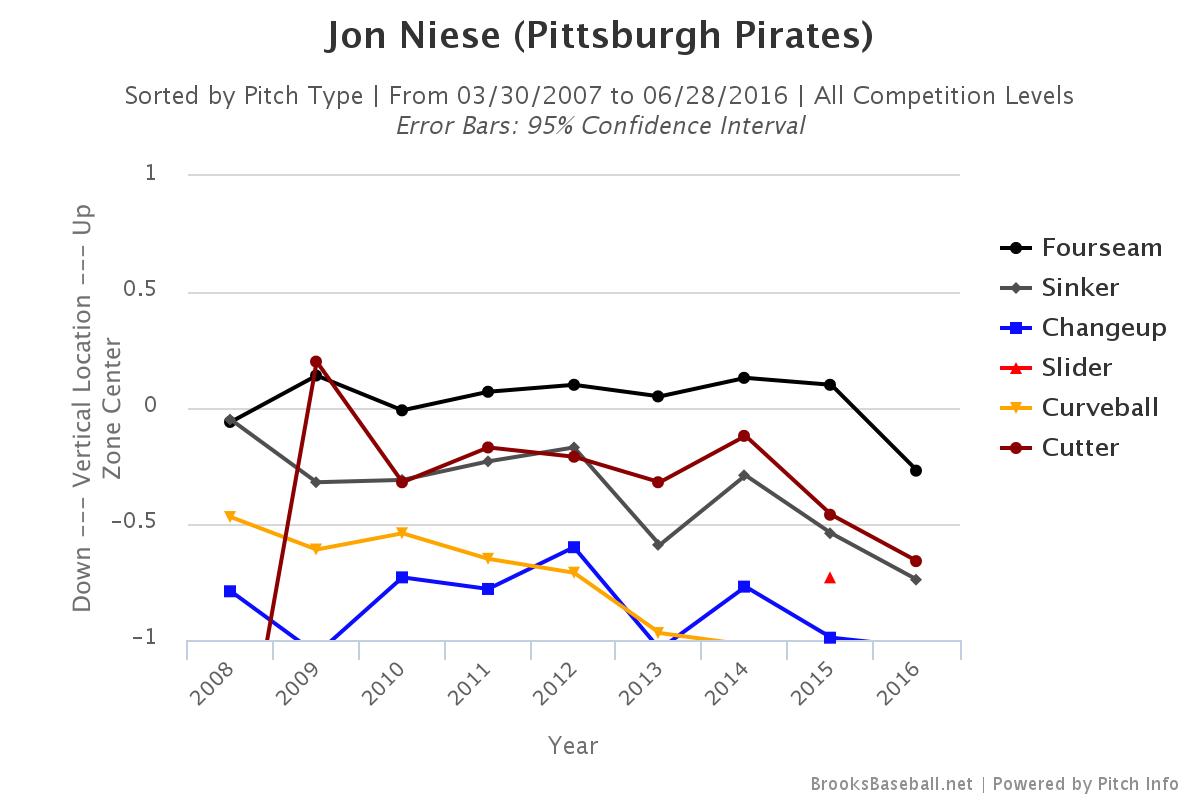
There’s nothing alarming in his velocity or movement – he appears to be the same Jon Niese who underwhelmed for the Mets last year. Niese’s 90mph fastball (four-seam and sinker) were never swing-and-miss pitches, but the damage done on contact is suddenly much, much worse. Why? Part of it may be Niese struggling to adapt to his wizard pitching coach’s strong belief that the best fastball is a low fastball. Niese is throwing both his four-seam and sinkers lower than ever before, and they’re getting hit like never before.
Of course, the M’s have had loads of winnable games and favorable match-ups in recent weeks and have found a way to fumble away most of them. The club needs to start pitching better or the season will completely get away from them. That sounds harsh, especially given the staff’s pretty-good ERA on the year, but someone’s got to take the pressure off an over-worked, under-performing bullpen. Through much of May and into June, Hisashi Iwakuma was the only pitcher reliably working deep into games, but after a less-than-5-IP, 3 HR disaster, even he’s looked a bit shaky. But while the Pirates’ offense has been good overall, they may be a good match-up for Iwakuma in that they’re relatively underpowered (while Iwakuma’s achilles heel is the long ball) thanks to strong ground ball tendencies. Throw some splitters, Kuma.
1: Marte, SS
2: Gutierrez, RF
3: Cano, 2B
4: Cruz, DH
5: Lee, 1B
6: Seager, 3B
7: Iannetta, C
8: Martin, CF
9: O’Malley, LF
SP: Iwakuma
The Futures Game rosters were announced today, with a World Team of prospects facing off against the US’s top prospects on All-Star Weekend. The M’s have two representatives this year, like last season, and again both will suit up for the “World” team. Jackson starting pitcher Dylan Unsworth (from South Africa) and his teammate Tyler O’Neill (Canada) represent the M’s org. In 9 starts this year, Unsworth’s allowed all of 9 total runs, and has an ERA of 1.16 and a K:BB ratio of 5:1. O’Neill just turned 21, and is hitting a well-better-than-expected .310/.371/.532 for the Generals. The top prospects on the rosters include SS Alex Bregman and Dansby Swanson, record-breaking international free agent signing Yoan Moncada, SP prospect Alex Reyes, and OF Alex Benintendi. Like many, I’d kind of assumed Unsworth’s South African heritage would make him the Futures Game representative with the most unlikely background, but no, that honor has to go to Pirates relief prospect Dovydas Neverauskas, who hails from Vilnius, Lithuania.
Zach Lee makes his second start for Tacoma today, this time in Fresno. He gave up 5 runs in 6 IP last time, so hopefully this’ll go a bit better. Tacoma scored 4 late runs to beat the RiverCats 6-2 last night, as Norichika Aoki had 2 hits in his first game for Tacoma. Tacoma’s now 11 games over .500 at 44-33.
Jackson won again, this time 3-1 over Chattanooga. Brett Ash tossed 6 2/3 solid IP to get the win, and the bullpen went the rest of the way without yielding a hit or a walk. DJ Peterson continues to rake, as he went 1-1 with a double and 3 walks, bringing his line up to .271/.340/.466 (after a dreadful April). The club’s off today, and are an incredible 48-27 on the year.
Tyler Herb matched up with Giants’ prospect (and Futures Game invitee) Phil Bickford yesterday, and both held their opponents scoreless for 5 IP. Bickford then left the game to his bullpen, who finished the shutout, while Herb tired in the 7th and gave up 4 runs in an eventual 5-0 loss. The Blaze had just one hit on the day, a bunt single by Aaron Barbosa. The loss dropped Bakersfield to 40-35 on the year.
Clinton destroyed Wisconsin 10-2 behind another solid start from Art Warren. The two clubs played an early game today, and Clinton again came out on top, this time 5-3. Nick Neidert pitched 7 strong IP, giving up 2 R on 2 solo HRs, but largely befuddling the TimberRattlers. Conner Hale had 4 hits for the L-Kings, who are now 45-31.
Everett dismantled Boise 13-1 thanks to a 2-hit, 5 RBI game from Kyle Lewis, whose bases-clearing 2B put an exclamation point on the win. Jake Brentz had 9 Ks in 4 2/3 IP for the AquaSox. Luiz Gohara’s off to a strong start and he’ll start tonight’s game in Spokane. The club is 7-4.