
Game 47, Twins at Mariners
King Felix vs. Pat Dean, 7:10pm
Happy Felix Day!
And happy “it’s another org guy making a spot start” day as well. I can’t believe I was worried about that Zach Neal just because he was similar to Kendall Graveman, a pitcher getting destroyed by the AL thus far. Anyway, Pat Dean is…a left handed pitcher. The Twins drafted him in the 3rd round out of Boston College several years back, but he took a long time to move up the ladder. An inability to miss bats and occasional HR trouble kept him firmly in the value-at-org-level range, until the stars aligned and he posted a great ERA for AAA Rochester last year.
If you knew nothing about the guy, not what teams he played for or anything, and you just looked at this Fangraphs page, I think you’d accurately pick him as a Twins hurler. In a few hundred innings across A-AA, Neal posted K% in the 10-13% range, marks that are essentially outside of the general big league distribution. From 2012-2015, 8 qualified pitchers posted K rates under 13%: Henderson Alvarez, Mike Pelfrey, Kevin Correia, Jeremy Guthrie, Clayton Richard, Mark Buehrle and Scott Diamond. Of them, *three* pitched for the Twins – Correia did it twice, once for the Twins, and once the year before they acquired him. It’s hard to make a living at this level giving up quite so many balls in play. It didn’t used to be, and you can certainly question whether the focus on the three true outcomes has become a tic, more obsessive compulsive disorder than logical thinking about winning ball games. But the stats do indicate that pitchers with Twins-level strikeouts tend to have Twins-style flameouts sooner rather than later. Diamond, Correia and Richard never qualified for the ERA title again and Buerle retired.
Dean throws a fastball without much notable movement in the 89-91 range; it has some armside run, but is pretty much average in vertical movement. His primary breaking ball is a cutter at 85 with moderate sink. He’s got a change-up without much sink at all, and a curve in the high 70s. He doesn’t elicit lots of out-of-zone swings, and he allows plenty of contact, so you’d figure he’d need to be a guy with an extremely low BABIP, but he hasn’t shown any aptitude for that, either. In his brief MLB career, it’s sky high, but it was over .300 for most of his MiLB career, and only .282 in his low ERA year last season. He’s been a fly ball pitcher which *should* help his BABIP, so I’ll just throw up my hands and say I’m not sure how Dean made it, or how he’ll stick around. Kudos to him for shutting down a good Toronto line-up in his only other big league start, but there’s a reason ZiPS’s rest-of-season FIP projection for him starts with a 5.
The Twins offense has been the worst in the AL thus far, with a slash line of .235/.301/.374. That’ll beat out the AAA clubs at the bottom of the NL, but that’s still pretty atrocious – it grades out to a wRC+ of 84. With a low-ish walk rate and bottom-third power, this may be a good match-up for Felix. His command hasn’t been elite yet, but he hasn’t really paid a price for it. He should feel emboldened to attack the zone a bit tonight, especially against the softer underbelly of the offense. It’s not entirely bad; Miguel Sano has pop, as does newcomer Byung-ho Park. But the back end of the line-up, with SS Eduardo Escobar, CF Danny Santana looks very much like a chunk of a Mariners’ line-up from 2010-2014 or so. Santana’s up because top prospect Bryan Buxton completely face-planted in April, and 2B Brian Dozier’s break out seems like it was a long time ago; in the last calendar year, Dozier’s posted a wRC+ of 89 with a .222/.295/.400 line.
1: Aoki, CF
2: Gutierrez, RF
3: Cano, 2B
4: Cruz, RF
5: Lee, 1B
6: Seager, 3B
7: Iannetta, C
8: Romero, RF
9: Sardiñas, SS
SP: El Rey
With Leonys Martin’s hamstring injured, the M’s have a decision to make. They can DL him and bring up an OF, or hold off for a few days to see if he’s ready. Martin apparently doesn’t want to go on the DL, but the M’s may want to be cautious…hamstrings can be stubborn. Boog Powell is still with Tacoma, so that’s not it. As Mike Curto just reported, Stefen Romero – hitting .358/.417/.601 at the moment – is flying to Seattle in case the M’s decide to DL Martin. [Edit 5:46] Ok, now we know: Martin’s heading to the DL retroactive to yesterday, and as you can see, Romero’s up and starting.
Tacoma pitchers’ string of 27 consecutive scoreless innings came to an end in last night’s 4-1 loss to Round Rock. James Paxton started well, but gave up 2 unearned runs in the 6th, and then the bullpen let a few more. Efren Navarro’s HR accounted for the Rainiers’ lone run. It’ll be Brad Mills on the mound for Tacoma tonight against New Orleans and fellow big league vet Chris Narveson.
Jackson beat Montgomery 8-5 thanks to HRs from DJ Peterson and 2B Tim Lopes. Brett Ash got the win, but the story on the mound may have been Edwin Diaz, who got a 4-out save, coming on with men aboard in the 8th. He K’d 3 of the 4 hitters he saw. He’s now made 7 appearances in relief, tossing 8 1/3 scoreless innings. He’s allowed 3 hits, no walks, and has struck out 14. The M’s thought he could be ready soon when they made this move. If he shows he can handle pitching on back-to-back days (coming up soon, I’d think), then he’ll be ready. Performance wise, this has gone better than anyone could’ve hoped. Jordan Pries takes the mound today for Jackson.
Bakersfield’s 3 run 6th propelled them to a 4-3 win over Rancho Cucamonga. Tyler Herb K’d 6 in 6 solid innings, though he did give up 2 home runs. Kyle Petty had 3 hits including 2 2Bs for the Blaze. The story in the league last night was Lancaster’s drubbing of Stockton by a football score of 29-11. The only Ports pitcher who didn’t get absolutely lit up was their left fielder, Melvin Mercedes who ended the game with 1 1/3 scoreless and a strikeout. Anyway, it’s Tyler Pike’s turn in the rotation tonight for Bakersfield as they face 16-32 Inland Empire, the Angels affiliate who swept them earlier in the year.
Clinton beat Wisconsin 7-6 with a walk-off sac fly in the 11th inning. The Lumberkings held a 6-2 lead late, but gave up 4 runs in the 7th/8th to send it to extras. Art Warren started and went 5 IP with 8 Ks, and Darin Gillies K’d 5 in 3 scoreless innings to pick up the win. Zack Littell starts for Clinton tonight.
A Quick Look at Mike Montgomery, Relief Pitcher
In a textbook example of the trenchant analysis you’ve come to expect from USSMariner dot com, I noted before the year that Mike Montgomery’s arsenal and history made him an odd fit as a relief pitcher. His one plus pitch was a change-up, and that led to some struggles against *left* handed bats, as the cutter that once looked so promising had fizzled out by the end of 2015. Coming into the year, the M’s were out of rotation slots and Montgomery was out of options. Following a flurry of acquisitions, even the M’s bullpen seemed pretty full, with Cishek, Benoit, Furbush, Scribner, Zych, Peralta seemingly in, and an assortment of others looking for a spot (Nuno, Justin De Fratus, Cody Martin, Jonathan Aro, Nick Vincent). A series of injuries in the spring cleared a path for the M’s to at least hold on to Montgomery, but what he’s done with that shot is nothing short of remarkable. In 27 innings, Montgomery’s yielded just 16 hits and 5 runs, striking out 22 and posting an insane 62% ground ball rate thanks to a 95mph fastball.
As a starter, Montgomery had essentially average velocity for a lefty, and threw a five-pitch mix weighted towards fastballs (~52%) and change-ups (~20%). He used his cutter and curve a fair bit, but less often than the change, which made plenty of sense. The change was his best bat-missing pitch, while his curve was handy when he needed a grounder. His fastballs (sinker and four-seam) were pretty much average in terms of their batted ball results. As a reliever, the M’s probably expected a bit of a bump in velocity, and they may have hoped that bump would improve his cutter/slider. As a starter, lefties hit .391 off of the pitch, but who knows – maybe it’d get sharper? His curve looked good, but even that didn’t seem to be a clear weapon against same-handed batters, and that’s generally what a manager would want when he brings in a lefty.
A fastball/change-up combination can work in the bullpen, as guys from Trevor Hoffman to Fernando Rodney to Joaquin Benoit prove. But Montgomery’s, with its big armside run and lack of real downward movement, didn’t seem like a great candidate for bullpen stardom. There was a reason Montgomery never posted big strikeout rates, and in fact, he’s not posting big K rates now. To be successful, Montgomery was going to need to manage contact and his walk rate, and Tony Blengino’s article from last August made that seem…unlikely. It seemed that way, but here we are with a potential breakout reliever. How’d this happen? I don’t think there’s one, clear, obvious explanation, but here are three guesses:
1: Velocity, velocity, velocity. In Brendan Gawlowski’s prescient-in-hindsight post about shifting Monty to the pen, he noted that while a velo gain of around 1mph is standard, some guys pick up more like 2-3-4mph. Even an extra tick would help, but the game-changing velocity bump was a possibility. Well, that’s what Montgomery got. By Brooks Baseball, Montgomery’s average fastball last year was 91. It’s now at 95, and that’s only looking at the relatively cold (read: slower FBs) months of April/May. Gawlowski also noted that the velocity would have an impact on his secondary pitches, too, and that’s exactly what we’ve seen. Montgomery’s curve seems to be benefiting from the extra spin, and gets more downward break than it did last year, leading to both better whiff rates and higher GB rates. The samples here are tiny, but you don’t need much to see changes in movement and velo. Velocity is also correlated with ground ball rates – a 95mph FB *should* get a few more grounders than a 91mph FB thrown with the same movement.
2: Pitch mix. Montgomery and the M’s have come up with a neat solution to the “but his best pitch is a change” problem: he’s become a fastball/curveball guy. Like the change, Monty’s curve had solid results against lefties and righties last year. As mentioned above, it’s now faster and has more spin, leading to more whiffs. Moreover, it’s being put in play more often. That sounds odd – more whiffs AND more balls in play – but it’s an important part of Montgomery’s sky-high GB rate. It’s not a pitch batters put in play much at all in 2015, but they’re doing so more this year, and most of that contact’s on the ground. And because of *that* most of the contact against him is pulled. Montgomery’s percentage of balls in play to the pull side is up by 11 percentage points this year, more or less identical to the 11.1 percentage point increase in his GB%. That makes him the perfect guy to shift behind, and god knows the M’s love to shift. That may be a partial explanation for Monty’s .229 BABIP. As I’ve said before, I’d still love to see him break out the change a bit more than he has – it’s still a great pitch to righties. There are signs he will – he used it a bunch against the A’s the other day, and the more he sees multi-inning stints, the more I’d imagine he’ll use it (it’s also a great GB% pitch). But Montgomery’s also been great at mixing his fastballs, mixing in his sinker to keep batters off balance. The shifts in usage aren’t huge, but the seem to be making a difference, particularly given his…
3: …Location, location, location. Montgomery’s clearly got a plan with his fastball now, and that didn’t always seem to be the case last year. Take the way he attacks righties. His four-seam heatmap from 2015 looks almost random. The plurality of pitches are middle-middle, but he threw the up and out of the zone on both sides, and mixed in some low ones. There’s no obvious pattern at all. This year, there’s a clear pattern: he’s pitching inside to righties. Inside fastballs at 95 are tough to hit, and extremely tough to hit to the opposite field. Batters looking for a four-seam or change might pull a ground ball. If they get a sinker instead, they’ll top it. If they expect a sinker, they’ll pop up the four-seamer; Monty’s infield pop-up rate’s doubled this year. The beauty of this is its simplicity. Montgomery struggled with walks in the minors, and he clearly struggled down the stretch last year, but his walk rate thus far is a solid 6.9%. It’s lower despite the fact that Montgomery *isn’t* throwing more strikes, and batters still aren’t swinging at his curve. But now, if he falls behind, he has a decent shot at getting a ground ball. With batters *ahead in the count*, Montgomery’s allowing an ISO under .100. Montgomery got crushed last year once he fell behind, but the simpler approach is producing both fewer walks AND better contact.
Now, this isn’t to annoint the man an elite reliever. It’s early yet, and he’s still not missing enough bats. But the M’s looked like they were going to lose him, and instead he’s been the M’s best reliever by WPA. Those win probability stats also illustrate something that probably needs to change: Montgomery’s been used in garbage time. It’s kind of amazing that Montgomery’s WPA is as good as it is, because he hasn’t seen many high leverage situations. You’d assume that’ll change if he keeps this up, with Joel Peralta the guy who’d be the easiest to swap roles with.
There’s always the possibility that batters will adjust to the new Mike Montgomery, just as they adjusted last year. We – okay, I – was probably too hasty in proclaiming him a solid big league starter, and we – okay, I – may be guilty of the same thing now. Anyone looks good when they’ve allowed zero HRs, and when their GB rate blows past anything they’ve done to date. The simplicity of his fastball approach cuts both ways, too: if you stick to one location too much, batters will adjust quickly. Still, through luck or skill, the M’s have unearthed a very useful piece. That they haven’t used him as effectively as they could is irrelevant. That he might’ve been pitching elsewhere if Charlie Furbush or Evan Scribner was healthy is irrelevant. I said at the beginning of the year that the M’s needed more than regression in HR/FB ratios from their pitchers – they needed to help them actually improve. Mike Montgomery would seem to be the poster boy for the value of instruction, and that the M’s new field staff is capable of improving their players (OK, OK, Leonys Martin is the real poster boy for that, but hey, Montgomery’s on the podium somewhere).
Game 46, Athletics at Mariners
Hisashi Iwakuma vs. Zach Neal, 7:10pm
After a riveting walk-off win against the heart of the Oakland bullpen, the M’s go for a series win facing a pitcher making his first big league start. This has happened a few times already this year, but when I saw the probables, I had no earthly idea who Zach Neal was. That’s always confusing, as I like to *think* I’m conversant with the 40-man roster of the AL West. In this case, I think the A’s front office and even Neal himself are all as stupefied as I am that he’ll take the hill at Safeco tonight. Neal was drafted by the Marlins in the 17th round in 2010. After a couple of so-so campaigns, he was released in 2013. The A’s picked him up, and he gave them a few more mediocre seasons. He’s not a strikeout guy, with minor league K rates around 15% or so. His control was fine, as he was stingy with walks, but that’s not the same as having elite command – he’s been very hittable at every level, which is why his runs allowed have been rather poor in the minors. He’s got a career AA ERA over 4, and a AAA ERA near 4, but that doesn’t tell the whole story: Neal’s given up *55* unearned runs across those levels, pushing his RA/9 to near 5.
Like a number of pitchers, he’s gotten better with more time at each level – he hasn’t had initial success, but with experience, he’s able to hold his own. That seems to be what’s happened this year, as he’s been Nashville’s best pitcher from a runs-allowed standpoint despite having less stuff and prospect cache than others. Still, it’s kind of amazing that a guy who, despite playing in the high minors the past few years, wasn’t invited to big league spring training and was nowhere near the 40-man is now making a big league start. Nominally, he’s replacing Sonny Gray, the A’s ace who’s been a shell of his former self and is now on the DL. The M’s have to like their chances.
There’s one small catch. Neal’s fastball has a lot of sink on it, and he’s got a so-so cutter/slider thing as well as a curve that doesn’t drop all that much. All of which points to extremely low spin rates on all of his pitches. High spin rate guys get a lot of attention, and for some good reason – the right kind of spin makes a pitch move, and movement is obviously useful. That said, there’s some value in being at the other end of the distribution. A ball that moves a lot LESS than people expect can be confusing in its own way. The poster boy for low spin rates last year was Kendall Graveman, whose sinking fastball and curveless curve kinda sorta worked for a back-of-the-rotation arm. It hasn’t worked this year in large part, but even last night, it’s been decent against the M’s. I don’t know of a way to search for M’s hitting against low-spin guys; if you want to make the intuitive leap that low-spin = ground ball guys, then the M’s have done fairly well. But they’ve also struggled against guys who don’t K or walk many batters, and in Neal they’ve got one. Neal is an underdog, and may get lit up tonight. I’d just feel better if he didn’t remind me so much of Graveman.
To be fair, Graveman has more movement on his pitches than Neal. Neal’s FB sinks a bit and is arrow straight, like an underpowered version of Garrett Richards’. But whereas Richards gets an insane amount of spin on his breaking balls, Neal’s just float up there as if they weren’t spinning at all. It’d be remarkable if the A’s didn’t throw a guy who did the same thing just yesterday. Still, the fact that even his fastball has very little armside run differentiates him from Graveman enough. And let’s not forget: because Graveman’s struggled so much the 3rd time through the order, the A’s got him out early yesterday. They’ve made some roster moves to give their pen some depth, but they may need to leave Neal in longer than they’d like, and if they DO go to the pen in the 4th-6th, it’ll be the B team there for a while. After beating up on the first string, the M’s should have some confidence today.
1: Martin, CF
2: Smith, RF
3: Cano, 2B
4: Cruz, DH
5: Seager, 3B
6: Lind, 1B
7: Iannetta, C
8: Sardinas, SS
9: Aoki, LF
SP: Iwakuma
As you can see, Luis Sardinas, having spent 10 days in the minors, can now be recalled from AAA, swapping spots with Chris Taylor.
Game 45, Athletics at Mariners
Nate Karns vs. Kendall Graveman, 7:10pm
Last night’s game was no fun, from the offense’s complete inability to figure out a guy throwing a blizzard of slow curves (all while looking like a bookish middle manager) to Chris Taylor’s two key errors. All that said, the M’s open today’s game in first, and the A’s just used their only bullet. As I mentioned in yesterday’s preview, the non-Rich Hill parts of the A’s rotation have been dreadful. Coming into today’s game, 114 pitchers have thrown at least 40 innings in 2016. Kendall Graveman’s FIP ranks 113, ahead of only the enigmatic Shelby Miller. Graveman’s ERA is slightly better, but it’s still below replacement level, the ugly product of a bunch of home runs and too many walks.
The home run problem is an interesting one, as you wouldn’t assume Graveman would have that issue thanks to his good sinker and well above-average ground ball rate. Indeed, Graveman gave up a grand total of 6 HRs in his entire minor league career, spanning about 200 innings. In 42 2/3 IP this season, he’s given up 10. Why? Most of the damage has come against his fastball. Graveman throws a sinker around 92-93, with average sink, but he really buries it on the corner or just below the strikezone, and in to right-handers. It’s not a swing-and-miss pitch, but it’s allowed him to run great ground ball rates, and it sets up his best pitch, a hard cutter at 88mph that he locates like a slider, down and away to RHBs. The cutter has en even higher GB% when batters make contact, and it also generates more whiffs. All in all, it’s a pretty solid pitch.
But Graveman’s having trouble getting to it. He’s already given up 8 HRs on his fastballs, and batters are slugging around .800 on them (including his rarely used and rarely good four-seamer). Without a real putaway pitch, batters can look for his fastball, and if they guess right, they can adjust to its movement. This shows up in his statcast numbers, where his overall average exit velocity hides a stark difference between grounders and balls in the air. He’s perfectly fine on grounders, but when batters elevate the ball, they *average* over 95mph in velocity. This same pattern shows up in a number of players, from Sonny Gray this year (whose HR rate has also spiked this year) to guys like Nate Karns’ old teammates, Jake Odorizzi, Chris Archer and Erasmo Ramirez. It’s not a kiss of death, necessarily. Karns and Archer get away with it because they strike out enough batters that they don’t need to be perfect at contact management. Odorizzi and Ramirez don’t walk many, and post high strand rates…as long as they can keep doing both of those things, some scary fly balls won’t hurt. But Graveman isn’t a strikeout guy at all – his K rate’s lower AND he walks more batters. He can be successful only if he’s getting guys to hit it into the ground. When they elevate, bad things will happen. He was solid against the M’s back in early May, but even then, the M’s had a number of 100mph liners and fly balls turn into outs, and they had Robbie Cano’s deep drive clank off the wall instead of fly over it. The M’s won nonetheless. Here’s hoping they have an easier time of it today.
1: Martin, CF
2: Smith, RF
3: Cano, 2B
4: Cruz, DH
5: Seager, 3B
6: Lind, 1B
7: Iannetta, C
8: O’Malley, SS
9: Aoki, LF
SP: Karns
Kyle Lohse and old friend Tom Wilhelmsen shut down the Rainiers offense in a 4-3 win for Round Rock. Adrian Sampson was solid through 6 IP, but gave up a 3R HR to ex-A’s 1B, Ike Davis. Lefty Kraig Sitton made his 13 appearance on the year, and his 6th for Tacoma. I mention it because Sitton is yet to allow a run on the year. 17 2/3 IP, 13 hits, 14 Ks, 2 unintentional walks, and zeroes on the board. Donn Roach starts tonight against Rangers prospect and MLB rotation depth, Chi Chi Gonzalez.
Jackson blanked Chattanooga behind a great start from Ryan Yarbrough. The righty went 7IP, with 3 hits allowed, no walks, and 7 Ks. DJ Peterson continued his hot streak with a double and HR, while Tyler O’Neill tripled. It’s a travel day for the Southern League today, but they’ll start a series in Montgomery tomorrow.
Bakersfield got blown out by Lake Elsinore, 14-5. Eddie Campbell struggled a bit, and then Thyago Viera struggled a lot in relief. Tyler Marlette was the player of the org for the day, hitting two HRs in the game – that’s the second time in a week he’s done that. Marlette’s been very good in May after a dreadful April; good to see. Lukas Schiraldi starts today’s game.
Clinton lost the finale to Burlington 8-3. Kyle Wilcox gave up 6 runs in 4 2/3, and Burlington couldn’t string together many hits. James Alfonso doubled, while Alex Jackson went 0-4. Jackson’s just 3-18 on the year (with 2 HRs, so his BABIP is terrible), but there are encouraging signs, too. His K:BB ratio is even at 3:3 – much better than last season, when he K’d 96 times in 76 games.
Game 44, Athletics at Mariners
Taijuan Walker vs. Rich Hill, 7:10pm
Fresh off a sweep of the Reds, the M’s return home to face the A’s, who sit 8 games behind the M’s in the AL West standings. As we talked about the last time these two clubs met up, the A’s have been remarkably pitching-dependent on the year, thanks to an offense that’s been atrocious so far…and that was WITH a healthy Josh Reddick, something they won’t have for a while now. The A’s are dead last in the AL in OBP, at a 2010-2015 Mariners-esque .294 mark. They’re dead last in all of MLB in BABIP, which you could argue is just bad luck, or you could argue is the logical outgrowth of starting Chris Coghlan, Khris Davis, and Billy Butler. What they may lack in walk rate and line drives, they more than make up for in errors. The A’s defense has been abysmal as well, with the 2nd-most errors and the worst team defense by Fangraphs’ advanced metrics. It all adds up to a position player group that’s been essentially replacement-level so far (again, WITH Reddick), ahead of only the Braves.
I said it’s been their pitching that’s carried them to a non-Braves-like season, but it’s really only their bullpen that’s been decent. Their starting rotation has the worst FIP and ERA in the American League, and the 2nd lowest fWAR total in the majors. A big part of the problem has been the long ball, with Sean Manaea’s 1.38 HR/9 mark the best* and Kendall Graveman’s astonishing 2.11 the worst. Sonny Gray, the ace of the group last year, is seemingly in a free fall, with an ERA over 6 and a FIP over 5. The A’s rotation has the 2nd highest walk rate in the AL, and there’s precious little in the minor league system to turn to. They’ve already ditched Eric Surkamp, so Jesse Hahn and Sean Manaea, both of whom have looked shaky, ARE the reinforcements. Now it’s up to pitching coach Curt Young to refashion these arms into a non-embarrassing group.
The A’s rotation has been awful, but the thing that amazes me is that they’ve put up these putrid numbers with a brilliant start by Rich Hill. The guy who went six years between starts in affiliated ball. The guy who signed last year off the independent league Long Island Ducks roster. The guy who signed a free agent deal this off-season for his age 36 season. THIS is the guy who’s putting his younger teammates to shame. The entire A’s staff has HR problems, but not Hill: his 0.36 HR/9 mark is great. He’s walked a few more than he did in his 4-game what-the-hell-was-that call-up for Boston last year, but the K rate’s stuck around. You could fill a book with the standard baseball rules (“old school” or sabermetric, doesn’t matter) that Hill breaks. He essentially throws only two pitches, a four-seam fastball and a curve. He doesn’t establish his 90mph fastball – against the M’s he threw 54 curves, and he’s actually thrown more in subsequent starts. Some time this year, Hill will throw > 60 yellow hammers in a game. He throws high fastballs slowly and doesn’t pay the price in terms of long-balls the way Chris Young or Marco Estrada do. He has a long and varied track record of failure as a big league starter, but looks dominant now.
How? What? The Rich Hill from the Orioles and Cubs? Really? This great interview starts to shed some light on what’s happening, at least from Hill’s point of view. The takeaway for me was Hill’s belief in what he dubs “creativity” – or manipulating his curve ball depending on what’s working, the opposing batter, etc. That sounded interesting, and I’ll definitely be watching for it, but it’s kind of amazing to go back to his pitch charts once you’ve heard him describe it. Here’s his last start in Seattle:
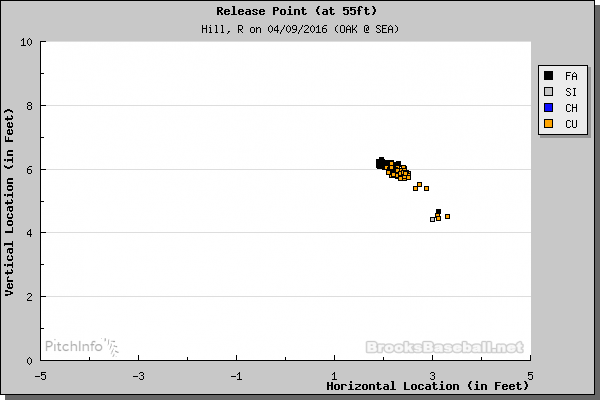
You can see he’s varying his release point, dropping down every once in a while against left-handed bats. In addition to release point, though, his curve is about as far as possible from a tight grouping in terms of movement and velocity. He doesn’t have one “curve ball” and I’d argue he doesn’t have two. He has a spectrum:
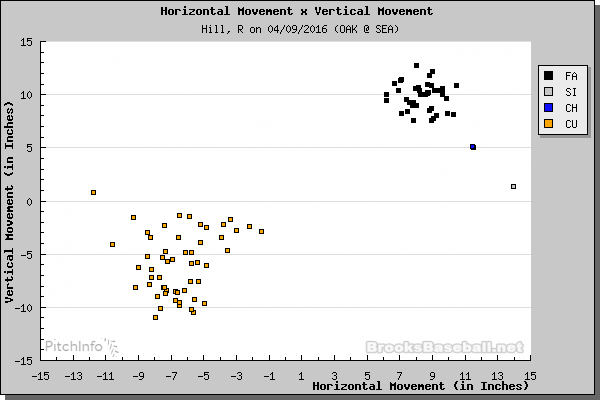
Some of these curves are in the low 80s, touching 82. Some are in the low 70s. Some have essentially zero horizontal movement; they’re an inch or two to the left of the zero line in the chart. Others are at 12″ of gloveside break. Looking at vertical movement, you see the same picture (uh, trust me, that’s enough graphs already). One curve came in with a positive 1-2″ of vertical break, whereas others were around -12″. The average for the game of -5.86 doesn’t tell you nearly as much as the variance around it. If he’s able to do this consistently, and do it with some kind of plan, that’s really interesting. I’d love to hear Hill unpack that word “creativity” and how it relates to this. You’ll see some games where the variance is much lower, and other games, like this one, where he’s just all over the map. At the very least, you’d think that might give him a leg up when he’s seeing hitters for the 2nd and 3rd time, and he’s only showing them two pitches. In the interview he says it helps him get K’s later in the game, and looking at his (tiny) splits so far this year bears that out: he’s worst the first time through the order, and becomes damn tough to hit later on.
Taijuan Walker’s struggled a bit since his neck spasms, as a spate of HRs has pushed his FIP up near 4 (the ERA’s still pretty good). It may be nothing, but his pitch mix has changed a bit in that time. From his first start through May 1st against KC, Walker’s most-used secondary pitch was his split. That was true – to an extreme degree- last year, and while he was mixing in more curves and cutters, it was still true in April. Starting with that abbreviated start vs. Houston, that’s changed. Now, he’s throwing the cutter more often than the split, culminating in his last start when he threw 24 cutters to just 10 splitters. This isn’t necessarily a problem or anything; the damage against him has come on his fastball, not his cutter. But I wonder what accounts for the change, and if there’s anything about the cutter that’s easier for batters to distinguish from the FB. Here’s where I’d love to see what the M’s can in terms of sequencing. Does throwing a splitter at some point in an AB make subsequent fastballs “better,” however you want to define that? How about cutters?
To be fair, some of the pitch mix variance may be a product of the line-ups he’s facing; it makes sense he’d throw more splitters to lefties and cutters to righties, but while Baltimore’s line-up was somewhat RHB-heavy, Tampa’s sure wasn’t. And Oakland’s not buying Walker’s strong reverse-splits in 2016 (or his even career splits), as they’ve got five lefties in there against him tonight.
1: Martin, CF
2: Gutierrez, RF
3: Cano, 2B
4: Cruz, DH
5: Lee, 1B
6: Seager, 3B
7: Iannetta, C
8: Aoki, LF
9: Taylor, SS
SP: Walker
Chris Taylor gets his first start of the year against the left-handed Hill. Shawn O’Malley remains on the bench, and may pinch hit if the A’s bring in a righty reliever.
Brad Mills made his second appearance of the year for the Rainiers in yesterday’s 8-1 trouncing of the Iowa Cubs. The lefty has sporadic MLB experience with Oakland, Toronto, and Anaheim. The Rainiers hit three HRs, one each from Boog Powell, Mike Zunino, and Stefen Romero. Luis Sardinas has done nothing but hit since his demotion; the 2 singles he hit yesterday have him hitting .429/.484/.464. After a dominant homestand, the R’s head out on the road today, where they’ll face Round Rock. Adrian Sampson takes the mound for Tacoma against MLB vet Kyle Lohse for the Express.
Jackson scored a 4-3 walk-off win over Chattanooga with a run in the 10th yesterday. Sam Gaviglio pitched 7 quality innings on his birthday, and Ian Miller tripled while DJ Peterson doubled to pace the offense. Dan Altavilla got the win in relief, throwing 2 perfect innings with 4 Ks. Ryan Yarbrough starts for the Generals tonight.
Bakersfield’s 9th inning comeback gave them a 6-4 win at Lake Elsinore. Down 4-3 in the top of the 9th, the Blaze hit three extra base hits around a walk and a single to come up with 3 runs. Jay Baum’s two run double was the big blow. Tyler Pike’s 5-IP start wasn’t great, but he kept his team in the game. Eddie Campbell faces off against the Storm’s Brett Kennedy tonight. Kennedy was an 11th-rounder last year, and has impressed thus far, striking out 86 in 67 2/3 pro IP. They’ve all been at low levels, as he just recently moved up from the Midwest League, but still – that’s a great start to his career.
Clinton lost to Burlington 4-3, as a late 2R HR by Jake Yacinich gave the Bees a lead they’d hold on to. Zack Littell pitched a very good 6 IP, with 7 Ks and just 1 BB. Nick Kiel gave up the big HR, and that was essentially that. Kyle Wilcox gets the ball for the Lumberkings tonight against what passes for an Angels prospect in righty Joe Gatto, BP’s #1 for the org. Of course, that’s a low, low bar, and John Sickels had Gatto at #6, but you get the point. Medium sized fish in miniscule pond.
* Besides Hill, of course. There’s nearly a full HR per 9 gap between Hill at #1 and Manaea at #2.
Game 43, Mariners at Reds
Wade Miley vs. Alfredo Simon, 10:10am
The M’s go for a sweep today in Cincinnati, and they’ve drawn the Reds worst starter, righty Alfredo Simon. Simon was a reliever for the Reds for a few years before moving to their rotation in 2014. A decent strand rate and low HR totals propelled him to the All-Star game that year, and then they traded him to Detroit, where he was a bit less successful last season. This year, the wheels have come off. With 9 HRs allowed AND a .398 BABIP, Simon has given up 38 runs in 31+ innings.
The Big Pasta throws a sinker, a four seam FB (both around 93), a cutter, and his best pitch, a splitter at 85mph. That split was important for him, as it gave him something to throw to lefties, who’ve hit his fastball hard. At the moment, though, he can’t really get to it, as lefties just tee off on his fastball. We’ll see if he throws more cutters or makes more use of his curve, the way John Lamb did yesterday.
1: Martin, CF
2: Aoki, LF
3: Cano, 2B
4: Cruz, RF
5: Seager, 3B
6: Lind, 1B
7: Clevenger, C
8: O’Malley, SS
9: Wade Miley
Shawn O’Malley starts today at SS, as Ketel Marte’s thumb injury will require a stint on the disabled list. According to Ryan Divish, the M’s placed Marte on the 15-day DL and recalled Chris Taylor, who joined the team this morning.
Game 42, Mariners at Reds
FELIX vs. John Lamb, 1:10pm
Happy Felix Day!
Dan Straily somehow held the M’s in check yesterday, but then the Reds had to go to the bullpen, and…wow. It’s one thing to see their stats and how comprehensively bad each and every one looks, but it’s another to see a former prospect come in and plunk the tying run in, and generally turn a 3-1 pitcher’s duel into an 8-3 laugher remarkably quickly. Beyond the HRs, the walks and the total lack of command, though, that HBP to Cano really stands out. It occurred to me, however briefly, that maybe the Reds just never explained the rules to their relief pitchers. Tony Cingrani was once a fascinating, if divisive, prospect, with jaw-dropping strikeout totals despite a so-so fastball that he’d throw 90% of the time. Some saw him as a gimmick pitcher, a guy with a funky delivery that the league would figure out. Others saw a deceptive genius, who didn’t need secondary stuff because batters literally couldn’t see the ball. After a brilliant rookie season as a starter, he’s been in something of a free-fall, with walks rising and HR troubles. The “gimmick pitcher” school of thought is ascendant now, but he still seems like someone who might break out with a change of scenery.
The M’s struggled a bit against Dan Straily, but they’ll get their right-handed line-up in there today against lefty John Lamb. Swapping things around, and getting Dae Ho Lee more PAs sounds great, but it’s kind of amazing how similar Straily and Lamb are. Straily throws his FB at 90, and it gets 5″ of armside run and around 10″ or so in vertical “rise.” Lamb throws his fastball at 90, with 5″ of armside run and 10″ of rise. Straily’s best pitch is his slider, which comes in at 85, with 2″ of gloveside break and with 8″ less vertical movement than his FB. Lamb’s cutter is 85-86, with 0″ of horizontal movement, and 7″ less vertical movement than his fastball. They both also throw a change, though Lamb’s is quite distinct: it’s thrown in the 70s, and despite the fact that gravity can work on it a bit more, it has much less “drop” than Straily’s. It’s actually been Lamb’s best pitch, getting swinging strikes and IF pop-ups, while his cutter is more of a pitch-to-contact offering, that at least gets ground balls. Interestingly, Lamb’s big, slow curve has even better results, albeit in a tiny sample: Lamb doesn’t throw it much. When he does, it’s hard to miss, as its average speed this year is just 68mph.
It’s hard to remember now, but waaay back when, all the way back in the dark ages of 2013, the Royals weren’t known for beating sabermetric projections, or instilling deep doubts within Base Runs’ breast, or speedy outfields and shutdown bullpens. No, back then, the Royals were famous for taking tons of high draft picks, unreal low-minors performances, and the best farm system ever, and clumsily crushing it into dust and frayed tendon. Mike Montgomery led BA’s rankings in 2010, while Mike Moustakas took the top spot in BP’s list, but both had John Lamb near the top (he was BP’s top Royals pitching prospect). By 2011, the hype was deafening: this Royals group was the best set of prospects many had seen in one system in years, and Lamb and Montgomery were neck and neck at the top. And then it all starting falling apart: Montgomery’s ascent stalled out in AA, and that high minors transition was no easier for Chris Dwyer. Danny Duffy retired for a while, then came back, but command and injuries have limited his effectiveness. Johnny Giavotella hit well in AAA, but didn’t get much of a shot with the big club, and fell on his face when he did. Wil Myers didn’t stick at C, and then got moved in what seemed like a terrible deal at the time. What about Lamb? Shortly after making his first big league training camp, he blew out his elbow, missing most of 2011 and 2012 rehabbing after TJ surgery. The doctors proclaimed him healthy in 2013, but he got hit hard, and worse, never felt healthy. After ditching the Royals training regimen and getting his own from a late-night informercial (you should really read that Minda Haas Kuhlmann interview linked above), his shoulder/arm/elbow finally started feeling better, and the results returned…just in time for him to be a part of the Johnny Cueto deal last year.
He seemed to thrive in the Reds org, striking out 58 in just under 50 IP for Cincinnati last year. That said, his ERA ballooned thanks to a sky-high BABIP and a few too many walks. This year, the BABIP remains, but the strikeouts are conspicuously absent. His K/9’s almost been cut in half, with his cutter especially getting fewer whiffs than last year. Not sure what’s going on there. In any event, his FIP is completely unchanged from last year: it was 4.16 in 2015, and it’s 4.16 last year. Unfortunately for Lamb, without a change in batted ball luck, his ERA’s not changing either: it was 5.80 last year, and it’s 5.79 coming into today’s game. The BABIP thing looks like horrible luck, but it’s never really been a strength. It was .326 in AAA for the Reds last year, and .480 in just three starts for Louisville this year. He’s the anti-Straily in that regard, I guess. Still, I always kind of root for the supposed “busts” from that insane Royals system. I’m glad Mike Montgomery’s found a home in the bullpen here, and I still want to see Lamb toss some 68mph curveballs for strikes…against someone else. Go M’s.
1: Marte, SS
2: Seager, 3B
3: Cano, 2B
4: Cruz, RF
5: Lee, 1B
6: Iannetta, C
7: Gutierrez, LF
8: Martin, CF
9/SP: King. Felix.
I need another Felix HR. Great ballpark for it today.
Tacoma won their 4th straight, 9-4 over Iowa. The R’s broke open a tense 5-4 game with a 4 spot in the 6th. Mike Zunino homered, and Stefen Romero had 3 hits to bring his season line up to .373/.434/.611. Boog Powell added 3H from the leadoff position. James Paxton starts tonight for Tacoma against Iowa’s Alex Sanabia (a former Marlins starter).
Jackson dropped a 3-2 contest to Chattanooga. Reining pitcher of the week in the SL Dylan Unsworth took a hard luck loss, giving up 1R in 4 IP with 4 Ks and 0 BB. Kyle Hunter let two more score, and the Generals 2 run rally in the 6th fell short. Tyler O’Neill hit his 10th double, and Leon Landry made two incredible catches in the OF. Jordan Pries starts for Jackson today.
Bakersfield was on the wrong end of a one-run game too, losing 5-4 to Lake Elsinore. Kyle Petty homered for the Blaze, and Anthony Misiewicz pitched fairly well, but Misiewicz tired in the 7th, and reliever Vinny Nittoli couldn’t shut the door. Tyler Herb looks to shake off a bad outing in his last start and get back to what’s made him one of the more eye-opening minor leaguers thus far.
Speaking of one-run losses and hark luck decisions, Burlington shut out Clinton 1-0 despite getting only 4 hits in the game. Nick Wells went 5 2/3, but clearly didn’t have his best command, walking 4 to just 1 K. Overall, the L-Kings walked 8 Bees. Art Warren starts today’s game.
Game 41, Mariners at Reds
Hisashi Iwakuma vs. Dan Straily, 4:05pm
Ah, the Reds. It’s a rebuilding year, and no one really expected much from them. It’s actually kind of *nice* to go into a rebuild when you share a division with a club that’s peaking, and is laying waste to the entire league. You probably weren’t going to compete with the Pirates/Cards this year anyway, Cincinnati, let alone the Cubs, so good on you and Milwaukee for building for the future. That sounds okay and all, but kind of like with Atlanta, you worry about poisoning the well with putrid play. The Reds pitching staff has been historically awful. Their ERA is nearly 0.6 runs per game worse than Colorado’s. Their FIP is the worst in baseball by even more than that. They have the worst walk rate in baseball by a mile, as well as the worst home run rate. And somehow, their bullpen has taken these anti-qualities and honed them, turning dog crap into crap-diamonds.
The A’s bullpen last year was famously bad, but they were bad in some specific ways. They gave up HRs, and they gave them up at the worst possible times. They weren’t historically bad *pitchers*, which is why Jerry Dipoto poached Evan Scribner from them, they just made their fans *feel* that way because they reserved their worst pitches for the times they’d hurt the most. Cincinnati’s might be historically bad. The Reds bullpen ERA and FIP starts with a 6. They’ve already accumulated -2.3 fWAR. In run expectancy terms, they’re worst in WPA, but that actually undersells them, because the rotation’s been bad enough that the bullpen sometimes comes in when the game’s already out of reach. By RE24, which measures the change in run expectancy after each plate appearance, the true magnitude of the Reds problem becomes clearer. Because it includes inherited runners, it’s probably a better measure than just ERA or FIP. The Royals (duh) lead MLB bullpens with a 23.06 mark as a group, meaning the sum of all plate appearances they’ve been in have made 23 runs less likely to occur, and Baltimore’s a fraction of a run behind. Anyway, at the other end of the spectrum sit the Rangers, at -17. Think of Tom Wilhelmsen’s repeated meltdowns, or how Shawn Tolleson’s lost his closing job. They’ve been up and down, but when they’ve been down, they do it comprehensively. The Reds are well over twice as bad, at a mind-altering -46, getting close to three times worse than the #29 team. The gap between the Reds and the 2nd-worst Rangers is the same as the gap between the Rangers and #9 Angels.
So, Dan Straily. The former pop-up prospect for the A’s has become a peripatetic journeyman, moving from the A’s to the Cubs to the Astros and now Reds, all since 2014. He came out of nowhere in 2012, an unheralded, late-round draft pick who led the minors in strikeouts by a mile. He never had a great walk rate, but it was average to a bit better, and he did it without an overpowering fastball. At 92-93, it wasn’t bad, but his slider and change meant he had weapons against lefties as well as righties. By 2013, his first full season in the majors, his fastball was down a tick or two, settling in at 91, but as it fell, his control got worse and worse. After a month in the rotation in 2014, his velo averaged 89+ in a start against the M’s, and the A’s sent him to AAA immediately after. Soon after *that* he was dealt to the Cubs in the Samardzija deal that sent Addison Russell to Chicago.
He got in a few games for Houston last year, but wasn’t all that effective, with a walk rate stubbornly above 10%, just as it was in 2014. This off-season, he worked with Kyle Boddy and Driveline baseball, as detailed in this August Fagerstrom piece at FG. In it, Boddy notes that it’s not uncommon for pitchers’ walk rate to go up as their velo drops.
“The first thing you see from guys who lose velocity is that they start not throwing strikes, not because of any mechanical problem they have, but because they’re just like, ‘Oh, shit, I’m throwing 88, I don’t want to throw anywhere in the zone,’” Boddy said.
Also mentioned in the piece were reports from the spring, in which Straily was hitting 94 again, so I’ve been very curious to see him now that we’re a quarter of the way through the season. It’s just… if he was throwing 94 in Florida, he hasn’t brought that north with him. In his first game of the year, he averaged nearly 92 and touched 93, which is a clear improvement over last year, and would put him on pace to hit 94 in the warmer months. But since then, he’s regressed again, averaging 90 in his last outing vs. Philadelphia and hitting a top velo of 92. He hasn’t averaged 92 since April, also the last time he touched 93+. I don’t say all this to impugn his work, or Driveline’s efforts at improving him. He is, or at least WAS, throwing a touch harder. But it’s probably a sign of how hard it is to maintain not only gains you make in the gym, but maintain the work rate you used to get them, all while playing a big league schedule.
Straily’s tried to reinvent his FB, and move away from the disappointments of last year, but here’s the funny (if you’re not Straily) thing: he’s having the *exact same season*.
| Season | K/9 | BB/9 | HR/9 | HR/FB | GB% | FIP | xFIP | ERA |
|---|---|---|---|---|---|---|---|---|
| 2015 | 7.56 | 4.32 | 1.08 | 10 | 41.5 | 4.63 | 4.85 | 5.40 |
| 2016 | 7.84 | 4.35 | 1.09 | 10.9 | 38.2 | 4.6 | 4.78 | 3.05 |
Every number is eerily similar except, of course, ERA. Straily’s stranding runners now, instead of letting them in, buoyed by a much lower BABIP (of note: Straily’s BABIPs have always been low, maybe due to his rising FB, dropping SL combo). And yes, BOTH years are stupidly small samples, but it highlights just how much ERA can vary from a nearly fixed set of peripherals.
Despite the fact that lefties have not hit him well this year, Straily remains pretty platoon-able. His best pitch is his breaking ball, a slider, and that’s made his K% much better against righties. At the same time, he’s still walking a lot more lefties…it’s just that lefties have put up a a BABIP of .118 against him this year. This is a game for the lefties, and hoping Adam Lind can keep his hot streak going.
1: Marte, SS
2: Smith, LF
3: Cano, 2B
4: Cruz, RF
5: Seager, 3B
6: Lind, 1B
7: Iannetta, C
8: Martin, CF
9/SP: Iwakuma
The Rainiers beat Iowa 2-1 on a solo shot from Mike Baxter and an RBI single from Luis Sardinas. Donn Roach had his best game of the year, going 6 2/3, striking out 7 and walking none. Joe Wieland starts for Tacoma tonight.
Jackson got a 3 run 5th and made it hold up for a 3-2 win over Chattanooga. Brett Ash was solid through 6, giving up 2 runs and K’ing 6. Edwin Diaz pitched the 7th, a 1-2-3 inning that included a strikeout and some 98mph fastballs. Dylan Unsworth starts today’s game for the Generals.
Andrew Moore was predictably good for Bakersfield, but the story was the offense, who scored 17 in a 17-2 win in High Desert. Even weirder, three starters were held hitless, which shows you how much damage the other guys did. 9th hitter Gianfranco Wawoe had 4 hits, including a 2B and HR, and 8th hitter Arby Fields had 6 RBIs on 3 hits (including a HR).
Clinton lost 9-4, so we didn’t get an org sweep, but we did get something better: top prospect Alex Jackson made his full-season debut after starting the year in instructs and crushed a 450′ HR. Clinton opens up a series with Burlington today with Nick Wells on the hill.
Game 40, Mariners at Orioles
Nate Karns vs. Tyler Wilson, 9:35am
Early game = abbreviated game post.
It’s funny the way we associated teams with a certain style of pitcher, or at least starter. The Orioles of the past few years were a great example: Miguel Gonzalez, Chris Tillman, Wei-Yin Chen all came from different countries, threw at various speeds, Chen was a lefty, Tillman a righty, etc., but there were all basically the same pitcher. They threw rising fastballs, gave up tons of fly ball contact, and used the resulting low BABIP to work around the home run issues that were a byproduct of this approach. I think most fans here would probably point to the Twins as well. Minnesota’s staff famously ranked last in baseball in strikeouts for a few years. It seemed that all of baseball followed the trend towards more and more whiffs, and the Twins decided that 1987 was great, and that they’d just like to stay. This is the club that signed Kevin Correia and Mike Pelfrey to free agent deals. The club that brought us Nick Blackburn, (the bad version of) Liam Hendriks, and Scott Diamond.
Given all of that, the only thing I think when looking over Tyler Wilson’s repertoire and results is: how did Minnesota miss this guy?
Wilson throws a straight fastball without much vertical rise, and he pairs it with a slow slider (MLBAM calls it a curve) and a change-up that’s remarkably whiff-proof. It all adds up to an extreme pitch-to-contact guy with above-average ground ball rates. This is Nick Blackburn reincarnate. Thus far, though, Wilson’s been fine as a 5th starter. In 66+ big league innings, he’s only given up 25 runs thanks to a very low HR rate that makes up for that fact he’s only struck out 28. That’s interesting, because in the minors, Wilson gave up tons of HRs. Is he going to get exposed the more hitters see him, the way Blackburn and, I don’t know, Blake Beavan were? I think so, and that in this era, it’s damn near impossible to be even a fifth starter with a K/9 under 4.
1: Aoki, LF
2: Smith, RF
3: Cano, 2B
4: Cruz, DH
5: Seager, 3B
6: Lind, 1B
7: Clevenger, C
8: Marte, SS
9: Martin, CF
SP: Karns
Rainiers open a home series against the Iowa Cubs today. In recent years, fans would’ve had this one circled on the calendar for months, as the Cubs high minors have been overflowing with big prospects, but that’s less true now. Still, it IS a good opportunity to see old friend Munenori Kawasaki, who’s now with the I-Cubs. They also feature CF prospect Albert Almora, as well as 1B Dan Vogelbach, RP Carl Edwards, Jr., and NPB single-season hit king Matt Murton. Donn Roach takes the hill for Tacoma against his former team.
Jackson opens a series against Chattanooga today with Brett Ash facing off with DJ Baxendale.
Tyler Marlette wins M’s affiliate player of the night last night with two HRs and 6 RBIs (one HR was of the grand variety). It’s been a rough year, but maybe this’ll get him going. Bako beat High Desert 10-3, by the way. Andrew Moore’s on the mound for the Blaze tonight.
Quad Cities beat up on Clinton, 9-3. Lukas Schiraldi starts today for the L-Kings against the Bandits’ Makay Nelson, who’ll be making his first career appearance above rookie-ball.
Game 39, Mariners at Orioles
Taijuan Walker vs. Chris Tillman, 4:05pm
Happy Mt St Helens day to you all. I’m not as into volcanoes as my one-time co-blogger Jeff Sullivan, but they are pretty cool, and the 1980 eruption is one of my earliest memories. I had a lot of fun camping down in that area a few weeks back, and I’m just struck at how much it’s changed. I’ve been going every few years, but the pace seems to have accelerated (or I hadn’t been down as recently as I thought).
I just want to thank Wade Miley for last night’s USSM game post-affirming performance. Using his four-seamer over twice as much as his sinker, Miley induced a bunch of harmless fly balls, and BABIP’d his way to a great outing. By FIP, it wasn’t great at all, thanks to his 1:3 K:BB ratio, but the whole thing seemed pretty deliberate. Miley wanted a specific kind of contact, and he was able to get it again and again.
Today, Taijuan Walker will try to get back to the form he was showing before missing a start with neck spasms. Of course, it’s worth remembering that Walker’s faced two fly-ball hitting teams in Tampa and Houston recently, and he’s been a huge ground ball pitcher this year. That said, Walker’s getting grounders this year NOT with his fastball, but with his split. His rising four-seamer looks a lot like Miley’s (albeit better, and coming from a right hander), and Miley may be able to talk about locations that work against a tough line-up like Baltimore’s. It’s not a real GB pitch. Instead, the reason Walker’s GB% has surged from 38% to over 50% this year is his splitter. Last year 59% of splitters in play against Walker were grounders. This year, it’s 85%. He’s throwing it a bit less, but it’s still a pitch that batters have a hard time laying off of, so it gets more swings and more balls in play than his other offerings. That’s important because the Orioles haven’t been great against splitters either this year or last (they were a touch above average on them in 2015, and well below in 2016).
He’ll face Chris Tillman, who’s off to a fast start in 2016. He’d settled into a role as a quiet middle-of-the-rotation guy who could use a low BABIP to “beat” his fielding-independent metrics and keep his team in a game. After a great 2013 seemed to indicate he could develop into a strikeout pitcher, his K% settled back down in the years since. With a good, not great walk rate and constant HR issues, Tillman always seemed like some bad luck away from collapse. Well, bad luck came in 2015, and his BABIP rose to a perfectly normal .293. That wouldn’t be such a big deal, but it sunk Tillman’s year. More baserunners, a few more HRs and a few more walks, and suddenly Tillman’s ERA was 5, above even his elevated FIP. It wasn’t HR/FB luck; his HR rate was actually lower than it was in 2013. But without the weird mojo that suppresses BABIP, Tillman couldn’t strand runners, and so he gave up runs in bunches.
This year, Tillman’s BABIP has crept over .300 AND his walk rate is currently at its highest level since his 50 IP 2010 season. So, he’s toast, right? In a strange development in a season full of them, Tillman’s refashioned himself as a strikeout pitcher, with 47 Ks in his 45 IP. Instead of bad luck, he’s gotten incredibly lucky on his HR/FB ratio, and the resulting mix of strikeouts and just 1 HR allowed have his ERA and FIP hanging out together in the mid 2’s. This isn’t all luck: Tillman’s FB velocity is up noticeably, and that helps. He’s altered his pitch mix substantially, too – he’s throwing fewer four-seamers, and more cutters and curves. The cutter’s an interesting pitch, as he’s able to get a lot of drop on it relative to his rising fastball. After years of so-so results, it’s been an effective pitch this year, particularly against righties. With a K rate of 26%, Tillman’s got another way to strand runners besides hoping for a lazy fly ball, and this he’s left many more runners on base. These changes are all quite striking, and quite sudden, so I’d welcome the M’s proving that they’re just small sample noise.
Speaking of small sample factoids that are still too good to ignore: Tillman remains undefeated against the M’s. In 8 career starts, Tillman is 6-0 with a 2.98 ERA. Against everyone else, he’s 55-43 with a 4.18 ERA.
1: Aoki, LF
2: Smith, RF
3: Cano, 2B
4: Cruz, DH
5: Seager, 3B
6: Lind, 1B
7: Iannetta, C
8: Marte, SS
9: Martin, CF
SP: Walker
The Rainiers beat Omaha 7-5 behind a great start from Adrian Sampson and some late-inning heroics from Rob Brantly. The Rainiers bullpen blew a lead in the 8th, but the R’s second catcher’s key 2-run single in the bottom of the 8th put the R’s back on top. Brantly also homered and doubled in the game. Sampson’s now pitched at least 6 IP in his last 5 starts, and has yielded just 6 walks in 51 IP this season. Tacoma’s off today.
Jackson dropped a 5-4 decision to Mobile. Tim Lopes and Leon Landry had two hits each. Early one for the Generals today on getaway day, and they beat Mobile 3-1 behind a solid (6 IP, 1 R, but no K’s) start from Ryan Yarbrough and a solid day at the plate by Guillermo Heredia. Emilio Pagan got a 2 IP save.
Bakersfield’s Tyler Pike started off the season strong, before a recurrence of his odd control issues. That’s why it was great to see him get back on the right track in last night’s 12-2 win in High Desert. Pike K’d 8 in 6 1/3, with 2 walks allowed. The Blaze hit four HRs, one each by Austin Wilson, Drew Jackson, Joe DeCarlo and Kyle Petty. High Desert IF Travis Demeritte’s hot start had him leading the minors in dingers, but he’s now one back. I mention this only because Demeritte was Kyle Petty’s teammate this winter in the Australian Baseball League, and I would like to credit the ABL for both players’ hot starts in 2016. Early game for Bako today, with Eddie Campbell on the mound.
I mentioned Clinton’s shutout win yesterday, but they’ll face Quad Cities tonight with Kyle Wilcox on the bump.