
Pessimist’s Guide To Mariners Pitching Prospects
Prospects are exciting, and pitching prospects are no different. When teams acquire prospects, they see bright futures, provided things break right and the players develop as they ought to. Every single player in professional baseball, at one point, had a reasonable shot of making it in the bigs. The talent was there, or at least it could’ve been. But most players don’t make it, and more of them fall well short of their ceilings. Even top prospects bust at an incredible rate, and when people stop evaluating them by their potential ceilings, they start to notice the red flags. There are always reasons why a guy doesn’t fulfill his promise. If you have a top prospect who doesn’t materialize into anything special, you can identify after the fact what went wrong. Things go wrong.
Pitching prospects go wrong, kind of a lot. Danny Hultzen might be going wrong before our eyes. That much, we don’t know yet, but the possibility exists. As such, let’s look at Hultzen, Taijuan Walker, James Paxton, Erasmo Ramirez, and Brandon Maurer, and try to identify the reasons why they might not make it big. For every single one of them, it’s way too early to call them disappointments. But if they were to become disappointments later on, what follow might be the explanations. You can think of these as predictions by a negative jerk.
Danny Hultzen
Doesn’t excel because: plagued by shoulder problems. They’ve popped up in 2013, and the shoulder is the bad one. The elbow is the bad one, too, and I guess everything’s better than, I don’t know, brain cancer, but if you’re a pitcher, you don’t want to hear anything about your shoulder. You don’t even want to hear good things. You just don’t want to hear a word about it because you don’t want to have to think about it.
Taijuan Walker
Doesn’t excel because: secondary pitches don’t develop enough, and the fastball gradually erodes. You can get by for a while at the start with a blazing heater. But in most cases, there need to be other weapons, and Walker’s are presently still coming along.
James Paxton
Doesn’t excel because: inefficiency, caused by inadequate control of the strike zone. In Double-A and Triple-A, Paxton has thrown a below-average rate of strikes, and he remains inconsistent. This might just be his thing, and maybe instead of turning into peak Erik Bedard, he becomes one of the other Erik Bedards.
Erasmo Ramirez
Doesn’t excel because: elbow. I know Ramirez is back and pitching and pitching well and pitching comfortably, but he missed some time with an elbow injury that wasn’t repaired surgically, and I’m of the opinion that these things eventually tend to be addressed surgically. It seems almost inevitable, and as much as we prefer elbow problems to shoulder problems, you’d rather there just be no problems, and there’s no such thing as a guaranteed post-surgical return to effectiveness. Maybe Ramirez’s body isn’t cut out for this. Maybe he’ll lose some of his command.
Brandon Maurer
Doesn’t excel because: mediocre command and incomplete repertoire. Maurer’s still trying to figure out lefties, and it’s not like he was amazing in Double-A. The best thing he did was prevent home runs, and that’s maybe the least reliable skill. The ability is in there, but Maurer might just end up as a reliever, or as a starter who gets exposed by lefty-heavy lineups. Developing that weapon isn’t automatic.
Tacoma’s starting rotation right now is incredibly interesting and incredibly promising, especially if this latest Hultzen flare-up is a minor one. It’s easy to imagine any single one of those guys going on to have a long and successful major-league career. It’s less easy to imagine busts, but that’s only because we don’t want to acknowledge the possibility. And I don’t want to seem like I’m actually this negative about all the guys. This post is deliberately over-the-top negative to make a point. But, let’s just say all of them bust, or at least that all of them disappointment. There will have been signs. Signs are always there. It’s a matter of how much attention they get.
Nick Franklin And The Hardest Thing
People weren’t prepared for Dustin Ackley to struggle. Even the realists who noted his odds of busting acknowledged that Ackley was probably going to hit, and he was going to hit soon. There’s no such thing as a sure-thing prospect, but there are prospects with higher and lower chances, and Ackley was thought to be low-risk. He hit, then he stopped, then he got worse, then he went to the minors. But around the same time, Kyle Seager emerged, and that made for welcome consolation. Ackley was supposed to be the good one, and Seager was supposed to be the uninteresting one. As Ackley struggled, Seager took steps forward, and now out of the pair the Mariners have a quality regular and a question mark. Does it really matter which is which? Yeah, it’d be great if both of them were good. It’d be terrible if both of them sucked.
Now the latest infielder to maybe pass up Dustin Ackley is Nick Franklin. We still don’t know what the Mariners have in Ackley, but Franklin has basically forced him to the outfield with his strong higher-level play. However disappointed you might be in Ackley, he doesn’t actually need to be part of the core. The Mariners have options, and if Ackley doesn’t turn out, they may well survive. And if Ackley does turn out, hey, that’s peaches, go Mariners. The situation’s not completely desperate.
Which isn’t to say that Franklin is a sure thing now, since of course Ackley was amazing out of the gate. But Franklin’s improved, and his numbers so far in the majors are legitimate. His defense has been perfectly fine, and in Franklin the Mariners might now see a long-term solution. This was a guy who spent at least a year as trade bait, and who came to spring training out of shape and in the organizational dog house. Now Franklin and his big stupid helmet might be here for the better part of a decade.
And it’s interesting to examine Franklin’s statistical record. He’s always had skills and he’s pretty much always hit. Baseball America has been a fan for years. But Franklin has really gotten going in 2013, and this graph seems significant:
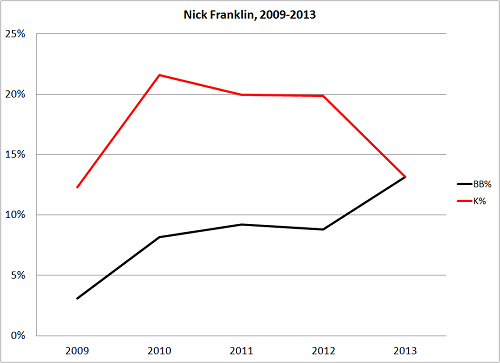
Franklin’s walks are way up, and his strikeouts are way down. His strikeout rate was this low in 2009, but that was 65 plate appearances in the super-low minors. This season, Franklin has 40 strikeouts and 40 unintentional walks, and he’s spent the whole time between Triple-A and the major leagues. His numbers, understandably, are worse with Seattle than they were with Tacoma, but they’re still good and Franklin’s still adjusting.
Used to be Franklin would run a contact rate in the mid-70s. This year it’s shot up to the mid-80s. Also, in the majors, 347 players have batted at least 100 times. Franklin’s rate of swings at balls is 20th-lowest, near names like Ben Zobrist and Kevin Youkilis. Franklin does swing at bad pitches, but everybody swings at bad pitches, and Franklin does it relatively infrequently. Franklin’s approach has been big-league caliber.
It’s not uncommon for prospects to improve in the minor leagues. That’s kind of the whole point. But it’s hard for a prospect to really improve his discipline, so it’s only seldom seen. Especially in the upper levels, when a prospect has already been pushed through and promoted a few times. How often have we daydreamed about Carlos Peguero in the impossible universe in which he figures out what balls look like? Discipline, usually, is the hardest thing to improve. Improvements tend to be incremental. I don’t know where Nick Franklin is going to settle in the bigger picture, but for now he sure doesn’t swing at many balls, and he sure does make a lot of contact. His ratios look different.
Sure, Franklin hasn’t walked much lately. But, lately, he’s seen more pitches in the zone than any other Mariner, so it’s not like the opportunities have been there. You can’t force a walk directly. You can only hit strikes and lay off the balls that pitchers might throw you because they’re worried about throwing you strikes. Franklin has an O-Swing% of 20.5%. The last 14 days, it’s 20.5%. Franklin’s all right.
You don’t want to get too far ahead of yourself, because Dustin Ackley is still too fresh in our minds. We don’t know what Nick Franklin is going to be. But he’s improved this season, at a time when the organization really needed it, and now it’s the beginning of July and the Mariners might have a new long-term second baseman. What could Franklin do? It’s not hard to notice a number of similarities between him and Jason Kipnis, if you want a hastily-identified comp. Obviously they’re different players, but they have somewhat similar skills and last year Kipnis was an above-average regular. This year he’s been a star for three months. If Franklin walks enough, makes contact enough, and defends enough, well, that’s a fine player right there. Not a fantastic player, not an All-Star, but good’s good and the Mariners haven’t had enough good. The Nick Franklin piece might fit in this puzzle.
And, boy, what if Ackley hits? It sure can be easy to not hate this team.
Danny Hultzen and Pitching Prospects
You may have heard that Danny Hultzen was scratched from his start last night, right before the start of the game, because he couldn’t get loose. This comes after making just one start after returning from a two month absence due to shoulder soreness. This is not exactly how the Mariners were hoping this would go, obviously.
Now, it could turn out to be nothing. Remember back a few years ago when Felix walked off the mound holding his elbow? He took a few weeks off and has been healthy ever since. Two years ago, Hisashi Iwakuma saw his free agent stock tumble due to diminished velocity because of shoulder issues; he’s doing just fine now, I’d say. Pitchers have problems that aren’t the end of their careers too.
But our initial reaction is always to prepare for the worst, because pitching prospects flame out at an absurdly high rate. There have been a lot of studies on this, and this isn’t a new idea, but here’s an article from a few years back that looked at the performance of Top 100 prospects from 1990 to 2003. Over that stretch, his analysis concluded that 77.4% of pitchers who rated as Top 100 prospects (according to Baseball America) ended up as busts. More than 3/4ths of all pitching prospects went on to produce little or no major league value, and the primary reason was injuries.
Position players go bust a decent amount too, of course — 62.9% of the time per this study — but don’t have the same health issues because swinging a bat is not as physically harmful as throwing a baseball. There’s more to prospect evaluation than just figuring out who is going to stay healthy, but pitchers come with an extra variable that no one has really figured out how to predict. Even if you get the talent part right, and you find a kid who works hard, and he understands how to adjust to higher level competition, it can all mean nothing if his elbow or shoulder give out.
That’s why the axiom is that if you want to find a good pitcher, start with 10 pitching prospects. It’s a slight exaggeration, but it’s not that far off, honestly. The success rate of even the best young minor league arms is just very, very low.
That’s why winning teams are generally built around position players, not pitchers. The flameout rate for hurlers is so high that you can have it all fall apart even if you collect the best arms anyone can find. Years of hard work and organization building can go up in smoke simply because of the natural risks that come from throwing a baseball. Pitchers are just not trustworthy. Yes, you love having Felix on the mound, but Felix is the exception that proves the rule. He’s great because he hasn’t had to have surgery and he figured out how to pitch at 89-93 instead of 95-99.
I hope Danny Hultzen is okay. I hope he doesn’t need surgery, and that this all just blows over, and he’s pitching in Seattle by the end of the year. But I’m not counting on it. I’m not counting on any of these young arms. With Taijuan Walker, Danny Hultzen, Brandon Maurer, James Paxton, and Erasmo Ramirez, you can look at the talent and imagine a dominating rotation. History shows that, more likely, four of them never amount to much of anything and you get one good starter from that mix.
I know it’s tempting to imagine a 2014 rotation of Felix, Iwakuma, Walker, Hultzen, and Ramirez, with Maurer and Paxton waiting in the wings in case anyone gets hurt. You’ll probably never see that rotation, just like we never saw Ryan Anderson, Gil Meche, Joel Pineiro, Clint Nageotte, and Jeff Heaverlo pitching together.
Stocking up on pitching prospects is a good thing, because you need a lot of them to build a rotation from within. Counting on a high percentage of those pitching prospects to turn into big league pitchers, though, is not a good thing, because you’re just going to be left wondering what if.
Danny Hultzen might be just fine. This might be nothing. This might also be the beginnings of the kinds of problems that have wrecked a huge percentage of Danny Hultzens that have come before him. I hope it’s not, but this is a reminder to not get your hopes up. Most of these kids are not going to make it. The Mariners are not going to ride the backs of these pitching prospects to a World Series title. That’s just not how it works.
Game 83, Mariners at Rangers
Joe Saunders vs. Justin Grimm, 5:05pm
So Joe Saunders last start, at home no less, could’ve gone better. Now he gets to pitch in Arlington, and while the Rangers aren’t a great hitting team (as you saw in Matthew’s series preview), they did knock Saunders around for 7 runs in less than five innings earlier this year. The Rangers have fared better against lefty starters this year, and the game time temperature will be in the mid-high 80s. On paper, it’s not a great match-up, and Saunders may sneak a glance at Rainiers box scores these days, with Erasmo Ramirez, Danny Hultzen and Brandon Maurer all a phone call away from taking his job.
Justin Grimm was a great story in April/May, with solid results and a great K:BB ratio, but he’s been knocked around in June. Of course, those of you with a good memory may point out that he faced the Mariners three times early on, compiling a 16:4 K:BB ratio in 16 1/3 innings, and then you notice that he’s faced Toronto, Boston, New York and Oakland in June and that’ll spare you the need to craft a narrative about how he’s “tiring” or “not used to the grind” of MLB. As you may recall, he throws a straight, 91-93mph fastball, a sinker, a change-up and a curve ball. Lefties have feasted on his sub-par change, while righties have enjoyed Grimm’s fastball (they’re slugging .613 on it), so Grimm’s not shown much in the way of platoon splits so far. His curveball’s been good, but he doesn’t throw it much when he’s behind in the count.
Grimm’s biggest problem this year has been sequencing. Like most pitchers, Grimm’s walk rate rises a bit with runners in scoring position. Pitchers often pitch around great hitters, and essentially trade OBP for power with men on base. With no one on, pitchers generally challenge hitters more, as a poor outcome doesn’t hurt them as much. Grimm’s got the slightly higher walk rate part of the equation down, but he appears confused about slugging with men on. With no one on, batters are slugging .436 off of him. With men on, that moves up to .526, and with RISP, it’s way up to .645. The samples here are absolutely miniscule, so this is more of a curiosity than anything. It’s tempting to point to problems pitching from the stretch as driving splits like these, but there have been too many cases (Brandon Morrow for one) where a pitcher has terrible men-on-base splits for 3, 4 years and then shuts down batters with men on for a year or two. It may not last, but the M’s should get a few runners on just to see what happens. If the M’s are lucky, Rangers pitching coach Mike Maddux has made these splits a point of emphasis, berating Grimm in front of his teammates for his lack of “guts” and for letting his team down, and Grimm can think of nothing else, his hands trembling in fear as he looks in for the catcher’s sign, each “you suck” from the crowd coming through loud and clear, and is the batboy laughing at me?, and the umpire’s been squeezing me the whole game.
1: Chavez
2: Franklin
3: Ibanez
4: Morales (DH)
5: Seager
6: Smoak
7: Ackley (CF)
8: Zunino
9: Miller
SP: Joe Saunders
Good to see Ackley’s injury a few days ago wasn’t serious. While it looked initially like a severe wrist sprain, it was actually his thumb, and while it’ll be wrapped tonight, he’s obviously able to play.
So Taijuan Walker’s pretty good. Another AAA start, another win, and still no runs scored off the young righty. Like most people, I think it’d be good for him to get plenty of work in at AAA and see if he can improve the consistency of his cutter and curve. Like most people, I won’t mind too much if Walker makes a really strong case for an accelerated timeline, though. Danny Hultzen pitches tonight in Tacoma vs. Colorado Springs if you’d like to get out to a ballgame locally. Everett’s in Vancouver, for those up north.
Mariners Venture to Vast Baked Terrain of Texas
| MARINERS (35-47) | ΔMs | RANGERS (48-34) | EDGE | |
| HITTING (wOBA*) | -10.4 (16th) | 3.4 | -15.1 (20th) | Mariners |
| FIELDING (RBBIP) | -16.8 (25th) | 2.6 | 17.1 (7th) | Rangers |
| ROTATION (xRA) | 11.1 (11th) | -3.1 | 24.0 (4th) | Rangers |
| BULLPEN (xRA) | 4.5 (12th) | 1.3 | -5.0 (21st) | Mariners |
| OVERALL (RAA) | -11.6 (16th) | 4.3 | 20.9 (10th) | RANGERS |
The last couple days of summer heat in Seattle are just a little taste of what every single day is like in Texas. It’s a miserable thing to endure and I’m glad I don’t have to any more. Best of luck, ball players.
By my numbers the Rangers are basically an average team plus Yu Darvish. However, the Mariners will miss him on this series. Which is likely good news, but it is always entertaining to watch Darvish inexplicably scuffle against the Mariners of all teams. Though that usually only lasts for an inning or two and then he settles down to domination mode. So, nice not seeing ya, Yu.