
Game 117, Mariners at Indians
Vargas vs Talbot, 4:05 pm.
Over the last 30 days, Michael Saunders has been the team’s best hitter – he’s at .288/.351/.442. Chone Figgins isn’t that far behind, at .298/.371/.375. Josh Bard has been decent for a catcher, hitting .257/.316/.400. And then everyone else has been horrible. Ichiro’s not hitting. Branyan’s not hitting. Gutierrez isn’t hitting. Lopez isn’t hitting. Neither Wilson can hit. Kotchman’s not hitting. Adam Moore’s still struggling. Bradley wasn’t hitting before they DL’ed him. Smoak wasn’t hitting before they optioned him to Tacoma.
Or, to put it another way, over the last month, the Mariners have hit 10 home runs. Adrian Beltre has hit nine.
This can’t continue forever. Eventually, some of these guys will start hitting. I promise.
Ichiro, RF
Figgins, 2B
Branyan, DH
Lopez, 3B
Gutierrez, CF
Kotchman, 1B
Bard, C
Saunders, LF
Josh Wilson, SS
Game 116, Mariners at Indians
Pauley vs Carmona, 4:05 pm.
Fausto Carmona does one thing well – he gets a lot of ground balls. He doesn’t throw many strikes, though, and he’s stopped getting many strikeouts, so he’s kind of a one trick pony. This is the kind of pitcher that the M’s attempted work-the-count approach should succeed against, as Figgins, Branyan, Gutierrez, and even Saunders have the ability to get deep into counts. I’m not saying that the M’s are going to explode for double digit runs or anything, but I’m at least somewhat hopeful that they’ll be able to create some offense tonight.
Ichiro, RF
Figgins, 2B
Branyan, DH
Lopez, 3B
Gutierrez, CF
Kotchman, 1B
Moore, C
Saunders, LF
Josh Wilson, SS
Should The Mariners Trade Chone Figgins?
A few weeks ago, we learned that the Braves and Mariners had a discussion about Chone Figgins before the July 31st trade deadline. The Braves, in search of a leadoff hitter and a guy who could play multiple positions for them, saw Figgins as the kind of guy they could use and get on the cheap, since he’d been a bust in Seattle so far. The Mariners reportedly rebuffed Atlanta’s advances, and the talks didn’t go anywhere.
Well, with today’s news that Chipper Jones has a torn ACL ans is done for 2010, you have to imagine that Frank Wren will at least call Jack Z to broach the subject again. With three years and $26 million left on his deal from 2011 to 2013, it is almost certain that Figgins would clear waivers and could be traded if the Mariners were so inclined. Given that he’s been on fire since August began, and the Braves are now a bit more in need of his services, you’d have to imagine the offer would be even better than it was a few weeks ago. So, that raises the question – should the M’s consider dealing Figgins if the Braves are interested, and if so, what should the asking price be?
Let’s just start with the facts. Figgins is set to make $9 million in each of the next two years, $8 million in the final guaranteed year of the deal, and then there’s a vesting option for 2014 that becomes guaranteed if he gets 600 plate appearances the year prior. This is not an outrageous salary by any means – he’s essentially getting paid like a league average player. However, if you were Jack Zduriencik, looking at the current roster and where the team was in relation to the AL West heading into next year, is that a contract you would offer Figgins as a free agent this winter?
I think the answer has to be no. For a contender, there’s a decent chance that Figgins is worth that much money. The marginal value of a win that pushes you from out of the playoffs into October baseball is huge. For a team like the Braves, who are fighting with the Phillies for one playoff spot, the opportunity to make an upgrade, even if its not a huge one, has a lot of value. For the Mariners, who have no chance of contending this year and probably a longshot at best chance next year, the wins that Figgins will add don’t have a lot of value.
Realistically, the Mariners are probably still going to be breaking in Michael Saunders, Dustin Ackley, Michael Pineda, Justin Smoak, and Adam Moore next year. It isn’t realistic to expect them to hit the ground running and carry this team to a 90 win season, but it’s also not prudent to block their devleopment by bringing in more proven MLB players. The 2011 Mariners are going to be a young team, and barring some huge breakout years from a couple of those guys, they’re probably not going to be able to keep up with Texas.
So, even if Figgins returns to previous form and is a +3 win player next year, those wins probably won’t put the Mariners over the top. By the time this team may be ready to be a legitimate contender in 2012, Figgins will be 34. Do you want to count on him still being an above average player in a few years? More importantly, are you willing to give up a significant chunk of the payroll now in order to find out?
Beyond just the value of the wins added, there’s a question of the natural fit for Figgins here in Seattle. The core of this team’s offense going forward is Ichiro, Gutierrez, Saunders, Smoak, and Ackley – three left-handed bats, a switch-hitter who struggles against lefties, and a right-hander who is in the line-up for his defense. If you keep Figgins, the only open positions where you could potentially get some legitimate offense from a right-handed hitter are SS, C, and DH. You can essentially eliminate the first two spots because guys who play those positions and can hit just aren’t available, so that leaves just DH for the M’s to balance out the line-up and give them someone who can provide some offense against southpaws.
Of course, as we’ve seen, Safeco isn’t a great place for right-handed sluggers, so you don’t really want the Mariners to throw a lot of money at a bat-only guy who hits from that side. In reality, the M’s probably should be looking to fill third base with a young, right-handed (or switch-hitting) third baseman with some power. That way, they could use the DH on a big slugging lefty who can take advantage of Safeco and provide some thump while also still having the kind of hitter in the line-up that doesn’t let teams just mow through the batting order every time they toss a left-hander out there.
If you keep Figgins, there’s no room for that kind of bat. As we’ve seen every time the M’s face a lefty lately, it’s a problem. You just won’t be able to generate much offense against LHPs with some combination of Figgins, Gutierrez, Smoak, Moore, and shortstop du jour as the right-handed bats in the line-up. The core of this team is missing a guy liike Adrian Beltre, who wasn’t just a good glove at third, but could also hit a good southpaw when they took the hill.
I won’t go so far as to say that signing Figgins was a mistake. The move made sense at the time, given the Mariners needs and the idea that they could make a run at the division title this year. However, circumstances have changed, and Figgins is no longer a great fit this team’s future. As they forge ahead with some young talent that probably needs another year of maturation, the aging veteran with a decent sized contract makes more sense for a team in win now mode than a team building for the future.
If the Braves are willing to take Figgins’ contract, the M’s should let them have him, then reallocate that money and position on a player who better fits what the team is now trying to do. Given the financial situation of most teams in baseball, the deal probably wouldn’t be that easy – the Braves would probably want the M’s to take some money back in order to stay under budget. That may end up being the sticking point.
The only two guys under contract for 2011 that the Braves would be willing to part with are Kenshin Kawakami and Nate McLouth. Given that the M’s are basically set in the outfield, McLouth won’t interest them at all, especially at $6.5 million for next year. Kawakami, though, is a bit more interesting. A starting pitcher who has been displaced by the Braves pitching depth, he’s a lot better than his W/L record would indicate – in two years in the big leagues, he’s posted a 4.57 xFIP, basically making him a league average starting pitcher. He’d take a bit of a hit coming to the AL, but he’d also pick up some value by coming to Safeco Field and pitching in front of the M’s defense.
At $6.7 million for next year, he’s a bit pricey for what he is, but not absurdly so. He could serve as an innings sponge for a team that could use one, helping fill a hole in the rotation that doesn’t have a natural answer for 2011. Given his pitcher type and the environment, there’s a decent chance that he could even become an asset for the organization, a guy they could move next summer as a low cost starting pitcher who had rejuvenated his career in a more friendly environment.
Would I rather pay Kawakami $6.7 million for one year or pay Figgins $26 million for three years? The former, and given the Braves current situation, you might be able to do even better than that. Whether its getting them to kick in some of the money owed to Kawakami for next year or kicking in a mid-level prospect in order to make the deal happen, this is the kind of move that the Mariners should be willing to make.
The Braves could use Figgins more than the Mariners, who should be focusing on future wins and building out their young core more than maximizing their current product. Getting out from under the rest of his deal while bringing in a potentially useful pitcher for 2011 makes too much sense to pass up. This is something that I hope Jack Z seriously explores. Signing Figgins made sense at the time – trading him now makes even more sense.
On Brock And Salk Today
I’ll be on with the guys at 9:35 am today.
Also, my latest post for their blog is now live.
You’re Fired, Probably
If ever you’d care to lose faith in all of humanity all at once — or, at least the middle- to upper-middle class, American portion of humanity — you’d do well simply to point your web browser to nytimes.com, direct your gaze towards the bottom right of the screen there, and behold the most popular articles of the day.
Invariably, your worst fears about the species — that we’re petty, self-obsessed — will be realized. Data show that a full 60-65% of these articles are about which kindergarten will best prepare your unborn child for Harvard; another 20% or so concern the health and beauty habits of French women (spoiler alert: they’re anorexic!); and the remainder are just borderline-pornographic descriptions of something called quinoa.
In short, it’s harrowing.
There are exceptions, though, and one such has occurred this week, as the story of Steve Slater, and his spirited departure from a twenty-year career as a flight attendant, has garnered a great deal of interest from the Times readership and, more generally, the American public.
If you’re not familiar with how Slater took care of bidness, here’s a brief account from the very popular Times article:
After a dispute with a passenger who stood to fetch luggage too soon on a full flight just in from Pittsburgh, Mr. Slater, 38 and a career flight attendant, got on the public-address intercom and let loose a string of invective.
Then, the authorities said, he pulled the lever that activates the emergency-evacuation chute and slid down, making a dramatic exit not only from the plane but, one imagines, also from his airline career.
On his way out the door, he paused to grab a beer from the beverage cart. Then he ran to the employee parking lot and drove off, the authorities said.
If you’re on the Twitters or are a reader of the disgustingly well-written Walkoff Walk, then you’re probably aware of this Giant News Event. Though some old-codger types might balk at Slater’s antics, I think most of us have found ourselves in such a situation as we would gladly inform our bosses, co-workers, customers — anybody, really — where they might stick it and how hard.
Plus, the fact that he had the presence of mind to take a beer with him kinda makes this Slater character an all-star in everybody’s
Slater’s dramatic exit — and the public’s corresponding fascination with it — is relevant to USSM readers not only insofar as it’s totally awesome, but also because the events unfolded on the same day — and, really, almost at the same time (mid-day-ish) — as Don Wakamatsu’s considerably less hysterical and certainly less surprising departure from that great, offensively challenged airplane known as the Seattle Mariners.
I don’t know exactly what’s to be learned from these twin events, but the fact that they occurred almost simultaneously and that both represent instances of someone leaving his place of employment in a conspicuous manner — well, it seems to beg for some kind of comparison.
If anything, probably what we can learn is just how weird baseball managing is in the grand scheme of possible employment. Like, here are some of the jobs that my friends and family currently hold: lawyer, writing instructor, sitcom staff writer, other kind of lawyer, children’s librarian, baseball writer, advertising copy writer, computer programmer, third type of lawyer. (Note to self: meet other people besides lawyers.)
With the exception of the comedy writer, whose job is largely dependent on a network’s decision to pick up the relevant sitcom, all these people have one thing in common: mostly decent job security. In each of these cases, the likelihood of getting fired because of poor performance is pretty close to nil. Any of these people would have to reallyreallyreally eff up in order to be relieved of their duties.
Nor is that to say that this particular sample of the employed is super-good at their respective jobs. I mean, they’re probably all good. But even if they weren’t, it’d probably be easy enough to hide their shortcomings.
In baseball, though, managers are fired all the time. And they have almost no job security. And, because we have no sure way to judge a manager’s actual contribution to wins/losses, he can be fired — usually is fired — for circumstances entirely outside his control.
Consider this list of the thirty current managers, sorted by years as manager of their respective teams.
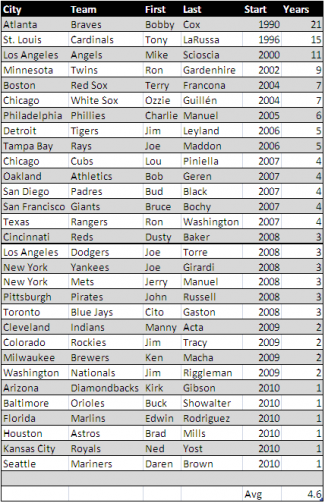
What jumps out first from this list is that a full six of those men weren’t managers at the beginning of the season. That means, right off the bat, that 20% of the employees from this particular group were fired just this year. Consider, by way of comparison, if Morrison & Foerster (the New York-based law firm known affectionately as MoFo) were to fire 20% of its associates. People would, in the parlance of today’s youth, freak the eff out.
Here’s what else we see: that the average manager can expect about 4.5 years of employment. But even that number is probably on the high side when we consider that (a) we’re rounding all the mid-year hires up and (b) the median number on that list is actually three years.
Three years? That’s crazy.
Let’s try a thought experiment. Say I’m a dude who can offer you a job. And say this job is pretty hot. But here’s the thing about it: you’re probably gonna be fired in 2013.
Would you take it?
If the men who’re employed as major leage managers are any indication, the answer is probably “yes” — because those are essentially the terms to which they’re agreeing when they sign their managerial contracts. Now, of course, there are quite a few managers who’re on their second or third or — in the case of Lou Piniella — five teams, which might skew the numbers upwards. Moreover, if someone’s managed for a major league team, he very likely will catch on at a lower level.
Perhaps it’s for these latter couple reasons that little drama surrounds managerial replacements. With the exception of former Seattle manager Mike Hargrove’s bizarre mid-season departure in 2007 — with the team standing at 45-33 and in the midst of an eight-game winning streak — there’ve been very few memorable managerial departures of late. (And there certainly haven’t been any involving emergency slides.) Perhaps managers know they’ll find employment elsewhere, if in a slightly less glamorous league. Perhaps, because many of them are ex-players, they understand that baseball is a game defined much more by failure than success.
Whatever the case may be, the principal draw of baseball’s managerial positions certainly isn’t job security.
Thanks to Dave Cameron and Zach Sanders for their help with Mike Hargrove info.
Game 115, A’s at Mariners
Braden vs French, 12:40 pm.
A little afternoon game for you today, as the M’s play early and then take tomorrow off before heading out on the road.
It’s only 27 innings, but French is having a pretty weird year for the M’s. He’s only issued four unintentional walks in the big leagues, and as a soft-tossing fly-ball guy, throwing strikes is a pretty big key for him, but then you see that he’s also hit three batters and thrown two wild pitches and realize that he hasn’t exactly been pounding the strike zone. He’s reduced his slider usage this year and is leaning more on his fastball/change-up combination, but his platoon split has actually been bigger than usual.
That said, it’s Safeco and he’s a flyball lefty, so he doesn’t have to be great to have success. If he avoids the HBPs and WPs today, he should be okay.
Ichiro, RF
Figgins, 2B
Lopez, 3B
Branyan, DH
Gutierrez, CF
Kotchman, 1B
Bard, C
Tuiasosopo, LF
Josh Wilson, SS
Joe Posnanski Writes A Bad Article
The headline is news, because Posnanski is the best sportswriter alive. He writes well on nearly every subject he tackles, and is often the most thoughtful pundit on each topic he is assigned. He understands the game and how to spin a good story. There are few people in the world I would rather read than Posnanski. So, when I saw that he wrote about the Mariners, I looked forward to going through it.
I was surprised more than I was disappointed. The guy who almost always gets it right missed, and missed big time.
Let’s start with the opening paragraph.
It all seems so obvious now, doesn’t it? Bringing back Ken Griffey? Trading for Milton Bradley? Giving 32-year-old Chone Figgins (and his lifetime 99 OPS+) a big-money four-year deal based mostly on one good season (and them moving him to second base)? Signing 32-year-old Jack Wilson to a multi-year contract though he had not played a full-season in two years? Going into the season with Rob Johnson, and his 58 career OPS+, slotted as the regular catcher? Trading for light-hitting Casey Kotchman and inserting him as the Opening Day No. 3 hitter? Building up all sorts of hopes about Ian Snell as a No. 3 starter? Making the moves of a “contender” when the team finished dead last in the American League in runs scored in 2009 and were outscored by 52 runs? Trading a 25-year-old one-time phenom Brandon Morrow and his 98-mph fastball for an older hard-throwing reliever with the same first name (Brandon League)? Expecting another low ERA closer year from David Aardsma? Letting go of Russell Branyan who was one of only two good offensive players on the team in 2009 (he led the team in OPS+)?
In order:
Bringing back Griffey? Bad move, yes. We (and a lot of other people) said so at the time.
Trading for Milton Bradley? Given what the cost was, this was a perfectly reasonable gamble. Carlos Silva wasn’t going to make this team, and so the front office paid $3 million to add Bradley, a switch-hitter with a strong offensive track record.
Chone Figgins had one good year? His WAR by season in LAA after becoming a regular: +3.2, +2.4, +0.0, +3.2, +2.7, +6.1. He had one bad year out of six, not one good year. He’s just factually wrong about Figgins.
Signing Jack Wilson? Not my favorite move, and I expressed concern about the injuries, but calling it a “multi-year deal” is not really being honest about the contract. Instead of picking up his one year, $8 million option, they signed him for $10 million over two years. He’d been worth $5 million or more every year but one since 2004.
Rob Johnson as the regular catcher? That wasn’t the plan. Adam Moore struggled and got hurt. It happens.
Casey Kotchman as #3 hitter? Again, not a factually correct argument. Kotchman hit 3rd against RHP for the first seven days, then moved down to 7th. He’s hit in the #3 spot only 20 times all season, most of which have come since the team gave up on the season.
Ian Snell as #3 starter? Another gamble, and maybe you can argue that the team should have known it wouldn’t have worked, but you can’t really blame the starting rotation for how the season has gone.
Moves of a contender for a team that was outscored last year? We’ve covered this. Pythag record is useless, and using it is lazy analysis. The Mariners won a game or two more than they should have last year. They had every reason to believe that they had a chance to be decent this year.
Trading Morrow for League? Bad deal, and we said so at the time. There’s no defending this one.
Expecting another good year from Aardsma? You can’t criticize them for bringing in League to shore up the bullpen on one hand, then act like they were counting on Aardsma to repeat his 2009 season on the other.
“Letting go” of Russell Branyan? The Mariners tried to re-sign him. They offered him more money than he ended up taking from Cleveland later in the winter. The problem is that he wanted a multi-year deal, and the Mariners didn’t think it was wise to give a guy with his history of injuries that kind of contract. You know, the exact same thing that Posnanski criticized them for doing with Jack Wilson a few sentences earlier. His right hand is criticizing them for doing something that his left hand criticized them for not doing. He then continues on with this:
Yes, it seems so obvious now that the Seattle Mariners were likely to have a terrible crash this season. And it probably should have seemed obvious in February too. And it probably WAS obvious then — Monday’s firing of manager Don Wakamatsu was etched in stone back before spring training.
No, it was not obvious in February. There’s a reason you didn’t see this coming, Joe – it was impossible to see coming. The things that have sunk the team – getting career worst years from Bradley, Kotchman, Figgins, Jose Lopez, Snell, and Rowland-Smith – were not things that you could predict. There was no reason to believe that those six guys would all play at replacement level or below. None.
A few commenters on Posnanski’s blog pointed this out to him, and he responded in another post, suggesting that if we look back a couple of years, maybe it was possible to see this coming, as Figgins and Gutierrez both had mediocre offensive seasons a couple of years ago, so if we just looked at more than one year of data, we could have seen some signs of the crash.
The problem? He’s wrong again. This is exactly what the various projection systems have been created to do. They take 3 years (or more, in some cases) of data to give a decent sample size, regress the performances to account for luck, and add in aging curves that take into account the way players skills develop and erode over time. Projections from systems like ZiPS and CHONE have proven to be pretty accurate overall. Here’s how those six main failures were projected to do this year:
Chone Figgins: .334 wOBA (ZiPS), .339 wOBA (CHONE), .307 wOBA (actual)
Milton Bradley: .355 wOBA (ZiPS), .353 wOBA (CHONE), .289 wOBA (actual)
Jose Lopez: .322 wOBA (ZiPS), .331 wOBA (CHONE), .266 wOBA (actual)
Casey Kotchman: .333 wOBA (ZiPS), .325 wOBA (CHONE), .275 wOBA (actual)
Ryan Rowland-Smith: 4.52 FIP (ZiPS), 4.41 (CHONE), 6.79 (actual)
Ian Snell: 4.45 (ZiPS), 4.49 (CHONE), 6.48 (actual)
In every single case, the player is performing so far below any reasonable expectation that you cannot make a case that this was something that anyone should have seen coming. Posnanski isn’t even consistent with his points. He asserts that we should been questioning the Figgins signing because his 2008 wasn’t as good as his 2009, but never mentions the fact that Bradley was the best hitter in the American League two years ago. We should have been worried about the age of Figgins and Bradley, but ignore the fact that Lopez and Kotchman were both at an age where players traditionally have the best years of their career?
Joe’s assertion is that looking at multiple years of data would have allowed us to see that the Mariners had a terrible offense and would crash and burn. The problem, though, is that this isn’t reality. ZiPS projected the Mariners for 86 wins, and it’s based on data, not off-season hype. CHONE was a bit more conservative, coming in at 78 wins, but not projecting any AL West team for more than 86 wins. Overall, the best projection systems thought the M’s were about a .500 team, maybe a little bit better.

Guess what? So did we. In my brief pre-season preview, I noted that this was a high variance team that was basically unpredictable. I projected the team for 83 wins and a second place finish behind the Texas Rangers. The guys over at Lookout Landing did two polls on Opening Day, with the majority of the readers suggesting that the team would win 82-86 games and miss the playoffs.
The idea that there was this runaway, uncontrollable optimism about the Mariners season that was unfounded based on facts is just revisionist history. By any reasonable standard, this team should have been viewed as a .500ish club – one with some problems, but also one with strengths. If things went their way, they could have been a contender. Instead, absolutely nothing has gone their way, and the result has been a disaster.
But no one saw this coming, and no one should have seen this coming, because this was essentially the perfect storm of problems in one season. There’s a reason Murphy has a law – sometimes, everything that could go wrong does. This is one of those times. It is not, however, a chance to look back and say “well, we should have known better.” No, you shouldn’t have. The team was evaluated fairly based on the best information available. It didn’t work out. That’s life.
Sorry Joe, but you’re better than this.
Minor League Wrap (8/2-8/10)
If you have any questions, better get them in now because I won’t be around to answer them next week, though the post will go up anyway. And before anyone asks that, I haven’t heard anything new on the draft picks, sorry.
To the jump!
Read more
Rey Of Hope
Well, that was fun.
Game 114, Mariners at A’s
Hernandez vs Anderson, 7:10 pm
Happy Felix Day.
I’ll be on with the guys at 1510 KGA at 5:15 pm, if you want to listen to me muse about Wak’s firing.
Two of my favorite pitchers square off for what should be a pretty good duel. Anderson’s still trying to get back to regular season form after a couple of DL trips, but when he’s right, he’s about as good as it gets, non-Lee-and-Halladay division.
Oh, and if you thought the line-ups were just because Wak was crazy, Daren Brown wants to let you know otherwise. See below:
Ichiro, RF
Figgins, 2B
Lopez, DH
Gutierrez, CF
Kotchman, 1B
Moore, C
Langerhans, LF
Tuiasosopo, 3B
Josh Wilson, SS