
Thanks, guys
It’s no secret that a Certain Other Baseball Site Dave Writes For is doing a major series right now that is generating a lot of, uh, discussion. (yeah, let’s call it that)
So, I just wanted to say, on behalf of all of the USSM crew:
Thanks to all of our regular commenters. Sometimes we take you for granted, and it takes something like watching a total trainwreck somewhere else to really make us appreciate what a good overall community we’ve managed to collect here at USSM.
(LL people, you’re awesome too, even if you won’t let me make Carlos Silva fat jokes anymore)
Garko Waived
Jon Morosi reports that the M’s have placed Ryan Garko on waivers, finalizing the speculation over the last week that Mike Sweeney took his roster spot. Garko had an option left, so that the M’s put him on waivers tells you just how little they want to keep him around. He didn’t impress anyone in Peoria, and this is the M’s just letting him go.
I’m not a fan of making roster choices based on March, but I already ranted about this last week, so I’ll leave it at that.
Update: It turns out we were all wrong assuming the M’s could just option Garko to Tacoma. I’ve been told that there’s a rule that requires any player to pass through waivers before he can be optioned after the 3 year anniversary of his major league debut. Since Garko debuted on September 18, 2005, he fits the criteria. Even though he has an option left, the M’s were still required to put him on waivers before they could send him down.
A Good Time To Be Hurting
The M’s are going to open the season at significantly less than full strength. With Cliff Lee, Erik Bedard, and Jack Hannahan on the DL, the team is going to have to fight through April with a roster that would probably finish below .500 over a full 162 game season. Don’t expect this team to come firing out of the gates and blow the doors off of everyone in the first month of the season.
However, if the M’s had to choose a month in which to be hurting, April may just have been their best bet. While they start the season with ten games against the A’s and Rangers, they follow that with series’ against Detroit, Baltimore, Chicago, and Kansas City. There isn’t a likely playoff team in that bunch, and in reality, the last two weeks of April looks like one of the easiest stretches of baseball this team will play all year.
It’s easy to look at the roster and be a little discouraged with how this spring has gone, but the M’s may have caught something of a lucky break in their schedule. Thanks to the weaker opponents they play in the first month of the season, they’re unlikely to get buried early. Even with a lot of question marks, I wouldn’t be surprised if the M’s posted a winning record in April, which should inspire a decent amount of optimism if Lee and Bedard can rejoin a team that’s already over .500.
May to August are going to be tough. The M’s need their big guns back for that stretch. April, though, they may just be able to sneak through with this less than perfect roster.
Comments off, server move in progress
Thanks for your cooperation. (Complete)
Casey Kotchman’s Upside
Many people see Casey Kotchman as something of a wild card in the 2010 Mariner lineup. Over at the Max Info blog, Dave mentioned that the hitting staff will be working with Kotchman to start focusing on hitting more fly balls to try and take advantage of the right field porch in Safeco. The idea is that with the right adjustments, Kotchman might just rediscover his power stroke and become an impact player.
Looking at his stats, it is very easy to see why people see Kotchman as a high upside guy. A top prospect his entire minor league career, Kotchman broke through with a .296/.372/.467 line in 2007. When a 24-year-old top prospect puts up a .372 wOBA while flashing a plus glove, most people assume he has nowhere to go but up. Even after a couple of disappointing seasons, it’s easy to keep dreaming on that upside and expect a breakout. As much as I would love to be on the Kotchman bandwagon, I’m not so sure anymore.
2007 was a tale of two seasons for Kotchman, who suffered a concussion in June of that year. Post-injury his power, which finally seemed to be emerging in the first half, dropped off. His .199 first-half ISO dropped down to .138 in the second half, stayed at .137 in 2008, and then plummeted to .114 last year.
This spring, I had the opportunity to watch Kotchman in both batting practice and game action down in Arizona. I was accompanied by a friend of mine who was a high school baseball standout and D1 recruit before an injury ended his baseball career. Suffice it to say he and I see the game a little bit differently. When I mentioned Kotchman’s name as a potential breakout candidate, my friend laughed, remarking “not with that swing he’s not.” Where I saw a 27-year-old hitter with a mature approach who’d hit for average and power in the past, my friend saw a guy who didn’t get the barrel of the bat through the strike zone quickly enough to punish major league pitching.
I was intrigued, and decided to look a little deeper into Kotchman’s offensive profile to see if I could isolate any differences between Kotchman’s 2007 and 2008-09 performances. While there were several small differences, each of which is potentially meaningful, one thing jumped out at me. In 2007, 36.2% of the pitches Kotchman saw were in the strike zone. In 2008, that number jumped to 48.8%, and rose again in 2009 to 49.6%. For comparison’s sake, league average Zone% has hovered right around 50% in those years. Unfortunately, rather than punish pitchers for their new-found hubris, Kotchman’s power fell off a cliff.
The only hard conclusion I can draw from this is that major league pitchers have made an adjustment in their approach with Kotchman. Where they used to tiptoe around him, they no longer seem afraid to challenge him. It’s pure speculation I know, but my gut is telling me that major league scouts are telling their pitching coaches something similar to what my friend told me: Casey Kotchman doesn’t have the bat speed to be a threat anymore.
I hope I am wrong, but I am starting to see Kotchman more as a known quantity/solid roleplayer than as a guy capable of returning to his 2007 form.
EDIT: Jeff Sullivan points out that there seems to be a major blip in Fangraphs’ 2007 Zone% Data for the Angels and Dodgers in 2007 which may or may not render this entire post completely moot. Incorrect source data is frustrating.
Pitch FX View of Spring Training II: Shawn Kelley
Last week, many of the beat reporters talked about two developments regarding Shawn Kelley. First, he’d be throwing more pitches/innings in his next few outings to stretch him out a bit, and second, he was going to revive the change-up he used as a starter for the Austin Peay Governors (a pitch he’d shelved after turning pro). He threw ten of them in his abbreviated start against Kansas City – how’d it look?
Pretty darn good. The pitch averaged 83 MPH, or about 7 MPH less than his fastball. Second, its vertical break isn’t all that different from his fastball, which is normal for change-ups, but it still distinguishes the pitch from the ‘change-ups’ with splitter-like sink like Tim Lincecum’s or Zach Greinke’s. His control with the pitch is already exceptional – he’s always around the plate with it (9/10 strikes), and he kept the ball from the top portion of the zone. He gave up one hit on a change, a single to Billy Butler.
Here’s a chart of his location with the change-up, with the strikezone in red (Pitch fx strikezone, not the ‘rulebook’ strike zone). There are some exceptional pitches on the black away from lefties, and there are a few scarier looking pitches in the heart of the plate. To be fair, most of these came against hitters who can’t hit change-ups (Jose Guillen and Josh Fields, I’m looking at you). So the optimistic view is that he was pitching to the scouting report; the negative view is that he made some bad pitches against the right team.
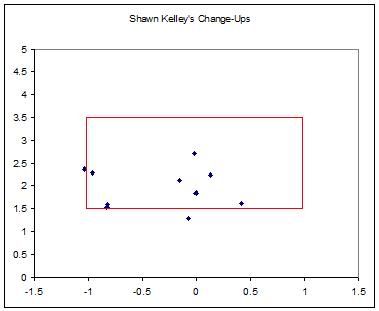
Remember though, this is ten (10) pitches. This means nothing. If you like Kelley, this is encouraging stuff – mostly down in the zone, not hit hard at all, etc. If you think it’s a bit late in the spring to be adding new pitches, you can point to what look like some mistakes. This isn’t all that meaningful, but it’s fun to look at and to speculate about. So far, the quotes from Kelley about having a lot of confidence in the pitch are borne out in his control. We’ll have to see about the results, but so far so good. Incidentally, why on earth did the M’s ever tell him to abandon this pitch?
Cactus League Game Thread, 3/26/2010
Last time out, French has been working on his change-up, and ran a 11/1 ground/fly ratio, which is kind of absurd considering that his ratio was at 0.37 in Detroit last year, 0.60 in Seattle, and about 0.71 before Sunday’s game in spring training. More groundballs makes French pretty interesting.
Geoff Baker also suggests that Tuiasosopo has made the team as a back-up infielder and that the team can live with him at short one or two times a week. I’m not really in agreement with the latter part of that assessment.
Lineup:
RF Ichiro!
2B Figgins
3B Lopez
DH Griffey
LF Byrnes
CF Gutierrez
1B Garko
C Johnson
SS Jack Wilson
LHP Luke French
Bad News, Meet More Bad News
Baker and others have the news of the day, and it ain’t great. Cliff Lee is going to take five days off before throwing again, so realistically, his entire spring training is gone. He’s definitely going to need a DL stint, and by the time he gets stretched out enough to pitch in a big league game, it’s going to be the end of April or early May.
Beyond that, Wak comes pretty close to confirming the growing suspicion that the Mariners are going to make room on the team for Mike Sweeney because of how he’s hit this spring. Sweeney will displace Ryan Garko on the 25 man roster and serve as a part-time DH against lefties and play first base sparingly, as Kotchman will not be platooned.
Put chemistry and feeling goodness aside for a minute – this creates all kinds roster problems for the M’s. Now, against LHPs, you’ve got Sweeney, Bradley, and Byrnes for two spots – DH/LF. Bradley kills lefties, so you don’t want to take him out of the line-up against southpaws, but Byrnes’ role on the team is lefty mashing outfielder, and pushing Bradley to LF against LHPs takes away his playing time.
So, not only is Sweeney going to remove Garko from the roster, he also is going to take playing time away from Eric Byrnes and force Milton Bradley to play the field more often. Neither of those are positives. Plain and simple, Mike Sweeney makes this team worse.
Now, if you want to argue that the pies in the face and the jokes and all that stuff make up for it, fine, make that argument. But remember, Mike Sweeney’s been the best guy in baseball forever, and teams he’s been on have finished over .500 twice in his 15 year career. Last year’s 85 win Mariner team posted the best record of any team that Sweeney has ever played for. If his personality was vital to a winning team, don’t you think he may have actually played on one or two of them?
Of course, it’s not fair to blame Sweeney for having lousy teammates in Kansas City, but I’ll still suggest that you can’t make an argument that having Sweeney on the roster leads to lots of wins that we can’t measure when there’s no history of teams he’s been on playing better than you’d expect. He might be a lot of fun to be around and great for the clubhouse, but in the end, good teams win and bad teams lose. Mike Sweeney hasn’t made any bad teams good by hitting his teammates in the face with pies.
The Mariners have already wasted one roster spot on Griffey in the name of clubhouse chemistry. Now, it sounds like they’re going to waste two roster spots on clubhouse chemistry. When Kotchman is facing a tough lefty in a high leverage situation or the team can’t pinch hit for Jack Wilson with the bases loaded, you can thank the team’s desire to have both Griffey and Sweeney around. There are consequences to carrying these guys, and you’ll see them play out on the field.
Let’s hope the M’s can win a lot of games in spite of Sweeney’s presence, because otherwise, we may look back at the way the end of this roster was put together with an awful lot of regret.
3/24 News/Links
1: Ken Rosenthal writes a fairly level-headed piece on why the M’s might face some trouble in 2010. This won’t be a shock to anyone here (Bedard is hurt? Wha?), but the article seems designed as a response to some of the plaudits the M’s have received in the national print media. Mind you, this article now finds its place amongst an equally voluminous collection of “the M’s haven’t won anything yet” pieces – like this one. I don’t think anyone here had the idea that the M’s are a 100-win true-talent team, so the article is fine as far as it goes.
One thing that caught my eye though was the quote from an unnamed scout about Milton Bradley. According to whoever it was who talked to Rosenthal, Milton Bradley doesn’t look so hot this spring. “I’m afraid he can’t play anymore,” says Scout X. This is the spring training yin to “He’s in the best shape of his life”‘s yang. For every hot-shot pitcher turbo-charged by some unexplained mechanical tweak (which scouts think will make him unhittable) you’ve got the guy with a hole in his swing, who fights what seems to scouts like a quixotic battle. Someone needs to track these assertions. I don’t mean to suggest that the scouts are wrong – if they’re right, this is really important info. If you can always find one guy who thinks he’s found a flaw in Pujols’ swing, well, that’s interesting too, but I’ll take these reports with a grain of salt. In this case, the scout is helpfully specific: Bradley apparently has trouble with pitches up in the zone (“above his hands’). It’ll be fun to see if this holds true.
2: How can fans keep track of something like that? Well, you could make heat maps with MySQL and R. That’s laudable. Alternatively, you could outsource that work to Craig Glaser and friends. Sabometrics has a new iPhone app that gives you a heat map for every player in baseball using 2009 pitch fx data. It’s called Batting Goggles, and it just came out this week. So, how does that scout’s observation about Bradley look through Batting Goggles? Actually, it looks pretty good – Bradley struggled with pitches up in the zone in 2009 (but killed pitches anywhere in the middle third). What does Ichiro look like in this view? Still amazing!
Read more
How Good Will The M’s Defense Be?
Last year, we saw the power of what a great defense can do for a team. Led by Death To Flying Things, the M’s ran out an historically great defense, catching everything that was put in play, and leading the league in ERA despite a so-so pitching staff. It is no secret that the M’s have put an emphasis on defensive value, and their off-season acquisition of Casey Kotchman, as well as the re-signing of Jack Wilson, continue to push that trend forward.
A year ago, the Mariners had the best UZR in baseball, at +85.5. Here’s how that broke down by position:
First Base: +3.4
Second Base: +2.4
Shortstop: -3.0
Third Base: +20.9
Left Field: +17.0
Center Field: +33.3
Right Field: +11.7
The M’s outfield defense was one of the best of all time. The infield was carried by Beltre/Hannahan, while the other three spots were just about average. The team made upgrading the infield defense a big part of their off-season, so can we expect the team to be even better defensively in 2010?
No. Realistically, we probably can’t even expect them to come close to matching last year’s totals.
We talked about this with regards to Gutierrez at the end of last year, but regression to the mean is a powerful force, and history shows that it is almost impossible to have the kind of season that he just had two years in a row. Gutierrez is a great center fielder, but he’s not a +30 center fielder. They simply can’t expect to get the same kind of value out of his glove as they did a year ago.
It’s not just Gutierrez, either. The Mariners won’t be getting +21 defense from third base again (the dropoff from Beltre to Lopez is going to be hard to watch, honestly), nor should we expect the Bradley/Byrnes platoon to put up anything near a +17 in left field. Here is how I would project the M’s expected defensive value in 2010, position by position:
1B: +5: Garko drags Kotchman down a bit
2B: +5: Figgins will eventually adjust to 2B and play well, but it might take a few months
SS: +5: Wilson’s a really good glove guy, but he doesn’t play 150 games a year.
3B: -5: Lopez will be okay at third, but probably a bit below average.
LF: +5: Bradley’s okay, but nothing special. Byrnes should be pretty decent.
CF: +20: The best projection we can give anyone. +30 won’t happen again.
RF: +10: Ichiro will eventually slow down. I don’t think it’s going to happen this year.
The total for those positions: +45. The Mariners, after adding Kotchman and bringing back Wilson, should be expected to lose nearly 40 runs of defensive value from their 2009 squad. You can quibble with some of the numbers if you want, but you’re not going to be able to come up with a projection much different – maybe you’d have them at +30 or +60 if you’re really optimistic or pessimistic, but it’s going to be in that range.
The M’s are going to be a really good defensive team, but last year, they were historically great. You can’t expect that again, even with a revamped infield. Don’t consider it a letdown if the M’s don’t match last year’s amazing UZR numbers – it’s just not a realistic expectation.