
A punishment of years, not weeks
I like to think that our sentence is nearly over, that we’ve got a few more weeks and then we can enjoy the playoffs, start speculating about our new GM, and thinking about how the team might turn around and finish the season with their heads above water.
I worry that it’s not. I’ve been torn about whether or not to even voice this because it’s so negative, but in the end, I think we have to talk about this. Every time I seriously consider this it makes me want to throw up, or close up shop, replace USSM with a page that says “We’ve been promoting your shitty product for years and years now, and it turns out we have a limit. Call us when you’re ready to be smart.”
In a way, though, that makes it the most important thing to talk about.
Here’s the short version:
– They announce that there will need to be a rebuilding effort after all, and payroll will need to come down (check)
– In the off-season, Mariners hire seemingly decent GM
– No higher-up changes happen: Lincoln and Armstrong aren’t held accountable for their responsibility in the long failure of the franchise
– They dump Beltre for very little
– The team doesn’t make any other significant moves because L/A are unwilling to dump salary even when it’s clearly in the team’s best interest (see: Washburn) and goes into next season with this squad essentially minus Ibanez
– The new GM does a better job at assembling the overall roster and putting a working 25-man lineup together, but
– They stink next year, because there’s no money to spend on $2m-$4m stop-gap and injury-return contracts
– Attendance drops even further
– Wamu and other corporate sponsors are toast
– With a drastically lower payroll and a ton of MLBAM cash, the team makes money
– The “rebuilding” goes on, as the team cuts payroll again, so money rolls off (like the Washburn contract) but is not re-invested
– The team makes more money
– Maybe the GM gets fired at some point
– Four years from now, after nearly a decade in the dumpster, the Baseball Club of Seattle either sells out or is re-organized and new owners seize control
– The new owners take over a team with newly-horrible media deals, Felix gone, Ichiro gone, and the only good players in the farm system the products of continually high draft positions
– Hope
“Rebuilding” will be a cover for how bad they are at putting winning teams on the field, a continual excuse for bad records, and at the same time justification for not spending while taking money out of the team through the back door.
I’ve tried not to engage in the “as long as Lincoln and Armstrong are here, there’s no hope” pessimism, but it’s an entirely valid viewpoint. They hire the new GM. But they’re entirely unqualified to do so. And even if we’re lucky and the right candidate makes an absolutely stunning presentation and is hired on the spot, we’ve already seen that they believe their baseball judgment is better than whoever they have in the job.
Consider how depressing that is: the maximum effectiveness of any GM candidate is likely to be determined by the baseball incompetence of Chuck Armstrong. Or: they can’t be smarter in running the team than Chuck is dumb in approving or overriding their decisions.
A point I haven’t made much that backs this up– the Mariners ownership consists essentially of Lincoln for Nintendo of America (and really, for Yamauchi). They’ve recently tried to sell the idea that the minority owners are somehow involved in the team — probably to spread blame more than anything– but this isn’t true. They have minority owners who have massive tech chops, and they have no say at all in the team’s operations. They have a stake in the team, their interests are aligned, but Lincoln’s never reached out to them for help, say, the wholesale construction of the kind of data infrastructure the Indians have.
Armstrong believes himself a sabermetrician, good enough to justify his team’s horrible ignorance of new statistical methods, and he’s not.
Armstrong believes himself a baseball talent evaluator and a better negotiator and a better GM at least than the man he put into the job, when Lee Pelekoudas worked for the team since ’79, and worked himself into the front office, and Armstrong got his because he knew George Argyros.
And this is my greatest fear, that he and Lincoln will run and gut this team for the years no matter what name appears on the front office page as “general manager.”
Graphing Morrow 9/21


Morrow pretty much defined the “establish the fastball” mantra today. His first 12 pitches were all fastballs between 93 and 97 mph and Johjima put down one finger for 26 of Morrow’s first 30 pitches. The first time through the lineup, every A’s batter saw a first-pitch fastball.
It didn’t hurt Morrow this time, as he pitched well through the first six innings. But if he continues to start off every game with basically 30 fastballs in a row, well … we’ve seen how that can turn out.
Another interesting thing is this: look at how his fastball just dies after about 80 pitches. It’s a lot easier to get by throwing 70 percent fastballs when you’re blowing them past guys at 95, 96, 97 mph. When those fastballs dip down to 91-94, it makes it a lot easier for hitters to get around on them.
Game 155, Mariners at Athletics
Morrow v Gallagher. 1:05.
The horrible thing for me is that without looking, I wouldn’t have been able to tell you how many games in a row the team’s lost. I’ve accepted the losing without much complaint, and when I turn off the TV after each road loss, I think “Was Sims right– is that nine?” and then move on. But writing this, I realized that their longest winning streak was only four. How unbalanced. No wonder we’re so beaten down. Last year there was a 9-game, but they also put together sustained winning streaks we could get behind.
I wish Morrow the best of performances and a reasonable lineup behind him.
Felix 9-19 start in one graph
Looking at the Pitch FX data for yesterday, I wanted to do another series of graphs showing what Felix’s stuff looked like, and I don’t think you need them at all.
In the first inning of yesterday’s game, Felix threw three fastballs to Buck. Then two fastballs to Cunningham. Then two fastballs, two “splitters” and two fastballs. Looking at the list, I immediately saw a huge almost-purely fastball streak, and counted it. Of his first 33 pitches, seven weren’t identified as fastballs (and then he threw two changes).
Here’s a version of the graph Dave’s offered a couple times:

That’s the only thing you really need to know about the start. At about pitch 50 after Kurt Suzuki singled to left (fastball-slider-single), Felix started to mix his stuff up. The A’s didn’t score again.
To that point, Felix had 3k (two of Cust), and every other batter put the ball in play — Buck for a home run. 14 hitters, 3 strikeouts, 11 balls hit. After he starts to mix the pitches, he faces 17, strikes out five, walks one, and 11 balls are put in play.
Felix throwing almost nothing but fastballs is a pretty good pitcher. Felix mixing his pitches is one of the best pitchers in baseball. Why he, and the team, continue to think that he should work on establishing and relying on the fastball is beyond me. The scouting report on him must be “he’ll throw almost nothing but gas for three, maybe four innings — key up for that fastball and hack, hack, hack, because this defense sucks and the ball will find a hole.”
1198 days until Silva’s off the books*
Ichiro isn’t the only player on this team making history. Observe…
 Highest ERA for Mariners pitchers with at least 150 IP
- Carlos Silva (2008): 6.46 (and counting)
- Ken Cloude (1998): 6.37
- Joel Pineiro (2006): 6.36
- Joel Pineiro (2005): 5.62
- Jamie Moyer (2000): 5.49
- Sterling Hitchcock (1996): 5.35
- James Baldwin (2002): 5.28
- Glenn Abbott (1978): 5.27
- Jamie Moyer (2004): 5.21
- Ryan Franklin (2005): 5.10
I expected to see more guys from the early Kingdome years on the list. That’s pathetic.
Same thing, but looking at all pitchers from 1961-2008
- Jeff Fassero (1999): 7.20
- Jose Lima (2005): 6.99
- David Cone (2000): 6.91
- LaTroy Hawkins (1999): 6.66
- Jose Lima (2000): 6.65
- Darryl Kile (1999): 6.61
- Ken Schrom (1987): 6.50
- Eric Milton (2005): 6.47
- Carlos Silva (2008): 6.46
- Ken Cloud (1998): 6.37
Game 154, Mariners at Athletics
26 innings and counting
The M’s haven’t scored a run since the first inning of their game on Wednesday. The Tacoma quartet (Lahair/Tui/Valbuena/Johnson) just don’t resemble anything like major league players, which shouldn’t be a huge surprise, since none of them were all that great in Triple-A.
The new GM is going to have to bring in about 15 new players this winter.
Game 153, Mariners at Athletics
7:05, Felix versus Eveland.
I’ve been the “coordinator” for a project at the day job that’s devoured a lot of my life for the last couple of weeks. It’s why posting’s been off since that last deluge, and why I’ve probably seemed more curt than is usual even for me. This final week it looked like it was going to come in, crash, work out, and today, with ~18m to spare, it worked and we were waved on to release.
And now I get to sit back with a quality beer and hopefully watch Felix carve up the A’s. I’m really looking forward to this.
Three views of a start
I’ve been playing with the Pitch FX data from Felix’s last start. This is the first time I’ve used Pitch FX data like this (Dave, obviously, is a little more familiar). I ask for forgiveness in advance if I’ve flipped an axis or something similar.
Velocity: this is the speed of the pitch as it leaves his hand
L-R break: this is taken from “pfx_x”. Positive is to the catcher’s right, negative to the catcher’s left.
Vertical break: this is taken from “pfx_z”. Positive numbers mean it rises, negative that it drops.
I mention that because the way break is handled will seem a little weird. It’s measured from a straight line, for instance, not from an average pitch. And for vertical break, gravity’s effect is removed, so you’re measuring is how much more or less the ball moved.
So this is easy:
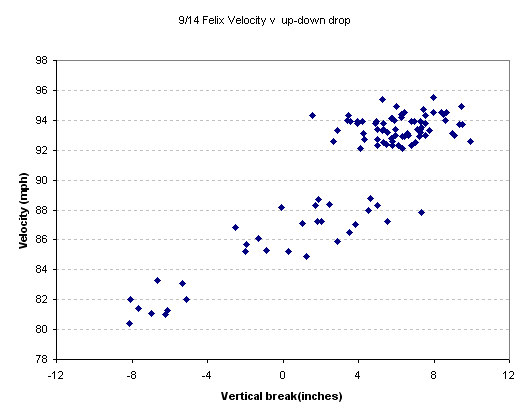
You can almost label the pitch groups there. We’re all familiar with that. Two more, then:
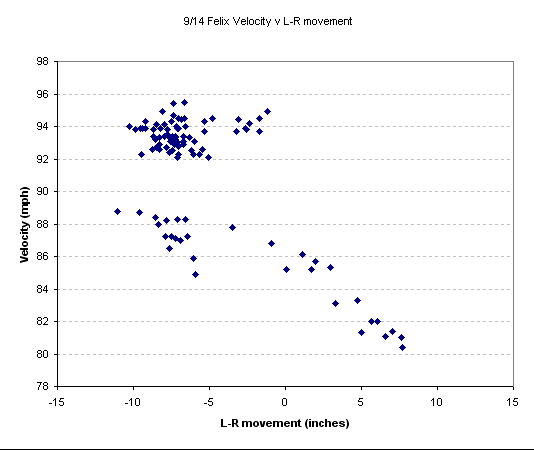
I don’t think I’d seen that chart done before: the grouping’s not nearly as neat, but the fast ball came in to righties.
Then both movements:
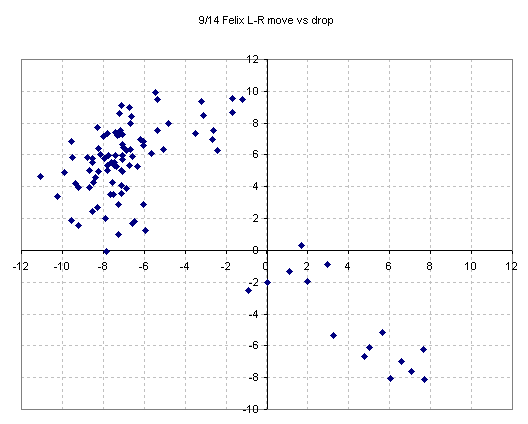
You can see the huge difference in how his stuff can move, and this is part of why Dave’s been so passionate about the need to mix the pitches up. There’s a huge grouping of pitches there with essentially similar overall movement and then the really sweet breaking stuff forms an outlier. If the movement on those pitches is the same, then varying velocity becomes a necessity for success. And moreover, if there’s one set of pitches come in and up and another pitch that drops wickedly and runs the other way, that’s a huge potential weapon that can also be better used.
Game Who Cares, Mariners at Royals
Greinke vs Feierabend, 11:10 am.
I challenge anyone to try to care about this game.