
Game 44, Mariners at Rangers
Hisashi Iwakuma vs. Colby Lewis, 5:05pm
The M’s and Rangers are separated by a half-game in the standings, and while things like games-behind don’t mean everything at this point, the M’s really do need to stick around Texas in the next month or two. Like the M’s, the Rangers rotation was plagued with injuries, as Derek Holland’s still out, Martin Perez joined the TJ club, and it’s not at all clear that Matt Harrison will pitch again, ever. Like the M’s, they committed a lot of money to a proven offensive weapon, and have watched said weapon disappoint. The Rangers were probably a better team, on paper, on opening day, but it was very close. The Rangers have had essentially everything go wrong, and they’re still essentially at or near .500. The M’s have had a lot go wrong, and they too are essentially a .500 team.
What you do with this set of selective similarities probably says a lot about your relationship with the M’s. The pessimists would say that the M’s can’t separate themselves from the Rangers even when half the team comes down with Bubonic plague, and they’re turning to Colby Lewis and Nick Martinez in their rotation. Optimists would say that the M’s version of Nick Martinez is names Roenis Elias, and Elias is likely better. That Robinson Cano’s a very good player, and that many fans saw Prince Fielder as a declining, limited player whose reputation (and salary) outstripped his actual production. Both views are justifiable, of course. The Rangers turned to Josh Wilson for a good chunk of April. Their opening day starter was a converted 7th inning reliever. But think back to what we all said on opening day – with Iwakuma and Walker out, the M’s just needed to stay close to .500 and make a run in the second half. With the news that James Paxton’s close to making a rehab start in the minors, hasn’t this condition been met?
It has, but there’s a problem; there’s ALWAYS a problem, it’d seem. The offense has struggled, and instead of getting key contributions from the likes of Stefen Romero, the M’s OF still ranks 25th offensively in baseball (though 19th overall! Silver linings!). Worse, the M’s found a *new* hole, as their shortstops rank dead last offensively. The fact that they’re hanging with the Rangers is encouraging as far as it goes, but the A’s have already left them in the dust, and the Angels look solid (except when facing the M’s, oddly). The M’s playoff chances (er, wild card chances) are still large enough to care about, but that’s in part due to the parity in the AL East and the ineptitude of the AL Central. All of this means that the M’s position vis a vis the Rangers, and to a lesser extent the Royals/Orioles/Rays/Jays could get important. This is the situation the Wild Card was supposed to create – that even a team in 3rd had some sort of hope. Well, the M’s have some. Now they’ve got to keep it alive.
Colby Lewis has quietly put up his best K rate since 2010, and has a brilliant K-BB%. But as a flyballer in Arlington, his actual runs allowed don’t look like it. A BABIP over .400 will do that, of course, but some of that may be the result of a shaky defense as Jurickson Profar, Adrian Beltre and others spent time on the DL. Lewis traditionally had problems with lefties, and he still does, though this year it’s righties that have hurt him. He’s a fastball/slider guy to righties, and he’s a fastball/sinker/change/slider/etc. guy to lefties.
As Jeff noted, Nick Franklin’s been recalled, and he’ll start today at DH. In the minors, he’s moved to the OF in the past week, playing a game in RF and one in LF. We’ll see if he gets some time in RF, or if he’ll bounce around the diamond.
1: Jones, CF
2: Saunders, RF
3: Cano, 2B
4: Smoak, 1B
5: Seager, 3B
6: Franklin, DH
7: Ackley, LF
8: Zunino, C
9: Miller, SS
SP: Iwakuma
EIGHT lefties. Pretty good line-up against Lewis.
Still can’t believe the M’s lost Corey Hart on a stolen base.
Jimmy Gilheeney starts for Tacoma as they open up a homestand against Reno. Lars Huijer gets the ball for Clinton in Peoria.
Felix Hernandez: Pitcher With A Catcher
I mentioned something briefly in the podcast I wanted to expand upon. One of the things we’ve learned about Mike Zunino is he’s an extremely capable receiver. The Mariners haven’t had many of those, aside from Jesus Sucre, who played eight times. I was beside myself with excitement over Sucre’s receiving skills, and I’ll never forget him even though I’ll probably never see him play again. So, the Mariners have been without receivers, and in the last few years, we’ve started to better understand what that’s meant. And now that’s all changed.
I was wrong about something I said — Felix wasn’t constantly getting screwed by the zone. In 2011 and 2012, Felix’s strike zone was basically normal. But in other years, it’s been disadvantageous, and in 2014, it’s been the opposite of that, as Felix has gotten more of the benefit of the doubt around the edges. We’ve seen Felix with bad receiving before, and we’ve seen him with roughly average receiving before. Now we’re seeing him with good receiving, and Felix is running a career-best strike rate.
I’m going to give you two tables and one .gif. The first table uses data grabbed from Matthew’s StatCorner. It covers the PITCHf/x era, from 2008-2014, and you’re going to see a few numbers — rate of balls within the strike zone, and rate of strikes outside of the strike zone. You’ll see Felix’s rates, the league-average rates, and the differences. Let’s just embed that table now:
| Year | zTkB% | League | Difference | oTkS% | League | Difference |
|---|---|---|---|---|---|---|
| 2008 | 26% | 20% | 6% | 7.0% | 8.1% | -1.1% |
| 2009 | 23% | 18% | 5% | 5.8% | 7.6% | -1.8% |
| 2010 | 19% | 16% | 3% | 5.8% | 7.5% | -1.7% |
| 2011 | 16% | 16% | 0% | 8.4% | 7.4% | 1.0% |
| 2012 | 15% | 15% | 0% | 7.7% | 7.0% | 0.7% |
| 2013 | 17% | 14% | 3% | 5.7% | 7.1% | -1.4% |
| 2014 | 10% | 14% | -4% | 11.2% | 7.4% | 3.8% |
zTkB%: rate of called pitches in the zone called balls
oTkS%: rate of called pitches out of the zone called strikes
For the first time, this year, Felix is getting fewer called balls in the zone than the average. Additionally, he’s getting more strikes outside of the zone, and the differences aren’t small, relatively speaking. Part of this, I’m willing to credit to improvements in Felix’s command. It’s easier to catch a pitcher who knows where the ball is going. But the catcher is also just a better catcher than Felix has mostly thrown to before, and Felix has benefited by having more places to throw the ball and get himself a strike.
Where has there been the biggest difference? To me, I think it’s around the bottom of the strike zone. Let’s create a box, from 1.5 to 2 feet above the ground, and from one foot to the left of the center of the plate to one foot to the right. It’s a rectangle around the bottom of the zone, with an area of one square foot, and in 2008, Felix got 24% strikes on called pitches in the box. This year that’s up to 80%. Those numbers speak for themselves. Except they don’t, accurately, because they ought to be put in a league context. The league overall has seen a rising strike rate on those pitches, but still, here’s another table:
| Year | Felix, Strike% | MLB RHP, Strike% | Difference | P/GS |
|---|---|---|---|---|
| 2008 | 24% | 44% | -20% | 5.9 |
| 2009 | 24% | 44% | -20% | 7.1 |
| 2010 | 26% | 49% | -23% | 7.8 |
| 2011 | 41% | 52% | -11% | 7.3 |
| 2012 | 43% | 59% | -16% | 5.2 |
| 2013 | 57% | 64% | -7% | 6.4 |
| 2014 | 80% | 70% | 10% | 7.0 |
In the first column (after the year), you see Felix’s rate of strikes on called pitches in the box. In the next column, there’s the league-average rate for big-league righties. Then there’s the difference, and then there’s the average number of called pitches Felix has thrown in that box per start. He’s always hovered around seven of those pitches, and where he used to come in 20 percentage points below average, now he’s above average by ten percentage points. Felix has always pitched low, and he’s always gotten whiffs and grounders low, but now he’s also finding some consistent called strikes, basically for the first time. Some of this is Felix; a lot of this is Zunino.
As a visual, I’ve created a little .gif using data from Texas Leaguers. Here are Felix’s called strike zones, from 2008-2014:
Corey Hart Disabled, Nick Franklin Able
What Happened
Over the offseason, the Mariners acquired a pair of bat-first players coming off knee surgeries. Both players are currently on the DL with leg injuries, and while that seems like an over-simplification, it also kind of doesn’t, in that it feels kind of obvious that we’ve wound up here. It wasn’t a guarantee that Corey Hart and Logan Morrison would develop the problems they’ve developed, but it’s not a surprise their lower bodies are currently preventing them from participating in the games the team plays.
Hart just hit the DL with a hamstring strain, and not one of the minor ones. He hurt himself stealing second, which seems like just teasing fate, and while now Hart isn’t disabled in the way that gives you a placard and better parking, he is disabled in the way that he’s still mostly able and collecting a massive paycheck. The estimate at the moment is that Hart will be missing from the Mariners for 4-6 weeks, and that’s a significant percentage of the rest of the season.
To replace Hart on the roster, the Mariners have recalled Nick Franklin. That’s a stupid word — it’s not like the Mariners forgot about Nick Franklin. All anyone’s literally wanted to talk about lately has been Nick Franklin. So the Mariners brought Nick Franklin up, which was going to happen soon anyway, and from the sounds of things Franklin will play all over the place, including the middle infield, the corner outfield, and DH. He’s not up to replace Brad Miller, but he’s also not up to watch Brad Miller from the dugout, so Franklin’s going to get his at-bats and he’s going to keep getting at-bats if he hits.
Is This Bad For The Team?
In almost all circumstances, it’s bad to lose a starter to injury. Hart has been the Mariners’ DH, demonstrating a preference for playing Corey Hart, and now the Mariners have to give those plate appearances to other guys. This is a decision the Mariners didn’t want to have to make. But it’s important to note that Hart hasn’t been hitting very well. I don’t think he’s as bad as his slash line, and just the other week he basically had two doubles turned into singles, but think of it this way: the rest of the season, Hart projects for an OPS in the mid-.700s. Franklin projects for an OPS in the low-.700s. And, in Tacoma, Franklin has been beating the living crap out of the ball.
Hart, in the majors, has under-performed. Franklin, a step below the majors, has as many walks as strikeouts and a slugging percentage that starts with a 6. Franklin’s hit even better than he hit last year in triple-A, and last year in triple-A, he forced his way up with his hitting. Granted, that was followed by a hot streak and a long big-league slump, so it’s not like Franklin has proven himself against the best, but this is his opportunity, and he’s not trying to replace David Ortiz.
Most simply, Franklin might be a slightly worse hitter than Hart. Or he might not — Franklin might have improved, and Hart might be declining. What Franklin provides that Hart doesn’t is flexibility, so a number of players can shuffle through DH in Hart’s absence. And this gives the Mariners an opportunity to challenge Nick Franklin’s bat without yet giving up on Brad Miller. By discipline, Miller is getting better. By hits, Miller is getting worse. The Mariners know what Miller and Franklin are defensively, but they don’t know what they are as bats at the highest level, and now they can see them both. That could help down the line if Miller continues to fight it. It’s easier to stomach a defensive downgrade if you know for sure you’re getting a considerably better bat. Franklin’s going to get a chance.
Of course, it is worth noting that Hart is a righty slugger and Franklin is a switch-hitter who bats righty like Hisashi Iwakuma break-dances. Since 2012, Franklin has 33 dingers batting lefty and one dinger batting righty. He’s a switch-hitter who really isn’t, so he makes the Mariners even more lopsided, and some of the time, that’s a problem. But, 63% of the Mariners’ plate appearances have come against righties, and I’d rather a player be useful a lot of the time than some of the time. Of all the concerns about the Mariners’ roster, the handedness isn’t high on my list.
So Corey Hart’s going to shut it down for a little while. Nick Franklin will take a lot of the playing time Hart’s giving away, and if Franklin performs, the playing time will keep on coming. There’s reason to believe Franklin’s as good a hitter, and this is a way to introduce his bat without yet having to make a call on Miller, who Lloyd McClendon thinks is progressing. In terms of expected performance, the Mariners aren’t meaningfully worse than they were a couple days ago. And now their lineup’s going to have another interesting young hitter, a hitter who’s done all the right things since returning to the minors. For sure, Nick Franklin’s got issues to iron out. Corey Hart has a .295 OBP. It’s not the worst thing to be forced into this.
Roenis Elias Fun Fact(s)
Funny thing about standards. If Felix Hernandez were pitching like Roenis Elias, we’d be like, oh man, what’s the matter with Felix? This isn’t like good Felix at all. We’d be extremely disappointed. But Felix isn’t pitching like Roenis Elias; Roenis Elias is pitching like Roenis Elias, and he’s the opposite of a disappointment, since just a couple months ago almost literally nobody knew who he was. We want the great talents to be great players, particularly when there’s a track record. But we also like when lesser talents prove themselves worthwhile, even if they aren’t stars. Not everyone can be a star, and every team needs quality role players around the core. Elias has been something of a very modest sensation.
In the beginning, we all had to learn the basics. What’s his fastball like? What’s his breaking ball like? How do you say his name? Are you sure he’s a real player? Elias was an unknown in camp and just out of it, and so we had to learn him from scratch. But now he’s kind of established himself, and he’s thrown 50 innings. We’re getting to know Elias in finer detail, and I wanted to make note of some of those details right here, in case you’ve missed them.
This is about arm angles and on-the-fly situational adjustments. In camp, we learned that the Mariners had worked with Elias on finding more consistent release points and angles. Used to be, he’d throw from anywhere, saying it’s what Cubans do. The Mariners tightened him up, and Elias sensed his stuff got a little better. But Elias does still use multiple slots. I’ll put the images after the jump. Recently the broadcast has started to notice what Elias has been doing, but it’s an easy thing to miss if you’ve just been watching casually.
Podcast: Felix is Mighty Again
Monday morning podcast(s) continues/begins.
The team has dipped below .500, but just barely and good(?) news is that there are four games versus the Astros on the docket for this week. Jeff and I discuss Mariner-stuff, much moreso than last week even though this week was worse.
Podcast with Jeff and Matthew: Direct link! || iTunes link! || RSS/XML link!
Thanks again to those that helped support the show and/or StatCorner work in general last week, and in the past, and hopefully in the future. It’s truly appreciated.
Felix Hernandez And True Talent
Today wasn’t one of Felix’s classic amazing starts, but that right there tells you where he’s managed to set expectations. He worked eight strong innings against the Twins, with plenty of strikes and enough missed bats, and as I write this Felix has one of the league’s better ERAs. He has one of the league’s better FIPs, and he has one of the league’s better xFIPs. He’s been one of the league’s better pitchers, and we know that, and we also know that, before today, Felix was in a bit of a slump. Four or five turns in a row he was somewhat mediocre, and so it’s good to see him come out of that. This was Felix pitching like Felix, and afterward, he said he felt great about his performance. We hadn’t heard that for a while.
We also suspect we know why he slumped, or at least why he slumped as long as he did. Granted, fans are always looking for excuses for under-performance, but some time ago Felix got really sick and lost considerable weight. The flu was going around the clubhouse, and it’s not like Felix struggled after a bad night of sleep. I don’t think it’s a reach to assume being sick, and having been sick, affected Felix’s pitching. When you’re sick, you’re weaker, and you get fatigued easily. When you’re recovering, the same stuff applies, to a slightly lesser degree. There’s healthy pitching and sick pitching, and it stands to reason the latter is a lot worse than the former.
This is actually less about Felix, specifically, and more of a general thought. Felix is just who brought it to mind. What Felix did while sick counts on his record. You can’t really just throw starts out, so those innings are just a part of Felix’s career. Now, in analysis, we’re frequently talking about a player’s true-talent level. That is, what his numbers would look like if he had an infinite sample. This is what projections try to approximate. We know that numbers are volatile — what we assume is that they fluctuate around the true talent. Our understanding of true talent is informed by the statistical record.
But the statistical record sort of assumes that everything evens out. We assume that, over time, the signal drowns out the noise. But how do we want to define true talent? Is true talent just overall average performance, or are we talking about true talent when a player is at or around 100%? Do we really want to care about what Felix did when he had the flu? Do we really want to care about what players do when they play through pain? Most recently, Jose Fernandez pitched through a damaged UCL and had a lousy evening. Now he’s officially out for a year. His numbers will always include those five innings and six runs, but why should we care about those when analyzing Fernandez later? Presumably, his true talent ought not involve a torn ligament.
Players will tell you that, especially later in the season, no one’s 100%. Absolutely, that’s correct — the season is brutally long, and taxing, and a player’s condition in September isn’t his condition in April. But there’s ordinary wear and tear, and there’s the more unusual stuff, and if players play through unusual stuff, it can affect their numbers, and it can subsequently affect the perception of their true talent. In some cases this is a minor thing, and in Felix’s case we’re just really talking about two starts involving illness, but I think it’s interesting to consider what true talent means.
Every projection is based on history. You can never be better than 100%, but you can be worse, and many projections will consider history when below 100%. And then they’ll just average that stuff out, such that, if you believe a player is 100%, he should probably be better than his projection. His projection unknowingly accounts for some performance-affecting issues, and if you want to know how good a player is, really, in theory you should strip that stuff out. That is, if true talent refers to when a player is fresh.
On the other hand, if you boost every single projection to put each player around 100%, then pitchers would be better and hitters would be better, and stuff would cancel out, and we’d be back to square one. A pitcher isn’t always 100%, but the hitters he faces aren’t all 100%, and you can’t just half-adjust. This all gets really complicated, and it’s a small-enough deal that it’s not like the projections are systematically wrong. This is me writing words about something insignificant.
Going back to the start: Felix’s numbers reflect, accurately, what’s happened with him on the mound in 2014. They reflect his performance, but they’re not a totally accurate reflection of how healthy Felix has pitched, because there are a few starts in there of Felix pitching while sick or post-sick, and in one of them he didn’t strike a batter out. Non-sick Felix this year has been outrageous, and while even the fresh version isn’t immune to the occasional stinker, it seems that we’re really most interested in how good a player is when he’s on his game. At the end of the year, Felix’s starts will all be grouped together, but depending on what we’re asking, perhaps that’s not quite appropriate.
Or maybe it is. I haven’t thought this all the way through, and I don’t know if that’s even possible, or if this is all just circular and infinite. I might be the only person who even gives a shit, and that would be totally fine. But Felix pitched sick. For the most part, when he hasn’t pitched sick, he’s been downright amazing. That’s more like what Felix really is. That’s what I’m most interested in talking about thinking about. We can’t strike games from the record, but we can ask if we should, under certain circumstances.
So You’re Waiting For Robinson Cano To Hit Dingers
Do you roll your eyes now when Robinson Cano comes to the plate? Do you feel like his at-bats are just demonstrations of slightly different ways to arrive at a weak grounder to second? You shouldn’t — after today, Cano owns the third-highest batting average in the American League, at .318. Not that we pretty much ever talk about batting average, since there are better statistics, but sometimes a simple statistic is more than good enough to tell a story. Cano’s been getting a lot of hits. He’s batting what he batted with the Yankees.
But there are different parts of hitting. There’s hitting for contact and average, which Cano is doing. His discipline is basically okay, in that he’s never been a huge walker. What’s been missing is the power component. Cano’s line, at present, is an almost exact mirror of Ichiro’s big-league career, and I’m not the first person to notice this. Cano’s been a hitting machine, but for the most part he’s been a hitting-singles machine, and eyebrows have been raised across the country. It’s kind of humiliating to be stuck on one homer.
Of course, what people will say is that Cano isn’t a classic power hitter. Of course, those people are correct. Of course, that kind of misses the point. Robinson Cano isn’t known as a power hitter. Hisashi Iwakuma isn’t known as a strikeout pitcher. But it would be a problem if Iwakuma were averaging 10% strikeouts. At issue is that Cano is below his own established baseline, that being the baseline of a non-slugger. You expect an ISO around .200. He’s posting an ISO under .100. That’s a legitimate thing to discuss, after a quarter of a season.
What I will attempt to do, now, is be reassuring. And this is how this starts: following are three balls in play that Cano has very recently hit. If you’ve been watching, you’ll recognize them.
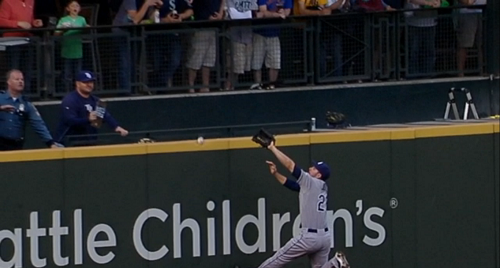
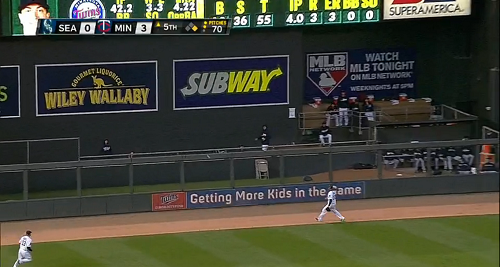
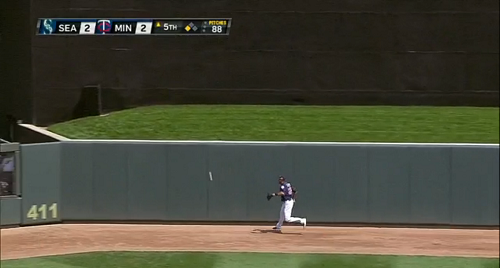
In each case, Cano came extremely close to hitting a dinger. In each case, Cano settled for a double, but there are doubles that are almost singles and there are doubles that are almost homers. This isn’t great analysis, but let’s just pretend those were homers. Then Cano would have four homers and a .441 slugging percentage, with a .123 ISO. He’d have those numbers doing basically nothing differently. The ISO would still be low, but it wouldn’t be as much of a talking point. People notice when a guy has one home run. That “1” is pretty conspicuous, and a “3” or a “4” would be a lot more acceptable.
You can’t just give Cano homers, but the point is more that pop is still in there, easy pop, the kind of pop where Cano can hit the ball 350 feet with what looks like a simple flick of the wrists. There’s no reason to believe the power’s gone, right? How would one even explain that?
You could say there’s something wrong with his swing. There might’ve been something wrong with his swing, early on. You’ve probably noticed that Cano’s groundball rate is up. But it’s up, and going down. I would say that this is an encouraging split.
| Split | Groundball% | Fly ball% | Line drive% |
|---|---|---|---|
| 2009-13 | 46% | 31% | 23% |
| April | 59% | 22% | 19% |
| May | 44% | 31% | 25% |
The first month of the year, Cano was putting way too many balls on the ground. That was not what he was supposed to look like. In May, though, he’s been himself, over 68 balls in play to date. The homers haven’t been there yet, but he’s driven the ball in the air. Today, while Cano hit his first pop-up of the season, he also hit another fly ball and a trio of line drives. While the April sample is still bigger than the May sample, and while the numbers overall are troubling, it would appear that Cano is finding himself. He’s doing the things that’ve made him so good, and he’s come awful close to busting the homer slump. It’s not that Robinson Cano is coming — it’s that it looks like he’s arrived, more or less.
It just takes time to recover from a bad start. It takes time to recover statistically, and it takes time to recover in terms of fan perception. We were introduced to Cano as a groundball machine, so it’s going to take time for that to be undone, so we can see Cano as he is and has been. He’s a guy who consistently sprays line drives, and he’s a guy who hits more home runs than he’s hit. Remember: the Mariners have this guy for ten years. Eventually, we’re going to see him in decline, and maybe when he’s declining, he’ll put everything on the dirt. We’ll have time to be frustrated by Robinson Cano. But right now, Cano’s coming out of his slump, and while his April sample is bigger than his May sample, his track record is bigger than his April sample, and his track record is obscene. The hits are already coming. The extra-base hits are presumably going to. I expect we’re going to love this guy before we don’t.
Game 43, Mariners at Twins
King Felix vs. Ricky Nolasco, 11:10am
Well, at least Nolasco’s not a ground ball pitcher. After getting shut down by Samuel Deduno and Kyle Gibson, the M’s get one of the Twins HR-plagued fly-ballers. The Twins’ 2013 starters posted the worst FIP, the worst ERA, the worst K rate, and the worst strand rate in all of baseball last year, so the fact that the Twins committed a combined $73 million on two FA hurlers seemed reasonable. Nolasco was the big prize, signing a 4-year, $49m deal after a solid season split between the Marlins and Dodgers.
The righty has always posted solid FIP numbers, with a career 3.80 mark over 1363 career innings. But, like a poor man’s Javier Vasquez, his actual runs allowed have generally come in much higher. His ERA’s been higher than his FIP each year since 2008, and in several, the gap’s exceeded one full run in two of those years. It’s not like you can point to one specific weakness; it’s not all BABIP, it’s not all sequencing. He’s just disappointed. No one capable of posting 4.4 K:BB ratios over a full year (or two!) of work in a big league rotation should post ERAs of 5. If you’ve read this site at all, you know that ERA can be misleading and that Nolasco probably isn’t a replacement-level starter, which is what his RA would tell you right now. You can’t justify the argument that Nolasco is 100% responsible for what happens once a ball is put in play. But 1,300+ innings suggest that he’s probably not 0% responsible either.
Nolasco throws a 91-93mph four-seam and two-seam fastball. His primary breaking ball’s his slider, which was very effective for many years, but has been his Achilles’ heel this year. He’s got a curve ball, but his other weapon is the oh-so-trendy splitter. It’s more like Dan Haren’s in that it looks/acts like a change-up, so it’s not terribly surprising that he only throws it to lefties. Lefties have given Nolasco trouble throughout his career, and they’re destroying him so far in 2014, but it’s not the splitter that they’re hitting. That may just be noise, or the fact that he can’t get to the splitter because they’re crushing fastballs first, but even a struggling M’s line-up isn’t a great match-up for Nolasco (at least on paper).
1: Jones, CF
2: Saunders, RF
3: Cano, 2B
4: Hart, DH
5: Smoak, 1B
6: Seager, 3B
7: Ackley, LF
8: Zunino, C
9: Miller, SS
SP: King Felix
Happy 34th anniversary of the Mt. St Helens eruption. It’s one of my earliest memories as a kid – going up to the attic and looking south at the towering ash cloud.
With Brad Miller struggling, it’s not surprise that the M’s are considering re-calling the hot hitting Nick Franklin. But Franklin’s been playing some OF recently, and Lloyd McClendon’s mentioned that positional flexibility’s a key to getting Franklin more playing time. After spending the spring asserting that the SS battle was an open competition, Franklin seems to be well and truly out of the running (though he could obviously be a factor for the M’s as a utility OF/IF). That’s probably got as much to do with Chris Taylor as anything, and I honestly wonder if they’d call up Taylor if he was healthy.
Erasmo Ramirez starts for Tacoma against Sacramento. The big story involving the RiverCats this morning is the rumor that they’ll switch affiliation to the other Bay Area club, the Giants, as early as next season. Don’t know if the A’s would take Fresno or if there’d be further swapping. Tyler Pike starts for High Desert. He’s walked four batters in each of his past five starts.
Taijuan Walker and James Paxton both had bullpen sessions yesterday and seem fine today. Sounds like they may do a simulated game on Tuesday.
Game 42, Mariners at Twins
Roenis Elias vs. Samuel Deduno, 4:10pm
Sooooo, the M’s struggled against another sinkerballer last night, as Kyle Gibson limited the M’s to a run over 7 innings. It’s always tough to apportion blame and credit on the pitching and defense side of the ball, and it’s doubly so when we’re trying to figure out if the M’s have a serious problem with ground ball pitchers or if they had a serious problem with Kyle Gibson. Today’s game offers a test. Same park, same offense, lots of sinking fastballs, but a different guy throwing them. Samuel Deduno is essentially the Twins swingman, having made 7 relief appearances and just 2 starts. Obviously, the M’s found the Rays swingman to their liking, but Deduno’s very different, and very strange.
Deduno gets a ton of grounders despite not actually throwing a sinker. He doesn’t need to: the vertical movement on his regular old fastball is unlike anyone else’s. Sort pitchers from the pitch fx era by vertical movement on a four seam fastball and Deduno’s comes in the lowest, and it’s not even close.* Justin Masterson’s swerving, low-3/4 four seam is in 2nd place, but at nearly 2″ more movement. It’s not exactly a blazing fast heater, and unlike Masterson’s, it has almost no horizontal movement. It’s not deceptive, it’s just so far outside of how a normal pitch behaves that hitters tend to swing over it. It’s the equal and opposite issue that hitters have with Chris Young’s extreme *rising* FB – the fact that they know it’s coming and that it’s coming in at a pleasing velocity doesn’t always enable them to actually hit it.
He’s primarily a FB and curveball pitcher, but he’s also got a change-up that he throws to lefties. Earlier in his career, he struggled against *righties* which is pretty odd, but this year, his splits are much more normal. His curve’s suddenly more effective against righties, but if you look at his career splits, he looks like a left-hander – his K:BB ratio is awful against righties, but he’s managed to strike out an un-Twins-like number of lefties. No HR issues to lefties, but an elevated HR rate to righties. Again, that’s disappeared this year, but I’m not sure if he made a conscious change to his approach or if this is luck/maturity/regression cocktail.
Just like Gibson, Deduno had some HR problems in his first call-up in 2011, and like Gibson, they’ve largely disappeared. He’s a Twins pitcher, so he’s not an overpowering guy, and teams that match up well with him – like Detroit, who, to be fair, match up well with most teams – have hit him hard. But the M’s have been completely befuddled by Deduno; he’s been excellent against them in 2012 and 2013. His last start against them came last July, and he shut them out on just 3 hits over 7 innings. On paper, this is…this is something of a challenge.
1: Jones, CF
2: Saunders, RF
3: Cano, 2B
4: Hart, DH
5: Seager, 3B
6: Smoak, 1B
7: Ackley, LF
8: Zunino, C
9: Miller, SS
SP: Elias
Good day in the M’s minor leagues, as Victor Sanchez takes the hill for AA Jackson. Jordan Pries starts for Tacoma, while Jochi Ogando starts for High Desert.
* Who ranks at the top of the list? The guy with the most vertical movement on a fastball? Chris Young, who sadly wasn’t fooling many Twins hitters last night.
Game 41, Mariners at Twins
Chris Young vs. Kyle Gibson, 5:10pm
Coming in to 2011, Kyle Gibson was the Twins #1 prospect. A sure top-10 overall pick, the RHP out of Missouri slid after his velocity dropped his junior year. He was effective without 95mph heat, thanks to great command and a swerving two-seam fastball that produced tons of weak ground balls. Still, many teams were scared off by the apparent trouble. He sailed through the low minors, posting good-but-not-great K rates, and tiny HR rates. He was flying up the ladder in 2011 when his velocity suddenly dropped again, and he was absolutely pounded in a few AAA starts. This time, he needed surgery.
He came back for a handful of MiLB innings and then played the Arizona Fall League (I think he started one game opposite James Paxton that year), and it seemed like he hadn’t missed a beat. He touched 95, but sat more like 92-94, showed a decent slider, and pounded the zone. A solid year in AAA in 2013 got him a promotion, but over the course of 10 starts, he looked like a different pitcher. He got ground balls, but he was wild – his zone% in 2013 was just under 42%, compared to a league average of 49%. Out of 187 starting pitchers with at least 50 IP, Gibson ranked 184th in zone%. To make matters worse, he gave up 7 HRs to go with his 20 BBs (and 5 HBPs); it all added up to an ERA of 6.53 and an ugly FIP. It’s a somewhat reassuring reminder that other clubs sometimes struggle with the AAA-MLB transition. Everyone agreed he had nothing left to learn in the minors, but it’s pretty clear he was starting from scratch in the bigs.
It could only get better from there, and to be fair to Gibson, it has. He’s limiting HRs again, and he’s throwing more strikes, but the walk rate’s still far too high, and he’s incorporated the Twins’ organizational philosophy of shunning the strikeout. So far this year, he’s walked 18 and K’d just 17. Gibson’s two-seam fastball is a 91-93mph pitch with good arm-side run and some sink (though not a ton). He pairs it was a four-seamer, a good looking slider and a change-up that he’ll use against lefties. The change occasionally looks like a solid pitch, but he doesn’t throw a ton of them. Given his sinker-heavy arsenal, he’s got some platoon splits, with lefties posting a .366 wOBA against him (in 239 PAs). The M’s can throw out a lefty-heavy line-up, and Gibson doesn’t have a real wipe-out pitch, so this should be easy, right? Well, the M’s have really struggled thus far against ground-ball pitchers. They’re doing OK against fly-ballers (although they sure didn’t LOOK fine against Jake Odorizzi), but they’ve managed just a .510 OPS against sinkerballing ground-ball pitchers. Fly-ball *hitters* would be a great match-up against Gibson, but the M’s don’t really have any of those. Logan Morrison’s been more of a fly-ball guy, but he’s hurt. Stefen Romero’s elevated the ball, but he’s struggling and a righty, so he’s not in the line-up. Corey Hart’s the best the M’s can muster. Normally, this’d be a great match-up for Robby Cano, but he’s always been a GB guy, and his GB:FB ratio has soared this year to the highest mark of his career (SSS alert, of course) – one of the big reasons why he’s struggling.
1: Jones, CF
2: Saunders, RF
3: Cano, 2B
4: Hart, DH
5: Smoak, 1B
6: Seager, 3B
7: Ackley, LF
8: Zunino, C
9: Miller, SS
SP: Chris Young
The injury bug continues to bite the M’s system, as Chris Taylor’s sidelined with a sprained finger, and LHP Anthony Fernandez looks set to join the long line of hurlers to have Tommy John surgery (hat tip: Ryan Divish).
Minor league starters tonight include Edwin Diaz, Andrew Carraway, and Dylan Unsworth.