
Game 22, Rangers at Mariners
Roenis Elias vs. Robbie Ross, 7:10pm
The M’s faced Ross on April 14th, and the undersized lefty was brilliant, shutting the M’s out in 7 2/3 despite only two strikeouts (to the first two batters of the game). Ross’s approach, especially as a starter, is to let batters put the ball in play. To righties, Ross tries to keep his fastball in, which makes sense, but the striking thing is that he gets grounders no matter where his fastball ends up. In, away, even elevated fastballs still get pounded into the ground. Ross’ vertical movement looks like it should be hard to elevate, though it’s not dramatic. Especially given the platoon splits he’s shown (lefties don’t tend to hit that many grounders off of him), it’s clear that he’s got some deception: the ball isn’t moving like right-handers expect it to.
I’ve talked at length about Elias’ fly ball tendencies coming up through the minors. You look at his fastball, and you look at the way it moves, and you peg him for a 40% GB guy, which, unsurprisingly, is where he was in the minors. So what’s he doing with a ground ball rate over 50%? The key’s been his breaking ball. In the link above, I mentioned that I didn’t think his slow curve would generate a ton of whiffs. So far, it hasn’t. But what it HAS generated is a ton of weak contact, and much of that’s been topped. When batters make contact with Elias’ fastball, they tend to hit it in the air (FB/LD/pop up). But they hit his curve ball the way righties hit Robbie Ross’ fastball. This is an interesting pattern; it’s not intuitively surprising, but it’s odd it didn’t balance his minor league GB rates. Was this a case where minor leaguers swung through the slurve, and only put the fastball in play? Or did they adjust to the curve after a while and start to elevate it?
1: Almonte, CF
2: Bloomquist, SS
3: Cano, 2B
4: Hart, DH
5: Romero, RF
6: Smoak, 1B
7: Seager, 3B
8: Gillespie, LF
9: Zunino
SP: Elias
The M’s stack their line-up with seven righties. Is Ackley being platooned officially? Bloomquist at SS? Don’t they know Robbie Ross’ career splits? Honestly, Hart has to be in there, as he hit the ball very hard off of Ross the last time, even if he wasn’t always rewarded for it. Beyond platoon splits, the M’s have been awful against ground-ballers. As the A’s know well, fly-ballers tend to hit ground-ball pitchers better than average, so it’s no surprise that Hart (a guy with an uppercut swing) has better career numbers against ground-ball guys than anyone else. Zunino should hit them better too, if he can make contact.
Jason Churchill’s got an interesting piece up on the struggles of Brad Miller and Kyle Seager. Using brooks baseball data, he shows how both lefties have been pounded away by opposing pitchers. He notes, though, that the approach was mostly the same last year as well. To Churchill, the problem is that Miller’s expanded his zone, and is swinging at more pitches off the plate, and making less contact. That’s plausible – he clearly IS making less contact, and that’s showing up in his K rate, which is now about DOUBLE is 2013 K%. It’s odd, especially since Miller was always a good contact hitter, never touching 20% in the minors.
My own theory, which may be complementary to Churchill’s, is that Miller and a few other hitters are guessing, or over-thinking their at-bats. At first, I thought Miller was ending up behind in the count a lot more, which can lead to more out-of-zone chases, but that doesn’t seem to be the case. His batted-ball profile shows more elevated contact and fewer grounders, which should help him if he ever gets his contact rate back where it was last year. Even last year – when he feasted on fastballs and change-ups – he had some issues with bendy pitches. This year, he’s seeing a few more sliders/curves, but not enough to matter. The problem’s his approach to fastballs. Last year, he didn’t miss many fastballs, in any count. This year, he’s making a bit less contact on them overall, but *dramatically* less contact with 2 strikes. Obviously, all of this comes with SSS caveats. It’s been a month, and we’re looking at splits against a particular pitch *with two strikes*. Noted. But it’s just odd, and it ties in to the problem he’s had getting any production from the times he HAS made contact. According to Statcorner, he’s pulling more fly balls than he did last year. But he’s slugging .435 when he pulls the ball overall, and has far below average production on fly balls in general. The strikeout rate is the most obvious sign of a problem, but Miller’s been poor even putting strikeouts aside. Unlike Ackley, there’s not a clear weak spot for him, and unlike Ackley, his batted ball profile didn’t go into the toilet after an encouraging half-season. Overall, he’s too good to hit this poorly, but given the struggles up and down the line-up, I wonder what the approach is. As a team, the M’s are struggling with two strikes (compared to the league average), but they’re hopeless when they’re *ahead* in the count. The whole club, but Miller in particular, seem to get fastballs when they’re expecting breaking balls and vice versa.
The arresting thing to me in Churchill’s article was the claim that pitchers have put only 41% of the pitches they’ve thrown to Miller in the strike zone. But Fangraphs’ plate discipline numbers show over 50% of pitches have been in the zone, and that he’s seen slightly *more* strikes than he did in 2013. Statcorner’s numbers corroborate that. This isn’t about picking on a number, or on Churchill or anyone. It’s just that early in the season, it doesn’t take very many pitches called strikes or balls to generate really different averages. I talked about this the other day, as BIS numbers show James Paxton avoiding the zone at all costs, while the pitch fx data from MLBAM shows that he’s thrown MORE strikes than average. It’s confusing, and it’s going to happen a lot until the sheer number of pitches (hopefully) pushed the data sources closer together. And yes, I see the irony given I was just talking about zone% to Miller as well. But the best we can do is probably just be clear about what data we’re using, and, if we’re aware, if other data sources don’t agree.
Lots of roster moves recently. As you’ve already seen, Erasmo Ramirez and Nick Franklin were sent down, while the M’s have called up Cole Gillespie (making his M’s debut tonight) and LHP Lucas Luetge.
Game 21, Astros at Mariners
Chris Young vs. Jarred Cosart, 12:40pm
Shhhh….shhh..it’s almost over now. The Astros and Marlins will be gone for a good long while. They were bullied themselves, you see, and can’t help but continue the cycle of violence, borne from their anger and helplessness. They lash out not because they want to, but because they never learned anything different.
Collin McHugh had and 8:5 K:BB ratio in 14 AAA innings coming into last night’s game, FYI. Either the PCL is no joke this year or the M’s…never mind.
OK, the M’s have avoided the Astros’ best pitcher to date, Scott Feldman, but today they’ll tangle with the Astros most *talented* hurler, Jarred Cosart. The strong-armed righty came to Houston in the Hunter Pence deal in 2011. He sits in the mid-90s with his fastball, but like Nathan Eovaldi, he’s had some control issues coming through the minors and never quite put up the strikeout numbers you’d imagine for someone with that kind of velocity.
What he has shown in the majors thus far is an ability to get plenty of ground balls and avoid really loud contact. His HR/FB was pretty lucky in 2013, and it could certainly regress – but he’s a righty who gets a staggering number of GBs against *left* handed hitters. He’s been better against lefties overall thus far because of it. He’s pitched all of a handful of big league games, so you wouldn’t forecast that to continue, but it’s something to keep an eye on – he had a slightly better MiLB FIP against lefties too, though this was due to a couple of HRs more than sustainable differences in K:BB/batted balls.
In fact, he reminds me a lot of James Paxton. Just looking at the vertical movement on their fastballs, you wouldn’t peg it as a grounder-generating machine, but it is. Like Paxton, he backs it up with a big curve ball that *also* gets ground balls. Paxon’s fastball has a bit more arm-side run despite his over-the-top delivery (and may be something that Paxton tweaked a bit during 2013), but Cosart’s more of a classic cutter. Depending on the pitch fx source you use, it may be that the cutter is essentially the ONLY fastball he throws (as Brooks Baseball suggests); others (MLBAM) think he uses it most often, but mixes in quite a few four-seamers as well. Looking at this chart, I don’t see a clear break between FC and FA, so I’d tend to believe the Brooks coding, but it’s not critical for game thread analysis: Cosart throws a lot (or nearly exclusively) 95mph cutters that allow him to get ground balls and frustrate lefties. He’s not close to a finished product; in his last start, he gave up 7 runs on 4 walks and 2 HRs in just one third of an inning. His control/command issues prevent him from taking the next step and becoming an elite starter, but Cosart is talented and has done an admirable job of learning in the big leagues. He was clearly due for some regression coming into 2014, but I’d like to have a guy throwing a 95mph cutter all day on my team.
Chris Young starts today. I’d say that things have to get better as he’s pitching in a fly-ball friendly park, but then, so is Marlins Park. I don’t know. Do something interesting, Mariners.
1: Almonte, CF
2: Miller, SS
3: Cano, 2B
4: Hart, DH
5: Smoak, 1B
6: Seager, 3B
7: Franklin, RF
8: Ackley, LF
9: Zunino, C
SP: Young
I feel like this season has already fallen into familiar patterns – snark about the M’s, add in some Felix-worship, talk about prospects – so what’s one more: the Rainiers are pretty fun to watch, and you should do so if at some point it stops raining. The R’s are crushing the ball despite playing most of their games in damp and chilly Cheney Stadium thus far. After a slow opening series, SS Chris Taylor is leading the charge with a .636 slugging percentage. AAAA vet Cole Gillespie didn’t seem to have a future here, as he’s not on the 40 man, but he’s at .362/.456/.741 so far, and he could get a look if Saunders/Almonte continue to struggle. Given that Nick Franklin’s already up, it looks like they’ll give the erstwhile IF further looks in LF/RF, but he’s slumping like everyone else. Anyway, go see the Rainiers some time if only to remember what it looks like when a team scores lots of runs.
Game 20, Astros at Mariners
Erasmo Ramirez vs. Collin McHugh, 7:10pm

1: Almonte, CF
2: Ackley, LF
3: Cano, 2B
4: Hart, DH
5: Seager, 3B
6: Smoak, 1B
7: Saunders, RF
8: Zunino, C
9: Miller, SS
SP: Ramirez
With rain in the forecast, the M’s decided to give Hisashi Iwakuma a simulated game in Seattle as opposed to sending him to Cheney Stadium to pitch with Tacoma. Ryan Divish reported that he was throwing 89-90, and stopped at 58 pitches. Shannon Drayer tweeted that he’ll go up to 75 pitches on Sunday, and then perhaps 90 after that.
Game 19, Astros at Mariners
King Felix vs. Dallas Keuchel, 7:10pm
Happy Felix Day – may it end happier than last Felix Day.
About a decade ago now, Michael Lewis’ “Moneyball” came out and changed the way many fans looked at the game, and, importantly, got businesses and organizations around the country to think about market inefficiencies and how they balanced things like tradition and organizational memory with data-driven analysis. For a while there, Paul DePodesta, Billy Beane and Lewis were popular on the lecture circuit, talking about opportunities and threats and how corporations like baseball teams or car companies or government departments evaluate claims and make decisions.
Whatever you think of the book, whether you think it gave short shrift to Tim Hudson and Miggy Tejada, or whether you thought it was a landmark in the appreciation of and realization of the power of data, it was a pretty big deal. The fact that firms paid to discuss these concepts showed just how transferable certain skills and approaches could be. With the right message, an executive in a ball club could conceivably help an executive in manufacturing or marketing. Admittedly, I’m somewhat biased; I’m sympathetic to the specific message that Beane/DePo like to talk about, but they’re just one example, and I feel like baseball’s richness has interesting concepts hidden within it.
This is actually not a complaining-about-the-M’s-FO post, this is about Felix. Look, the whole “use data” thing is really important, and if it bent the curve in industry even slightly towards rationality, cool. But I’ve been just stunned watching Felix this year, and I keep thinking there is an incredible story that Felix himself probably isn’t equipped to tell. The A’s had to contend with competitors with far more resources. Felix has to contend with aging, regression to the mean, and the fact that everyone on every team gets to prepare for *him*. He’s a known entity, and it’s not like he’s become a knuckleballer or shifted to a sidearm delivery. Felix has a target on him every time he pitches, and he’s lost several ticks on his fastball since debuting in 2005.
And to this point in 2014, he’s gotten better. Every small sample size caveat applies; we’re still in March. But at least in the early innings, Felix has thrown four games of Pedro-in-2000 ball at his divisional rivals. As you know, many advanced pitching stats like FIP and xFIP have smaller spreads than ERA/RA. That’s because by ignoring aspects of performance that are more influenced by luck – strand rate, BABIP – they tend to pull pitchers back to the middle. Any truly amazing performance, like any completely abysmal one, is a combination of true talent and luck; winning 116 games means you had an amazing team AND you got a bit lucky. So, Felix right now has an xFIP – a measure doubly-insulated against “lucky” stats – is 1.84.
To say that that number will rise is trite and missing the point entirely. Of course it will. But a 28 year old Felix, after over 1,800 major league innings, started off this season with the same 92-93 MPH velocity and ripped off 39Ks to 3 walks. By xFIP, he’s been UNlucky. The point is that Felix has adapted and is now lethal to batters, and *I can’t figure out how.* The movement on the pitches is the same, the velocity’s essentially the same. He seems to throw the same number of strikes*. He doesn’t have a new pitch. He’s throwing the same pitches to hitters who’ve seen him dozens and dozens of times – Coco Crisp has faced him 66 times! Howie Kendrick has 73 PAs! – and they’re reacting like they’ve never seen a pitch before, let alone a Felix change-up. How’s this possible? To be fair, it’s not just Felix. Clayton Kershaw debuted as a young fireballer with an unreal curveball and command issues, and over time turned himself into clearly, unquestionably the best hurler in the NL. He did it despite losing some velocity and despite throwing his curveball far less (sound familiar?). Command is a crucial part of the equation to be sure, but so is limiting contact. Do they make trade-offs consciously? Do coaching staffs help them plan their attack, and do they tailor it to specific line-ups? Or do they get to a point where they stop thinking about the other team entirely? If so, what do they think about instead? There are cliches to fill the space here, like take it one pitch at a time, or trust your stuff, or focus on the gameplan, but to be pithy about it, that won’t sell on the lecture circuit. What IS Felix’s gameplan? The fact that his change-up and sinker are now 2 MPH apart in velo and with similar arm-side run…that runs counter to decades of accumulated pitching wisdom. It’s also clearly “the gameplan.” Does Felix think about this? Does he sequence them differently now than he did three years ago when the velo gap was nearly as small? Does he target different parts of the zone? Felix is extraordinary and Felix is way more extraordinary than we thought.
This weekend for reasons I can’t even remember, I was reading about the evolutionary dance between rough-skinned newts and garter snakes, two animals that are pretty common around here. The newt secretes a very, very powerful toxin (TTX, the same stuff in blowfish livers that scare sushi-lovers off of fugu) from its skin. Garter snakes developed a way to process that poison that allows them to eat slow, docile newts (you don’t have to run fast from predators when you are literally built of tetradotoxin). Many newt populations have responded by growing ever more toxic. The snake apparently required fewer genetic steps to develop immunity (since the process only happens in its stomach, as opposed to its skin), and so has pulled ahead even in areas in which the newts are many times more toxic than poison dart frogs. I keep thinking of that story when I look over Felix’s early 2014 stats – all of the work hitters can do to make themselves more toxic. Stacking line-ups with lefties, or watching tons of video. The A’s add a bunch of fly-ball hitters who hit *better* than average against sinker-baller/ground ball pitchers. But the snake makes a tweak and swallows the newt, and slithers off unaffected.
Oh, uh, Dallas Keuchel is a ground-balling lefty who is nothing like Felix at all. Fastball/slider/change-to-righties.
1: Almonte, CF
2: Ackley, CF
3: Cano, 2B
4: Hart, DH
5: Smoak, 1B
6: Romero, RF
7: Seager, 3B
8: Zunino, C
9: Miller, SS
SP: FEEEELLLLIIIXXXX
* Here BIS and pitch fx differ. To pitch fx, Felix has thrown FEWER pitches inside the zone, and gotten batters to chase many more of them. To BIS, he’s thrown MORE pitches in the zone. This is essentially the opposite of the discrepancy with Paxton, where BIS thought he had an extremely low zone%, but got swings anyway, while pitch fx saw him as pounding the zone while hitters were powerless to punish him for it. Early in the season, these discrepancies are larger and perhaps more numerous; it’ll be interesting to see if they converge over time.
Losing Streaks
On the afternoon of April 15, the Mariners were 7-5, having the day before beaten the Rangers by six runs. Out of the gate, Dustin Ackley was hitting well at the bottom of the order. Lloyd McClendon spoke to the media.
McClendon also said that he doesn’t see himself moving Ackley or Zunino up in the lineup this year. Thinks it is good for them to get a yr
— Shannon Drayer (@shannondrayer) April 15, 2014
Lower in the lineup. When asked if it could get hard to resist the temptation McClendon said “For me? No. I have the pencil.” — Shannon Drayer (@shannondrayer) April 15, 2014
On the afternoon of April 21, the Mariners are 7-11, having over the weekend been swept by the Marlins. Brad Miller hasn’t found his stride at the plate. Lloyd McClendon drafted a lineup.
Ackley up to # 2 in the order today…
— Shannon Drayer (@shannondrayer) April 21, 2014
Is there even a criticism here? I don’t think there’s a criticism here. You could say, okay, maybe Lloyd McClendon is a flip-flopper, but another way of describing a flip-flopper is saying the person has an open mind and is willing to change. McClendon liked the original setup. If he didn’t, it wouldn’t have been the original setup. But now he’s responding to something — maybe it’s just early success and struggles, or maybe there’s more to it, I don’t know. Clearly, McClendon doesn’t think Ackley will be overwhelmed batting higher, and maybe the sense is that Miller has been pressing in front of the lineup core. If you even want to call it a lineup core, but that’s a different story.
The surface point here is that it took Lloyd McClendon one six-game losing streak to change his mind about something he suggested could last all year. The broader point, as Matthew has written about before, is that while managers talk to the media pretty much every day, they’re under no obligation to be entirely truthful, and what a manager says one day might not be what he says the next. They change their minds, because the season’s long and unexpected issues can crop up. McClendon isn’t a liar or a hypocrite or something. He’s a baseball manager who makes decisions, and when managers are asked about their decisions, they explain they were made with conviction, because that’s a part of leading. Leading is making tough choices, and believing in them, and possessing a willingness to do something different if circumstances demand. The Mariners were probably due for a lineup switch, so here’s a lineup switch. It will work or it won’t and there will be a lot more different lineups in the next five and a half months.
Don’t judge a manager by what he says, and don’t freak out if he seems to verbalize too much of a commitment. Judge a manager by what he does, and understand that they know what’s going on. They want to win even more badly than you do, and they’re constantly conceiving of all possible combinations. There were reasons McClendon said he wanted to keep Ackley low. There are reasons now he’s willing to move Ackley up. We don’t even know for sure whether this is better — it could be that Ackley isn’t ready to hit second, that he could really benefit from more time at the bottom like McClendon preferred. But let’s just take this as a sign of open-mindedness. Don’t judge someone as being closed-minded until you have sufficient evidence. It’s easy to say something’s going to last a while before a while happens. The circumstances of a baseball team change literally every single day, and no manager can know what things are going to look like a few days down the road. A manager can only make the best decision he can make at the time, and then, we’ll see. We’ll all see.
Podcast: Oh mannnnn…
Monday morning podcast(s) continues/begins.
Well… There was the… Hmm… Err… //sigh, I mean, ok, well we did podcast?
Podcast with Jeff and Matthew: Direct link! || iTunes link! || RSS/XML link!
Thanks again to those that helped support the show and/or StatCorner work in general last week and in the past and hopefully in the future. It’s really appreciated.
Game 18, Mariners at Marlins
Brandon Maurer vs. Kevin Slowey, 10:10am
Happy Easter
Ah yes, the reshuffled line-up. The first step in breaking a losing streak – one level below “closed door team meeting” and three steps below “fire the hitting coach.” That sounds snarkier than I really intend it, but there’s something about losing to the Marlins that has everyone feeling fatalistic. And it’s not like Miller hasn’t earned himself a day on the bench.
Brandon Maurer – not sure at all how this is going to go, but a successful Brandon Maurer would really, really help the M’s pitching depth. Kevin Slowey’s the ex-Twin whose career looked to be over when HR problems made his command skills unworkable. Really, Blake Beavan’s been trying to make this skillset work: very low walk totals, a few Ks, and a low BABIP driven by extreme, Chris-Young-style fly ball rates. Like Beavan, avoiding walks and giving up elevated contact meant giving up lots of HRs. Like Henderson Alvarez, Slowey’s been better in Marlins park, in part because the park suppresses HRs, and in part due (I guess) some sort of mechanical tweak. He returned with Miami last year and while he wasn’t great, he ran a sub-4 FIP over 90+ innings.
Unlike Beavan, though, he doesn’t have big platoon splits. While Beavan’s actually OK against righties, Slowey’s splits are completely normal, and hasn’t been great (or awful) against opposite-handed hitters. Part of the problem seems to be that his curve ball wasn’t great, so righties teed off on it. We’ll see if he adjusts and starts throwing more of his cutter. After last night’s game, he’s probably feeling fairly confident.
Line-up:
1: Almonte, CF
2: Bloomquist, 3B
3: Cano, 2B
4: Hart, RF
5: Ackley, LF
6: Smoak, 1B
7: Franklin, SS
8: Buck, C
9: Maurer
OF James Jones was optioned to Tacoma to make room for Maurer on the 25-man roster.
On the plus side, the Marlins line-up is extremely right-handed, with only Garrett Jones and Christian Yelich batting lefty against Maurer who struggled mightily against lefties in 2013. Sure, some of the righties include Ozuna and Stanton, but this isn’t a bad match-up on paper.
Game 17, Mariners at Marlins
Roenis Elias vs. Henderson Alvarez, 4:10pm
I honestly don’t know what to say about the fact that its up to Elias to stop a Mariner losing streak. Uh, go get ’em kid. Watch out for Stanton. That slow curve? Keep it far away from the spot Medina placed his slider.
The plus side isn’t just that Elias is a fly baller in a park that’s hard for non-Stantons to homer in- the plus is that the M’s are facing Henderson Alvarez. I kept trying to think of who Hector Noesi reminded me of – who else threw a swerving 94mph sinker with a breaking ball that didn’t look obviously bad and posted terrible results? Henderson Alvarez, of course! While with the Blue Jays, Alvarez managed the near impossible trifecta of early-80s, sub-Beavan K rates, ground balls AND an awful HR rate. He faced the M’s 3 times, giving up 3 HRs in 18 IP, with 8 free passes given up against just 6 Ks. Because these facts pertain to the M’s of 2011-12, I should note that he went 2-0, but still – bad numbers.
Then, pretty much immediately after joining the Marlins, he turned into a decent, sometimes better, but clearly not terrible starter. The K rate improved, as it would when you suddenly get to face pitchers. But the big change was the HR rate. He gave up just 2 HRs last year Ina bit over 100 IP, a year after yielding 29. He’s still never given up a HR in Marlins park. He’s not exactly good, and lefties still have a distinct advantage against him, but he limited the damage they could do. The BABIP gods may not be as kind to him this year, but he looks like an ok back of the rotation starter, and he just turned 24 yesterday.
I mention this because it’s clear to me that this will play out for Noesi too. He’s not going to win any Cy Youngs, but someone – maybe Texas, maybe his next stop- is going to make a tiny adjustment to his mechanics or grip and Noesi will turn into an innings eater who gives up few HRs. It’s easier if you prepare yourself ahead of time and react intellectually, perhaps musing on the nature of coaching, or of maturity.
1: Almonte, CF
2: Miller, SS
3: Cano, 2B
4: Smoak, 1B
5: Saunders, RF
6: Seager, 3B
7: Ackley, LF
8: Zunino, C
9: Elias, SP
I don’t believe Elias has ever batted professionally.
Jordan Pries, who’s been on a tear to start the year in AA, starts for Jackson. Dutchman Lars Huijer starts for Clinton.
Enhance
The Mariners lost another heartbreaker Friday. In the aftermath, the thing a lot of people want to talk about is the latest case of the new transfer rule rearing its controversial, impossibly stupid head. I don’t know why — it was pretty obvious to me that Kyle Seager didn’t catch the throw from Yoervis Medina at all. Of course everybody was safe on the play; why would you expect anything otherwise?
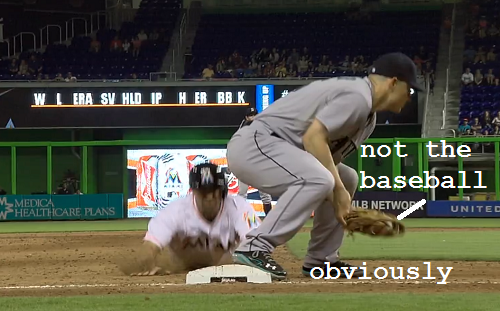
Incidentally, I’m not sure what the Marlins were doing. If that play is called in a not-stupid way, the Marlins lose the lead baserunner. But if that play goes as intended, the Marlins move runners up to second and third with one out. That would bring up Giancarlo Stanton, who is the team’s good hitter, but then Stanton would just be walked intentionally to bring up Garrett Jones, who is not the team’s good hitter. By bunting in front of Stanton, the Marlins were effectively taking the bat out of the hands of both Stanton and Marcell Ozuna. But Stanton still got to swing away in the end, because the play didn’t go as intended for either party.
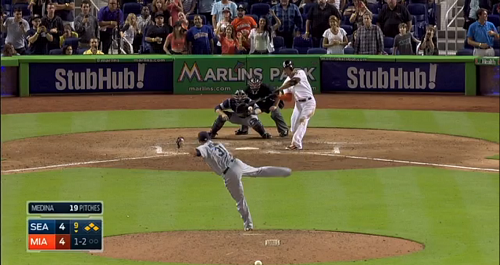
And so Giancarlo Stanton faced Yoervis Medina with nobody out and the bases loaded in the bottom of the ninth of a tie game. Medina was up against it, through only partial fault of his own. He allowed a leadoff single, but then Justin Smoak messed up a sacrifice bunt, and then Kyle Seager messed up didn’t mess up? technically messed up a sacrifice bunt. At that point the Mariners were a long shot, and the story was almost certain to be the reviewed play at third no matter what. But I do think something has to be said about just how terrible a decisive pitch Medina threw. The ninth inning featured controversy and misplays and heroics from a predictable source, but it also featured one of the Mariners’ worst pitches of the young season.
Medina got ahead. He got ahead, and he got to two strikes. Getting that far was kind of a miracle — at 1-and-1, Stanton swung right through an elevated breaking ball. He wasn’t tricked; he just swung under the ball, but he swung very comfortably. Stanton was on the pitch. If the pitch were to be thrown again, it would have to be thrown low and away, in an area where the worst-case scenario would be a called ball. Medina needed a strikeout, and strikeouts come from breaking balls out of the zone.
The problem is…well, let me tell you a little story. When I was young, in elementary school, we took a family trip to Europe and at one point we stayed with friends of a relative in a rural town in France. One afternoon my brother and I were out front in the yard, playing whatever we were playing, when a car pulled up and the passenger window rolled down. I walked over and, in French, I presume the driver asked for directions. I presume that because, after a brief pause, the driver subsequently asked in English for directions. Let me just make sure you’re getting this — I was a boy, and I obviously wasn’t in a familiar setting, because I was in a country that speaks a language I couldn’t speak. The driver requested my help anyway. I must have looked like a reliable child.
Two facts:
(1) I definitely didn’t know where the thing was that he wanted to get to.
(2) I definitely wasn’t going to not give him directions.
I thought for a moment and then very confidently instructed the man to go this way, then this way, then this other way, and then that way for a little bit before hanging a final turn. I didn’t want to seem like a know-nothing idiot, so I acted like a know-something idiot, and the driver thanked me, rolled up the window, and drove off. My brother and I resumed playing, and now that I think about it, I think we were playing with walkie-talkies and laser toy guns. I don’t know if the driver ever reached his destination. I don’t know where I led him to. For all I know he’s still there, driving around, lost, considerably older, and slightly less trusting of the area youth. I’m pretty sure I was too young to have the capacity to feel guilt. I just wanted to be a helpful boy.
To bring this back to the Mariners, Yoervis Medina is me, and the baseball is a lost driver in rural France, asking an American boy on vacation for directions. Medina knows he can’t direct the baseball properly, but he also knows he has to direct it somewhere, lest he look like a fool. No man wants to look a fool, and no developing man wants to look a fool, so a man gives directions, even if he doesn’t know quite where he is himself. The result is that Medina’s baseballs take a lot of turns, but it’s always a mystery where they end up. He just sends the baseballs on their way, and once the baseball is out of Medina’s hand, the baseball is…out of Medina’s hands. He has no command, and sometimes that means he throws terrible balls, and sometimes that means he throws terrible strikes, even with the count 1-and-2 against one of the best players in the league in a necessary strikeout situation. It’s a credit to Medina’s raw stuff he’s even a little effective. It’s no mystery why he isn’t more effective.
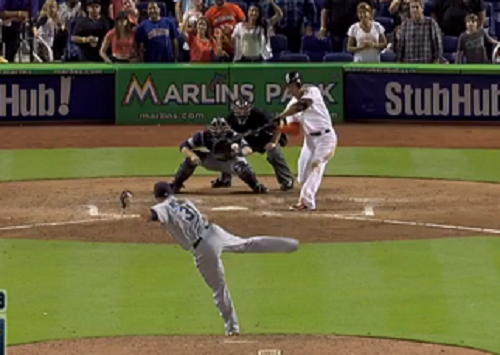
This is the first time Medina’s slider has been taken deep in the majors. It deserved it. Looking at Stanton’s player card, the slider was thrown to an area where Stanton’s slugged…oh, .856, all right. What Medina couldn’t have done was just stand there, on the mound, never throwing. What Medina ultimately did was the worst. Maybe the literal worst. So that’s something, that he accomplished.
ENHANCE
ENHANCE
ENHANCE
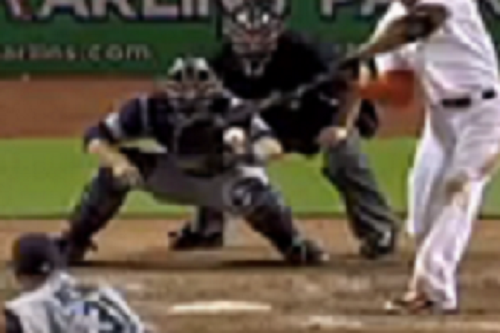
ENHANCE

ENHANCE

ENHANCE

ENHANCE

Game 16, Mariners at Marlins
Chris Young vs. Nate Eovaldi, 4:10pm
The M’s face the Miami Marlins, this time in *actual* Miami.
Chris Young and Nathan Eovaldi have very similar repertoires, as both rely heavily on 4-seam fastballs, and pair it mostly with sliders. They both mix in occasional curves, though Young’s heart clearly isn’t in it, and they both have change-ups, seemingly just to be able to tell pitching coaches that they do. Fastballs and sliders, platoon splits be damned. Both have OK K rates and somewhat poor walk rates. Peas in a pod, right?
As you probably know, this is a match up between one of the league’s hardest throwing starters and one of its softest tossers. Eovaldi has averaged – AVERAGED – about 97mph on his four-seamer this year while Young’s at 86.5mph. This gap of about 11mph doesn’t sound incredible, but it’s actually tough to find games with a larger disparity. If you exclude RA Dickey, whose “fastball” functions more as a gimmick pitch or a change-up to his knuckler, about the maximum gap you can have nowadays is around 12-13mph – between Eovaldi/Garrett Richards/James-Paxton-on-a-good-day/Jose Fernandez on one end and Mark Buehrle on the other. But these guys don’t match up all the time, and thanks to the miracle/curse of regression, baseball itself seems to abhor such gaps; Stephen Strasburg isn’t throwing 98 anymore, and Livan Hernandez is out of a job (though given all the injuries, he may not be for long).
So if Young’s velocity’s down a bit from 86+, and if Eovaldi is amped up to face, uh, the…ok, nevermind…we could see something we don’t often get to see. It’s by no means unprecedented, as Buehrle faced off against a hard-throwing Sonny Gray last year. Rookie year Strasburg opposed Bronson Arroyo back in 2010 too, but these games are actually rarer than you’d think. Buerhle faced off against Yu Darvish last year, but Buerhle averaged a respectable-for-him 85 while Darvish sat at 93. Anthony Vasquez opposed guys like Everett Teaford and Colby Lewis, not Strasburg or Verlander.
There you have it. A safe, identifiable thing to watch when you can’t bear to actually get invested. This is poor example of a kind of post that Jeff does so well, I know. Part of the reason I love things like this is that Jeff’s a good writer, but part of it is for the reminder that some odd and occasionally remarkable things occur that we don’t even notice at the time. We’re caught up in the at-bat, or the game, or the race, and we miss something fascinating, something lesser men will demean with the adjective “quirky.” For some, these things are a distraction from the things that matter. For others, these things are a distraction from the things that hurt. The M’s scored six runs in an INNING yesterday, and even as that inning came to a close, I knew how the game would end. I bet a lot of you did too. So yes, I’m going to find some strange angle to this game and the next few until Brad Miller reminds me that I wrote this without trying to be satirical.
The M’s are better than they *feel* right now, and they’re facing a mediocre team with an Angels-grade bullpen. But holy hell did that Texas series suck.
1: Almonte, CF
2: Miller, SS
3: Cano, 2B
4: Hart, 1B
5: Saunders, RF
6: Seager, 3B
7: Ackley, LF
8: Zunino, C
9: Young, P
Riiiiiiight, this is where the pitchers hit for some reason. Got it.
Sooooo, 1B prospect and current Tacoma Rainier Ji-Man Choi was suspended 50 games for testing positive for methandienone, an anabolic steroid. As Todd Milles writes, this opens the door to Jesus Montero, who is now the clear starter, and not in a job-sharing role. Sooooo…..yeah. Choi’s had trouble staying on the field, but has hit very well – the stocky lefty had a .500 OBP through 10 games this season, after posting a .377 OBP for Jackson last year. With his suspension, Choi moves to the restricted list, which opens up 40-man roster spot. We’ll see who grabs it.
Speaking of good-hitting, injury-bedeviled prospects, OF Julio Morban’s also been called up to Tacoma. Not sure if it’s just a paper move, as Morban hasn’t yet played this season due to…wait for it…injury.
Brandon Maurer will be called up to make a spot start against Miami on Sunday. The probable starter’s been labeled “TBA” for a few days, but with Beavan’s injury, the M’s didn’t have a lot of choice in the matter. It really came down to Maurer and lefty Anthony Fernandez, and Maurer’s the right call there.