
Stop What You’re Doing And Think About Felix
I hope you’re enjoying this — it might not last too much longer. Rooting for an undefeated baseball team is a delightful and wonderful feeling, a feeling like anything’s possible. Eight years in a row now, a day after the first day, I’ve gotten to feel like anything’s possible, for the Mariners. Of course it turned out for at least the first seven of those, many things were in fact not possible for the Mariners, but this is a perfect one, this feeling right here. Coming out of spring training, you’re ready to re-embrace the baseball routine. Fans everywhere are a little over-confident. But you don’t remember what games really feel like. Win the first game and you only know wins. Lose the first game and you only know losses. Baseball only starts to feel normal when your team has won and lost, but for the time being we only know the 2014 Seattle Mariners as winners. Big winners, as a matter of fact, allowing us to pretend like this team is a juggernaut. It isn’t, but, where’s the evidence? The Mariners were a juggernaut Monday. That’s all the data we’ve got.
When the Mariners get around to losing, it’ll be familiar, and we’ll start to entertain impressions both positive and negative. We’ll know what this team is within several weeks. What we think this team is today is unstoppable, and it sure is helpful to be able to give the ball to Felix Hernandez. With Felix on the mound, you always feel like the only team that can beat the Mariners is the Mariners. Sometimes a team comes out of camp and the ace struggles in the opener, and fans get really worried. Nothing to worry about here.
I’m not in the business of recaps anymore, especially not a day after the fact, and this isn’t a Mariners season opener game recap. In somewhat recappy form, I will say it’s extra delicious to rip the hearts out of the Angels. I will say I’m a supporter of Abe Almonte, and I’m a supporter of the idea of Robinson Cano somehow making Justin Smoak better, and I’m a supporter of Mike Zunino’s defense more than I’m a supporter of Mike Zunino’s offense. I don’t know why Charlie Furbush was pitching to Mike Trout. I don’t know where Dustin Ackley was running on Albert Pujols’ double. If Ackley hits enough, I’m not going to care about his funny routes. If Kyle Seager hits enough, we’re going to have a lineup.
But all I really want to get to is a chart. Last night, a whole lot of things happened, involving a whole lot of different Seattle Mariners. They scored, ten times, against a good baseball team! But sometimes I get King Felix tunnel vision. And here’s one display of what Felix did over his six innings of excellent work.
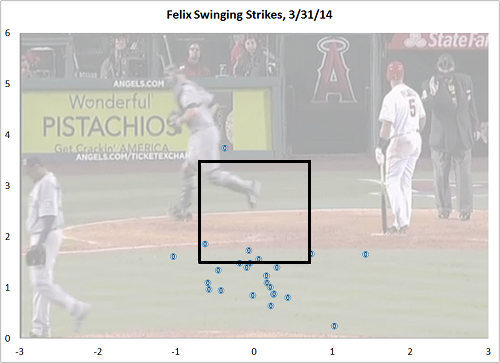
Count ’em up. Or, don’t, because two of them are almost perfectly overlapping. Last night, against Felix, the Angels swung and missed 21 times, and they racked up another three foul tips, yielding a total of 24 swinging strikes. All but one of them were low, and the one high one was a fastball to blow away Raul Ibanez. Felix was dominant around and beyond the lower edge, and if you’re trusting of Brooks Baseball’s classifications, the Angels were an unbelievable 3-for-20 trying to make contact with Felix’s changeup. It’s hard to separate the change from the two-seamer, since the changeup is basically a fastball, so the classifications could be off, but let’s not lose the important point. Pitch types be damned; Felix owned the Angels at the knees and the shins. Even the slider that Trout hit out was an inch or two away from being a good slider to a great hitter.
And by the way, that isn’t all of it. The Angels had 24 swinging strikes out of 48 swings, giving a game contact rate of 50%. That is the lowest single-game contact rate of Felix’s major-league career. It’s not even all that close. It wasn’t, of course, the best start that Felix has ever had, but by one statistical measure, it was his most unhittable start. He’s made a lot of starts. The Angels have a good lineup, and after the first two batters, Felix was like, knock if off, go away and sit down over there. He was that much in control, and he put the Mariners in position to go wire-to-wire. Presumably they won’t, but we’ve earned a day to pretend.
It was a good game for baseball as a sport, overall. People got to see King Felix at his best. People got to see Mike Trout go deep against one of the best. And then the Mariners won, and while it’s not like the Mariners are America’s Team, they are in position to be a little lovable on account of how bad they’ve been for so many years. The game featured some of the most talented players in baseball, players you can respect even from the other side, and I’m glad I got to see Trout keep being amazing, in a way. I’m also glad Trout ended up bummed out and his team got booed in its own home opener. The Mariners did that!
One game represents 0.62% of a full baseball season. There’s an incomprehensible amount of baseball left. But if the Mariners were projected to finish, say, .500, now you add about a half-win to the projection. And that increases the playoff odds by a few percentage points. You never earn your way to the playoffs in April — or March — but every win goes in the same win column, and when a division race is expected to be tight, it’s never too early to try to pull out in front. The Mariners might be worse than the Angels, Rangers, and A’s. The Mariners, right now, are in front of the Angels, Rangers, and A’s. And how much worse might they be, really? No one’s ever complained about having a lead.
The Mariners play again soon. They might lose. Until they lose, I don’t even remember what losing means. I only know King Felix, ten runs, and sweet sweet victory. Baseball’s a good friend, sometimes.
Game 2, Mariners at Angels
Erasmo Ramirez vs. CJ Wilson, 7:05pm
Coming off of a disappointing 2012 with the Angels – his first year of a 5-yr $77.5m deal – and with so much uncertainty in the Angels rotation last year, CJ Wilson needed a return to his 2010-2011 form. When he kicked off 2013 by walking way too many, it looked like he was on the decline phase of his career, just as the escalators in his contract hit (he’ll be paid $16m this year, up from $11m last year). But by mid/late May, Wilson had worked out the kinks and settled in to post a 3-fWAR season, his best since his last year in Arlington.
Wilson gets a fair number of strikeouts and has average walk rates, so he seems like a guy whose FIP could swing significantly based on how many long fly balls go over the fence. In fact, Wilson’s consistently good HR rates are a key to his success. He’s done it in HR-haven Arlington, and he’s continued to do it in HR-suppressing Anaheim. He’s done it as a high-GB% guy, as he was most years in his career, and last year he did it despite a steep drop in his GB%, which seems to have been driven by throwing fewer two-seam fastballs and relying on his four-seamer more (again, this makes sense given his home ballpark, and divisional haunts like Oakland and Seattle). His breaking pitches tend to be hit on the ground, which helps, but another factor may be the sheer number of pitches he throws.
As you probably know, a starting pitcher tends to lose effectiveness each time through the line-up. MGL (Mitchel Lichtman) did a study recently that found that pitchers with more pitches in their repertoire tend to suffer *less* from this penalty. That is, they retain more of their overall effectiveness the 2nd/3rd/4th times through the line-up. Intuitively, this makes sense. It would certainly be advantageous to have a pitch in your back pocket that a particular hitter hasn’t seen yet, and Wilson throws 5 pitches with some regularity. It’s a similar result to one found by Joe Roegele at the Hardball Times, who measured the increase in each hitter’s wOBA each time they see a certain pitch from a pitcher (that is, they hit better on the 5th four-seamer they see from a pitcher in a game, and slightly better again on the 6th, and better still on the 7th). Another recent study – this one from Robert Arthur – found that throwing a number of different pitches, and throwing them without a clear, repetitive pattern, has a small but significant impact on K%.
So that’s presumably why Wilson and his 91mph fastball, and an array of so-so to pretty decent breaking pitches can be effective and consistent. Some pitchers don’t need a bunch of options. Randy Johnson might have been a HOF hurler with only one pitch. But diversity is pretty important to the guys without overwhelming stuff or plus-plus breaking balls. Incidentally, this might be something to watch with Erasmo Ramirez, who gets the start tonight for Seattle. Ramirez threw more breaking balls last year – especially sliders – and used his very good change-up less. This wasn’t because of batter handedness; he saw a much HIGHER percentage of lefties in 2013 than he did in 2012. He just stopped throwing the change to righties. All of this is speculative, as he hasn’t pitched enough in total for us to really get a sense of how the M’s want him to attack hitters, and the new coaching staff’s a confounding variable too. But while his slider’s results weren’t great, the fact that he throws one (and an occasional curve) may help him stay effective overall. Now he just needs to stay healthy.
1: Almonte, CF
2: Miller, SS
3: Cano, 2B
4: Smoak, 1B
5: Hart, DH
6: Seager, 3B
7: Romero, RF
8: Ackley, LF
9: Buck, C
SP: Erasmo Ramirez
The M’s RH-heavy line-up takes its first turn of 2014, with Corey Hart at DH and Stefen Romero making his big-league debut in RF. Miller and Ackley are the only lefties in the line-up. A good, early test of the M’s off-season plan to get better against left-handed pitching.
Game 1, Mariners at Angels
King Felix vs. Jered Weaver, 7:00pm (ESPN2/ROOT Sports TV)
Happy Felix Night, and I hope you’re all enjoying a pleasant Opening Day 2014.
I can’t think of a more wide-open AL race in years. Certainly, the AL West is more tightly-bunched than it’s been in recent memory, and the super-teams – the Tigers and Red Sox – have also come back to the pack a bit. It’s not just that there are more teams bunched more tightly around 81 wins, within the margin of error (or the margin of luck). It’s that there seem to be reasons to believe that the variance of these forecasts is somehow higher. Jose Abreu and Masahiro Tanaka are two of the bigger off-season signings, and we don’t have minor league or major league data to generate a projection. Or, looking at MLB veterans, think about how vital bullpen performance has been to so many recent “out-of-nowhere” contenders. The Royals were fringe contenders last year not because of their great young position players, but because no one could touch their bullpen. Not their closer, not their set-up guys…no one. Baltimore pulled this off in 2012 (without all of the strikeouts…even weirder), and then the group fell back to earth in 2013. The Blue Jays were awful in 2012, and then pretty good in 2013 (though every other facet of the team was awful). The point is, bullpen performance is perhaps more important than it’s been in quite some time given the narrower spread in talent. But bullpen performance is notoriously hard to project.
The M’s have holes throughout, but we can be reasonably sure that their team wRC+/wOBA will be better than it was in 2013*. The question remains: will it matter? Tonight’s just one game, but it’s an important early look at another really difficult team to project, the Angels. Mike Petriello had a good article on them today at Fangraphs, and I see that Dave and others have picked them to win the division (gun to my head, they’d be my pick too, but hopefully that won’t be necessary). Albert Pujols’ plantar fasciitis and Jered Weaver’s ailing elbow sidelined two of their best players for a short while, and contributed to poor-by-their-standards performance while they played through pain. Especially on the pitching side, more innings went to replacement-level and below arms, and the depth that they’d acquired blew up in their face.
Now, the Angels rely on a very different Jered Weaver. Since 2011, his average four-seam fastball has fallen from 90mph to 87.5mph last year. This spring, it’s in that same vicinity or a bit lower, and it looks like he’s mixing in more of a sinker around 86mph. Weaver was never a big velo guy, but he’s having to adjust to very different stuff than he had when he came up. With that pop-up generating fastball, he hasn’t had much in the way of platoon splits, but using a sinker more often is usually a way to see platoon splits rise. Thanks to a minor league system bereft of good pitchers, and the departure of guys like Tommy Hanson or Joe Blanton (which most Angels fans applaud) has left them short of good depth. They have Mike Trout though, so…
1: Almonte, CF
2: Miller, SS
3: Cano, 2B
4: Smoak, 1B
5: Morrison, DH
6: Seager, 3B
7: Saunders, RF
8: Ackley, LF
9: Zunino, C
SP: King Felix
GO MARINERS
* This is not a case of projecting growth off a prior season, or mixing up true talent and observed performance. This is about a full year of Brad Miller/Robby Cano and not dealing with Brendan Ryan/Dustin-Ackley-at-2B. It came at a very high cost, and the future’s uncertain, injuries, blah blah blah, but the M’s added one of the 5 best hitters on the planet and subtracted one of the five worst hitters (among everyday players) on the planet. That has an impact on true talent.
The Troubled Mind of the M’s Fan
Odi et amo. quare id faciam, fortasse requiris?
nescio, sed fieri sentio et excrucior
-Catullus
We are, thankfully, a year removed from the acrimonious debates over the Jaso/Morse trade. The past year has probably been kinder to the M’s than to most of their divisional rivals, due to a combination of injury and Robinson Cano. We’ve spent the past four years, or, if you really think about it, the last TEN years, searching for progress. Here, as the 2014 season begins, we have it. We can quibble about the magnitude of the progress, or what it says about management, or any number of things, but the M’s start the 2014 season with a real chance at postseason baseball. After years of doubt, scorn, and apathy, M’s fans must be ecstatic, right? Well, no, not really. Jeff described the psychological state of the M’s fans in his “If It Goes Right” post, and it’s worth repeating: the 2004-2013 Mariners are a classic case of operant conditioning. A decade spent eradicating hope; glimmers of promise felled by a series of misfortunes (Guti) and missteps (Horacio Ramirez). You can argue that this metaphor obscures more than it helps: that a bad trade for a crappy DH either one or seven years ago doesn’t illuminate the 2014 season, it just illuminates your own cynicism. The problem is that you can’t pretend that these moves aren’t linked. If you’ve lamented the direction the team’s gone, you can’t just tell yourself that the moves this FO made in the past have no bearing on the moves they’ll make in the future. If you believe that there’s something fundamentally wrong in how the team assesses pro talent, you probably aren’t convinced that everything will work out now that the stakes are higher.
So here I am, feeling both excitement and dread at the same time. Picking apart every minor move because they seem so haphazard and picking apart every minor move because, for the first time in a while, they might actually matter. Lamenting the missed opportunities and the obvious holes, but looking around the division and seeing obvious holes everywhere. Worrying that way too much is needed from Dustin Ackley, Mike Zunino and Roenis Elias, and thinking that I’d rather have Zunino over JP Arencibia, and Elias over Nick Martinez, and wait, are you seriously starting Josh Wilson at 2B, Texas? The M’s bought the premier player in free agency, and then everyone told them that Cano, on his own, wasn’t enough to change the AL West picture. The M’s stayed put, and then the baseball gods changed the AL West picture for them. And now our brains can’t stop debating it all.
“Chris Young is a great stopgap for the 5th rotation spot. This isn’t about giving an “Ex-All Star” a job based on his name, and it’s not about a good spring training line. Chris Young was broken, and now M’s scouts are convinced he’s not. Thoracic Outlet surgery changes the picture completely, and it has the benefit of being a much easier procedure to rehab from than a labrum or rotator cuff tear. Randy Wolf was bad, and then left when he demanded more security than the M’s felt comfortable offering. Young’s problem has been durability, and now he’s in a position where durability just isn’t a big concern. Young’s been good, and with the 45-day opt out, the M’s can remake the rotation in May if Hisashi Iwakuma’s ready to go.”
“Let the record show that perhaps the best argument in favor of the Young pick-up is that he recently had his third shoulder surgery. I’m told he’s now throwing 88mph again, much better than he showed last year. But this sort of thing is trotted out about as often as “best shape of his life” stories. I mean, it wasn’t that long ago that Scott Baker came in amid whispers he was throwing harder than he was last year with the Cubs. He came out in early March and touched *92*. Jeremy Bonderman did this last year. The real reason Young is here is that he signed the 45-day opt out and Wolf didn’t. That’s it. Flexibility is important, and no team wants to just waste $500-750,000. But this kind of flexibility can be overstated. In any event, the M’s are going into the 2014 season projected to be very close to the division’s top teams, and the best they they could do was to see what Roenis Elias was capable AND buy high-ish on Chris Young?
“The M’s OF depth isn’t great on paper, but the M’s will be able to mix and match players and get the platoon advantage while also improving the OF defense overall. Abraham Almonte showed signs that he could be a league-average bat, and using Saunders/Ackley in the corners will give the M’s much more range than they had last year. The M’s OF defense was -17.5 runs by UZR in 2013, 1.5 WINS worse than the Angels’, and 2-3 wins worse than the A’s/Rangers. Push them to average, and the division is basically a toss-up. Against good lefties, they can deploy Corey Hart and/or Stefen Romero. That’s an offense-for-defense trade to be sure, but it illustrates that the M’s have actual options both when they look at pitching probables and for late-game situations. This is the M’s weak point, and the ability to swap players around means that it shouldn’t be a black hole. Their depth in AAA isn’t excellent, but it’s no worse than their rivals. Importantly, it means that if Almonte’s awful, they can just swap him out.”
“The M’s actions this offseason, particularly regarding the outfield, show that THEY don’t believe they’re contenders. The division is incredibly tight and the M’s all but gave the starting CF job to a guy with a career MiLB slugging percentage of .399, and who wasn’t really a full-time CF until he was pressed into the job due to injuries/promotions/other people failing. The team has more speed in the OF corners, but they have career wRC+ numbers of 89 and 86, respectively. If they couldn’t run, they’d be out of baseball. And running’s nice, but Ackley hasn’t demonstrated great range in the OF. That’s not necessarily is fault, and the tools are there, but he’s learning on the job, as is Romero. If Hart plays significant time in RF, the OF defense could still be a problem. Hart’s progress has been achingly slow, which seems to hurt the group’s chances of adding value offensively. To top it off, Almonte starts the year in the lead-off spot for reasons no one can fathom. The M’s were contenders by default, and their lack of attention to a clear, known weakness will prevent them from taking advantage of it.”
“How can you criticize the M’s for not making more moves to shore up the team when your biggest fear was management making rash moves to protect their jobs? The cynics were the ones lamenting an overpay for Nelson Cruz or David Price or [insert trade candidate here] before they happened; they can’t then turn around and say the M’s didn’t do enough to improve. The division’s tight, and the M’s still have Nick Franklin and Tai Walker in the fold. Walker will be an important part of the M’s rotation and Franklin could either be a factor for the team in the 2nd half or a potentially even-more-valuable trade chip at the deadline. More importantly, the M’s have positioned themselves for 2015 and beyond. They haven’t closed any doors by overreacting to spring training injuries to Oakland/Texas. This means they can actually compete in 2014 while at the same time assessing which players they can count on for 2015. Is Dustin Ackley slow to develop, or is it just not going to work? Is Nick Franklin’s struggles against lefties fixable? Is Mike Zunino making steady progress, or will his contact issues plague him? The M’s have a free year – they’re figuring out who’s going to be a part of the next great M’s team AND they can compete in the short term thanks to Felix/Iwakuma/Cano/Miller.”
“If the only options were “Stand pat” and “make stupid, panic-driven overpays,” we wouldn’t spend much time on baseball. Those are *never* the only options. The M’s shouldn’t have traded the farm for David Price, but they saw Ervin Santana sign a one-year deal and opted to go with Roenis Elias instead. Teams around baseball need help at SS/2B, and the M’s held tight to Nick Franklin, waiting to be blown away by a ludicrous offer that never came. Like Nelson Cruz or Santana, the M’s could’ve adapted to the market, or they could’ve gone for one of the free agents once their market tanked. It’s not enough to say that the M’s can evaluate their youngsters this year when they’ve shown no ability to have contingencies. That’s why they started the season last year with Jesus Montero at C, Justin Smoak at 1B and Dustin Ackley at 2B. Zunino helped them avoid the full effects of Montero’s collapse, but they still need Ackley and Smoak to produce. They’ve had the same “youngsters” for years, and while Cano is a huge upgrade, they’re still surrounded by Almonte/Saunders/Zunino. What, exactly, is going to change next year?”
I’m really glad I’m not anticipating big philosophical arguments with fans of the Morse deal, but all that means is that the big philosophical arguments have moved to my own head. This is a strange, strange 2014, and despite all of the angst and teeth-gnashing, it’s a better version of strange than we’ve seen in a while. How much that has to do with the FO and how much has to do with pitcher attrition elsewhere is still a big question. However you resolve it is up to you, and ultimately, it’s fun that circumstances (“no! prudent management.” “I’ll concede the point only if you can identify the team’s employee who decimated Texas’ clubhouse this spring”) let us have the debate with the gap between the M’s and their rivals smaller than at any point since 2009.
Monday Podcast with Jeff and Matthew
Monday morning podcast(s) continues/begins.
If you’re new to these, this isn’t anything special. Jeff and I go into a recording with a vague idea of stuff to talk about and it sort of organically goes how it goes. It usually goes negative, as much as neither of us prefer it to. I would really like for people to get something out of these other than just us basically chatting with each other, but Jeff has way too many other things to do throughout each day and I’m just kinda lazy. Sorry! Not really, though, because this is free to you.
This week we talked a little about Randy Wolf and the payroll, and got sidetracked into hating the Mariners’ past teams and current FO. Whoops!
Podcast with Jeff and Matthew: Direct link! || iTunes link! || RSS/XML link!
In hopes of capturing some creative juice again, I’m playing around with the format a little. Intro music is The Temperature of the Air on the Bow of the Kaleetan by Chris Zabriskie. I don’t know if Kaleetan refers to Basque or the Chinook or something completely else. Context suggests the ferry?
If It Goes Right
I’m sitting here right now, hating the Red Sox. Expressed like that, this is hardly unfamiliar. I remember I made the mistake of rooting for the Red Sox in 2003 and 2004, when I was living in New England, and as good an experience as it was when they won that first World Series, boy do I ever look back on that and shake my head. I haven’t been able to stand the Red Sox since the first day of 2005, and I’ve been pretty actively rooting against them for years. But this whole time, that whole decade, I’m not going to pretend like a lot of it wasn’t jealousy. Or envy. Is there a difference? I couldn’t stand them in large part because they were so successful. I was bitter about my own baseball team, content to lash out. For some time, I’ve hated the Red Sox, and I’ve rooted against them in important games. For the first time, I’m hating the Red Sox because I don’t want them to knock out the Mariners. Used to be I hated them because of what they were. Today I hate them because of what they aren’t. They aren’t us. They’re kind of in our way.
As I take this short breather to reflect, I think what gets me the most is the very obviousness of this outcome. Not that the Mariners, of course, were ever the favorites in this division, but look at the way things played out. This wasn’t a team that needed any miracles, nor was it a team that received any miracles. We had a sense this would be a talented young team, with upside given development. Talented players developed. Talented players produced and prevented runs. Talented players won games. If you forgot everything you heard about the front office, you’d almost be tempted to think, hey, this team did everything right. They entered the season with upside, and they were carried into first by baseball ability we all already knew about.
I remember paying so much attention to projected standings even weeks before the start of the year. FanGraphs rolled out its Cool Standings stuff, and then there were projections and then there were projected records. Initially, the Mariners were projected to be pretty close to the rest of the AL West best. Then they never really fell away. Not when the system was updated. Not when the depth charts changed. Not when ZiPS was included. PECOTA was saying similar things. On several occasions, I tried to figure out where the projections were going wrong. It seemed like the Mariners were being overrated, and the rivals were being underrated. Now in hindsight I feel like I was just acting damaged. The Mariners made me expect the Mariners to disappoint. It sure looks now like the projections were telling us the truth all along. The Mariners were right there with the other three from the start. The Mariners were a few player developments away from being division champs.
Obvious. The Mariners as a successful baseball team was obvious. Not obvious as a certainty, but obvious as a possibility. So many of us just weren’t ready to believe it. It was obvious the Mariners would be good in 2008, too. It was obvious they’d be good in 2010. When you’re hurt that bad, when you’re caught that much off guard, it changes your psychological DNA. We didn’t want to think that the flower might bloom, but the dirt was fertile and the sun was coming out. Flowers blossom in the right conditions, and it’s as simple as nature.
It was obvious that Felix would dominate. Felix always dominated. Why wouldn’t he continue to dominate? It’s always fair to point out that pitchers are unreliable and success and health can be fleeting, but when it comes to one’s own, there’s an over-inclination to be concerned. How often have we freaked out about Felix’s velocity? How often have we expressed worry when nothing was wrong? It never felt quite right for the Mariners to have one of the greatest players in the world, but that was on us, not him. Felix was amazing, so Felix would be amazing. That’s just pattern recognition.
It was obvious that Robinson Cano would be incredible. That’s what you pay $240 million for. Again, some of us acted like victims of abuse. We entertained notions of Cano coming apart in Seattle. One doesn’t soon forget Chone Figgins or Jeff Cirillo. One doesn’t soon forget another team’s experience with Albert Pujols. But what reason was there to be worried, actually? Cano had been one of the most consistently healthy and valuable players in baseball. Having Robinson Cano wasn’t all that different from having Miguel Cabrera. Cano was a superstar, and he played like a superstar. Yeah.
It was obvious there was other talent. One day in March, for reasons I never figured out, I flipped on a Marlins spring-training game. The broadcasters were talking about Jose Fernandez, then some guy hit a fly ball out to Giancarlo Stanton. I watched and thought, “hey, the Marlins have two unbelievable superstars, and they’re still projected to be the worst team in the league. Why should the Mariners be special?” It took me too long to realize, “oh yeah, the Mariners also have other guys.” Felix and Cano were the selling points. They were the stars, aligned. But there was always an abundance of talented support.
It was obvious Dustin Ackley wouldn’t be a disaster forever. He’d been obvious from the date of his drafting, and he’d shown signs of improvement down the stretch in 2013. It was obvious Kyle Seager would hit enough, because he was the reliable guy before Robinson Cano was the reliable guy. It was obvious Brad Miller would be a stud shortstop, even with the defensive issues, because his bat adjusted to the majors immediately and it always felt like he had a high floor. It was obvious Mike Zunino would improve from his initial, hurried cup of coffee. It was obvious Abraham Almonte would be a better player on this side of his alcoholism. It was obvious Michael Saunders would be regularly playable. It was obvious Justin Smoak would be just good enough.
It was obvious Corey Hart would hit, when he could play. It was obvious Taijuan Walker could overpower quality big-leaguers. It was obvious James Paxton could outmaneuver quality big-leaguers. It was obvious nothing would be wrong with Hisashi Iwakuma’s split-finger. It was obvious there was talent in the bullpen. It was even — dare I say — obvious the Mariners were in better hands with Lloyd McClendon than they had been in recent seasons past. In spring, I kept waiting to find reasons to be annoyed by McClendon as a manager. Obviously there were a few things, there are always a few things, but as managers go, I’ve been surprisingly pleased, and maybe I shouldn’t have been surprised at all. McClendon was saying a lot of the right things from the beginning.
I’m saying too much about a season that isn’t over yet but I can’t really gain control of my fingers. They’re just typing at this point, happily typing about a baseball season I’m maybe trying to prove to myself actually happened. The more words I write about the 2014 Mariners, the deeper it’ll sink in that, yeah, those Mariners happened, and they’re still happening, and before long they’ll happen before a sellout October crowd at Safeco Field. People have said for years that the fan base was there — the Mariners just needed to find a way to tap back into it. Turns out Safeco can get full and loud, too. Mariners fans, Seahawks fans, Sounders fans — they’re all fans from the same city, and many of them are some loud sons of bitches.
This year’s Mariners aren’t done making memories. Maybe the rest of them will be bad, I don’t know. I thought I would’ve expected so, but these Mariners make me feel differently. Whatever happens, we already have quite the assortment of seemingly unforgettable season highlights. The 2012 perfect game made me feel deeply proud of a Mariner. The four-game May sweep of the Angels made me feel deeply proud of the Mariners, after thrashing their opponents — delightfully — 43-8. That gave me a feeling I hadn’t had in years. There were the two Walker showdowns against Yu Darvish, and it feels like ages ago we were worrying about those pitch counts. I think I remember two-thirds of the pitches Chris Young threw in his one-hitter right after Erasmo Ramirez’s elbow thing. Stefen Romero’s walk-off? Miller’s walk-off inside-the-parker? The game-ending play at the plate in Toronto? The consecutive huge rallies against New York? Every win had something. Every win always has something, but in a successful season, those somethings are connected, lifted to feel like and mean something greater than they would on their own.
I’m definitely thrilled to have finally washed the taste of Lollablueza out of my mouth. I couldn’t believe how long it had been since the Mariners played at least some later-summer games of significance, and this time they didn’t wilt. They didn’t wilt after losing the first one; if anything, it seemed to inspire them. The 2007 Mariners were never going to do anything anyway. It’s not like they could’ve been champs, had they just beaten the hell out of the Angels. But that series made me feel embarrassed, personally embarrassed by a baseball team I like, and now those demons are exorcised. Now it’s time to exorcise some other ones.
When Matthew and I would talk in the before-times, we’d often discuss whether or not we were even Mariners fans anymore. We certainly didn’t feel like it. We felt like they were just going to be terrible, and we felt like that was okay, and we felt like we weren’t even thrilled about the prospect of rooting for this team given some of the decisions it had made. I always knew I liked the Mariners the most, but for long stretches I didn’t feel like I was into them. I wanted to know how I’d feel about a successful baseball team. I couldn’t know, just imagining it.
I’m into them. We’re all into them. We were mostly all always into them — we just also had to protect ourselves. The introspective, philosophical baseball fan is a baseball fan of a bad baseball team. A baseball fan of a good baseball team doesn’t really give a shit about the bigger questions, not in the moment, because the moment is about winning the next baseball game against the next enemy baseball team. It’s just sports. You have to question yourself when you’re following bad sports. There’s nothing to question when you’re following good sports. In our defense, we couldn’t have known that.
I just want to read everything. I want to immerse myself in this, to bathe myself in this, to let this seep into every nook and cranny of my tall and awkward physical and emotional form. I always had so much trouble writing things like series previews about the playoffs for my job, because they always felt so uncreative and it always felt like no one would be interested in whatever analysis I could provide. I couldn’t in any way relate to the audience. I get it now — when your team’s in the playoffs, you never want to stop consuming media coverage, no matter how insubstantial. You just want to experience everything, and you want to force yourself to continue to experience everything. Used to be I’d feel a renewed love of baseball come playoff time, when I could watch good teams in boisterous atmospheres without the Mariners being terrible. Now the Mariners are in the playoffs. I’m not prepared for this, but I really want to try to be.
When I’m not writing about the Mariners, I’m reading about the Mariners. And right now, no matter what I’m doing, I’m also hating the Red Sox. Right now, the Red Sox are the baseball team I hate the very most. It’s not weird to be hating the Red Sox — I’ve been hating the Red Sox for a long, long time. But to hate them the very most? To hate them as my first or second thought after waking up in the morning? To hate them with every sip of hot, delicious, northwest-roasted pour-over coffee? This is all new. The only baseball team I’m used to hating that much is the Mariners.
I still don’t know what it means to be true to the blue. This season has raised a whole lot of questions, which, perhaps, is always going to be the case. I like new questions, anyway. Make me feel curious. But this season has also provided one big answer, separate from the littler ones. I know that I am a Seattle Mariners fan. And it’s October, and I know that I’m going to be an emotional wreck. How about that?
Cactus League Game…2nd to Last, Rockies at Mariners
Roenis Elias vs. TBD, 7:05pm
A live game on Root Sports/MLB.tv as the M’s near the finish line of the Cactus League Season. This’ll be Roenis Elias’ last game before officially joining the M’s rotation, along with Chris Young. Think about that sentence.
The game is crucial for Elias, and for the M’s in projecting how his initial month-or-so in the rotation might go. The first time we saw him, his release point was all over the map, but he had a surprisingly lively fastball. Since then, he and the M’s have talked about changes they’ve made to simplify his delivery. So, on the eve of the regular season, is he noticeably more consistent? Does this help or hurt his platoon splits (it looked like he dropped down vs. lefties against LA)? And how does he deal with a Rockies club who’s seen him before? Elias is a great story, and he’s worked hard to earn his spot, but we’re talking about promoting a guy from AA based on a good-not-great spring training featuring an 8:8 K:BB ration. I wish him all the best, and it sounds like he may be more mentally ready for the challenge than Brandon Maurer, last year’s surprising promoted-from-AA Cactus League star.
One thing that’s going to be critical to Elias as a pitch-to-contact guy who generates a lot of fly balls is the outfield defense behind him. On paper, he’s a good fit for Safeco, as lefty flyball pitchers benefit more from the marine layer’s RH-power-suppressing properties. But a terrible OF defense – as the M’s trotted out last year – can counter that advantage. Elias posted a 40% GB rate the past two years in the minors by MLCentral; Statcorner has him around 41 or so, against a league average of 46%. Whatever number you pick, he’s been below average in the minors, where GBs are MORE common than in AAA/MLB. His strikeout rate isn’t huge, as his primary breaking ball (the slow slurve) probably isn’t going to rack up whiffs. Couple this with the M’s new acquisition posting the lowest GB rate in MLB in recent years, and suddenly Dustin Ackley and Abe Almonte are a bit more important than they otherwise would’ve been. Ackley in particular looked a bit lost in the OF last year, but that had a lot to do with his lack of (recent) experience. He’s been better in the spring, and the upgrade from Ibanez/Morse to Ackley – even a still-learning Ackley – seems like a massive one. Ackley was always going to be a key to the season, as going from a well-below average hitter to a league average one could really help the line-up’s balance and productivity.* With Elias/Young, his defense will be all the more important as well.
1: Almonte, CF
2: Miller, SS
3: Cano, 2B
4: Smoak, 1B
5: Seager, 3B
6: Morrison, DH
7: Ackley, LF
8: Saunders, RF
9: Zunino, C
SP: Elias
That’s probably your opening day line-up right there.
The final issue in camp has been what to do with Nick Franklin. Once he lost the supposed SS battle, and once the M’s decided not to snap at any of the offers they got for him, they could transition him to a super-sub role, or they could send him to AAA. Today, they opted for the latter. This has to be bitterly disappointing to Franklin, who’s been great this spring, but it *does* mean he’ll continue to get regular at-bats and can either concentrate on the middle infield, or refine his routes in the OF if the M’s are serious about the super-sub thing. The M’s will go with Stefen Romero in the 5th-OF/back-up CIF role.
* We’ve mentioned it before, but the M’s have scored far fewer runs than you’d expect just judging from their total number of walks/hits/HRs/etc. This was probably due – in part – to the fact that the bottom of the line-up was sooooo bad. Of course actual runs would trail hits/walks when you had Brendan Ryan/M’s catchers/2012 Ackley trying to knock runners in.
Chris Young Isn’t Randy Wolf
It’s because of Randy Wolf we’ve all learned about the existence of the 45-day advanced-consent release. And it’s because of the 45-day advanced-consent release that Randy Wolf isn’t on the Mariners anymore, after having learned they wanted him in the starting rotation. Basically, the Mariners didn’t want to guarantee seven figures to a potentially temporary starting pitcher. Wolf wanted the commitment. Ultimately he opted out, preferring the freedom of free agency. That’s how Randy Wolf ceased playing for Seattle before even setting foot in the actual city.
And so began the most surreal chapter of my entire month, and earlier this month I got into a staring contest with a cat in another apartment. The Internet was suddenly flooded with angry, emotional Mariners fans. Mariners fans who were angry because Randy Wolf wasn’t going to be a part of the roster in the year 2014. Mariners fans who immediately assumed the worst of the whole situation, which, I’ll grant, is sort of what we’ve been conditioned to do. But everybody took Wolf’s side. Everybody got on the organization, and the controversy(?) even made its way to god-damned Deadspin, the young white Internet’s primary go-to source of whatever it does. “The Mariners are cheap!” they yelled. “The Mariners are embarrassing!” they…yelled, too.
Chris Young has taken Randy Wolf’s place. From Shannon Drayer:
“Yeah I signed an advance consent. It really was a non-issue,” [Young] said of the document that allows the club to release him for any non-health related reason in the first 45 days of the season. “I always tell myself it is a performance-based game and the club has the right to release you at any point. It’s just a matter of whether your salary is guaranteed for the rest of the season. For me I don’t play for the money. I play because I love the game. The opportunity to be out here and be healthy, I am just super excited to be out there and making the most of the opportunity.”
It reads, a tiny little bit, as a shot at Randy Wolf. Probably, that’s not what was intended, and Young really is just thankful for this opportunity. For him, it was a non-issue. And that’s more or less what the Mariners thought it would be for Randy Wolf: a non-issue. Young didn’t pitch in the majors in 2013 after surgery. He can expect only so much of a commitment. Wolf didn’t pitch in the majors in 2013 after surgery. He, too, can expect only so much of a commitment. What the Mariners presented to Wolf was something common, something accepted. The response had less to do with the team, and more to do with Wolf.
Players sign these things every year. It’s usually the teams that have all the leverage, and while players would prefer to have guaranteed full-year salaries, the sort of player who ends up in this situation is the sort of player fighting for any kind of playing time. You can see why Wolf would’ve been bothered by the paperwork, which the Mariners, by rule, couldn’t have introduced when they first inked him as an NRI. You can also see why the Mariners wouldn’t have expected Wolf to react as he did. Players might sometimes sign these things begrudgingly, but they haven’t made a habit of complaining to the press.
Think about what the Mariners were then faced with. They could’ve guaranteed Wolf’s seven-figure salary. Or they could’ve opted for the alternatives. Is Wolf really better than Blake Beavan and Roenis Elias? Those two guys are cheaper. And then there were free agents, free agents just like Chris Young. Was it worth it to give Wolf what he wanted, or were there other deals? Seems to me the Mariners wound up with a good deal. Young’s inexpensive, and he seems a bit promising.
With Randy Wolf, the Mariners made a business decision. That cost them Wolf, but they’ve emerged none the worse for wear. Without question, I think they’ve looked a little bad. This makes them look really cheap, and Wolf’s story was published by someone as prominent as Ken Rosenthal. Maybe this makes you question the Mariners’ ethics. But while the Mariners are stingy with even just six-figure sums, that’s hardly unique to them. You want to pretend like you’re watching fair, ethical baseball? Don’t examine the baseball too closely.
Remember: front offices don’t do players favors. Nobody gives money away if money doesn’t need to be given away. Pretty much every single contract has a team paying a player as little as it can get away with, and the whole search for inefficiencies is built around the principle of paying players less than they’re worth. Every team wants to maximize every dollar. Every team thinks about every little payment, even if the roster happens to feature a $240-million second baseman.
The Mariners liked Randy Wolf the most, but the margin wasn’t worth Wolf’s guarantee. So they went in search of a better deal. Baseball is about business, not people, and the business can be judgmental and cold. You like Kyle Seager, right? Important part of the ballclub. This year the Mariners will pay him $0.54 million. Basically half what they’ll pay John Buck. Last year Seager made $0.51 million. The Mariners are paying Seager only what they need to, even though he’s an important everyday contributor. I also remember a controversy with the Angels a year ago. They renewed Mike Trout’s contract at $0.51 million, despite him having been the best player in baseball the season before. Trout’s agent complained to the media. The Angels didn’t care. Pretty soon the two sides will agree to a massive multi-year contract extension. Baseball is a lopsided game, in terms of financial “fairness”, and the Mariners aren’t the first team to make a decision over a seemingly inconsequential amount of cash. Everybody does it, and Randy Wolf just called attention to the factually ordinary.
I imagine this reads like I’m on the Mariners’ side. I don’t have a side. There’s no question Randy Wolf made the Mariners look bad. They did make a decision to go another way over a few hundreds of thousands of dollars. That’s enough to rub people the wrong way, but I think what’s important to understand is that the Mariners didn’t do anything unusual. Wolf’s is the party that acted unusually, as every team in baseball makes these kinds of calls. If you don’t like it, you can plead for change within the industry, and sit there dissatisfied over the injustice. Or, if you don’t like it, you can try to put it out of mind, and just watch the baseball players play baseball and think of other things. You know who has an incredible story? Roenis Elias. It’s so good of the Mariners to give him a chance to fulfill his wildest dreams. What an organization!
Five Interesting Things About New Mariner Chris Young
On one hand, the Mariners revealed themselves to have some pretty lousy starting-pitching depth. On the other hand, we only got here because of unforeseen injuries to Taijuan Walker, Brandon Maurer, and Hisashi Iwakuma, because Scott Baker under-performed, and because Randy Wolf decided he was a principled man. Just yesterday, people were lamenting that the Mariners would open the season starting both Roenis Elias and Blake Beavan. People thought such a situation was embarrassing, regardless of the reasons. The Mariners agreed! So the Mariners are no longer in that situation, as they’ve picked up the tall white pitching Chris Young after he was dropped by the Nationals.
Young’s been signed to a major-league contract, and it would appear that he’ll take Beavan’s place out of the gate. Or he could get hurt, like he does, but reports from Florida have been encouraging, and this is why one shouldn’t complain too much about Blake Beavan until Blake Beavan is actually throwing relevant innings. The 40-man casualty is Bobby LaFromboise, and there are things to be said about that, but they aren’t things you’ll find here. Understand that I always feel guilty being so dismissive of professional athletes. Understand, by the same token, one can’t cover everything in everything. What’s most important here is Chris Young, and, following, please find five interesting things about him. In a list, on the Internet!
(1)
I remember, many many years ago, before I even considered Dave and myself friends, he sent me an email as part of an exchange, and he said, paraphrased, that Chris Young threw crap. It wasn’t just Dave’s opinion — it was everyone’s opinion. Young used to work in the high 80s, and more recently he’s come down to the mid 80s, and that’s not the kind of velocity you like to see from a right-handed pitcher. Yet Young was successful in the majors nevertheless, and it’s because there’s actual velocity, and there’s perceived velocity, and it’s the second one that’s the big one.
Of course, usually, they’re awfully similar. But Young’s extreme. Because of his height, and because of his forward stride, Young releases the baseball unusually close to home plate, which means it has to cover less distance than an average pitcher’s pitch. So it gets on the hitter faster, and, here’s one supporting quote:
“When you’re standing there on deck and you see the ball coming out of his hand, there’s nothing special to it,” said Florida Marlins outfielder Logan Morrison, who faced Young in his last spring-training start. “But when you get in the box, it gets on you quick. Even though he’s throwing 85, you have to treat it like 90, 92.”
In effect, Chris Young’s stuff plays up, which is one reason he’s had a long career despite the burden of Barry Zito’s arm strength. His fastball these days is around 84-85, but it doesn’t seem that way, and I should also note, relatedly, that Young’s delivery is a bit deceptive because of his height and his arm path. Chris Young can’t succeed at any velocity. He probably can succeed at his current velocity, because his current velocity isn’t the velocity hitters think that he has.
(edit: Young topping out at 88 in the spring? What do you know? Players love to say how healthy they feel, but, Young feels really healthy, and stronger than he has in years past.)
(2)
We don’t have public HITf/x data, but we have been given glimpses in the past. In November 2011, Mike Fast performed a full analysis of numbers from 2008. He found that Chris Young allowed weaker contact than average, and he ranked tenth-best in baseball in average horizontal batted-ball speed off bat (regressed). Granted, 2008 was a long time ago! Young threw a little bit harder back then. But consider this additional evidence that Young is unusually difficult to square up, and that’s probably less about his velocity, and just more about him.
(3)

(4)
Chris Young has a career groundball rate of 27%. Since 2002, 403 starters have thrown at least 200 major-league innings. Young’s groundball rate is the lowest in the group, with Chuck James nearest at 30%. The median is about 44%. Young is a super-extreme fly-baller, and he’s also a pretty extreme infield-fly-baller. You can thank his over-the-top delivery and his preference to work up in the zone. Or, if not thank, then blame, if you really don’t like fly balls. Young’s fly balls usually aren’t that bad. Again, weaker contact. Again, deceptiveness.
(5)
Over Young’s career, baserunners have attempted 179 stolen bases. On 162 occasions — 91% — they’ve been successful. That’s the highest success rate against any starting pitcher since at least 1969. In 2006, runners were 41 out of 45. The next season, they were 44-for-44. Obviously, when it comes to steals, the catcher plays some kind of role, but the pitcher plays the more important role, and Young has been easy to steal on because he’s basically a 6’10 MechWarrior with an awful lot of moving parts that doesn’t deal well with having to move suddenly in a different direction. Because of the baserunners, Young has suffered a little bit in the stranded-runner department. Runners have a slightly easier time scoring against him. It doesn’t cancel out the batted-ball effects, but it does negate a chunk.
—–
Young didn’t pitch in the majors in 2013. When he pitched in the majors in 2012, he was mediocre. He’s become one of the more fragile starting pitchers in the game, sort of a more polite Erik Bedard, and he has the right shoulder of a mummy in a museum display. There’s absolutely no counting on Young to remain healthy all the way through this season. Thankfully, the Mariners don’t need him to do that. Really, they just need him to last until Iwakuma and/or Walker can come back, and then anything beyond that is gravy. So the Mariners just need Chris Young for a handful of starts, and if he’s throwing as well as recent reports have suggested, this could have actual upside. We all, naturally, know better than to believe too fiercely in a guy like Chris Young, since we’re accustomed to pain and he’s also accustomed to pain, but this is depth at no cost. Young’s probably better than Randy Wolf. He would’ve made the Nationals if they had a thinner rotation. The Mariners have a thin rotation, for the time being, and now Young’s coming into a big park with an improved outfield defense. I can understand, maybe, not liking this. I can’t understand disliking this.
Cactus League Game Suddenly Bereft of Meaningful Roster Battles, Mariners at Rangers
Erasmo Ramirez vs. Colby Lewis, 12:05pm
It’s been an interesting couple of days in M’s camp. First, Scott Baker opted out of his contract when it became clear he wouldn’t make the rotation out of spring. That one’s somewhat easy to understand, whatever nervousness you have about Blake Beavan/Hector Noesi. It’s not just that his raw stat line is ugly, or that it’s ugly precisely in the “true talent” areas of K:BB ratio, but it’s that there just didn’t seem to be any evidence of progress. Baker’s recovery from Tommy John wasn’t as smooth as some, and it’d be perfectly understandable if he wasn’t quite in MLB-rotation shape on March 1st. But the problem is that March 1st was by far his best appearance.
In that game, he pitched two scoreless with a walk and a K against the Angels. He got OK results in his next outing, though he didn’t miss any bats. Then came a disastrous start against the Angels in which he gave up 5 runs on 5 hits and 3 plunked batters (that’s three *consecutive* hit batsmen), and he may have been worse against Oakland on March 22nd. He’d been better in a minor league game in between, but having a so-so outing against AA-AAA hitters and a 10-1 free pass to K ratio against AAA-MLB hitters didn’t inspire a lot of confidence. The M’s most critical need for SP depth is in April. Baker seemed like a guy who, if everything broke right, could contribute later, and would get knocked around in April while he tried to find his mechanics and command. Now he’ll do that for Texas; the Rangers signed him to a minor league deal, and he’ll spend the first part of the year in AAA.
Moving to the Rangers org makes a lot of sense. Like the M’s, they’ve been beset by injuries, and have a real need for a back-of-the-rotation starter in April, before Matt Harrison comes back from back/neck stiffness. The Rangers would love to pencil in today’s starter, Colby Lewis, but the veteran (who’s ALSO coming back from serious injury – he missed the 2nd half of 2012 with elbow surgery, and then needed hip surgery last season. Ex-Mariner Ryan Feierabend may make the Rangers opening day bullpen, to give you an idea of their need for pitchers who can throw without pain, but Colby Lewis doesn’t look to be ready. He’s gone four innings total this spring, giving up 8 runs on 8 hits, seven free passes and just two K’s. It’s been ugly. As is their wont, the Rangers are converting some bullpen arms to fill their rotation needs. Robbie Ross was brilliant in his last start, while Tanner Scheppers could be a decent stop-gap, as long as his balky shoulder holds out. Joe Saunders is almost certainly going to make this team, and he won’t be the fifth starter. The Rangers, everybody!
It’d be great to capitalize on this run of bad luck (Jurickson Profar is *also* out 10-12 weeks…ouch), but the M’s haven’t quite shown they know how. Yesterday’s big story was Randy Wolf declining to sign a 45-day option and becoming a free agent. It’s perfectly within the M’s rights under the collective bargaining agreement to ask this of Wolf, and it’s obviously his right to say no. But the press around this has been uniformly bad, and it’s pretty easy to understand why. The M’s had apparently decided that they wanted Wolf in the rotation, and thus, Wolf figured the contract he signed would apply – 1 year, $1 million assuming he made the team. The M’s wanted the added flexibility of an opt-out – they’d owe Wolf only a pro-rated portion of that salary instead of the whole thing if they cut him within 45 days. I get it: the M’s will know a lot more about the state of their rotation, Iwakuma’s health, Brandon Maurer’s progress, etc. 45 days from now. In that sense, paying for Wolf on the installment plan makes loads of sense. But look at what this says: the M’s, suddenly fringe contenders as the Rangers camp starts to look like the Battle of the Somme, decide they can’t commit $1 million to their own preferred 5th starter-candidate. That they prize the financial flexibility over a pro-rated portion of $1 million to starting the season with Roenis Elias AND Blake Beavan/Hector Noesi in their rotation. The M’s open with 16-straight divisional games.
One of the cool things about twitter is hearing directly from players and ex-players when odd situations come up like 45-day options. Ex-reliever CJ Nitkowski’s twitter feed includes a lot of brief, barbed comments about the M’s move, and he re-tweeted Russ Ortiz mentioning that he was in a similar situation years ago. Ortiz declined to mention which team gave him the sign-it-or-you’re-out ultimatum, saying he didn’t want to “rat the team out,” which gives you a pretty clear idea of how players view this move. I completely understand players not being happy with management using a tool that grants them (management) more leverage over players. But a late-spring roster move involving Randy freaking Wolf has become something of a national story.
This isn’t the first time the tight-lipped, headline-averse Mariners have blundered their way above the fold for minor moves. Last year, the front office and manager Eric Wedge engaged in a public dispute over why Wedge wouldn’t be returning for 2014….during the tail end of the 2013 season. This all culminated, of course, in Geoff Baker’s story on the M’s “dysfunction” featuring plenty of quotes from Wedge. Again, not too many people would argue that moving in a different direction at manager was unwarranted or unfair. Slightly fewer people, but some, could argue that the competition between Wolf and Beavan was so close, and NOT having the flexibility of the 45-day contract was the thumb on the scale for the guy they’ve developed. But the situations have been handled…let’s be nice and say “questionably” and essentially made a distraction out of issues that shouldn’t be. I want to feel confident that the M’s gains (Cano chief among them) and the Rangers slipping might *mean* something. There’s no reason why terrible press, by itself, should change the projections. But it’s hard to be confident, isn’t it?
1: Chavez, CF
2: Miller, SS
3: Cano, DH
4: Smoak, 1B
5: Saunders, RF
6: Franklin, 2B
7: Ackley, LF
8: Bloomquist, 3B
9: Buck, C
SP: Erasmoooo
The M’s officially ended the notion that Nick Franklin was “competing” with Brad Miller for the starting SS job, and actually put Franklin in RF for a few innings last night. Today, he’s back at his 2013 position, 2B, with Cano DH’ing. Not sure if the M’s want to use him in a Zobristian-super-sub manner, or if they want to showcase his flexibility for others, but as many, many of you asked last night, why start this now, less than a week from opening day? Showcasing his SS skills is one thing, but failing to make a deal and THEN shifting course may not help Franklin or the front office.
Corey Hart’s ailing forearm (and a season’s worth of accumulated rust) has opened the door for RH-outfielder Stefen Romero. With Endy Chavez slated to open in Tacoma, the roster is more or less set at this point, with a bullpen spot or two potentially in play. That’s great news for Romero, obviously, and the Oregon State product’s been solid this spring, but he’s very new to the OF and looked shaky in LF for Tacoma last year. He also posted a .779 OPS in the offense-friendly PCL. Like the rotation, the M’s clearly had needs in the OF. Like the rotation, they’ve suffered some bad luck. But they’re now preparing to open the season giving a number of jobs to guys with a lot of question marks. Hey, at least Dustin Ackley’s hitting, right? Brad Miller looks really good.