
Cactus League Game Whoa, Stanford, Holy Crap
Randy Wolf vs. Josh Lindblom, 1:05
Lindblom is a fly-baller RHP with a fastball, slider, change and the odd curveball. At this point, he’s probably more well known as a secondary piece in a surprising number of trades. Drafted by LA, he went to Philadelphia as a part of the Shane Victorino deal, then went to Texas when Michael Young headed east. This off-season, the Rangers included Lindblom in the Craig Gentry-for-Michael Choice deal.
1: Almonte, CF
2: Magic “Fingers” Beans, SS
3: Cano, 2B
4: Smoak, 1B
5: Seager, 3B
6: Morrison, RF
7: Ackley, LF
8: Saunders, DH
9: Zunino, C
SP: Wolf
James Paxton’s Impossi-ball
James Paxton was a pleasant surprise at the end of last season, and the more you dig into his brief MLB career, the stranger it looks. I don’t mean to imply that Paxton got by on luck, or that he doesn’t have the talent to be an excellent pitcher in the big leagues. It’s just that he pitched so differently from the views we’d seen in the minors, the AFL and in spring training. The obvious one – and the factor that had the biggest impact on his runs allowed – was his strand rate. The guy who was completely undone by big innings early in the PCL season stranded nearly every baserunner he allowed (small sample size, of course). The guy who stranded just shy of 66% of runners in the minors shot to the majors and stranded 88.5%! It’s odd, but it’s not the strangest thing, at least to me. The strangest thing was that his ground ball rate was higher than Justin Masterson’s.
Paxton had essentially average GB rates coming up, hitting 50% for Tacoma by Statcorner, or 46% by MinorleagueCentral.com. The exact number doesn’t really matter; the point is, he was typically in the high 40% range, against league averages from 46-44% (as you probably know, the league-wide ground ball rate slowly drops as you rise through the minor league levels). In the majors, he posted a 59% rate, higher than any month he had in AAA. I get it – he made 4 (four) starts. Maybe it’s a fluke, but the M’s clearly don’t think so, and they (or rather Rick Waits) made some sort of an adjustment to his motion mid-way through the 2013 campaign. If he’s really going to run GB rates a standard deviation or two above the mean, that’d be huge for his projections.
It would also be bizarre, given his throwing motion. There are a few attributes of a pitch that lead to higher ground ball rates. The first is location. If a pitch is down in the zone (or, even better, out of the zone), it’s more likely to be a ground ball. As Dave Allen wrote years ago, a pitch’s whiff rate increases and the ground ball rate *decreases* the higher it is. But this effect may be dwarfed by a pitch’s movement. A sinker or two-seam fastball can often get strikeouts in the middle of the zone simply because the pitch appears to sink more than most fastballs, and batters don’t always adjust. As Dan Lependorf found, it often helps a fastball to have a lot of horizontal movement as well, as two-seamers and change-ups do. This is why Carson Smith has always run, and WILL always run crazy ground ball rates. His sinker is tailor-made to get ground balls. But Paxton’s fastball – and his whole throwing motion – is the opposite of that. He has an over-the-top delivery and has shown a lot of vertical movement. Paxton got tons of grounders on his fastball, and he got them pretty much wherever he threw them. The answer pretty much has to be in the movement on his fastball.
When Paxton hit the Arizona Fall League in 2012, we finally got to see some legitimate velocity and movement readings on him. The results were encouraging, and matched up with the his mechanics pretty well. His fastball checked in around 95mph (woohoo!), showed very little horizontal movement, and a ton of “rise” or horizontal movement. This made sense: the more a pitcher comes “over the top,” he imparts less side spin, and much more backspin . Look at a list of the guys with the highest GB rates and you see plenty of side-armers for a reason. Guys with over-the-top deliveries like Josh Collmenter, Chris Tillman, or Stephen Pryor don’t get ground balls. So how’s this possible?
Well, we can just check pitch fx and see what that change he made in Tacoma was all about, right? Well, this is where the park-by-park calibration of the pitch fx system comes in. Paxton hasn’t thrown too many pitches in front of pitch fx, and unfortunately for us, the two parks we’ve seen him at most – Safeco and Peoria Stadium – are two of the biggest oddballs around. Safeco’s raw movement readings look strange -they’re consistently shifted down vertically by around 3″. Brooks Baseball adjusts for this, but there are a few games when the system’s calibration error is much larger than normal. As it happens, Paxton’s MLB debut was one of them. The raw data show Paxton’s fastball in the first inning had about -5 inches of vertical movement, or about the same as the average curve ball. This is just garbled stuff, really – instead of shifting the vertical movement down 3″, it was down around a foot or so.* The data were clearly adjusted by the time they were posted on Fangraphs/Brooks, but they’re not terribly comparable with any other movement readings we’ve seen from Paxton. Since he only had 4 big league starts, this game exerts a pretty big impact on his season averages. So, to sum up, Paxton’s averages in the spring/AFL and his averages in his brief call-up look nothing alike. Both Peoria and the MLB data is somewhat problematic. Awesome.
OK, I’ve got a few guesses as to what’s going on.
1) Paxton used to throw a four-seam fastball, but either shifted to a two-seamer or made a slight tweak to his release in July/August of last year. That’s what explains the slight bump in horizontal movement. Sure, it doesn’t have actual sinking movement, but maybe much of the contact on pitches coded as “four-seamers” are actually stealth sinkers. Hard-throwing reliever Jeremy Jeffress of Toronto used to have movement very much like Paxton’s, with almost zero horizontal movement and a ton of “rise” on his plus fastball, but like Paxton, he got above-average GB rates all the way up the ladder. Last year, he also made a slight tweak to his fastball, adding a bit more horizontal movement, and he posted a nearly 70% GB rate (in a small sample, of course). This hints at the third attribute of a grounder-inducing pitch: velocity. The harder it’s thrown, the more grounders it’d get, all other things equal. But the problem is that the baseline – given the vertical movement we’re talking about – is so low, that velo alone doesn’t seem enough to explain it. Again, it’s not like Stephen Pryor has elite (or even average) GB rates.
2) Paxton’s GB rate, which he’s maintained throughout the spring, is going to fall as he moves through the regular season. For reasons I’m not sure on, hitters may hit the ball on the ground when facing new pitchers, especially if they’re throwing hard. Yordano Ventura of the Royals saw a bump in his GB rate when he hit the majors as well, and he’s got Paxtonian vertical movement on his 100mph fastball. That’s probably not going to stick around either, as he always had slightly below average GB rates in the minors. But there may be something to the combination of hitters seeing someone for the first time and velocity that makes it really hard to elevate the ball. This is the “it’s all a small-sample mirage” explanation; looking at his minor-league career numbers, it’s tempting to go with this. But it doesn’t explain why his career numbers are still higher than you’d guess, and it doesn’t explain why he’s continuing to rack up worm-burners in the spring.
3) There’s something in Paxton’s delivery that gives hitters some trouble in locating the ball. The other “anomaly” in the over-the-top pitchers is the guy the M’s told Paxton to model his delivery after – Clayton Kershaw of the Dodgers. Kershaw’s fastball looks like Tillman’s via pitch fx. It’s no longer got plus velocity, it’s arrow straight and it has plenty of “rise.” But while Kershaw’s GB% is below 50%, it’s a bit above average, and he’s able to get GBs from everywhere in the zone on his four-seam fastball. It’s not a sequencing issue, where hitters expecting FBs hit over the top of sliders – the beat a rising fastball into the ground. Gabe Kapler talks about Kershaw’s delivery here. That said, the aspect Kapler mentions – Kershaw’s mid-motion pause – isn’t something I associate with Paxton. On the other hand, Kershaw’s GB rate was higher with men on base/RISP last year, when he’s pitching from the stretch and not his stop-start wind-up. It may be that Kershaw, Paxton and Jeffress are able to hide the ball longer than other pitchers with similar motions, and this is what gives the pitch the appearance of sink – the dreaded “heavy ball.”
What about the old stand-by, the vaunted “Downhill plane?” Well, the problem is that hitters’ swings have loft, which counteracts the benefit of a pitch coming in at an angle. And again, if “downhill plane” on its own made for a flurry of ground balls, the purely over-the-top pitchers – the Collmenters and Pryors and Tillmans – would be near the top of the league in GB rates, not clustered together at the bottom. Paxton’s intriguing for a number of reasons, but I’m really curious about his GB rates for 2014. If I’m honest, this is less about how plus-plus GB rates would affect his projections or the M’s wild card chances and more about wanting to learn something new about baseball and how pitching works.
* This happens every now and again. For another example, look at Felix’s 9/1/2012 start against the Angels.
Bad Nicknames For Brad Miller
While the Mariners refuse to admit that there’s a winner of their spring-training shortstop competition, the numbers don’t lie. Because they are numbers, and numbers are intangible things. People do use numbers when lying, a lot of the time. In that way numbers are very commonly deceptive! They are used by liars and truth-tellers, both. But the point is that numbers are good and Brad Miller’s numbers are good and Brad Miller’s performance has been good and Brad Miller’s projections are good. Brad Miller is a better shortstop than Nick Franklin, and soon the Mariners will announce that, or reveal to the world their own self-destructive silliness. Here’s a fun tweet from this afternoon from a man that you know:
Amazing how many argue Seattle SS Brad Miller is The best player no one knows
— Peter Gammons (@pgammo) March 21, 2014
Before 2012, Miller wasn’t a Baseball America top-ten Mariners prospect. Before 2013, he was ninth, between Stefen Romero and Victor Sanchez. (Franklin was fifth!) Now he projects to be a top-ten shortstop in the majors, a rare quality all-around position player in a Seattle uniform. If the Mariners are good this season, odds are Miller will be a big reason why. If the Mariners are good in any of the upcoming seasons, really, odds are Miller will be a big reason why. He’s a solid young player just ready for you to fall dangerously in love with him, and as such, here are some really terrible Brad Miller nicknames.
Brad Miller
This is his regular name.
Bad Miller
Literally a bad nickname.
Brad
(See first entry)
B-Mill
Too easy to confuse with Joe Beimel, who is in camp and could make the team as a lefty. Or as a righty, but probably not.
Fingers
This doesn’t really highlight any part of Miller’s game, and as a standalone, this is the kind of word that makes you want to take a shower.
Ten-Fingers
That’s neat, I also have ten fingers, evenly distributed.
BM
I’d say Yuniesky Betancourt was more of a BM.
Jack of the Adirondacks
Brad Miller is Brad and he is from Florida.
Clancy
No
The Jap, The Sap, The Map
This is less like a baseball nickname and more like the title of a racially insensitive buddy comedy about an ill-fated treasure hunt.
Table For Three
A nod to Brad Miller’s ability to swat and leg out a lot of triples. Also, is bad.
Nick Franklin
Then they might mess up and do something with the wrong one.
The Thriller
In isolation it’s actually okay, if a little lazy, but Will Clark was The Thrill, and we can’t go around stealing other people’s nicknames. Or at least not until they’re dead.
The Very Best Shortstop
Heart’s in the right place, words could use some tightening and substitution.
Running Down The Sunset
I’ve read this at least a dozen times and I can’t make heads or tails of it.
Mrad Biller
I hate/love trying to say this.
Mad Briller
Improvement but still doesn’t really accomplish anything re: highlighting aspects of Miller’s performance and talent.
The One Where Rachel Quits
The tenth episode of the third season of Friends, which aired on December 12, 1996.
Flower Pot
Captures that Miller is blossoming into something beautiful; inappropriate, emasculating for a baseball star.
Hat
Brad Miller does wear a hat.
Rump Roast
While Brad Miller might enjoy rump roast, he would not enjoy being referred to as rump roast, probably.
Lefty
Miller bats lefty but throws righty.
Righty
Miller throws righty but bats lefty.
Einstein of the Infield
This meets one of the standards of proper nickname criteria, out of many standards.
Desert Island Disc
If I were stranded on a desert island I would have strikingly little use for one twenty-fifth of a single baseball team.
Legless
Uses own legs, often.
And Now You Know
This is probably the very douchiest nickname that has yet to be the assigned nickname for an actual person on Earth.
Magic Beans
I mean, maybe, but I don’t want to know that or think that.
Cactus League Game Man, They Just Keep Coming, Don’t They? Padres at Mariners
James Paxton vs. Ian Kennedy, 7:05
A primetime game on live TV – it’s really starting to feel like baseball season. Tune to ROOT sports at 7pm if you can tear yourself away from March Madness.*
Ian Kennedy was part of one the biggest trades in recent baseball history, the three-team deal that sent Max Scherzer and Austin Jackson to the Tigers, Curtis Granderson to New York, and Ian Kennedy and Edwin Jackson to Arizona. Kennedy posted a 21-win season in 2011 and gave the D-Backs about 10 WAR in the 3.5 seasons he spent in Arizona, but at this point, he, like E. Jackson, is kind of a footnote to a trade that kickstarted the Tigers’ recent run of success. It’s kind of fun to look back on that deal with the benefit of hindsight. People like Dave saw that Arizona was paying too much, but I think it’s interesting to see how many people underestimated both Scherzer and Austin Jackson. Easy for me to say – I WAS one of the people actively underrating the Tigers CF. As good as the deal was for the Tigers, it *still* worked out fairly well for Arizona. The D-Backs rode Kennedy’s brilliant 2011 to a worst-to-first division title, but they’ve been a .500 team since then, despite adding some quality arms in Trevor Cahill, Wade Miley, Pat Corbin and Brandon McCarthy. Kennedy struggled mightily in 2012 and when he couldn’t find his form in 2013, the D-Backs shipped him to San Diego for two relievers (one big league, one A-baller).
As many have noted, it’s a great play by San Diego. The park is perfect for Kennedy’s fly-balling ways, and his solid change-up allows him to avoid huge platoon splits (his career wOBA split is .320/.320). His velocity’s unchanged from where it was in his 2011 campaign, and the odd dishwashing-injury aside, he hasn’t been plagued by a recurrence of the serious arm trouble that plagued him early in his career.
Opposing him is James Paxton, who I’m writing a separate post on, so…yeah. Wait for that one, or, uh, don’t.
Line-up:
1: Almonte, CF
2: Miller, SS
3: Cano, 2B
4: Morrison, 1B
5: Seager, 3B
6: Saunders, RF
7: Ackley, DH
8: Romero, LF
9: Zunino, C
SP: James Paxton
According to Bob Dutton, the M’s will send both Stephen Pryor and Taijuan Walker to a minor league game tomorrow to pitch their first competitive innings of the spring.
Paxton’s scheduled for six innings tonight as he gets stretched out for the season.
Aroldis Chapman is recovering in the hospital from surgery to help repair the damage that a Sal Perez liner caused. He’s apparently well enough to tweet a picture of his many, many stitches. Again, this is a picture of surgical stitching to Chapman’s head. Your call.
We talked about the not-likely, but-definitely-possible scenarios in which the M’s make the playoffs in the divisional race post a few days ago. Now Sam Miller at BP is gone several dozen steps further in this post about the Astros winning the AL West. The *Astros*. BP, like anyone doing playoff odds, essentially inputs each team’s projected strength and then simulates the season 1,000,000 times. In the context of one meeellion iterations, it shouldn’t be too surprising that the Astros win in *some* of them. But it’s a Sam Miller piece, and a Sam Miller piece talking about incredibly unlikely events. Just click it, already.
One more BP link, since it looks like these are all outside the paywall today…. Ben Lindbergh talks about how next year’s free agent class is shaping up to be historically terrible thanks to good young players signing extensions. This year’s class was already markedly weaker than any since 2006, and yet it garnered unprecedented total dollar compensation thanks to an increase in the number of years teams committed. Lindbergh points to the caps on draft and international signings as one reason why teams are spending so much more on some pretty mediocre free agents, and wonders if the pendulum starts to swing the other way, with young players opting to risk going the free agent route instead of signing an extension. Incidentally, this is one factor that I’m sure went through the M’s mind as they debated giving Robinson Cano so much money. Especially in December, the team didn’t look like a contender in 2014 even with the Cano addition. But if you think the team’s window for contention is 2015-2017, you have to look at what you could possibly BUY then to fill out your line-up. The M’s grabbed Cano earlier than they may have wanted to, but they did so knowing that no one like Cano is going to be a free agent next year.
* I love MLB much more than I love college basketball, but March Madness is a near-perfect sporting event. It’s a national treasure, and I say that acknowledging that most every criticism people level against the NCAA is true. Major college sports are a bizarre enterprise, and even more than politics or sausage-making, the less you really dig into the details, the more you’re able to enjoy the spectacle. But March Madness has perhaps lucked into a perfect balance between rewarding great teams and giving slight advantages to underdogs that make the tournament so compelling. I’ve gone on too long, as this is nominally a post about spring training baseball.
Cactus League Game # Twenty-something, Mariners at Cubs
Erasmo Ramirez vs. Jeff Samardzija, 1:05pm
Apropos of last night’s musings on the AL West race, a friend sent me this link from Joe Peta’s “trading bases” blog. Peta’s an ex-Wall Street trader who immersed himself in sabermetrics and decided to make his living betting on baseball. You may have heard about it at ESPN or the saber-slanted sections of the baseball blogosphere. Anyway, Peta made a fairly bold prediction for 2014: The M’s will win the West. Not sure if this bold call comes as a result of some favorable lines (I could see that) or just the gap between actual and expected runs allowed (mostly due to terrible situational pitching from the ‘pen last year).
Erasmo appears to have one of the rotation spots sewn up, though I have no idea what McClendon and Waits have in mind. I’d think Erasmo’s upside would get him the nod even if the club really wanted to keep both Wolf and Baker, but who knows. A good performance today would help clarify things.
Cool link from Beyond the Box Score that aggregates the M’s top prospect lists from various sources into one amalgamated ranking. No surprise at the top, of course, but I’ve been a bit surprised by the near unanimity to the view that DJ Peterson’s the second best prospect. (Hat tip, Lookout Landing).
Line-up:
1: Almonte, CF
2: Seager, 3B
3: Cano, 2B
4: Smoak, 1B
5: Hart, DH
6: Morrison, RF
7: Ackley, LF
8: Franklin, SS
9: Buck, C
SP: Erasmooooo
Best wishes for a speedy recovery to Aroldis Chapman, who was hit in the head by a line-drive that some speculate was going over 110mph in last night’s Royals/Reds game. He seems to have escaped more serious injury, but man that was ugly. This, and the more expected news that Brandon Beachy will indeed have TJ surgery, would seem to cap a rough spring for pitchers and pitcher health.
Fun With Projected Standings
Several sites have published 2014 projected standings, and Vegas has its over/under lines – can they tell us anything new about the M’s or the division chase? Ok, no, not really, but let’s just go with this anyway. Below is a table of the projected AL West win totals from BP’s PECOTA depth charts, Fangraphs’ Projected Standings, Clay Davenport’s version of same, and the Vegas line from Sportsbook.ag*
| 2014 Projected Wins | ||||
|---|---|---|---|---|
| PECOTA | Fangraphs | Davenport | Vegas | |
| Angels | 88 | 85 | 86 | 86 |
| A’s | 84 | 85 | 90 | 86.5 |
| Rangers | 85 | 84 | 85 | 87 |
| M’s | 82 | 83 | 79 | 81.5 |
| Astros | 66 | 67 | 68 | 62.5 |
A few observations here:
1: Fangraphs has the division incredibly tight, with two games separating first from fourth. The M’s of course are one of the most improved teams in the league, but the real story is how much the top teams in the league come back to the pack. The Rangers’ runs allowed takes a big step back, thanks in part to injuries to Derek Holland and Matt Harrison. The A’s pitching depth helps them work around Jarrod Parker’s TJ surgery, but their offense falls back to earth (losing a half a run *per game*) in the Fangraphs projections. PECOTA is slightly more bullish on the A’s offense, while Davenport projects the A’s to be quite similar to the team they were last year. The Rangers’ projections are remarkably similar – either 84-85 in the projection systems, and slightly higher in the Vegas lines for bettors who might overweight recent win totals. The A’s and Angels – two teams who’ve posted such large variance between actual and projected win totals the past few years – have a bit more variation.
2: It’s great that the division’s so tight, but the M’s remain 4th in every iteration. The relatively small gap supports those who’ve argued that the M’s needed to make at least one more “big” free agent signing, especially after it became clear that the A’s and Rangers were falling back to earth. But the jumble of teams clustered around 81 wins (there are TWELVE teams on Fangraphs’ standings page between 80-84 wins. Stretch that to 80-85, and over HALF of MLB teams show up) shows that it’s not exactly a vote of confidence. Still: that there’s no yawning gap in talent is wonderful, and it’s something M’s fans have been hoping to see since getting blown off the field by Texas or Oakland repeatedly since 2010.
3: I’m struck by how *similar* the projections are on the M’s offense. About one run *per month* separates the pessimistic from the optimistic forecast. Thus, the action’s really on the runs allowed side, which makes sense given how young/unproven so much of the M’s pitching staff is. For the optimists, you see the M’s starters as the team’s secret weapon, and laugh at the projection systems’ misunderstanding of Paxton/Ramirez/Walker. If you’re a pessimist, this is exactly where an Ervin Santana could be really, really helpful. I should point out that nobody’s exactly pessimistic about the M’s pitching staff – the total runs allowed is expected to improve significantly in all projections. But while PECOTA and Fangraphs have it improving by about a half run per game, Davenport’s a bit less enthused. Again, the optimists will say that a half run per game spread over plenty of not-Maurer starts, and not-Carter Capps meltdowns is an eminently achievable goal. Pessimists will point out that the “up” forecast relies on a massive improvement in the M’s staff AND a simultaneous massive regression from the A’s offense. Optimists will argue that the gap isn’t that big a deal, because the M’s true talent was likely better than their actual RA would indicate; they weren’t great, but they were also unlucky – in part due to atrocious defense. Pessimists would say that the OF defense isn’t much better, with minor league corner OF Almonte now looking like the starting CF, with Corey Hart’s duct-taped knees replacing Mike Morse, and a full season of Brad Miller replacing half-Miller/half-Brendan Ryan at SS. All of that debating at least hones in on the importance of OF defense to the M’s runs allowed. The M’s were a terrible, terrible defensive team last year. They haven’t exactly addressed that need, but some regression plus some positioning help, and the RA gap feels a bit more doable.
4: The offensive projections are pretty similar, especially comparing slash lines. The sites just shuffle those same lines around the diamond – some crediting Logan Morrison more, as they see him getting time in RF. Others docking Abe Almonte for playing in a corner. Ultimately though, they end up in the same place. If the M’s are going to surprise, they probably need to score more than 700 runs (the projection systems have them around 690). To that end, the M’s look like a very different team if Mike Zunino hits this year. Not, “hits well enough for a catcher, I guess” and not, “well, he’s still young – give him a few years” or, “he’s better than Miguel Olivo – you gotta give him that,” but hits well in the context of big league hitters. The other key is Brad Miller. Dave and others have pointed out that the projection systems “love” Miller – as Fangraphs, ZiPS, and Davenport have him as a 3 win player. Pretty much every system has a near-identical batting line (his SLG% varies wildly between .401 and .405 in each), but I keep looking at the line and wanting to bet the over. Miller is credited as a well above average player because he can play SS without embarrassing himself, and because he’s capable of a non-Nick Punto/Brendan Ryan batting line. But, I mean, have you SEEN Miller recently? No one’s saying you need to take a 1.000 slugging percentage in Peoria at face value, but…I like his chances of beating that projected batting line.
* I have no idea what this is – it was linked in Grantland’s over/under piece, and I’ve shamelessly stolen it. If you have a go-to site for O/U lines, by all means, post it. I’m curious at how much spread there is. Vegas abhors a big book-to-book spread, and this year, none of the projection systems have much of one either.
Cactus League After Dark – Mariners+Padres
Randy Wolf vs. Josh Johnson, 7:05pm
A live TV game! A vet hanging around for one more shot in a big league rotation, versus the phenom who suddenly imploded, and has gone from great bounce-back candidate to “oft-injured” to “frustrating.”
The bigger story is that Nick Franklin gets the start at SS over Brad Miller – Miller will play 2B tonight.
Line-up:
1: Almonte, CF
2: Seager, 3B
3: Morrison, DH
4: Smoak, 1B
5: Hart, RF
6: Ackley, LF
7: Franklin, SS
8: Zunino, C
9: Miller, 2B
SP: Wolf
More to come tonight/tomorrow on pre-season playoff odds/projected standings.
Hisashi Iwakuma looks like he’ll resume throwing in the next couple of days.
Cactus League, Yet Again: Mariners at Angels
Roenis Elias vs. CJ Wilson, 1:05pm
The M’s start Cuban lefty Roenis Elias in order to avoid Scott Baker make three starts against the Angels in quick succession. You can never be too careful, I suppose. CJ Wilson just pitched against the M’s, so that whole “You can never be too careful” thing isn’t a hard and fast rule that all teams accept.
1: Almonte, CF
2: Seager, 3B
3: Hart, DH
4: Smoak, 1B
5: Saunders, RF
6: Ackley, LF
7: Zunino, C
8: Miller, SS
9: Bloomquist, 2B
SP: Elias
Bloomquist makes another start while Robinson Cano attends to “personal business” in the Dominican Republic. Not sure what that business is, and I have no interest in speculating, but he’s worked around whatever it was that forced him to fly home in the middle of spring training AND he’s missed some games with a root canal. It’s been a rough spring, and through it all he’s shown some leadership and continued to show that he’s one of the best hitters in the game. At some point in the regular season, he’s going to be slow running out a grounder and some people will point to it and say, “there it is – we warned you.” But running out grounders, no matter what people say, isn’t an end in itself. It’s supposed to be a sign of something more malignant, more important. It’s virtually impossible to take much from spring training and watching the few games that we get to see on TV, but everything we’ve seen so far would seem to indicate that sometimes not running out infield pops ISN’T indicative of a me-first attitude, or a complete lack of interest in the game or leadership in general.
The biggest story of the day was Taijuan Walker’s successful bullpen. The M’s are still bringing him along slowly, but at least Walker himself felt like he was ahead of where he expected to be. At this point, it’s looking more and more likely that Walker will be able to return to game action in April.
Cactus League Game # Something or Other: Mariners at Rockies
King Felix vs. Franklin Morales, 6:40pm
More Felix is always a good thing, but it’s too bad the way the television schedule’s gone. We don’t get to SEE Felix, but we caught every pitch of the slugfest started by James McDonald and Randy Wolf.
Morales was once the second big prospect in the Rockies org behind Ubaldo Jimenez. But he never put it all together, and has bounced around as a sometimes-effective lefty reliever with Boston and Colorado. As Paul Swydan wrote recently, this season could be seen as his last chance. Mostly a situational reliever, Morales has a career FIP of over 4.5. Now he’s moving back to the rotation – or trying to.
King Felix is light, beauty and the absence of barriers to fulfillment and self-expression.
Some of his teammates have, of course, been barriers to his OWN fulfillment and self-expression, but maybe they’re a bit less barrier-y this go-round?
1: Almonte, CF
2: Seager, 3B
3: Romero, LF
4: Hart, 1B
5: Gillespie, DH
6: Ackley, LF
7: Buck, C
8: Miller, SS
9: Reinheimer, 2B
SP: Felix
Reinheimer was the glove-first SS the M’s picked up in the 5th round of the last draft out of East Carolina.
Reviewing The 2014 Seattle Mariners Commercials
I like the people with the Seattle Mariners who help put together the team commercials every year. I like the Seattle Mariners, or at least I think I do, or at least the Seattle Mariners are the most recent baseball team that I know that I have liked. Just the other day, the Mariners released their set of commercials for the 2014 season, and this is where you can watch them. The link’s been out for a few days, and the commercials have already started to air on TV, so there’s a good chance you’ve already seen them and thought about them at length. But I consider it a responsibility of mine every March to review the commercials and in so doing take them entirely too literally. This is the fulfillment of my annual obligation to myself.
A note: I don’t know when it happened, but somewhere along the lines, all commercials on TV got really weird. I don’t know if there ever really used to be straightforward advertisements, but now everything is surreal or tries to play off a really unusual joke. Take any commercial literally and your brain is going to refuse it. They seldom stand up to sense. So while some of the Mariners’ commercials don’t stand up to sense, that doesn’t make them sloppy. That makes them normal, because normal is weird, and that’s weird. Weird is in! Weird is hip! We’re not all going to go dateless! Maybe FanGraphs jokes should stay on FanGraphs. Okay, back to this. Brief reviews, in order.
Crowned
As is generally the case, the best commercial in the group stars Felix Hernandez, who manages to have a playful personality to go along with his literally lethal repertoire that is lethal literally. Felix Hernandez could kill a man with his baseball pitches. What we have is Felix suddenly donning various regalia after each strikeout. Articles appear on his person out of thin air, and they change every time. Remarkably it’s taken in stride, considering the completely unprecedented nature of matter being made out of nothing, or, alternatively, teleported from an unknown location.
We know this hasn’t happened before, because when Felix first earns a crown, he looks up and says “huh?” He is decidedly unimpressed, and when it happens a second time, Felix responds with sarcasm. He grows accustomed in a hurry. The same goes for the people on the field behind him.
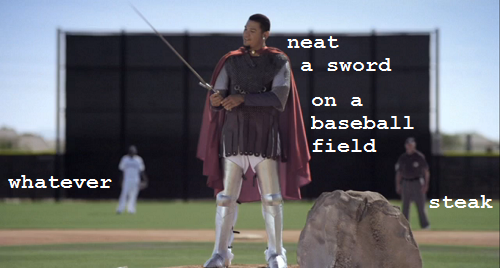
I’m not even addressing Felix’s mechanics. For his first strikeout, he drops down and throws at about 75% effort. For subsequent strikeouts, he somehow throws without leaving the rubber. I’d say that’s burying the lede, but I guess it’s fair to make the lede the scientific improbability of things appearing on a man where before there were no things. Of interest: Felix always keeps his uniform on, underneath the articles that appear. However, three of four times, he loses his hat, and it seems like in each case he loses his glove. Does he have to get a new hat and glove before the game can resume? What is that delay like? How about the delay of having to remove a suit of armor? What do you do with a suit of armor that you can’t wear during a game? Every time Felix strikes a batter out he ends up in violation of the MLB on-field uniform policy.
You wonder where the crowns and other articles are coming from. Are they created, or are they moved from another location? Are they removed from someone who was already wearing them? In that event I’d like to see that side of the commercial, too. It isn’t brought up, but without question this would get annoying, pretty quick, for everyone. It’s neat at first, but so is an earthquake, and no one wants to keep going through earthquakes. As such, I suspect, in time, Felix would start pitching to contact, actively trying to avoid strikeouts. So Felix would be worse, and he’d work slower (due to uniform delays), so Felix would turn into Miguel Batista. It’s quite the monkey’s paw kind of arrangement. “I want a crown every time I strike someone out!” /wish granted “oh no, the unforeseen connnnnnnnnsequences”
Slow Mo and Music
Sticking with the comfortable theme of scientific impossibilities, we observe a world in which everyone acts in real time, except for Robinson Cano, who exists within our world and his own slow-motion world simultaneously. Again, as was the case with Felix, what we’re seeing is a new phenomenon, presumably. Brad Miller hadn’t heard about this. We’ve certainly heard nothing about this. But Lloyd McClendon saw it coming, so maybe McClendon is a seer, or a visitor from a future time. I feel like, if I were Cano, I’d be considerably less cheerful if I could never speed up. One would adjust — one can adjust to just about anything — but I think you’d miss real speed if you could no longer operate at it, especially if everyone around you is scurrying by like nothing’s up.
There’s something extra strange: that which interacts with Cano is also slowed down. The Moose slows down. Grounders slow down. Pitches slow down. Miller and McClendon don’t slow down, even though they’re talking about Cano and looking right at him, making eye contact. Where’s the line between active and passive engagement? Are Miller and McClendon just coincidentally immune? WHAT IS HAPPENING
My favorite angle is the mocking one. Cano does everything smoothly, but he developed the reputation in New York of being an occasional candyass. People got on him for not busting it down the line to first base, and now the Mariners have aired a commercial that has Robinson Cano acting in slow motion. Yankees fans would be like “yeah basically”. Then they’d be like “what do you mean ‘Brian Roberts'”. I like to think the Mariners did this somewhat on purpose even though I’m certain they did not. I mean, they filmed the commercial on purpose, but, oh nevermind.
Quiet Surprise
Hisashi Iwakuma, the all-business pitcher and the all-surprising person. Not gonna lie — this one’s grown on me, and it’s mostly because of this one single screenshot:
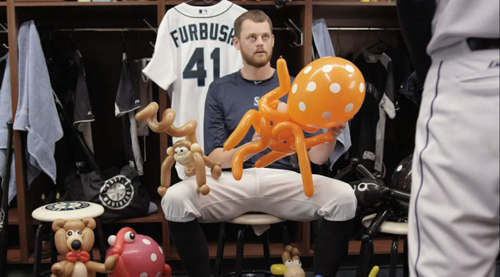
Here’s the thing I don’t understand. Charlie Furbush is surprised by Iwakuma’s balloon animals. He’s surprised by Iwakuma’s break-dancing. He’s surprised by Iwakuma’s singing in the shower. Charlie Furbush and Hisashi Iwakuma have been teammates on the Mariners for two seasons. Spend two seasons with a guy and you usually get to know him pretty well, even if you don’t mean to. Hell, Mike Zunino isn’t surprised by Iwakuma, and he’s been a teammate for a fraction of the time as Furbush. What is the history between Furbush and Iwakuma? Why did they keep such distance from one another? What’s brought them together in 2014? Did something about Furbush make Iwakuma uncomfortable before? Did something about Iwakuma make Furbush uncomfortable before? I should also note that Iwakuma is probably forbidden from break-dancing per the standard terms of his contract. Which doesn’t mean he wouldn’t still do it, but he probably wouldn’t do it in the team’s own weight room.
Old School Kyle
Kyle Seager is pitched as an old-school style of baseball player. What this actually means is that Seager is white and mostly adequate across the board without having any particular standout skills. He’s a guy who works hard to maximize his relatively ordinary talent. Now, as far as the commercial is concerned, I don’t know what’s old school about starting a game with a dirty uniform, since I’m pretty sure even in the olden days they had laundry. There’s certainly nothing old school about using Twitter, no matter how you do it, and if you equip an old typewriter with Internet capability then to be honest that’s pretty cutting edge and sort of hipster. Even if Seager wanted to practice getting hit by pitches, I’m pretty sure the Mariners would put an immediate stop to it on account of not wanting to be reduced to starting Willie Bloomquist. You know who’s the most old school? The Seattle Mariners’ front office. They could’ve alternatively shot that commercial. But then I would hate that commercial and the individuals featured within it. The new school’s pretty good. The old school can be kind of antiquated, and if you go back far enough, super racist. And if you go back even further, wow, dinosaurs! As you might be able to tell I don’t have many thoughts on this commercial.
Chadwick
First of all, yeah, no one’s going to recognize Henry Chadwick the first time. Everybody will recognize Henry Chadwick the second time, and all subsequent times, because the previous times will have identified the man as Henry Chadwick, and people pay attention. And then, if you’re going to go to the trouble of bringing up Henry Chadwick, you probably shouldn’t tell people it “makes no sense” to use a K for a strikeout. It’s weird, to be sure, but there is an explanation, and it’s kind of famous — the S was already used to denote a sacrifice, and K is the last letter of “struck”. So Chadwick went with K, and K is kind of the most distinctive letter in “strikeout” anyway. Who’s narrating this? Why didn’t he look that up? I just looked it up again and it took me 30 seconds. A little research and the narrator could’ve avoided his completely erroneous conclusion! How embarrassing for him, this is going to air on television a whole bunch of times.
Overall
The Felix commercials will stick — Felix isn’t going anywhere, and I think the guy behind him in center field is Abe Almonte, who also isn’t going anywhere. Even if he does, he can’t be identified in the spot conclusively. Seager’s commercial will stick. Iwakuma’s is a little more dicey, as you never know when Furbush might get traded, and I think that’s John Buck there in the break-dancing scene, and Buck could go away with little notice during the summer. Cano’s commercial will stick, because Brad Miller is the shortstop and Lloyd McClendon can’t get fired that quick. By keeping all the commercials in steady rotation, it’ll take longer for them to get old, but I don’t find any of them to be genius. There are just individual highlight moments, like Furbush’s stare, or Felix earning his first crown. In other words, there are moments like Bullpen Face and last year’s Dustin Ackley, but there’s no Larry Bernandez in the crop. Maybe that would be unfair to expect. They’re 30-second commercials, and being incredibly and consistently clever is hard.
As always, I appreciate that the Mariners have people who make this a priority, and I appreciate that the team commercials are a point of pride. I appreciate that this is a thing to look forward to, and I appreciate the players’ willingness to participate. I appreciate that my standards are impossibly high and if you’re trying to be funny I’m difficult to please. Maybe all of next year’s commercials should feature John Mulaney instead of Mariners stuff. If I still like John Mulaney by then. But who could possibly ever grow tired of John Mulaney? He’s adorable! The cold truth is that no matter what you do you’re probably going to have a hard time selling people on the Seattle Mariners. Better days ahead, hopefully.
Oh wait, I just realized something. Another way in which Kyle Seager is old school is that he’s a talented and productive position player on the Mariners.
Bonus: Slogan
For the second year in a row, the Mariners are “True to the Blue”. For the second year in a row, I’m perplexed. Is it a reference to people who are blue, or depressed? Is it a reference to Seattle Mariners tradition? In either case, if the Mariners were to stay true to the given blue, it would seem to promise a summer of agony. “2014 Seattle Mariners: we’re going to Mariner again.” Good seats are still available!