
Game 86, Mariners at Reds
Aaron Harang vs. Mike Leake, 4:10pm
Aaron Harang was once a near-elite pitcher for Cininnati, averaging nearly 5 fWAR per year in his three-season peak from 2005-07, but a combination of health and aging has left that peak an isolated, sort of bizarre outlier in a journeman-type career. He topped 2 WAR only once outside of those three years, and while he hasn’t exactly been awful, his status as the cream of the DFA crop is sort of understandable at this point. It’s the sort of precipitous drop that cries out for an explanation – why did a guy throwing 230IP per year and averaging about 5 WAR suddenly turn into a 1-2 WAR #5 starter? Harang himself points to a four-inning relief appearance midway through his 2008 campaign as the major turning point. Indeed, he’d been pitching decently through late May ’08 when he pitched the 9th-12th in a game against San Diego, but he faded badly the rest of the season, struggling with a HR problem that became an unwanted calling card for him.
Cininnati’s Great American Ballpark is a great hitter’s park, with insane HR factors according to Statcorner (look at the RHB factor!), but the fly-balling Harang had fought his home park to a draw during his peak. In only one season though (2006) did he post really noticeable home/road power splits. Even after his homer problem started in earnest in late May of 2008, it wasn’t something linked to GABC – he gave them up everywhere. His opponent today, Mike Leake, stands in stark contrast to Harang’s ecumenical spirit.
Leake’s got a great ERA this year, and as Eno Sarris noted, it’s not that he’s been incredibly lucky. He’s running a normal-ish BABIP, and while his K% and BB% are very close to career averages, they’re both slightly improved. The big difference is in his HR rate. Even though he’s a slight ground ball pitcher, Leake’s struggled with HRs in the past – his HR/9IP is far and away a career best, and is actually half what it was in 2012. Not surprisingly perhaps, his home park isn’t driving that change. He’s still giving up homers at home, but his road HR/FB and HRs allowed have fallen dramatically.
Is it sustainable? I’d tend to doubt it, but that’s sort of the sabermetric stock answer, isn’t it? Scott Weber and Sarris both note that he’s got a slightly different pitch mix this year, using more change-ups/curves and less sliders. That’s a possible driver of an improved HR rate, but there are two problems there. First, a chunk of the difference probably’s due to the batters he’s faced. In 2011, he faced more right-handers than left-handers (362-331), so it’s not surprising that he threw more sliders overall. This year, he’s facing more left-handed hitters (222-200), and so it makes sense he’d throw fewer sliders and more changes. That doesn’t explain 2012, but maybe he’s a slow learner. Second, it would help the theory if his slider was a particularly bad pitch for HRs – it’s not. He’s given up HRs on 3.8% of at-bats ending with a slider and 4.9% of at-bats ending on a change (again, this makes total sense when you remember what hand the batters in these ABs presumably hit with), and 3.7% of at-bats ending with a curve. That plus his fairly normal HR/FB at home lead me to think that his true-talent HR rate is pretty much where it’s always been – his command is still excellent, but when he makes a mistake, hitters have been able to punish him.
Interesting line-up today:
1: Miller, SS
2: Franklin, 2B
3: Ibanez, LF
4: Morales, 1B
5: Seager, 3B
6: Zunino, C
7: Saunders, rF
8: Ackley, CF
9/SP: Harang
The M’s get an extra lefty bat with Saunders in right in lieu of Bay, I suppose. It also helps the M’s rest the aging, Yuni-destroyed legs of Endy Chavez, which is among the many things I never thought I’d be writing this season.
I mentioned Scott’s article above, which reminded me: Scott Weber, Patrick Dubuque et al have been doing great work at Lookout Landing of late. Completely different place than it was when Jeff/Matthew ran it, which is to be expected, but good stuff.
Good day in the minor league system with Erasmo Ramirez making a start in Salt Lake, Victor Sanchez pitching at home for Clinton, and Thyago Vieira pitching for Everett.
Go M’s
Game 85, Mariners at Rangers
Hisashi Iwakuma vs. Martin Perez, 5:05pm
Happy 4th of July – sincerely hope everyone enjoys the holiday. Canadians, I know you just celebrated, but I think you really get into the spirit of July 4th by blowing off work and celebrating again. I celebrated Canada Day in a quiet, understated way by having some red wine and a sensible dinner at home – I like to think you appreciated the gesture. Today’s not really about “quiet” or “understated” however, so have a beer and yell at the Rangers on TV. Or whatever else it is you’d like to do today (freedom!).
It’s fitting that the M’s are playing in Texas, somehow. Though modern-day Texans lustily celebrate today’s holiday, they’ve less reason to celebrate than those of us in more civilized lands. It’s true of course that Washington wasn’t an original colony, and there wasn’t much of a population here when the US celebrated its centennial. But I like to think we’re celebrating some enduring values, some principles, when we dust off our copy of the Declaration of Independence. It’s the call to reason, the clear, sober delineation of grievances and a demand of redress, not of blood or vengeance. Many point out the myriad ways in which the country founded by people who wrote the federalist papers, the constitution and the declaration has failed to live up to those values. Fair enough, but I’d like to think we can ALL come together in the celebration of universal natural rights. All of us except Texans, maybe.
Texas was created as a Republic, bitterly divided between those who wanted to gradually join the Union, and those who wanted to stay a republic, drive out Native Americans and march west to the sea. Eventually, the unionists won out, but the victory proved temporary. Texas was one of the original seven states of the Confederacy; less than 20 years after joining the union, they took up arms against it. Following *that* defeat, they continue to observe Confederate Memorial day as a state holiday. I’m all for having holidays. I’m drinking a beer and I’m not going to work right now. But it seems a bit odd to really celebrate the 4th of July seven months after Confederate Heroes day*.
Martin Perez, as I’ve mentioned before in these previews, was a Top 100 prospect for what felt like a decade. A rough introduction to AAA in 2011 was followed by a rough start to 2012, culminating in a disastrous start in Tacoma in which the likes of Scott Savastano battered a laboring Perez to a pulp. After a regroup and work with the Rangers’ coaches, Perez started to put things together down the stretch – aided by the fact that his velocity ticked up a bit. He touched the mid-90s routinely as a teen and into his early 20s, but was in the low-90s early in 2012. When he debuted with Texas he was averaging 92-93, and has progressed further this year, as he’s sitting at about 94 with his four-seam fastball.
A brilliant outing in relief last year – against the M’s – saw him rack up 5Ks in 4+ innings, still his career high (tied with a 6IP start vs. Oakland), and pushed him into the starting rotation in September. His results there were mixed, and he wasn’t able to lock down the 5th spot in the Rangers’ rotation this spring. Injuries and great run of form for Round Rock have led to another opportunity, though, and he appears to be capitalizing – he’s coming off six shutout innings against a good Cincinnati team. Perez’ success has come without the aid of strikeouts, and without much of any success at all against righties. His FIP’s OK thanks to a very low walk rate and fantastic luck on HR/FB, but his K rate’s worse than Blake Beavan’s 2012 mark because he’s got nothing to throw to righties.
Last year, he tried a curve ball along with his slider and change, but he’s largely scrapped that in favor of the change in 2013. The change isn’t a terrible pitch, but it’s not exactly a swing-and-miss pitch, and unlike last year, his fastball’s not fooling any right-handed hitters. He’s kept it in the park, but BABIP and HR/FB won’t make up for actual stuff. That said, scouts have been raving about Perez’s stuff for years, so it’s possible he’s got more stuff than he’s shown thus far. Still, a full-strength M’s team would be a decent match-up, as a 2-3-4 of Franklin, Morse and Morales would presumably trouble the Venezuelan. But the M’s *aren’t* at full strength, and filling out a line-up that reflects Perez’s weakness means giving Brendan Ryan a start. Ah well.
1: Bay
2: Franklin
3: Ibanez
4: Morales
5: Seager
6: Smoak
7: Chavez
8: Blanco
9: Ryan
SP: Iwakuma
The M’s are going for their first sweep in Texas since September of 2001. Do it for America, Mariners!
The Rainiers are in Salt Lake, with Brian Sweeney on the hill. Roenis Elias is pitching right now for Jackson in Pensacola, and Andrew Carraway’s making a rehab start in Everett tonight (he threw four hitless innings against Spokane five days ago).
* In bitter, Texas-sized irony, Confederate Heroes’ Day sometimes coincides with Martin Luther King day.
Game 84, Mariners at Rangers
King Felix vs. Derek Holland, 5:05pm
Happy Felix Day!
For reasons that no one fully understands, close losses in games Felix pitches are felt much more keenly by a large segment of the M’s fanbase than by Felix himself. I love this team, but if I was Felix, I might’ve…well, *explored* alternatives to a long-term extension here. I cannot imagine how amazing it would be to live as an incredibly wealthy person in Seattle. And maybe that’s enough – in the grand scheme of things, tough losses to Jeanmar Gomez are whatever’s beyond first world problems. Maybe Felix’s personality is such that he genuinely doesn’t mind. He can see how offensive futility eats at players (like Brendan Ryan), at managers, and fans – maybe he’s made the decision that bitterness isn’t worth wasting time on, and in any event, he can afford any and all distractions he wants. So if not for Felix, the M’s offense owes a good stretch to *us*. It sounds stupid to frame it that way, and frankly, it IS stupid. This is entertainment; if it isn’t entertaining, we’re supposed to find alternatives, not invoke some bizarre obligation on the part of the entertainers.
Still though, this whole thing seems cruel when you step back from it. The M’s acquire, develop and showcase a singular talent – someone who justifies every ticket to the stadium by his presence. Then the club surrounds him with a succession of some of the worst offenses in history. We’re now in the somewhat odd position of being able to compare and contrast different styles, different modes of futility, as we watch Felix labor on heroically. The context of a pennant chase or contention has been stripped from a jaw-dropping percentage of Felix’s starts, especially if you include the beginning of years like 2011-12 and probably 13 where they were in de jure but not de facto contention (if you can even talk about contention in April). So I cheer for Felix every five days, without context. But take all that away, and the failures like five days’ ago look senseless. It’s like I bought my kids a ticket to “Bambi” and it was a 2-hour long, ultra-slow motion clip of Bambi’s mother being shot. So yes, I have a grievance. Yes, I am complaining to my entertainers instead of finding better entertainers. You mess with Felix, you mess with me. Stop messing with Felix, even if Felix doesn’t mind.
Derek Holland is an enigma, in that he voluntarily attended a Counting Crows show this year, and then got himself ejected from the theater. Also, his career is dominated by variance in his home run rate. He came into the league a fire-balling lefty without much command, and MLB hitters punished him. But as he developed his slider and change, and as his command improved, he appeared on the verge of stardom – his 8+ inning 2-hit shutout performance in the 2011 World Series seemed to be the moment that would propel him to ace status, or that not-quite-ace-which-is-still-handsomely-remunerated status that CJ Wilson had. Instead, he was pretty bad in 2012, with 32 HRs allowed in less than 180 innings and just 1.7fWAR (adjusted for Arlington).
This year, his HR/FB rate is less than half of his career average, so as you probably know, he’s got the fourth-most fWAR of any pitcher in baseball. It’s not just about HRs – his K% is up, though it’s not appreciably higher than it was in 2010. But, coupled with a slight drop in walks, and Holland’s pitched like the ace many thought he’d be in 2012. As a lefty with a big fastball and a good slider, many observers thought he’d have to refine his change-up to avoid big platoon splits (like many tough lefties, Holland faces a steady diet of right-handed batters). Instead, his change-up is still the same work-in-progress it’s been for years. In 2010, righties hit .256 and slugged .558 on the change-up (small-sample warning) – since the start of 2012, they’ve hit .318/.557. The pitch doesn’t generate whiffs, and it never did. Instead, he’s throwing his slider to righties, and it’s worked just fine. I’ve talked about some in the context of Brandon Maurer, but there are a few pitchers out there (most of them lefties, I’d say), who are able to get away with throwing opposite-handed hitters a lot of sliders and have success. Madison Bumgarner for one, or CC Sabathia for another. Holland may be in that group now.
Line-up:
1: Bay
2: Franklin
3: Ibanez
4: Morales, DH
5: Seager
6: Smoak
7: Ackley, CF
8: Zunino
9: MIller
SP: FELIX
Tyler Pike’s on the hill for Clinton in the Midwest League, while James Paxton starts for Tacoma at lovely, warm Cheney Stadium. The Rainiers always have their big fireworks show on July 3rd, and it’s probably the best attended game of the year – it’s a tradition that long pre-dates the Rainiers or the association with the Mariners, and it is, somewhat oddly, one of the things I find myself missing about Tacoma now that I don’t live there anymore.
Pessimist’s Guide To Mariners Pitching Prospects
Prospects are exciting, and pitching prospects are no different. When teams acquire prospects, they see bright futures, provided things break right and the players develop as they ought to. Every single player in professional baseball, at one point, had a reasonable shot of making it in the bigs. The talent was there, or at least it could’ve been. But most players don’t make it, and more of them fall well short of their ceilings. Even top prospects bust at an incredible rate, and when people stop evaluating them by their potential ceilings, they start to notice the red flags. There are always reasons why a guy doesn’t fulfill his promise. If you have a top prospect who doesn’t materialize into anything special, you can identify after the fact what went wrong. Things go wrong.
Pitching prospects go wrong, kind of a lot. Danny Hultzen might be going wrong before our eyes. That much, we don’t know yet, but the possibility exists. As such, let’s look at Hultzen, Taijuan Walker, James Paxton, Erasmo Ramirez, and Brandon Maurer, and try to identify the reasons why they might not make it big. For every single one of them, it’s way too early to call them disappointments. But if they were to become disappointments later on, what follow might be the explanations. You can think of these as predictions by a negative jerk.
Danny Hultzen
Doesn’t excel because: plagued by shoulder problems. They’ve popped up in 2013, and the shoulder is the bad one. The elbow is the bad one, too, and I guess everything’s better than, I don’t know, brain cancer, but if you’re a pitcher, you don’t want to hear anything about your shoulder. You don’t even want to hear good things. You just don’t want to hear a word about it because you don’t want to have to think about it.
Taijuan Walker
Doesn’t excel because: secondary pitches don’t develop enough, and the fastball gradually erodes. You can get by for a while at the start with a blazing heater. But in most cases, there need to be other weapons, and Walker’s are presently still coming along.
James Paxton
Doesn’t excel because: inefficiency, caused by inadequate control of the strike zone. In Double-A and Triple-A, Paxton has thrown a below-average rate of strikes, and he remains inconsistent. This might just be his thing, and maybe instead of turning into peak Erik Bedard, he becomes one of the other Erik Bedards.
Erasmo Ramirez
Doesn’t excel because: elbow. I know Ramirez is back and pitching and pitching well and pitching comfortably, but he missed some time with an elbow injury that wasn’t repaired surgically, and I’m of the opinion that these things eventually tend to be addressed surgically. It seems almost inevitable, and as much as we prefer elbow problems to shoulder problems, you’d rather there just be no problems, and there’s no such thing as a guaranteed post-surgical return to effectiveness. Maybe Ramirez’s body isn’t cut out for this. Maybe he’ll lose some of his command.
Brandon Maurer
Doesn’t excel because: mediocre command and incomplete repertoire. Maurer’s still trying to figure out lefties, and it’s not like he was amazing in Double-A. The best thing he did was prevent home runs, and that’s maybe the least reliable skill. The ability is in there, but Maurer might just end up as a reliever, or as a starter who gets exposed by lefty-heavy lineups. Developing that weapon isn’t automatic.
Tacoma’s starting rotation right now is incredibly interesting and incredibly promising, especially if this latest Hultzen flare-up is a minor one. It’s easy to imagine any single one of those guys going on to have a long and successful major-league career. It’s less easy to imagine busts, but that’s only because we don’t want to acknowledge the possibility. And I don’t want to seem like I’m actually this negative about all the guys. This post is deliberately over-the-top negative to make a point. But, let’s just say all of them bust, or at least that all of them disappointment. There will have been signs. Signs are always there. It’s a matter of how much attention they get.
Nick Franklin And The Hardest Thing
People weren’t prepared for Dustin Ackley to struggle. Even the realists who noted his odds of busting acknowledged that Ackley was probably going to hit, and he was going to hit soon. There’s no such thing as a sure-thing prospect, but there are prospects with higher and lower chances, and Ackley was thought to be low-risk. He hit, then he stopped, then he got worse, then he went to the minors. But around the same time, Kyle Seager emerged, and that made for welcome consolation. Ackley was supposed to be the good one, and Seager was supposed to be the uninteresting one. As Ackley struggled, Seager took steps forward, and now out of the pair the Mariners have a quality regular and a question mark. Does it really matter which is which? Yeah, it’d be great if both of them were good. It’d be terrible if both of them sucked.
Now the latest infielder to maybe pass up Dustin Ackley is Nick Franklin. We still don’t know what the Mariners have in Ackley, but Franklin has basically forced him to the outfield with his strong higher-level play. However disappointed you might be in Ackley, he doesn’t actually need to be part of the core. The Mariners have options, and if Ackley doesn’t turn out, they may well survive. And if Ackley does turn out, hey, that’s peaches, go Mariners. The situation’s not completely desperate.
Which isn’t to say that Franklin is a sure thing now, since of course Ackley was amazing out of the gate. But Franklin’s improved, and his numbers so far in the majors are legitimate. His defense has been perfectly fine, and in Franklin the Mariners might now see a long-term solution. This was a guy who spent at least a year as trade bait, and who came to spring training out of shape and in the organizational dog house. Now Franklin and his big stupid helmet might be here for the better part of a decade.
And it’s interesting to examine Franklin’s statistical record. He’s always had skills and he’s pretty much always hit. Baseball America has been a fan for years. But Franklin has really gotten going in 2013, and this graph seems significant:
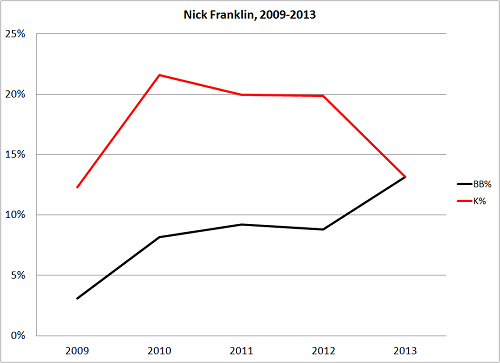
Franklin’s walks are way up, and his strikeouts are way down. His strikeout rate was this low in 2009, but that was 65 plate appearances in the super-low minors. This season, Franklin has 40 strikeouts and 40 unintentional walks, and he’s spent the whole time between Triple-A and the major leagues. His numbers, understandably, are worse with Seattle than they were with Tacoma, but they’re still good and Franklin’s still adjusting.
Used to be Franklin would run a contact rate in the mid-70s. This year it’s shot up to the mid-80s. Also, in the majors, 347 players have batted at least 100 times. Franklin’s rate of swings at balls is 20th-lowest, near names like Ben Zobrist and Kevin Youkilis. Franklin does swing at bad pitches, but everybody swings at bad pitches, and Franklin does it relatively infrequently. Franklin’s approach has been big-league caliber.
It’s not uncommon for prospects to improve in the minor leagues. That’s kind of the whole point. But it’s hard for a prospect to really improve his discipline, so it’s only seldom seen. Especially in the upper levels, when a prospect has already been pushed through and promoted a few times. How often have we daydreamed about Carlos Peguero in the impossible universe in which he figures out what balls look like? Discipline, usually, is the hardest thing to improve. Improvements tend to be incremental. I don’t know where Nick Franklin is going to settle in the bigger picture, but for now he sure doesn’t swing at many balls, and he sure does make a lot of contact. His ratios look different.
Sure, Franklin hasn’t walked much lately. But, lately, he’s seen more pitches in the zone than any other Mariner, so it’s not like the opportunities have been there. You can’t force a walk directly. You can only hit strikes and lay off the balls that pitchers might throw you because they’re worried about throwing you strikes. Franklin has an O-Swing% of 20.5%. The last 14 days, it’s 20.5%. Franklin’s all right.
You don’t want to get too far ahead of yourself, because Dustin Ackley is still too fresh in our minds. We don’t know what Nick Franklin is going to be. But he’s improved this season, at a time when the organization really needed it, and now it’s the beginning of July and the Mariners might have a new long-term second baseman. What could Franklin do? It’s not hard to notice a number of similarities between him and Jason Kipnis, if you want a hastily-identified comp. Obviously they’re different players, but they have somewhat similar skills and last year Kipnis was an above-average regular. This year he’s been a star for three months. If Franklin walks enough, makes contact enough, and defends enough, well, that’s a fine player right there. Not a fantastic player, not an All-Star, but good’s good and the Mariners haven’t had enough good. The Nick Franklin piece might fit in this puzzle.
And, boy, what if Ackley hits? It sure can be easy to not hate this team.
Danny Hultzen and Pitching Prospects
You may have heard that Danny Hultzen was scratched from his start last night, right before the start of the game, because he couldn’t get loose. This comes after making just one start after returning from a two month absence due to shoulder soreness. This is not exactly how the Mariners were hoping this would go, obviously.
Now, it could turn out to be nothing. Remember back a few years ago when Felix walked off the mound holding his elbow? He took a few weeks off and has been healthy ever since. Two years ago, Hisashi Iwakuma saw his free agent stock tumble due to diminished velocity because of shoulder issues; he’s doing just fine now, I’d say. Pitchers have problems that aren’t the end of their careers too.
But our initial reaction is always to prepare for the worst, because pitching prospects flame out at an absurdly high rate. There have been a lot of studies on this, and this isn’t a new idea, but here’s an article from a few years back that looked at the performance of Top 100 prospects from 1990 to 2003. Over that stretch, his analysis concluded that 77.4% of pitchers who rated as Top 100 prospects (according to Baseball America) ended up as busts. More than 3/4ths of all pitching prospects went on to produce little or no major league value, and the primary reason was injuries.
Position players go bust a decent amount too, of course — 62.9% of the time per this study — but don’t have the same health issues because swinging a bat is not as physically harmful as throwing a baseball. There’s more to prospect evaluation than just figuring out who is going to stay healthy, but pitchers come with an extra variable that no one has really figured out how to predict. Even if you get the talent part right, and you find a kid who works hard, and he understands how to adjust to higher level competition, it can all mean nothing if his elbow or shoulder give out.
That’s why the axiom is that if you want to find a good pitcher, start with 10 pitching prospects. It’s a slight exaggeration, but it’s not that far off, honestly. The success rate of even the best young minor league arms is just very, very low.
That’s why winning teams are generally built around position players, not pitchers. The flameout rate for hurlers is so high that you can have it all fall apart even if you collect the best arms anyone can find. Years of hard work and organization building can go up in smoke simply because of the natural risks that come from throwing a baseball. Pitchers are just not trustworthy. Yes, you love having Felix on the mound, but Felix is the exception that proves the rule. He’s great because he hasn’t had to have surgery and he figured out how to pitch at 89-93 instead of 95-99.
I hope Danny Hultzen is okay. I hope he doesn’t need surgery, and that this all just blows over, and he’s pitching in Seattle by the end of the year. But I’m not counting on it. I’m not counting on any of these young arms. With Taijuan Walker, Danny Hultzen, Brandon Maurer, James Paxton, and Erasmo Ramirez, you can look at the talent and imagine a dominating rotation. History shows that, more likely, four of them never amount to much of anything and you get one good starter from that mix.
I know it’s tempting to imagine a 2014 rotation of Felix, Iwakuma, Walker, Hultzen, and Ramirez, with Maurer and Paxton waiting in the wings in case anyone gets hurt. You’ll probably never see that rotation, just like we never saw Ryan Anderson, Gil Meche, Joel Pineiro, Clint Nageotte, and Jeff Heaverlo pitching together.
Stocking up on pitching prospects is a good thing, because you need a lot of them to build a rotation from within. Counting on a high percentage of those pitching prospects to turn into big league pitchers, though, is not a good thing, because you’re just going to be left wondering what if.
Danny Hultzen might be just fine. This might be nothing. This might also be the beginnings of the kinds of problems that have wrecked a huge percentage of Danny Hultzens that have come before him. I hope it’s not, but this is a reminder to not get your hopes up. Most of these kids are not going to make it. The Mariners are not going to ride the backs of these pitching prospects to a World Series title. That’s just not how it works.
Game 83, Mariners at Rangers
Joe Saunders vs. Justin Grimm, 5:05pm
So Joe Saunders last start, at home no less, could’ve gone better. Now he gets to pitch in Arlington, and while the Rangers aren’t a great hitting team (as you saw in Matthew’s series preview), they did knock Saunders around for 7 runs in less than five innings earlier this year. The Rangers have fared better against lefty starters this year, and the game time temperature will be in the mid-high 80s. On paper, it’s not a great match-up, and Saunders may sneak a glance at Rainiers box scores these days, with Erasmo Ramirez, Danny Hultzen and Brandon Maurer all a phone call away from taking his job.
Justin Grimm was a great story in April/May, with solid results and a great K:BB ratio, but he’s been knocked around in June. Of course, those of you with a good memory may point out that he faced the Mariners three times early on, compiling a 16:4 K:BB ratio in 16 1/3 innings, and then you notice that he’s faced Toronto, Boston, New York and Oakland in June and that’ll spare you the need to craft a narrative about how he’s “tiring” or “not used to the grind” of MLB. As you may recall, he throws a straight, 91-93mph fastball, a sinker, a change-up and a curve ball. Lefties have feasted on his sub-par change, while righties have enjoyed Grimm’s fastball (they’re slugging .613 on it), so Grimm’s not shown much in the way of platoon splits so far. His curveball’s been good, but he doesn’t throw it much when he’s behind in the count.
Grimm’s biggest problem this year has been sequencing. Like most pitchers, Grimm’s walk rate rises a bit with runners in scoring position. Pitchers often pitch around great hitters, and essentially trade OBP for power with men on base. With no one on, pitchers generally challenge hitters more, as a poor outcome doesn’t hurt them as much. Grimm’s got the slightly higher walk rate part of the equation down, but he appears confused about slugging with men on. With no one on, batters are slugging .436 off of him. With men on, that moves up to .526, and with RISP, it’s way up to .645. The samples here are absolutely miniscule, so this is more of a curiosity than anything. It’s tempting to point to problems pitching from the stretch as driving splits like these, but there have been too many cases (Brandon Morrow for one) where a pitcher has terrible men-on-base splits for 3, 4 years and then shuts down batters with men on for a year or two. It may not last, but the M’s should get a few runners on just to see what happens. If the M’s are lucky, Rangers pitching coach Mike Maddux has made these splits a point of emphasis, berating Grimm in front of his teammates for his lack of “guts” and for letting his team down, and Grimm can think of nothing else, his hands trembling in fear as he looks in for the catcher’s sign, each “you suck” from the crowd coming through loud and clear, and is the batboy laughing at me?, and the umpire’s been squeezing me the whole game.
1: Chavez
2: Franklin
3: Ibanez
4: Morales (DH)
5: Seager
6: Smoak
7: Ackley (CF)
8: Zunino
9: Miller
SP: Joe Saunders
Good to see Ackley’s injury a few days ago wasn’t serious. While it looked initially like a severe wrist sprain, it was actually his thumb, and while it’ll be wrapped tonight, he’s obviously able to play.
So Taijuan Walker’s pretty good. Another AAA start, another win, and still no runs scored off the young righty. Like most people, I think it’d be good for him to get plenty of work in at AAA and see if he can improve the consistency of his cutter and curve. Like most people, I won’t mind too much if Walker makes a really strong case for an accelerated timeline, though. Danny Hultzen pitches tonight in Tacoma vs. Colorado Springs if you’d like to get out to a ballgame locally. Everett’s in Vancouver, for those up north.
Mariners Venture to Vast Baked Terrain of Texas
| MARINERS (35-47) | ΔMs | RANGERS (48-34) | EDGE | |
| HITTING (wOBA*) | -10.4 (16th) | 3.4 | -15.1 (20th) | Mariners |
| FIELDING (RBBIP) | -16.8 (25th) | 2.6 | 17.1 (7th) | Rangers |
| ROTATION (xRA) | 11.1 (11th) | -3.1 | 24.0 (4th) | Rangers |
| BULLPEN (xRA) | 4.5 (12th) | 1.3 | -5.0 (21st) | Mariners |
| OVERALL (RAA) | -11.6 (16th) | 4.3 | 20.9 (10th) | RANGERS |
The last couple days of summer heat in Seattle are just a little taste of what every single day is like in Texas. It’s a miserable thing to endure and I’m glad I don’t have to any more. Best of luck, ball players.
By my numbers the Rangers are basically an average team plus Yu Darvish. However, the Mariners will miss him on this series. Which is likely good news, but it is always entertaining to watch Darvish inexplicably scuffle against the Mariners of all teams. Though that usually only lasts for an inning or two and then he settles down to domination mode. So, nice not seeing ya, Yu.
Taijuan Walker’s AAA Debut: Now it Can Be Told
Due to computer issues, I wasn’t able to get this up yesterday, but that just allows me to harvest quotes and play off all of the great posts and articles about Walker’s outing, while the off-day means I’m not obligated to bang out a gamethread instead. So hey, instead of talking about the rising frustration about the offense, Felix’s lack of support, the bullpen’s bizarre collapse or in-fighting about Raul Ibanez, let’s focus on the fact that the M’s have one of the best pitching prospects in minor league baseball.
I say this as someone who’s been a bit more lukewarm on Danny Hultzen than his numbers might lead you to believe.* Hultzen’s older, has an extremely high floor, and will pitch in Seattle fairly soon, but Walker’s potential and poise make him the superior prospect. Everyone mentions how raw he was coming out of high school as a two-sport star. He had a live arm, not a lot of coaching, and enough question marks that pushed him down to the supplemental round – and enough that many saw the M’s selection as an overdraft. And that’s why it’s so amazing to actually see Walker now. Raw is just not the word that jumps to mind when you see him. His fastball command isn’t perfect, but he’s by no means wild. His new pitch, a cutter that he learned late last year and really showed off in spring training, simply wasn’t working – he didn’t have a feel for it. So he worked around it, and used his big breaking curve ball as a put-away pitch instead. His poise was tested by an umpire who may not have been used to a 70MPH death-dealing curve, and at least one of his two walks absolutely needs an asterisk by it. But he caught himself, refocused, and worked out of trouble.
The first thing you notice about Walker is, of course, his size. He’s tall, athletic, and his mechanics make good use of that build. While most athlete height/weight listings are…generous, Walker looked at least his 6’4″ listing. He stood next to Alex Liddi, also listed at 6’4″, for the national anthem and looked a touch bigger. The second thing you notice is that his throwing motion is easy, not violent or complicated. This may help his fastball seem a bit faster than its plenty-fast 94-97mph, and, as Jason Churchill mentioned, helps him maintain his velocity from the stretch. He started his night off with a bang – striking out Giants’ CF prospect Gary Brown out on three pitches. He gave up his first hit to the 2nd batter, however, and didn’t really show pure strikeout stuff with his fastball again.
I was curious to see how he handled lefty hitters, but they didn’t present many problems for him. No one’s confusing the Fresno Grizzlies with the 1927 Yankees, but Todd Linden’s a pretty good professional hitter, and Walker absolutely froze him with his curve ball and ended up striking him out twice. Roger Kieschnick isn’t great, but he’s a successful PCL hitter, so it’s not like Walker faced a terrible line-up. He was able to move his fastball around, get some fouls and fly balls off his cutter, and then go to the curve when ahead to righties and lefties alike.
Overall, the things I was most impressed with were:
1) His curve ball. Walker changed the grip on it this spring, but this looked more like the curve that first opened eyes in instructs several years ago. This spring, his curve averaged 76-77MPH, but on Tuesday, it was in the low 70s, and the absolute pitch of the night came in at 69. That one elicited a spontaneous giggle from me. It had clear two-plane break, and looked like it was going into the earhole of the righty batter before dropping into the strike zone. It was just one night, but the curve was an easy plus pitch. I’m just sort of surprised, given the struggles he had with it last year, and with so much talk about how his cutter was becoming his go-to breaking ball.
2) Poise. I talked about it above, but this looked like a veteran. Walker pitched around a subpar cutter and subpar umpiring without getting flustered (and he had opportunities) and without resorting to centering fastballs. He started using more fastballs and pitching up, and got some quick fly-outs in the middle innings. It didn’t help his FIP numbers, but it looked deliberate – and smart.
3) Control. He began the year walking a ton of Southern League hitters, but something clicked for him in late May, and whatever change he made continues to work. This is not a guy who throws 98 and hopes for the best.
And, just for the sake of balance, some things that weren’t perfect:
1) His control of the fastball was great, but the Grizzlies put some good swings on it. His motion is clean and efficient, but perhaps not the most deceptive. His height may give him a deeper release point, but he didn’t have too many whiffs.
2) His cutter was just off. He mentioned this in a post-game interview with Ryan Divish, but batters clearly ID’d the pitch and he wasn’t spotting it where he wanted to. It wasn’t bad – no one really pulled a ball all night, but this pitch got rave reviews in the spring and through the AA season, and at least on Tuesday, it was something of a letdown.
3) As awesome as the big, slow curve is, I wonder if MLB hitters will be able to react when the velocity differential is so huge. Again, Walker touched the high 90s, and then dropped in a curve that occasionally hit the high *60s*. It was a very good pitch, and no one in Fresno’s line-up looked prepared to punish it. But I wonder if that’ll be true in the big leagues. Stephen Pryor worked on a slow curve this spring too, and he’d have a Walker-esque velocity difference if only he was healthy and felt like throwing the pitch in game situations. Something to watch, but it feels like a nitpick given how effective the pitch was.
* I’m happy to report that Hultzen rejoined the Rainiers tonight and tossed 6 scoreless innings against Las Vegas with 6 Ks. Still, I’m a bit concerned that he may run larger platoon splits than his MiLB numbers would suggest (ala Carter Capps/Brandon Maurer), and he simply hasn’t shown the Maddux-like command that some attributed to him out of UVA. Now, a lot of this isn’t Hultzen’s fault – he’d be a great pitching prospect for anyone, but he’s held to an extremely high standard as a #2 overall pick. But in 2012 he had that bizarre lapse in command in Tacoma and in 2013 he’s been shelved with a sore shoulder. No one’s saying he’s bad, but like pretty much any GM in the game, I’d take Walker.
Game 82, Cubs at Mariners
Jeremy Bonderman vs. Edwin Jackson, 1:10pm
It’s 90 degrees in Seattle today, a second straight perfect day. I’ve got a beer, my kids are playing on a slip and slide, and for whatever reason, I just can’t summon the will to write about Jeremy Bonderman vs. Edwin Jackson.
1: Chavez
2: Franklin
3: Ibanez
4: Morales (DH)
5: Seager
6: Smoak
7: Bay
8: Miller
9: Blanco
SP: Bonderman
Interesting that Wedge has bumped Seager down from his customary 3rd spot to….I’m sorry…I’ve got an emergency gin and tonic to prepare. Go M’s!