
Game 81, Cubs at Mariners
Aaron Harang vs. Jeff Samardzija, 4:15pm
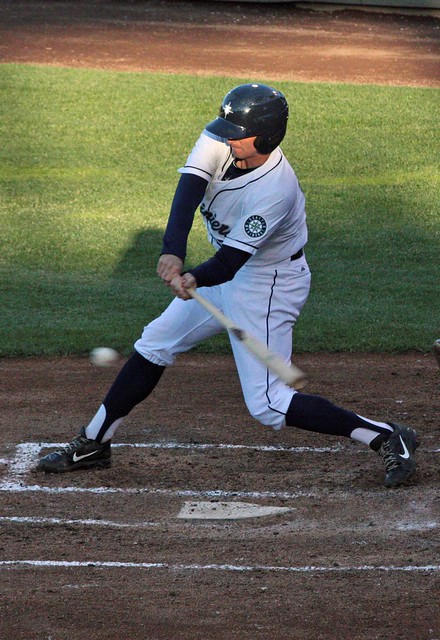
Odd start time, and odd uniforms today. The M’s and Cubs are wearing uniforms from 1909 – the Cubs sporting the, er, Cubs uniforms of that year and the M’s donning Seattle Turks jerseys. The Turks were in the old Northwest league, then categorized as class B. With the Pacific Coast League pulling back from the northwest, the B-division NWL was pretty advanced, and it wasn’t too rare for players to jump from the NWL to the majors. There were plenty of local teams in the league – Tacoma’s original Tigers played in the league from 1906-1917, Seattle joined in 1907, and over the 12 or so years the league operated, there were teams in Bellingham, Spokane, Victoria, Vancouver, Grays Harbor, Aberdeen, Everett, Butte and Great Falls.
Seattle’s club was known as the Siwashes for its first two years, but they changed it, perhaps realizing that “Siwash” was a racist, derogatory term for Native Americans.* So, in 1909, they became the Turks** (sensitivity isn’t a light switch you just flick on, apparently) and the club won an astounding 109 games to win the league title. Maybe because they wanted to go out on top, and maybe because the Ottoman Empire was both far away and fading, they changed their name again the following year – this time to the Giants. The Northwest League had some pretty good names, if you look past things like ‘Siwashes’ (they probably went with that since Spokane was already in the league as the Indians). The Vancouver club’s name in the inaugural season was the “Horse Doctors.” “Veterinarians” was apparently too hifalutin. Victoria was the “Legislators” which is the sort of name that probably wouldn’t make anyone’s short list these days (though Sacramento had a similar name, the Solons, around this time).
Minor League baseball was in flux around the turn of the century, trying to stay profitable in the sparsely populated far west. There’d been a Pacific Northwest League years before, which then merged with a California league to form the Pacific Coast League. The Seattle Indians were a part of that first season in 1903, but the league contracted in 1906, and Seattle merged with the four-year old Northwest League. Tacoma migrated to the PCL for just one season before essentially re-joining the Northwest League. Portland also moved from the PCL (where they were the Beavers) to the NWL (where they became the Pippins).
OK, enough history. The M’s face the Cubs’ immensely talented right-hander Jeff Samardzija today. The Cubs famously bought Samardzija away from the NFL (he was a great wide receiver at Notre Dame) and then watched in horror as he moved through the minor leagues with Blake Beavan-ish strikeout numbers. He threw a darting 95-98 sinker, a slider and a splitter, but these generated contact, not whiffs. Something clicked for him in 2008, and he started getting K’s – he struck out over a batter an inning in is initial cup of coffee that year. In 2009, his K rate fell again, and paired with his poor control and home run problem, he regressed to a sub-replacement-level pitcher. In 2010, he was actually even worse, with fewer K’s, more BBs and HRs. He’d dumped his sinker, become an extreme fly ball pitcher, and changed his delivery from a whippy three-quarters to more of an over-the-top release. He looked like he was well on his way to becoming a very expensive bust.
In 2011, everything changed. He moved his delivery back closer to where it was when he came up, ditched his sub-par curve that he threw in 2009-10, and his velo played up as a reliever. He had a very good year, so it surprised me when the Cubs moved him back to the rotation in 2012. His fastball is still oddly hittable for a 96mph pitch with plenty of movement, but his splitter is a real wipeout pitch, especially to lefties, and his slider’s very good against righties. But one of the biggest things that helped Samardzija take his big step forward was refinement in his location. Both lefties and righties have punished Samardzija on middle-in pitches, and they still do. Early in his career, his command was terrible, so he mixed a ton of walks with centered pitches (and, I’m guessing, some ill-advised advice to “control the inside corner” and push people off the plate). As his command improved, he was able to pitch to the outside edge much more effectively, and that’s helped him get to his breaking balls – his first strike percentage moved from about 56% from 2008-2011 to 62% these days.
The M’s send Aaron Harang to the hill, with Nick Franklin getting an off-day. You’re looking outside and really considering blowing this one off, aren’t you?
1: Chavez, RF
2: Miller, 2B
3: Seager, 3B
4: Morales, DH
5: Ibanez, LF
6: Smoak, 1B
7: Zunino, C
8: Ackley, CF
9: Ryan, SS
SP: Harang
Franklin’s off-day isn’t just to give him a rest – he’s got a stiff neck, but is still available to pinch hit. Michael Saunders hurt his finger, so he’ll be out for a few days.
* – It’s amazing to look back at something like ‘Siwashes.’ I mean, it’d be inconceivable that you could get away with naming a sports team something like “Redskins” today, right? Wait, what?
** – The Young Turks revolution in 1908, which led to the restoration of Parliament that had been suspended in the 1870s and the re-imposition of the constitution of 1876, may have led to the somewhat strange-seeming decision for Seattle to have a club named the Turks. This situation held until the Young Turks coup of 1913 after the Empire’s lost nearly all of its possessions in the Balkans. I always wondered if that, and then the Empire’s participation in World War I got that line about the Dardanelles included in UW’s fight song “Bow Down to Washington.” Maybe the guy really just needed a rhyme for “excels.”
Dissecting a Box Score
Yesterday was probably not an important day to many of you unless it’s your birthday in which case, oh gosh, I’m sorry. Or it may be if you’re a history buff, considering we have the assassination of Franz Ferdinand, the Treaty of Versailles, and the beginning of the Irish Civil War all happening on the same day in various years. Man, that is some history. But for me, today marks the four-year anniversary of one of the most bizarre minor league box scores I’ve ever had to talk about, which was the defeat of the High Desert Mavericks at home against the Lake Elsinore Storm by a final score of 33-18 in a game that lasted four hours and ten minutes.
Every few months, I go back and look this one up and each time I seem to uncover something new. Its depths likely aren’t endless, but that such a box score would have certain eccentricities goes without saying. This time around, I’ve decided to report on my findings on this particular trip down the rabbit hole. What follows is going to be a lot of fragments pertaining to what happened and, to a lesser extent, how it came about and what happened next for the players involved. I’m not going to try to re-construct a narrative from it because, for one thing, you can just follow the game log, and for another I would imagine that to be even more tedious. I’m also not trying to write “well” about this box score so much as relish in its oddities.
June 28th 2009 was a Sunday. A crowd of 1,054 was enduring a gametime temperature of one hundred degrees and the wind was blowing out to left at seven miles an hour. We certainly never expected what happened next.
Read more
Game 80, Cubs at Mariners
Hisashi Iwakuma vs. Travis Wood, 7:10pm
I looked at the pitching probables and saw “Chi: Wood” and instantly thought of Kerry Wood. He hasn’t pitched for the Cubs in years, and retired and all of that, but still…if you weren’t watching baseball in the late 90s, you missed one of the most incredible debuts in baseball history. Wood’s 20 strikeout game came in his 5th big league start, and it is by some measures the best pitched 9-inning game ever. So, uh, yeah, good thing the M’s are facing Travis Wood.
Wood’s had something of an odd career path so far. He came up with Cincinnati and was an above-average starter for half a year in 2010. That faded to something more like average for another half year in 2011, and then deteriorated to “bad” last year with Chicago. He’s a lefty with a straight, rising 90mph fastball who is about as grounder-averse as they come. Predictably, his results tend to be more volatile – if a bunch of fly balls go over the fence, his ERA and, especially, his FIP suffer. If they stay in the yard, he looks decent (think of Blake Beavan’s quality-start streak in his first half-season). This year, they’ve stayed in the yard, and Wood comes into the game with an ERA under 3 and a solidly above-average FIP.
He throws a very straight 90mph four-seam fastball, a straight, almost rising sinker with enough vertical movement that you figure Wood doesn’t quite get either the concept or the execution of a sinker, a slider, and a flurry of cutters. He throws the occasional change as well, but he throws about 30% cutters to both righties and lefties, along with 50-60% fastballs. So far this year, he’s benefited from a ludicrously low BABIP, but he’s helped himself by cutting back on free passes as well. Unlike with the Pirates hurlers in the last season, there’s really not much of a mechanical or strategic cause to point to for the changes in his results. His pitch mix hasn’t really changed. His delivery’s become more over-the-top, less 3/4, but that’s been a gradual shift since he came up, not a big move in 2013. Thus, the BABIP and HR/FB (both numbers are career bests for Wood) look a lot better as suspects.
Enough about Wood. Today’s going to be remembered by M’s fans for the line-up – both who’s in it and where they’re playing. Brad Miller makes his debut for the M’s in the starting line-up, batting 9th. Dustin Ackley gets his first start since his return from Tacoma too, and he’ll play center-field. I’m not clear on what Ackley’s done in the past day – he may have needed to prove to Wedge that he could handle playing CF in a spacious park, but I thought it was notable that he’ll debut against a lefty, and not the righty Jeanmar Gomez. Oh well. This may be the first start of a long-term double-play combo for the M’s, and hopefully this could be the first game of many for Ackley in the OF.
Line-up:
1: Chavez, RF
2: Franklin, 2B
3: Seager, 3B
4: Morales, 1B
5: Ibanez, DH
6: Bay, LF
7: Ackley, CF
8: Zunino, C
9: Miller, SS
SP: Iwakuma
That’s actually one of the most watchable line-ups the M’s have trotted out in quite a while. Ibanez DH’ing, Franklin, Zunino, Miller all in the line-up, Ackley in CF…this game’s not short on storylines.
The 40-man move to get Miller was announced – Josh Kinney’s been outrighted to Tacoma. As a guy still rehabbing his way back, that’s probably smart; if they’re able to slip someone through waivers, he’d be the one to slip. [Edit: The 40-man move is actually the DFA’ing of 3B Alex Liddi. The power hitting Italian really regressed this year, particularly in contact skills. We’ll see if he gets through waivers.]
James Paxton starts tonight in Tacoma. Hultzen started last night, Tai Walker a few days before that (yes, I’ll have a recap of that – just have to wait until MillerMania dies down a bit) and Paxton winning the PCL pitcher of the week recently, the M’s pitching depth is finally rounding into form.
Chance Ruffin and Anthony Fernandez start for Jackson in a double-header, while Thyago Vieira and Tyler Pike start for Everett and Clinton, respectively. Good day in the organization.
Go M’s
Brad Miller – Why Now?
Ever since Dave’s post a few days ago urging the M’s to call up Brad Miller, it’s been discussed throughout the M’s blogosphere. Alex Carson of Prospect Insider/Lookout Landing and I talked briefly about it on Tuesday. I’ve seen quite a few fans question the move, given the question marks surrounding his defense. But ultimately, this is the right move. Why?
* Miller’s made a number of errors, generally on routine plays. OK, you know who else used to do that? Nick Franklin. I haven’t seen Miller play as much as I saw Franklin, but I saw several more mental lapses from Franklin than I have from Miller. This isn’t about picking on Franklin as it is pointing out that mental lapses *can* be minimized in MLB. The stakes are higher, the fields are better, and there’s more time to prepare and less time spent waiting for connecting flights and bus trips. This isn’t handwaving; Miller needs to work at this, but this a fundamentally different situation from a hitter who has trouble with breaking balls or good velo. This isn’t a skills issue. MLB is *brutal* on kids with deficient skills, and it *can* be brutal on those who aren’t able to focus 100% of the time. But it’s often a good environment to improve focus as well. From what I’ve seen, he’s got plenty of skill to play SS at the big league level, and I never would’ve said that about Nick Franklin.
* Why? Because Miller now gets to learn from Nick Franklin, a guy who’s become a *better* fielder since his call-up, and he gets to work with one of the best defensive shortstops in the game in Brendan Ryan. I think we all have this image of Ryan as a joker, as a free spirit who wants to do imitations instead of work on his craft, but that’s not entirely accurate. There’s a reason the M’s kept Brad Miller with the big league club so long this March, and there’s probably a reason they wanted Miller to play 2B alongside Ryan. Ryan has a lot to pass on in terms of preparation and learning hitter and pitcher tendencies, and Miller will benefit from that a heck of a lot more than he will from fielding a few more grounders in Albuquerque or Salt Lake.
* Ultimately, because the M’s need to see if he can hit. Miller reached base in every game he played for Tacoma, so I’m going to assume a batting line better than Ryan’s is a given. But if he’s able to approach what Franklin’s done, then that really changes how the M’s approach the offseason. The M’s haven’t had offense from the position in a loooong time, and what better time to get a sense of their 2014 starting line-up than now? The season’s over from a contention point of view.
Welcome to the show, Brad.
P.S. – I’m indebted to Ryan Divish for point 2 above; Divish saw how Ryan’s preparation in the spring impacted Miller, and talked to me about how it could change Miller’s focus. He also pointed to bench coach Robby Thompson, whom Divish thinks has helped Nick Franklin)
P.P.S – Dave’s post on Miller’s call-up is here.
Brad Miller is Coming Up
Ryan Divish has the news from Tacoma.
Brad Miller will join the Seattle Mariners tomorrow for the Cubs series
— Ryan Divish (@RyanDivish) June 28, 2013
In Miller’s final game for the Rainiers, he hit a home run to extend his hitting streak to 22 games. Not bad.
I won’t spend too much time talking about Miller, since I just wrote that the Mariners should make this move a few days ago. All the reasons why I think it’s time for Miller to join the Mariners now are in that post. I’m glad they agreed.
Divish noted in a subsequent tweet that Brendan Ryan will move into a backup role (for real this time), with Carlos Triunfel heading back to Tacoma to open up a spot on the 25-man roster. Miller will take over as the starting shortstop, Ryan will serve as the backup, and Triunfel will play regularly at Triple-A. This is the best alignment of talent the Mariners have right now. Expect Triunfel to return whenever Ryan gets traded to a contender, which will probably happen closer to July 31st.
The Mariners will also have to add Miller to the 40 man roster. If they want to keep everyone in the organization, they could put Jesus Sucre on the 60 day DL, since he’s already 20 days into his DL stint and it doesn’t sound like he’s anywhere close to returning. If they go with the DFA option, I’d guess that Lucas Luetge would be the most vulnerable, though the Mariners could also potentially DFA Aaron Harang and replace him with Erasmo Ramirez. My guess is that that’s the move that’s going to happen sooner or later, so since they’ll need a 40 man spot tomorrow, Harang is scheduled to go Saturday, and Erasmo could take that spot on regular rest, they might just make that move now in order to not have to DFA anyone else.
We’ll find out tomorrow who is leaving the 40 man to make room for Miller, but the main point is that he’s now the Mariners starting shortstop. He might not have the defensive chops to stay there long term, but the best way to find out is to see how he handles the position for the rest of the year. His bat is going to be a legitimate upgrade, and if he can cut down on the errors, the Mariners long running search for a shortstop of the future may be over.
Asking The Audience: Dustin Ackley
Dustin Ackley is back, in one sense. Not in the sense that “Dustin Ackley is back!” like we all hope we’re shouting a week from now. But Dustin Ackley is back on the Mariners, probably for good, and after sitting out a couple games it seems like he’s going to get started in actual action on Friday. He’s going to be an outfielder most of the time, and that matters, but what we care about most is the bat, since it’s the bat that’ll determine whether or not he’s a keeper. For Ackley and for the rest of Ackley’s career, this is going to be an important three months, as he simply has to show more than he showed before getting sent to Tacoma.
Now, some quick background. As a rookie, Ackley posted a .766 OPS. He went into that offseason feeling pretty good about himself, and in 2012, he posted a .622 OPS. That was a letdown. Remember that letdown? Remember when it was a surprise that Ackley was bad?
Coming into 2013, Ackley made some changes to his swing and his stance. They were revealed in spring training, and Ackley felt encouraged, as anyone does after making deliberate adjustments. He felt like something had to be worked on. Ackley’s spring was underwhelming, and he started the year 3-for-30 with three singles.
Then Ackley changed the changes to his swing and his stance. That decision was made during a day off, and Ackley felt encouraged, as anyone does after making deliberate adjustments. He suggested he felt the best he’d felt in a couple years. Between then and getting demoted, Ackley posted a .572 OPS. The second half of April was pretty solid; the month of May was a disaster from start to finish. It finished in the Pacific Coast League.
Now Ackley’s back again. This time, it wasn’t about mechanical changes — it was about mental changes, changes in approach. Eric Wedge wanted to see Ackley more ready to hit, and while Triple-A pitching isn’t major-league pitching, Triple-A pitching got abused much of the time Ackley stood in. Ackley claims he has his confidence back, and he just hit .365 at a high level with 19 walks and 14 strikeouts. Ackley didn’t chase in Tacoma. He wasn’t over-aggressive, he wasn’t too passive, and he made a lot of contact. He flashed some line drives to left and left-center. There are reasons to be encouraged, because Ackley is encouraged and the stats back it up.
So, a poll. I think I know how this is going to go, but I’d like to make sure. Maybe you guys will surprise me. Usually, you guys don’t surprise me, but I am very smart about not being surprised. This is a lie. I am shockingly easily startled, even by things I know are there. If anything it’s only getting worse.
Game 79, Pirates at Mariners
King Felix vs. Jeanmar Gomez, 12:40pm
Felix was brilliant against Pittsburgh a few months ago, and now he has the added motivation of trying to atone for his 5 IP 7 R meltdown against the Angels on the 20th. The M’s could use a good outing, as their bullpen’s still in some disarray after Carter Capps struggles, Tom Wilhelmsen’s fall from grace and the fact that the team now relies fairly heavily on Yoervis Medina in high-leverage situations.
Jeanmar Gomez, by fWAR, has been a below-replacement-level pitcher in 2013, with a FIP pushing 5, a lack of strikeouts and a few too many walks. By fielding-dependent measures, however, he’s been a great find – someone who’s solidified the back of the rotation and kept the Pirates in nearly every game he’s started. Like Jeff Locke, he’s throwing a few more balls than he has in previous seasons (when he toiled for Cleveland), and he’s also benefiting from tremendous defense behind him. The question is how these two things work together.
As I mentioned yesterday, the Pirates throw the fewest strikes of any team in baseball. You know what else the Pirates do? They allow – by far – the fewest hits on balls in play. The Pirates defense has been a huge asset to their pitching staff. Starling Marte and Andrew McCutchen are outstanding in the OF, but with so many ground-ballers (the Pirates *also* lead the league in GB%), they’ve relied heavily on Clint Barmes and Jordy Mercer at SS/2B, respectively, while Pedro Alvarez has been above average at 3rd. They’ve got solid defenders at key positions, so it’s not like this is ‘lucky’ per se, but their DER and park-adjusted defense numbers are off the charts. Tampa’s 2011 team is the best recent comp for what the Pirates are doing in 2013, but to find a team that was clearly, unambiguously better, you’ve got to go all the way back to the 2001 Mariners.
Clint Barmes and Andrew McCutchen can pick it, but to get to this level of DER while also employing Garret Jones, I wonder if something else is at work. Here’s a plot of where Gomez threw his pitches in 2012. Here’s the same graphic for 2013. Again, the shift is subtle, and the magnitude’s much lower than we saw with Locke, but quite a few pitches in the zone, particularly in the center of the zone, have been shifted to the edges – and actually off the outside edges of the plate. It’s not clear to me if the Pirates are getting more balls in play on out-of-zone pitches, but that would certainly account for a lower BABIP.
Beyond that rather speculative theory, this is another indication that there are many ways to succeed in MLB. The Pirates line-up, even with McCutchen and Marte, own a 95wRC+, pretty close to the M’s 93. The M’s came into the year determined to make a break with their approach of 2009-10, when they had defenders at SS/CF, and occasionally in the corner spots as well. Whatever you think of how those (crappy) M’s teams were put together, the Pirates are another example of a team actually succeeding with a blueprint the M’s helped to popularize and now disown: that assembling a team of great defenders can help your pitching staff outpitch their “true talent” and drive runs allowed way down. Obviously, that’s not the entire story. They’ve outplayed their pythagorean and 3rd order winning percentages thanks to timely hitting and a lock-down bullpen (Jason Grilli is putting together a historical, all-time great sort of season). They’ve got uber-talented, franchise-core types in McCutchen and Marte – two guys who would be the best position players on the M’s if they played for Seattle. But fundamentally, this club is the anti-Mariners – they field the ball, keep it close, and their bullpen’s amazing. They’re getting anti-Mariner results on the scoreboard, too.
1: Chavez
2: Franklin
3: Seager
4: Morales (DH)
5: Ibanez
6: Smoak
7: Saunders
8: Blanco
9: Ryan
SP: King Felix
Felix Hernandez Point/Counter-Point
POINT
It’s neat that we can record pitch velocities. Batters don’t have any equivalent kind of measurement, any direct reflection of what’s going on inside the body, and how the body’s working together. Pitch velocity, for example, can be a strong indicator of an injury. What do we have for batters? Under-performance? Complaints of an injury? Also, pitch velocity is just fun. With that in mind, 119 different starters this year threw at least ten innings in April, and have thrown at least ten innings in June. Let’s look at the biggest gains in average fastball velocity, out of that group:
- Jeff Francis, +1.9 mph
- Mat Latos, +1.8
- Felix Hernandez, +1.7
- Jonathan Pettibone, +1.6
- Chris Sale, +1.6
- Matt Harvey, +1.6
People have written a lot about Felix’s diminishing fastball. People have tried to make comparisons to Tim Lincecum, and Felix sure as shoot doesn’t touch 100 anymore. But he can touch 94 and 95, and right now he’s gaining strength. It’s looking like he hasn’t slipped from last year. He might even end up gaining a little bit, overall. Talk about the days when Felix might become a finesse pitcher appear premature. He’s got as hard a fastball right now as Clayton Kershaw, if not a little harder, since separating the heat and the changeup is tricky. And can we take a moment to pause and acknowledge how bizarre it is that separating the heat and the changeup is tricky? Is Felix’s changeup someday going to lap his sinker? Is it going to be like when a baserunner accidentally passes the guy who’s supposed to be in front of him? That seems like the logical conclusion to this ongoing absurdity.
COUNTER-POINT
So what about Felix’s velocity? He threw his hardest in his early years, and in his early years, he was undeveloped. At one point Felix made the leap, and from then the fastball has been slipping while the results haven’t been. You’re taking velocity to be a meaningful indicator. What’s a more meaningful indicator than how batters do against the pitchers, no matter how hard they’re thrown? As a rookie in 2005, Felix allowed about 76% contact. So far this year, he’s allowed about 76% contact. There’s not really any proven link between Felix’s heat and Felix’s results, and it’s the results we ultimately want.
POINT
Pitchers are fragile. So tragically fragile. (Tragile?) Felix is one of the best pitchers, and he’s the best pitcher on this team, and he’s the face of this franchise. He’s the superstar, and he’s under contract for a long time, and he’s the guy you’d pay to watch. He has his own special cheering section, which used to be more rare than it is now, in part because of Felix’s cheering section. If Felix’s velocity were slipping, we might be concerned that the structural integrity of his joints is also slipping. We’re always worried about the possibility that Felix will get hurt, and the team will be devastated. The evidence suggests that Felix is getting stronger. There’s no sign of injury, and there’s no sign of fatigue which could lead to injury.
COUNTER-POINT
Didn’t the team just put Felix through a rigorous physical exam over the offseason, prior to his contract extension being finalized? Didn’t we already know he wasn’t hurt? The Mariners put cameras in every single pore and every single organ. There was nothing wrong at all, except for some fraying in the elbow, leading to the contract’s containing protective language. The shoulder? Nothing up with the shoulder. And the shoulder’s the biggie. We already had peace of mind, before this peace of mind.
POINT
It’s been a long time and a lot of pitches, though, since that exam. It’s good that nothing’s started to go wrong.
COUNTER-POINT
But like you said, pitchers can break at the drop of a hat. Maybe the next pitch is the bad one. There’s no way to know. Pitchers are only durable until they’re not, and that can happen suddenly. If you’re looking to live in fear, you can live in fear all the time, if you like. There’s always something to worry about, because there’s always the unknowable future.
POINT
I’m just trying to say something positive about Felix Hernandez. Have you seen this team? What is there to say? Okay, great, Nick Franklin is succeeding and maybe now Dustin Ackley is fixed, and Taijuan Walker just pitched well in his Triple-A debut so he might not be all that far off. But the Mariners aren’t good and they’re not in the race and the season’s not half-over. The season’s not half-over. Jesus! There’s nothing wrong with being positive about Felix Hernandez. It’s lighting a candle in a dark auditorium.
COUNTER-POINT
Present the facts, but don’t over-interpret them. Lay them out and say what you can say without stretching. Facts can be interesting on their own, and if a fact doesn’t seem interesting, but you think it is interesting, you should only explain why it’s interesting using other, related facts. Fact: Felix’s velocity is up. That’s about it. What does it mean? Can’t really say. It’s not science to begin with a fact and then try to figure out what it means in the bigger picture using just your biased imagination. Well, it’s not good science. Facts are firm soil. Interpretations can be quicksand.
POINT
I don’t think I did over-interpret.
COUNTER-POINT
You implied it.
POINT
Are you sure you weren’t just assuming my motives? Are you the one over-interpreting?
COUNTER-POINT
Does objectivity even exist? In isolation, sure, but when humans become involved, is there such thing as perfect objectivity in the eyes of the beholder? We’re not computers. We’re mostly computers, but we’re computers with agendas, like future evolved terror computers.
POINT
We might be over-thinking the Mariners.
COUNTER-POINT
Doesn’t seem like we’re talking about the Mariners.
POINT
In a way, we’re never talking just about the Mariners.
Franklin Gutierrez is Baseball, All Right
I’ve watched the play so many times – Alexi Casilla lining a ball into the left-CF gap in the old Metrodome, April 9th, 2009. I remember watching it in slow motion and stopping the video at various points, trying to see at what moment a catch looked likely, or even possible. My honest answer was never. At the start of the video, Franklin Gutierrez wasn’t on the screen, and while he comes flying over to his right, his stride seemingly at a different frame rate than the rest of the video, as he begins his dive, the whole thing still looks ludicrous. “Why is he diving at thaOH MY GOD!”
Baseball is so good at delivering moments like this, and stories like Franklin Gutierrez’s 2009. It’s why Jeff’s piece from April is still 100% true- MLB serves up so much greatness, so much upside, that the whole thing can get dizzying. It’s why M’s fans have convinced themselves they could compete in 2006, 2007, 2010, OK, 2013, maybe 2015. Taijuan Walker’s pitching tonight in Tacoma after slicing through the Southern League this month. No one can get Brad Miller out. Jesus Montero’s the best hitting prospect in the minors. Franklin Gutierrez is the guy you build a dynasty around.
In 1940, 21-year old OF Pete Reiser was hitting .378 and slugging .618 for Elmira of the Eastern League. After a one week dip in Montreal, the Dodgers called him up in late July and watched the youngster hit .293, and post a 104 wRC+ in 58 games. He had a lot of speed, and covered a lot of ground in CF, and obviously had some ability at the plate, but I’m not sure anyone could’ve predicted Reiser’s breakout 1941 campaign. Reiser hit .343/.406/.558, playing in 137 games. He was robbed of the MVP award, which went to his teammate, Dolph Camilli, a 1B with a lower slugging percentage than Reiser’s. Reiser’s 7+WAR led all position players in the NL, despite missing several games due to injury. Reiser’s all-out style made him a stellar defender, but he was never able to hold back, to keep a hitter to a single. Fans probably loved it, if fan reaction to Ichiro’s lack of dives is anything to go by. The next year, the 23 year old was building on his jaw-dropping 1941 season, and was sitting at .366/.423/.564 in mid-June. A little later, Reiser crashed face-first into the OF wall in St. Louis, trying to catch a drive off the bat of Enos Slaughter. Another great effort, he’s just 23, give him a day off and send him out there. That’s just the way he plays, kid can’t help it. Reiser was never the same, slumping through the end of 1942, and then getting injured again while playing for a US Army team during WWII. He was selling cars in his early 30s, and managing in the minors through the 1950s (including a stint in Spokane).*
Upside is probably why a bunch of us are still here, still following this team. We put downside and risk out of our minds because it’s not terribly fun, and if a player flames out, well, that just opens up a spot for this guy they haven’t had room for, the guy who’s tearing up the PCL/SL/whatever. Upside is preferable to downside, and it is *everywhere*. And thus, I think we miss what baseball’s doing at the same time it’s presenting all of this upside. It’s brutally, mercilessly, hunting down and attacking greatness. Injuries are always a great way to lay a pitcher low, but simple regression can be just as effective. The Jeremy Reed career trajectory is familiar to many M’s fans, but we just sort of look past the Raul Mondesi/Tim Salmon career paths – guys who were very good and looked like they could take the leap to great, and just didn’t, because it’s ridiculously hard to do and truly great players are rare. It’s why the transcendent stars like Trout/Cabrera/A-Rod/etc. are so incredible. They fight regression to a draw for a while – their true talent so incredible, random variance can’t obscure it – and then, hopefully, age gracefully. Fighting age is particularly impressive – I think this is huge reason why fans love and overrate Nolan Ryan, and it’s a big reason why Raul Ibanez is perhaps more popular now than he was in 2006. But sometimes, baseball doesn’t wait for age. Sometimes the initial volleys are enough.
It was 1981, and M’s phenom Edwin Nunez headed back to Wausau in the Midwest League. He’s pitched there the year before, at age 16-17, posting a credible ERA even in the pitcher-friendly league. He’d pitched for Bellingham in 1979, as a brand-new 16-year old. If the Northwest League wasn’t a short-season league, he’d have begun the year at 15. So, in 1981, at age 17 but with considerable professional experience, the Puerto Rican began laying waste to the college kids in the Midwest league. Nunez went 16-3 with a 2.47 ERA, striking out 205 in 186 innings, and giving up just 143 hits. His walk rate, which was fairly high the year before, was now pretty good. His K rate was ridiculous, especially in the pre-K boom 1980s. Thus, it wasn’t ridiculous when the M’s had him start the 1982 season in the major league bullpen. He was 18 when he made his debut against Minnesota, pitching 3 1/3 IP against the Twins, and giving up just one run. He was even better in Anaheim a few days later. The M’s and Angels were locked in a 2-2 tie in the 12th inning, and the 18-year old needed to sop up some innings as he was the sixth pitcher used that day. He couldn’t hold a lead in the 14th (giving up hits to Rod Carew and Don Baylor…NUNEZ WAS 18, REMEMBER), but he kept the M’s in the game through the 17th. They eventually suspended the game after the 18th inning, and the Angels won the continuation the next day, because of course they did. Nunez’s line was 6IP, 2H, 1R, 2BB, 5Ks. The M’s moved him into the rotation for a couple of starts, then sent him back to Salt Lake in the PCL to get stretched out. Partially due to the M’s indecision around Nunez’s role, and partially due to some lingering soreness, the M’s kept him in relief for much of the next few years. He pitched 90 innings in 1985, but his shoulder continued to bother him. Nunez complaints of injury were ignored or refuted by the team, who told him every pitcher is sore now and then. This battle between Nunez and the team reached a boiling point when the M’s sent him back to AAA during his poor 1986 season, and Nunez refused to report, and then accused the team of racism in their treatment of him. Somehow or another, GM Dick Balderson and Nunez made peace, and Edwin bounced back in 1987 to some degree. In 1988, the M’s traded him to the Mets for Gene Walter, who the M’s released not long after.
Anyone who watched him in 2011 could see it wasn’t the same Franklin Gutierrez. He looked hollowed out, and when he was diagnosed with IBS in April, we at least knew why. Now we had a cause of his terrible second-half in 2010. Now, with management, he’d be back to 2009-level! The more they managed the disease, the more Guti looked like a shell. His K% was lower than it was in his good year, but the ball made a different sound off his bat. He limped through a rehab stint in Tacoma, but he couldn’t hit at all once he was back in Seattle. His defense still looked OK, at least visually, but my relationship to it had changed. That old feeling of anticipation when a ball went into a gap was replaced by apprehension. The possibility of seeing a diving play was replaced with the sincere hope that I wouldn’t. Since then, the glimpses that we’ve gotten have been great, but we know what they are and what purpose they serve.**
As Larry Stone wrote, none of this is Gutierrez’s fault, just like none of this was Nunez’s fault or Reiser’s fault. This is baseball’s fault. Almost every nail that sticks up gets hammered down, so we resume scanning for other protruding nails, and we cheer for them even as the hammer falls again and again. It’s awesome when someone upsets the natural order and Ryan Vogelsong’s, or Tom Wilhelmsen’s their way to something approaching greatness. It’s fun, and it shows a range of possibilities beyond another setback with Franklin Gutierrez’s leg or another 4-3 groundout by Dustin Ackley, but it doesn’t change the game. The hammer’s still falling.
Look, I know he just tweaked his hamstring and he’ll be back in a day or two. He isn’t dead, and his career’s not over. But I could’ve written this any of a half a dozen times over the past 12-18 months. The more we learn about Gutierrez’s struggles, the more we see them as potentially unique and the more we see Franklin as a tragic figure. This probably isn’t the injury that marks the end of his M’s career. The problem’s that we’re all waiting for the one that does. Imagine trying to play with that over your head.*** You were amazing, Franklin Gutierrez.
* Just saw someone with SBN did a Reiser-Bryce Harper piece. It’s good, and the link to Bryce Harper makes more sense than to Franklin Gutierrez DNA-level maladies, but the point of all this is to show the range of baseball’s cruelty.
** Not “this is a player you build a dynasty around,” kinds of purposes.
*** I always imagine specialists trying to contain their enthusiasm around Guti. “This test revealed a bizarre genetic malfunction that’s caused the tendons to seat the bones in the joint under stress. But the weirdest part is that the malfunction may be preventing the tendons from adapting and rewiring. I’ve never seen anything like it. It’s so cool.”
“Cool?”
“Horrible. So horrible. Didn’t I say horrible?”
Game 78, Pirates at Mariners
Joe Saunders vs. Jeff Locke, 7:10pm
Matthew mentioned Jeff Locke’s very low BABIP in the series preview, and ID’d Locke as a prime regression candidate. That’s quite true, as it’s difficult to sustain this level of run prevention without a real put-away pitch. Locke’s a rare pitcher who’s achieved better results on his fastball than he has on his curve or change-up. Think about how weird that is – you typically throw your fastball when behind in the count, and batters typically hit really well when they’re ahead. If you’re pitching and you’ve got two strikes on someone, a curve or change doesn’t need to be in the zone, and you might get a stay-alive swing – swings that almost never result in hard contact. But there’s Locke, throwing a 90mph fastball no matter what the count and getting away with it. How?
Locke made a small adjustment that’s paid off thus far. Here are Locke’s “zone%” numbers for his three partial seasons – see if you can spot the outlier:
2011: 52.6%
2012: 53.5%
2013: 40.8%
Here’s the 2013 leaderboard for starters. There’s Locke, second from the bottom in zone%. Why? How can, er, NOT throwing strikes work for a 90mph ground-ballish lefty? I think it’s working, so far, because the magnitude of the change isn’t all that big. In 2012, he went after righties by throwing fastballs at the bottom of the strikezone. So far this season, he’s peppering the area just below the strikezone. I’m not sure if he’s getting more called strikes or hitters still perceive the pitch as coming in within the zone, but he’s getting some o-swings. Not a ton, mind you – his o-swing% is still below average. But if he gets ahead, maybe a pitch that a hitter would’ve laid off earlier in the AB becomes too close to take. Maybe it’s just something the Pirates have learned (the Pirates are an excellent team, and are dead last in MLB in pitches thrown within the strikezone).
This approach seemed to work for Pirates’ reliever Jared Hughes who turned not a ton of stuff into a brilliant 2012 season by throwing an absurd 35.5% of his pitches for strikes, the lowest zone% in baseball. Hughes may have helped the Pirates (and baseball) the lower bound, however. In 2013, Hughes is throwing an absurd 27% of his pitches for strikes, and while he gets more o-swings than Locke does, *twenty-seven percent.* His walks are way up, and his results have been terrible. Still, I appreciate any ballplayer who does something really weird, and I’d submit that this Pirates tendency to throw balls all the time qualifies as weird. They think you’re suckers, M’s! They may be right!
1: Chavez
2: Franklin
3: Seager
4: Morales (DH)
5: Ibanez
6: Bay
7: Smoak
8: Zunino
9: Triunfel
SP: Safeco Joe Saunders
Perhaps fewer eyes than normal will be on this game, due to it being a midweek contest between the M’s and Pirates, but even more than that, today marks Taijuan Walker’s AAA debut. The 20-year old phenom will pitch for Tacoma against the Fresno Grizzlies starting at 7, assuming the weather allows. We had wet weather in the morning, some sun in the early afternoon, and some massive showers in the south sound in the late afternoon. We’ll see.
Even younger phenom Victor Sanchez continues his 2013 season for Clinton today. He’s been sidelined since May 30th, so it’s good to see the 18 year old back on the hill.
Dustin Ackley’s been recalled, and Franklin Gutierrez has been placed on the -sigh-15 day DL.