
Mariners Take Majority Ownership of ROOT SPORTS NW
We’ve known for a while that the Mariners had an opt-out in their agreement with ROOT SPORTS, and were going to be able to renegotiate their contract based on the fact that television revenues for Major League teams are skyrocketing right now. Because live sports are mostly DVR proof and not (legally) available through streaming sites, cable companies are investing very heavily in exclusive long term contracts for sports franchises, especially baseball, because it offers 162 broadcasts per year.
Instead of re-signing to a new deal with ROOT — currently owned by DirecTV, by the way — the Mariners have bought a majority stake in the network. What this means is that instead of simply licensing their television rights, the Mariners will generate revenue directly from the network, much like the Yankees do with YES. Wendy Thurm laid out all the different television contract arrangements in a great post at FanGraphs last year, so you can see there that the Mariners will join the Yankees (YES), the Mets (SNY), the Red Sox (NESN), and the Orioles/Nationals (MASN) as owners of their own RSN, rather than striking a licensing deal with an existing cable network.
The big advantage of owning your own network is having a separate entity in which to hide revenues and keep them from going into the revenue sharing pool that MLB takes a 34% cut from to distribute among the lower revenue clubs. If the Mariners had signed a deal that simply caused DirecTV to cut them checks for their broadcast rights, the team would have had to disperse 1/3 of that to MLB. As owners of the network, the Mariners will simply be able to claim that revenue as ROOT SPORTS revenue and not Mariners revenue, and thus won’t be subject to the same revenue sharing rules. It’s a loophole, but it’s one that MLB has not yet seen fit to close. It doesn’t mean they won’t close it eventually, but it’s more difficult to track revenues of affiliated companies than it is to track what the teams have to disclose as income, so it’s likely that this partnership will result in the team being able to keep a larger percentage of their television rights money than if they had struck a pure licensing deal.
What this will mean is that the Mariners are going to have a significant increase in revenues going forward. Under their current television deal, the publicly available information has the team bringing in about $45 million per year, or at least that was the average during the life of the deal – it might be higher at the moment if the deal was backloaded. Every team who has signed a new licensing agreement with an RSN over the last few years has done significantly better than that AAV, ranging from $60 million per year (plus a 20% equity stake) for the Padres to $280 million per year for the Dodgers. That the Mariners chose to take a controlling stake instead of signing a licensing deal means that they believe they can make even more money by controlling the RSN than they would have by signing those rights away, so while we’ll never know exactly how much the team will get from owning a good chunk of ROOT, you can bet it’s going to be a sizable raise.
So, yes, the Mariners payroll is going to go up, and probably go up a good amount next year. Pretty much every new TV deal has been met with a payroll increase for the team that signed the contract, even among the lower revenue teams. The Indians just signed Nick Swisher and Michael Bourn over the off-season in large part because of the deal they struck to sell SportsTime Ohio to Fox Sports. Don’t be surprised if the Mariners are among the most aggressive teams in free agency next winter. This is generally how things work after a team signs a new TV deal or creates their own RSN.
But, at the same time, you have to realize that this isn’t a Mariners specific thing. The Mariners are taking part of a trend that is pushing up the revenues and the payrolls of every Major League team. Relative to the rest of the league, the Mariners had to do this just to keep pace. Having their own RSN doesn’t instantly make the Mariners into the Yankees. They’re just jumping onto the wave that is lifting all Major League clubs at the moment, and so they’re going to have more money to spend, but when everyone has more money to spend, players just get more expensive.
And, as we’ve talked about, free agency is changing. The wave of long term extensions for players like Felix Hernandez and other teams’ versions of Felix mean that premium young talents aren’t getting to FA early in their careers any more. Money that used to go into luring away star players is now being used to keep star talents with their original organizations, and so the players who actually change teams are of lesser quality — or are just older — than they used to be. The Mariners may very well go into this coming off-season with a lot of money to spend, only to find that the best players available are Jacoby Ellsbury and Matt Garza. Franchise saviors aren’t hitting the market much anymore.
It doesn’t make that money useless, though. In my opinion, the new advantage of financial resources is going to come through a heightened ability to make trades. While MLB teams haven’t traditionally sold off their best players, I wouldn’t be surprised if teams like the Rays and Marlins begin to look for some kind of financial compensation when they put David Price and Giancarlo Stanton on the trade block. The commissioner’s office might not go for large cash transfers, but there are creative ways that low revenue teams can get teams flush with cash to provide them some financial flexibility. Maybe instead of just asking for five good prospects, the Rays would want the Mariners to sign Taijuan Walker to a guaranteed six year contract with a bunch of team options for $40 or $50 million guaranteed and then agree to pay Walker to pitch for the Rays for the next decade. Would MLB go for this? I don’t know, but this is the kind of thing that a team with money to burn and no obvious free agent targets could try.
And now the Mariners are going to be that kind of team. The payroll is going to go up, and they’re going to be more aggressive in player acquisition than they have been. This isn’t an unexpected gift from the heavens, as they’ve known this windfall was coming and it was part of the motivation behind the Felix Hernandez extension, but it’s still going to be a financial boost to the team. It doesn’t make them the richest team in baseball or anything, but you can bet that the team almost certainly isn’t going to run an $85 million payroll again next year.
One final note – if your plan is to respond to this post with a rant against ownership being cheap bastards who are just pocketing all the money and screwing the fans because they don’t want to win, don’t bother. In fact, go away. You don’t know what you’re talking about. The perpetuated myth that the team is intent on screwing you out of your money by putting a bad product on the field is stupid and wrong. Winning teams make more money than losing teams. If the Mariners were completely and utterly intent on maximizing profits with no regard for anything else, they’d have invested more heavily in the product, because winning breeds revenues. It isn’t a lack of desire to win, or a preference for profit over winning, that has caused the team to stumble the last decade. They just made a bunch of bad baseball decisions that ended up doing real long term harm to the franchise. It is as simple as that. They aren’t losing on purpose. Stop believing that crap.
Mariners Holding Their Own Against Top Teams
| MARINERS (6-8) | ΔMs | TIGERS (7-5) | EDGE | |
| HITTING (wOBA*) | -3.7 (20th) | 2.3 | 16.5 (3rd) | Tigers |
| FIELDING (RBBIP) | 2.5 (12th) | 0.4 | 1.5 (16th) | Mariners |
| ROTATION (xRA) | 1.3 (13th) | 2.0 | 5.7 (6th) | Tigers |
| BULLPEN (xRA) | -0.6 (18th) | 0.9 | -0.6 (17th) | — |
| OVERALL (RAA) | -0.5 (16th) | 5.6 | 23.1 (3rd) | TIGERS |
The Mariners split their four-game sets with Oakland and Texas but have dropped to Chicago and Houston. Because, baseball.
Still, the news of the day will not be the forthcoming bullpen move to replace Stephen Pryor, but that the Mariners have finally done what many of us long suspected and started building a partnership group for a regional sports network.
Few actual details are available, but I’m doubting that it makes the Mariners worse off in terms of revenue. As with other recent deals, this one is a doozy in length, lasting until 2030, so both parties had to feel comfortable with growth projections to lock in together for that length.
It’s Easy, Not Easy To Be Carter Capps
Carter Capps is a player in major league baseball! He’s 22 years old and two years ago he hadn’t even been drafted yet, from a little school you couldn’t place on a map. He’s young, he’s loved, he’s healthy, he makes good money doing what he’s good at, he’s already earned his boss’s trust, and he’s blessed with the sort of raw stuff most relievers would…well I don’t know if anybody would kill for Carter Capps’ stuff, but plenty of people would probably willingly break the law. Carter Capps has an awful lot going for him, and better days probably still lie ahead. Capps has things as figured out as any young reliever can.
But boy has Capps ever gotten boned on the strike zone. Ryan Divish tweeted a few things on Sunday to the effect of Capps not getting the benefit of the doubt because he’s inexperienced, he throws from a funky arm angle, he doesn’t have great command, and his pitches really move. There’s also the matter of the people who have been catching Capps in games. But anyhow, check out Capps’ called strike zone since his debut, courtesy of Texas Leaguers:
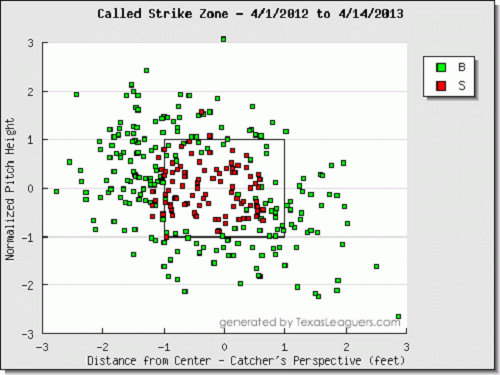
Thanks to StatCorner, we can also put that into numbers. A league-average reliever has had about 15% of pitches in the strike zone called balls, and about 6-7% of pitches out of the strike zone called strikes. That strike zone is defined as the strike zone that’s actually called, not the strike zone in the rule book. Capps, meanwhile, has had 29% of his pitches in the strike zone called balls, and 4% of his pitches out of the strike zone called strikes. Now, that’s only counting pitches not swung at, and with Capps we’re dealing with samples of about 120 pitches taken in the zone and 189 pitches taken out of it. These samples are little and so these samples and the other results come with considerable error bars. But in the early going, the numbers back up the claims — Capps is not an easy guy to catch, and he’s not an easy guy to call. So he ends up with pitches that aren’t balls getting called balls, as a consequence of how unusually talented he is.
Some of this should go away as Capps establishes himself as a big leaguer. Some of this should go away as Capps stops pitching to Jesus Montero. Some of this should go away if Capps improves his command. And this isn’t preventing Capps from succeeding — he’s still thrown nearly two-thirds of his pitches for strikes, and he’s got 38 strikeouts in 32 innings. The neat thing about Carter Capps is that his stuff is so good he doesn’t need a generous strike zone, or even an average strike zone. He’ll work with what he’s given and he’ll still make hitters miss, and I’m guessing he won’t keep running a .382 BABIP. Capps is already good, as things are.
But Capps hasn’t been treated fairly. I’m not even necessarily blaming anyone. I can’t imagine what it’s like to catch a guy who throws like that. It’s probably hard enough to catch Joe Saunders. I can’t imagine what it’s like to call a guy who throws like that, since I imagine I’d constantly be flinching and covering my junk. I get why things are the way they are, but I’d love to know how Capps could look if he pitched to the same zone as most of the rest of the guys in the league. Just because this smaller zone is sort of a tax on a guy with better-than-average stuff doesn’t make that fair to the guy with better-than-average stuff. All pitchers should pitch with the same rules.
Carter Capps is going to make hitters swing and miss. At least for the foreseeable future, he’s going to have to, because called pitches haven’t treated him very generously. Congratulations on not thinking about how Dustin Ackley sucks for the last five minutes. Oh, crap.
Nothing You Couldn’t Have Guessed
For the record, before we begin, know that it’s uncomfortable and weird to be writing content about baseball on a day like today. I can see how it could be interpreted as insensitive and tactless, and you’re free to feel however you feel, but if part of the purpose of sports is to provide a reliable constant, to be a rock in the whitewater, then we should be looking to them now more than ever. After donating blood. Donate blood. Now on to sports. Stop reading if you don’t think it’s right to be reading.
On Saturday, against the Rangers, the Mariners lost, but they lost close and they lost late. They lost because two runs scored against Carter Capps, but before those runners crossed the plate, Capps had a ball called on what he thought was a strikeout. Given that strike, things would’ve gone differently. On Sunday, against the Rangers, the Mariners won, but they barely won, and earlier a controversial ball call with Brandon Maurer on the mound helped the Rangers to take the lead. There are missed balls and strikes in every single game that gets played, but this past weekend, there were missed strikes of import. Mariners pitchers weren’t given particularly generous strike zones.
You probably feel like umpires haven’t been kind to the Mariners this season. Truth be told, probably every fan base feels that way about umpires and their team, but in the Mariners’ case, it turns out the feeling is justifiable. The season’s only just underway, but it didn’t take long for the Mariners to find their way to the bottom of a leaderboard. Or the top of a leaderboard! If you sort in the opposite order. Gotta think positively.
It’s possible, using plate-discipline data available at FanGraphs, to derive a sort of “expected strikes total”. One can then compare this against a team’s actual strikes total, to see how the zones have been. It’s not a flawless statistic, but it’s an interesting statistic that doesn’t mean nothing. So far this season, across the entire league, the average difference between strikes and expected strikes has been -2 per 1,000 called pitches. In the lead we find the Brewers, at +67 per 1,000 called pitches. At the bottom we find the Mariners, at -45 per 1,000 called pitches. That is, on a per-1,000 basis, the Mariners have been 43 strikes worse than the average, and 112 strikes worse than the Brewers.
The Mariners, as a team, are creeping up on 1,100 called pitches, in order to give you some reference for that denominator. I admit it isn’t the best denominator or the most intuitive denominator but I really like the roundy feel of a thousand. How much do numbers really mean at this point in the year? I went back to 2012 and compared April numbers against full-season numbers. The r-value came out to 0.78, and that doesn’t control for changes in personnel. Turns out these numbers matter, and they’re reflecting a skill or shortcoming. The Mariners, again, look like they’ll be given a smaller strike zone than most other teams.
Via Baseball Heat Maps, let’s compare the Brewers’ 2013 strike zone against the Mariners’ 2013 strike zone:
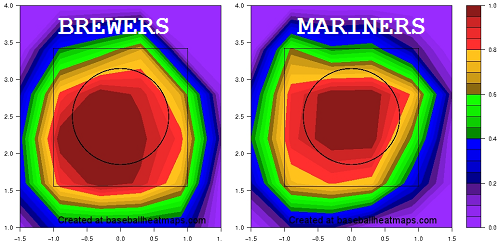
Now, that’s a comparison between the league’s best and the league’s worst, not the league’s average and the league’s worst. And of course, most of the Mariners’ strikes are called strikes, and most of the Brewers’ balls are called balls. But it’s about incremental differences in percentages, and the Mariners get more balls on pitches in the zone, while the Brewers get more strikes on pitches out of the zone. Something is working for the Brewers. That same thing is not working for the Mariners.
And a lot of this, predictably, presumably has to do with the catchers and with pitch-receiving. Jonathan Lucroy is an absolutely fantastic receiver, every bit as good as Jose Molina even though Molina gets a lot of the sabermetric attention. With Seattle, Jesus Montero has gotten a lot of the time behind the plate, and Montero is kind of an all-around catastrophe. The thing about receiving is that it’s very subtle, and an untrained eye won’t spot the difference between the best and the worst at it. But Montero is one of the worst at it, and here’s where that’s showing up.
Montero hasn’t caught all of the innings, and Kelly Shoppach might deserve some of the blame. Additionally, maybe the Mariners haven’t had a representative sample of umpires, and maybe the Mariners’ pitchers haven’t been doing their catchers any favors with inadequate command. The wrong thing to do would be to look at this and conclude “well Jesus Montero sucks”. It’s by also looking at the rest of Jesus Montero’s game that that conclusion can be reached.
Jesus Montero is not a good defensive catcher. John Jaso is not a good defensive catcher. Miguel Olivo is not a good defensive catcher. Josh Bard is not a good defensive catcher. Adam Moore is not a good defensive catcher. Rob Johnson is not a good defensive catcher. Kenji Johjima was not a good defensive catcher. And so on. It’s been a long time since Dan Wilson, who’s probably under-appreciated by the statistical community, and Montero is only continuing an organizational pattern. Unsurprisingly, Montero probably isn’t going to be a catcher for very long. Unsurprisingly, the Mariners are in love with Mike Zunino, because Mike Zunino might actually be a passable catcher in all facets of the game.
So if and when Zunino comes up, we could see these numbers start to change. I don’t know how Zunino is as a receiver, but it’s hard to imagine he’s worse than Montero is. The Mariners might manage to pull themselves out of last, and of course this isn’t the reason why the Mariners probably aren’t going to make the playoffs. That has more to do with the rest of the pitches thrown, and with the hitting and the defense. This is just a little factor. It’s felt like the Mariners haven’t pitched to a normal-sized strike zone. This is because the Mariners haven’t pitched to a normal-sized strike zone. And how! League’s worst. Nowhere to go but up, or down, deeper in the hole.
Why Mike Zunino Needs More Seasoning
I like Mike Zunino a lot. I think he’s going to be a very good player, and he might be the best catcher in the Mariners organization right now. I think he’s been generally underrated as a prospect because his tools aren’t so flashy, but his combination of skills project out to star level quality. I’m probably more excited about Zunino than I have been about any Mariners prospect in a while.
And, yes, his early results down in Tacoma have been excellent. With Jesus Montero looking more and more like a bust — at this point, I don’t see him as a productive Major League player any time soon — the M’s are going to be tempted to call Zunino up sooner than later. I think they’re probably best holding off for a while, and it has nothing to do with service time or Super-Two status. It has to do with his contact rate.
You’ve seen all of Zunino’s good numbers. You know his overall line is great. Here, however, are the contact rates for all of Tacoma’s hitters this season*:
| Name | Age | PA | Pitches | P/PA | Strike% | Swing% | Contact% |
|---|---|---|---|---|---|---|---|
| Jesus Sucre | 25.17 | 11 | 49 | 4.45 | 59.2% | 40.8% | 90.0% |
| Carlos Triunfel | 23.33 | 47 | 182 | 3.87 | 68.1% | 48.4% | 85.2% |
| Nick Franklin | 22.25 | 21 | 82 | 3.9 | 69.5% | 53.7% | 84.1% |
| Nate Tenbrink | 26.5 | 45 | 165 | 3.67 | 59.4% | 43.0% | 83.1% |
| Scott Savastano | 27 | 17 | 80 | 4.71 | 57.5% | 32.5% | 80.8% |
| Endy Chavez | 35.33 | 31 | 113 | 3.65 | 61.1% | 36.3% | 80.5% |
| Rich Poythress | 25.83 | 43 | 167 | 3.88 | 61.1% | 35.3% | 79.7% |
| Alex Liddi | 24.83 | 50 | 182 | 3.64 | 59.3% | 42.9% | 74.4% |
| Eric Thames | 26.58 | 49 | 202 | 4.12 | 62.9% | 47.5% | 72.9% |
| Mike Zunino | 22.25 | 37 | 126 | 3.41 | 65.1% | 47.6% | 71.7% |
| Carlos Peguero | 26.33 | 50 | 164 | 3.28 | 72.6% | 56.1% | 71.7% |
| Denny Almonte | 24.75 | 27 | 111 | 4.11 | 67.6% | 51.4% | 49.1% |
*Minor league pitch data isn’t as good as major league pitch data, so none of this is gospel. These numbers could be somewhat incorrect, but the general idea is probably right.
Mike Zunino has the same contact rate as Carlos Peguero. He’s making less contact than Eric Thames or Alex Liddi. We’ve seen these guys at the big league level, and we’ve seen how major league pitchers exploit an overly aggressive approach. Despite their power, they’ve flopped in the majors, because they simply don’t control the strike zone well enough to be real offensive contributors.
Zunino is better than these guys, and the bar for offensive production is lower because he’s a catcher, but if Triple-A pitchers are getting him to miss on 30% of his swings, you shouldn’t expect him to do much better against Major League pitchers, and the list of Major League hitters who have succeeded with contact rates in the below 70% is very small.
Long term, I don’t think this is going to be a huge problem. Zunino posted a very high contact rate in his short stint in Jackson last year, and he’s shown a good approach at the plate both in college and in his prior minor league stints. We’re dealing with a sample of 126 pitches. The first 126 pitches a guy has seen from Triple-A pitchers. Pitch selection is something that improves with experience, and Zunino has very little.
But that’s why the minor leagues exist. They’re not just for fringe big leaguers to hang around and wait for someone to get hurt. Zunino is getting valuable experience against guys who can spin breaking balls and get him to chase pitches out of the zone. He’s good enough to punish their mistakes, but he also needs to learn how to lay off pitches that he can’t destroy. It is better for Zunino to learn those things in the minor leagues. Not only should the organization should be hesitant to start his service time clock, the Mariners should be hesitant to expose yet another young player to a frustrated fan base that is used to seeing every offensive prospect turn into a bust. If the Mariners bring Zunino up and he hits like Aaron Hicks has in Minnesota or Jackie Bradley Jr has in Boston, it could be damaging to both his development and the psyche of an already frustrated fan base.
Because of how fast he rose through the minors, Buster Posey is the often used optimistic comparison for Zunino. During his 359 plate appearances in Triple-A, Posey posted a 14.7% strikeout rate. Not only did the Giants give him a half season at the minors highest level, they also didn’t give him a regular job until he showed he wasn’t fooled by minor league pitchers. Given how well he performed after getting the call, you could argue that he might have been ready earlier, and I’m not sure Zunino will need 359 Triple-A plate appearances before he’s ready for the majors, but I would like to see him controlling the strike zone better than he is right now.
And that’s not something that you can rush. The power is tempting, but undisciplined power hitters get to the big leagues and get exposed all the time. The Mariners should avoid getting seduced by the power and evaluate how well the total package will work in the Majors. Until he starts making better contact, it’s best to let him get that experience in the minors. He’ll be ready soon, but rushing him won’t help Zunino or the Mariners.
Game 14, Rangers at Mariners
Brandon Maurer vs. Nick Tepesch, 1:10pm
The M’s head into their first off-day of the season needing a win to get a split and avoid dropping three straight series losses. Brandon Maurer’s shouldering a bit more pressure than his teammates, as he’s got to know he can’t have a repeat of his 2/3 of an inning performance against Houston. As many have mentioned, Danny Hultzen’s in the same spot in the rotation just 30 miles away; Hultzen will start today against Salt Lake in Tacoma in what amounts to another job interview. He wouldn’t accrue a full year of service time if he was brought up soon, and while the M’s don’t want to yank Maurer out of the rotation so quickly, *2/3 of an inning, at home, against the Astros.*
What’s his problem been? I have to say I’m a bit surprised it’s gone as poorly as it has, but there are some issues he could conceivably work on. First, his release point is all over the place. It doesn’t look too bad averaged, but his fastball release point can vary by over 6″ within a single at-bat. During the spring, I was worried that he had a decidedly lower/more towards third base release for his slider and change. It was subtle, but MLB hitters are selected in part on their ability to detect and interpret information like that. From what I can tell, that hasn’t been a big problem in his first two starts. Instead, he’s all over the place with all of his pitches. Maybe there’s a theoretical benefit to that, but given he’s had clear problems putting his pitches where he wants them, any gains in batter confusion remain hypothetical for Maurer.
The other issue is pitch sequencing. In his second game, Maurer fell into a pattern of throwing his slider (or the change, in Pena’s case) for his 3rd pitch of an AB. It may have been nothing, or just coincidence, given that he didn’t get through an inning, but he and his catcher should mix things up a bit more. Part of that may be throwing more fastballs. In his first game, he threw fastballs in a minority of his pitches. You can’t really take anything from his second start, but he’s clearly attempting a mix that’s not all that common. Madison Bumgarner of SF is probably the most successful pitcher to rely on his slider so much, but given how rudely MLB hitters have treated Maurer’s, maybe it’s time to use that pitch in a different way. More than anything, he’s just got to avoid hanging it. Even with two strikes, he’s had lapses where he leaves a slider up and out over the plate. That can’t continue today.
The Rangers start their *other* out-of-nowhere back of the rotation rookie, Nick Tepesch. Justin Grimm fared reasonably well in the Rangers win over King Felix, so the Rangers will hand the ball to another unheralded right-hander in Tepesch. Tepesch was a 14th round pick in 2010 after an up-and-down college career at Missouri (sounds a lot like Grimm so far), and though his draft position doesn’t reflect his talent (he signed over-slot), he was clearly a little lost in college, giving up 250 hits and 147 runs in 213 innings. As a pro, he’s used solid command of a fastball, curve and slider/cutter to limit walks and runs. The fastball isn’t great, averaging around 91 MPH, but he gets good sink on his two-seam/sinker, resulting in good ground ball rates.
He tends to use the sinker more to lefties and saves his straight-as-an-arrow four-seamer for righties, which is a bit odd, but hey, he’s the 14th rounder who’s already in the majors. He’s had issues with long balls here and there, and righties have actually hit more of them on a rate basis. He balances that with a better K:B ratio, so on balance, his splits are pretty standard.
The M’s line-up:
1: Chavez, CF
2: Bay, RF
3: Morales, DH
4: Ibanez, LF
5: Smoak, 1B
6: Seager, 3B
7: Montero, C
8: Ackley, 2B
9: Andino, SS
SP: Maurer. C’mon kid.
Hmm, still no Gutierrez.
I’ll be at the Rainiers game watching Hultzen; game time is 1:30. Jimmy Gilheeney starts for Jackson, and Matt Anderson will start for Clinton. Trevor Miller goes for High Desert.
Game 13, Rangers at Mariners
Joe Saunders vs. Alexi Ogando, 7:10pm
I’ve been at CenturyLink Field today, watching a team off to an even more disappointing start than the M’s. I did hear that Franklin Gutierrez’s leg tightness has returned, necessitating a second consecutive Ibanez/Chavez/Bay outfield. Don’t mock it; they’re undefeated in the ‘victory’ formation.
Line-up
1: Chavez, CF
2: Bay, RF
3: Morales, DH
4: Ibanez, LF
5: Smoak, 1B
6: Seager, 3B
7: Shoppach, C
8: Ackley, 2B
9: Ryan, SS
SP: Saunders
The Rainiers are continuing yesterday’s home opener today. Mike Zunino has another RBI already, and Ferris HS grad and one-time UW Husky Andrew Kittredge is making his AAA debut. DJ Mitchell elected to become a free agent after he was DFAd to make room for Endy Chavez.
Game 12: Rangers at Mariners
Hisashi Iwakuma vs. Yu Darvish, 7:10pm
Deep breath. Dave’s post below adds some sobering numbers to the ill omens so many of us have already seen. The team has plenty of time to stop producing said omens and start cranking out good ones, but this is a team with a hobbled offense and that’s going into the next 9 games with a good pitching match-up maybe once or twice. Hisashi Iwakuma’s been very good so far, but you can’t give him a true-talent edge tonight. So the M’s need to forget about true talent and steal some wins the way Houston did, and the way the White Sox (behind Dylan Axelrod) and the Rangers (behind Justin Grimm/Joe Ortiz) did.
It’s not completely crazy. As we’ve talked about here before, Yu Darvish has been pretty mediocre in his four starts against Seattle. For whatever reason, he’s allowed a higher OPS to the M’s than any other team he’s faced more than once. He had stunning command lapses both in his first home start and then last summer at the USSM/LL meet-up game; while he’s not exactly been a control pitcher to the rest of the league, he’s nibbled more against the hapless M’s offense last year than any other team. Maybe that irrational and small-sample oddity will continue! Ho boy, that would really be helpful. Darvish already has my favorite pitch fx page, with 8 distinct pitches, and an average velo spread between his FB and his slow curve of 24mph. Everything he throws has crazy movement, and he throws essentially everything. This might be a time to wait and watch a few pitches and hope several of them slide out of the zone. He really struggled in Safeco, just as he struggled in his one game in Oakland. Maybe he just really hates the cold? All of this is extrapolation based on miniscule samples, but remember: if we’re throwing out true-talent, we can’t get caught up in sample size or logical argument.
On the other side, Hisashi Iwakuma’s been struggling with a finger issue that’s hampered his ability to grip his splitter, far and away his best pitch. While it’s not exactly clear what pitch he grooved to Adam Dunn last go-round in Chicago, he’s got to keep the ball out of the center of the zone. It’s going to be interesting to see the movement on his splitter tonight, and it’s an important pitch for a guy looking to limit home runs. So far, there’ve been 15 HRs hit in the four games in Safeco this year, and a hobbled Iwakuma’s not the kind of pitcher who’s going to hold the Rangers homerless.
With a tough right-hander on the mound and injuries to Morse and Saunders, the M’s line-up is not going to strike fear in the Rangers’ hearts. We’ve wondered if we’d see an OF with Morse, Ibanez and Bay, but while that would be GIFable, it might also hit a dinger or something. Tonight’s OF is Ibanez, Endy Chavez, and Bay, and there’s really nothing to say about that. I understand why Wedge has deployed these players in these positions, and he doesn’t have a whole lot of choice, but the M’s are facing Yu Darvish, at home, with a starting pitcher who may not be 100%, and it *kind of makes sense* to start Ibanez/Chavez/Bay in the outfield. That’s why the M’s are in trouble in the short term. But if you’re going to steal a win, *steal* one. Make it hurt. The M’s felt like crap after dropping a series to the Rangers, and the M’s have the ability to do something similar to Texas tonight in their feeble, grizzled hands.
Line-up:
1: Chavez, CF
2: Bay, RF
3: Morales, DH
4: Ibanez, LF
5: Smoak, 1B
6: Seager, 3B
7: Shoppach, C
8: Ackley, 2B
9: Ryan, SS
SP: Iwakuma
Or, you know, check out the Rainiers home opener tonight at Cheney Stadium. Due to a combination of work and family commitments, I’ll be missing my first home opener in several years, which sucks – I make games started by Chaz Roe or Luke French, but I have to miss James Paxton pitching to Mike Zunino. But you don’t! I’m going to try and watch it, so if you’d like updates via milb.tv, follow me on twitter. If you’d like some updates from people at the game, check out Jason Churchill (@prospectinsider) and/or Mike Schwartze (@Mike_Schwartze). I’ll be there this weekend, but I’m not happy to miss Paxton tonight. If Paxton’s velo and stuff rebounds from where it was in Arizona in March, that really helps change the picture on the M’s rotation depth, especially with Erasmo Ramirez still ailing.
Jackson’s playing a double-header tonight, though they’re down early in game 1. Hector Noesi goes in game 2; hopefully he sees a repeat of his very encouraging first start. Clinton’s double-header today was rained out again. Send dry thoughts to the midwest; hopefully they can start their home season soon.
The Next Nine Days
I’m going to make two statements about the team that are both true, even though they might seem contradictory:
1. It is too early to make any rash judgments about the quality of the team based on the first 11 games of the season.
2. The Mariners might be in trouble.
A 4-7 start isn’t the end of the world. Losing a series to the Astros doesn’t prove that the team is terrible. Michael Saunders getting injured isn’t a death blow for the franchise.
However, things are going wrong for the Mariners at the wrong time. Saunders is definitely out for the next few weeks, and Michael Morse is out for at least a few days, maybe longer. The Mariners are going to spend the next few days starting both Jason Bay and Raul Ibanez, and they’re not going to have anything resembling a real bench.
And their next nine games are against the two best teams — in my view, anyway — in the American League, and Felix is only going to start one of those nine games. This could get ugly.
The Tigers and Rangers are good teams. Let’s just say, for sake of argument, that they’re both .575 clubs, which translates to about 93 wins per full season. And maybe you were optimistic about the Mariners heading into the season, and you thought they were a .500 team. Now, though, you’re taking away Saunders and replacing him with Endy Chavez, and you’re taking away Morse and replacing him with no one. If you think those guys are both average players — it would be hard to think the Mariners were a .500 team and that both of those guys were below average — than taking them off the roster would push the team down to a .475 club, or somewhere in that range. The fact that they’re playing short-handed since Morse isn’t going on the DL is another bump down, so maybe the roster until he returns is more like a .470 club, since they have no flexibility and can’t play the match-ups with this roster.
Now, take into account that the .470 projection includes Felix throwing about 16% of the team’s innings. Over the next nine games, he’s probably going to throw about 8% of the team’s innings, so you have to move the needle down even more. With Aaron Harang or Blake Beavan filling the space, now you’re closer to a .450 club.
What are the expected outcomes when a .450 club plays nine games against a .575 club? You don’t just take the winning percentages for each team, since those are against a broad spectrum of clubs. Good teams beat bad teams more than the average, so we can use a mathematical tool called log5 to estimate the outcomes of that kind of match-up. And log5 says a that a .575 club would beat a .450 club 62.3% of the time, which rounds out to a 3-6 expected record over the next week and a half. In other words, if these estimates held, the Mariners would go to Houston on April 22nd with a 7-13 record in their first 20 games.
Baseball is a weird game. Maybe the Rangers fall on their face and the M’s take the next three and this all looks moot by Monday. We just saw the Astros pound the Mariners, and the Mariners are almost certainly a better team than the Astros. Maybe this nine game stretch won’t turn out so bad.
But, it’s not ridiculous to suggest that the Mariners could easily go 1-8 or 2-7 during this stretch either. This is a rough part of the schedule, and the Mariners are bringing a rubber knife to a gun fight. Attendance is already setting record lows, and frustration is starting to build with the fan base once again. The Mariners spent a lot of time during the spring selling hope, based mostly on the import of a few guys who could hit home runs and meaningless spring training numbers. That hope is taking a beating right now, and given what’s coming up in the next 10 days, it might get extinguished completely.
It is early, but sometimes, the story of the season is written early on. For a team with a veteran roster full of guys on one year contracts, the Mariners don’t have six months to let things get sorted out. The Mariners need to start putting some wins on the board, but now they’re going to have to get those wins with the end of the roster going up against the likes of Yu Darvish and Justin Verlander. Good luck.
Game 11, Rangers at Mariners
Felix Hernandez vs. Justin Grimm, 7:10pm
The Astros series offered something of a no-win bargain: if the M’s won the series, or even swept it, eh, who cares? They were playing the Astros. If they lost it, oh my god, you just lost to the ASTROS? Today’s match-up isn’t no-win. Anytime you get to see Felix Hernandez, you’ve won. But if Felix pitches the M’s past Justin Grimm, eh, of course you won *that* game. And if he doesn’t, more and more fans will start to watch from home, or maybe give a Sounders game a go. I don’t envy the M’s here. The Supreme Court promotion tonight is great, and it shows that sometimes, rarely, the right ballplayer actually can put a dent in attendance numbers all by himself.
The context for the game is troubling, as it always is when these two teams face off. The Rangers are, in my opinion, one of the best-run franchises in sports. The M’s are…struggling, as they have been for several years now. Jack Zduriencik and crew clearly faced tremendous obstacles when they began their work in Seattle, and I don’t mean to minimize them in any way, but Bill Bavasi left in 2008, and it’s not impolite to point out that the obstacles the franchise faces now are largely self-imposed.
Everyone – every team in baseball -makes dumb trades. Jaso for Lueke comes to mind. So I’m not going to argue that Jon Daniels is a miracle-worker who out-thinks his rivals. He’s good, but that’s not enough. Where they seem to shine is in player development. They extract value from more players, and more *types* of players, than anyone. Justin Grimm is a decent example. The year he was drafted (in the 5th round in 2010, a few picks after Stephen Pryor), he pitched for the University of Georgia. He went 7-12 over three years with the Bulldogs, and gave up 138 runs in a bit over 180 total innings. He had a live arm, so-so control and zero command. In the Rangers system, he’s been excellent at every stop, coming out of nowhere to land in the top 10 of the Rangers top prospect list at Fangraphs (and the Rangers had a great system). I’m not sure what the Rangers have done with Grimm, and if asked, they probably wouldn’t say. But the Rangers took a talented kid who was quite obviously doing something, or several things, wrong and they fixed it well enough to get to the majors.
They’re not infallible. They’re still working on 2010 1st rounder Kellin Deglan, and Julio Borbon just got DFA’d as he never learned to hit. And every system has its successes – the M’s tweaks to Brad Miller’s swing mechanics appear to have paid off so far, and their work with Taijuan Walker has been excellent. But it seems like every time these series pop up, the Rangers are sloughing off some adversity by pulling up some nobody that they developed. Meanwhile, every time these series pop up, Mariner fans are worrying about their struggling blue-chip franchise-core players. Colby Lewis went from a joke of an acquisition to an extremely important starter to injured, but the Rangers had depth in someone like Alexi Ogando that they could move between the pen and the rotation. Borbon sucked, but they acquired Leonys Martin and developed defensive whiz Craig Gentry.
OK, enough meta-gloom (metancholy?). Justin Grimm is a fastball/curveball righthander with low-mid 90s velocity. He’ll mix in a change-up to lefties, but he’ll use the curve to both lefties/righties, especially once he’s ahead in the count. He had average-ish ground ball rates in the minors, but I’d expect they’d be lower in the big leagues, especially as he hardly ever throws his sinker. The M’s still aren’t a great on-base team, so as usual, they’re going to need a long ball or two this year (man, that’s still weird to type). Grimm hasn’t shown much in the way of exceptional splits, so the M’s aren’t loading up with as many lefties as they could. So of that is by choice (see below), and some of that has to do with Michael Saunders’ shoulder.
In 2010-2011, the idea of Dustin Ackley facing a guy like this would’ve made us excited. Now, while I’m definitely leaning a little closer when Ackley’s up, it’s for slightly different reasons. Tonight, he’s got the day off, against a righty. Gotta be flexible. Gotta get everyone out there.
Line-up:
1: Gutierrez, CF
2: Seager, 3B
3: Morales, DH
4: Morse, RF
5: Ibanez, LF
6: Smoak, 1B
7: Montero, C
8: Andino, 2B
9: Ryan, SS
SP: King Felix
Saunders shoulder injury was severe enough that he’ll head to the DL for 15 days. Saunders himself said it wasn’t too bad, and described it as ‘day to day’ but the M’s wanted to bring in some help: they have apparently called up Endy Chavez who was off to a red-hot start in Tacoma (though several guys down there can say the same). They’ll need a 40-man move to do that, but I haven’t heard what it is.
The Tacoma Rainiers home opener is tomorrow night. You should probably go. All the dingers of the big club, with none of the ennui! Tonight though, they finish off their series in Sacramento, with Jeremy Bonderman on the hill, trying to keep himself in the discussion for pitching depth.
Two other M’s affiliates faced one of the most dreaded occurrences in the minors: rain-outs on home opening days. Jackson’s home opener’s off, and Clinton’s was scratched due to a water-logged field. Teams can count on great attendance only a few times a year, and so they do a collective rain dance around opening day, and generally try to get the game in unless the rain’s torrential. If you went to the first game in the redesigned Cheney Stadium, you know the phenomenon. The wind and rain that night were awful, and it had chased 60-70% of the fans by the 6th inning or so, but they were not going to suspend the park’s grand opening. I always wonder how many rain-out teams have on their big mid-summer games – the 4th of July in some parks, the 3rd of July in Tacoma. From what Mike Curto says, calling off one of those games can have huge financial ramifications.