
Game 148, Mariners at Athletics
Robbie Ray vs. James Kaprielian, 6:40pm
Ahhh, development. For all of the cliches about how it’s not linear, or about how it can make or break a team, it still seems elusive and slippery. If a pitcher teaches a teammate a new sinker, the way Robbie Ray taught George Kirby his, does the team get credit? Does the pitcher? Does the team get docked for having failed to do something that 15 minutes in the bullpen with a colleague could? Does it matter who gets credit, and if it doesn’t, how does a good organization fairly assess how well their own group is doing?
I was reminded of these issues reading Jarrett Seidler’s piece in Baseball Prospectus arguing that it’s probably time to take the organization into account when assessing prospects. It’s been kind of verboten in the past in part because trades may change the context dramatically, but at some level, if a player is on the Dodgers (or Royals), you should probably take that into account. The same pitcher seems like a better bet in the Cleveland organization than in, say, the Nationals. I’d argue we mentally do this in part, but it’s probably good to be explicit about it. But even then: what do we do with the organizations around the middle of our mental distribution of development ability? Forget the Dodgers, what does “average” actually look like?
I’m going down this philosophical rabbit hole tonight because of a really interesting match-up we’ll see tonight. The A’s starter, James Kaprielian, was a first round pick and had tantalizing minor league numbers, but simply couldn’t stay on the field. Solid velo and a very nice slider/curve combo overwhelmed low-minors hitters, and he pounded the zone enough to avoid walks. Very little of that has translated to the majors. He’s not out and out bad, though his FIP suggests he might be. Rather, through a combination of raw stuff (awful spin rate) and approach (target the very top of the zone or above), his fastball has simply not been good enough at this level. He’s given up too many HRs AND too many walks – a bad combo if ever there was one. The A’s have helped him stay healthy, but the problem with the fastball isn’t getting any better despite some tweaks they’ve made – he’s increased his release point over time, going to a more standard or higher 3/4 delivery from slightly lower. That helps him get more effective backspin on the ball, but his spin rate isn’t going to allow him to get to average or above average vertical movement. Everyone’s trying. It just hasn’t shown up in results yet.
Tonight, Kaprielian could end up pitching to Jarred Kelenic. Kelenic was just recalled, with the M’s swapping out LFs with Taylor Trammell heading back to the PCL. Kelenic, rather famously, has had some issues adjusting to big league pitching. Somewhat like Kaprielian, only far louder, Kelenic’s minor league stats suggest someone with expert knowledge of the strikezone who – at worst – should have average-ish batting averages. In 500 MLB PAs, Kelenic is hitting .167/.246/.329. He’s made adjustments in his pre-swing load, in his batting stance, anything. He’s listened to coaches in the org, and he’s listened to private coaches and ex-coaches like Mark McGwire. Being bull-headed and stubborn is not the problem. Hitting big league off-speed and breaking stuff is. The M’s sent him down to AAA and let him alone for several months this year to re-start his development. It was a move he both understood and later chafed at. Now we get to see if it did anything.
Kelenic is a good fielder and has some speed. He’ll be confident coming back from the PCL where he put up a line over 20% better than the league’s. He’s just 23. But…we’ve seen all of that before. He was trending the right way at the end of 2021, and essentially collapsed in 2022, with a K% over 38%, lower walk rates, and less power than 2021. He’s hit well in AAA, but still has trouble with off-speed pitches and a hell of a time against breaking stuff.
I hope Kelenic has a role to play in the M’s playoff push, and I hope it gives him confidence. I know nothing he does in the next two weeks or so is dispositive about his development. He’s got time, even if things get scarier with each 0-4. I don’t think James Kaprielian just IS a 5th starter with bad control, just as I don’t think Jarred Kelenic will never hit a big league slider. The M’s are where they are in large part because of the development of Julio Rodriguez, George Kirby, and Logan Gilbert. The A’s have hung around for years despite a meager budget because of what their development group was able to do with the likes of Frankie Montas, Chris Bassitt, and a host of Paul Blackburns, Cole Irvins and Lou Trivinos. That’s cold comfort to Kaprielian, I bet, just as it didn’t help Jesus Luzardo – another top prospect seemingly poised for greatness who just sort of collapsed in Oakland. The M’s failures (to date!) with Kelenic and Evan White haven’t prevented them from having development-driven big league success. It’s all confusing. I just hope it works out in the end, and Kelenic’s a part of what is shaping up to be a great 2023. I hope Kaprielian learns to throw strikes. Just not yet.
To his credit, Kaprielian has really cut back on the home runs allowed recently. He gave up 5 in June, but just five since the calendar flipped to July.
1: Juliooooo, CF
2: France, 1B
3: Haniger, RF
4: Santana, DH
5: Winker, LF
6: Raleigh, C
7: Frazier, 2B
8: Toro, 3B
9: Crawford, SS
SP: Ray
Game 147, Mariners at Athletics
Luis Castillo vs. JP Sears, 6:40pm
An easy win and an Orioles blowout loss eased the pain of the M’s recent losing skid, and it’s getting harder and harder to see how the M’s could blow a playoff spot if they really tried. They played without Suarez, Julio, and Cal Raleigh and they couldn’t help blowing out the Angels. Today, the M’s head north to Oakland to take on another team that’s just playing out the string, the hitless wonder A’s.
The A’s are “hitting” .216/.280/.346 this year, good for a .277 wOBA. The M’s hit .226 last season thanks to a hot September, but their OBP/SLG were far, far higher than this A’s club. Offense is down league-wide, but the A’s lack of…anything is noteworthy, and might even be historic if the hapless Tigers weren’t matching them out for out.
Like those Tigers, the A’s were counting on a number of their young prospects to hit the ground running, and that simply didn’t happen. There were always question marks about CF Cristian Pache’s hitting ability going back to before they acquired him in the Matt Olson deal, but .157/.204/.224 has to be seen as a worst-case scenario. Shea Langeliers spent most of the year demolishing the high minors, but has been equally befuddled by big league pitching. Hey, M’s fans can relate to that.
Would the A’s prefer that their prospects put up solid numbers? I’m sure they would, yeah. But at a fundamental level, I don’t think they really care all that much. This was never going to be a contending year, and no one can be shocked that the team has played so poorly when they traded off nearly anyone with a MLB track record to speak of (except Jed Lowrie, who came back and was somehow *too bad to continue being an Athletic*). The struggles have enabled the team to shuttle players back and forth between Oakland and Las Vegas, gaining club control. They’re making a run at the top pick in the draft. The playoffs are what good teams play for, and watching prospects get overmatched is what the bad teams euphemistically call “development.” Not everyone can be the Astros.
The A’s sent Frankie Montas to New York in exchange for a package of prospects including JP Sears. Montas has been a disaster for the Yanks, but there are no take-backsies in baseball, and the lefty Sears will get a chance to start for a rebuilding A’s team. You may remember Sears as a starter the M’s drafted in 2017 – he went to then-low-A Everett and moved up to the Midwest league as a high-K reliever. Seriously, he struck out 51 in 27 2/3 IP, giving up just 13 hits. But then, in a deal that seriously pissed me off, the M’s sent him to New York in exchange for Nick Rumbelow. The Yankees, one of the better pitching development groups in the game, converted him back to starting, and especially since 2021, he’s been an excellent hi-minors arm, and got spot duty with the Yankees before the trade this year.
I don’t want to oversell him. Part of the reason the M’s were OK moving him is that those gaudy K rates aren’t really backed up with top-tier stuff. Sears throws 93 from a low 3/4 angle, and features a slider that’s pretty solid and one of those great change-ups that the Yankees teach their pitchers. He hasn’t thrown it much, but to me, it could be his best pitch. In any event, Sears uses that low angle to get a flat approach angle and do a poor man’s Paul Sewald impression, but from the left side.
It’s funny – Sears has decent enough numbers (5-2, 3.90 ERA, 4.66 FIP), but he’s nothing like the guy he appeared to be. In the majors, he’s not striking out anyone. All of his pitches are more likely to be put in play than swung-and-missed, a fact I didn’t think was even legal in 2022 baseball. He’s not really managing contact, either, as he’s giving up a very high average exit velocity, more barrels than league average, and thus a high expected wOBA-against. He’s young, he pitches in a great ballpark for pitchers, and he’s not getting blown out. If you’re the A’s, you take that. They’ve done well with guys like this (Cole Irvin comes to mind), even if they can’t quite find another Chris Bassitt.
Luis Castillo had a bad game against the A’s a few weeks ago, but with the playoffs looming, it’s time to just dominate a line-up that’s eminently dominate-able. Do the thing, Luis.
1: Juliooooo, CF
2: France, DH
3: Haniger, RF
4: Santana, 1B
5: Crawford, SS
6: Moore, 2B
7: Toro, 3B
8: Casali, C
9: Haggerty, LF
SP: Castillo
Juliooooo is back. Cal apparently needs one more day, while Eugenio Suarez still hasn’t picked up a bat after fracturing his pinkie finger.
Congrats to Team Great Britain, the squad Harry Ford is playing for in World Baseball Classic qualifying. Thanks in part to Ford, the Brits are through to the WBC! They’ve never qualified before.
Game 145, Mariners at Angels: Splitting Headaches
Marco Gonzales vs. Reid Detmers, 1:07pnm
It’s clearly not time to panic, but dropping the first two in Anaheim is sub-optimal for the M’s pursuit of the #1 wild card spot. They have quite a few games against the underbelly of the league like Detroit and Oakland coming up, so nothing’s decided yet, but avoiding sweeps would be advisable (as it always is). I’d say that the M’s hit much better away from home, but as we saw last night, these are not the regular Mariners. You have to make do and hope for some 2021-style nonsense like Abe Toro walkoffs. We can also hope for an extension of Marco Gonzales’ current hot streak.
But I want to talk a bit more about the M’s home/road hitting splits, just because they’re so noteworthy. Their overall batting lines are different, but only separated by about 36 points of OPS. BABIP has a lot to do with that, as T-Mobile park has the lowest BABIP of any venue in the league: It is exceedingly hard to get a base hit in Seattle. Despite medium but not insane OPS splits, the gap is much larger in something more important: runs. The M’s score 3.82 runs/game at home, but a healthy 4.55/game on the road. That has some implications.
The first thing that we notice is that the hitting woes at home are NOT driven by home runs. The days of T-Mobile being a HR-suppressing monster are long gone, but the days it almost actively encouraged them are gone too. The average distance a fly ball flies is lower in T-Mobile than any other park. But that doesn’t mean you can’t hit HRs; the M’s have homered in 3.26% of their home plate appearances. On the road, however, it’s…uh, 3.26%. If you can hit the ball hard enough, you can get it out of T-Mobile, just as you can get it out of any other park in the league. But if you don’t hit the ball hard to begin with, you might be in trouble. T-Mobile is not a place to luck into a wall-scraping HR on a mis-hit – this isn’t 2019, so those are hard league-wide, but essentially impossible in Seattle.
This is partly the reason the M’s are scuffling so badly at home: they seem to have spotted what they believed was a market inefficiency. Instead of going for the Judges/Stantons type who nearly break statcast with super-high exit velocities and distances, they would acquire guys who hit the ball comparatively softly. No, you’re not going to hit home runs with this type, but the idea was that they would get base hits – soft line drives falling in front of MLB outfields that are now positioned much further out than the pre-Statcast era. Dee Gordon, JP Crawford, and now Adam Frazier are the obvious ones, and each had some kind of track record, even within a season, where this approach was seemingly proved right. None would be a superstar, but having players put pressure on defenses and getting on base in front of your sluggers makes a ton of sense.
At this point, they may need to rethink this. T-Mobile doesn’t appear large enough for flares to fall in front of outfielders regularly, and a complete lack of consistent HR (or extra base hit) power renders even a so-so batting average worthless in T-Mobile. This has left Crawford with an extremely empty .248 average with an ISO under .100, but it’s left Adam Frazier nearly unplayable at .224/.293/.299 in Seattle. And of course, most worrisome of all, it’s turned bat-first corner OF Jesse Winker into a .202/.329/.282 hitter at home.
This is odd, given that Winker was, until this year, someone who hit the ball pretty hard. He wasn’t Aaron Judge, but this year’s 87.7 MPH wasn’t exactly predictable. Worse is the distribution of that average. Last year, he hit fly balls and line drives at 95.7 MPH, right alongside Pete Alonso and George Springer. This year, those air balls are at 90.8, good for 210th in baseball, down from the mid-40s a year ago. The contrast with his ex-Reds teammate, Eugenio Suarez, couldn’t be starker. Suarez is hitting air balls at 94.3. A bit above average, nothing superhuman. His ground balls are remarkably poorly struck, which kind of makes sense: he is never attempting to hit a grounder, and any ground ball is thus, definitionally, a mis-hit. This profile looks familiar.
In 2021, Kyle Seager hit air balls at 94.1 and ground balls at 82.4 MPH. This year, Suarez is at 94.3 and 82.7, respectively. Suarez has fractionally more hard-hit balls, which helps him avoid Seager’s terminally low BABIPs. Suarez is also walking a bit more, but the *shape* of the slash line is familiar, because the underlying contact pattern is nearly identical. Suarez will not win any batting titles, but hitting the way he does allows him to hit for power *even at home.* He’s following Seager’s path to posting a solid WAR despite a low average, and being productive at home despite a park that hurts hitters. Jesse Winker is…not doing any of that.
All of that said, it’s unsurprising that the M’s are scuffling a bit with all of their “hit the ball hard” guys on the shelf. Suarez is now on the 10-day IL, while Julio’s back will hold him out today and maybe one more game. Winker isn’t in his pink-hued sarcophagus, but Anaheim is only marginally better for a hitter like him. The most important thing the M’s can do is work with him in the offseason to figure out where that missing 2-3 MPH in exit velo went.
1: Crawford, SS
2: France, 1B
3: Haniger, RF
4: Santana, DH
5: Haggerty, LF
6: Moore, CF
7: Frazier, 2B
8: Toro, 3B
9: Casali, C
SP: Marco Gonzales
Ooof, that’s not a great line-up. Let’s go Marco.
As a lefty with a good slider/curve, Reid Detmers has sizable platoon splits. That’s good for guys like Dylan Moore, but maaaan, you wish Julio/Eugenio were here to try their luck.
Game 143, Mariners at Angels
Robbie Ray vs. Michael Lorenzen, 6:38pm
This blog’s long history has meant that trawling through the voluminous archives means you’re constantly finding records of battles that seem incomprehensible to modern eyes. USSM had to defend Ichiro from…haters? Explaining what FIP was to a skeptical audience? Arguing that Felix would be excellent against an army of TINSTAAP and “the minor leagues don’t mean anything” comments? It all seems so dated, in part because so many of those fights ended so decisively.
Ichiro is a beloved Seattle icon, and the folks who thought him selfish or what not have the good sense not to maintain their beliefs. We don’t really have to argue about pitcher wins anymore. Felix’s entire career came and went (sigh). But I keep thinking about a theme of this blog was the long-standing and contemptible good fortune of…are you ready for this?…you’re not…ok, here we go…The Los Angeles Angels of Anaheim.
They’d won a World Series in 2002 by finding a legendarily dominant closer. Their actual wins exceeded their pythagorean winning percentage every year from 2004-2012. They often built a good bullpen, and spent heavily in free agency or trade to stock their rotation, but didn’t often build a great line-up. They didn’t strike out much, but that was about it. In those years, you could point to so many things that screamed “fluke:” Jered Weaver’s rookie year of 2006 looked downright pedestrian by FIP. Surely, that ERA would rise to match, right? Well, Weaver had a long career and had better results than FIP would predict in nearly all of them – a combined 11 WAR worth above and beyond the fWAR he got with that so-so FIP. They famously burned through prospects – not just the Dallas McPhersons and Brandon Woods, but guys who otherwise had OK careers: Erick Aybar, Casey Kotchman. They couldn’t seem to build around the likes of Garrett Anderson and Vlad Guerrero…and it didn’t matter. They won anyway. You could point to the specific failures, but they’d just point to their record. It was maddening.
Fast forward about a decade, and I think you can make the case that the Angels are the most cursed franchise in the game. They employ two of the most transcendent talents the game has ever seen, and in an ironic inversion of their old history, it doesn’t matter at all. They can’t really do anything to change the overall outcome. Yet again, this season has been a complete failure, just as the last 8-9 have been. Their pitching was so awful in recent years that not even peak Mike Trout could score enough to overcome it. So, this year, they’ve got an ERA under 4 and in line with some contending teams (not great teams, but some good ones). It. Doesn’t. Matter. This isn’t happening. The specific successes are just as irrelevant as the specific failures were in 2009.
They’ve had several different front offices in this period, and I’m struck by just how many different ways they’ve found to lose. They’ve spent big in free agency, going back to Josh Hamilton and through to Anthony Rendon. They’ve been burned in international free agency, they’ve run afoul of the law, and then, tragically, saw one of their own employees give a starting pitcher the drugs that killed him. There are systemic failures, largely around player development, and there are one-offs, like the communications director running a drug ring in the clubhouse. They just keep coming.
It’s tempting to write this off as just the natural swinging of a pendulum, a kind of gambler’s fallacy-style equilibrium. But it isn’t. I think it speaks to how hard it can be to change a culture or processes in an entity as large as a major league team. It also might have something to do with how you prioritize your resources; the Angels may not have seen their player development issues as a critical threat as long as Arte Moreno would spend in free agency. Teams can get set in certain ways that hinder development, as this damning piece on the Royals from the Athletic details. Whatever the ultimate reason, it’s amazing to think back to when we couldn’t believe how lucky they seemed – the way complementary pieces seemed to fall out of the sky for them. Nothing seems further from current reality. I love it.
1: Juliooooo, CF
2: France, 1B
3: Suarez, 3B
4: Santana, DH
5: Winker, LF
6: Crawford, SS
7: Frazier, 2B
8: Casali, C
9: Lamb, RF
SP: Ray
Travis Sawchik has a good article on the M’s usage of the sinker and the uptick in league-wide sinker usage AND sinker effectiveness. I’m not really surprised to see this resurgence – you can’t shun a good a pitch, especially to same-handed hitters, and be as effective. Sure, the newer uppercut swings hurt sinkers for a while, but that’s not a reason to abandon the pitch entirely. In fact, the M’s themselves show it almost doesn’t matter what batters do against them – the value is in the fact that they give hitters something else to think about. For all of the sinkers M’s pitchers have thrown in the past few months, by pitch type run values, they remain…kind of bad at throwing them? It hasn’t mattered, because M’s four-seam fastballs are 3rd best in MLB, behind only the twin juggernauts of the Astros and Dodgers.
The M’s low minors affiliates are now done for the year. Everett finished 59-72 with the worst run differential in the Northwest League. Their 715 runs allowed was easily the worst in the circuit, and over 200 runs more than what first-place Eugene conceded. Modesto finished 66-66, despite a +131 run differential. They are apparently the Portrait of Dorian Gray of Fun Differential, absorbing all of the bad luck that slides off the Mariners. Modesto scored a lot of runs, and really should’ve finished higher. The Arizona League M’s finished at 26-29.
Lookout Landing has good season wrap-ups of Everett , and Modesto.
The Arizona Fall League rosters came out, with nine M’s heading to Peoria to transfer into Javelinas and take on prospects from other organizations. It’s a huge opportunity for minor leagues, especially those who may have missed time due to injury. It seems most MLB superstars logged time in the AFL, from Mike Trout to Bryce Harper (who played in the same AFL season) to MAx Scherzer. With the big Luis Castillo trade, the M’s don’t have as many big names to send down – Noelvi Marte will be there, but for the Reds org, of course. But that doesn’t mean there won’t be players to watch. The M’s are sending five pitchers, including relievers Ty Adcock and Jorge Benitez, two injury-plagued starters in Juan Then and Adam Macko, and former TJ rehabber and breakout prospect in 2022, Bryan Woo. Woo was dominant at times this year for Modesto and Everett, and I’m fascinated to see what he can do against some very good hitters. Adam Macko has brilliant stuff, but hadn’t pitched since May.
Position players include Spencer Packard, coming off a great campaign for Everett, Robert Perez, Jose Caballero, and current 40-man rostered OF Alberto Rodriguez. LL also has a great rundown on all of these players in their AFL preview.
Game 142, Padres at Mariners
Mike Clevinger vs. Luis Castillo, 1:10pm
Sorry I’ve been away – a camping trip plus Covid in the family has made it impossible. And what a week to miss: the M’s had perhaps their signature win of the year on Sunday to beat Atlanta, and have essentially sewn up a playoff spot in 2022. The drought is about to end. All that remains is seeding.
So, let’s talk about that. The new playoff format from MLB is somewhat odd: the overall #1 seed in the AL (overwhelmingly likely to be the Astros) faces the winner of the match-up between the second and third Wild Card teams. The third wild card team faces off against the worst division winner, quite likely to be the Cleveland Guardians. Importantly, the winner of *that* series faces the AL’s second-seeded division winner, or the Yankees if they can hold onto it. There’s no re-seeding, and the three wild card teams are, at present, neck and neck. You could make a very good argument that the 6th overall seed has an easier path to the AL pennant than the top wild card team, and very clearly easier than the second wild card team.
The M’s schedule and the fact that Toronto and Tampa play each other so much gives Seattle a clear pathway to that top wild card seed. That’s good, to be clear: it would give them something we’ve been dying for since 2001: HOME playoff games. It’s not just a single game anymore, so that’d be three playoff games at T-Mobile. That’s pretty good. But the M’s record is *better* in road games this year, and for a very good reason: they still haven’t quite figured out how to hit at T-Mobile. After a good start at home, the team’s gone cold: they’re hitting .219/.303/.376 on the year in Seattle. Now, that’s better than last year’s mark, but it’s depressingly close to last year’s mark. Meanwhile, they’re hitting .238/.320/.398 on the road, and maaaan is it easy to forget just how depressed batting is right now.
Not every player has a T-Mobile problem. Julio Rodriguez is slightly better at home, and Ty France is clearly better there. But the players impacted by the low run enviroment are often *really* impacted by it. Jesse Winker is hitting .200/.329/.281 at home. Your starting bat-first LF has a home SLG% of .281. That shouldn’t be possible. Adam Frazier hasn’t been great anywhere, but Seattle’s BABIP-suppression and general lack of extra base hits means he’s been almost unplayable at home. All of this means that, at home, the line-up just gets a bit shorter. It’s not night-and-day different the way it was last year, and of course the pitchers get all of the power- and BABIP-suppression that Winker loses, so they’d be a tough out anywhere. But as we saw last night, the M’s can sometimes struggle to score runs at home.
Would you rather the M’s get the third wild card and face and ALDS series with the Yankees, a team they’ve beaten in the last two series (home and away)? Or get the top seed and face a red-hot Houston club in the second round? Would you rather the M’s get home field for the first round and then go to Houston, or be the road team against a mediocre Cleveland club and have a line-up that’s better prepared to do damage from 1-9?
There are good analytic, galaxy brain arguments to be made here, but let’s be clear: I care a lot more about M’s fans than the line-up’s BABIP woes. Give me the home series in round one every day of the week. Waiting to face Houston in the ALCS vs. the ALDS just isn’t some sort of supremely-valuable prize. If you want to win it all, you’ve got to face them at some point. Guarantee yourself home playoff games, and this entire fanbase can breathe a little bit easier, and that’s far more valuable than an edge in road pythagorean winning percentage.
Luis Castillo’s generally been the guy the M’s wanted when they traded a massive prospect haul to Cincinnati. He blanked the Yankees for 8 IP, but has had some hiccups along the way, notably in his last start in Oakland. Castillo has an absolutely gorgeous sinker with tons of armside run that pairs delightfully with his slider and death-dealing change-up. But the best pitch he’s thrown this year? His four-seam. The M’s have upped the percentage of four-seamers he throws to lefties, and it’s been incredibly successful. Castillo has been great against lefties as a Mariner, and has been even better at home thanks to a very low BABIP and George Kirby-like K:BB ratio. He just doesn’t give up free passes.
Using the sinker mostly to righties makes sense, as it’s a pitch with fairly high platoon splits. That armside run is much more effective against righties than lefties. But beyond that, it’s a pitch that – despite *looking* unhittable – has been put in play an awful lot. Again, in Seattle, that’s less of a problem. But it’s something of an issue overall. This year, Castillo has generated a swing and miss about twice as often as a ball in play with his four-seam fastball; less than 10% of those straight heaters become balls in play. His sinker is 3.5X as likely to be a ball in play than a swing-and-miss. Small sample, perhaps, as Castillo’s pitch type splits haven’t always been this different, but that’s something he should be aware of.
1: Juliooooo, CF
2: France, 1B
3: Suarez, 3B
4: Santana, DH
5: Winker, LF
6: Raleigh, C
7: Frazier, 2B
8: Haggerty, RF
9: Crawford, SS
SP: Castillo
Mitch Haniger’s sidelined with a back issue, so Sam Haggerty continues to get playing time, and he’s made the most of it.
Congrats to Cade Marlowe, the M’s prospect OF, on his promotion to AAA Tacoma. He shook off a brutal slump early on, and now has his season line up to .291/.380/.483.
Led by George Kirby and Logan Gilbert, M’s pitching has been dominant over the last 30 days: a 2.41 ERA and the second-most fWAR in MLB. But the back of the bullpen is struggling just a tad, with Paul Sewald, Matt Festa and Diego Castillo giving up some HRs. Matt Brash and Andres Munoz have been dominant, so it’s not a clear warning sign, but I wonder if the bullpen sees a shake-up in roles in the playoffs. The fact that they’ve never really had defined roles probably makes this easier, but it’s going to be interesting to see how manager Scott Servais handles this over the final month.
Game 137, White Sox at Mariners
Michael Kopech vs. Luis Castillo, 1:10pm
The M’s continue to benefit from nearly untouchable starting pitching. Their starters have a 3.29 ERA/3.27 FIP since the start of August, a performance which, if anything, undersells how good they’ve been. Similar to the surging Rays, the M’s starters have been excellent at limiting free passes. This has helped produce a dominant set of numbers. M’s pitchers have allowed a wOBA of just .281 since August 1, 5th best in the game, and just behind the juggernauts in Houston and Los Angeles. Their starters, led by Kirby and last night’s starter, Logan Gilbert, have essentially stopped walking people. This means that the hard-hit contact they give up, and they give up kind of a lot, occurs in situations least likely for that contact to hurt them.
But the real stars of the past six weeks have been the bullpen. We could’ve said that at several points over the past few months, but look at this. The ‘pen can take a very different approach. The bullpen is fine giving up walks, or at least, they give up more of them than the starters, but they absolutely smother quality of contact. The M’s pen has the lowest average exit velocity in the majors by over 2 MPH since August. The gap between the M’s and #2 is the same as the gap between #2 and #19.
Michael Kopech came up as a flamethrowing super-prospect, the centerpiece (along with Yoan Moncada) of the Sox trade that sent Chris Sale from White to Red. Famous for his top-of-the-scale velocity, Kopech has battled injuries off and on, but become a solid pitcher. That’s perhaps less than the White Sox hoped for, but more than looked possible when Kopech was rehabbing TJ surgery or another arm injury. He looked to have turned a corner last year, producing dominant K:BB numbers in a (wait for it) bullpen/spot-starter role. Limiting walks, something that had troubled him in the past, made him a potential Cy Young candidate in 2022, albeit potentially as a closer. How would starting full time impact him?
Well…it’s not been great. Kopech doesn’t have the top-end velocity anymore, and certainly not as a starter. He’s above average, for sure, but it isn’t overpowering. And what’s worse is that he doesn’t know where it’s going. All of his control gains from last season have been frittered away, as he’s now sporting a K-BB% of 9.4%, down from 27.7% last year. His fastball is still *good*, and it may be helping him hold his BABIP down in the .220s, but this does not, at first glance, look like a sustainable trend – particularly not since it was over .300 last year. For all of his velocity and elite spin rates, Kopech’s fastball continues to underperform. It’s not just the walks; he gives up lots of hard-hit contact, too.
Logan Gilbert and George Kirby are fine with hard-hit contact, and a part of me still thinks they could become Cy Young winners once they learn better breaking stuff to limit it. But their fastballs are so, so good that it doesn’t matter. Luis Castillo, Kirby, and Gilbert are all in the top 30 in MLB in Fastball run values (linear weights after each pitch) – it’s a counting stat, so the fact that Kirby’s that high despite having pitched 30-50 innings fewer than his competition says something. They give up hard line drives, but don’t walk many, and get swings and misses. Kopech’s done this before, but he is absolutely not doing it now.
Does this say that velocity isn’t important? No, I wouldn’t go that far. I still think spin is a bit overrated, and Kopech is showing why. But more than that, if you can’t control contact, then you simply have to control the zone. Giving up some smashed singles is fine for Logan Gilbert. It’s less good if you’ve walked two in the inning.
1: Juliooo, CF
2: France, 1B
3: Haniger, DH
4: Suarez, 3B
5: Winker, LF
6: Frazier, 2B
7: Trammell, RF
8: Casali, C
9: Crawford, SS
SP: Castillo
The Rays face Boston at home, while Toronto continues its series with erstwhile Wild Card rivals Baltimore.
Game 133, Mariners at Guardians
Robbie Ray vs. Xzavion Curry, 4:10pm
Since July, Robbie Ray’s sporting one of the most improved fastballs in the game, ranking 10th in Cameron Grove’s stuff/command metric improvement. Is he throwing his four-seamer harder? More break? No, it’s really not due to stuff at all – instead, he’s showing much better command of it. Essentially, his locations are expected to generate bad swings and bad outcomes by hitters. Do we see that in real games? Yes, kind of. Ray’s four-seamer has generated significantly more swings than it did in the first few months of the year. For a guy who’s struggled off and on with control and command in the past, that’s a notable achievement, and by and large, the results have followed.
But not entirely. Since August 1st, Ray’s four-seamer has become nearly untouchable, with batters hitting .122 and slugging .268 against it. But one of the big changes he made to get hitters OFF of that four-seamer was bringing in a sinker, and that pitch is… well, in that same time, batters are slugging .500 off the sinker, and righties, who face him a lot and see the bulk of those sinkers, are slugging .619. I get it – there are interactions at play, and you can’t just stop throwing a change-of-pace pitch without it impacting the rest of the arsenal. It’s not an open-and-shut case that going back to being (essentially) a two-pitch pitcher is the right course of action.
That said, if you throw a pitch that turns league right-handers into 2022-Paul Goldschmidt when they face it, you might want to throw…literally anything else. Ray was brilliant in August, but he’s still had an up and down year. Mostly up, don’t get me wrong, but there’s still room for improvement here.
Xzavion Curry has thrown all of 5 big league innings, and was called up to take the place of Aaron Civale, who went on the IL. Curry came into the year as Cleveland’s #11 prospect after a huge 2021, though he’s struggled quite a bit in AAA this season. Control had been his calling card coming into 2022, but he’s walked far too many this year. The key to his control was his four-seam fastball, an arrow-straight offering with good vertical movement. That rise has enabled him to throw it in the zone a ton, as hitters in college and the low minors would swing underneath it. I wonder if that’s happening a lot less in the upper minors… the scouting report on his secondaries isn’t glowing, so I’m not sure Curry had a plan B if his invisiball heater started popping up on the more advanced radar systems used by elite hitters. He’s had HR troubles occasionally in the minors as well, which makes sense given that fastball shape. No one’s going to have trouble elevating it – the only issue is making contact.
1: Julioooo, CF
2: France, 1B
3: Haniger, RF
4: Suarez, 3B
5: Winker, LF
6: Santana, DH
7: Frazier, 2B
8: Raleigh, C
9: Crawford, SS
SP: Ray
Luis Torrens played some 2B in Tacoma’s win last night over Sacramento. No jokes, no scouting reports, just…just thought you’d like to know. Mason McCoy hit a grand slam in the R’s 6-3 win.
Tyler Dollard starts for Arkansas today; he’s the biggest prospect among the affiliates’ probable starters.
Game 132, Mariners vs. Guardians
Luis Castillo vs. Cody Morris, 4:10pm
The M’s arrive in Cleveland red hot after sweeping the hapless Tigers. They just finished off beating these same Guardians back in Seattle, so they’ve been good against potential playoff rivals as well as roadkill like Detroit, and there’s really no question why.
The M’s pitching staff is on quite a run. In the last 30 days, they’ve been the best in MLB, with quite a gap between themselves and second-place…Cleveland. They’ve done it despite an extremely high (for today’s game) BABIP, but they haven’t given up a lot of home runs. They now have three starters in Robbie Ray, Logan Gilbert, and George Kirby who have somewhat elevated BABIPs, but who’ve been dominant at times. All three fit into a weird category of guys who give up hard contact, but strike out enough and, when going right, simply don’t walk anyone. This means that to beat these guys, you need a whole lot of well-struck balls in play to get down for hits, *right in a row*. That’s just not happening, and while that sounds like I’m kind of diminishing their own agency in their success, I don’t mean it that way. These guys are absolutely dominant on the things they can control, and thus giving up a few line drives each day simply isn’t a big deal.
But what about home runs? How can you give up hard contact and NOT give up home runs? Here once more we need to talk about the ball. As Joe Sheehan’s been banging on about, something weird happened in August, generally a month with a lot of home runs due to warm temperatures. The game was following its normal seasonal shifts perfectly through June: April’s SLG% was .362 with an awful ISO of .137, rising to .410 and .167, respectively, in June. Okay, rough start, but looking more normal. But then, a reversal: .400 and .155 in July. In August, the decline accelerated:: .393 and .148. August’s cumulative batting line is now lower than the season’s cumulative line. That makes…no sense whatsoever. That flies in the face of physics, or at least it would if the ball used was the same throughout. But recent history suggests we can’t assume that.
So baseball’s got a new, less-juiced ball, and they’ve put in new restrictions on the number of roster spots that can go to pitchers. All of this led starters to pitch *more* innings in August. Fewer pitching changes, fewer strikeouts, quicker games, and more scoring through balls in play seemed to be the desired goal, and MLB saw all of those things happen…except the last one. Strikeout rate is down, and was down in August. Fewer HRs also leads to fewer walks. But the runs aren’t showing up, as we’ve seen from watching the M’s pitching staff cut through the AL Central like a hot knife through butter.
All of this has hurt the M’s *offense* too. They’re batting .222/.303/.394 in the past 30 days, but they’ve done something pretty well. They’re tied for 4th with the Dodgers in the most HRs hit in the past 30 days. They can’t string together a bunch of base hits any better than the suckers trying to do it against the M’s pitchers, but they HAVE been better at taking the rare meatball they see deep. That’s been incredibly helpful in allowing them to score enough runs for their dominant bullpen to take over. The M’s just need to keep games close right now, and while they’re never going to blow teams out with their line-up alone, they’re scoring enough to win. It’s great to see a good team fire on all, or almost all, cylinders.
Speaking of the Guardians’ similarly good pitching staff: it’s banged up. Today’s named starter, Zach Plesac, is out after breaking a finger punching the T-Mobile mound after yielding a HR in his last start. Newcomer Cody Morris will make his MLB debut today. And Aaron Civale just went on the 15-day IL with a forearm issue this afternoon, too. It’ll be a series with some young pitching prospects – not exactly what Cleveland wanted in the stretch run of their quest for the AL Central title.
1: Julioooo, CF
2: France, 1B
3: Haniger, RF
4: Suarez, 3B
5: Winker, LF
6: Santana, DH
7: Frazier, 2B
8: Raleigh, C
9: Crawford, SS
SP: Castillo
Game 129, Mariners at Tigers: What’s With Julio?
George Kirby vs. Matt Manning, 4:10pm
Absolutely great pitching match-up between two up and coming starting pitchers, AND between two CFs who began the year as highly anticipated prospects. Riley Greene has had some growing pains, and actual, physical pain to work through (he dislocated his foot on a foul ball in spring training), while Julio Rodriguez has become an icon. That said, Julio hasn’t quite been himself at the plate lately. After a lightning-fast course correction, Julio’s K rate tumbled in June and July, but it’s creeping back up lately. As Twitter user Ben Knibbe mentioned, this is due in large part because he’s expanding his zone: he’s swinging at more out-of-zone pitches, and even though he’s making contact, it’s not the good kind. Essentially, nothing good comes from such swings. Julio’s success at the plate depends on really hard contact. When he’s hitting the ball hard, he does well, and he’s stopped doing so consistently. What’s going on?
At the beginning of the season, Julio had a problem. Breaking balls were eating him up, and when he made contact, it was typically on the ground. His GB% was over 40% in April, and over *50%* in May. But he made an adjustment, and started being both more selective on breaking balls AND more dangerous on them. Julio’s been one of the best breaking ball hitters since June – not in the Aaron Judge stratosphere, but in the top 25 in MLB. But as I said the other day, he hasn’t been able to maintain his success against fastballs. He’s hitting worse overall against straight stuff since mid-June. He’s been either/or this year.
And a specific kind of fastball, too. Perhaps in an attempt to hit the ball in the air, Julio’s expanding his zone upwards, especially on fastballs. Here’s a heatmap of Julio’s swings against fastballs through June 15th. Not bad. Some questionable swings, but great for a young rookie.
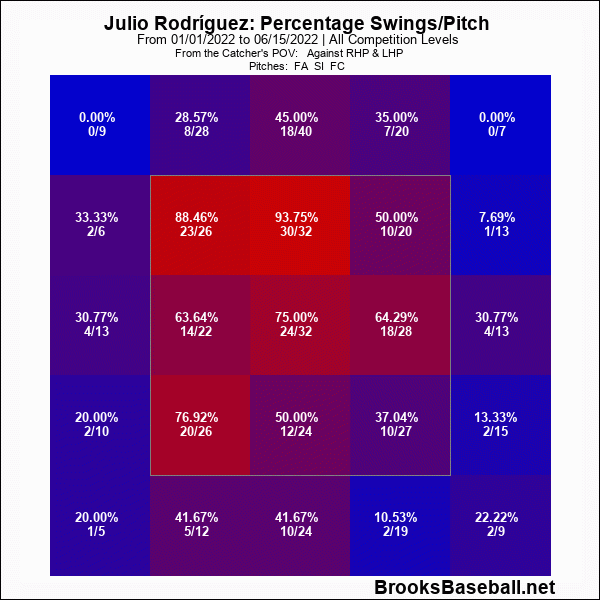
Heatmap of Julio’s FB swings through June
Since that time, though, he’s expanded his zone. Notice the increases in swings above the top of the zone.
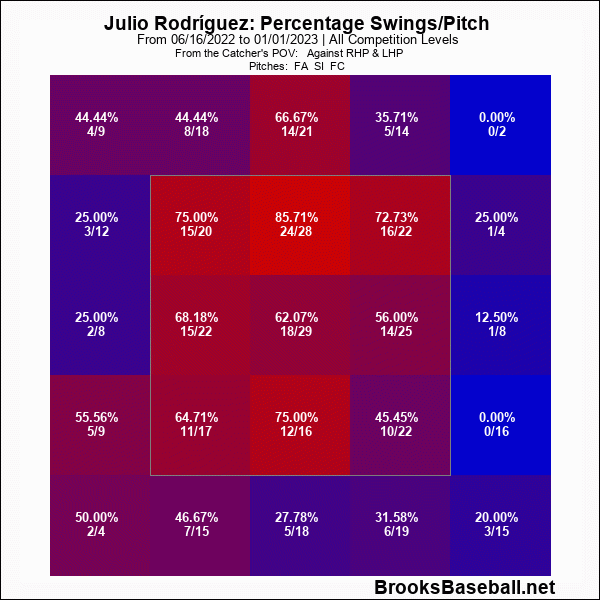
Heatmap of Julio’s swings on FBs since June.
If we focus on the current month, it’s even more obvious. Julio’s trying to take high fastballs and drive them for home runs.
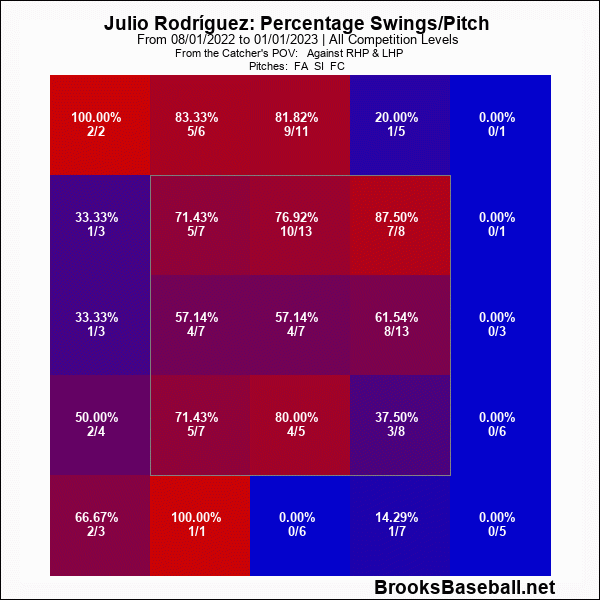
Heatmap of Julio’s FB swings in August
This is why his out-of-zone swing rate is up, and it’s why he’s making worse contact. It’s not all bad; he took a Carl Edwards Jr. pitch above the zone out against Washington, though that was a breaking ball. He’s hitting the ball at a higher angle since June, and it’s probably a good sign. But just as he made an adjustment once, he’s going to have to do so again. High heaters have been tempting pitches since baseball was created, but hitters have to know not to chase them all. Julio’s probably better positioned to do so than most, given the way he’s learned to avoid chase pitches, especially bendy ones. This should be a comparatively easier fix.
1: Julioooo, CF
2: Winker, LF
3: Haniger, RF
4: Suarez, 3B
5: France, 1B
6: Santana, DH
7: Frazier, SS
8: Raleigh, C
9: Toro, 2B
SP: Kirby
Toro’s back with Dylan Moore on the IL with a pectoral issue. With JP Crawford also dealing with injury, Adam Frazier makes his second start at SS in the bigs, and first since 2017.
Matt Manning shook off a rough rookie season last year and is pitching very well for Detroit. He doesn’t get a lot of strikeouts, but has managed contact rather well – he’s got a wOBA on contact of just .300. It’s not Justin Verlander/Paul Sewald good, but you can be a very successful pitcher if batters have a wOBACon that low. The star of his arsenal might be the hard slider at 83, but the workhorse is a sneaky-good four-seam fastball at 93-94. Batters are slugging .304 on it this year, and hitting them, on average, at 87 mph. These are results you’d expect from a breaking ball, not a four-seamer thrown half the time.
Game 126, Guardians at Mariners: Celebration of Life
Logan Gilbert vs. Shane Bieber, 7:10pm
In a day that will be remembered fondly for decades, the M’s have signed Julio Rodriguez to a massive (and complicated) extension. Essentially, the minimum guarantee is 8 years and $210 million, but with escalators and team options could run until the late 2030s and approach $500 million ($470M). It’s a big, big deal, and Julio will be a Mariner for a long, long time. Tonight’s game will be a celebration, a party.
Is it a fair deal? Fangraphs’ Dan Szymborski’s ZiPS projection-based look suggests it balances the risks to team and player pretty well, and that’s my own view. The massive top-line, maximum outlay happens if Julio becomes what it looks like he’s becoming, and the team isn’t crushed if he doesn’t.
More importantly for all of us, Julio will be a Mariner for 7-8 more years at the very least. We’re finally getting the superstar we haven’t had since Felix, and unlike so many teams, we’re not dreading the arrival of big arb paydays or imminent free agency. The M’s developed a star, the star stays, and the fans benefit. This is how it’s supposed to go.
Even more, tonight’s game is a celebration of what can happen when you don’t try and squeeze every financial advantage at the expense of players. The M’s May or not feel burned by their pre arb Evan White deal. Jarred Kelenic sure felt burned by the M’s insistence he sign one if he wanted to see the majors in 2020, and then by waiting until gaining an extra year of club control in 2021.
I’m probably too optimistic, but this deal and the playoff-hunt context it was signed in, *really should* put an end to all of those service time shenanigans. The M’s had Julio up on day one. If he struggled, they could have sent him down. But they made a choice not to muck around with his salary, and I assume Julio was aware of that heading into these negotiations. Had they left him down, his adjustment period may have come not in April but June, and if that was the case, I’m not sure the M’s are in wild card position right now.
Bring players up when they’re ready. If they’re awesome, pay them to stick around. This is the easiest stuff ever, and it’s an indictment of baseball that it’s comparatively rare. But let’s celebrate. Let’s celebrate Julio potentially being a Mariner for decades. Let’s celebrate the mundane but cool idea of doing the obvious right thing and not the easier, “clever” thing. This is the first night of a new era. Certainly for the M’s and their fans, but hopefully for all of baseball.
1: Julioooo, CF
2: Winker, LF
3: Haniger, DH
4: Suarez, 3B
5: Santana, 1B
6: Frazier, 2
7: Raleigh, C
8: Crawford, SS
9: Haggerty, RF
SP: Gilbert