
A word in praise of Riggleman
Riggleman was handed a terrible job to do, and I want to give him some credit for doing it well.
None of us knew that much about Riggleman when he took over. Bench coaches are supposed to be the strategic in-game minds, but often they’re not and almost everyone in baseball manages more or less by the book anyway. They often fill a sort of liaison role with the players, or rat them out constantly to the manager, and they run the team when the manager’s been ejected.
With Riggleman, there’d also been a huge gap between his last managerial job in Chicago and taking over here: he hadn’t managed team since 1999. A lot’s changed since 1999 but, as it turns out, a lot hadn’t.
What a horrible job he was handed. The team was badly built to start and dogged by constant injuries to the starting rotation particularly, the clubhouse was dividing into factions and players were sniping at each other through proxies in the press. There was no way with 72 games down that they were going to contend. They were 25-47 when McLaren left, on their way to a 56-106 season.
61-101 isn’t that much less embarrassing than 56-106 on the surface of it, but it really is. There are about 75 teams in post-World War 2 history that have 56 or fewer wins. And that includes years shortened by labor actions. Throw out years with a labor problem and there’s about 50. As historically bad-for-the-franchise as this was, it could have been much worse.
The team wasn’t as bad as its record when Riggleman took over, but Bedard got all his starts in early in the year. After Riggleman took over for the June 20th game, Bedard got three starts in, for 13 and 2/3rds innings. The rest of the year he had to patch that whole while Batista and Silva and even Washburn came and went through injuries, and he only got four Morrow starts way at the tail end of the season.
Cesar Jimenez made two starts! And there weren’t other options! I know I did my share of second-guessing about who to pitch on how much rest, but I largely gave up. When you’re starving it feels wrong to whine about what’s on the menu that evening.
And yeah, he batted Vidro fourth for a while and said some strange things about it. But once Vidro was thrown off the team, he put together what were, on the whole, pretty reasonable lineups compared to McLaren. He played the outfield for defense, and that improved, or at least until Wlad took his turns out there. I don’t think playing Cairo was ever a solution, but later we were also watching the team test out Valbuena and Tuiasosopo to see how they’d handle playing against major league competition. And to return to Vidro as an example, we can’t really know what instructions he was working under to showcase one player or get some value out of another. I’m inclined, given that it was a lost year and the M’s would later insist on value for Washburn, to believe that there were certainly some marching orders there.
We should though recognize that Riggleman took over and refused to play clubhouse games. His responses to real and invented controversy was steady and laudable.
Divish: Why would someone say stuff like this?
Riggleman: Pettiness, seventh-grade mentality, just pettiness of whatever jealousy, pointing fingers, deflecting responsibility, lack of accountability, just a lack of a character. These things happen when you’re losing; you’re not seeing that happen with winning teams now. But those winning teams go out and lose a couple games and you’ll see it.
I can’t imagine how hard it must have been for Riggleman. Being a major league manager is a coveted job, but this was a nightmare, and he kept plugging away at it, refusing to thrash his players in the press though it would have been so, so easy, not having any part in the clubhouse issues. If we found out years later that Silva’s back problems this year were a cover for Riggleman beating him silly with a fungo bat every time he caught him badmouthing a teammate, I don’t think I’d be that surprised.
And somehow, without Bedard, without the rest of his rotation healthy, managing a terrible team that had been playing below itself and then got worse, they got a little better.
This season’s not going to be that great on his resume. It doesn’t show he can develop young players, take a modest team and squeeze one or two games out of them to squeak into the playoffs, or manage a veteran team to a championship. But when I think about where he had to take over and what happened afterwards, I wonder how many people could have kept things going as well as he did.
Whether or not he comes back next year, I tip my M’s cap to him. Thanks.
Good luck, Jamie
Moyer’s starting in the World Series.
Go get ’em.
On Gillick as advisor
The last time Gillick had an advisory role with the team, it was after he quit as GM to run the team from the shadows, handing Bavasi a list of things that were all but done or that he needed to be done, and the results stank. Bavasi eventually came out on top to be the in-name and in-fact GM, and the results stank, sure, but at least the team had direction.
I’ve been harping a lot on the lack of baseball sense of Armstrong/Lincoln and how that affects the team as a whole organization. And we’ve talked about the new GM hire. If Armstrong hires Gillick to be in the same kind of position, it’ll be bad all around.
I wonder if this possibility wasn’t a factor in other candidates declining to interview. Gillick’s planned departure from Philly’s been known for some time, and the possibility that they’d be a new GM for a team with Pat Gillick whispering in the ownership’s ear constantly and undermining their position might well have made the job far less attractive to them.
There’s just too large a potential for conflict. If they wanted to hire Gillick to be the GM again, they should have held off on the process and hired him. If they wanted him back in the front office, that’s the way to go. And I don’t think giving him Chuck’s job would be much better: with a president so highly experienced supervising anyone, the chance they’ll decide they could do the GM job better is quite high (see the Tigers a few years back).
And yet you can see how attractive this proposition would be for those at the top. With a new and untested GM, they’d love to have someone with Gillick’s success and knowledge around for oversight and reassurance.
Resist! Resist, Chuck! It’s a bad idea!
2001 Team Defense
David Appelman revamped the team pages over at FanGraphs, so I’ve been playing around with all kinds of fun new data over the last couple of days. Because we can now sort through all kinds of team totals, by year (or by month, or week, or whatever) going way back, and we can look at the comparisons between teams easily, I can produce a graph like this:
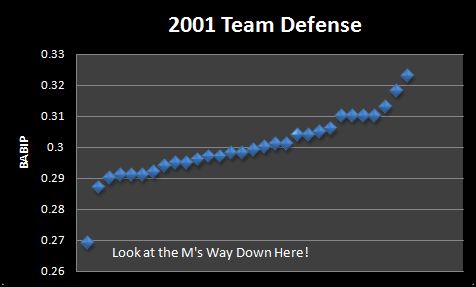
That’s the opponents batting average on balls in play, for each team, in 2001. This is a rough measure of defense – it’s not perfect, but in general, a low BABIP for your opponents means you’re playing some good defense.
Look at the Mariners in relation to the rest of baseball in 2001. The team had a 4.11 FIP, good for 10th in baseball, but still managed to allow the fewest runs in the league because of the remarkably outstanding defense.
As always, the moral of the story – defense matters. A lot.
Riggleman out
Looks like Jim Riggleman won’t be managing the M’s. He accepted a bench coach job with the Nationals.
News Conference
The news conference to introduce Jack Zduriencik as the new GM will start at 10 am. You can watch on FSN or on MLB.com.
Zduriencik hire can be good and still depressing
I’ve been really pretty nasty about the whole hiring process lately, as I’m sure you’ve all noticed, in particular calling out the people doing the hiring as bumbling fools unfit to decide what to order for lunch, much less pick who to be in charge of the operations of the franchise (Power structures and the GM hunt, Essential problems with the interview process, Target-rich environment, on and on).
There’s been some great discussion on the hire, particularly in the comments to Dave’s last post, Thoughts From Milwaukee which I highly recommend. I feel like many of the people there.
I come to this feeling, unfortunately, a lot like I did about the Bavasi hire — that hiring Zdurincik is about as good as we’re going to get out of the Mariners. It’s actually better than I’d feared, that they’d retreat into the safety of a name former GM retread. Zduriencik might work out great (and we don’t know, any or all of the others would have been awesome, too).
But I want to talk about why this pick is bad for us, in a larger sense than what the GM’s going to do soon.
The M’s organization has viewed advances in baseball knowledge with at best antipathy and often a heaping amount of scorn. This is evident in many of the moves we’ve seen in the last few years, but even removing the Bavasi years and focusing just on the views of the people who were going to make the hiring decision, it’s true. We don’t need to look any further than their comments on the A’s — they’ve continually refused to give the A’s any credit for anything, and gone out of their way to denigrate what Beane’s done even as year after year the A’s have handed the M’s their ass, sometimes on a nice silver tray as the protein course in a eighteen-game season meal of whooping.
At the same time, they’ve looked to the Twins as an example of an organization they admire. There’s nothing wrong with admiring the Twins. They’ve been successful running a team on a shoestring while pretty much discarding baseball research.
But the disdain for the A’s and other smart teams has always been one of the larger and more prominent symptoms of the team’s at time galling arrogance about how smart they are. Chuck Armstrong thinks, more or less, that because he has engineering training that he knows stats, and because they have a stathead on a consulting contract and once in a while ask him questions like “how many more games would we win if we brought Carlos Silva instead of playing Baek?”
It’s crazy. There are, as I think every serious fan of baseball would agree, many ways to put together a championship team. You can look down recent league winners and see some amazing contrasts both in how the teams play but how they were constructed.
The Mariners front office essentially decided that they preferred one way, and therefore that was the only correct path to follow in building a team. And teams that didn’t follow it and were successful were lucky, or cheating, or… I’m not sure what their argument was here.
This drove me nuts.
This off-season presented a chance for the team, and particularly the front office, to take a serious look at itself, where things had gone wrong, and change. Ownership did not change the people responsible for running the team. The people running the team made some noises about opening themselves to new ideas, new approaches, and there was hope.
The hope was that they would finally consider that perhaps they had something to learn from the teams that were getting more from much less payroll, much more from the same payroll, from teams that were using wholly different approaches.
The hope was that they’d hire one of the crazy-competent hybrid GM candidates, the people who are building organizations based on getting all the information they can out of the stats and the scouts, and weigh it appropriately. Someone who can look at a free agent pitcher and say “sure, he’s got a 3.50 ERA, but he got amazingly lucky stranding runners, and he wants $15m a year. Why don’t we take the guy with a 4.50 ERA who got unlucky for $8m and get something shiny for left field?”
This would have been the reason to double the celebration if the team had hired an Antonetti, for example:
– great hire
– clear demonstration that the team at a level higher than GM recognizes where the franchise has gone wrong
Zduriencik to me may check off the first box. But he doesn’t at all mark that second one.
In many ways, he’s what they wanted but did not get out of Bavasi. He’s a scouting and player development guy, well-respected within baseball. I joked at one point that if Bavasi had put on a wig, shaved the facial hair, and dummied up a resume to get onto the long list, he’d have made it all the way through the interview process again.
Moreover, the finalist list reinforces that worry:
– LaCava was fine, but he’s not a known hybrid-y guy
– DiPoto was fine, but he’s not a known hybrid-y guy
– Ng is a cipher
– Zduriencik is a scouting-side guy
I freely acknowledge that the team had a terrible time getting permission to talk to candidates and getting the candidates interested (which is another stunning indictment of them, but that’s a seperate argument). And that we have to throw up our hands on Ng a little. But there was no finalist who could have for certain turned the organization somewhere new, or someone who would have taken the M’s organizational strengths and helped meld it with an improved analysis side.
There’s the letdown — whoever the new GM is, we know that the people above them didn’t take this opportunity to do some serious thinking about what they’ve wrought. You could go ask Armstrong right now if he’d reconsidered his opinion on the A’s success, and I’d bet you pennies to dollars that he’d say the same thing he’s been saying for years.
As Dave’s said, they’ve decided to stick to their guns and shoot for becoming a well-funded Twins franchise, and if we’re lucky, the M’s look like the 90s Braves, or the good version of the Mets. And that’s okay by me. I have a ton of respect for what the Braves did.
Maybe Zduriencik is going to survey the franchise in the next week and decide to spend some money putting some serious technology people together to build some tools, get some quality stathead analysts hired and figure out how to make them a part of an organization that could badly use them. I don’t know.
But I worry that that’s not going to happen. I worry that even if he thought of that and decided that that was how he was going to run the organization, he’d have an impossible sell to Armstrong (why does the team need to beef up anything on that side of the house when they’ve received so little value from it in the past?). And I know that’s not rational, that the GM’s going to have the freedom to build their own staff and their own organization.
Again we’re back to that worry: that the Lincoln/Armstrong Return to Community means exactly that, and that Zduriencik’s brilliance may well be limited by the team’s unwillingness to back him financially in drafting players. Or that they won’t sign off on contracts that make sense, or will mandate extensions for their favorite players, and on and on. Because, and I hesitate to bring this up again, there’s years of evidence that they’re no good at evaluating deals. Sure, Armstrong was there to veto a Washburn dump, but where was he when we signed Washburn? Or any of the horrible deals up to the supposed hands-off 2007 off-season?
Certainly almost every GM operates with some degree of managerial control, but one of the greatest lessons of the Twins and A’s success is that the ownership gave good baseball people the freedom to operate as they should. Reading Moneyball, you’re probably struck as much by how unfettered Beane was allowed to operate within the financial bounds given him. He wasn’t told “You can increase payroll by $250k to improve the team but you have to get at least one good prospect back if you trade a current starter…” And the Twins have much the same latitude in baseball decisions.
Will ours? The evidence of this off-season points to them wanting to be more involved, and that’s bad.
And it points to the HoChuck brain trust as not having learned much from these last few years, and that’s bad too.
I wish Zduriencik all the success possible — I am, above all, a great fan of the franchise. And I’m wary of finding the downside to every decision, and in being too critical from being beat down these last few years. But what this season and the hiring process have shown us about the organization as a whole is worrisome. What if Zduriencik fails? Will they hire the super-super-Bavasi, the guy they thought they were getting when they got the guy they thought they were getting in Bavasi?
And if he succeeds, will they feel vindicated? Even more confident their renewed involvement was the key to success? What does that look like?
Site work
I’ll be catching up on some stuff that piled up while I was out. May be bumpy for a bit.
Thoughts From Milwaukee
One thing there is no shortage of when it comes to the hiring of Zduriencik is opinions. Everyone has them, and no one is shy in sharing them with the world. However, opinions aren’t particularly useful in and of themselves. If we want to hold an opinion that has some substance to it and could be considered useful, what we really need is information. So, in search of more good information about Jack Zduriencik, I went to the smartest guy I know who follows the Brewers with the same kind of passion that we follow the Mariners – Patrick Ebert, one of the guys in charge of BrewerFan.net and a writer for Perfect Game USA, the top independent amateur scouting agency around.
Patrick’s been a friend for a while, and he knows baseball, and specifically, he knows the Brewers. He isn’t random fan-on-the-street. So, after the Zduriencik hire was announced, I talked with Patrick, and he’s agreed to let me publish his last bit of our conversation, because it’s worth reading.
It’s always funny reading the comments from one fan-site/blog to another. Brewers fans are crushed that he’s gone, knowing that he is largely responsible for supplying most of the talent to the Brewers, a team that hadn’t made the postseason in 26 years, and the fans of USS Mariner seem to think the Ms chose the worst candidate of the four they were considering.
Your post was dead-on. Zduriencik isn’t going to bring any revolutionary statistical analysis with him, at least not on his own merit, and it will be interesting to see what kind of stat-crunching team, if any, he puts in place (Doug Melvin has one, at least one person, if not one team).
You mentioned the teams that have a strong scouting backbone, and that is definitely the approach you should expect. He will trust his scouts, not only the amateur guys in regards to the drafts, but the pro guys looking to nab the next Scott Podsednik off of waivers, the next Doug Davis as a minor league free agent, the next Carlos Villanueva in a dump trade (thank you Wayne Franklin) or the next Gabe Kapler as a reclamation project of sorts. These were the deals he witnessed while watching Doug Melvin do his thing, and reportedly Jack Zduriencik was very involved with all baseball decisions, not just those that pertained to the draft, as the team even flew him to Latin America when trying to make crucial decisions on what young Latin players they should sign.
And that in itself is another point to Jack’s credit. The Brewers have never been strong signing international talent, and yet they have succeeded by accumulating almost all of their homegrown talent through the draft. This is something that Jim Callis of Baseball America has brought several times in the past when love for Jack Z. is being shared (and of course Zduriencik has international scouting experience during his time spent with the Dodgers).
One other thing I noticed was that a few people questioned several of his first-round picks, including Dave Krynzel, Mike Jones and Mark Rogers. It should be noted that no scouting director is perfect, and fortunately when Zduriencik didn’t hit a home run with his first round pick, he did so with a later round pick the same year. in 2000 it was Corey Hart (11th round). In 2001 it was J.J. Hardy (2nd) and Manny Parra (26th, DFE signing in ’02*). In 2004 it was Yovani Gallardo (2nd) among others the team is still counting on to be a part of the future.
*The DFE process is something else that needs to be mentioned, as few scouting departments used this opportunity as much as the Brewers did under Zduriencik’s watch, a sign of the true essence of the team’s scouting background.
And again, he transformed an organization that had no talent to one that has so much that GM Doug Melvin didn’t hesitate trading some prominent prospects to acquire C.C. Sabathia, something few teams would be able to do without sacrificing the future stability of the team (I know this hits a little closer to home given what the Ms gave up to acquire Bedard), much less be able to make such a trade at all.
I know you know most to all of this having followed the Brewers in your work with BP to our previous conversations, not to mention your initial love for Brad Nelson back in 2002 when he tore up the Midwest League. But as you know I’m very passionate about this kind of stuff, and I had to share some of my thoughts with you on the subject since you’re equally passionate about the Mariners. I hate to see him go, but no one in baseball deserves this appointment more than Jack Zduriencik, a true baseball man and one, if given the proper support, should do wonders in turning your organization around.
And don’t expect him to draft a college reliever in the first round.
Patrick also shared this link about a story written for SABR about Tony Blengino, one of Zduriencik’s main scouts in Milwaukee, and his take on statistical analysis. For those of you afraid that Z and his scouts are going to be anti-intellect, anti-knowledge, your fear is not based in reality. Read Patrick’s comments again, read the linked article, and realize that very smart people can run a very successful organization with a scouting mentality.
Zduriencik’s Resumé
PERSONAL
Born: January 11, 1951 in New Castle, Penn.
Education: BA in Education from California University of Pennsylvania, master’s in Physical Education from Austin Peay State University.
WORK EXPERIENCE
• Milwaukee Brewers
10/25/99—10/21/08: Scouting Director (in charge of both amateur and international)
Notable draft picks: Corey Hart, J.J. Hardy, Manny Parra, Prince Fielder, Dana Eveland, Rickie Weeks, Tony Gwynn Jr., Yovani Gallardo, Angel Salome, Lorenzo Cain, Ryan Braun, Mat Gamel, Will Inman, Jeremy Jeffress, Cole Gillespie, Jonathan Lucroy, Caleb Gindl, Efrain Nieves, Matt LaPorta, Brett Lawrie, lots of other quality picks this year…
Notable signings: Alcides Escobar & Hitaniel Arias
>First non-GM to be named Executive of the Year by Baseball America.
>Two former scouts working under Zduriencik are now Scouting Directors—Tom Allison in Arizona & Bobby Heck in Houston.
• Los Angeles Dodgers
10/29/98—10/24/99: Director of International Scouting & Special Assistant to the General Manager
Notable signings: Hong-Chih Kuo
• New York Mets
1998: Special Assistant to the GM
1996—1997: Minor League Operations Director
1994—1995: National Scouting Crosschecker
• Pittsburgh Pirates
1991—1993: Scouting Director
Notable draft picks: Tony Womack & Jason Kendall
• New York Mets
1990: National Scouting Crosschecker
1983—1989: Area scout (Texas, Oklahoma & Missouri)
Notable draft picks: Butch Huskey
• Tarpon Springs High School (Fla.)
1980—1982: Baseball & Football Coach
• Clairton High School (Penn.)
1977—1980: Baseball & Football Coach
• Austin Peay State University
1975—1977: Baseball & Football Coach
• Chicago White Sox
1973—1974: Minor League Catcher