
Cano Suspended 80 Games
The M’s won their make-up game thanks to a great start from Wade LeBlanc and some shut-down relief work. They head home to take on a reeling Rangers club, mired in last place in the division. What could possibly bring down the M’s, save having to go back to Minnesota on another off-day? What’s that?
Source confirms: #Mariners’ Cano will be suspended 80 games for violating baseball’s joint drug agreement. https://t.co/rIcEp7Sztd
— Ken Rosenthal (@Ken_Rosenthal) May 15, 2018
Oh…ohhh. Yeah, that’d qualify.
The initial reports, as they’re wont to do, made it seem like something of a hard-luck situation. Cano claimed he had a valid medical reason to use the masking agent/diuretic (Furosemide), it’s just that his doctor in the Dominican Republic didn’t know it was on MLB’s banned list of substances. Mark Feinsand’s sources say it was for high blood pressure, and that he tested clean before and after. But cracks started appearing in that defense pretty soon afterwards: in MLB – unlike the Olympics – a player can get a therapeutic exemption if the doctor can show that the substance was prescribed for a valid medical issue. That’s not what happened here. As ESPN investigative journalist TJ Quinn wrote (and talked about on 710am), MLB needed evidennce that the masking agent was used to mask an actual PED, and that it wasn’t used to lower Cano’s blood pressure. No one knows or is saying what that PED was, or what evidence MLB marshaled, but it seems like MLB was able to meet that standard, and that – not the pinky injury – is why Cano dropped his appeal.
At least if tonight’s line-up is anything to go by, the M’s are keeping Dee Gordon in CF and will go with Gordon Beckham at 2B. [EDIT: whoopsadoodle. After writing that, Shannon Drayer tweets that the M’s are indeed moving Dee back to 2B, and shows a picture to prove it. Huh.]That takes care of their alignment, but let’s be clear: this does tremendous damage to their playoff chances. The M’s don’t have much margin for error simply because the wild card race will include at least two frighteningly good teams: whoever loses the AL East, and the Angels. The M’s are running close behind the Angels, and while the Halos are better on paper, you could envision a scenario in which the M’s slip by them. With Cano now missing half the year, you’ve got to halve his production, and if the M’s contend and win ~90 games, that’d presumably be a sizable amount. There’s almost no way this doesn’t shave 1.5-2 wins off of the M’s total, unless Gordon Beckham turns back the clock to 2009. In another year, maybe that’s 1.5 wins you could make up somewhere else. When the M’s need a break or two to close the gap? This feels like a massive, massive blow.
The M’s have other players who’ve been suspended for PEDs, including Dee Gordon and Nelson Cruz. You could make the case that Cruz’s suspension in 2013 was similar, in that it impacted a pennant chase: the Rangers won 91 games that year, but lost the AL West to Oakland and ultimately didn’t make the playoffs. That probably made their decision not to re-sign him in 2014 a bit easier. The M’s and Cano are linked for a lot longer than this year, and as these two players show, fans are willing to forgive and forget after a while. Cano will be back this year – though he couldn’t play in the playoffs if the M’s made it- but the impact here isn’t so much on his legacy or fan reaction (though there will be an impact), but on the M’s playoff odds. This self-inflicted wound comes at precisely the wrong time, and I’d assume his teammates are livid, however much they want to believe their clubhouse leader.
The M’s would be playing today’s game in a daze no matter what – it’s their third game in three days in three cities, after all. But today’s news has to hit hard. I’m still not sure if it’s helpful to go out and play instead of answer questions about the news, or if playing when even a fraction of your mind is on something else is the equivalent of playing with an injury. Whatever the answer, the M’s have to focus on the Rangers now. This was supposed to be the easy part of the schedule – the Rangers just passed the M’s in HR/9, and their staff ranks 26th in MLB in both fWAR and ERA. Their offense is somehow even worse, and just today, Adrian Beltre moved to the DL with an injury, joining Elvis Andrus. With the Astros and Angels playing each other, this series is the best chance for the M’s to move up.
1: Gordon, CF
2: Segura, SS
3: Haniger, RF
4: Cruz, DH
5: Seager, 3B
6: Healy, 1B
7: Zunino, C
8: Heredia, LF
9: Beckham, 2B
SP: Leake
Ryon Healy’s been red hot since the Cleveland series; this would be a great time for Nellie Cruz to break out of the doldrums he’s been in since his own DL stint back in April.
Jayson Werth had his best game for the R’s last night, going 3-4 with 2 2Bs and a HR in the Rainiers’ 8-5 win over Sacramento. That brings his season OPS up to .572, so there’s room for improvement there, but it’s nice to see signs that the rust is falling away. Rob Whalen gave up 5 R in 5 IP, albeit with 8 Ks, but Casey Lawrence reacted well to getting optioned down with 4 brilliant, scoreless IP to close it out. He K’d 5. They played an early one today, with the Rainiers again winning 8-5. They were held scoreless through 5, but scored all 8 in the 6th-8th innings. Max Povse wasn’t great, but got his ERA under 9, and K’d 9 in 5 IP (with 4 BBs). Lindsey Caughel got his first AAA win in relief.
Arkansas destroyed rebel holdouts NW Arkansas 13-5, hopefully ending this longstanding Texas-league Intrastate Civil War. Chris Mariscal hit a grand slam in the first, which is a good way to set the tone in a game. Andrew Moore starts for the Travelers tonight.
Modesto lost to Lake Elsinore 9-1, their 3rd straight loss to the Storm. Starter Reggie McClain wasn’t bad, but the bullpen gave up 5 runs, and the Nuts offense wasn’t in it anyway. They’ll try their luck against San Jose tonight, with Danny Garcia on the mound.
Clinton had a tough test, facing rehabbing MLB player/uberprospect Alex Reyes. So, uh, maybe we can forgive them for getting blown away by Reyes, who went 5 scoreless innings, striking out 12 Lumberkings. They got a couple of runs off the Peoria bullpen, but couldn’t erase an early deficit in what ended up a 5-2 loss. They played an early one today, and if anything, it went even worse than last night. Peoria ended up winning by a score of 13-1, with Clinton’s Oliver Jaskie taking the loss and reliever Adonis Cruz giving up 9 runs in 2 2/3 IP.
Game 40, Mariners at Twins: The *Real* Pitching Depth Was Inside Of Us All Along
Wade LeBlanc vs. Jake Odorizzi, 4:10pm
Yesterday’s game was an abject disaster. The M’s lost a game started by their ace, James Paxton, pushing the M’s season record in Pax’s appearances to just 5-4, which is somehow the worst record for any M’s starter. Worse, they lost Robinson Cano to a broken pinky finger thanks to an inside pitch from Blaine Hardy. The M’s had a perfect chance to win another series with their best pitcher facing a guy who’d never started a big league game in his life, and left with a loss and serious questions mounting about how to deploy Juan Nicasio AND with their star 2B out for several weeks.
It feels unfair, because it is. Cano’s been an important part of the M’s successful offense by getting on base like never before (his .385 OBP would be a career high). Paxton’s pitched well enough to win multiple times, only to see his bullpen lose a lead or, like yesterday, give up the winning run. Sure, sure, he’s been bailed out by his offense a few times, especially in his start in Texas, but you feel like the M’s should *win* Paxton’s start, given that James Paxton is *James Paxton* and all, but it doesn’t always work that way. Instead, the M’s have better records in the games Felix Hernandez, Mike Leake, and Marco Gonzales have started despite the fact that all three have pitched worse than Pax. It kind of reminds me of the M’s of 2006-2007, when the M’s won nearly all of Cha Seung Baek’s starts despite the fact that he wasn’t exactly dominating, or when the M’s were nearly .500 in Horacio Ramirez’s starts – the games in which he walked more than he K’d and put up an ERA of 7.16.
Is that a problem with the way we look at statistics? Paxton’s peripherals paint a picture of an elite starter, but if the M’s aren’t winning his games, should that change our view of him? No. Just…no. Things like record in appearances has no predictive value, as it’s includes – is designed to include – a ton of information about things that are extraneous to the pitcher. Let’s flip it around: the M’s are 1-6 in games in which Wade LeBlanc has appeared. This has next to nothing to do with LeBlanc, who’s been oddly effective pretty much every time. It has everything to do with the fact that he started the year as the team’s garbage time reliever, and thus appeared in two blowout losses, and has one of the lowest leverage indexes on the team. It’s bad luck mixed with the role the M’s used him in, so it has no bearing on how we view him as a starter. He’s not a AAAA guy without the will to win; he’s solid starting pitching depth. Perhaps a bit boring, but *good* boring – the total inverse of the Juan Nicasio experience right now (bad-exciting).
Let’s pan out a bit here: the M’s acquired good-boring Wade LeBlanc at the end of spring training to help shore up their SP depth, something that looked like a weakness, but which the team itself was fairly confident in. LeBlanc wasn’t thrust into the role initially; he didn’t need to be. The M’s had so many off-days, they didn’t need a 5th starter, and thus Ariel Miranda could cool his jets in Tacoma while the club waited on the return of Erasmo Ramirez. The club had Andrew Moore in AA and Rob Whalen/Max Povse in AAA behind that. You can kind of see what the FO would’ve been thinking – you don’t want to bring in just any SP on a one year deal to block Whalen/Povse/Moore, but none of those guys would fetch something better in trade. They had multiple options to go to, and with the restructuring of the bullpen, you could argue that they’d need many fewer IP from 5th-6th-7th starters than ever before.
And panning out still more, it’s not like this was a brand new situation. Dipoto and company inherited a team with very little in the way of starting pitching depth, and what little they had was stuck in the low-minors. In order to keep their contention window open, they needed to look for more near-term options. They weren’t in the position of the Astros, who could sell off bits of near-majors pitching depth to fill holes. The Astros probably aren’t too concerned with the fact that everyone from Teoscar Hernandez to Josh Hader were traded off; the ‘Stros got their championship, after all. The M’s didn’t have a Josh Hader, let alone a combo of Teoscar Hernandez and Domingo Santana to move. They’ve had to rebuild their pitching depth from the ground up.
Or maybe not. Yesterday, ex-M’s pitcher Freddy Peralta tossed a stunning MLB debut, striking out 13 in 5 2/3 IP of 1-hit ball. On the 9th, Enyel de los Santos, fired 7 IP of one hit ball for the Phillies AAA club, bringing his season ERA below 1, and giving him 39 Ks in 32 1/3 IP. Ryan Yarbrough starts tonight for the Rays, and he’s got a FIP of about 4 in 29+ big league innings. Zack Littell isn’t going 20-1 like he did last year, but he’s up in AAA with the Twins org, and could get a look fairly soon. Pablo Lopez has made 5 starts for the Marlins AA team, and given up just a single run in 26 IP; he has a 27:4 K:BB ratio. Evidently, the M’s had a ton more depth than essentially everyone knew about.
With the possible exception of Yarbrough, who many saw as a 5th starter, none of these guys were on prospect hounds radar. We’re not talking about Luiz Gohara or Nick Neidert, the two guys who were consensus top-10 types. Guys like Dillon Overton were on the list at one point, as were close-to-the-majors relievers like Dan Altavilla; it’s not like there weren’t big-league pitchers identfied, but . Edwin Diaz was on it in 2016, even though we didn’t know he WAS a close-to-the-majors-reliever at the time. Zack Littell and Pablo Lopez had decent stats, but were pooh-poohed by the prospect watchers. de los Santos had decent stuff, but was seen as a longshot when he was swapped for Joaquin Benoit, kind of like Peralta when he was the secondary piece in the trade for Adam Lind (Daniel Missaki was the headliner, despite the fact he was rehabbing from TJ surgery he underwent in 2015. Now, about 3 years later, he’s yet to pitch again). The good news is that the M’s system was dramatically better for pitching depth than anyone thought. The bad news is that it’s all gone.
This is not purely an indictment of the FO; I’ve written those posts before. Clearly, it’s some sort of a problem that the M’s have either not identified big league talent or not properly valued it. It could also be that these guys would never have gotten to where they are had they stayed, which just shifts blame from one department to another. On the other hand, though…that’s a lot of starting pitching depth in a system that wasn’t supposed to have any. At least a few had already showed signs of being much more than their original scouting reports thought, and that’s true for guys at lower levels as well, like JP Sears and Robert Dugger. No, not everyone who’s been moved has instantly starred – Jio Orozco and Brandon Miller come to mind. But I keep waiting for the M’s to prove the industry experts wrong. I want to not laugh when the M’s vociferously deny that their prospects are the worst group in baseball. This is intriguing evidence that, while you could use it to bury the FO, the experts aren’t foolproof any more than the teams are. The M’s weren’t responsible here, but *baseball* turned a group of org depth guys into real, actual, high-minors (or majors) SP depth. It sucks that they’ve essentially leapfrogged Whalen/Povse/and possibly Moore, but the fact that it happened gives me a bit of pause when I lament the lack of depth in the system now.
The question is, what does this mean? That the M’s had a secretly good draft class years ago? What does this mean for the future? Is this like the M’s record in Wade LeBlanc appearances, and it has no bearing on the future? Was this all due to the previous FO who signed Lopez, Littell, Yarbrough, etc.? Or does it show that the M’s have been better than previously thought at developing unheralded pitchers? I guess we’ll see.
Jake Odorizzi was an obvious trade candidate this off-season as the Rays clearly hit reset and went into a rebuild. Given his fly balling ways and broad repertoire, I thought he’d be the ideal Jerry Dipoto project. This team has already tried off-brand Odorizzis like Nate Karns and Drew Smyly – it seemed like the time to try the real thing. But given their pursuit of Shohei Ohtani and the deals to acquire Dee Gordon, the M’s cupboard was pretty bare. The Twins, fresh off a surprise playoff appearance, pushed their chips in the middle and acquired Odorizzi for a minor league OF and then picked up Lance Lynn on a bounce-back contract. It all looked like textbook GM’ing and adapting to a new, better, place on the win curve. Be more like Thad Levine, we said.
The Twins are now 17-19, and their revamped pitching staff is neck and neck with the M’s staff. The M’s “first, do no harm” approach didn’t bring in a lot of depth outside of nearly-free guys like LeBlanc and Roenis Elias. The new guys for the Twins have been the anchors of the rotation, as Lynn’s ERA is 7.34 and his FIP’s in the mid-5s, while Odorizzi ERA masks a FIP that’s worse than Lynn’s. The two are 1-2 in HR rate on the Twins (anyone who’s pitched at least 20 IP). Odorizzi’s got a rising fastball, a sinker, a slider and curve, both with solid horizontal movement, and his outpitch, a splitter. That pitch allowed him to get grounders when he needed them, and got a ton of swings on pitches outside of the zone, just the way Hisashi Iwakuma used to do. Unfortunately, his command of the pitch has slipped a bit, and now batters aren’t offering at balls. His swing rate on the pitch is way down, and the percentage called balls are way up. That means that when batters *do* swing, they’re swinging at slightly higher pitches, which may be why they’re not topping the pitch as much this year.
1: Gordon, CF
2: Segura, SS
3: Haniger, RF
4: Cruz, DH
5: Seager, 3B
6: Healy, 1B
7: Zunino, C
8: Gamel, LF
9: Beckham, 2B
SP: LeBlanc
Welcome back Gordon Beckham. The ex-White Sox 2B/3B played well for Tacoma last year and got a September call-up. He re-signed with the M’s this year and he’s gotten the call to replace Robbie Cano. He was hitting .300/.412/.500 for Tacoma with more walks than Ks, and that .200 ISO is the best mark he’s put up in a long, long while – he had a .197 ISO in half a year in AA in 2009. The M’s had space on the 40 man, so they added him today without a move. They still technically have an opening on the 40-man, as David Phelps is still on the 10-day rather than 60-day dl.
Rob Whalen, Anthony Misiewicz and Reggie McClain start in the M’s minors today, but the game to watch may be in the MWL, as Clinton’s Raymond Kerr takes on former top-pitching-prospect-in-baseball Alex Reyes, who’s making his second pro start since undergoing TJ surgery in 2016; he tossed a few IP for the Cardinals’ Florida State League affiliate a little while ago.
Game 39, Mariners at Tigers
James Paxton vs. Blaine Hardy, 10:10am
As I missed the second game of yestersay’s twin bill and thus Felix Day, allow me to improvise and wish you an yours a very happy Maple Day.
James Paxton looks to keep his hot streak going against the Tigers and spot starter Blaine Hardy. Hardy, a lefty, throws 89 with his fastball and pairs it with a so-so change up and a good, hard slider. The overall stuff isn’t amazing, but he’s had flashes of making it play up a bit.
Or at least, he has in the pen. He was always a reliever in the Royals and then Tigers systems, but made a handful of bullpen day starts. But despite debuting back in 2014, he’s *never* started a big league game.
1: Gordon, CF
2: Segura, SS
3: Cano, 2B
4: Cruz, DH
5: Haniger, RF
6: Seager, 3B
7: Healy, 1B
8: Zunino, C
9: Heredia, LF
SP: James Paxton.
It’s nice to head into today’s game having already beat Michael Fulmer *and* with Paxton on the mound today.
The M’s are still facing a lot of lefty starters…which they seem to enjoy doing.
Tacoma, Arkansas, and Modesto lost; Clinton avoided the org sweep with a 3-2 win. Tacoma’s in Sacramento, with Arkansas facing Springfield, Modesto’s hosting Lake Elsinore and Clinton’s off today before kicking off a series with Peoria on Monday.
Game 37, Mariner at Tigers – Weather Permitting
Marco Gonzales vs. Matt Boyd, 4:10pm
After an encouraging series beating up on Toronto pitching, the M’s face the rebuilding Tigers in Detroit. It’s raining in Detroit, and it’s forecast to last for the evening and into tomorrow, so we could see a double-header tomorrow or Sunday. That could become an issue, as the M’s off-day on Monday has already been used to reschedule a rain/snow-out in Minnesota back in April. A double-header on Sunday and then a make-up game in another city and then a home game on Tuesday is a pretty brutal 72 hours. That is, there’s the potential here for the M’s to play 4 games in 3 days in 3 different cities. Clean up your act, AL Central.
The Tigers gave up Justin Verlander and essentially entered into a rebuild last year. Their pitching staff was horrid last year, and they haven’t really tried to do much about it – they’re hoping for rebounds from the likes of Jordan Zimmermann, their free agency dud, and today’s starter, Matt Boyd, the overachiever who made the majors and may be the pitcher *least* suited to the home-run-happy era we’re now in. To be clear: they haven’t done the huge take-down that the White Sox did, so the Tigers aren’t as awful as the White Sox were last year and are this year. At the same time, there’s a bit less to look forward to; they traded Verlander, but guys like Miguel Cabrera and Zimmermann aren’t movable right now. They can wait out those contracts and try to build, but they don’t have a Chris Sale-on-a-cheap-extension or even a Jose Quintana to deal.
Thus, if they’re going to be credible, they’re going to need some of the guys who are on this team to get significantly better. Thus far, Boyd’s done just that. The lefty came up in the Jays system and pitched two games for Toronto before being sent to Detroit. He’d been a middling prospect but his stock rose after improving his velocity training at Driveline. He wasn’t throwing 95 regularly, but he used a high-spin four-seamer with solid rise, and even at 91-92, it missed some bats. His approach was designed to elicit whiffs, even at the expense of elevated contact. His GB% in 2015 was under 32%, and thus he gave up a ton of fly balls. And, given what was going on in the second half of 2015, it probably shouldn’t be a huge surprise that a lot of them left the yard. He gave up *17* dingers in just 57 1/3 IP that year, which led to unsightly ERA/FIP totals. At least he knew what he needed to work on. That off-season, he worked again at Driveline, this time on his breaking ball.
In his first season in the bigs, he threw a four-seamer, a change, a slider, and a rarely-seen curve, all from a relatively high 3/4 arm slot. The slider, his primary breaker, was somewhat slurvy at 80 MPH – it was quite effective, albeit in a tiny sample, but what killed Boyd that year was his fastball, which batters absolutely destroyed. His change wasn’t much better, so it was merciful that his slider escaped unscathed. That next season, 2016, Boyd unveiled a series of changes to his repertoire. His fastball was largely the same, but he used it up in the zone more than in 2015, letting batters get under the ball and improving his whiff rate. He debuted a new sinker to give hitters a different look. And his new slider was much, much harder, with an average velocity nearly 5 MPH higher than 2015. As a pitcher in Detroit giving up tons of fly balls, his ceiling was perhaps limited, but he put together a nearly 1 fWAR season in 1/2 to 2/3 of a year. Not good, not too bad.
The following year, Boyd reinvented himself yet again. He dropped his arm angle significantly, and used a low-3/4 slot, giving his four-seam and sinker much more horizontal movement at the expense of vertical rise. His slider was *harder still* at a cutter-ish 86-87 MPH, but he used it much less and his curve much more. His fastballs were better than in 2015, but the arm slot didn’t cure his HR problem, and both the four-seam and sinker had poor SLG%-against numbers. He’d changed the shape of his pitches, changed his mix, and while his HR rate came down (helping out his FIP), he had the exact same GB% and was, on the whole, less effective than he’d been the year before.
Thus far this year, Boyd’s split the difference in his arm angle, raising it above 2017’s level, but keeping it lower than it was when he entered the league. He’s gone back to his old slider, the one thrown at 80-81, and he’s using it far more than ever. He’s essentially tripled his slider frequency over last year. He’s avoided HRs thus far despite the fact that he’s suddenly lost 2-3 ticks on his fastball. April of 2018 was his slowest average velo ever, and while it’s improved in May, it’s still low for him. His K% is lower than 2017, which was lower than 2016, but he’s doing fine with his Chris Young imitation thus far. Of course, that’s a very difficult trick to pull off long term, and with Comerica still looking like a park that engenders a lot of good contact, he’ll have to have great command to make it work.
Marco Gonzales arm angle and movement look pretty similar to Boyd’s 2017, though hopefully he can improve upon Boyd’s 2017 results. Gonzales’ cutter has seemed to make a huge difference, and you kind of wonder if that’s what Boyd was thinking about when he added 6-7 ticks to his slider. What’s tough is that if Gonzales’ cutter is making a difference, it’s probably going to show up in the results of his *other* pitches. His average against and SLG% on his cutter are so-so. But watching the games, you can see that batters react to his change and even fastball *differently* than they did last year when he didn’t have the cutter. Here’s hoping his BABIP can start regressing down towards average one of these days, though of course Comerica’s not a great park for that with its expansive OF.
1: Gordon, CF
2: Segura, SS
3: Cano, 2B
4: Cruz, DH
5: Haniger, RF
6: Seager, 3B
7: Healy, 1B
8: Zunino, C
9: Heredia, LF
SP: Gonzales
The M’s are one of the league’s best teams against left-handed pitching, which may not be a huge surprise given their big righties like Haniger and Cruz. Having Heredia start over the slumping Ben Gamel probably helps those numbers as well. Kyle Seager’s no slouch against southpaws either, though:
Since 2012, Kyle Seager has hit 54 home runs vs. left-handed pitchers. His 54 HR off a lefty by a left-handed batter are tied with Chris Davis-BAL for most in the Majors during this stretch. #Mariners #GrandSalami
— Kelly Munro (@kmunro1) May 10, 2018
Game 36, The Loneliness Of the Middle-Inning Reliever
Mike Leake vs. JA Happ, 4:05pm
Juan Nicasio has a 19:1 K:BB ratio, and an ERA of 6. Nicasio’s fastball has induced whiffs at scarcely believable rates, and his fastball has been hit very hard when batters make contact. This is in some sense the issue with small samples, and early in the year, anyone’s numbers are small sample, but that goes triple for relievers. I know I’m not exactly comfortable watching the game when he’s in, but it’s also hard to pinpoint why. He’s missing bats and not walking anyone! The BABIP will regress! Everything’s fine justpleaseputinDiaznow.
Can the new statcast numbers uncover something about the way he’s throwing or shed some light on how much of his BABIP has been “Earned” through crappy pitches? Uh, no, not really. To be fair, I’m still trying to wrap my mind around what’s really predictive in the great wave of new data we’ve got access to. I console myself by thinking that the same is true for other, smarter, analysts. I think they can help show that sometimes a pitcher’s BABIP looks bad because *he’s pitching bad* and you can’t wait for the regression fairy to just magically fix him. Other times, the results seem to show just how incomplete our picture is if we look *just* at speed off the bat and angle, however much better it is than using fly ball/ground ball/line drive buckets to bin batted balls. Here’s an example. Here are two M’s hurlers, with their performance in 2018 in three familiar statcast metrics, expected wOBA, average launch angle, and average exit velocity:
| Pitcher | xwOBA | Launch Angle | Exit Velocity |
|---|---|---|---|
| A | 0.309 | 21.2 | 90 |
| B | 0.309 | 17.5 | 88.6 |
Slight differences in velo and angle, but not much, and the exact same expected results based on angle/velo.
How about since May 1?
| Since May 1st | xwOBA | Launch Angle | Exit Velocity |
|---|---|---|---|
| A | 0.387 | 18.3 | 92.5 |
| B | 0.277 | 17.1 | 91.3 |
Now the difference in xwOBA is massive, even while the other numbers aren’t much different. And pitcher B’s xwOBA’s way better despite giving up harder contact.
The reveal: A is of course Juan Nicasio, who has not enjoyed May at all. His ACTUAL wOBA-allowed this month is nothing like .387, which’d be bad: it’s .614, which is ridiculous. B is a guy named James Paxton, who’s given up some loud contact, but much of which has been hit at people, or at least within diving range (luv you Kyle Seager). Overall, they’re pretty similar by any number of measures: they’re missing bats, and they’re missing bats *with fastballs*. As a result of their approach and perhaps a philosophical adjustment, both have seen their ground ball rates tumble this year, and thus, both have high HR rates (remember again though about the whole small sample thing). The more you dig, the more similar they look. It’s the 30,000 foot view – the “how many runs did they give up?” type question – that makes them look completely, utterly dissimilar. I’ll try to remember that as I watch Nicasio and realize that I’m unconsciously watching through gaps in my fingers.
You know who looks absolutely awful by Statcast measures? Mike Leake. Yet another hurler with a GB% that’s fallen through the floor, and he’s someone who’s given up some of the hardest hit balls in the game. Mike Leake is better than he’s looked thus far, that much is clear. He just hasn’t pitched like it in recent weeks. He’ll get back to his normal, somewhat boring, predictable, reliable self, but it’s been a rough go, really since his first start against Cleveland.
1: Segura, SS
2: Haniger, RF
3: Canó, 2B
4: Cruz, DH
5: Healy, 1B
6: Seager, 3B
7: Zunino, C
8: Heredia, CF
9: Romine, LF
SP: Leake
I don’t get playing Andrew Romine in an OF corner, I really don’t. Taylor Motter had options, isn’t good, etc., I know, but don’t we pretty much know that Romine can’t hit? I’d think even Romine would argue he helps in other ways. A no-hit, glove-first back-up SS/3B/2B is…well, it feels very 1983, but whatever, I grew up with those guys. A no-hit glove-first OF corner/1B…what…who ordered that?
The Rainiers beat El Paso 8-5 behind a good start from Rob Whalen and HRs from Taylor Motter and Cam Perkins. The R’s also got solid relief from Darin Gillies for 2 scoreless IP before a man named Tucker Healy finished up, giving up 3 meaningless runs in the 9th. The M’s apparently picked him up from the A’s org a few days ago after he’d been released from the Midland Rockhounds (AA Texas league). Huh. Max Povse starts for Tacoma tonight against Luis Perdomo, a mainstay of the Padres rotation the past few years. He stunk up the joint in April and was optioned to the PCL not too long ago.
Arkansas was off yesterday, but they’re starting up another series against Springfield tonight with Andrew Moore on the mound opposite the Cardinals’ Chris Ellis. Ellis was part of the big Andrelton Simmons trade, as he and Sean Newcomb went to the Braves org in exchange for the SS. Then, he was part of one of the many, many deals involving Jaime Garcia the past few years, this one sending him from the Braves to the Cards org. He got knocked around a bit last year in AA/AAA, but he’s been solid in the Texas league this year.
San Jose beat Modesto 9-5, scoring all 9 runs in a huge 6th inning explosion. Reggie McClain was cruising up to that point, but stumbled and then Jack Anderson couldn’t staunch the bleeding. Gareth Morgan homered, but as Rick Randall noted on Twitter, he’s now got 70 strikeouts in 117 at-bats (and just 6 walks). Danny Garcia starts tonight against the Giants’ Conner Menez, who’s been tough thus far: he’s got 37 Ks in 25 1/3 IP, and sports a RA/9 of 1.42.
Clinton lost to West Michigan 8-5, as noted in yesterday’s post. On the plus side, OFs Jack Larsen and Dimas Ojeda ran 4th and 5th in OPS in the Midwest League, and figure to get a look in the California league before too long. Ryne Inman starts for the Lumberkings tonight against Javier Assad of South Bend, as Clinton kicks off a series with the Cubs affiliate.
Game 35, Mariners at Hitless Jays
Wade LeBlanc vs. Jaime Garcia, 4:05pm
The Mariners try to turn James Paxton’s no-hitter into some sort of momentum as they again face the suddenly-struggling Jays, whose season started brilliantly, but who have been treading water for weeks.
The pickings for free agent starters were pretty slim this past offseason, but there were a few FAs that M’s fans wanted Jerry Dipoto to pursue: Yu Darvish at the high/unrealistic level to Lance Lynn in the middle, above the one-year bounce-back guys and minor-league-contract-with-invite-to-spring-training guys like, uh, Wade LeBlanc. I took it as an ominous sign that the M’s never seemed to seriously pursue any free agent pitchers besides Shohei Ohtani, all the while talking up their starting pitching depth like it was a strength and not a weakness. The club seemed to think they were a playoff team already, while many of us who wanted them to stretch a bit and actually *be* a team with great pitching depth were stunned at these pronouncements. That said, it’s not like all free agents are created equal, or that any of them would be similarly helpful. Lance Lynn had a ton of red flags, and I wrote about a few of them before the year. It’s not just Lynn, though. On the whole, the FAs that were talked about as potential targets have fallen on their face a bit.
Yu Darvish has an ERA right at 6, with a FIP of 5.09. That’s actually better than Lynn, whose ERA is over 7, and whose FIP is in the mid-5’s. The guy I wanted, Jaime Garcia, is not looking like the smart buy I thought he was, either. His ERA, like Darvish’s, is right at 6.00, but then, so is his FIP. His groundballing ways are over, as his GB% has plummeted by 14 percentage points, while his HR/9 has more than doubled from last year. His velocity’s down since 2017, but then, that’s never been the focus of Garcia’s game: he’s at 89 MPH now, and he was at 89 MPH in 2012, when he was an effective starter for the Cards for over 100 IP.
His slider – probably his best pitch – looks nothing like the sharp, hard pitch it used to be, but it’s now just as effective as a Kluber-style curve/slider hybrid. It’s thrown slower, but has more break now, and it’s been good for him this year. His fastballs…have not. As time’s gone on, he’s thrown his four-seamer more and more, particularly against righties, who’ve always given the left-handed Garcia some trouble. This year, though, his sinker has been the big problem. The movement on it isn’t appreciably different – it has less vertical movement, but that may just be because it’s slower this year – and his arm slot hasn’t changed. For whatever reason, batters are seeing it well, and hitting over .400 against it with 3 HRs. He’s given up another 3 HRs on his four-seamer, which has always had mediocre results, and which looks OK only in comparison with his sinker in 2018. It’s an odd, sharp decline for Garcia, who may snap out of this at any point, of course. But until he does, he looks less like a guy who could’ve put the M’s over the top and more like a left-handed Erasmo Ramirez-in-2018.
1: Gordon, CF
2: Segura, SS
3: Cano, 2B
4: Cruz, DH
5: Haniger, RF
6: Seager, 3B
7: Healy, 1B
8: Zunino, C
9: Heredia, LF
SP: LeBlanc
Rob Whalen starts for Tacoma tonight, with Reggie McClain getting the nod for Modesto. Arkansas is off tonight, and Oliver Jaskie and the Clinton Lumberkings already lost to West Michigan, 8-5. Clinton’s undrafted, overachieving OF Jack Larsen hit his 5th HR.
Multiple Ways to Dominate: James Paxton No-Hits the Blue Jays
I was sitting down to write this, and then noticed that Jake Mailhot over at LL (and Fangraphs now?) wrote a great summary of what I was going to do here. So…uh, yeahhhh. You could just go read Jake’s article, which’ll probably be more concise.
So, as Jake has elegantly laid out, one of the striking things about last night’s game was just how *different* it was to Paxton’s last start, a start that looked more like traditional dominance. I’m not going to get into the debate over whether no-hitters are a statistical irrelevance; I think they’re cool, and I was pumped when Seager threw out Josh Donaldson last night. But Paxton’s command came and went throughout the night, he gave up a lot of loud contact, and most importantly, he approached the Jays line-up in a profoundly different way than he did the A’s on May 2nd.
You’ll remember that in that earlier start, he used high fastballs more than ever, and racked up dozens of whiffs on them. Whereas his average four-seam fastball prior to May 2nd came in below the center of the zone, they averaged 0.3 feet *above* the zone in that contest. Last night, that average dropped back to just about the center – higher than his April average, sure, but noticeably lower than against the A’s. Here’s the Baseball Savant view of his pitch mix last night – there are still plenty of high fastballs, but they’re mixed in with some low-in-the-zone heaters, too.
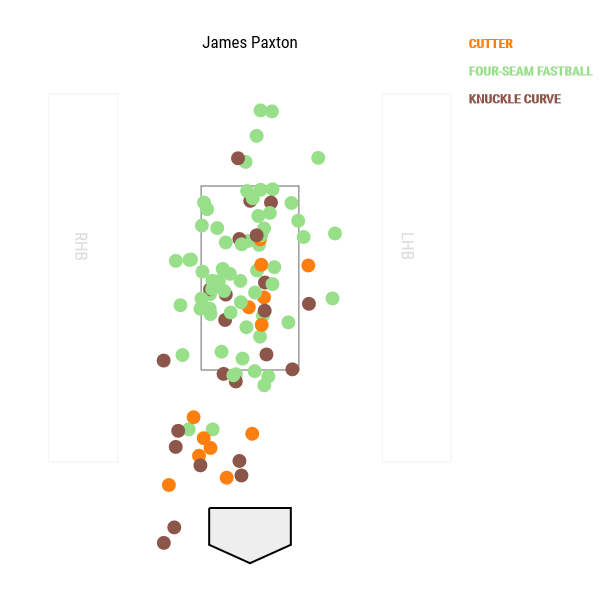
Was that an intentional decision? It seems likely, and there are a couple of reasons why. First, Paxton/Zunino seemed to want to work deeper into the game, and their pitch mix and locations seemed designed to elicit more contact – and they got their wish. Fewer whiffs, but more quick innings. Was this change at all related to the Jays line-up? I think so; if you look at expected wOBA or wOBA on fastballs above the midpoint of the zone, you’ll find that the Jays are one of the best hitting clubs in the game.
The problem is that in absolute (as opposed to relative) terms, they’re even better at hitting *low* fastballs. That came across last night; on fastballs below the midpoint, the Jays put 4 balls in play at an average speed of 96 mph. The 6 balls they hit on fastballs above the midpoint averaged 83 MPH off the bat.
The other difference in this game was in Paxton’s choice of secondaries/breaking pitches. His curve has been a problem all year, but last night, it was a perfect change of pace, and one Paxton used to get ground balls – including the double play that Kevin Pillar hit into. Paxton’s curve has lost some of its bat-missing power over the past few years. It got whiffs on 40% of swings over 2016-17, over a standard deviation more than the MLB average. For whatever reason, it’s getting whiffs less frequently now, but it was still able to help Paxton’s plan to pitch more economically. His cutter is and remains a swing-and-miss pitch, so it’s a testament to just how committed to their gameplan that Paxton threw so few of them last night. After throwing over 20 in 4 straight starts in April, he’s now using it sparingly, which may help its effectiveness. Or, he may just not have had a great feel for the pitch, especially after seeing Lourdes Gurriel hit a 3rd inning cutter 388 feet to the wall in left.
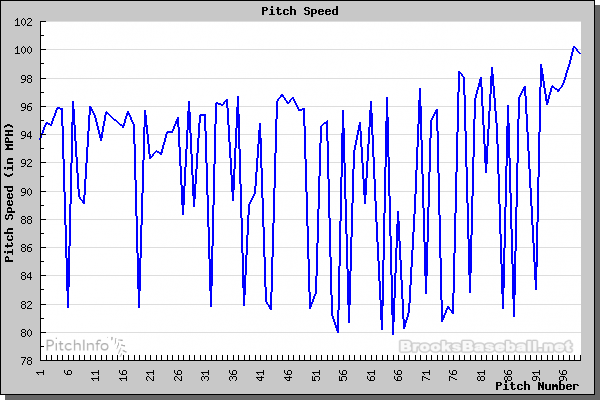
Essentially, Paxton and Zunino seemed to come into the game with a plan to get quick outs even if that meant going away from Paxton’s most effective pitches: the high fastball and the cutter. It worked, despite some well-struck balls in play, and it enabled Paxton to work through the 9th without breaking the 100 pitch mark. Paxton’s curve was more effective than it’s been all year, and that means Paxton has multiple ways to beat teams. That efficiency meant that late in the game, Paxton was able to reach back for more velocity when he needed it:
James Paxton is on quite a run, and there’s essentially no pitcher in the league right now teams would want to face less than Big Maple. I’m still not a huge fan of throwing low fastballs, but it’s nice to know he can give batters another look every now and again. The development of his curve is crucial to how long he can keep this level of performance up. His fastball is legitimately one of the best pitches in the game right now, right there with Kluber’s slurve. Over time, batters will learn to adjust to it, even when it’s thrown at the letters. Having a breaking ball to get quick outs or as a different putaway pitch should preserve the fastball’s effectiveness a bit longer. All hail the Big Maple.
Game 34, Mariners at Blue Jays – BABIP Woes
James Paxton vs. Marcus Stroman, 4:05pm
The M’s head to Toronto to take on the surprisingly decent Blue Jays, who used a solid off-season to retool and are hanging around at 19-16. The Jays offense has some pop, but not much else; they’re hitting .237/.315/.427, which works out to dead-on league average. Unfortunately for Toronto, they’ve paired that with poor defense, and thus their position players rank 21st by Fangraphs’ WAR.
If you think it’s a bit early for defensive stats like UZR, well, right. But just using defensive efficiency, they’ve been among the league’s worst teams at turning batted balls into outs. One of the noticeable trends in baseball the past few years has been an increase in league-wide BABIP, a finding that’s hard to square with the fact that more and more teams are using data to shift their defense into better/newfangled arrangements. But this year, it’s dropped quite a bit, back to the heady days of 2010-11, when offense was scarce and pitchers ruled baseball’s landscape. It’s in that context that the Jays’ team BABIP of .309 looks like a real problem. Their offense is leading the league in HRs, and while their staff has given up a bunch (46), the real problem is that they’re still giving up old fashioned runs – runs that are the product of walks and base hits.
Of course, the M’s are only one rank ahead of the Jays in BABIP. Their .307 mark ranks 5th highest in MLB, and is a massive decline from where it’s been in recent years. So is it the defenders’ fault that James Paxton’s BABIP is sky high? Among the 114 pitchers who’ve logged at least 30 IP this year, Paxton’s .349 BABIP is 6th worst. And tonight’s opponent, Marcus Stroman, is in 13th place, at .330. (They’re all trailing the guy with the worst BABIP in baseball, Marco Gonzales). Well, maybe not.
Stroman has been one of the worst pitchers by the new Statcast measures of batted ball quality. Among pitchers who’ve given up at least 50 batted balls, Stroman’s percentage of balls struck at 95 MPH or more is 3rd worst, and it’s the worst among pitchers w/ at least 100 batted balls, just ahead of Mike Leake. Well over half of the balls hit off of him have been 95+ MPH, which is why he’s given up plenty of “barrels” and has an above average exit velocity in every batted ball type. Marcus Stroman isn’t stranding any runners and has a sky high BABIP, but these numbers show us that he’s not just a hard luck case – he’s pitched extraordinarily poorly.
James Paxton has a low average exit velocity, and it’s very low for fly balls/line drives, so his BABIP is purely luck, right? Well, the distribution of those batted balls is kind of strange. Paxton’s given up a lot of 95 MPH+ contact, and that’s saying something given the fact that he hasn’t allowed much contact at all. So with Stroman, you have batters who are fairly consistently hitting him hard. With Paxton, they’re either striking out, hitting absurdly poor contact, or driving the ball.
It’s odd, as Paxton’s extreme fly ball tendencies should help him produce a low BABIP. Indeed, most pitchers near him at the bottom of the league GB% table have very low BABIPs. I wonder if Paxton’s velocity and fly ball tendencies may be producing more balls hit down the lines, particularly to the opposite field? It’s also true that when he slows things down by throwing his curve, batters have tended to punish it – think of Miguel Sano’s long HR. In any event, we’ll see how much of these BABIP woes were just the product of his old fastball usage, where he’d throw his fastball low in the zone and watch batters drive it. Against the A’s 5 days ago, he showed us a very different game plan, and one that might suppress his BABIP.
1: Gordon, CF
2: Segura, SS
3: Canó, 2B
4: Cruz, DH
5: Seager, 3B
6: Haniger, RF
7: Healy, 1B
8: Zunino, C
9: Gamel, LF
SP: Paxton!
The big news ahead of today’s game has nothing to do with the game, but it’s become all too familiar. Jays closer Robert Osuna was arrested last night for assaulting a woman, and he’s been put on “administrative leave” by the league. Screw you, Robert Osuna. MLB is played by people, and people are imperfect at best and sociopathic at worst, so at some level, we’ll always see stories of baseball players committing heinous acts. But it’s pretty clear there’s a problem in this area specifically, and it’s one the MLB, the MLBPA, teams, etc., would do well to focus on. They’ve imposed punishments, so the deterrence side is better than it used to be, but I hope there’s work going on behind the scenes on changing hearts and minds, on deescalation, on not being predatory and/or violent with partners.
Roenis Elias solid start led the Rainiers to a 3-1 win in Reno, which is a terrifying pitching environment. They’ll kick off a series in El Paso against the Padre-affiliated Chihuahuas tonight with Ariel Miranda on the mound.
NW Arkansas beat good ol’ fashioned, everyone’s included Arkansas 5-2 last night. Nathan Bannister kept the Travs in the game despite going 6 IP with 0 strikeouts and 2 walks and 10 hits allowed. Uh…nice..job, I guess? Joey Curletta had 2 hits, and is slashing .286/.437/.527 on the year. Anthony Misiewicz starts for Arkansas tonight.
Modesto was off last night, but start a series against the San Jose Giants tonight with Ljay Newsome taking the hill for the Nuts. The righty has an awesome 34:3 K:BB ratio, but unfortunately, he’s also given up 44 hits and 24 earned runs in 31 2/3 IP, good for an ERA of 6.82. The zone-controlling is right on track, but now it’s time to limit contact.
Clinton beat the West Michigan White Caps 8-7 in 10 IP last night, as Joe Rosa and Dimas Ojeda homered. Tommy Romero was solid for 4 IP, but walked 5 over that span, so his night was cut short. After some ugly middle relief, Kyle Wilcox K’d 5 in 2 1/3 for the win. Raymond Kerr starts for the Lumberkings tonight.
Angels at Mariners: The Most Anticipated Game of the Year
King Felix vs. Shohei Ohtani, 1:10pm
After last night’s classic back-and-forth comeback, today’s game looks even bigger. And let’s be honest: this one didn’t need a boost from context.
These two teams look like they’ll be fighting all year for the wildcard, and if so, these two pitchers will be critical. Felix seems to have righted his ship a bit, and Ohtani’s been as advertised: plus-plus velocity, good secondaries, and a bit of an injury issue. Ohtani’s already notched the fastest pitch by a starter, and is averaging 98 on his fastball.
It’s early May, but this game just *feels* big, and that’s a great sign.
1: Gordon, CF
2: Segura, SS
3: Cano, 2B
4: Cruz, DH
5: Seager, 3B
6: Haniger, RF
7: Healy, 1B
8: Zunino, C
9: Gamel, LF
SP: El Cartelua
Game 31, Angels at Mariners
Mike Leake vs. Garrett Richards, 7:10pm
The M’s host the Angels this weekend in what’s now a must-see series for a completely different reason than we thought a few days ago. With Shohei Ohtani on track to pitch…maybe…on Sunday, this was supposed to be Ichiro’s chance to face another Japanese icon, and perhaps a fitting way to close the curtain on his playing days. Instead, he’s already a member of the front office, but given the way the M’s, Angels, and Astros have played, the three clubs enter today separated by a grand total of a half game. The Astros have fallen back to earth thanks to an encounter with the Yankees, while the Angels struggled with both the Yankees and Red Sox. Sure, sure, the M’s have had the easier schedule to date, but they’ve done what they’re supposed to and win series against inferior teams. The Angels are coming off a sweep of the Orioles, so they know a thing or two about that as well.
Tonight’s game features the Angels’ Garrett Richards, a pitcher I’ve long thought could be great if he could stay healthy. I even picked him as a potential Cy Young vote-getter before the season started, a prediction that now looks…well, it’s early, and how about that Braves pick, huh? Let’s talk about that instead! Richards has his highest ever K/9, and it’s not even close. Unfortunately, he’s going through something affecting several good pitchers this year: a three true outcome explosion. From 2013-2017, Richards’ walk rate stayed around 7%-8%. A bit higher in 2015, the one year he’s eclipsed 200 IP, but lower in 2017. This year, it’s currently at 15%, essentially right where he was this spring (14% in the Cactus League). Worse, he’s given up 4 HRs already, the first time he’s had a HR/9 over 1.0 since his 2011 cup of coffee.
His GB% is still elite, driven by his 96 MPH cutter/four-seamer that has high spin and extremely odd movement. He backs that pitch up with two of the highest spinning breaking balls in the game, a slider and curve that’s he’s using more of now than in prior years. His contact rate is an extremely low 72%, and while he’s not getting a lot more whiffs, he’s tricked batters into NOT swinging at strikes. Batters are offering at just over 53% of strikes, the lowest rate for any starter in the game. That sounds great, but then you look at his walk rate again and realizing that they’re not swinging for a very good reason. If they do nothing, he’s liable to walk them.
This pattern – lots of Ks, lots of walks, lots of HRs, and few swings – is happening to a few other talented pitchers. Robbie Ray’s K/9 would lead baseball if he qualified, and is somehow still ahead of James Paxton’s, but batters are swinging at just 41% of his pitches and taking advantage of a 14% walk rate. They’re waiting until they get a pitch to hit, and then crushing it, as Ray’s HR/9 is also the highest of his career. Paxton’s overall season numbers look like they might belong in this group, but I’m guessing he’s graduated from it, as has a clear example from last year, Blake Snell. Yu Darvish, with a BB/9 of 4.80 and a HR/9 of 1.80, is the new kid in this class.
Of course, the M’s aren’t exactly a patient team. With an above-average swing rate and below-average walk rate, they may be just what Richards needs. Or they would be, if they didn’t have the kind of power that can really hurt a pitcher who’s struggling with the long ball. Lay off low sliders and hunt middle-middle cutters, and you’ll be fine, M’s. Meanwhile, Mike Leake needs to give them a chance. Leake has the highest average exit velocity of any pitcher with at least 100 batted balls, and the second highest average fly ball/liner – which is a problem, given his sudden lack of ground balls. Leake looked like his old self against Cleveland in his last start, so it’s not all hopelessness and dingers. If he made an adjustment, that’s great (he threw more sliders last time out, but nothing too striking).
1: Gordon, CF
2: Segura, SS
3: Cano, 2B
4: Cruz, DH
5: Seager, 3B
6: Haniger, RF
7: Healy, 1B
8: Gamel, LF
9: Freitas, C
SP: Leake
The best article on Ichiro’s shock retir..whoops, transition, came from Patrick Dubuque, to no one’s shock. It’s over at BP, and it’s a free article, so go read it now.
The Tigers have sent Miguel Cabrera to the 10-day DL, and have decided that John Hicks, their back-up C/bench bat, will get the majority of the ABs that Cabrera misses. This is itself pretty unremarkable, but M’s diehards may remember Hicks as the glove-first C prospect the M’s drafted out of Virginia in the 2011 draft headlined by his college batterymate, Danny Hultzen. Hicks had a great year in High Desert, but other than that was not known for his hitting; he played in Tacoma for parts of 2 seasons, and was decidedly below average in both, with a slugging percentage under .400. He got a cup of coffee in one of the many lost years the M’s had in the Zduriencik era and came to the plate 34 times, going 2-32 with a stunning 18 strikeouts. He was DFA’d after that and bounced around AAA a bit, but the Tigers signed him in 2016. He’s now come to the plate 77 times for Detroit and has a cumulative slash line of .265/.328/.455 with 8 HRs, which is 8 more than I would’ve bet he’d ever hit. This isn’t a “why do they always get better?” lament, this is a just another hilarious example of baseball’s bizarre developmental paths. Good for John Hicks.
Matt Harvey will be DFA’d tomorrow after refusing a minor league assignment. It’s a move that seems to be in everyone’s best interest, as the odds that there remain things that the Mets could tell him that he hasn’t already tried are pretty low. His behavior makes the decision even easier for New York, but if he’s going to get back on track, it’s exceedingly unlikely that it’d happen in that organization.
Rob Whalen looks to bounce back from his first poor outing of 2018 5-6 days ago, as Tacoma kicks off a road trip in Reno. Tacoma avoided a sweep at the hands of the Albuquerque Isotopes with an 8-3 win yesterday, as Gordon Beckham and Mike Marjama homered and Ariel Miranda pitched pretty well.
Andrew Moore tossed 7 brilliant innings in Arkansas’ 9-1 win over Tulsa, but the game was a 1-1 pitchers duel most of the way. The Drillers Dennis Santana gave up 1 run over 5, but the Travs scored 6 in the 8th off of Shea Spitzbarth, and another 2 in the 9th just to make sure. Chase de Jong takes the hill against Tulsa’s Caleb Ferguson tonight. Ferguson was a 38th round pick by the Dodgers in 2014, and spent a few years in rookie ball thanks to TJ surgery in his senior year of HS, but has pitched brilliantly over the last year+. He started the year as the Dodgers’ #16 prospect, but could make a push up the rankings if he keeps his solid start going. The lefty has a low-90s FB and a good curve.
Modesto beat Rancho Cucamonga 9-6. Reggie McClain tossed a quality start, and Joe Rizzo and Nick Zammarelli continued their hot hitting in the win. Former Pirates top prospect Stetson Allie worked an inning in relief in this one; I guess he’s pitching again. He was a two-way star in high school in Ohio, but was drafted as a high-90s power pitcher. After walking 37 in 26 2/3 IP, including 8 in 2/3 of an IP in 2012, he picked up a bat. He tore up the Sallie League, and had an OPS over .800 in AA in 2014, but a low average and high strikeouts meant he could never quite get over the AA hump. He started pitching again a bit in the Dodgers system last year, and is throwing this year – he has 0 PAs for Rancho – but the walks have returned. Modesto heads to Lake Elsinore to start a series against the Storm tonight, and the Nuts will have Danny Garcia on the mound.
Bowling Green scored 5 in the first signalling pretty clearly that no, there would not be an organizational sweep. They ended up winning 8-3 despite 3 hits from L-Kings OF Jack Larsen, an undrafted FA out of UC San Diego who’s slashing .308/.407/.551 on the year. Oliver Jaskie stars tonight against the Dayton Dragons’ Adrian Rodriguez, a Mexican righty who’ll be back on a minor league mound for the first time since July of 2016…must be TJ surgery?