
Game 28, Angels at Mariners
Hisashi Iwakuma vs. Ricky Nolasco, 7:10pm
Last night’s loss was tough to take. Edwin Diaz seems so, I don’t know, HUMAN all of the sudden. His strikeout rate’s good, the velo seems to be there, but the sense of inevitable dominance certainly isn’t. Small sample, I know, but I’m not talking about Diaz’s talent, I’m talking about what it feels like when Diaz enters a game now, and how different that feeling is than 8 months ago. Everything about him seems like it’s on fast-forward, from his meteoric rise after transitioning to the pen to spending all of 3-4 months as one of the most dominant relievers in the game, and then this (perhaps inevitable) fall. He’s young, he’s still got great stuff – he can come out of this and reclaim his spot among the elite closers, but man, the M’s track record of helping pitchers successfully pull out of tailspins isn’t great. They’ve sent Dan Altavilla back to Tacoma, and Cishek’s hanging out there for a while as they work on his mechanics. Sending their closer down would seem like a vote of no confidence in the big league coaching staff as well as a white flag on the season, so I don’t think anything like that’s close. But games like last night’s put you in a pessimistic mood.
If that wasn’t cheery enough, James Paxton lost the strikezone, and while he kept the club in the game, it ultimately wasn’t enough. It certainly feels like the M’s need to win his starts, given the uncertainty in the rotation behind him. That’s a nearly impossible burden to put on a guy, even one as talented and locked in as Paxton’s been this year. But while Matt Shoemaker isn’t chopped liver, the offense needs to be a bit less streaky – a bit more consistent from game to game. They had plenty of chances to do more damage against both Shoemaker and the Angels pen, but couldn’t quite do it. The 9th inning comeback was great, but why’d you NEED a 9th inning comeback?
Hisashi Iwakuma starts tonight, and tries to extend his little run of solid pitching despite down velocity. He was great in Detroit, hitting his spots and avoiding the heart of the zone, but he hasn’t been able to do that consistently this year. Getting the ball down is key for Iwakuma these days, as batters are turning more of his missed fastballs into home runs. Balls that fall below the zone can’t really hurt, and if they’re splitters, they may even induce an ill-advised swing. Balls that fall in the middle or top of the zone (at 83 MPH) become souvenirs.
That’s why Iwakuma’s been so focused on the low pitch, as we’ve talked about. I’ve re-checked the numbers, and among all pitchers who’ve thrown at least 150 pitches this year, Hisashi Iwakuma’s rate of pitches at the lower edge of the strikezone and below ranks 17th out of 330 pitchers. Nearly 46% of his pitches aren’t just lower than the midpoint, but *extremely* low. Among starting pitchers, that percentage ranks 7th in baseball; Dallas Keuchel is famously #1 by a mile among SPs, with Mike Leake, Wade Miley and Zach Greinke a ways back. A few of these guys – Keuchel, Andrew Triggs, Leake – use this strategy to induce a lot of ground balls. But others, like Greinke, Miley and Iwakuma, aren’t putting up insane GB rates. Greinke and Iwakuma aren’t even above average.
That might be a good thing. If you remember, I talked about the VERY early team defense numbers a few weeks back, and how the M’s outfield defense didn’t look as amazing as promised. But that was only after 9 games – far too early to tell much, right? Well, it’s been a bit longer, and the overall numbers still look similar. The M’s team defensive efficiency – the percentage of balls in play they turn into outs – is still stuck just below .700, among the worst in the league. At that point, the M’s defensive efficiency just on fly balls ranked 16th. Now, with a few more weeks of play, and with Jarrod Dyson in CF, they rank…15th. There are really two main takeaways you get from comparing the numbers after 10 games to the numbers after 27 – first, the M’s pitchers aren’t quite as ground-ball heavy as they were in the early going and second, the M’s have been awful on ground balls.
The M’s defensive efficiency on ground balls now stands at .710, by a wide margin the worst in baseball. Baseball Prospectus’ data on DER by batted ball type seems to go back to 2003. In that time, no team has *ever* posted a DER on ground balls as low as the M’s current .710. For years and years, the *lowest* DER on grounders would be in the .740s. This is…this is bad, people. The 1B position has been suspect at times, but probably doesn’t get enough chances to make an impact like this. Taylor Motter probably isn’t a true SS, and had to fill in for Jean Segura, and that’d make a dent in the team’s DER. But the magnitude here, especially with some solid defenders racking up innings, suggests something more systemic. The M’s shift all the time now, and while Manny Acta proudly mentioned the number of plays saved thanks to the shift last year, I’m seeing less of it this year. A lot of this may be luck, but I’m wondering if the M’s are either shifting too much, or shifting incorrectly. There’s no reason for *this* group of players to put up historically bad defensive efficiency numbers, but as long as they are, I guess I’m glad Hisashi Iwakuma’s not a ground ball pitcher anymore.
I lambasted the odd trade last year that sent Hector Santiago to Minnesota in exchange for Ricky Nolasco and Ricky Nolasco’s big contract, but wouldn’t you know it, it hasn’t been a disaster for Anaheim. Nolasco, coming off a year and a half of replacement-level pitching in the Twin Cities, ended 2016 with 21 consecutive innings without allowing an earned run. He tossed a CG shutout earlier in his Angels’ tenure. This year, he hasn’t been great thanks to a persistently high HR rate, but…I wanted a disaster, not quiet mediocrity and admirable consistency. This year, even Santiago’s getting into the act, running a very nice ERA and FIP in a handful of starts. People always talk about win-win trades, but they’re hard to find in the wild. This boring swap of back-end starters may be an example.
1: Segura, SS
2: Gamel, RF
3: Cano, 2B
4: Cruz, DH
5: Seager, 3B
6: Valencia, 1B
7: Heredia, LF
8: Zunino, C
9: Dyson, CF
SP: Iwakuma
Remember when Taylor Motter’s bat was unbenchable, and how he’d get starts in the OF and 1B? That was *so* April. We’re moving on, people.
Tacoma beat Las Vegas 5-3 last night at Cashman Field, and thought it was so enjoyable, they’ve done it again today. Yesterday’s win featured more solid pitching from Christian Bergman, who’d been in Seattle by now if he had, I don’t know, Dillon Overton’s 40-man spot. They also got HRs from Dario Pizzano and Zach Shank. Today, they got a decent start from Ryan Weber, and a HR from DJ Peterson. They needed 11 innings to get to their 5-3 result, but that just let the bullpen show off – they pitched 5 scoreless and racked up 5 Ks against no walks.
Tulsa and Arkansas were rained out today.
Modesto beat San Jose 4-3 behind Pablo Lopez and a shutdown save from Lukas Schiraldi. Braden Bishop had a hit and a walk. Last night, the Giants used a 6-run inning to pull away from the Nuts and win 11-7. Kody Kerski gave up 8 runs in 1 IP, and Bishop doubled and singled.
Clinton held on to that 5-0 lead I mentioned yesterday, albeit barely. They ended up with a 5-4 win over Lake County. Today, they lost another close one to tastefully-named Eudis Idrogo 3-2. Idrogo, a Venezuelan lefty, spent 3 years pitching in the VSL for the Tigers affiliate, and in each year, he allowed 12 walks. His innings totals varied, as did his other results, but in each campaign: 12 free passes. He made his way to the US affiliates in 2015, splitting time between the NY-Penn league and the Rookie-level Gulf Coast League. Combined, he threw 54 1/3 IP that year, with, yes, 12 walks. Last year, Eudis Idrogo showed that he’s his own man; good luck trying to figure out what Idrogo’s gonna do. You don’t OWN Idrogo. (He gave up 14 walks). Ronald Dominguez tossed 4 IP of scoreless relief in today’s game.
Game 27, Angels at Mariners – More Roster Churn, and Gamel’s Gains
James Paxton vs. Matt Shoemaker, 7:10pm
The M’s return home after a frustrating road trip that saw them on the precipice of winning a second straight road series, before falling in ugly fashion to the Indians. That game seems to have occasioned another series of roster moves, with the M’s returning to the 8-man bullpen that fans so loathed. The first move, and it’s not exactly a shock, is Dan Vogelbach heading back to Tacoma. Another 25- and 40-man spot was created when Casey Fien was once again knocked off the roster, this time through being designated for assignment. The M’s created one final roster spot by moving UTIL Shawn O’Malley from the 10- to the 60-day DL. So who are the beneficiaries of the new 40-man spots? Two Tacoma relievers, MLB vet Jean Machi and prospect Emilio Pagan.
Machi, 35, has thrown nearly 200 big league innings, and while he’s not a huge strikeout guy, he uses a sinking fastball to generate a lot of ground balls. While he throws a slider, his big putaway pitch is a splitter with good vertical movement, and that’s helped him produce reverse platoon splits over his career. Clearly, Machi’s not a righty-specialist, but could be used to get a lefty if they’re in a tough spot before they want to use Marc Rzepczynski, and he could be called upon in a double play situation. Emilio Pagan was a 10th-round pick back in 2013 out of a tiny college in the south, and has made steady progress since. He’s about to turn 26, so he’s not exactly a young phenom, but he’s posted gaudy strikeout totals at each stop, so neither is he just a AAAA veteran who’s posted a nice line in a couple week stint. He saw action in the World Baseball Classic, setting up for Edwin Diaz for Puerto Rico, a job he could one day reprise in the big leagues. His fastball comes in around 95 and has good vertical rise. His change-up has nowhere near the drop that Machi’s does, but, helpfully, his slider does. Machi’s FB’s nearly as fast as Pagan’s, but its totally different movement produces a totally different batted ball profile. Pagan’s an extreme fly ball pitcher, and whereas Machi’s got reverse splits, Pagan’s fastball/slider mix makes him very tough on righties, but somewhat vulnerable to lefties.
That last spot on the roster seems set for Steve Cishek, but not quite yet. The righty pitched a bullpen session in front of Mel Stottlemyre, Jr. today, according to Ryan Divish, as the M’s try to spot the mechanical problems that have produced 5 hits and 3 walks in just 4 IP between AA Arkansas and AAA Tacoma.
I mentioned it in the last post, but Vogelbach’s passivity at the plate was crippling his at-bats, and I’m hoping he can work on that in Tacoma. While we used to think of plate discipline and aggressiveness as being innate, we’ve learned over the past few years just how much hitters can change. Vogelbach was utterly unprepared to be a big league 1B this month, but he could be down the road. Ben Gamel had the exact same problem, and frankly, I thought his chances of making it in the big leagues were…uh, slimmer than Vogelbach’s. As a corner OF, Gamel needs to either hit for a very high average or hit for enough power to justify his position in the line-up. Last year, we saw a guy who was overly selective, working himself into pitcher’s counts, and swinging only reluctantly at strikes. When he did so, he didn’t strike them with enough authority to do worth while. More simply, his K rate was way too high to support a low ISO. This was Leonys Martin’s issue recently, and one of the things that crippled Ketel Marte’s M’s tenure. Every batter brings strengths and weaknesses in a few critical skills: contact, power, and batting eye. Jeff wrote about “the Gallo threshold” the other day at Fangraphs, which is a great way to envision one pole. Joey Gallo makes less contact than just about any player in the game, and like Chris Davis, doesn’t play enough a tough defensive position. He DOES hit for more raw power than just about anyone alive, so he’s just got to make enough contact for his power to carry his value. We saw this recently with George Springer; many teams were scared off after he posted high K rates in college and then again in the minors. When he hit the ball, it went a long ways, and unlike Gallo, he could theoretically play CF. But even so, he needed to make enough contact to make his power playable. Over time, he did. Ichiro’s perhaps the best example of the opposite pole – players who don’t hit for power and don’t draw a ton of walks, so need to make contact to add any value. Dee Gordon’s another. Gamel seemed on the verge of slipping through the gap: not enough power AND not enough contact (not because of whiffs, like Gallo, but because he stubbornly stared at called strikes). Like so many other players, Gamel seems to be changing that.
Last year, Gamel’s average launch angle was just 3.7 degrees, and came off the bat under 86 MPH (the sample is ridiculously small, I know). This year, those figures are 13.8 degrees and 91 MPH, respectively. Are players capable of increasing their angle by 10 degrees? All while increasing exit velocity? Sure – his teammates did it. In 2015, Jean Segura had an average launch angle of 3.9 degrees with an average of 86 MPH off the bat. The very next year,he was at 7 degrees, and this year it’s at 10.5. Robinson Cano was at 5.5 in 2015, and then about 11 in 2016. And while it wasn’t as dramatic, Ryan Zimmerman’s launch angle change has transformed his production this year. After talking with Daniel Murphy, the Nats slugger has 11 HRs thus far after increasing his launch angle.
James Paxton starts for the M’s tonight as he tries to continue the most dominant run of his career, and one of the most impressive months a Mariner’s produced in a while. I’d mentioned earlier that Hisashi Iwakuma was throwing more balls this year as hitters were destroying the ball when he threw it in the zone. Responding to that, Iwakuma’s throwing fewer and fewer strikes. In recent games, he’s actually become much better at locating around the edges, which is why his walks are starting to come down, but he’s still got to avoid the heart of the zone, because he’s getting killed there. And as you’d imagined, Chase de Jong’s getting hit even harder. The point of this elaborate set-up? James Paxton doesn’t need to nibble. When Paxton throws a pitch in the zone, not even the edge of the zone, but the middle of it, batters are slugging .241 off of him. No starter’s lower thus far this year.
I’d be happier if this seemed like a more stable skill; if you remember, Paxton gave up tons of loud contact, and batters slugged .510 on these pitches in 2016. Still, this seems an indicator not only of his good fortune, but his improved command. With a better cutter and better location, batters can’t load up and target pitches within the zone. Kind of like the Gallo threshold, power pitchers give themselves some wiggle room through high velocity (producing weaker, more defensive swings) and great stuff (producing swings and misses and pitcher’s counts). Paxton doesn’t NEED to hit the edges as much as Iwakuma. If he can keep batters on the defensive, they’ll need to cut down their swings and just try to stay alive. The Angels come in with the lowest isolated slugging in the AL West, and they rank 28th in MLB (ahead of only the Red Sox – huh? – in the AL), so this seems like a good match-up for Big Maple.
1: Segura, SS
2: Gamel, RF
3: Cano, 2B
4: Cruz, DH
5: Seager, 3B
6: Valencia, 1B
7: Heredia, LF
8: Zunino, C
9: Dyson, CF
SP: PAXTON.
The Rainiers looked like they’d kept their winning streak alive and completed a 5-game sweep with a comeback win over Sacramento, but they showed that they’re not the only team with bullpen issues in the Northwest. Down 2-1 in the 8th, they loaded the bases with no outs against Giants prospect Tyler Beede. But Beede induced 2 infield pop-ups and looked on the verge of wriggling off the hook, until Zach Shank singled in 2, and then came in on another 2-run single. That 4-run inning gave them a 5-2 lead headed to the 9th. But Mark Lowe gave up 4 hits and a walk, leaving Nick Hagadone to come in with the bases loaded and a tie game. Hagadone let one run score, and that gave the RiverCats a 6-5 win. Yuck. Lowe’s given up 18 hits and 14 runs in just 8 1/3 IP. Rob Whalen started, pitching 4 2/3 scoreless with 4 Ks and 1 BB. Tacoma’s Christian Bergman leads the R’s into Las Vegas tonight.
Arkansas scored 5 runs in the 7th to come from behind and beat Springfield 8-7. Dylan Unsworth was so-so, giving up 4 runs in 4 2/3 IP, but got some offense from Marcus Littlewood and Ryan Casteel, and then Zac Curtis tossed 1 1/3 perfect IP to save it. Tyler Herb starts tonight for the Travs.
Modesto had THEIR big inning in the first, scoring 5 to take over the game against San Jose and cruising to a 7-3 win. Braden Bishop and Jordan Cowan each had 2 hits, and Gianfranco Wawoe doubled in 2. Joe De Carlo started at catcher again, by the way. SP Nathan Bannister now has given up just 3 walks in 5 starts, but he’s also given up 35 hits in 25 2/3 IP, including 6 HRs. Nick Neidert tonight!
Clinton starts a series against West Michigan today, and Tigers prospect Kyle Funkhouser. Funkhouser pitched collegiately at Louisville, and seemed like a candidate to go in the high first round after his sophomore year, but after a down year as a junior, he decided to return for his senior year. His walk rate crept up again, and that pushed him down to the 4th round. He’s been solid as a pro, but not as dominant as you’d think for a college senior draft pick who’s striking out tons of young hitters. And, wouldn’t you know it, the LumberKings just knocked him out of this one in the 3rd, after getting 6 hits and 3 walks in just 2 2/3 IP. It’s 5-0 L-Kings at this point.
Game 26, Mariners at Indians
Chase de Jong vs. Josh Tomlin, 10:10am
The M’s have a chance to steal a road series against one of the AL’s best teams and turn what could’ve been a disastrous road trip into a sign of hope. After losing the first three in Oakland, the M’s awoke last Sunday morning in last place and sporting the AL’s second-worst record. A win that day and then a series win in Detroit – coupled with the Astros cooling off a bit – has changed things, if only slightly. The M’s offense looks much different now, even after facing some tough pitching on the trip.
Injuries mean that their starting pitching really needs to step up, and thus in this game that probably feels a bit more pivotal than it is, the M’s give the ball to Chase de Jong, who’ll make his first big league start. The righty’s four-seam fastball is arrow-straight, and with a bit more rise than usual. His primary breaking ball is an intriguing slurvy slider, that’s thrown at 81 MPH, just 9 MPH less than his fastball, but which features almost 12-6, curve-like break. The vertical break on it would seem to pair well with his fastball, and he’s got an actual curve that’s a bit slower to further change batters’ eye level. He has a change-up with armside run, but he hasn’t used it much; we’ll see if he goes to it today when he’s facing batters a second time.
His MLB sample is tiny, but de Jong’s not going to strike a ton of batters out. His fastball command’s been so-so, and he’s yet to record a swinging strike with it (at 90 MPH and straight, it’s never going to be a swing-and-miss pitch), but he’s generated surprisingly few with his slider. He’s not doomed or anything, as he’s actually posted some decent results in Tacoma and in his four-inning long relief appearance…I’m just still trying to figure out exactly how he’s done so.
His opponent today is control expert Josh Tomlin. Armed with a fastball even slower than de Jong’s, Tomlin’s succeeded by keeping the ball low and away to righties and lefties. This has transformed him a bit from a Blake Beavan clone in his early years (2011-2012) – a guy who’d post vanishingly low K rates and BB rates, but who’d give up plenty of fly balls and home runs – to a ground ball pitcher these days.
Unlike many pitchers, Tomlin seems to change not just his pitch mix from year to year, but also the shape of each pitch. In 2014, his fastball got well over a standard deviation more than the average ‘rise.’ Last year, as if adapting to his new game plan, it has *less* vertical movement than average. He’s also gone from pitching off his fastball and using a cutter as his breaking ball to essentially using his 85 MPH cutter as his primary fastball, and mixing in sinkers and curves along with it. At the same time, he’s transformed his platoon splits. Early in his career, they were normal, or perhaps a bit exaggerated, as lefties hit him much harder than righties. For the past several *years* this pattern’s essentially reversed, and now it’s righties that have done more damage. A command-and-control righty that targets the outside of the zone may seem like an awful match-up for Taylor Motter, but the splits have me wondering. The M’s appear to be banking on this being small sample weirdness, and have their lefty-heavy line-up in there today.
1: Segura, SS
2: Gamel, RF
3: Cano, 2B
4: Cruz, DH
5: Seager, 3B
6: Heredia, CF
7: Vogelbach, 1B
8: Ruiz, C
9: Powell, LF
SP: “Tasty” Chase de Jong
Congratulations to Boog Powell, now up with the team and forcing the M’s bullpen back down to a more normal 7 players. Powell made his MLB debut yesterday…kind of. He was announced as a pitch hitter, which induced Terry Francona to summon Andrew Miller from the pen. That in turn resulted in Scott Servais pulling Boog back and pinch-hitting Chooch Ruiz. As Powell was announced, he wasn’t eligible to play in the game again, and had his name written in the box score…he just didn’t…you know…DO anything. Today, he’ll get that chance. As always, he has a very discriminating eye at the plate, and has drawn walks wherever he’s been (when he’s not suspended, that is). The actual hit tool is a bit more of a work in progress, as he’s hit in the mid .260’s with very little power in about 325 PCL plate appearances in 2016-17.
Plate discipine is a good thing, and swinging at balls generally leads to horrible results for the batter. But there’s selectivity and then there’s passivity, and for too long, Ben Gamel seemed like he was tipping over the line into being passive. As a guy without much demonstrated power, he was going to need to avoid Ks to make it as a corner OF, and the number of taken strikes was killing him. That looks like it’s changing over the past week, and that’s very encouraging.
On the other side, Dan Vogelbach still looks lost. He’s swinging at less than 40% of pitches he sees, which means he’s not swinging at too many balls (other than that 3rd strike against Allen yesterday). But a so-so contact rate and a low rate of swinging at *strikes* mean that he’s been behind in counts and looking out of sorts. He’s better than this, but it’s been a very rough go in the majors for him, and with both Valencia and now Motter able to play 1B, he needs to turn things around fairly quickly, or the M’s will send him back to AAA.
Tacoma jumped on Sacramento early in a 7-4 win yesterday at Cheney stadium. Tyler Smith, Mike Freeman and Dario Pizzano all homered, and Orlando Calixte homered twice for the RiverCats…wind must’ve been blowing out last night. Tyler Smith, now up in the 2nd spot in the line-up, has his OBP up to .372. Emilio Pagan had 4 Ks in 2 perfect innings, and is positioning himself to be the next guy up. He’s not on the 40 man, but if Casey Fien loses his grip on the line-up spot again, they may give his spot to Pagan, who has 18 strikeouts in 11 innings. Chris Heston starts today against one of the Giants top pitching prospects, Tyler Beede.
Arkansas was rained out yesterday. It’s a great pitching match-up as Max Povse faces off with Jack Flaherty.
Modesto lost a heartbreaker 5-3, after giving up 4 runs in the 8th to Visalia. Anthony Misiewicz pitched well, but Joe Pistorese had his first real meltdown of the year, giving up 3 of those runs in the 8th. Braden Bishop singled in the game, and has a slash line of .330/.410/.440.
Clinton, too, was rained out. Double header today in Clinton against Quad Cities.
Game 25, Mariners at Indians
Yovani Gallardo vs. Danny Salazar, 1:10pm
Great win yesterday with the M’s 4th/5th starter on the mound. That had to give the M’s some hope heading into this one.
Felix Hernandez was diagnosed with bursitis in his shoulder…he’s expected to be back in 3-4 weeks. That’s the time frame for Mitch Haniger’s return as well.
1: Segura, SS
2: Gamel, RF
3: Cano, 2B
4: Cruz, DH
5: Seager, 3B
6: Valencia, 1B
7: Heredia, LF
8: Zunino, C
9: Dyson, CF
SP: Gallardo
Game 24, Mariners at Indians, plus Hisashi Iwakommentary
Ariel Miranda vs. Carlos Carrasco, 4:10pm
The Mariners got a much-needed series win on the road in an at times frustrating, but ultimately very encouraging win yesterday in Detroit. Hisashi Iwakuma outdueled Justin Verlander, and while the M’s bats scuffled occasionally, they got a timely hit in the 9th to win 2-1.
So was Iwakuma’s velocity mostly back, the way it was (according to the data we have) in his previous start? Well, no, it wasn’t. Instead, Iwakuma was able to consistently avoid big innings and loud contact. Even without his “old” fastball, this was Kuma’s first start of the year without allowing a home run. Critics, and I remain terrified each time he starts, point to his sky-high FIP and abysmal K:BB ration. The M’s will no doubt point to the fact that he hasn’t allowed all that many runs to score.
Whether or not that’s sustainable, it’s worth remembering that when Kuma was at his best, he always looked average-ish by FIP. Kuma’s game is built on beating his fielding-independent measures, so maybe the fact that his FIP screams “not major league quality” isn’t the final word on the subject. Specifically, Kuma’s posted a very good strand rate over his career, and while it dipped in recent years, it’s currently right back where it was in his 2012-13 heyday. Sure, at 84 MPH, we can expect that to perhaps decline a bit, but the point is that he’s beating his FIP in the exact same way he always has.
But if that’s true, why are some of his key stats so different? One of the reasons he was so effective was his sterling control and K:BB ratio. Now, by both of those measures, he’s among baseball’s worst starters. It seems odd to hang your optimism on his strand rate’s consistency if everything else about him is different. So, I decided to see if Iwakuma was locating differently, and perhaps targeting the edges of the strike zone. At a much lower velocity, he’s going to get fewer swings and misses, but maybe if he locates well, he can induce crappy contact.
The new Statcast database has expanded their strikezone…uh, zones beyond the old 14-zone grid used in the Gameday app. The new set includes more than 20 zones, with a set that defined as a ball’s width on either side of the strikezone border. That is, pitches on the edge (and just off) of the zone. My guess was that Kuma was throwing more pitches here, and perhaps getting more balls called on them. What do the data say? Nope, that’s not it. Iwakuma’s nothing special in terms of hitting the edge of the zone, and he’s worse than average by exit velocity when batters contact such pitches. He hasn’t really been punished for it, but that’s not what’s driving his runs-allowed success.
A little while ago, I mentioned this Jeff Sullivan article about Dallas Keuchel, and how the sinkerballer who’s always targeted the low strike is now throwing pretty much nothing but low pitches. If Iwakuma’s results are the product of a strategy, it’s the Keuchel strategy. Kuma’s throwing nearly everything low, including a lot of pitches well below the edge of the zone. You can see this in his plate discipline numbers at Fangraphs. By the Pitch FX-based zone, his zone% has dropped nearly 10 percentage points from last year. It’s as if he got burned by staying too MUCH in the zone, and has taken the opposite tack this year: he’s going to try and make you elevate really low pitches, and expand the zone southward to try and get poor contact. As we’ve seen this year and last year, at his velocity and level of command, he’s not getting ground balls even with this strategy – Keuchel throwing 90 with good command can do this, while Iwakuma throwing at 84 with meh command can’t. But while this strategy has greatly increased his walk rate, his BABIP is still pretty good (another strength of Iwakuma’s since his first day in the US). Despite decent exit velocity and angles (ie., batters aren’t just topping all of these low pitched), it’s still somewhat hard to do real damage on them. The grounders that batters HAVE hit have been anemic, which has made his BABIP on grounders astoundingly good. While they’ve hit fly balls hard, the distribution is skewed by the 6 HRs he’s already allowed. He’s induced quite a few in the “donut hole” area: 90 MPH hits that are elevated are some of the easiest balls in play to turn into outs. The HRs will be a part of his game now, even more than they already were. If his command increases a bit and he can limit walks, then while I don’t think he’ll be a GOOD starter, he can be a very odd #4-#5.
Given the drop in velocity and the fact that slower pitches are more affected by gravity, it’s worth considering that this apparent change in approach isn’t a conscious strategy, but rather the result of applying physics to his OLD approach. If that were true, we’d see his zone% increase and his walks decrease as he learned to adjust for his slower fastballs. Something to look for in his next few starts. I’ve made a bunch of claims here about statcast but haven’t linked to it; I did some research yesterday, but I tried to re-run it and link it now and none of the queries run. Uhhh, trust me, or better yet, wait until his next start and hopefully I’ll have links and pictures.
Today’s game looks like a mismatch on paper, with Ariel Miranda facing off against one of the Indians’ best starters, Carlos Carrasco. Carrasco’s been using the ol’ Iwakuma method to succeed this year, with a sky-high strand rate and low BABIP. Unlike Kuma, though, neither has ever really been a strength of his. His career ERA’s over his career FIP thanks to a poor career strand rate and average BABIP, but it must be nice to see how the other half live this April. His repertoire actually looks like a super-charged version of Iwakuma’s: he has a four-seamer without a ton of rise, but which comes in at 94, a sinker with plenty of horizontal/arm-side run, and then a change with very good vertical drop. He also throws a lot of sliders, and then has a curve that’s not that great, but gives batters a different look. The gap in vertical and horizontal movement from his change to his sinker look very much like Iwakuma’s…they’re just both thrown much harder.
Another way in which Carrasco’s struggled at times is that he hasn’t been able to make that change-up solve his platoon split issues. They were always a problem for him before his mid-career renaissance in Cleveland, but after a few years in which he seemed to have “solved” them, they’re back. They’re not overwhelming or anything, but lefties have fared better, while he continues to dominate righties. This is a day for the disappointing-so-far Dan Vogelbach to make his presence felt.
1: Segura, SS
2: Gamel, RF
3: Cano, 2B
4: Motter, 1B
5: Seager, 3B
6: Heredia, LF
7: Vogelbach, DH
8: Zunino, C
9: Dyson, CF
SP: Miranda
Tacoma had a rain-shortened game in Tacoma that featured the return of CF Leonys Martin. Steve Nelson and I debated the likelihood of Martin sticking in the org, and I have to tip my cap here: Steve was totally right. I’ll admit I’m still surprised, but it may be the M’s want another crack at “fixing” Martin more than they want salary relief. Anyway, Martin went 0-2 with 2 Ks and a walk, while Mike Freeman had the only 2 hits of the night for Tacoma. How’d Tacoma win 4-0 on just a pair of singles? Walks. Lots of walks. The R’s got 2 bases-loaded walks plus a bases-loaded wild pitch in the 2nd off of Ricky Romero, whose Blass disease recurred. Christian Bergman continued his run as one of the most effective starters in the PCL with 5 scoreless. Ryan Weber starts for Tacoma tonight against Michael Roth at Cheney Stadium.
Tulsa beat Arkansas 6-3 as the Drillers jumped on Lindsey Caughel for 4 runs early and held on. Ian Miller doubled and Ryan Casteel homered for the Travs, who got 2/3 of an IP from Steve Cishek. The Drillers bullpen was excellent, tossing 4 IP of scoreless baseball with 8 Ks and just 1 walk. Andrew Moore starts tonight as the Travs open a series in Springfield. Speaking of Cishek, this was his first time pitching in back to back games, generally a last test before recall. Today, though, the M’s transferred his rehab to Tacoma, suggesting he has some more work to do. We’ll see. (Hat tip: Bob Dutton of the News Tribune).
Modesto shut out Inland Empire 6-0 behind a great game from prospect Nick Neidert. The Georgian went 5 IP, giving up 2 hits and 2 walks while striking out 5. Braden Bishop and Gianfranco Wawoe both had two hits, and Donny Walton homered. Joe DeCarlo is back in the Cal League for Modesto, but that supposed position switch we heard about in the spring, where the erstwhile 3B was going to catch? Yeah, that’s not happening. He’s made a number of starts this year, but has donned the tools of ignorance in none of them -:Edit: Oops, reader Lailoken notes that De Carlo got a start behind the plate on 4/25. He’s played 5 games; 1 at C, 2 at DH, and 2 at 3B. It may not be that the pos. switch is entirely off, but it’s not really on, either. Pablo Lopez starts tonight against Visalia, the team he posted his first good start of the year against 5 days ago.
Clinton doubled up on Quad Cities 10-5, posting a 9 run 3rd inning in the process. Ljay Newsome struck out 8 in 5 innings, giving up 3 hits and 2 runs. Newsome now has a K:BB ratio of 30:1 on the year, which is unsurprisingly one of the league’s best. Two Lake County Captains hurlers, Shane Bieber and Aaron Civale, have 28:1 and 25:2 marks, but both are college draft picks and thus older than Newsome. Jon Duplantier’s 28:4 mark is great, but again, he’s a relatively high draft pick from Rice, not a 26th-rounder out of a northern state HS. Among 20-21 year olds with similar marks, I can only find Sam McWilliams of Kane County, who’s repeating the league, and Jesus Castillo of Burlington, an IFA out of Venezuela in the Angels system, who also had a month or two in the MWL last year. Their ratios are 20:1 and 22:2, respectively. Anyway, tough test tonight, as Danny Garcia leads the L-Kings against Quad Cities and Astros top pitching prospect Forrest Whitley.
Game 23, Mariners at Tigers – Thank You, Big Maple
Hisashi Iwakuma vs. Justin Verlander, 10:10am
Not going to spend a long time on this one, as the tarp’s on the field and it may not happen, but the M’s go for a series win today following yesterday’s command performance by James Paxton.
Paxton tossed 103 pitches, 74 of which were fastballs. The heater averaged 97, generated 12 swinging strikes, and essentially gave the Tigers no chance. Paxton’s cutter is really rounding into shape these days. I think that pitch more than any other benefited from Paxton’s lower release point, and now its vertical movement has more separation from his fastball. His curve’s fine, but it almost feels unnecessary at this point. Paxton’s velo and command are just overwhelming teams right now.
Iwakuma’s velo and command are NOT overwhelming right now, but his uptick in his last start was a very encouraging sign. I think everyone’s going to be looking at gameday if this game ends up getting played.
Justin Verlander’s off to a poor start, walking a bunch of people and getting hit harder than he has since 2014. Let’s hope that continues today.
1: Segura, SS
2: Motter, 1B
3: Cano, 2B
4: Cruz, DH
5: Seager, 3B
6: Gamel, RF
7: Heredia, LF
8: Ruiz, C
9: Dyson, CF
SP: Iwakuma
Game 22, Mariners at Tigers
James Paxton vs. Daniel Norris, 4:10pm
It’s been a rough 24 hours. The M’s gave up 19 runs in Comerica as Felix and then Chris Heston and Evan Marshall imploded. The M’s then lost their best hitter thus far, Mitch Haniger, to an apparent oblique injury that he’ll fly back to Seattle tonight to have evaluated. And, worst of all, Felix Hernandez has been placed on the DL with “shoulder tightness” and “dead arm” after tossing a couple of lackluster innings. Felix is the beating heart of the team, or rather, of M’s fandom. At this point, it’s pretty obvious that there are better players on the team, however you want to measure that, and that he hasn’t been among the game’s elite pitchers for a couple of years. But M’s fans are scared right now. Felix has, almost singlehandedly, justified mental energy spent on the M’s. His personality, his approach on the mound, the way he threw himself into Seattle and this region – he was the return on our collective investment.
I have no idea what will come of the inevitable tests on his right shoulder, but I’ve found comfort in the fact that I’ve felt like this before. It was April 18th, 2007. Felix came into that season off of a disappointing 2006 in which his dominating stuff produced less-than-dominating results. HRs and high BABIP led to too many big innings, but we all knew what he was capable of. That April, he showed us. He struck out 13 in 8 utterly dominating shutout innings against Oakland on opening day, and then in what became a defining game for him, he upstaged Daisuke Matsuzaka on his home debut, one-hitting Boston in a CG masterpiece. If you were around the M’s blogosphere then, you remember the feeling. Jeff Sullivan, then at Lookout Landing, was AT that game at Fenway, and all of us were going nuts as we watched Felix ascend the throne and make his nickname (which many other fans began to use pejoratively in 2006) manifest and obvious. And then came the 18th, his next start. It was at home against the Twins, and he looked off immediately. He was getting hit, and then couldn’t find the zone. After two straight walks, the trainers came out, and his day was done after just 1/3 of an inning. Later that night and the next day, we heard why: Felix experienced pain in his right elbow, and was placed on the disabled list. I was certain the TJ surgery was being scheduled. The M’s later said he’d be reevaluated and could come off the DL in May, but it seemed too improbable, and unbelievable from a team that suffered a wave of pitching arm injuries. An entire fan base tensed up for a blow that never came. Felix wasn’t quite Felix the rest of that year, but he was healthy, and made the leap to superstardom soon enough. I’m feeling today a lot of what I felt on April 19th, 2007, and the only thing making it easier is knowing that I was completely wrong the last time I thought the worst about an injury to El Cartelua.
The M’s game in Detroit takes on a very different feel now, and there are already articles discussing a potential rebuild. As we’ve talked about, that’s simply not an option for the M’s. Their core is older and signed to long-term contracts that, while they wouldn’t scare teams off, reduce the potential return. The farm system was raided to bring in the complementary pieces on this club. There’s not much help on the farm right now, as Felix’s rotation spot will be filled for the moment by Chase de Jong. This is the greatest test of the team’s vaunted culture. If they can stay positive and competitive now, then their work on a loose, positive clubhouse enviroment will have been one of the best investments in the club in years. If not, then the old sabermetric notion that wins produce a positive culture much more than a positive culture produces wins will get more supporting evidence.
James Paxton starts today in, what, his third must-win, please-don’t-let-us-down game of the year already? The M’s have loaded a ton of expectations on Paxton’s shoulders, and now they’ll load plenty more as Paxton’s going to have to pitch like an ace all year and hope the patched-together rotation keeps the team afloat. The loss of Haniger may be just as problematic, as the team has plenty of reasonably athletic corner OFs, but none with Haniger’s demonstrated ability at the plate. In the short-medium term, Taylor Motter simply becomes an OF full time. Kyle Seager’s scheduled to be back from his hip issue tomorrow, and thus the infield’s back to full strength. Ben Gamel’s up as the team’s best RF defender now, but Motter can play LF and move Heredia either to spot-starting in CF, or to RF when the M’s face a lefty. Gamel starts today, but we’ll see what the M’s do once Motter’s pushed to the OF.
Daniel Norris is a lefty who’s taken a while to make it in the big leagues. He throws 94, and has a good slider/change-up, but HRs and command problems made his results more mediocre than his talent would indicate. He shook that off last year after spending much of the year in the minors, returning to post a well above-average K rate and K-BB% in 13 starts. Despite the lefty velocity, he doesn’t have strong platoon splits; this isn’t a game where you’d want to get righties in the line-up at all costs. His command seems a bit off again this year, as his K:BB ratio is awful thus far, and he’s throwing more balls on every pitch type. Part of this is that batters are simply swinging less; he’s never been one to get a lot of out-of-zone swings, and this year, batters’ patience has paid off.
1: Segura, SS
2: Heredia, LF
3: Cano, 2B
4: Cruz, DH
5: Motter, 3B
6: Valencia, 1B
7: Gamel, RF
8: Zunino, C
9: Dyson, CF
SP: Paxton. Save us, Paxton.
The M’s predictably sent Chris Heston and Evan Marshall to AAA, and called up a new long reliever for the third time in a row. Today, it’s Dillon Overton’s turn. Joining him are Ben Gamel, and “Tasty” Chase de Jong, who’ll be slotted into Felix’s rotation spot. In a surprising move, the M’s also purchased the contract of reliever Casey Fien, whom they’d outrighted 2 weeks ago. Steve Cishek may not quite be ready, and Dan Altavilla was sent down less than 10 days ago, so they had fewer options than you’d think, but given that the move required creating a 40-man spot, they could’ve called up anyone in Tacoma. With Mark Lowe/Nick Hagadone struggling, I guess Fien sort of makes sense? I’m still a bit surprised they didn’t simply recall Altavilla. Rule 11(b)(1) prohibits a team from recalling a player within 10 days of being optioned, but there are exceptions. One of them is if another player is DL’d within that 10 day time frame. Felix’s DL trip seems like a tailor-made allowable exception to the rule. Maybe the team simply wants Altavilla to continue working with Tacoma’s coaches. It’s a mess.
Tacoma’s game yesterday was postponed, and they’ve got a travel day today.
Arkansas beat Tulsa 3-2 as Dylan Unsworth K’d 8 in 6 solid innings. Unsworth seemed poised to become the first African-born player in the majors this spring, but today the Pittsburgh Pirates called up SS Gift Ngoepe, another South African. Ngoepe’s a great story, and I’m excited for him – he’s a plus glove at SS, but not much of a hitter. Unsworth can become the second if he continues to pitch well. We’ll see if he can move back up to Tacoma given all of this roster churn. Peter Tago got the save for Arkansas; the righty whom the M’s picked up on waivers this off-season has been solid thus far. Tyler Herb and Colt Hynes face off today.
Modesto lost to IE 7-2, as the 66ers broke open a close game with 4 runs in the 9th. Reggie McClain was solid again for the Nuts, and Ricky Eusebio homered again, but Braden Bishop’s hit streak was snapped with an 0-4 night. Nathan Bannister starts today against Austin Robichaux.
Beloit shut out Clinton yesterday, as Michael Murray and Dakota Chalmers gave the Lumberkings fits. Joe Rizzo continued his hot start with a 2-4 day that actually reduced his batting average to .583. They played again today, and Clinton came back from an early 4-0 deficit and tied Beloit with 2 runs in the 9th, but then watched as the Snappers walked off with a 5-4 win on a, uh, walk-off single by “Pale Imitation Of” Edwin Diaz. Rizzo was a mere 1-4 with a 2B.
Game 21, Mariners at Tigers
King Felix vs. Jordan Zimmermann, 4:10pm
Happy Felix Day!
The M’s take on a Tigers team that’s tied for the lead in the AL Central, and – if the projections are any guide – one of their primary rivals in the hunt for a wild card. They’ll do so with Felix on the mound against Jordan Zimmermann, the former Nat who signed a $110 million deal with Detroit to replace/upgrade the hole in their rotation left by Rick Porcello.
Zimmermann was a low-key star, a pitcher with a fastball that averaged nearly 95 and who racked up at least 3 fWAR in 5 consecutive seasons, and who’d kept his ERA and FIP under 4 while averaging 200 IP for his last 4 years in Washington DC. In his first three outings for Detroit, he tossed nearly 20 innings and didn’t give up a single run. Still, there were some warning signs: Zimmermann’s fastball was down 2 ticks, averaging just 92.4 MPH. And while his walk rate was still better than average, it was higher than his own established level of performance – Zimmermann had kept his walk rate in the vicinity of 5% for years. As the summer wore on, Zimmermann started to feel pain in his neck, and he was DL’d in July after giving up 12 runs in 9+ innings. After returning, he was still not quite the same, giving up another 12 runs in just 2 1/3 IP in 2 disastrous starts. Between bouts of ineffectiveness and trying to work his way back into game shape, he failed to pitch more than 4 IP the rest of the season. The result was a poor overall season line, with K rates far below his established average, higher walk rates, higher HR rates, and lower velocity.
It wasn’t all bad, of course, as he showed flashes of his previous self, and ultimately figured out what was bothering his neck/shoulder (a pinched nerve, apparently). But three starts in to 2017, it’s not like Zimmermann’s back to being the exceptionally steady #2/#3 he was in DC. He’s still walking people, and his K rate is stuck well below average. In DC, Zimmermann’s fastball had slightly less “rise” than most, and was thrown from a 3/4 arm slot. In Detroit, he’s moved his arm slot up, albeit very slightly. This has led to more rise, as more of the spin is back spin as opposed to side spin. There are plenty of reasons why a pitcher might want that, but the results for Zimmermann are a fastball that’s easier than ever to elevate, and one that gets fewer whiffs. In general, a fastball with more vertical movement might be expected to get MORE swinging strikes, but Zimmermann’s ceteris is not very paribus: the significantly lower velocity swamps any effect of more vertical movement (and the movement/arm slot differences are pretty minor).
Zimmermann relies on his fastball quite a bit, and also throws a slider and curve. He’s been toying with a change-up for years, and seems to be throwing more of it this year, but I don’t know if that’s just a fluke or if he has more confidence in it now. He has fairly normal platoon splits – probably a bit on the small side, actually, which is somewhat surprising for a fastball/slider guy. The M’s have their first-choice line-up in there, so hopefully they can get to him early or at the very least run up his pitch count.
1: Segura, SS
2: Haniger, RF
3: Cano, 2B
4: Cruz, DH
5: Motter, 3B
6: Vogelbach, 1B
7: Heredia, LF
8: Zunino, C
9: Dyson, CF
SP: FELIX!
Welcome back, Jean Segura. The debate about how to get Taylor Motter ABs will pick up after Kyle Seager returns from his hip issue, but until then, hey, more Motter. Minor leaguer Jonathan Aro, whom the M’s acquired in the Miley-Carson Smith deal, was suspended 50 games for a positive drug test.
Lots going on in the minors, with more players joining affiliates who started the season in extended ST or on the DL. One such player was the unfortunate starter in Tacoma’s bullpen day in Albuquerque yesterday, Rafael Pineda. Pineda was a 30th round pick back in 2013, and first played in Pulaski, a level of pro ball the M’s did away with not long after. Pineda’s been hurt for a while, but made his first appearance since getting a handful of innings in Bakersfield last year. It didn’t go well. He gave up 5 runs in 2/3 of an inning, and that was essentially that for Tacoma in an 12-8 loss. Mike Freeman had 2 hits in his return to AAA, Tyler O’Neill hit his 3rd HR and also had 2 2Bs, and Boog Powell had 4 hits including 2 2Bs of his own. The R’s and Isotopes were scheduled to play today, but it was rained out.
A day after Andrew Moore’s first not completely successful start (the Travs lost to Cards prospect Jack Flaherty and Springfield 8-1), Max Povse had a nearly identical start in a nearly identical game (this time, the Travs lost to Tulsa 8-1). Not creepy at all! Povse gave up 4 runs to Moore’s 3, so his ERA is now 1.82, while Moore’s is *totally different* at 1.46. Chuck Taylor doubled and tripled in a losing effort. One reliever who pitched in the game for Tulsa was a familiar face – Edward Paredes, now in the Dodger org, who pitched for Tacoma and Everett 10 years ago. He was a decent prospect in the M’s system what seems like a lifetime ago. He’s been in the minors so long, he appears in our ancient “Future Forty” prospect lists (Carlos Triunfel – projected star)! Arksansas looks for revenge tonight with Dylan Unsworth on the hill.
Inland Empire scored 7 runs in the middle innings to pull away from Modesto, 9-4. Rehabbing Angel Luis Valbuena had a 2-R 2B, and Matt Thaiss added 2 2Bs for the 66ers, while Braden Bishop extended his hitting streak to 15 and Ricky Eusebio homered for the Nuts. The two clubs play again tonight; no word on the pitching match-ups.
Clinton completed the org sweep by losing 10-7 to the Beloit Snappers. A furious comeback fell a bit short, as Clinton scored 5 in the 9th, but they needed at least 8. Joe Rizzo, the M’s overslot 2nd rounder last year out of a Virginia HS went 4-5, and is now 5-8 in 2 games. This is an aggressive assignment for the teenager, but it’s a great sign that the org believes he can handle it. Nick Zammarelli, one of Everett’s best hitters last year, played his 2nd game and 1st at 1B – he’s off to a good start as well, going 3-9 with a HR in his first action of 2017. Tim Viehoff takes the mound for the Lumberkings tonight.
Off-day Stuff: Leonys, Pitcher Value, Segura’s Return
No M’s game today, as the club travels to Detroit and a series with the Tigers, but there’s still things to talk about.
1: The biggest news of the day yesterday wasn’t the recall of Dan Vogelbach, another El Motterdor homer, or even Nelson Cruz getting his first HR of the year. Instead, it was the unexpected jettisoning of their starting CF, Leonys Martin.
Martin’s season started with a new swing, a move that only in hindsight makes it reminiscent of Dustin Ackley’s 2013 and not like Mitch Haniger’s 2016. Baseball is about adaptation, but it’s difficult to select for adaptability itself as a skill. We all know that, say, Daniel Murphy’s swing changes turned him into a completely different player, or that Haniger/Motter or doing similar things for the M’s. On the other end of the scale, we’ve got Ackley or Brendan Ryan trying something – anything – to unlock the mystery of hitting at the highest level. Some of these changes work, and some don’t, and I don’t think anyone really knows why. Being coachable doesn’t seem to be enough; Eric Wedge once blamed Ackley’s struggles on too MUCH willingness to change, and Scott Servais clearly thinks Leonys was willing and able to implement changes – but nothing worked.
And it really has been a while since Martin was a competent hitter. Since July 1 of last year, Martin’s batted 390 times. His slash line in that time frame is .220/.252/.294. It’s also been falling throughout that time period. When the Mariners acquired Jarrod Dyson, they had to see this move as a possibility; moving Dyson to CF makes better use of Dyson’s range, and both are left-handed bats. While the move to grab multiple “athletic” outfielders could be framed as a way to help the pitching staff (“three CFs out there!”), it also sets up an implicit competition, in which the M’s could move on from whoever didn’t work out.
You can see the move as a results-trump-culture statement by the front office, and that no amount of personality can make up for 4-6 months of abysmal hitting. That frame gets the coaches off the hook, though. Not only are the coaches the ones supporting and embracing the team’s loose, positive culture, they’re supposed to be the ones using it to drive development and improvement. And Martin may be their highest profile failure. When Martin looked reborn in April-May of 2016, the coaches got a fair amount of credit. It seemed to make sense – new batting coach, plus a reunion with Servais, who’d worked with him in the minors – but I think there’s probably a little too much credit given to coaches when players take off, and too little blame applied when players falter and fail.
Ultimately, I don’t really care about apportioning blame in this situation. I just want the organization to succeed with, say, Dan Vogelbach, or Yovani Gallardo. Martin’s poor start would’ve cost him his job at some point, and if the M’s really thought they couldn’t do any more for him, then DFA’ing now may be everyone’s best interest (particularly as clubs are looking for defensive help in the OF). I hope the M’s understand what went wrong with Martin, and how they can help avoid it in the future.
Many M’s fans lament the 8-man bullpen and argue that the preference for carrying so many arms made Martin’s DFA possible. My bias is that no team needs an 8 man pen, particularly if you have long-relievers you can switch in from AAA, just the way the M’s are doing. I don’t know if this is a lack of faith in a bullpen that’s gotten off to a rocky start, or if it makes them feel more confident given their slightly banged-up rotation, but I think it’s hard to justify logically. That said, the point of a bench is to give the manager something different from his starting line-up, and I have no idea how Leonys Martin, bench bat, was supposed to work. He could be a late-inning defensive replacement! But in LF, where he hasn’t played? Or would he bump Dyson to a corner? What if Dyson’s the superior defender at this point (as I kind of think he is)? Do you bump Mitch Haniger? He’d be a good pinch runner, I suppose, but even cutting the bullpen down by 1 or 2 players doesn’t create space on the bench for THAT specialized a skill.
2: In late November, Sam Miller penned a great article about WAR using Arizona lefty Robbie Ray as an example of how different WAR frameworks saw pitcher skill. By Baseball-Reference RA/9-based WAR, Robbie Ray was a bit below average, harmed by a sky-high BABIP-allowed (which RA/9 WAR included). By Fangraphs’ FIP-based WAR, he was slightly better than average thanks to a really good K rate (which is included in FIP, unlike BABIP). By Baseball Prospectus’ DRA-based WARP, Ray was a minor star with a sub-3 ERA-equivalent. All told, the gap between the three was pretty large, at 2 runs per 9 innings, and a handful of wins above replacement (I can’t see his DRA-based WAR now; DRA was updated this spring, and his DRA changed from 2.90 to 4.33).
Today, I stumbled upon an even bigger discrepancy. A pitcher for the Cardinals in the 1960s named Ray Sadecki had a solid career, logging 2,500 IP and going 135-131 with an ERA and FIP in the high 3’s. He started at 19, though, and things were a little hit and miss early on in his career, but by and large, he settled in fairly quickly, and while he pitched in a low run-scoring era, he doesn’t seem out of the ordinary at all. In 1963, he gave up a number of unearned runs, and the combination of environment, park, and defense meant that by BBREF’s WAR, he was just slightly below replacement level. By Fangraphs’ measure, he was getting the hang of things, and his FIP was far better than his RA/9, so he accounted for a below-average-but-not-bad-at-all 1.2 WAR. By WARP, though, Sadecki was abominable. At a staggering *NINE WINS* below replacement, Sadecki’s normal looking season is by far the worst on record at Baseball Prospectus. I have no idea why; I’d love to see it apportioned out by defense, park, or what have you, but even since seeing it, I’ve been trying to envision what *NINE WINS BELOW REPLACEMENT* would even look like. Murdering a teammate on the field? Collapsed in a heap on the mound, sobbing uncontrollably, while the umpire calls automatic balls for hours on end? The closest I can get is to assume me, right now, starting 32 games in the majors. That might do it.
Not far below Sadecki on the list of worst seasons ever on this questionable but fun leaderboard sits Dave Fleming‘s 1994. Fleming was an unheralded lefty who threw in the mid-80s and who’d somehow been the M’s most valuable pitcher in 1992, when Erik Hanson had a down year and Randy Johnson was still trying to figure out how to be RANDY JOHNSON, something he’d figure out the next year. But in 1992, Fleming’s rise kind of made up for the disappointment of Hanson, who’d bounce back the next year. For a while there, despite the presence of the most electifying position player to ever wear the uniform, you could squint and make out a contending M’s team that focused on run prevention. Johnson/Hanson/Fleming would combine for nearly 14 BBREF WAR in 1993 (fWAR has it about the same). The next year, the ill-fated 1994, told a different story. By then, Jay Buhner had broked out, Edgar was Edgar, and Junior had become the greatest player in the game. They had A-Rod laying waste to the minor leagues. And what of the rotation? Hanson was traded for WITH Bret Boone and for Dan Wilson and Bobby Ayala, but Randy had made the leap and was worth 7 WAR in 1994. But beyond that…devastation. Fleming’s ERA ballooned to 6.46, and he was never the same again. Chris Bosio, who’d been very good for the M’s in 1993 suffered a down year as well. Top prospect Roger Salkeld made 13 regrettable starts that were somehow worse than Greg Hibbard’s 14. The M’s, despite a having 4 starters with SLG% over .500, saw their winning percentage tumble nearly 70 points from the false-dawn of 1993. 1995 made up for things, but 1994 was tough for baseball fans everywhere, but *especially* in Seattle.
BPro’s WARP stat declares that Fleming’s 1994 season was 5.1 wins BELOW replacement level, a figure that doesn’t seem logical, but is emotionally on the money. Even as the promised prospects began to deliver, and began to blow away the already sky-high expectations we had, the key supporting cast members were falling like flies. That’s the way it’d be in Seattle for the next few years, as the offense became a historical juggernaut, and occasionally found ways to bail out a pitching staff that was Randy Johnson, maybe one other good player, some random guy who’d get hot for a year, and then an absolute nightmare. In 1994, Bobby Ayala looked like a star. In 1995, it was Norm Charlton. In 1996…no, just checked, everyone was bad that year (RJ was hurt). In 1997, Jamie Moyer joined RJ and propelled the M’s to the playoffs. It’s in that context that Fleming’s 1994 *felt* disastrous, when a look at the stats wouldn’t make it jump out at you (there were a LOT of higher-than-6 ERAs back then). He was emblematic of the M’s inability to hold on to the key secondary pieces that could’ve made the difference for them. It’s in that spirit that I embrace the figure of 5 wins below replacement, even if I cannot really accept it.
3: Mike Freeman’s been optioned to AAA Tacoma, where he’s in tonight’s line-up against Albuquerque. That means that Jean Segura’s back from his rehab assignment in Arkansas, and the M’s will now need to get creative in order to keep the un-benchable bat of Taylor Motter in the line-up. As a righty, he could spell Dan Vogelbach at 1B against lefties, but they could also use him in LF. None of these options are ideal. The M’s don’t want to freeze out Danny Valencia entirely, I don’t think, and they also may want to see how Vogelbach responds to same-handed pitching. Guillermo Heredia’s in LF, and he’s a right-handed bat who’s come on in recent games; can’t imagine they’d love to bench him at the moment. Kyle Seager’s ailing hip will buy them some time, but they’ll either have to sit a starter once a night or under-utilize Motter as a bench bat.
I’m sure the M’s want to see what they have in Heredia, but in the short term, LF seems like the path of least resistance for Motter. Cutting loose Danny Valencia would also ease the roster crunch, but I can’t see Dipoto waiving his self-identified key free agent target from the off season so soon. Whatever they decide to do, Motter needs to stay in the line-up. Statcast has just completely re-done their data pages, filling in missing data that Trackman missed for one reason or the other. Most of these “misses” are on very weak contact like pop-ups and grounders, so some average exit velocities have come down as a result of the changes. Motter, of course, hasn’t changed. He’s still in the top 10 in MLB this year, and has yet to make any sort of “weak contact” according to Trackman. He’s elevating the ball and hitting it very, very hard. Look:
Taylor Motter, 2017
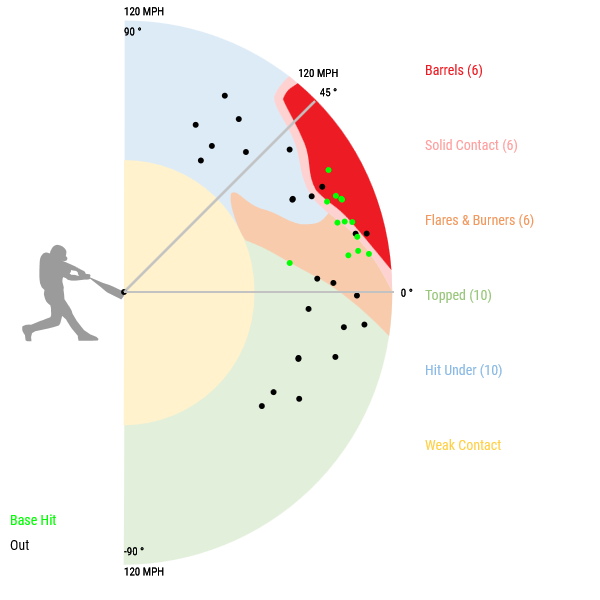
You can see a somewhat similar approach in his 2016 data, but with far, far less pop:
Taylor Motter, 2016
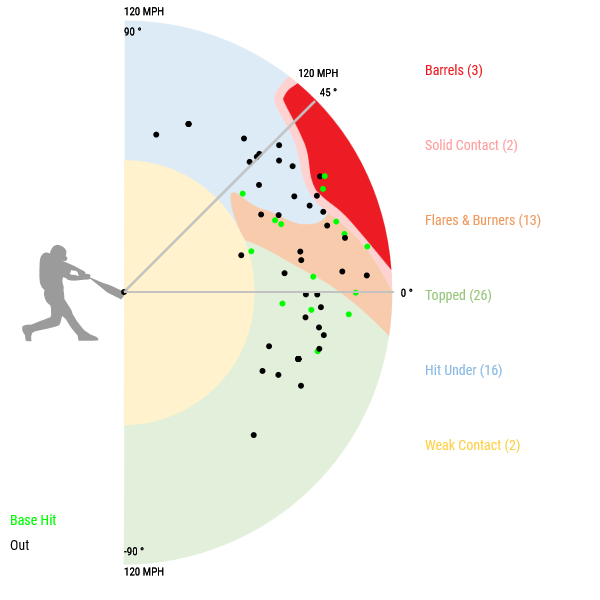
Last year, only 8% of his balls in play were “solid contact” or better. This year, he’s already got 12 such balls in play, or 32% of his balls in play. This is why Motter has 11 extra base hits on the year and only 2 singles.
Game 20: Mariners at Athletics – Sweep-Avoidance Sunday
Yovani Gallardo vs. Andrew Triggs, 1:05pm
Last year, the M’s hosted the A’s in their first homestand after opening the season in Texas. The A’s swept the M’s, kicking off an abysmal start at home that left fans wondering why the M’s were so much better on the road. This year, it’s just the reverse, with the M’s struggling mightily on the road, and the A’s again looking better than we thought.
Just like last year, there’s no real meaning to the M’s lopsided home/road splits, and just like last year, a solid start doesn’t necessarily mean that the A’s are going to be darkhorse contenders. Both teams’ records at this point have a lot of noise and a bit of signal buried in it. The M’s don’t have some weird psychological break about playing on the road, just like they didn’t have psychological issues that prevented them from winning in Seattle in April of 2016. That doesn’t mean that everything’s fine, and the M’s slow start is irrelevant, and it ALSO doesn’t mean that the A’s really are terrible – it means that we need to look for factors outside of the team’s record in their first 19 games.
I mentioned it before the series started, but the A’s have a chance at building a remarkably solid rotation on the cheap. Getting Sonny Gray back and healthy is going to be important to reaching that goal, but the A’s group of unheralded young starters may be better going forward than former first-rounder Gray. The perfect example of this is today’s starter, Andrew Triggs. As Jeff Sullivan detailed last year at Fangraphs, Triggs was a career reliever, with prototypical reliever-only mechanics. His release point looks a bit like Steve Cishek’s or Carson Smith’s, but it’s pushed even more towards the third base line. The best match in terms of release point may be yet another ex-Mariner, Carter Capps’, but without the weird crow-hop delivery and definitely without the 99 MPH velocity. So he seemed destined to fill a Sean Green role of a righty-specialist, or maybe a ground ball guy, but he showed very good K:BB ratios in the minors.
You’d think that a team would see that and fast-track him to the majors, but Triggs has faced skepticism at every turn. Despite putting up some good numbers, the Royals sold him to Baltimore, not even getting a PTBNL in return. He made the Orioles 40-man roster, but didn’t make it out of AA – a AA season in which he laid waste to the eastern league, with an ERA of just about 1 and 10 K’s per 9. Again, though, he was released when the Orioles needed a spot on their 40-man, and the A’s picked him up. The A’s gave him a shot in their bullpen, and while he didn’t exactly set the world on fire, he’s been unbelievable since a short-handed A’s team decided to move him to the rotation.
Given his release point and his Carson Smith-style slider, you’d expect he’d run huge platoon splits like Justin Masterson. So far, that hasn’t happened, and even in the minors, his splits looked pretty even. There are two main reasons why. First, he’s developed a good change-up that breaks away from lefties. Second, that insane release point’s created by stepping across his body with his right leg. This produces some deception to hitters, but lefties in particular seem to struggle picking up the ball as it’s hidden behind Triggs’ (hefty) frame. He’s posted exactly even splits thus far in his career, and while you might expect that lefties have an advantage that’ll grow as he pitches longer, he doesn’t seem to be the kind of guy you want to pack as many lefties as possible into the line-up.
This year, he hasn’t been striking people out, but it hasn’t mattered. He’s kept his sinking fastball away from both lefties and righties, and racked up ground balls. No, he probably won’t continue to post a sub-.200 BABIP to say nothing of a 0.00 ERA, but he’ll continue pitching like an underpowered Zach Britton until batters learn to elevate the ball against him. The M’s have really struggled against guys like this; Triggs throws 71% of his pitches to the bottom of the zone or below, which is pretty near 2017-Dallas Keuchel, and we saw how that worked out for the M’s. They’ve struggled against GB pitchers, which I don’t think Dipoto and company foresaw. With plenty of fly ball hitters, this was supposed to be a team strength. Why it hasn’t worked out that way is a mystery, at least to me, but I’m hoping Edgar Martinez is working with them on it.
1: Dyson, CF
2: Haniger, RF
3: Cano, 2B
4: Cruz, DH
5: Vogelbach, 1B
6: Motter, SS
7: Heredia, LF
8: Freeman, 3B
9: Zunino, C
SP: Gallardo
Yep, that’s Dan Vogelbach in the line-up at 1B, replacing Danny Valencia. The corresponding move was somewhat unexpected/dramatic: the M’s have DFA‘d erstwhile starting CF Leonys Martin. The M’s also swapped out de facto long-relievers, calling up Chris Heston and sending Chase de Jong back to Tacoma. There’s something admirable about decisive moves like this, and not letting a black hole in the line-up tank the overall offense. Leonys Martin has looked lost for a while now, and the M’s now have plenty of CF depth. The move at 1B also reflects the M’s 1B depth, but it essentially reverses the equally bold, decisive, win-in-2017 move that they made about one month ago – the move that sent Vogelbach to AAA and gave Valencia the 1B job on his own, instead of in the expected platoon. Either Tacoma’s coaches very, very quickly sorted something out with Vogelbach, or the M’s are essentially admitting that their last move backfired.
Tacoma won again, taking the first game in Albuquerque 5-3. The R’s scored 4 in the first and coasted to the win behind another good start from Christian Bergman. Sam Gaviglio starts today opposite Zach Jemiola.
Arkansas’ had a strange game, but it ended well. They took a 4-0 lead, then allowed Springfield to tie it up, and then scored 2 late runs for a 6-4 win. Thyago Vieira got the win in relief with one of his best performances of the year. Jean Segura singled in 3 at bats. It’s a prospect showdown today, as Andrew Moore and Arkansas face off with Cards prospect Jack Flaherty.
Modesto scored 4 runs in three separate innings in their 12-4 domination of Visalia. Nick Neidert was, by his standards, only so so, but the Nuts’ bullpen was solid, with Kody Kerski striking out 5 in 2 shutout innings, and Joe Pistorese K’ing 3 in 2 perfect IP of his own. Today, it’ll be a battle of starters who would love to just hit reset on the year. Pablo Lopez takes the ball for Modesto, with Justin Donatella pitching for Visalia. Both starters’ ERA are over 10.
Clinton beat Quad Citied 6-1 behind another solid start from Ljay Newsome. He struck out 4 in 6 IP, and walked his FIRST batter of the year. His K:BB ratio is now definable, and is 22:1 in 21 IP. His ERA is still kind of ugly thanks to his first start of the year, but yesterday was his third straight solid outing. Danny Garcia and Jorge Alcala face off today in Quad Cities.