
So It’s Come To This
I have a thing to share with you. I don’t really know how to set it up, and I don’t really know how long I want this post to be. I know that I want a decent introduction, so I don’t just immediately slap you in the face with numbers, but I don’t know what it should look like, and usually when I get into this sort of trap I just talk about writing until I feel comfortable enough to move on to the baseball substance. And, well, would you look at this!
A little over a week ago, Dustin Ackley drew a walk, against Brandon Morrow. Morrow walks a lot of guys, but he walks fewer guys than he used to, and every walk counts. A few days before that, Ackley drew a different walk, against one Z. Clark of the Baltimore Orioles. That could be Zach Clark, or Zack Clark, or Zachary Clark, or Zacharia Clark, but whatever it is, I can’t imagine there’s compelling reason for me to know or care. These are Ackley’s walks in May. There are two of them, after there were three walks in April.
This season, Dustin Ackley has drawn five walks. He’s batted 129 times, giving him a walk rate of 3.9%. Keep that figure in mind, as I show you two more. Miguel Olivo is pretty old, now, and he’s nearing the end of his major-league career. Over that career, he’s walked in 3.9% of his plate appearances. Carlos Peguero might go on to have a long career, or his career might never take off. But over his career to date, he’s walked in 4.6% of his plate appearances.
In fairness, Olivo and Peguero have drawn some intentional walks. Remove those and their rates come in under Ackley’s. But it’s not about Olivo and Peguero walking more or less than Ackley. It’s about the fact that a comparison can be made. Dustin Ackley’s walking about as often as two of the Mariners’ all-time most undisciplined hacks.
The reason Olivo and Peguero walked was because they’ve swung and missed a lot, leading to deeper counts. Ackley hasn’t walked because he makes a lot of contact, putting balls in play before counts can advance. That’s fine, walking isn’t mandatory if you want to be a successful hitter, but Ackley’s got 23 strikeouts and one home run. He owns a .549 OPS and a not-weird BABIP. The Dustin Ackley plan isn’t working, and while he put together a bit of a hitting streak after tweaking his stance, he’s got five hits this month with twice as many whiffs. If you’re going to pay attention to hot streaks, you need to be aware of when they’re over. Ackley’s seems to be over, and so he remains difficult to figure out.
Because, in case you’ve forgotten, Ackley was in Tacoma for half of 2011. He walked 55 times, to go with 38 strikeouts. The year before he had a similar ratio in Double-A. Dustin Ackley’s whole thing, the thing that made him such a safe and certain bet, was his control of the zone. Remember, it was his defense that was a question mark. Now Ackley’s a hell of a defender at second base. His strengths and weaknesses have swapped costumes. This is a year in which Dustin Ackley’s hitting like a good-hitting pitcher and Yuniesky Betancourt’s hitting like Robinson Cano with a cold. It makes some sense that Ackley would struggle, but it’s hard to wrap your head around the idea that Ackley’s gotten worse. In three consecutive years, his OPS has started with a 7, then a 6, then a 5. This guy was the lock. This guy was one of the safest prospects in baseball.
This post doesn’t reveal a proposed solution, nor does it tell you anything you probably didn’t already know. It’s just meant to call your attention to something: Dustin Ackley can’t even walk, now. Not because he’s swinging too much, but because he isn’t swinging as wisely as he used to, and because he’s making too much contact. Contact isn’t necessarily a good thing in and of itself. Contact is only worth making if it’s quality contact, and Ackley’s putting 56% of balls in play on the ground. I forgot to say that that’s another change. That rate was 40% when he was a rookie. Ackley’s drawn fewer walks and hit more grounders, eating into his power. The result is a guy you want to pinch-hit for.
When people ask, I tell them I still have faith in Dustin Ackley — way more faith than I have in Jesus Montero. That’s the way I truly feel. What I can’t figure out is whether or not that feeling is warranted by who Ackley is now, or if I’m just resisting giving up what Ackley was supposed to be. Do I still believe in Ackley because he’s worth believing in, or is it because it used to be the idea of Ackley failing was unbelievable? Presumably, it’s a blend, because that’s how the brain works, and presumably, it’s going to be hard for Dustin Ackley to not be bad anymore, at some point.
The risky ones are more risky than they seem. The safest ones are never that safe. God bless you, Felix Hernandez. This seems like a pretty good way to wrap up. For every post, really.
Well Now What The [Heck] Is This
In recent years past, the Mariners have had some terrible team offenses. It was kind of the identity — the Mariners were able to prevent runs, but they also prevented too many of their own runs, and so in the end they were not good. Over the offseason, the Mariners prioritized adding good hitters, in order to improve the offense. And they prioritized adding veteran hitters, to take some of the pressure off the younger guys. They felt bad for having forced young hitters into the middle of the lineup, so they went after talented veterans to relieve the psychological burden. It follows that the Mariners figured veterans would be better able to handle the stress than rookies and new guys. Veterans have been around the block, and so on and so on.
Look, here.
[Morse and Morales are] expected to handle the bulk of duties in the Nos. 3 and 4 lineup spots, taking the pressure off younger hitters by bumping them further back in the order.
[…]
All kidding aside, Morse says there’s a big difference hitting in the middle of the order compared to other places.
[…]
Morales, who debuted in 2006 with the Angels, feels there’s a confidence level required to stay in the middle of the lineup.
Look, here.
“In those situations, sometimes you rarely get to see a fastball. They are going to pitch you different and they are going to pitch you tough. You really have to relax and not try to do too much,” Morse said. “It’s tougher when you are young. It’s a big role and it’s a tough role. They had to learn the hard way.”
On Sunday, Michael Morse and Kendrys Morales were bumped down in the Mariners’ lineup. Morales is batting fourth, after batting third all season. Morse is batting fifth, after batting fourth all season. What’s the deal? We turn to our fearless leader:
“I’m playing around with it a little bit,” Wedge said. “I still stand by the fact that Morales and Morse are just trying to do too much. They know they’re the guys here and I think with that sometimes you put a little too much pressure on yourself to do too much. You see both of them chasing more than they should.”
Morales and Morse were supposed to be stable, veteran additions, immune to trying to do too much in response to batting in the middle. Now, in Eric Wedge’s estimation, they’ve been trying to do too much in response to batting in the middle. It’s not that I don’t believe there’s some difference between batting in the middle and batting somewhere else. It’s not that I don’t believe veterans benefit from their experience. But I think this speaks for itself. In the Mariners’ own words, the experienced veterans aren’t doing what they were brought in to do. Wedge thinks they’re pressing, just like he thought the young guys were pressing.
Yet, furthermore, consider the evidence. Wedge thinks Morales and Morse are chasing too much. Morales has swung at 30% of pitches out of the zone, below his PITCHf/x average of 32%. Morse has swung at 35% of pitches out of the zone, right on his PITCHf/x average of 35%. Neither Kendrys Morales nor Michael Morse are the disciplined sort. They’re the slugging sort, and they’re likely to finish with an ugly ratio of walks to strikeouts. That was easily predictable coming in, and Wedge can’t reasonably allow himself to be frustrated by the veterans doing what they’ve always done. Morse is going to strike out. He strikes out a lot. Morales isn’t going to walk. He doesn’t walk a lot.
So Wedge thinks the veterans are pressing, which would be funny, given the whole idea behind their acquisitions. Evidence suggests they might not be, which would call into question Eric Wedge’s ability to evaluate who is and is not actually pressing. Which would make us reconsider seasons past. As is always the case with baseball posts like this, we have to acknowledge on some level that the guys in the clubhouse have a better idea than the guys like us. Wedge knows these players, and he has a better idea of what they’re going through. But where Wedge has an advantage in terms of that sort of information, we have an advantage in terms of other sorts of information, and we also don’t get wrapped up in generally discardable baseball bromides. Morales already has a home run today. Sometimes good players do well. Sometimes they don’t. Most of the time, there’s not any reason.
Game 38, A’s at Mariners
Saunders vs Milone, 1:10 pm.
If you watch today’s game, you’re going to hear the announcers tell you that Joe Saunders has a very good change-up. They like saying this, because he doesn’t throw hard, and he’s left-handed, and every soft-tossing lefty has a good change-up. Except Joe Saunders doesn’t have a good change-up, which is why right-handers have beat his brains in over the years. You know who is a soft-tossing lefty with a good change-up, though? Tommy Milone. That guy’s got a crazy good change-up, and is the main reason why a pitcher whose fastball averages 87 can run a 41/6 K/BB ratio in his first seven starts of the season.
Milone, as we’ve noted before, handles right-handers better than left-handers, because of how his change-up moves. For the season, he has a 13% K% against LHBs and a 23% K% against RHBs. The Mariners, naturally, have stacked their line-up with righties against Milone, as Saunders and Seager are the only two hitters who will face Milone from the left side. The M’s even moved Morales and Morse down in the order to hit Jason Bay second.
Wedge did this in the third game of the season too, when this same Milone-Saunders match-up occurred down in Oakland. That day, they ran eight right-handed hitters at Milone, with Seager being the only left-handed hitter in the line-up. Milone gave up four hits and two runs in seven innings, and the Mariners lost 6-2. But, hey, I’m sure things will be different this time. Just keep running out RHB heavy line-ups against him because he’s left-handed. Let’s just keep pretending that there’s no real difference between Joe Saunders and Tom Milone.
Blech.
1. Saunders, CF
2. Bay, LF
3. Seager, 3B
4. Morales, DH
5. Morse, RF
6. Smoak, 1B
7. Montero, C
8. Andino, 2B
9. Ryan, SS
An Adjustment For Brandon Maurer
The Mariners, as I write this, are still busy playing the A’s. They’re losing! But Brandon Maurer’s effort is finished, and he went five innings, throwing 95 pitches and missing with a lot of them. On one hand, Maurer’s game wasn’t particularly good, since he allowed eight baserunners, three runs, and two dingers. He’s currently on the hook for the loss. But Maurer also finished with two walks and four strikeouts against a lefty-heavy lineup, and when Maurer faced the A’s on April 4, he allowed six runs in six frames while striking out one. So for Maurer, this wasn’t bad, and more importantly, he did something he hadn’t really done before.
Dave’s written about Maurer’s godawful platoon splits. Here’s all you need to know about Maurer coming into today:
vs. RHB: 2 walks, 16 strikeouts
vs. LHB: 6 walks, 2 strikeouts
Maurer has really liked his slider, and his changeup hasn’t been any good. With a good slider, Maurer’s pitched well against righties, but without a good changeup, he’s been exposed against lefties, leading to the comical numbers above. Maurer’s going to need to be able to pitch to lefties if he wants to stick as a starter. The best way for a righty to be able to pitch to lefties is by having a worthwhile changeup.
Or a worthwhile curveball. And Maurer throws a curveball, but he hasn’t thrown it much, especially against lefties. Not in the early going. One out of every 26 pitches Maurer had thrown to lefties had been a curve. Over Maurer’s first six big-league starts, he threw all of eight curves to lefties. Tonight, against Oakland, he threw 11 curves to lefties.
A summary table, showing Maurer against left-handed hitters:
| #Start | #Curves | #Pitches |
|---|---|---|
| 1 | 5 | 48 |
| 2 | 0 | 16 |
| 3 | 1 | 38 |
| 4 | 1 | 46 |
| 5 | 0 | 7 |
| 6 | 1 | 57 |
| 7 | 11 | 61 |
And for whatever it’s worth, PITCHf/x also missed a few pitches. According to Shannon Drayer, Maurer had been working on deploying the curve more often in side sessions, and sure enough, he brought the adjustment into meaningful gameplay, not shying away from something he hadn’t been doing. Dave wrote that Maurer was probably going to need a better change. At least for now, Maurer seems to prefer the curve.
But throwing the pitch more often is only part of the battle. Of the curves, eight were balls, two were called strikes, and one was swung on and missed. It’s going to take some time for Maurer to develop the curve and/or the change into weapons against lefties. It might not even ever happen. Effort and practice don’t always yield the desired results in the end. But it’s good to see Maurer try something, and he did walk just one lefty, against three strikeouts. In Maurer’s seventh start, he threw three more curves to lefties than he had in his first six, and he struck out one more lefty than he had in his first six. Maybe it’s something. Surely, we’ll find out.
Mike Zunino’s a prospect who’s down on the farm, and he’s actively developing, going through a bunch of highs and a bunch of lows. That’s to be expected, and one hopes that he’ll learn from his struggles and get better as a consequence. Brandon Maurer is also a prospect. He’s just trying to get his growth in in the major leagues. Maybe it’s better this way or maybe it’s worse, but if nothing else we’ll be able to keep an unsettlingly close eye on his progress.
Watching Hisashi Iwakuma
At points last year, Hisashi Iwakuma was good, bad, and everything in between. That’s a sentence that could apply to everyone in baseball, but Iwakuma came in with expectations, then got relegated to the hidden corner of the bullpen, then wound up as a starting rotation standout. Down the stretch, Iwakuma was fantastic, and he did enough to convince the Mariners he was worthy of re-signing. There really could’ve been only one complaint: Iwakuma took his damn time. “Pace” is a measure of the average number of seconds in between pitches. (Find it at FanGraphs!) (Find these USSM authors at FanGraphs!) (FanGraphs!) The league-average pace last year for starters was 21.4 seconds. Iwakuma’s pace as a starter was 26.1 seconds. This was the slowest pace out of every starter in baseball.
I remember Matthew and I talked about this on a small handful of occasions. I suppose you can’t have a handful of occasions. Unless they’re like bacteria occasions, or pistachio occasions. Anyway I think we reasonably concluded that we could put up with Iwakuma’s tempo so long as he was good, but if he started to go off the rails, he’d be intolerable and unwatchable. Ryan Franklin, at least, was fast when he was not good. Nobody wants a slow, ineffective pitcher. Nobody wants Miguel Batista.
Of course, pace doesn’t have much, if anything, to do with pitcher effectiveness, but if baseball’s here as entertainment, slower pitchers are less entertaining. Watchability is genuinely important, for us. Games that drag tend to be games that are less fun, and I don’t need to explain this any more to you. This is a fairly self-evident principle.
We skip ahead now. So far in 2013, Iwakuma’s been outstanding, matching a lot of zeroes with Felix Hernandez. Iwakuma and Felix have both allowed ten earned runs, and a dozen runs overall. Iwakuma has allowed fewer runs than Joe Saunders has strikeouts, if that helps, and Iwakuma’s just been a hell of a pitcher and a hell of a bargain. This year, if you care about park-adjusted ERA, FIP, and xFIP, Iwakuma’s been the same as Clayton Kershaw. Clayton Kershaw is amazing! Hisashi Iwakuma has been amazing.
But it’s not just that his performance has improved. His tempo, also, has improved, if reduction counts as improvement. Iwakuma’s pace, now, is down to 23.5 seconds, a drop of 2.6 seconds from last year. That’s the biggest drop for any starter in baseball, and I’ll show you the top five:
- Hisashi Iwakuma, -2.6 seconds
- Clay Buchholz, -2.1 seconds
- Tim Lincecum, -2.0 seconds
- Matt Harvey, -1.9 seconds
- Mike Minor, -1.8 seconds
Iwakuma hasn’t been fast. But instead of bringing up the rear, now he’s just a little slower than average. He’s less than a second slower than Felix, and nobody complains that Felix takes too much time out there doing nothing. I have to note that Iwakuma hasn’t allowed many baserunners, and pitchers work faster with nobody on. Iwakuma’s pace would be a little higher, I’m guessing, if he’d had to throw more pitches out of the stretch. But it’s not like Iwakuma allowed a ton of runners as a starter in 2012, so while these numbers will move around, it does look like Iwakuma’s a little quicker. In terms of performance, he’s increased his watchability. In terms of pace, he’s also increased his watchability.
Maybe 2.6 seconds doesn’t seem like a lot of time. And, really, it’s not. Especially if you consult with a mountain, or really any geologic process. But for one thing, that adds up over the course of a start. And this guy drank a whole beer in 2.6 seconds. Iwakuma has shaved a whole that guy’s beer off of his pace. Hopefully this is about the only comparison we can make between Hisashi Iwakuma and that guy, with the beer.
We used to joke about how Doug Fister just never stopped improbably getting better. First, he just stopped walking people. Then he started to get groundballs. Then he started to get strikeouts. It’s important for people to remember when they reflect on the trade — Fister then wasn’t what Fister is now. Iwakuma, too, has just gotten better. He built up his arm strength, he’s quit it with the home-run problems, and he’s working faster. Iwakuma is a legitimate, quality AL starting pitcher, and for a time in spring training 2012 Mariners people didn’t know how they’d even keep him on the roster. The days have gotten better for Iwakuma, and, therefore, for us.
Just as an overall closing note: Iwakuma has made 24 major-league starts. They’ve all come within the last one calendar year. Over that year, according to FanGraphs, he’s posted baseball’s fourth-lowest adjusted ERA, among regular and semi-regular starters. His adjusted xFIP ranks 17th out of 130, right around guys like Zack Greinke, Cliff Lee, Fister, Kershaw, Madison Bumgarner, and CC Sabathia. The one thing Iwakuma hasn’t shown is in-game durability, and he doesn’t log a ton of innings, but on a per-inning basis, Iwakuma’s been as good as almost anyone. Not just this season — over the last 365 days. He is making Joe Saunders’ salary.
Game 37, A’s at Mariners
Maurer vs Parker, 6:10 pm.
And now we get to the part of the rotation that is why the Mariners are not a good team. The gulf between Hernandez/Iwakuma and Maurer/Saunders/Harang is just so vast. Maurer is in for a bit of a test tonight, as the A’s can load their line-up with LHBs, who have owned him so far this year. With six left-handed hitters, and the right-handed bats including Yoenis Cespedes, this is a pretty good test to see if Maurer’s change-up is making any progress. If it’s all sliders all the time tonight, expect Oakland to put up crooked numbers early.
And the disaster OF defense makes another return, since Raul hit a home run last night and Major League managers absolutely are bound by yesterday’s performance when setting the line-up. Good thing Maurer’s not a contact pitcher who relies on his defe… oh.
1. Saunders, CF
2. Seager, 3B
3. Morales, DH
4. Morse, RF
5. Smoak, 1B
6. Ibanez, LF
7. Ackley, 2B
8. Shoppach, C
9. Ryan, SS
Game 36, A’s at Mariners
Iwakuma vs Straily, 7:10 pm.
Marc’s taking the weekend off, so prepare for three less comprehensive game previews than you normally get. To find out about the specifics of the series, read Matthew’s preview right below this.
One quick note on Iwakuma, though – he ranks second in the majors among starting pitchers in getting batters to chase pitches out of the strike zone, with a 36.4% O-Swing rate; only Tim Hudson rates higher so far this year, and wouldn’t you know it, Hudson also throws a split-finger fastball. Felix — whose change-up is basically a splitter, since he throws it at 89 mph — ranks #4 in O-Swing%. The splitter/change-up is an exceptional pitch. The Mariners have two guys who are really great at getting ahead of batters and then getting them to chase a tumbling breaking ball falling out of the zone. Iwakuma’s not going to put up an ERA below 2.00 all year, but he is a quality pitcher with a real out pitch.
Also, let’s hope his blister is feeling better and he can keep the ball on the ground tonight, because the outfield defense is going to be disastrous.
1. Saunders, CF
2. Seager, 3B
3. Morales, DH
4. Morse, RF
5. Smoak, 1B
6. Ibanez, LF
7. Montero, C
8. Ackley, 2B
9. Ryan, SS
The Mariners have Drifted Back to the Middle
| MARINERS (16-19) | ΔMs | ATHLETICS (18-18) | EDGE | |
| HITTING (wOBA*) | -11.6 (23rd) | 1.5 | 18.3 (4th) | Athletics |
| FIELDING (RBBIP) | 7.0 (8th) | 8.7 | -10.9 (26th) | Mariners |
| ROTATION (xRA) | 7.8 (8th) | 1.6 | 7.1 (9th) | Mariners |
| BULLPEN (xRA) | 0.7 (14th) | -3.8 | 1.0 (13th) | Athletics |
| OVERALL (RAA) | 3.9 (14th) | 9.4 | 15.5 (8th) | ATHLETICS |
Well that was a bad two weeks of Mariners’ baseball for me to miss as the M’s went 8-4 and climbed back to the edge of contention. They hadn’t been as bad as their record back in late April so some regression in the win-loss column is not surprising. If only they could beat the Astros as other teams do they could be above that .500 plateau right now.
A Mariners Don’t Anger Us Podcast
Well things got better. The Mariners went 8-4 since the last podcast, beating up on some fellow bottom dwellers and now they look downright forgettable instead of abjectly embarrassing. So it’s a kindlier and gentler, albeit often divergent, Jeff and Matthew podcast this time around.
Speaking of not speaking solely about the Mariners, at the end I ask about how people feel when we venture off the strict Mariners path. Please leave your feelings below on the matter.
Podcast with Jeff and Matthew: Direct link! || iTunes link! || RSS/XML link!
How Jesus Montero Caught Starling Marte Stealing
I don’t know much about the Pirates, because I’ve never had a reason to, but I know that Starling Marte is an exciting young player of theirs and he bats leadoff so I can only assume he’s a talented runner. I’m only slightly exaggerating my Pirates-related ignorance, but in just 78 major-league games coming into today, Marte had eight triples and 22 steals to his name. He’s young and he moves like you’d expect a guy named Starling Marte to move, so he’s a constant threat when he has a chance to do damage with his legs.
Also coming into today, Jesus Montero had thrown out zero of 15 base-stealers. There’s been talk that some of that has been due to pitchers not holding runners on, and that’s undoubtedly been a factor, but regardless, Montero had thrown out as many baserunners as you or me or the Queen or all of us combined, and, no, wait, hold on, let me make that better, Montero had thrown out as many baserunners as my living-room sofa that just broke last week although I think I fixed it although I don’t trust it yet. Well that didn’t make things better. Montero had thrown out as many baserunners as a cup of yogurt. Any cup of yogurt. If you’re going to the grocery store later, stop by the yogurt, and consider the containers, and consider Jesus Montero as a defensive catcher. 15. Zero.
And so, naturally, today Jesus Montero threw out Starling Marte attempting to steal second in the bottom of the eighth. It was a big play, as the Pirates were behind by one at the time, with Travis Snider up to bat. Marte thought he’d go and get himself into scoring position. Montero was like, “no don’t,” and then shortly thereafter the Mariners won. How did Montero do it, after so many weeks of not doing it? We go to the video for a screenshot breakdown.
(1) Starling Marte stopped running toward second base
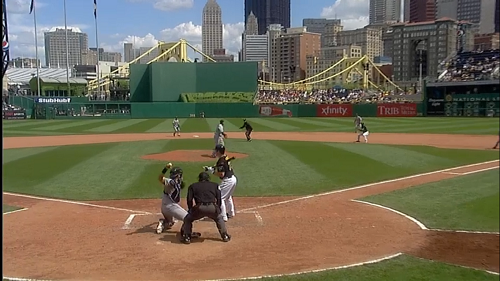
This was a big part of the play. Marte stumbled when he got his jump, and when Montero cocked to throw down, Marte stopped in his tracks. So the first step toward Montero keeping Marte from second was Marte deciding to not run to second anymore.
(2) Starling Marte actively ran away from second base
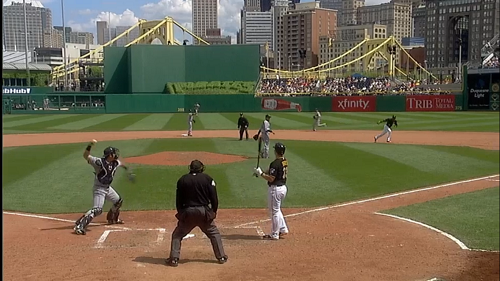
Marte didn’t just stop in his tracks. I mean, he did do that, but then he immediately began to retreat. This was another big part of the play. The second step toward Montero keeping Marte from second was Marte choosing to run away from second instead of right at it. Montero threw to first base, and Marte became involved in a short-lived pickle. He was tagged, and that’s how Jesus Montero threw out Starling Marte attempting to steal second base.
So Montero is now 1-for-16. Based on the evidence, here is how 2013 Jesus Montero prevents runners from stealing second:
- runner stops on the way to second
- runner goes in opposite direction
Congratulations to Jesus Montero for showing the rest of the league how it’s done. And to think there are people who don’t think Montero is a catcher long-term. There are lots of long-term catchers out there still looking for their first success in gunning down Starling Marte on the bases.