
DePodesta fired
LA Times, elsewhere.
The Dodgers didn’t have a great season, certainly. But what’s most interesting to me is the extent that the daily press in LA took him down. DePodesta was subject to almost constant criticism of his every move that often ranged freely into personal attacks on him (Jeff’s talked about this here only a few weeks ago). Dave and I both said that we thought the Dodgers had a horrible off-season (others disagreed), and the season turned out badly.
But does his on-the-job performance justify getting canned this early? It seems as if they’re reacting much more to the perception of his work, rather than what he actually has done since coming on, and have decided to bow to the meme-makers.
Sports columnists across the country must be breaking out the champagne. If you’re nasty enough and loud enough for long enough, and your ownership’s weak-willed, you can bring down a GM in two years.
The Best and Worst Things About the White Sox Sweep
With the ouster of the Astros — who went out with T.S. Eliot’s whimper rather than a bang — we can drop the curtain on this year. So it wasn’t exactly an epic battle. Say this about the World Series: no one was seriously injured, unless you count Roger Clemens, and who does?
Time to turn the page. To help with this endeavor, I’ve compiled a list of the five best and worst things about the World Series being over.
Best Things:
No more national exposure for that infernal buzzing whenever one of the “Killer B’s” comes to the plate. This means the end of the most annoying noise in sports (non-Tim McCarver division). I can’t believe more hasn’t been made of this. Whose idea was it to use what sounds like the soundtrack to a terrible 80s B horror movie as a point of inspiration? Is this the reason they were stingless? Give me a zillion Day-Os before I ever hear that again.
The hot stove fires itself up. Mariner fans have had a jump on more fortunate affinity groups, the ones preoccupied with their playoff-bound squads, but now the whole musical chairs process begins in earnest. Who should end up where? Who will? For those of us fascinated by roster construction, it’s a wonderful time of the year.
Televisions at my friendly neighborhood watering hole and gym are now safe. There was prior risk that I, or a like-minded Bellinghamster, might throw something heavy at Scooter, or react with similar rage to those brutal anti-steroid PSAs. Technology is exempted from this wrath, for the time being, thanks to the end of the World Series.
For those of us whose teams played like sick nuns in 2005, now is also when the kernel of hope cracks open. The calendar changes, and hopefully, fortunes do, too.
Finally, Ozzie Guillen might just retire now. I doubt he will, but it would be a fitting end to a wacky career.
Worst Things:
The inevitable “and they clinched with Freddy Garcia as the winning pitcher!” woe-is-me-isms from Seattle columnists and sports radio callers. We love our retrospectives, especially when they involve the saddest words of tongue and pen. Please, please, please, let’s just let this one go.
Behold the vaunting of the small ball, the clutch hitter and the stolen base. In the time it took me to drive to work this morning, my radio told me that the White Sox won because they always bunt runners over, never fail to get the timely hit, and play aggressively on the basepaths. Now, every baseball team is going to want to build a club in this mistaken image. (Wait, poor strategy is a gift when employed by one’s rivals — maybe that should be under “best things.”)
Piling on the Cub fans just got turned up to eleven. Thrilled as we have to be for the Pale Hose faithful, a dozen knives are about to be repeatedly stuck between the North Side’s collective ribs. Everyone in America knows it’s been nearly 100 years. Soon, deaf mutes in the Andes will know, too.
Unfortunate and unfair labels affixed to exceptional players. Mercifully, rumblings about Brad Lidge have been muted by other factors. But the first time he blows a save next year, expect to hear the names Albert Pujols, Scott Podsednik and Jermaine Dye. Remember when Mariano Rivera blew two saves against Boston in April, and he was supposed to be done? Everybody fails. April’s a great time to do it; October’s not.
Finally, the worst thing about the World Series coming to a close: the end of the 2005 baseball season. ‘Nuff said, true believer.
Being For The Benefit of Mr. Guillen
In recognition of the White Sox’ trip to the World Series, here’s a trip-down-South-Side-Memory-Lane link from Barnacle Press’ online archive of vintage comic strips. I was pleased to find some selections from “You Know Me, Al,” a 1920s comic strip by Ring Lardner about the fictional Jack Keefe, who is sold to the White Sox.
I think this one is my favorite. “Well, I ain’t payin’ no eight dollars a week to be near your mother” has to rank with the greatest pick-up lines of all time.
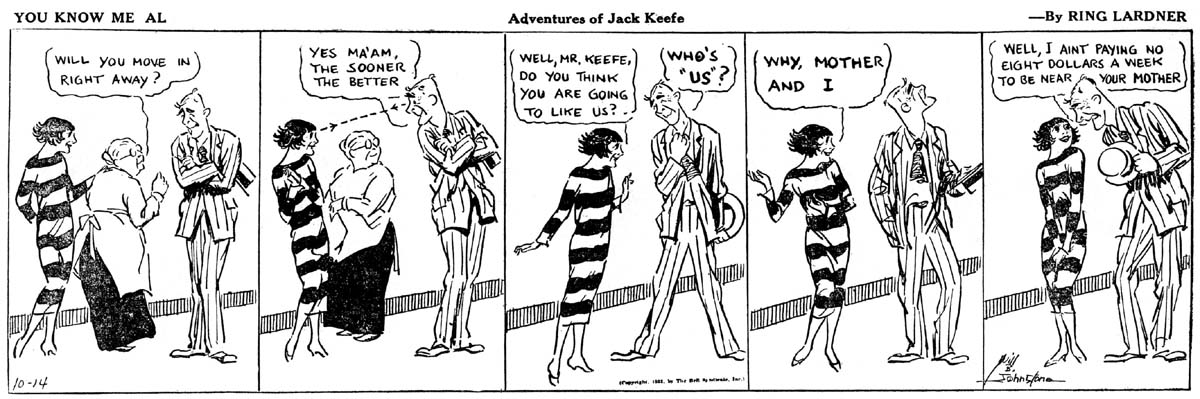
Link to Barnacle Press shamelessly lifted from Metafilter
News, M’s and otherwise
Leo Mazzone, legendary pitching coach and possible Hall of Fame candidate, left for Baltimore after a brief flirtation with the Yankees. Orioles manager Sam Perlozzo is a long-time friend. Too bad the Mariners didn’t get him, of course, but whaddayagonnado.
Former Mariner pitching coach Bryan Price got shut out of managerial jobs and took a place-holder position as pitching coach for former Mariner manager Bob Melvin with the Diamondbacks.
Joe Girardi is the new Marlins manager.
Discussion on who the Mariners might still get rages. Larry LaRue in the TNT files a report that makes it seem as if organizational candidates Jim Slaton and Rafael Chaves are forgotten (which is odd).
On the original short list of possible candidates to succeed Bryan Price in Seattle two weeks ago, Slaton hasn’t yet interviewed – and Chaves said he hasn’t even been told he is a candidate.
LaRue also gets some quotes from Guardado, who’s annoyed the team didn’t immediately tell him whether they’d be picking up his team option.
“If they said, ‘Look, we want you back but not at the larger figure,’ fine, I’d understand that,†Guardado said. “Or if they said, ‘We don’t want you back, period,’ I’d understand that, too.
“But why push it until the free-agency period begins? Why not just talk to me now? If they don’t want me back, no hard feelings – but let me start to explore my other options as soon as I can.
“I’ve shown them respect for two years, and I’d love to come back and be part of what could happen here. Just talk to me.â€Â
And I include this only because it seems to pop up on every freaking comment thread, Bob Finnigan would like us to know that Ichiro is sad and neglected.
And the World Series is White Sox v Astros.
“Miracle at Minute Maid”
Courtsey of my friend David, who emailed me this one today, I present an article so heavy with cliches that it could have been written by a computer. Rick Rizzs, or Rico, as Dave Valle would call him, would be proud.
How posting works
This comes up every time a Japanese player is rumored to be heading over (now with Matsuzaka), so here’s a quick overview. Not every Japanese player goes through this process. Players who are free agents in Japan can sign wherever they want. Players like Ichiro, who are still under team control (and team control in Japan is much longer and odious than MLB), must go through the posting process. Using Ichiro’s case as an example, here’s how this works.
(prelude: player asks their team to be posted, and team decides they’ll do so)
1. Japanese team notifies the Japanese Commissioner’s Office that they’ll let Ichiro be posted.
2. Japanese Commissioner notifies MLB
3. MLB notifies all teams that Ichiro is available
4. Teams have four days to submit a bid. The bid is how much they’ll pay the team not for the player but the chance to negotiate a contract with the player. The Mariners submit a bid of $12.5m.
5. The Japanese team, Orix, is informed of the highest bidder, the Mariners
6. The Japanese team has four days to accept or reject the winning bid
7. They make a decision:
If they accept, the winning team has 30 days to agree to a contract with the posted player
If they reject, no deal. They can’t then shop him to the second-highest bidding team or anything.
In Ichiro’s case, Orix accepts the posting offer, and the Mariners begin discussing contract terms with Ichiro.
8. Then the player and the winning team negotiate, and one of two things happens:
If the winning team and player can come to an agreement, the player signs and reports to spring training next season, and the Japanese team gets the posting fee. The Mariners and Ichiro agreed, and he signed his original 2001 deal.
If the winning team and player can’t come to an agreement, the player returns to the team that controls his rights, and the Japanese team does not get the posting fee. The player then waits for next year or to become a normal FA, when he can go where he wants
This is pretty bad for the player, who already has a tough lot as a Japanese player compared to his MLB peers. There’s also potential for abuse by MLB teams playing games with each other.
Matsuzaka Will Ask Seibu To Post Him
Seibu sounds unconvinced about doing so, but the Japan Times is reporting that Daisuke Matsuzaka will ask his team to post him this offseason.
Indians, tech, and Antonetti
You may recall that we’ve mentioned Cleveland’s Chris Antonetti as a possible GM candidate, and in general we’re fans of what that front office has done. Check out this article for some detailed info on the kind of information advantage they’re working with.
It does contain this:
This information, plus another computer analysis that showed no one player’s salary had exceeded 15 percent of a team’s payroll on any World Series champion club since 1985, overrode the Tribe’s emotional instinct to pay Thome the guaranteed salary he wanted for six years to allow him to finish his career in Cleveland.
I can’t believe that that really swayed anyone, it’s such an obvious failure of reasoning. It’s been circulated so widely it’s worn thin, but that doesn’t make it worth anything. I wonder if they spread that because it’s accepted wisdom by many of baseball’s writers and analysts so it can be used to justify unpopular moves, whether or not it’s true.
And yet, there’s a lot about it, including this :
Back in 2000, when the Indians were preparing for negotiations with then-Indians slugger Manny Ramirez, Antonetti examined championship teams’ player salaries. He found that no World Series champion between 1985 and 2000 allocated more than 15 percent of its payroll to a single player. In addition, he determined the higher percentage of payroll a team spent on one player, the lower its winning percentage.
For example, teams that spent 17.5 to 20 percent of their payroll on one player won 47 percent of the time. Teams that spent 7.5 percent or lower on one player won 53 percent of the time.
Antonetti concluded there was a significant decline in a team’s chances to make and advance through the postseason if it allocated more than 15 percent of its payroll to a single player. On average, his analysis found, successful teams spent a little more than 12 percent on their highest paid player.
Not surprisingly, then, Antonetti recommended that Thome’s contract should not exceed 15 percent of the Indians’ team payroll in any season in which management felt the club had a “legitimate” chance to contend for the playoffs. Why? Because they needed the salary flexibility to acquire other players to put together a winning team.
Ideally, Antonetti said, Thome’s salary should make up about 12.5 percent of the payroll.
To refute, briefly: this is the logical fallacy “Cum hoc ergo propter hoc (with this, therefore because of this)”. It’s like discovering the Mariners only contend for division titles when Lucent and Cisco stock is highly valued. Should the Mariners use their huge bank balance to buy up those stocks in an attempt to drive up their price?
Of course not. While “salarly flexibility” sounds good as an explanation (and, I’d argue, roster flexibility is a huge boon to a team) the issue is much simpler than that.
– Teams with high payrolls generally win more.
– High payrolls mean that one player with a big contract does not consume so much of the team’s total salary.
That’s it. Take the Angels, for instance. They have a $95m payroll, and they’re paying their star player Vlad Guerrero $12.5m this year. 13% of payroll.
Now say that he plays on the Royals, or the Devil Rays, or the Pirates. He’d still be the same player, but now he’s make up about 26% of the payroll and the team would be terrible.
It’s the same deal with the Cardinals and Pujols (and, for them, Walker-Rolen-Edmonds).
You can look at examples of teams that have one player who makes a ton of money. They’re bad to awful teams who’ve retained one marquee player, or someone who had a horrible contract they couldn’t dump off on anyone, or even a modest veteran picked up to plug a huge hole in the roster.
Or think about it this way: at a 40m payroll, the threshold for consuming 15% of payroll is only $6m. At the mid-point for teams, it’s about $10-11m. At $90-something, it can be about $13-14m, and at the Yankees’ level, they can have players making $30m without exceeding 15%. It’s not about proportion of payroll consumed at all, and it never has been.
I’m surprised to see someone as smart as Antonetti spending any signficant time researching this.
Still, it’s a good article, and intersting food for thought.
Are you kidding me?
There are two baseball games tonight, Game 1 of the NLCS and Game 2 of the ALCS. They’re both on at the same time, on the same channel. FOX, MLB, you guys are the best. No, really. I’d much rather have you tell me what game to watch than be given the choice. You guys know best, anyway. Thanks!
Purges begin
Ed Wade is out in Philly. In the short term, I expect a rise in Ryan Howard rumors.
In Baltimore, Jim Beattie’s not going to return. He was as close to a GM as the team’s had in years. Mike Flanagan might be next.
This comes only a couple days after the Devil Rays finally firing Chuck LaMar, who by any reasonable standard did an awful job in Tampa, and the Rangers got a new GM as well.
Who’s next?