
Fans Scouting Report Article
Tom Tango has written an article at The Hardball Times that looks at the differences between the average Mariners fans opinion about the team’s individual defenders and my own. Tom’s project is pretty interesting, so check it out.
Game 145, Rangers at Mariners
1:40 PM, Millwood vs Jimenez.
The M’s are doing a bullpen game today due to Silva’s absence (with his wife for the birth of their child) and Washburn’s injury. If you love spring training games, this is for you.
Nelson Cruz
A few months ago, I suggested the M’s trade for a 28-year-old Triple-A outfielder. They didn’t, and tonight, he’s starting against them, while being better than just about every player the M’s put in the line-up tonight.
Rebuilding isn’t that hard if you know where to look for undervalued talent.
Game 144, Rangers at Mariners
Padilla v Felix! 7:10.
I had one of the worst days of my IT career yesterday, for a whole host of reasons I’ll skip, and when I got home I was disappointed that I wouldn’t get to at least watch a game to relax. And today I get to work a 7am-9pm and miss at least the first couple of hours of Felix Day. I hope everyone else who gets to go out to the game and watch live gets to see something truly awesome, but I’m not going to follow the game because I am dying to get home, turn on TiVo, have a beer, and sit down to watch King Felix.
Have fun, all.
Happy Felix Day
In the spirit of Felix Day, another chart – this one from Felix’s last start against Texas.
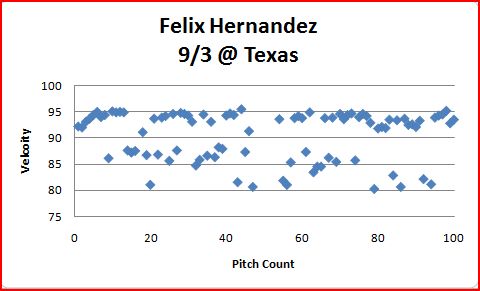
I promise, I’m almost done with the graphs and will get back to writing soon.
And yes, that big blue clump in the upper left hand corner – that would be establishing the fastball. It’s worth noting that the only run of the game came in the first inning, and the M’s lost 1-0.
Feierabend’s Learning Curve
When you don’t have time to write 10,000 words, draw a picture. Here’s today’s:
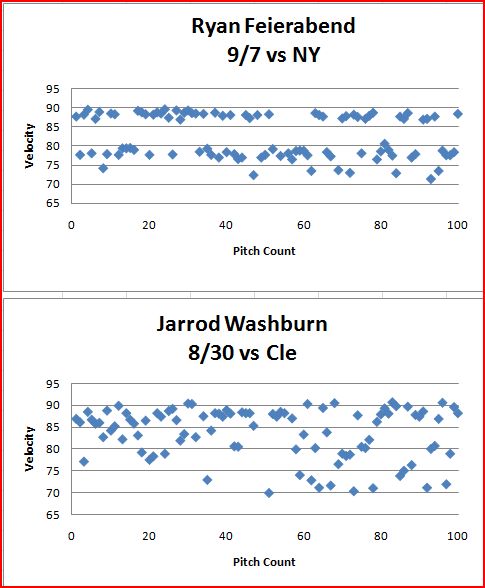
It’s the same pitch-by-pitch graph I did for Morrow and RR-S over the weekend, but this time, it’s comparing Ryan Feierabend’s start yesterday with Jarrod Washburn’s last start in Cleveland. I think the graph helps illustrate one of the main things that Feierabend is going to have to work on: keeping hitters off balance, and this won’t show up in average velocity readings.
Washburn and Feierabend have nearly identical average velocities on most of their pitches – they’re both 85-90 with the fastball, 75-80 with both their breaking ball and change-ups. However, as you can see in the graphs above, Feierabend is much, much more consistent with his velocities – there’s basically nothing in that 80-85 range all game. Washburn, on the other hand, has a much greater variety, with a far more random scattering of pitches than Feierabend’s fast-or-slow approach.
This is basically what people mean when they talk about keeping hitters off balance. It’s not just about mixing your pitches (though that’s important too), but mixing velocities within your pitches. This is what Feierabend needs to get better at.
I can’t believe I’m saying this, but Feierabend needs to learn from Jarrod Washburn. Washburn really represents his upside – a pitch to contact flyball lefty who looks okay in front of good defenses and in a generous home park – so emulating Jarrod isn’t a bad idea for him. With a little bit of work, Feierabend could basically replicate what the Mariners think they’ll get from Washburn next year, and hopefully, if he improves the final month, the team will realize that Wash is simply not worth $10 million to this organization when he’s so easily replaced.
Game 142, Yankees at Mariners
Mussina v Silva
Silva pitch type, 2008
Fastball 69%
Slider 10%
Change 21%
Mussina pitch type, 2008
Fastball 51%
Slider 19%
Curveball 25%
Changeup 6%
I’m a long-time fan of Mussina: you may remember not that long ago I was wildly advocating the Mariners trying to pick him up when the Yankees were unhappy with him. And I have to admit that as much as I rail against the stupidity of the arbitrary standards for Hall of Fame admission, if there is going to be a “twenty-game winner” check box that counts for five points, well, I wish him luck getting it.
Not tonight, of course. But Mussina’s going to need to pick up three wins in these four likely starts:
Tonight, against the M’s.
Saturday, against the Rays.
Thursday the 18th against the White Sox.
Wednesday the 24th against the Blue Jays.
Now there are two rest days in there, and the Yankees suck, so say they skip forward in the rotation where possible. Then there are five:
Tonight.
Friday the 12th against the Rays
Wednesday the 17th against the White Sox.
Tuesday the 23rd against the Blue Jays.
Sunday the 28th against the Red Sox.
He gets the extra start, and probably against a Red Sox team, but one looking ahead to the playoffs and possibly resting some regulars.
What makes me sad, though, is the thought of the Yankees potentially stooping to get him some vulture wins to get him to twenty. But stupid standards often drive stupid decisions, and if it’s the difference between getting him into the Hall or not, well, good luck with that.
Clement Out For Season
Jeff Clement has a torn meniscus and will have surgery that will sideline him for the rest of 2008. The new general manager will have to be one to make the call, but at this point, moving Clement to first base seems like the right move. He’s pretty lousy behind the plate, and knee problems for a catcher aren’t a minor deal.
Game 141, Yankees at Mariners
Ponson vs. Ryan Rowland-Smith.
In the spirit of Dave’s Graphing Weekend, and since a few of you guys liked the ones I did for Morrow’s start last night, here’s a graph of Rowland-Smith’s last start versus Cleveland. Velocity is still on the vertical axis and pitch count is on the horizontal axis.
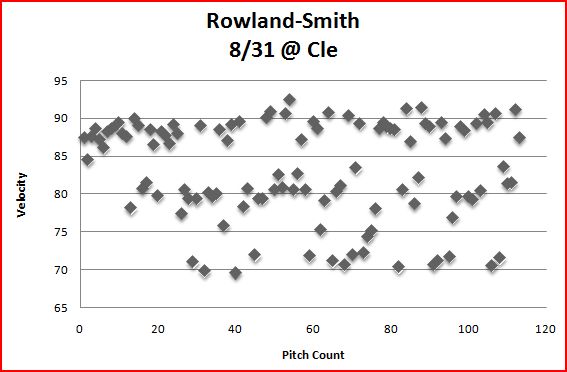
There are basically three distinct areas where you’ll see mostly consistent values – his fastball in the upper 80s, his change-up around 80, and his breaking ball around 70. Despite the fact that he doesn’t throw very hard, as you can see, he throws a ton of change-ups to keep RH batters off balance. Against lefties, he threw 9 fastballs and 8 curveballs with no change-ups. Against righties, it was 48 fastballs, 33 changeups, and 9 curveballs.
The change-up is really the pitch that allows RR-S to get RH hitters off balance, and if he succeeds as a starter long term, that pitch will be the reason why.
More Morrow Graphing
Because it’s nice to have something fun to talk about again. Here’s another graph of Morrow’s pitches as the game goes on, with velocity on the vertical axis and his pitch count on the horizontal axis. I’ve also included the trendline.
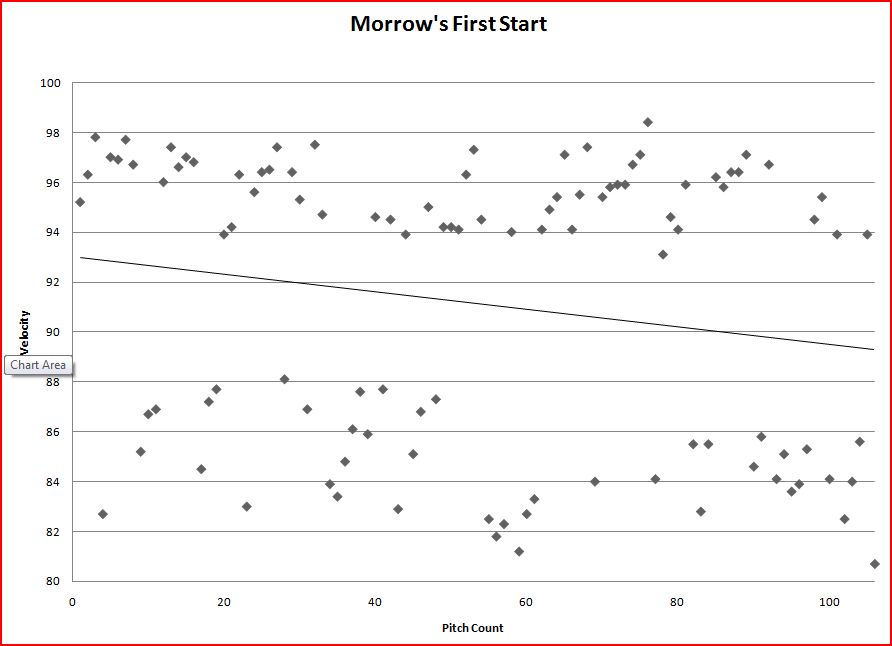
A few things jump out, but the most obvious is shown best by the trendline, but can also be seen in the density of pitches in each region – as the game went on, Morrow threw more and more offspeed stuff. You can see it’s basically all fastballs to start off, but then he mixes in some slower stuff in the second inning. Then, around the 40 pitch mark, he just starts throwing a ton of breaking balls, going chnage-curve-curve-slider-change-slider in the Damon/Jeter at-bats in the 4th inning. He went back to his fastball later, but then at the end of the game, he was basically Jamie Moyer – 12 of his last 16 pitches were offspeed.
His fastballs at that point in the game were also down to the 94 range rather than the 96 MPH heaters he was throwing up an inning before. It is pretty likely that he just ran out of gas in the 8th inning, which is to be expected considering his situation. However, if out-of-gas Brandon Morrow can still throw 94 and has the confidence to work in a bunch of breaking balls, then out-of-gas Brandon Morrow is still twice as good as Carlos Silva.