
Nobody’s Departure Prompts Matthew/Jeff Podcast
It’s been a while!
Jeff and I round up all the Mariners news from the trade deadline. Which was none. Exhausted by the effort, we talked about other teams’ trades for a bit then circled back to the Mariners, touching on the young players in the way we like to touch on them. Gently. Almost lovingly, but in a admiringly platonic way that’s not creepy at all.
Podcast with Jeff and Matthew: Direct link! || iTunes link! || RSS/XML link!
Pick One DH. Just One.
Since the Mariners predictably decided to do nothing at the trade deadline, the team and the local media have repeated one primary talking point: we didn’t want to trade impending free agents because we want to re-sign them for 2014. In the post-deadline press briefing, Zduriencik said this:
“When you let a guy leave, it is harder to get him back. Once you break that marriage up and all of a sudden you want to go back and ask that player to come back? It’s harder to do. He probably feels somewhat betrayed. The guys are here, they have the right to walk but also we have the first opportunity to re-sign them if we choose to do that, and that is important to a player, especially if they like Seattle. Who knows what is going to happen? We’re going to be able to have the inside track in bringing some of these players back here. That was part of the thinking as well.”
The obvious player being talked about here is Kendrys Morales. Because of the qualifying offer system, the Mariners can essentially nuke his value as a free agent this winter and force him to either accept a two or maybe three year deal or play out 2014 on a one year contract for $14 million. The talk that the Mariners could net a first round pick for Morales is mostly incorrect; there just isn’t going to be much of a market for Morales once draft pick compensation attaches. The Mariners leverage is being able to make him a free agent with baseball’s equivalent of leprosy, forcing him to pick between a one year deal or a short term contract at a slightly lower AAV.
We covered all this ground in June, when I noted that the Mariners didn’t need to sign Morales to an extension then because of the qualifying offer. There’s a decent argument to be made for retaining Morales, though it’s probably worth noting that if he ends up accepting the qualifying offer, paying Morales $14 million for 2014 is less than ideal, given all the other holes the team has to fill this winter. He might be worth it, especially with the fact that the deal comes with no long term risk, but it’s not any kind of bargain, and keeping Morales at that price would likely prevent the team from making other necessary upgrades.
But, there is some logic and reason to not trading Morales. The qualifying offer is a real piece of leverage that they would have lost if they had traded him. Without knowing what was on the table, I don’t have much of a problem with the Mariners hanging onto Morales and using the QO to try and get him re-signed to a two or three year deal at around $10 million per year.
But here’s the problem. If you’re keeping Kendrys Morales when there’s a significant shortage of offensive pieces available in the trade market, you’re doing so for the sole purpose of re-signing him this winter. And if you re-sign Kendrys Morales, you’re re-signing him to play DH. And if you’re re-signing Kendrys Morales to DH, then you simply shouldn’t have any interest in bringing back either Raul Ibanez or Michael Morse.
I know, I know, Raul is the Golden Boy who can do no wrong. He hit a bunch of homers. He’s beloved in the clubhouse. He’s a great guy. I heard you the first 10,000 times you shoved your Raul Ibanez affection down our throats. He’s still a highly flawed player whose sole value at this point is as a part-time designated hitter. His outfield defense has never been good and has reached embarrassing levels. Whatever offensive value you think he might retain at age 42 will be given back on defense.
Since the start of the 2010 season, Ibanez has accumulated almost 2,000 plate appearances. He’s hit .254/.315/.453, which equals out to a 106 wRC+, making him a slightly above average hitter. That’s what he’s done from 38-41. Yeah, he keeps himself in great shape, yada yada yada, but he’s still getting older, and the laws of nature still apply. If you honestly expect Raul Ibanez to be a productive player in 2014, you’re believing in wishes rather than reality.
And, really, the same thing goes for Michael Morse. Like Ibanez, Morse is simply a one trick pony who is basically terrible at every part of baseball that isn’t hitting home runs. Unlike Ibanez, Morse is also injury prone and unreliable. You could make a case that Morse could be decent DH next year, and perhaps even a lower cost alternative to Morales if the team wanted to keep him around. But he also should never play the field. He might even be worse defensively than Ibanez, which is saying something, and his over-muscled body tends to break down when he forces himself to run with any kind of frequency.
If you’re re-signing Morales, then there simply is not room on the roster for Michael Morse. You could perhaps make an argument that Ibanez could fill a bench role, except we already know how that story plays out, as having him around simply means that he’s going to play more than he should. This organization is not capable of admitting that Raul Ibanez is a poor baseball player, and they won’t be able to admit it next year either.
Plain and simple, logic demands that the 2014 Mariners pick one and discard two. They can have Morales, Morse, or Ibanez, but they can’t have all three. It doesn’t work. The team tried this silly defense-doesn’t-matter strategy already and it blew up in their face. The team is last in UZR and last in DRS, and not coincidentally, they’re 25th in runs allowed. This roster construction experiment was a failure. It should not be repeated.
The fact that the Mariners didn’t trade Morse, Morales, or Ibanez doesn’t bother me all that much, simply because I doubt the offers on the table for Morse and Ibanez were particularly good. Other teams understand that these are two limited players with limited value, and Jack’s track record doesn’t suggest that he and his staff would have been able to identify players worth targeting anyway. Keeping tradable assets that other teams may have been interested in might be silly, but I doubt it hurt the Mariners that much, given the group of people that would have been in charge of making the trades.
However, keeping those tradable assets because the organization is still deluded enough to think that they’re the foundation of a winning team? That’s a serious problem. Retaining one of Morales, Morse, and Ibanez is defensible, but only one of them. The Mariners cannot run three DHs out in the field again next year. It’s time for the organization and the people that cover the team on a daily basis to just man up and admit that the plan that was put in place was a poor one and the team needs to move on and try to get players that can actually play the field again.
There simply isn’t room on a winning team for Kendrys Morales, Michael Morse, and Raul Ibanez. Pick one and wish the other two good luck finding jobs with AL teams that need a DH. It might take some pride swallowing and some actual reflection on why the 2013 Mariners haven’t been very good, but if the people in charge of the team aren’t capable of that, then they shouldn’t be in charge of the team any more.
Game 108, Mariners at Red Sox
King Felix vs. Ryan Dempster, 4:10pm
So the first two games of the series could’ve been better. The M’s have had a few timely hits, and their pitchers have escaped some jams with double plays or through completely insane throws from CF to catch runners at the plate, but they’ve fallen short twice. Nice to send King Felix to the hill to stop a losing streak, but it’d be even better to stop sending Felix out to extend winning streaks instead of stopping losing streaks.
Ryan Dempster’s primarily a three-pitch pitcher: a 91mph fastball, a slider, and a splitter that functions like a change-up. The M’s looked vulnerable to splits last night as Koji Uehara cut through the line-up with ease (Nick Franklin has got to be hoping that Uehara doesn’t pitch tonight), but Dempster struggled mightily against the M’s at Safeco a few weeks back. In that game, he gave up nine hits in 3 1/3IP, including a HR to Kyle Seager. Homers have been a particular problem for Dempster this season, with 20 yielded thus far in 2013. Somewhat unusually for a slider-heavy pitcher, it’s righties who’ve done the most damage. As I mentioned last time, he’s got fairly even splits over his (long) career, with a better K% and HR% against lefties than righties. This is partially undone by much higher walk rates against lefties, however.
1: Miller, SS
2: Franklin, 2B
3: Seager, 3B
4: Morales, DH
5: Saunders, CF
6: Smoak, 1B
7: Chavez, RF
8: Ackley, LF
9: Blanco, C
SP: FELIX
Morse sits to allow Saunders and Ackley to play. Ackley moves to left today, which is somewhat unusual, but Saunders is still the superior defensive CF as he showed last night.
James Paxton starts for the reeling Rainiers at home against Omaha tonight. This is a big game for the Canadian lefty, as he could very easily find himself in the Tacoma rotation in the event the M’s slip Joe Saunders through waivers. He’s been brilliant recently, as we’ve detailed, and another month demonstrating good command will go a long way towards putting the calls for him to shift to the bullpen to rest. Stephen Landazuri starts for High Desert where his opposing starter will be intriguing prospect or historic bonus baby bust Michael Ynoa. Ynoa signed the all-time record (at the time) signing bonus with the A’s in 2008, but injuries and ineffectiveness have kept him in single A. Even so, he was added to the A’s 40-man roster this year; they still believe in the 6’7″ Dominican, though his statistics in 2012-13 do not inspire a lot of confidence.
Today’s Fun Fact: Dustin Ackley
I couldn’t figure out what to do with this, but I knew I wanted to do something with this, so this is what I’m doing with this. I made a chart and now you’re going to look at it.
When Dustin Ackley was demoted to Tacoma, it wasn’t about Ackley’s swing being completely off. It wasn’t that the Mariners were displeased by his ability. It was more about Ackley’s approach, with the team suggesting he wasn’t being aggressive enough, and with Ackley admitting sometimes he let himself get too passive. The Mariners, and Ackley, wanted him to get back to being “ready to hit,” whatever that means. It was a psychological thing, and that was Ackley’s mission in Triple-A. Instead of waiting around, Ackley had to adjust to get to going on the attack.
So here’s that chart I made. It shows Z-Swing% and O-Swing%, where the former is the rate of swings at pitches in the zone, and the latter is the rate of swings at pitches out of the zone. How has Ackley profiled since his recall? This is one way of looking at it. A chart of rolling 20-game averages:
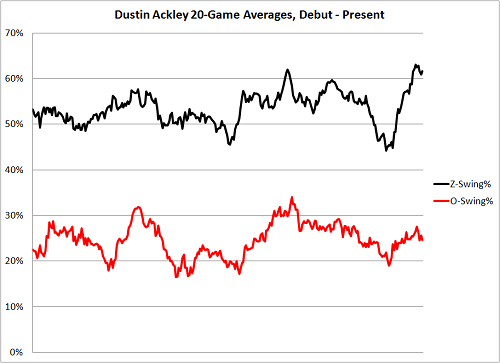
Ackley since July 3:
- Z-Swing%: 62%
- O-Swing%: 25%
Ackley’s most recent 20 games when he was demoted:
- Z-Swing%: 46%
- O-Swing%: 21%
Ackley, over his entire career:
- Z-Swing%: 54%
- O-Swing%: 25%
There’s evidence to suggest Ackley is indeed a little more aggressive now than he used to be. But this isn’t unprecedented — his Z-Swing% has reached the 60s over stretches before. When he was initially extremely successful, his Z-Swing% hovered around the low 50s. What’s clear is that Ackley hasn’t completely changed his approach, nor was that the goal. This is just something to monitor going forward, as it follows that “being ready to hit” should show up in higher swing rates. Alternatively, it might be about swinging at the same pitches, but just being more ready for them, in which case all we can really do is examine the results. Since being recalled, Ackley’s hit .240 with a .613 OPS and zero home runs. Sometimes he’s looked real good, but Felix Hernandez has hit a grand slam.
So, yeah. Take this for whatever it’s worth. Those are Dustin Ackley’s swing rates over time. If you don’t think this was worth posting, don’t blame me. Blame my parents, without whom this post wouldn’t exist.
The Myth Of The Stupid Boring Deadline
The Mariners didn’t do anything on Wednesday, in advance of the non-waiver trade deadline. That’s not really fair — they did plenty of things, taking plenty of calls and doing plenty of research. If you suggested to the Mariners on Wednesday that they didn’t do anything, the executives would laugh in your face. They were at work. They were busy. But they didn’t, ultimately, make a deal. The roster that was remains the roster that is, despite the roster having a number of perfectly tradeable players. The Mariners weren’t the only team to stand pat. The Giants didn’t do anything. Lots of teams didn’t do anything. People have said this was a slow and boring deadline, perhaps in part owing to the reality of two extra teams qualifying for postseason play.
It actually feels like people say that almost every year. Almost every year, people feel like the trade deadline was boring, and I know this year a lot of Mariners fans were thinking about potential moves, potential prospects. There are few things fans love more than trades, and the opportunities to discuss them. The Mariners gave their fans no trades to discuss, at least not trades that actually happened. The overall trade deadline was light on stars and light on concrete activity. People say they’re bored. People say this deadline was lame. I’m pretty sure they’re wrong; I’m pretty sure they’re missing the point.
The trade deadline is only in very small part about trades that take place. The excitement about the trade deadline, I mean. Let’s say a trade happens. Let’s just say. Let’s say it involves your favorite team! That’s exciting! For a very short time. Do you know how quickly the average person gets over transactions? Do you understand how amazingly and sometimes disappointingly quickly we adapt? Trades are exciting because they represent change. T will represent time points. At T1, you have a roster, and at T2, you have a different roster, because of a trade. Between T1 and T2, there was change. But then you’ll hit T3, and T4, and T5, and so on and so forth. You perceive the most sudden change immediately. After that, you feel the change less and less. Eventually, a changed roster feels like a normal roster. After the initial rush of talking about what you got and what you lost, you get familiar with the new reality. That which is familiar is particularly unexciting, relative to when things are exciting.
We love when trades happen, even if they’re bad trades, but it’s a fleeting high. It’s an ephemeral whiff of emotion. The minute a trade gets announced, you start getting used to it. Within a surprisingly brief period of time, your team is just your team, and you’re rooting for the same stuff. Fans of good teams want wins, however. Fans of bad teams want progress, however, or maybe even losses. You start to forget about the trade because more important than a trade are the games. The games are the heart of the season.
The trade deadline is somewhat about the trades, but so much more than that, it’s about the possibilities of trades. It’s about all those solid rumors and nonsensical rumors, about imagining whatever you want because who knows what some team might do? Until the trade deadline, anything is possible, anybody might become available. And you start to care even about the lesser players. Bud Norris isn’t very good, but he’s trade-deadline interesting, and he was the subject of countless rumors leading up. It was almost anticlimactic when Norris finally got moved. The real thrill of it was thinking about Norris moving, and where he might go and what he might get and what the implications might be.
The appeal of the trade deadline is the circus. Or, let’s think of it as an amusement park ride, a roller-coaster. The trade deadline is a ride, and even if nothing real substantial happens in the end, was a roller-coaster not worth it because no one gave you a big stuffed animal when you got off? In the weeks leading up, you get to fill your time thinking about countless possibilities. You get to think about which pieces to move, which pieces to get, what might fit where. You get to follow rumors — and there are millions and millions of rumors — and then you get to speculate on validity and significance. Around the trade deadline, baseball keeps a fan engaged. The next rumor might be five seconds away. It might be something you’d never heard before. Nothing’s certain until the deadline passes, and even then, we’re always warned that trades can be announced afterward, since they need to be approved. So it’s more like people can’t calm down until half an hour after the deadline. This year, the post-deadline trade was Drew Butera to someone for something, which in a sense is appropriate, but it doesn’t matter what happened. It doesn’t matter what happened. It mattered what we thought could happen, in our heads, at the time.
In terms of stuff to discuss, there’s no such thing as a slow trade deadline. Especially now in the Twitter Era. Everything gets tweeted, no matter how worthless, and sometimes the messages are contradictory. Every reporter with a source tries to get his voice out there, and that’s content, that’s fodder. We all know it’s absurd, we all know it’s unhealthy, but we all follow and click. We all become rumor addicts, even when we’re advising people not to become rumor addicts, because it’s fun and creative and ultimately it’s all stupid so why not participate in some more of the stupid? Active trade deadlines are awesome. Inactive trade deadlines are awesome. The excitement of the former just ends a few hours later than the excitement of the latter.
Here’s all the evidence you need that people love the trade deadline: every year, people complain that they’re bored by the outcome. Which means that, every year, people get into it, regardless of the year right before. There’s no such thing as a boring trade deadline. That’s just the come-down talking, after the drugs.
Game 107, Mariners at Red Sox
Hisashi Iwakuma vs. John Lackey, 4:10pm
Some times, the games follow these preview scripts eerily well, and other times, such as yesterday’s, they really don’t. Brandon Workman annihilated a better line-up than he faced a few weeks ago. Today, the M’s look to erase the memory of yesterday’s ugly eyesore behind Hisashi Iwakuma. John Lackey gets the start for Boston, and the veteran is having one of his better seasons in years. The clear pattern we’ve seen in these past couple of series against the Red Sox holds true for Lackey: he doesn’t materially change his pitch mix against lefties/righties. When he was with the Angels, he had a slider that he used against righties while sticking to a curve ball and change-up against lefties. That’s a text-book, standard, pitching-101 mix, but he started throwing more sliders to lefties when he got to Boston. This year, he’s throwing even more sliders, with his change-up now a rarity. This shift in approach looked disastrous, as he was replacement level in 2010-11 (by bWAR) and then rehabbed from Tommy John surgery in 2012. This year, however, he’s walking fewer and striking out more than he has in several years. Did the slider-heavy approach cause or exacerbate his elbow injury? I have no idea, and it’s pretty pointless to speculate, but he’s striking out more righties than he even has while limiting lefties to a 3.31 FIP.
Of course, there’s plenty of luck here. His BABIP against lefties is very low, and they’re not hitting as many HRs as they have in the past. But some of everything is luck, and we can’t just chalk everything up to random variation. He’s always been effective against lefties, and lefties have always hit fewer HRs against him. In that sense, it’s kind of amazing that he’s still the same John Lackey despite the TJ surgery and throwing completely different pitches. Against righties, his fastball’s been the key to his 2013 success – he’s getting more whiffs on his four-seam than ever. He’s always had plenty of vertical movement on it, but he’s now throwing it with essentially zero horizontal movement, perhaps making it function more like a cutter. It’s a very different pitch, but Felix’s four-seamer gradually shed horizontal movement along with velocity and stayed effective (though it’s a bit more traditional this year). He’s also throwing it a bit differently, eschewing the standard “low and away” approach and keeping it elevated. Throwing the ball up can generate more whiffs, but the trade-off is generally HRs. And Lackey’s definitely been HR-prone, but with his great K:BB ratio, it hasn’t hurt him too bad.
Line-up:
1: Miller SS
2: Franklin 2B
3: Seager 3B
4: Morales DH
5: Ibanez LF
6: Morse 1B
7: Saunders RF
8: Ackley CF
9: Quintero C
SP: Iwakuma
It’s perhaps inevitable that since Brandon Workman made my preview look silly, the M’s may attempt to make my assessment of the trade market look silly too. There are all sorts of rumors that several teams have an interest in Mike Morse, though you’d have to imagine the returns wouldn’t exactly be franchise-altering. Since April 8th, Morse has played in 50 games and hit .236/.300/.385 with 6 homers. Teams will not be acquiring him for his defense. In recent games he’s been destroyed by Workman and Robbie Erlin, so teams that put a lot of value in the most recent sample (or the ‘eye-test’) may be…concerned. Who knows, though. He’s got pop, and all of the selective end-pointing in the world doesn’t change that. If someone wanted to trade a top prospect for him, that’d be peachy.
Tai Walker’s now in his first real funk of 2013, after giving up 9 hits and 4 runs in 6 IP against Omaha last night. In his last two starts, both at relatively pitcher-friendly Cheney Stadium, he’s thrown 11 innings, giving up 15 hits, 5 walks and 9 runs. Of course, he’s thrown more than 100 IP this season, and his slide in 2012 began much sooner. It’s possible that this is nothing, just two off games in a hitter’s league, and it’s possible that his poor pitching in July/August in 2012-13 are related to fatigue.
Blake Beavan starts for Tacoma, Anthony Vasquez for Jackson and Jordan Pries for High Desert. The biggest prospect on the hill tonight is lefty Tyler Pike, who gets the ball for Clinton.
If You’re Wondering
If the Mariners make a trade today, I’ll write about it. I don’t expect them to, despite the reports that they’re talking to other teams about Michael Morse, Oliver Perez, and Tom Wilhelmsen. My guess is that their asking price is probably a bit different from what teams are going to want to pay for these guys.
That isn’t to say that the Mariners won’t make any trades this season. A lot of the M’s pieces are guys you could trade pretty easily in August. Joe Saunders isn’t going to get claimed by a low-ranking non-contender, so if he doesn’t clear waivers, he’d probably still get to someone who might give something up for the stretch run. Same with Raul Ibanez, who I doubt the M’s have any interest in trading anyway, but if they did decide to let him have another playoff run to end the year, they could get him to a contender in August. Morales, they’re going to keep and try to extend or at least make the qualifying offer. At least, that seems like the pretty clear plan.
So, really, besides Morse and Perez, their trade chips aren’t really subject to today’s deadline anyway, and those guys might end up getting to a contender as well, depending on how they perform over the next few weeks. They’re less likely to sneak through waivers, but it’s not completely out of the question.
Today’s trade deadline is really about pieces like Jake Peavy or Matt Garza. These guys can’t really be traded in August because their value is too high for even non-contenders to pass on them. For bit pieces, role players, and marginal improvement guys — basically, everyone the M’s might sell — this deadline isn’t really a deadline.
Joe Saunders Thought Train
(1) Last night, the Mariners got clobbered by the Red Sox, and Joe Saunders caused something of a little stir later on when he fielded questions from the media. Saunders was the Mariners’ starter and he lasted just five innings, and in the post-game interview he said things like “I was throwing good pitches. I wasn’t getting much help.” and “We didn’t get our breaks. They got some breaks.” Saunders declined to go into further detail, but he went off the normal grid to seemingly take a jab at the umpiring and at his teammates, and he defended his own effort, despite the nine hits and six runs. Anything out of the ordinary in a post-game interview is likely to get attention, because the ordinary is empty and mindless. Saunders knew enough to stop himself.
(2) The first inning, of course, was sloppy defensively. Brad Miller committed an error on a routine grounder, and he fumbled an attempted bare-hand later on when gloving the ball probably would’ve worked just fine. Henry Blanco failed to catch a perfectly catchable pitch, and a run scored on the passed ball. Everyone knew the defense did Saunders no favors, and he also threw some borderline pitches throughout that came back as non-strikes. There were a handful of Saunders pitches that easily could’ve gone the other way, and at least once, Saunders expressed his frustration:
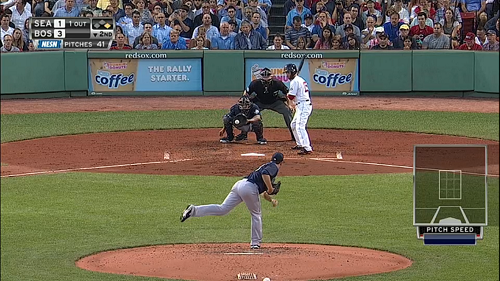
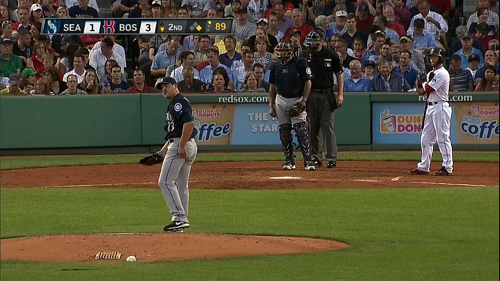
(3) On the other hand, the Red Sox didn’t get to pitch to a way more generous strike zone, and their pitchers allowed two runs. Saunders didn’t have a single obvious strike called a ball, and he did get the benefit of the doubt on a few borderline pitches. You’re never going to get the benefit of the doubt on all of them. Additionally, Saunders threw some decidedly poor pitches, like the one Dustin Pedroia hit out, and as for breaks, the Red Sox made two outs on the basepaths while Saunders was on the mound. In the second, Jose Iglesias hit a ball off the wall and was thrown out trying for second, and then trying for first. In the fourth, Pedroia was thrown out trying to stretch a single. That’s two times the Red Sox made outs on hits off Joe Saunders.
(4) So Saunders was frustrated, and he voiced as much, and he selectively remembered things that would make him look better. Yes, he had some reasons to complain, but he also had some reasons not to, and generally veteran leaders are supposed to be more stable and calm. Saunders threw some good pitches, and he threw some bad pitches. He didn’t get some breaks, and he did get other breaks. It was, like he said, just one of those nights.
(5) So basically Saunders was like anyone else. We all selectively remember things to make ourselves look better, all of the time, and when we’re frustrated we have less control over what we say and what we keep to ourselves. Typically, we keep our frustrations penned in, but sometimes the gates open up and things spill out. It’s fine if Saunders wants to be critical of the umpires, and it’s not like he hates his young Mariner teammates. Quote from the linked article: “I’d like to stay here. I love playing here. I think we have a good thing going with these guys.” Miller knows he messed up, Saunders knows he shouldn’t have said anything, and there won’t be a single hard feeling because these emotions are gone as soon as they’re put in the air. The consequences and significance of what Saunders said are nothing. He felt like a normal person and he’s allowed to be frustrated when he gives up six runs in five innings. Nothing has been revealed about his personality; nothing has been revealed about his psychology. Certainly, nothing has been revealed about his pitching. He’s Joe Saunders. He needs a bigger share of the breaks to be really good.
(6) In conclusion, whatever. You have now spent this time reading about Joe Saunders on the day of the trade deadline. Not reading about Joe Saunders rumors. Reading just about Joe Saunders.
Jesus Montero 2013 Checklist
Remember Jesus Montero? He’s a guy the Mariners pay money, and he’s played for them, and he was a big deal when the Mariners got him for Michael Pineda. He’s 23 years old. Let’s review what he’s accomplished this season!
Underperformance: check
Montero batted 110 times this year with the Mariners, posting a .590 OPS that puts him below Endy Chavez. He has a .686 OPS over the equivalent of a few weeks in the minors, and it’s not like Montero lit the world on fire a year ago. Statistically, it’s been a bad season for Jesus Montero.
Position change: check
The Mariners said a lot over the offseason about how much faith they had in Montero as a catcher, but it didn’t take long before he was essentially splitting time with Kelly Shoppach, and then the Mariners announced that Montero wouldn’t catch anymore. He’s trying to be a first baseman, and he’s really basically a DH, and he’s 23.
Significant injury: check
Montero required knee surgery for a torn meniscus!
PED suspension: apparently check
From Jon Heyman, and many others:
A-Rod is the headline-grabbing name, but the other players with 50-game bans looming are Rangers outfielder Nelson Cruz, Tigers shortstop Jhonny Peralta, Mariners catcher Jesus Montero, Yankees catcher Francisco Cervelli, Padres shortstop Everth Cabrera and minor leaguers Fernando Martinez, Fautino de los Santos, Cesar Puello and Norbeto Martin.
We knew that Montero’s name showed up in the paperwork, but at first we didn’t know how much we ought to make of that. Now it’s looking virtually certain that Montero will be suspended for his Biogenesis involvement, as will a handful of others. We don’t know what Montero did, exactly, but we can conclude it was bad, and we can assume MLB has plenty of evidence.
About the only thing Montero hasn’t done to diminish his value is commit some kind of felony. Otherwise, he’s ticked off the whole list. He’s done poorly at the plate, he’s done poorly in the field, he hasn’t been completely healthy, and he’s getting busted by baseball for breaking the rules, even though he should’ve known better. It’s not fair to describe Montero as a catastrophe — there can’t really be baseball catastrophes, in this vein — but as careers go, this has been a disastrous several months. We can’t even know what to make of Montero’s famous raw power, since it now appears he’s been a user of performance-enhancing drugs.
Top prospects have busted before. They bust all the time. People remind you of this every year when they talk about potential blockbuster trades. Delmon Young has a career WAR below zero. It’s beginning to look like Jesus Montero is a real bust. But seldom do top prospects bust this quickly. Between the 2011-2012 seasons, Baseball America ranked Montero as the sixth-best prospect in the league, ahead of guys like Jurickson Profar, Shelby Miller, Manny Machado, and Gerrit Cole. He was, that recently, can’t-miss. It was always a possibility that Montero could bust — he was high-upside and high-risk — but it’s not even the end of 2013 and I can’t really imagine what Montero would look like as a significant contributor. He’s not going to do anything in the field or on the bases, and he’s probably never going to walk a lot. He basically needs to slug in the .500s to be an average value, and so far he’s slugged .396.
Montero’s trade value is almost completely shot, I have to imagine. Now, I figure the Mariners will get some calls in the winter, with other teams looking to buy low. Sensible, that. I’d try to buy low, too, if Montero belonged to someone else, and he’s not worth completely giving up on. You never know, and scouty-types loved him for a reason. But in January 2012, the Mariners basically got Montero for Michael Pineda, and in July 2013, Montero’s all but forgotten when people discuss the Mariners’ crop of young organizational talent. Some top prospects take the trail down the cliff. Montero just stepped off the edge.
Game 106, Mariners at Red Sox
Joe Saunders vs. Brandon Workman, 4:10pm
The M’s head east for three against the Red Sox and three in Baltimore before returning home next Monday. The Sox were just passed by the streaking Rays for first place in the AL East, and the M’s have Michael Morse back from injury, meaning it’s likely you might hear this series (mis)described as “pivotal.” The Red Sox are looking at upgrades in the rotation, as today’s rumor about Cliff Lee attests. At the moment, rookie Brandon Workman occupies the #5 spot in the rotation, and while he’s been fairly effective so far, I don’t think anyone sees him as a great option down the stretch or in the playoffs. Workman throws a four-seam fastball, a curve, a cutter and a change. Like many of his Red Sox teammates (Felix Doubront, for example), Workman doesn’t exhibit a markedly different pitch mix to righties and lefties. That is, he’ll throw his change and to righties and lefties alike. His fastball has relatively little horizontal movement, but above-average vertical movement so it’s not a big surprise to see that he’s a real fly-baller. He posted GB rates in the mid-high 30s in the minors and will likely settle in that range in the majors as well.
Given his lack of a big slider or sinker, it’s also not much of a surprise that he never posted much in the way of platoon splits in the minors. His MLB “career” has lasted all of about 1 hour, so there’s not much to go on there, but his change-up’s not the kind of pitch that can really trouble the M’s lefty-heavy line-up. He’s posted 13 strikeouts in 12 innings in his MLB career, a number boosted by his two-inning relief appearance in Seattle (his MLB debut). In that game, he struck out notable sluggers like Henry Blanco, Brendan Ryan and Jason Bay, so while he posted solid K rates in the minors, I’m not convinced he’s going to be a real swing-and-miss pitcher if he stays in the rotation. I’ll always remember that game back on July 10th for one of the more improbably “first MLB at-bats” I’ve seen: Brendan Ryan welcomed Workman to the bigs with a home run. The M’s also hit three doubles in that inning, so we’ve seen that they’re capable of dealing with Workman’s 92mph heat. The Red Sox were able to move some starters around in the past week, meaning that Workman hasn’t pitched since the 22nd; we’ll see if the long rest helps his velocity or stamina.
Michael Morse is back with the team, and he’ll get the start tonight in RF for the M’s. That’s pushed Dustin Ackley out of the line-up for a day; as Matthew mentioned, Ackley and Saunders will presumably split time for as long as Morse stays healthy.
Line-up:
1: Miller, SS
2: Franklin, 2B
3: Seager, 3B
4: Morales, DH
5: Ibanez, LF
6: Morse, RF
7: Smoak, 1B
8: Saunders, CF
9: Blanco, C
SP: Joe Saunders
The trade deadline looms, but there’s been surprisingly little action thus far. A few relievers moving hither and thither, but outside of Matt Garza, there haven’t been any big moves. The Angels moved Scott Downs, which means they could look to sell at the deadline in an attempt to get cost-controlled prospects as their commitments to Hamilton/Pujols/Wilson rise over the next few years. Teams are looking at Howie Kendrick and Erick Aybar. Long-term extensions have already altered free agency, and they (and the new CBA, to be fair) may be doing the same to the trade deadline. There are fewer 2-3 month rentals and a few more 1.5, 2.5 year players on the block, which amplifies both the potential risk and the potential return.
The M’s actually have 2-3 month rentals to trade, but the season’s conspired to make those moves less attractive. Morse has been hurt half the year, and has been mired in a slump since April. Kendrys Morales has been very solid, but injury issues and a perceived inability to play 1B daily compromises his value to NL teams. Raul Ibanez is 41, and while I never would’ve imagined him having much trade value this season, he may be the most likely to go, though that’s not saying much. It’s looking increasingly likely that all three will be in M’s uniforms in August.
Taijuan Walker heads the list of today’s minor league pitching probables. He and Tacoma welcome Omaha to Cheney Stadium tonight at 7 (you should probably go). Anthony Fernandez starts for Jackson; the lefty was injured in Spring Training and got knocked around when he returned to the Generals rotation in April/May, but he’s been pretty good recently. Lars Huijer takes the hill for Everett as they play the Hops in Hillsboro for those of you in the Portland area.