
What You Knew I Was Going To Write About Mike Zunino
I’ve never seen an episode of The Wire. I’ve never seen five minutes of an episode of The Wire. I have seen one clip, hosted on YouTube, but I didn’t know it was going to be a clip of The Wire when I went there, so in that sense it was an accident. I’m not bragging and I don’t have anything personally against the series. My understanding is that the series is supposed to be fantastic — one of the best series put together in at least the recent history of television. That’s what everybody says. But that’s the problem: that’s what everybody says. The show is too beloved, too popular, too often talked about on the Internet in which I exist. I do intend to watch The Wire someday, but for now I’m already sick of hearing about it, and I’ll watch it when no one’s gushed about it to me for a calendar year. I mean, I ride the tide with Breaking Bad, and I live with it, but the Internet’s been on The Wire like the Internet’s been on bacon and I just don’t care. Shut up and let me learn to care on my own.
So I wouldn’t blame you if you’re already tired of reading about pitch-framing, or pitch-receiving, or whatever you want to call it. Over the years since pitch-framing was really quantified and made public, it’s taken baseball analytics by storm, and the community has turned Jose Molina into a cult hero. People are hyper-aware of framing now, they’re looking for it on every pitch, and people talk about framing like nothing else a catcher has to do matters. At least, like nothing matters as much. Because framing research still has that new-car smell, it’s a popular thing to talk about, and maybe that makes the discussion repetitive and overwhelming.
But, whatever, I’m here to talk about framing, and I’m here with a positive message, that you’re free to accept or ignore. Mike Zunino has been up with the Mariners for a short while, now. It’s too soon to know what to make of his offense, and that part of his game is still being polished. His defense, though, has long been considered his strength, and based on the evidence to date, receiving is one of his skills.
That shouldn’t be surprising, in that Zunino’s always been billed as a plus defender. That should be surprising, because Rob Johnson was supposed to be a good defender too until it turned out he sucked. That should be surprising, because the Mariners haven’t had a decent framer for a while, excepting Jesus Sucre, who was never supposed to be in the plans. For years, the Mariners pitched to a shrunken strike zone. Now, this is a whole new experience.
Let’s look just as last night, for a moment. A good indicator of good framing is when the hitter responds to a call all angry-like. Last night, Zunino was the Mariners’ catcher, and here are some selected screenshots:
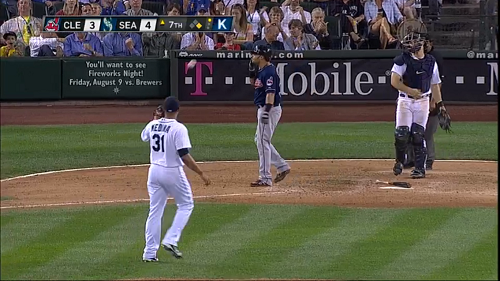
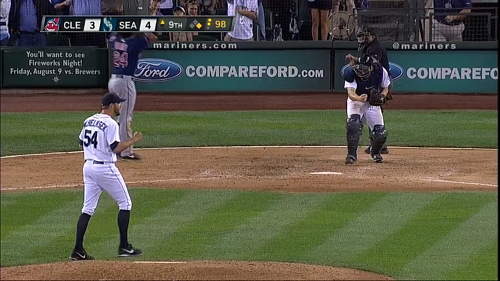
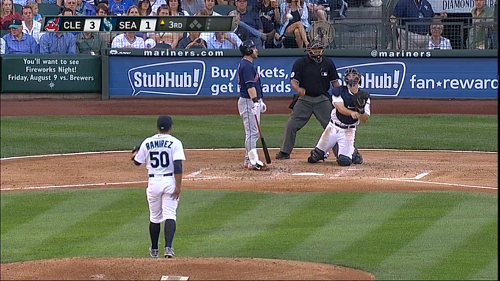
Zunino, yesterday, seemed to buy the Mariners some calls. The final pitch of the game was one such call. But, all right, when you’re looking at one game, you can be influenced by any number of variables, most obviously the home-plate umpire. You need to look at a broader range of information. I want to show you something. Using plate-discipline data available at FanGraphs, I’ve been able to come up with a home-brewed receiving metric. It isn’t catcher-specific, but it is team-specific, and it compares actual strikes against expected strikes, based on pitches in the zone and whatnot. A positive number means more strikes than expected, suggesting good catching. A negative number means fewer strikes than expected, suggesting bad catching. Let’s look at where the Mariners have ranked in this statistic, broken down by month:
April: 30th (last)
May: 24th
June: 12th
July: 4th
Zunino arrived in the middle of June. In April, Jesus Montero got 52% of the starts, and the Mariners were dreadful. In May, the playing-time leader was Kelly Shoppach, at 42% of starts. In June, Zunino was the playing-time leader, at 41% of starts. In July, it’s been 83% Zunino and 17% Henry Blanco. As Zunino has played more and more often, the Mariners have pitched to a strike zone more and more generous, or at least more and more fair.
Of course, it isn’t all Zunino. Sucre received well before he got hurt, and Blanco has a strong reputation. In order to focus on Zunino specifically, I called on Matthew, who keeps his own pitch-framing numbers. Matthew generously helped me out. Zunino has caught some thousands of pitches. Matthew calculates his own strike zone, based on what umpires actually call, as opposed to what the rule book dictates. With Zunino, 91% of pitches taken in the zone have been called strikes. The league average is about 86%. With Zunino, also, 7% of pitches taken out of the zone have been called strikes, which is right on the average. It’s not so much that Zunino gets extra calls by the barrelful; it’s that he gets the calls the team deserves, mostly. Compared to an average catcher, Zunino’s averaged better than one more strike per game. That ranks him highly among his peers, albeit below the very best.
A bit of a conversation from last night, after Yoervis Medina and Mike Zunino froze Nick Swisher:
Blowers: …think you give Mike Zunino some credit on that strike, that pitch looked like it was just off the plate, running off the outside corner, but Zunino does a good job of framing it and holding it there on the corner for umpire Adrian Johnson.
Wilson: Yeah, outstanding job to kinda…stick that pitch on the outside corner, fool the umpire a little bit.
So Dan Wilson did that thing he does where he talked without introducing any new information, just repeating the guy who talked before him, but Blowers spotted the receiving and Wilson — a good defensive catcher! — agreed. In that case, Zunino bought the Mariners an iffy strike. More often, he just gets the strikes that probably ought to be strikes, where a lot of catchers give them away near the edges.
Framing is probably one area where we don’t need to worry about age-related decline or sudden other changes. How you catch is how you catch, and though Zunino isn’t flawless and entirely motionless, the results are the results and he looks more good than bad to the eye. He keeps his body quiet and there’s hardly anything in the way of pointless motion. Because it’s only been a handful of weeks we will, of course, need to look at this information again down the road, but I feel good about this. To the eye, Zunino knows how to catch, and by the numbers, that statement is supported.
And oh, by the way, Zunino’s shown a better hitting approach in July than he did in June, not that those samples can really tell you much. He’s dropped his swing rate from 53% to 45%, and he’s gone from two walks and 11 strikeouts to seven walks and 15 strikeouts. That’s a positive step, but it might be nothing, and we’ve known for a while that Zunino’s hitting is a work in progress. What he is now, he shouldn’t be later on. At the plate, Mike Zunino is still learning, and he should be a better hitter a year from now.
Behind the plate? Zunino’s still learning about the majors and about a major-league pitching staff, but he seems to do most everything right. I liked Jesus Sucre simply because he was defensively capable. Mike Zunino is defensively capable, but he’s also an actual prospect with overall upside. This one should be a good one, and already, he’s a good one in a way in which the Mariners haven’t been good for a while.
Seattle Mariners Trade Deadline Preview
The Seattle Mariners haven’t lost for a while, and if they keep that up, they’re certain to make the 2013 MLB playoffs. Partially as a consequence of the team’s recent success, the front office has gone on record as saying it’s not really that interested in selling pieces off. But there are people who want to see moves, specifically because the Mariners probably won’t keep not losing for the next couple of months. The Mariners’ MLB playoffs odds are all but equivalent to the Mariners’ NHL playoffs odds; though they are equal in the standings to the Angels, which would’ve been exciting to know in March, the twist is that it’s the Angels who’re bad more than it’s the Mariners who’re good, and bad teams who aren’t going to the playoffs are supposed to sell present value for future value. That’s what we think we know — that’s what we think we understand.
Okay, so the Mariners aren’t bad. But the Mariners might not sell. And that might frustrate you, as a fan who likes transactions. But when you examine the Mariners’ roster, it would make sense for them to more or less stand pat. They don’t actually have all that much flexibility. We begin!
Aaron Harang
In April, the Mariners got Harang from the Rockies for Steven Hensley. Right before that, the Rockies got Harang from the Dodgers for Ramon Hernandez. Both times, Harang was packaged with cash, albeit not literally. As a Mariner, Harang has posted interesting peripherals, but also an ERA over 5. The Mariners might be able to dump him if that’s something they wanted to do, but there’s no value that would be coming back.
Hisashi Iwakuma
Hypothetically, this would be the Mariners’ big piece, as Iwakuma would have a lot of trade value were he put on the market. Over the past calendar year, among 135 starters with at least 100 innings, Iwakuma ranks 6th in park-adjusted ERA, 47th in park-adjusted FIP, and 16th in park-adjusted xFIP. He’s really quite good, even if he has a bit of a dinger problem. But the Mariners have expressed zero interest in moving him, as they like him, and he likes it here, and Iwakuma is a bargain potentially under contract through 2015. He’s in line to provide the Mariners with a lot of excess value, and while maybe they could get more value from moving him, it’s basically a coin flip and I’d be more than happy to keep him around. If the Mariners aren’t far away from being all right, then Iwakuma could be a part of a potential playoff contender.
Oliver Perez
Here’s a good piece I think the Mariners could and will move, because not only is Perez a left-handed reliever who’s a free agent to be, but he’s also been effective against righties, which is a rare and desirable quality. And the Mariners already have Charlie Furbush, and Lucas Luetge if you care about Lucas Luetge. Brian Moran has posted absurd numbers with Tacoma. Perez is desirable and expendable, and he should get dealt, but he’s also a non-closer reliever and as a return you’re talking about a second- or third-tier prospect. Last year, Edward Mujica got Zack Cox, and Mujica had another year of control. Jonathan Broxton got minor-league relievers. Craig Breslow got Matt Albers and Scott Podsednik.
Joe Saunders
Joe Saunders is basically Joe Saunders, as much as he’s ever been. He got traded last August, for Matt Lindstrom and money. To that point, he’d been a decent starter for the Diamondbacks. To this point, he’s been a decent starter for the Mariners. Saunders could easily be moved to someone looking for a back-of-the-rotation starter, but all the Mariners would really get out of that is a little extra money, or a half-interesting prospect we convince ourselves at the time is more interesting than he actually is.
Kendrys Morales
Here’s an interesting one, because Morales is reliable and good and set to be a free agent. But a National League team probably wouldn’t trust him to play first base all the time, making him mostly desirable to AL teams. And right now there are eight contending AL teams. The Red Sox don’t make sense, the Rangers don’t make sense, the Tigers don’t make sense, the A’s don’t make sense, and the Rays probably don’t make sense. That would leave maybe the Orioles, maybe the Yankees, and maybe the Indians. But the Orioles are said to be tapped out of money, and the Indians are sort of shuffling between Jason Giambi, Mark Reynolds, and Nick Swisher. The Yankees would be an obvious fit, but here’s the other point: what if the Mariners want Morales back? They could try to trade him for value, sure. Or they could keep him and extend a qualifying offer. If he accepts it, that’s a good player on a one-year contract. If he doesn’t, he’ll have a depressed market, and maybe the Mariners could re-sign him for a couple years. Sure, you could say that blocks Jesus Montero, but, oh no. Worry about that when Montero doesn’t suck. Morales has been solid this year, especially so if you consider that he played through a hurt back in parts of June, when he was ineffective.
Brendan Ryan
It would be great if the Mariners were dangling a starting shortstop around deadline time. Unfortunately what they might be dangling is Brendan Ryan. All Ryan’s fetching is a low-level nothing and a sigh.
Jason Bay
Jason Bay is still around! And his overall numbers show something! He’s a bench player, though, who’s batted just 38 times since the middle of June, and as much as he might attract some attention as a leader and as a quality teammate, people don’t pay out the nose for these guys, so there’s little incentive for the Mariners to dump Bay just because. Of course, he could get forced out in a roster crunch.
Endy Chavez
The Mariners signed Chavez for pennies in March. He’s subsequently posted a negative WAR.
Franklin Gutierrez
Maybe an August trade, maybe if Gutierrez comes back and actually plays some. I could see him as a high-upside gamble for a bench behind a questionable starter or two. But all you get for Gutierrez is salary relief. Nobody’s going to trust him. Franklin Gutierrez probably doesn’t trust him. Teams want to acquire certainty this time of year, not fliers.
Raul Ibanez
Another guy who’d fit with the Yankees in some capacity, but Ibanez, like Morales, is basically a DH, and despite the numbers he’s 41 years old and this has been one big ol surprise. Plenty of teams would love to have Ibanez on the bench, but no one’s going to cough up much value for a bench bat, and there just aren’t really teams that would see Ibanez as a starter. Throw in the fact that the Mariners aren’t motivated to trade Ibanez and that Ibanez isn’t motivated to leave, and this doesn’t look like a developing story. So the Mariners might get nothing in return for Ibanez, instead of a lower-tier prospect or two. They’ll hope that Ibanez’s continuing influence is of greater value than the lower-tier prospect(s). It’s not really a missed opportunity if it isn’t an opportunity for much.
Michael Morse
Morse hasn’t started since June 19, and he’s only now beginning a rehab assignment. He’s a DH facing the same issues as Ibanez and Morales, in terms of market, and while Morse had that enormous first go with the Mariners, he’s posted a .692 OPS since April 16. He’s a guy who’s been hurt and relatively ineffective and even before getting hurt he wasn’t a capable defender at any position. The Mariners sold Morse as a big splash when they got him, and that’s what they were hoping he was going to be, but there’s no second big splash. The Mariners could probably move Morse if they wanted, but not only might they not want to — there’s not much they could get. Teams love dingers and personality, but they also love durability and defense. Morse is no one’s idea of a season solution.
There are moves that the Mariners could make, and I expect that some will be made. But the big ones? I don’t see the big ones panning out, either because I don’t think the Mariners would do them, or because I don’t think the return would be substantial. The Mariners aren’t sitting on a potential prospect haul. If they have a pretty underwhelming deadline, it’s not because they missed a chance. It’s because, whatever. What the team has been, it’s probably mostly going to be.
Game 100, Indians at Mariners
Erasmo Ramirez vs. Zach McAllister, 7:10pm
Wooo, 100 games! Through 99 games last year, the M’s were 43-56. Through 99 games in 2011, the M’s were 43-56. In 2010, they were 39-60. It’s been rough in recent years, and the play of Brad Miller/Nick Franklin and the incremental improvement to today’s 47-52 mark is welcome. The M’s recent hot streak has seen them retake 3rd place from the Angels, and while that’s a somewhat meaningless consolation prize, I suppose we’ll take it. There have been no prizes in recent years, with the exception of every day of Felix Hernandez’s existence.
Erasmo Ramirez gets a second chance to lay claim to a rotation spot today. His first start wasn’t good, as he was wild and largely pitched without his change-up…the pitch that got him to the big leagues and that he used to great effect after joining the rotation in 2012. Only ten of his 100 pitches against Boston were cambios; he used it on over 22% of his 2012 pitches. Could’ve been a one-game fluke, but it was a pattern I noticed in his last start in AAA Tacoma, immediately prior to his start against the Red Sox. I’m not sure if he’s having trouble getting a feel for the pitch after his injury layoff, or if he’s not commanding it, or what. After that game in Tacoma, I speculated that Seattle may have asked him to throw more curves/sliders, but that obviously wasn’t it. In any event, that’s a pitch he’s going to need if he wants to get back to where he was down the stretch in 2012. His command is obviously critical as well – the Red Sox (a good hitting team, of course) didn’t chase pitches and forced Ramirez into bad counts (last year, 38% of his pitches came when he was ahead in the count compared to just 28% the other day).
I feel like I’ve talked more about Zach McAllister in these game previews than just about any other pitcher, with the exception of Jerome Williams. If you’ll remember from last year, McAllister garnered some attention by posting an almost absurd gap between his ERA (4.24) and his RA (5.60). His ERA and FIP were dead on, but McAllister allowed a ton of unearned runs. You can argue that this wasn’t his fault, but he’s now pitched 208 MLB innings, or about a full season. And in that time, he’s allowed 29 unearned runs. 29! CJ Wilson’s another guy who racks up unearned runs, but not even CJ can match McAllister’s pace. Ok, ok, this has nothing to do with the game, or his performance against the M’s, but for reasons I don’t really understand, I find this fascinating.
McAllister’s a fastball/slider/change pitcher who throws his four-seam around 70% of the time. In that respect, he reminds me a little of Doug Fister, who came up throwing nothing but fastballs and gradually morphed into a (very good) pitcher with command of several breaking balls.* He throws his FB about 92, and has fairly normal movement for a guy with a 3/4 delivery. Somewhat unusually, he uses it differently to righties and lefties. Against right-handed bats, he’s strictly by the book: he likes to keep the pitch down and away, though he throws middle-away too (perhaps because his command isn’t exactly pinpoint). But against lefties, he keeps the fastball UP and away, not down. As a result, his batted-ball profile changes a bit. Righties hit a few grounders, lefties almost none. It’s a somewhat unusual pattern, but something his teammate Ubaldo Jimenez has employed this year as well. Both of them have GB% that are lower vs. lefties than against righties. As of yet, it hasn’t really hurt him – that is, he hasn’t yielded a flurry of HRs to lefties, and his fastball’s appears to be one reason why. When the batter’s ahead, they are essentially guaranteed to see a four-seam FB. Despite this AND the platoon advantage, lefties haven’t annihilated his fastball. His change isn’t used enough to say much, but in the tiny sample, lefties haven’t had much of a problem driving it. It’s the FB that they’re only so-so against. That’s going to be interesting to watch tonight, as the M’s lefty-dominant line-up will see quite a few fastballs. And after years of being historically futile against FBs, the M’s are suddenly 2nd in MLB in pitch type run value against them.**
1: Miller, SS
2: Franklin, 2B
3: Ibanez, LF
4: Morales, DH
5: Seager, 3B
6: Smoak, 1B
7: Saunders, RF
8: Zunino, C
9: Ackley, CF
SP: Erasmooooo
In the minors tonight, Jimmy Gilheeney starts for Jackson, who would just like to play a $#@%ing baseball game one of these days. Steven Ewing starts for Everett who play host to Tri-Cities. Tacoma played this morning, with Andrew Carraway starting against Tucson. Perhaps inspired by Erik Bedard’s bizarre outing against the M’s, the command artist walked five in five innings but didn’t give up a hit. He left with a 4-0 lead, and before the quips about his “guts” or pain tolerance, he’s just back from injury. Unfortunately, the bullpen allowed six runs to score in the sixth, and the R’s are currently behind. Josh Kinney did most of the damage, though the just-demoted Bobby LaFromboise let all three inherited runners score, then gave up a HR in the following inning. Ouch.
Today’s rehabbers include Mike Morse, who knocked a double vs. Tucson, and Franklin Gutierrez, who’s 0-3 as the DH today.
* And, I’d guess that part of Fister’s fastball-reliance was due to pitching coach Rick Adair’s belief in establishing/commanding the FB.
** Yes, I’ve been wary of using pitch type run values in the past, but at a team level I think it could be relevant.
Game 99, Indians at Mariners
Aaron Harang vs. Ubaldo Jimenez, 7:10pm
Last time these two teams faced each other, the M’s came in red hot, and with a good chance to hit .500. A 4-game sweep later, the M’s were in a tail-spin they’ve only recently showed signs of emerging from. So, uh, beat the Indians, Mariners. That weird thing with all of the walk-off losses? Less of that.
I talked about Ubaldo Jimenez at length back when he faced Brandon Maurer and the M’s in mid-May. At the time, he’d just started to show signs that he wasn’t an imminent DFA candidate, and that there was still some talent left in the guy the Indians traded for in 2011. Since then, he’s been mediocre to solid, which isn’t great for a team that’s actually in playoff contention, but again, is a heck of a lot better than the Jimenez of 2012-April of 2013. Yes, his velocity is still down, and yes, his sinker’s still got awful results (in part because he always goes to it when he’s behind). But he’s sticking around, with a FIP on the year of 4.5, and if his walks are elevated, at least he’s getting a few more Ks again.
From his call-up in 2008 through 2010, Jimenez and his 97mph fastball and big slider gave him a nearly insurmountable advantage against righty bats. As his velocity started to drop, he ditched his change-up for a splitter to try and keep lefties off balance. Without premium velocity, lefties were starting to batter Jimenez’s sinker, and the splitter is a great pitch to attack opposite-handed-hitters, as Hisashi Iwakuma knows well. From 2010 to 2012, Jimenez’s wOBA-against to lefties went .265 to .311 to .371. This shows just how bad lefties were hitting the sinker, and that his new pitch wasn’t exactly a panacea. The funny thing is that, as soon as he developed the pitch, he started getting a lot more K’s against lefties than righties. In 2009, he had a better K/9 against lefties, but his K% was still better against righties (as you’d guess). That k% shot up in 2010, to nearly 27% of lefties. It was still around 26% in 2011, even as his results against *righties* were going down the drain. It’s at 24% now, and his K:BB ratio looks pretty good. And that’s helpful, because he’s walked about as many righties as he’s struck out. His command’s essentially gone against righties, but he’s kept the ball in the park. Against lefties, he’s like a very poor man’s Iwakuma: He’s striking them out, keeping walks more-or-less in check, but giving up HRs like it’s 2000 and he’s back in Coors Field.
Aaron Harang’s probably sympathetic. Like Jimenez, he’s had terrible results with his two-seam/sinker, and that’s in part due to the fact that he throws a lot of them when he’s behind in the count to lefties. In 2013, batters (righties and lefties) are slugging .800 on Harang’s sinker. That’s not an OPS, that’s a slugging average. Eight-hundred. It’s slightly higher vs. just lefties, and in any event he hardly throws it to righties. Now, it’s easy to look at a half-season’s results, or a half-season’s results *broken down by batter handedness* and say he needs to change his pitch mix. Of course it’s not that simple – batters might crush the four-seamer if he threw it instead, and Harang’s certainly been around long enough to have some sense of the trade-offs involved, not only for balls in play, but how a sinker may or may not set up other pitches in his repertoire. All of that said, Harang may want to rethink this. His results on the two-seamer since 2007 have been much worse than his other pitches, and sinkers tend to have larger platoon splits than other fastballs (and it’s sort of amazing how many pitchers throw mostly sinkers to opposite-handed batters). 2013 has been unlucky, but at this point, I think it’s looking like the anomalies are those years in which he HASN’T been burned on the pitch.
Unlike Jimenez, Harang’s platoon splits look quite normal. He’s not walking much of anyone, and he’s striking batters out (especially righties) at a decent clip. His problem is focused on HRs, and especially HRs to lefties. It’s easy to say that he needs to pitch around lefties and perhaps trade more walks for HRs, but it’s not that he’s throwing balls down the middle when he’s behind. He’s given up four HRs on the first pitch and another two on 0-1 pitches. Five HRs have come in any at-bat that started 1-0, but five HRs have come in any at-bat starting 0-1. He’s just made some mistakes, and batters have crushed them. That could indicate that this is just terrible luck, and his freakish HR/9 will start to regress if his HR/FB moves back to where it’s been in previous years. But this doesn’t exculpate his sinker, either. It doesn’t prove that’s the problem, either, but the clear majority of his HRs have come on that pitch, and they haven’t all come in 3-1/2-0 counts. Sometimes a pitch looks bad when you strip it from its context. Other times a pitch looks bad because it’s bad.
1: Miller, SS
2: Franklin, 2B
3: Ibanez, LF
4: Morales, DH
5: Seager, 3B
6: Smoak, 1B
7: Saunders, RF
8: Zunino, C
9: Ackley, CF
SP: Aaron Harang
In the minors tonight, James Paxton starts for Tacoma as they host Tucson. Pulaski’s Eddie Campbell makes his third start in the Appy League. Campbell was drafted in the 15th round out of Virginia Tech, where the lefty had an up-and-down junior season, but a solid stretch towards the end of the year convinced the M’s to draft him. Yes, he’s a major college guy in a rookie league, but Campbell’s struck out 17 batters in his last two appearances, covering 9 2/3IP, and he’s walked two. He’s always been a big strikeout pitcher, but walks and struggles with men on base left him with unsightly runs allowed figures. We’ll see if he moves up soon.
Victor Sanchez followed up his CG no-hitter with another solid game this morning, throwing 5 IP of 1 R ball in a no-decision. He gave up 6 H, 1 R, 0 BB, 3 Ks, to run his season K:BB to 44:8. That’s impressive, but it’s not the best on the team. South African Dylan Unsworth was working on a 44:2 ratio over ten starts, before arm trouble sidelined him in June. Get well soon.
Jackson looks to be rained out yet again. Early this year, it looked like Clinton would have to play 4-5 double-headers a week to get their season in. Now, I think Jackson’s caught them (or passed them) in games lost due to weather. Meanwhile, Tacoma quietly gets nearly every game in, even in April/May.
The first of the biogenesis penalties was handed down today, with MLB suspending Ryan Braun of Milwaukee for the rest of the 2013 season.
The on-again, off-again Matt-Garza-to-Texas trade was finally consummated, with the Cubs getting 3B Mike Olt, P Justin Grimm, and P CJ Edwards from the Rangers. Grimm’s been a back-of-the-rotation starter this year for Texas, while Olt fought through an odd eye problem to resume his power-hitting, strikeout-prone career in the PCL. Olt was a gem of the Rangers system, but that elevated K rate and some statistical stagnation (which may have been caused or exacerbated by that bout of double-vision) cause his stock to fall a bit. CJ Edwards opened eyes in 2012, blasting through Spokane of the NWL with 60Ks in 47 IP. The unheralded righty out of a South Carolina HS was drafted in the *48th* round, but he’s followed that up with an even better 2013. In 18 starts for Hickory, he’s got an ERA under 2 and 122 Ks to 34 BBs in just 93 1/3IP. This is what I’m talking about when I say that I’m basically in awe of the Rangers player development machine. Garza figures to add just shy of 1 win over the rest of the season; not a massive upgrade over Grimm, but an important one for a Ranger club that’s trying to overtake Oakland for the division lead. And as valuable as Olt was, he’s scuffling this season and has no real place to play in Texas with Adrian Beltre at 3B and a rotation of Mitch Moreland, Jeff Baker and maybe Lance Berkman at 1B.
How Will History Remember Erik Bedard?
It’s extraordinary, what Erik Bedard did last Saturday night. It’s extraordinary that Bedard no-hit the scorching Seattle Mariners into the top of the seventh inning. It’s extraordinary that he managed to rack up so many strikeouts. It’s extraordinary that he was removed, and that he wound up with the loss, without having surrendered a hit. And then, more than anything, it’s extraordinary that he pitched. That he even pitched in the first place. That much is extraordinary in two ways.
Other fans don’t have the relationship with Bedard that we do. He’s pitched for a whole bunch of teams, but they haven’t gone through the same ups and downs. Other teams didn’t invest so much into an Erik Bedard acquisition. Other teams didn’t start Erik Bedard over Felix Hernandez on opening day, and other teams didn’t go through the same drawn-out Erik Bedard experience. Bedard is not remembered fondly in Seattle, and something about the Saturday performance felt uniquely appropriate — here’s a guy, talented, hitting the wall and all but removing himself despite the circumstances. Twitter was littered with jokes, and that was even before the Mariners closed out their incredible win.
Think about Bedard’s reputation these days, and think about the stories we’ve all heard. Bedard has never come off like a leader, and he’s never seemed like one to hang around the practice fields after hours. Bedard has appeared to exhibit disinterest, and not just with the media — he’s never seemed that committed to the game, or to his team, and it’s because of Bedard that I’m familiar with the expression five-and-dive. You think of Bedard and you think of a guy who’s toast after five innings or 100 pitches, whichever comes first. And, naturally, you think of the aches and pains. Bedard’s always been fragile, and he’s seemed to take his time. He’s seemed to demonstrate an unwillingness to work through much in the way of discomfort.
I’m not here to say that anyone’s wrong. Bedard is written about in a certain way for reasons. Departing coaches, in the past, have taken parting shots at Bedard, accusing him of not giving enough or caring enough. Bedard isn’t Derek Jeter, and there’s no way to twist the tale such that a comparison fits. Bedard, often, has disappointed in a variety of ways, and that colors the way that he’s covered. But, for not my first time, I feel like it’s important to acknowledge the rest of the story.
Bedard had his first taste of surgery in 2002, when he had his UCL replaced. The first taste wouldn’t be the last, as Bedard had different shoulder surgeries in 2008, 2009, and 2010. You can’t fake or exaggerate a needed surgical procedure, and Bedard cited those surgeries when explaining why he was okay with coming out of his no-hitter. To quote:
“I’ve had three shoulder surgeries, so I’m not going over 110. I’d rather pitch a couple more years than face another batter.”
Look at that quote, examine it. It’s not just Bedard trying to quit his day’s work. When he came out, he’d walked four of seven hitters. His last fastball came in under 87 miles per hour. Bedard was finished, and he knew it better than anyone. Then there’s the last bit. “I’d rather pitch a couple more years.” For a guy who’s long been accused of disinterest, Bedard seems pretty damn interested in sticking around as a major-league pitcher.
Which might explain why he’s been pitching for the Houston Astros after signing as a free agent. Bedard re-signed with Seattle in December 2010 after all his shoulder surgeries. He pitched pretty well, he got traded to Boston, and he got hurt. Then, in December, he signed as a free agent with the Pirates. 13 months later he signed a minor-league contract with the Astros. Bedard made $7 million in 2008. He made almost $8 million in 2009. Bedard didn’t need to keep pitching, but he kept getting hurt and he kept coming back, signing with teams that wouldn’t be good. Let it not be said that Erik Bedard doesn’t care about baseball.
And as for his toughness? In 2009 he pitched through a torn labrum. Though he was dropped by the Pirates in late August 2012, to that point he’d missed just one turn, with back spasms. And there’s the reality of Bedard overcoming all of those operations. Sometimes one shoulder surgery can mean the end of a pitcher’s career. Bedard had three in three seasons, and since then he’s thrown 353 innings, with 332 strikeouts. Bedard, in the past, has pitched through pain, and he’s started regularly, and he’s fought back from being hurt and virtually forgotten.
He hasn’t always pitched through pain, or fatigue, as he’s famously racked up a bunch of short outings. But how much of that is weakness, instead of intelligence? We know beyond a shadow of any doubt that Bedard is injury-prone. We know that pitchers tend to perform worse when they approach a triple-digit pitch count, such that it might be in everyone’s best interests to go to a reliever. When managers ask starting pitchers how they’re feeling, the pitchers almost always respond as if they’re good to keep pitching. Much of the time, they’re not. Injuries and ineffectiveness happen when a pitcher goes too long. Bedard’s gotten crap for seldom putting up much of a fight. He even took the ball out of his own hands in a no-hitter. Why is that weakness? Why is that not refreshing, helpful honesty? I get that there’s a balance, and you want a guy to want to keep pitching, but maybe Bedard’s just deeply aware of his own limits. That would be good for a team, not bad for it.
So Bedard doesn’t go deep enough. So he has one career complete game. He’s thrown more pitches per plate appearance than average, because he’s been so difficult to hit and because he’s never had pinpoint command. And, of course, Bedard isn’t any kind of work horse. To complain about this is to say “you should be better and more physically blessed.” Everyone in baseball could be better, and Bedard wasn’t blessed with a work horse’s body, but he was blessed with a body that could spin a hell of a curveball, sometimes, and even though that meant sometimes he’d be inefficient, Bedard could at least get outs, for five or so innings at a time.
What I personally can’t know is how much effort Bedard has put into making himself better. I don’t know if his injuries could’ve been avoided with, say, more or different conditioning. I do know you don’t just recover from three consecutive shoulder surgeries by accident overnight. I know you don’t just luck into being able to retire major-league batters, especially after all those times being knocked unconscious in a hospital. We’ll never be able to know what Erik Bedard’s career might’ve looked like had he possessed Raul Ibanez’s work ethic and leadership skills. You’re left feeling like he could’ve and should’ve been more, and you wonder if he could’ve been more durable. But the career Erik Bedard has actually had has been remarkable, and it seems like he’d like to extend it, even though he doesn’t have a need. Maybe he likes pitching away from the spotlight, in places like Seattle and Pittsburgh and Houston, but he wouldn’t be the only such player.
It’s tradition in sports to play through pain until someone pulls you off the field. Erik Bedard has done that. He’s also not done that, on purpose, but there’s a balancing point beyond which it’s stupid to play through pain, both in the short-term and the long-term. Maybe if Bedard were more conventionally “tough,” his career would already be over. With luck, attitudes will change over time, and with luck, athletes will come to better understand their own physical limits. Bedard gets his, even if we all wish his limits would’ve been higher.
The headline question is a dumb one. History will remember Erik Bedard the way it remembers everyone: too simply. Bedard will have been a talented but fragile pitcher who sadly could’ve been more than he was. The reality of Erik Bedard is the reality of everyone: it’s complicated. Erik Bedard might just be baseball’s toughest weak player.
A Tom Wilhelmsen Fly-By
I don’t know what your viewing experience is like. I could never know exactly what your viewing experience is like, because even if you tried to explain it to me in words, your words wouldn’t quite capture all the little intricacies. That’s not a slight against you — it’s just about the difficulty of capturing emotion and psychology with ordinary language. But for me and my own viewing experience, I’m still not quite trusting Tom Wilhelmsen when he’s up on the mound. Wilhelmsen is back to closing again after losing his job for a little while — and he earned the demotion — and while he hasn’t recently blown up, I think the memory of his struggles is still too fresh. My experience is biased by my expectations of the experience, and that’s just a part of perception.
But I’ve found some relief in the numbers. Sometimes the numbers can be cold and stupid and discouraging. Like, say, the Mariners’ team UZR. But sometimes the numbers can make you realize something positive you might not have otherwise realized. First, here’s Tom Wilhelmsen over 12 appearances between mid-May and mid-June:
- 12 innings
- 9 unintentional walks
- 7 strikeouts
- 57% strikes
- 80% contact
Those are the numbers of a struggling pitcher, of a pitcher who shouldn’t keep pitching high-leverage ninth innings until he figures out whatever’s wrong with his mechanics. Pitchers just don’t reliably succeed below 60% strikes. Especially pitchers like Wilhelmsen who basically have two pitches, one of which he likes to throw for a ball on purpose. Poor control basically neutralizes Wilhelmsen’s curve, and then he’s just not much of a pitcher.
Now here’s Wilhelmsen over 12 appearances since:
- 12.1 innings
- 4 unintentional walks
- 11 strikeouts
- 66% strikes
- 66% contact
A year ago, when Wilhelmsen was good, he threw 66% strikes while allowing 77% contact. Lately he’s been throwing just as many strikes while generating even more swings and misses. It’s a very small sample — with relievers, they’re all small samples — but it was also a small sample when Wilhelmsen was having problems, and here we’re talking about a span of 200 pitches. Wilhelmsen’s been better about getting his strikes, so Wilhelmsen’s been better, just. Whatever he was struggling with, he seems to have figured out, if not completely, then mostly.
We could talk about Wilhelmsen’s reduced zone rate. We could talk about his fastball command or his curveball command or his developing changeup. But none of those are the actual problems — any issues Wilhelmsen has stem from delivery and maybe confidence, and the reality is that Wilhelmsen is never going to be known for his pinpoint location. Even last year, when he was rolling, he didn’t make a habit of just drilling his spots. The quality of his stuff gives him a margin of error, and when he’s around the zone enough, he can get by. It isn’t fair to expect Wilhelmsen to be a shutdown relief ace, because he’s probably just supposed to be good, and recently he’s been good. Good closers will allow runs and blow saves, but that much can’t be avoided. What’s important is seeing improvement.
Wilhelmsen seems to be coming out of things, and that’s good timing for him with Stephen Pryor on the road back to the bigs. At any point Wilhelmsen could again reverse course because relievers are annoying in that way, but this obstacle seems to have been overcome. And, anecdotally, I think Wilhelmsen gets a considerable benefit from pitching to Mike Zunino instead of any of the other framing clowns the Mariners have employed. Evidence suggests Zunino might be a good receiver; far more compelling evidence suggests the other guys have been bad receivers, and Wilhelmsen has lost a lot of would-be strikes especially around the bottom edge of the zone. A decent receiver should help him be only better still.
Maybe it’s odd to focus on a closer in a season in which the Mariners are still several games below .500. But it’s important for Wilhelmsen to be good the rest of the way, either so the Mariners can count on him in 2014, or so the Mariners can explore the trade market. It doesn’t help that Carter Capps is an ineffective mystery, and that Pryor is still in his rehab. We don’t know what those guys are going to be in a year, so it’d be super for Wilhelmsen to not be bad anymore. Really it’d be super for all of the Mariners to not be bad. I’m pleased to see that they’re in the process of trying it.
Mariners Continue Rolling, Face Indians Next
| MARINERS (46-52) | ?Ms | INDIANS (52-46) | EDGE | |
| HITTING (wOBA*) | 16.6 (8th) | 12.6 | 14.9 (9th) | Mariners |
| FIELDING (RBBIP) | -22.1 (26th) | -5.4 | -2.3 (17th) | Indians |
| ROTATION (xRA) | 10.4 (12th) | 4.8 | 1.4 (15th) | Mariners |
| BULLPEN (xRA) | 1.8 (15th) | -0.4 | -20.7 (29th) | Mariners |
| OVERALL (RAA) | 6.7 (11th) | 11.7 | -6.6 (13th) | MARINERS |
The Mariners’ offense is rolling, and all without Michael Morse. Remember him? Oh well. Franklin’s grand slam yesterday was his seventh home run and that took me by surprise, that he already had seven. He’s established himself quite quickly.
The deltas above are from the past two series as I didn’t get a preview up for the Astros.
With a minimum of 250 PAs this year and a majority while playing first base, Justin Smoak’s current 126 wRC+ ranks the tenth best in the majors. Sustainable? I don’t know. He’s not going crazy with the power so I don’t view that as a risk. He’s walking a lot more but he’s also swinging at dramatically fewer pitches outside the strike zone, so that makes sense.
You can point out the elevated BABIP and that’s true, but his line drive rate and all around contact seems to be vastly improved so perhaps this is his new normal. Whatever happens, this is a welcome worry compared to before. The numbers and more, after the jump.
First Half In Review: Mariners Go Sailing
In a belated continuation of another stupid tradition, here we’ll summarize each player’s first half with a selected word(s) from the Wikipedia page for “mariner“.
Game 98, Mariners at Astros
King Felix vs. Jordan Lyles, 11:10am
Happy Felix Day. There are very, very few things better than those three simple words, and if we’re honest, a majority of them are merely modifiers of the underlying sentiment. Such it is today, as the M’s go for a sweep of Houston on this happy Felix day.
Jordan Lyles is a righty grounballer with a four- and two-seam fastball, a slider, a curve and a change. He’s had home run problems in previous years, which makes sense given his home park, but so far in 2013, he’s largely avoided the long ball. As with Bud Norris, there’s no easy explanation for this outside of the ol’ standby: luck and random variance. That said, he’s gradually shifted from using the slider as his primary breaking ball to the curve, and, at least focusing on results, that’s been a positive change for Lyles. Not only does his curve generate more whiffs/strikeouts, it has less platoon splits and he’s given up fewer homers on it. He doesn’t have the clear, obvious platoon splits that Norris had, but this is a better match-up for the new lefty-dominated M’s batting order than last night.
1: Miller, SS
2: Franklin, 2B
3: Ibanez, LF
4: Morales, DH
5: Seager, 3B
6: Smoak, 1B
7: Saunders, RF
8: Ackley, CF
9: Blanco, C
SP: King Felix
Not a huge day for pitching in the M’s minor leagues, but Chance Ruffin gets his second start in AAA for Tacoma. The Rainiers snapped a nasty losing streak last night with an 11-4 win over Fresno; Rich Poythress hit two homers to pace the offense.
Game 97, Mariners at Astros
Hisashi Iwakuma vs. Erik Bedard, 4:10pm
Ah, Erik Bedard. Misunderstood? Unlucky? Guy with a flukish career year? Overly associated with Bill Bavasi? Like many of you, I actually like Bedard – I really enjoyed the brief stretches of healthy Bedard from 2009-2011, and if there weren’t enough of them, well, we can’t really hold that against him any more than we get angry at Franklin Gutierrez. He appeared to take a clear step back last year, as his ERA topped 5 and his walk rate crept back up over 4/9. This earned him a DFA from Pittsburgh, but saber-inclined fans pointed to his OK FIP and the fact he didn’t appear to have any health problems as a reason to take a flyer on him. Houston did, and they’ve been rewarded with a small uptick in velocity and new, hellish horizontal movement on his pitches. Unfortunately, his FIP’s finally regressed back to where his ERA was last year.
At his peak with Baltimore, he ran Iwakuma-like 48-49% ground-ball rates, along with great K rates. He never had Iwakuma’s command, but he missed more bats and didn’t have Iwakuma’s home run problem. Well, he’s got it now. Through the years, Bedard’s GB% has moved downward in two big jumps. It dropped precipitously upon his arrival in Seattle, then held steady at around 42% for several years. This year, it’s a Beavanish 35%. Houston’s not the park where you’d want to be a fly-ball pitcher, though, to be fair, his home park hasn’t really hurt him yet. The bigger problem has been his steadily diminishing ability to get right-handed hitters. Like Iwakuma, Bedard ran reverse splits at his peak, and his career FIP is still worse against lefties than righties. A great curve and a change will do that (or a splitter, in Iwakuma’s case). After years of dominating righties, he’s now struggling, having yielded 30 XBH to them so far in 2013 and a wOBA of .349. In 2012, his wOBA against was .342; this is a small sample, but it’s not miniscule.
The M’s obviously have a very left-handed line-up these days, but Bedard’s been worse against lefties too. In any event, this will be a great test for Brad Miller and Dustin Ackley. Miller’s coming off his best game as a big leaguer, and while it’s extremely early, I’m already starting to wonder where he’ll place on next year’s Fangraphs trade value list. Dave mentioned that he toyed with the idea of including him *this* year, which would’ve been premature, but it’s a testament to how good Miller’s looked. A lefty-hitting, gap-powered shortstop with the ability to be an above-average MLB hitter this year/next year is incredibly valuable. If he avoids the Dustin Ackley career path, he’ll be someone to build around for a decade. It’s absurd how optimistic one really good shortstop can make me.
1: Miller, woooo
2: Franklin, 2B
3: Ibanez, LF
4: Morales, DH
5: Seager, 3B
6: Smoak, 1B
7: Bay, RF
8: Zunino, C
9: Saunders, CF
SP: Iwakuma
Tai Walker had another good outing last night, throwing 5IP and giving up 1R, to *raise* his ERA to 0.86.
The big starters in the M’s system today are all in the low-low minors, as Tyler Pike takes the hill for Clinton of the Midwest League, and Luiz Gohara starts for Pulaski in the Appy league.