
Game 18, Mariners at Rangers
Joe Saunders vs. Yu Darvish, 5:05pm
Yesterday’s game, like the proverbial half-filled glass, confirmed the previously-held suspicions of pessimists and optimists alike. I woke yesterday morning pretty firmly in the former camp, but there’s something about beating Justin Verlander that leads you to re-evaluate and, at the least, keep your options open. The M’s are midway through one of the toughest stretches in the season’s schedule, and they’re still standing. I went on a twitter rant yesterday about how the team is so ill-prepared to face quality right-handed pitching, but they’re actually doing better against righties than lefties (though that’s not saying much at all). They’re winning despite their offense, but the flip side is that their pitching has kept them in a lot more games than I would have thought. The M’s were absolutely throttled by Detroit pitching, but they fought off what seemed like an inevitable sweep. To the optimists, the team has gotten great performances when they’ve needed them most, and they’ve shown they won’t wilt under pressure. To the pessimists, the rotation’s peripherals still aren’t great, and the less said about the line-up’s production, the better.
The M’s now head to Texas and what we still expect is a very different run environment*. It’s too early for batted ball rates to mean much, but the M’s have been about as fly-ball heavy as they were a year ago. I’m surprised by that, but again, it may just be a sample-size glitch.** Joe Saunders’ career numbers are every bit as bad in Texas as they were good in Seattle, and both splits contain less actual, relevant information than many suspect. That said, Saunders needs to keep the ball down and avoid mistakes to Beltre and Kinsler. The bullpen’s still presumably gassed a bit after the marathon game the other night and after Pryor’s injury. With Wilhelmsen pitching three innings in the past two days, it’s not likely he’ll be available. That means Hector Noesi may make his return to the majors in Arlington, and they may not be able to wait until garbage time. Yoervis Medina may pitch some extremely high-leverage innings as well. C’mon bats, let’s score 21 runs again.
Yu Darvish has pitched against the M’s five times, and he’s given up 21 runs and 17 walks in just 29 innings. The big problem has been the first inning – he’s given up 12 runs in the first frame against Seattle. The bad, of course, is that he’s been pretty stingy after that. Given his arsenal of pitches and a fairly normal arm slot, it probably comes as no surprise that his platoon splits are fairly normal. I’d worry more about the match-up if the M’s hadn’t just beaten the guy less than a week before they’d beaten Justin Verlander, but the M’s still look weaker against really tough righties (and Darvish is one of them, his ‘career ERA’ against Seattle notwithstanding). Robert Andino and a huge pinch hit helped the M’s squeak past Verlander, and the M’s took advantage of Darvish’s wildness back on the 12th. There’s still time for Dustin Ackley to show that the proximate cause of his early season struggles was that pre-swing timing mechanism; having a high-OBP hitter in the line-up against righties would be huge if the M’s are going to maximize the impact of adding Morse/Morales. That’s exactly what Ackley was drafted for.
Franklin Gutierrez is still out with his groin issue, but in this particular case, that’s probably OK. Not that Endy Chavez is a great hitter, but a not-at-full-strength Guti against a righty just seems like a bad idea. This team needs Michael Saunders healthy, and they need him soon. Speaking of OF groin problems, Julio Morban is practicing and doing some running with AA Jackson, but isn’t in the line-up quite yet. Chris Harris estimates he’ll see the field again this weekend.
Line-up:
1: Chavez, CF
2: Seager, 3B
3: Morales, 1B
4: Morse, RF
5: Smoak, DH
6: Ibanez, LF
7: Shoppach, C
8: Ackley, 2B
9: Andino, SS
SP: Joe Saunders
* Fun fact: The M’s gave up 28 runs to the Astros in four games, but held Texas and Detroit to 15 in a combined seven games.
** The big difference from last year is Hisashi Iwakuma, who had the best GB% on the staff in 2012, but has been a fly-baller so far in 2013.
Mariners Visit Rangers, Series Feels Like Precipice
| MARINERS (7-10) | ΔMs | RANGERS (9-6) | EDGE | |
| HITTING (wOBA*) | -7.8 (24th) | -4.1 | -3.3 (18th) | Rangers |
| FIELDING (RBBIP) | 2.2 (11th) | -0.3 | 3.5 (10th) | Rangers |
| ROTATION (xRA) | 6.5 (5th) | 4.2 | 3.3 (8th) | Mariners |
| BULLPEN (xRA) | 0.8 (13th) | 1.4 | -0.6 (17th) | Mariners |
| OVERALL (RAA) | 1.8 (13th) | 2.3 | 2.9 (10th) | RANGERS |
Every game counts equally. Every regular season game, that is. But each game is merely 1/162th of eventual total. That’s not much, rationally. But our rational selves and our emotional selves do not communicate well. I can’t put a scientific label on it, but the difference between seeing the Mariners travel to Texas with a 7-10 record and seeing the Mariners travel to Texas with a 6-11 record seems enormous, even though it isn’t.
The Tigers came to town with a great hitting offense and entered a park that, in a stupidly small sample so far, hadn’t spelled doom like it had last year. In fact , you can’t even spell doom with Safeco Field because you don’t have an ‘m’. Anyways, the Tigers had a bunch of dangerous and hot — whatever that means (nothing) — hitters and the Mariners pitchers shut them down.
I don’t have much more to say in general. I’m going to back to trying to work and keeping tabs on Boston.
Wendy Thurm on the Mariners TV Deal
Over at FanGraphs, Wendy Thurm has been doing a great job keeping track of all the various television rights deals in MLB, and today, she has a column on the Mariners new venture. If you’re interested in the concepts that drive the decisions between a team owning their own RSN or licensing their broadcast rights to an existing network, you should check the piece out. Wendy has as good a handle on these issues as anyone.
Game 17, Tigers at Mariners
Hisashi Iwakuma vs. Justin Verlander, 12:40pm
(Note the early start-time today for getaway day)
First of all, thank you Felix. Thank you for that display of mastery, for rising to and far beyond the challenge the Tigers line-up provides. Thanks for breaking the will of Prince Fielder, and in so doing, making Franklin Gutierrez feel less bad about HIS night (or at least making him feel less alone). There’s only so much you can say about a mid-April loss to a good team, and thankfully you can read all you need from Jeff and Dave.* Thanks for appearing to care and for expending so much effort in a game with a result that seemed so inevitable. The M’s were never going to hit Scherzer, for reasons I talked about yesterday. That the M’s nearly won is remarkable and the game is very, very close to his perfecto or maybe some of his better games from 2007 in Felix’s sheer dominance. But ultimately, Felix (and M’s fans) needed help. Ultimately, Felix needed help from people remarkably ill-prepared to give it.
Dave’s article breaks down many of the managing issues, and they were legion, but the injury issues mitigate some of the blame. That Endy Chavez is here doesn’t explain away why he was used the way he was (I mean, what), but the fact that Saunders *wasn’t* available directly led to Franklin Gutierrez facing tough right-handed pitching in high-leverage situations. This is Franklin’s whiff rate by location against right-handed pitchers, compared to *other* right-handed batters. Guti’s career wOBA against righties is almost exactly the same as Brendan Ryan’s career wOBA. The M’s may have successfully purged one “part-time player” who couldn’t be trusted late in games due to his splits, but really needing hits from Gutierrez is roughly equivalent to requiring Endy Chavez to spark a two-out rally against Max Scherzer as a pinch-hitter.
Of course, the final, unavoidable case of a player attempting to do something he’s just not capable of was watching Smoak try to score from 1B on a sharp double to right. The decision to send him was the right one, given how long the game had gone on and how rare scoring opportunities were. But the M’s will win exactly when they do not need Endy Chavez to pinch hit while Jason Bay pinch runs. When Franklin Gutierrez faces a lefty with men on base, and when Justin Smoak is telling an actual runner to slide, not angrily barreling into a catcher who’s already got the ball safely tucked away. At this point, the line-up has known problems and other teams are unsurprisingly exploiting them.
So, today, the M’s face Justin Verlander. All of that stuff I said yesterday doesn’t necessarily apply. Verlander’s arm slot means his splits aren’t as extreme as Scherzer’s. And that’s all I’ve got as far as hopeful signs go.
1: Chavez, CF
2: Bay, RF
3: Morales, DH
4: Morse, LF
5: Smoak, 1B
6: Shoppach, C
7: Ackley, 2B
8: Andino, 3B
9: Ryan, SS
SP: Iwakuma
Hector Noesi was scheduled to make his 2013 debut with Tacoma today after impressing with AA Jackson. But that’s on hold now, as he’s been surprisingly recalled to Seattle, with Bobby LaFromboise heading down I-5. Last night’s long game means they need a long man, and hey, he was on the 40-man. Speaking of Jackson, Chance Ruffin continues his surprising run as a starting pitcher.
* The first gif in Dave’s article at Fangraphs may be in my top 5 all-time. *That’s* Felix. An unearthly pitch to a good hitter, and the reaction combines excitement with an air of inevitability. He’s excited, because he did exactly what he wanted to do, and it was about as difficult for him as dropping the resin bag, or putting on a hat.
Simplifying Jesus Montero
Here’s the starting point: between 2009 and 2010, Baseball America ranked Jesus Montero as the fourth-best prospect in the league. That was one slot behind Giancarlo Stanton, and a few slots above Buster Posey. The next year, BA ranked him as the third-best prospect in the league. That’s one slot behind Mike Trout. The year after that, BA ranked him as the sixth-best prospect in the league. That’s one slot ahead of Jurickson Profar. Scouting is scouting, and prospects are prospects, but nobody does the business better than Baseball America does, and for at least three years in a row, they absolutely loved Jesus Montero. They loved his skillset and they loved his future. It wasn’t a straight Yankees hype job — other sources, objective sources, saw Montero and saw his promise. Montero, if nothing else, was going to be a hell of a bat.
You know the background and you know the current state of things. Montero, right now, is only 23, and if he were on another team instead of the Mariners, some team we don’t care about, some team we don’t watch every day, we’d say “well of course he needs more time.” We wouldn’t write him off; we’d say it would be silly to write him off. And, indeed, Montero can’t be written off, not at this age and not after just 666 big-league plate appearances. But we should talk about what we’ve been able to observe. Montero’s in his second year with the organization, and I’ve personally never been more down on him. I’m preparing a simple checklist for the purpose of figuring out where Montero might be going:
Is Montero going to stay as a catcher?
- Almost certainly not, because he isn’t very good. It’s always been a question whether Montero could stick behind the plate, and while the Mariners seemed to make a commitment to him in 2013, they did so with an understanding that Mike Zunino shouldn’t be far off. If Zunino develops, he’s the guy. He’s the guy who can actually catch. Montero might be able to catch somewhere else, but he’s never going to be a good defensive catcher, and the reality is that his time at the position is probably just about up.
Is Montero athletic?
- lol no. Even after an offseason of learning how to run, Montero still can’t run, and he might be the least athletic player on the team. A good defensive position player doesn’t exist within his body. Maybe he’ll end up at first base, but he probably won’t be great at it. I’m not going out of my way to be critical of Montero because he’s probably a better athlete than I am, but I’m not a player in the major leagues and he just doesn’t measure up.
Is Montero ever going to walk?
- Jesus Montero isn’t programmed to draw walks. The walk he drew last night was his first of the season, and it should’ve been a called strikeout if we’re going to be honest. Now, as a rookie, Miguel Cabrera didn’t draw many walks. As a rookie, Miguel Cabrera was 20 years old, and when he was Montero’s current age he drew unintentional walks in 9% of his plate appearances. Over the equivalent of one full season, Montero has drawn unintentional walks in less than 5% of his plate appearances. And since when is it fair to compare a guy to one of the greatest hitters in the world? Cabrera’s eye for the baseball is just about unparalleled. Sometimes I don’t think Jesus Montero even sees the baseball when it’s pitched.
Is Montero ever going to hit for tremendous contact?
- Montero’s career contact rate is 79%. That’s a little below average. There’s obvious room for improvement, and Montero should improve, probably, but the league’s best contact hitters tend to have been contact hitters all along. If things really break Montero’s way, he’ll eventually settle somewhere in the mid-80s or so. So far this year, he’s been worse than he was last year. A big part of making contact is pitch recognition. That’s the most difficult thing to teach, and Montero hasn’t yet learned it.
Is Montero ever going to hit for big power?
- And there’s the thing that made Montero such a super prospect. Scouts loved his power, or his power potential. We’ve seen occasional flashes of incredible strength, so we know for a fact that there’s a major power hitter in there. Montero’s ISO ceiling is at the level of a league elite. But you know who has even more power? Carlos Peguero. Wladimir Balentien, obviously, had a lot of power, and so did Charlton Jimerson, if you remember him, which you don’t. Good power is only as valuable as the frequency with which it’s displayed, and has Montero even struck one ball with authority this month? Montero keeps mis-hitting baseballs, even when he hits them, so he’s done a lousy job of barreling up. He hasn’t been able to tap into his power reserve, because he hasn’t had the recognition and timing right.
If you want a reason to be optimistic, Montero’s rate of swings at pitches out of the zone is down from something like 38% to something like 29%. But we’re dealing with a sample of not even 75 pitches out of the zone, yet, so that doesn’t say much, and Montero also doesn’t pass the eye test of possessing an improved approach. Evaluating a player’s approach isn’t as easy as looking at his O-Swing% and his Z-Swing%, and for evidence, know that Dustin Ackley and Mike Trout have nearly identical plate-discipline stats. They don’t have nearly identical approaches. If Montero had a good approach, he would’ve hit a baseball hard by now. He would’ve hit a baseball at least off of a fence. He doesn’t recognize pitches, or he does and he doesn’t know what to do with them, and those are kind of important things for a hitter to be able to do if he wants to someday not suck a lot.
On one hand, Montero is young and he was recently one of the game’s top prospects. On the other hand, Montero is a probable designated hitter getting out-hit by whatever Brian Dozier is. It’s not like we can say “well, Montero’s going to lose his position, but at least he can mash.” What we can say is “well, Montero’s going to lose his position, but at least maybe he can mash, if he figures out how to recognize and react to different pitches.” Which is the hardest thing in baseball to do. At present, Montero is something like a below-replacement-level DH. His realistic upside is being all right, without an outstanding batting average and without an outstanding OBP. He won’t run enough to beat out groundballs or stretch singles into doubles, and he won’t walk enough for people to not be mildly surprised whenever he draws a walk.
We basically know Montero won’t be a catcher. We know he’ll subtract value with his base-running. We can be pretty certain he’s never going to have a great approach; he might just someday have an acceptable approach. Maybe then he’ll hit for legitimate, consistent power. As an aggressive-swinging DH. Montero is a young, supposedly core organizational asset. But just what sort of asset is he, really?
I can’t tell you how badly I want for Montero to start hitting. The ship hasn’t sailed. But the engine’s turned on, and even if we manage to board, it doesn’t actually seem like that nice of a boat.
The Statement Game
Ordinarily, in sporting circles, when people talk about statement games, they talk about big games, important games, games where you can send a message to the competition. They’re coming-out games, games of intimidation, games of deep, meaningful triumph. The Mariners, against the Tigers, just played a game that made a statement. But it was a different sort of statement game — a game that made a statement about the very state of the Mariners.
Somebody asked me not too long ago whether I’d ever write a book about what the Mariners have been through over the last decade or so. My answer was something to the effect of “no”, because the book would be almost immediately irrelevant and certainly immediately uninteresting. But let’s say that there were such a book. Let’s say that the book somehow became so popular it led to the development and filming of a major motion picture. Something really Hollywoody, something as nuanced and subtle as a sheet of hot pink construction paper. The movie, without question, would have to feature a baseball game. The baseball game would have to weave together as many story elements as possible. The baseball game would be played toward the end of the movie, at the climax, and that baseball game could look an awful lot like tonight’s baseball game did.
Here’s the message with which the movie slaps you in the face and then slaps you again, on the other side, just to drive home the point: the Mariners, for a while, have had Felix Hernandez. Felix Hernandez can’t do it all himself, no matter how much he tries, bless his heart. Success always seems just right around the corner, and you’re always able to talk yourself into believing the team is on the way, but over and over and over again, heartbreak. Maybe not heartbreak, because people have become desensitized. Dejection. Renewed disappointment.
Felix is the bright side. He’s the superstar, he’s the guy without whom there might not be any emotion at all. There are people who want the Mariners to win for Felix more than they want the Mariners to win for themselves. Felix sometimes feels like the only certain link between the Mariners and Major League Baseball, and Felix can be impossible when he sets his mind to it. Felix was impossible tonight, which is how he struck out 12 Tigers in eight innings. It’s how he allowed just four hits over that span, with a single unearned run. The Tigers are probably the best team in the American League, and Felix didn’t just flatten them — he made tortillas out of them, and he made filling out of some of the leftover bits, and he served a heaping helping of Tiger tacos. For eight innings, Felix played video-game baseball.
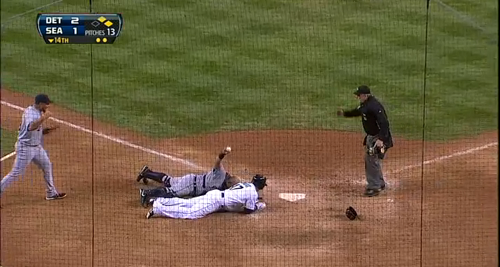
And he left with a no-decision. The team was dealt a loss. There was zero support anywhere in the lineup. The game could’ve been managed better, strategically. Because of Felix, things were always close, and the Mariners were never that far away from a victory. It would take but one simple swing of the bat, and the most loyal of followers stuck around to see if their faith would be rewarded. Because of the Mariners, that swing of the bat was never swung. Other swings of the bat were swung, instead, and the team wasted Felix’s brilliance by plating one run over 42 outs.
Felix gives the Mariners such a high baseline. He always has, at least ever since he blossomed into the ace he is today. The rest of the Mariners just can’t combine to get the team over the top. Some of them disappoint because they screw up. Some of them disappoint because they just aren’t good enough. Almost inevitably, they disappoint, if not to a man, then as a collective. Felix keeps going, perhaps perversely fueled by the challenge, but the outcome’s the same. The outcome’s pre-determined. The Mariners are going to have Felix, and the Mariners are going to fail.
Given Felix’s outing, this was a game the Mariners should’ve won. Of course, from the other side, you could say that given Max Scherzer’s outing, the Tigers should’ve won. And they did, and that’s valid. But fans get to be self-centered, and in fact they almost always are, and this game said so much about the organization in 267 occasionally spellbinding minutes. Here’s Felix. Here’s what the Mariners have. Here are the rest of the Mariners. Here is the intervention by the people in charge of the Mariners. Here’s the familiar outcome we approach every time as if it’s less familiar than it is. There are glimpses of hope, there are sparks, but nothing fully ignites. On the off chance something catches, it rains.
The story of the Mariners is that they’ve had a neat guy and they’ve sucked. Let it not be forgotten that on Felix’s most magical of days, last August, he was given one run of support. He was given the bare minimum, meaning the Mariners came close to wasting perfection. They didn’t, and maybe now that’s the lesson: you can win, Felix, so long as you’re perfect. And Felix takes up the challenge every time, never stopping to look around and see if anyone else has to meet the same impossible standard. A healthy pitcher looks at a game like tonight’s and concludes that there just wasn’t enough support. An unhealthy pitcher looks at a game like tonight’s and wishes he hadn’t given up a run. There’s no way, at this point, that Felix is healthy. Not between the ears, not after what the Mariners have put him through.
I think a good, appropriate team slogan would be Seattle Mariners: Almost. I just can’t tell if it conveys too positive an impression.
Game 16, Tigers at Mariners
King Felix vs. Max Scherzer, 7:10pm
Happy Felix Day.
I’m not sure why, but I’ve been thinking about Dustin Ackley a lot today. Part of it may be that he came up in Dave’s fangraphs chat, and then Jeff went a wrote a post about him below. We’re *all* thinking about Dustin Ackley and wondering when things will change, and, increasingly, IF they’ll change. The M’s are set up to be OK against left-handed pitching, with Mike Morse in the middle, Franklin Gutierrez at the top and even Kelly Shoppach and his career .375 wOBA (better than Morse’s career figure) keeping the pressure on pitchers and away from Jesus Montero who could sit back and mash. Against right-handers, the M’s had Morse again (who’s got essentially no splits), Kendrys Morales (who has huge splits), and the kids: Seager, Saunders and Ackley. The M’s team wOBA is below .300 against both lefties and righties, so it’s not that one side or the other is driving the M’s struggles scoring runs. But I would love to have more faith in the offense tonight than I do, and Ackley’s a big part of that.
Max Scherzer is a fastball/slider/change-up pitcher who throws from a low three-quarters arm angle. With plus velocity, a sharp slider and that low angle, he’s crushed right-handers historically. In his career, he’s held righties to a sub-.300 wOBA, and he’s been even better in recent years. In his breakout 2012 campaign, Scherzer struck out 35% of righties, holding them to a .244 OBP. He’ll throw the occasional mistake, so his HR rate is essentially identical, but he strikes out so many and walks so few right-handers, that the M’s absolutely need their lefties to produce. This is where Ackley should shine – just like in the minors, righties find it nearly impossible to strike him out, but his walk rate against them has tumbled as he’s steadfastly refused to punish them for staying in the zone. Kyle Seager’s done what he can, as all of his doubles have come against righties. Hell, even Shoppach’s done well against them in one of those April-split-oddities. This has been a problem, but it hasn’t become a huge one. If Dustin Ackley can’t drive fastballs from righties, we’ll have one.
King Felix attempts to stop his personal losing streak against what’s probably the best line-up in the AL, but the bullpen should be ready after they used Bobby LaFromboise and Yoervis Medina in high-leverage situations last night. Hopefully Carter Capps, Oliver Perez and, if things go well, Tom Wilhelmsen, will be ready. The M’s went and built themselves a specialist bullpen, with three (3) lefty specialists, but they haven’t really been able to deploy it. They had their sidearm-lefty (well, one of them anyway) pitch to Prince Fielder in a tight spot one inning, then left him in to face Victor Martinez, Jhonny Peralta, Matt Tuiasosopo and Austin Jackson the next inning. Before his demotion, Lucas Luetge’d faced 16 righties and only 5 lefties.
The line-up:
1:
2:
3:
4:
5:
6:
7:
8:
9:
SP: King Felix!
This has been entirely too pessimistic. Today’s game is a brilliant pitching match-up, and it’s Felix day. Baseball often seem designed to stamp out hope, to tantalize and then hide talent, to snip the ligaments you’d been tracking and wishing on for years. As the near-decade of futility casts shadows over every move, every discussion about this team, I find I *need* Felix more. I need to stop wondering about whose seats are hot and why Ackley can’t stop 4-3ing his way out of a job. I need to stop seeing frustration and confusion and something like resignation on the faces of so many faces, from Montero to Wedge. It’s kind of dumb, in that special way sports can be the exactly-right-kind-of-dumb, that an awesome change-up can temporarily push that away, but I’ll take it. I’ll take my optimism where I can find it, and if only Felix is convinced he’s playing for a championship-caliber team, I’ll at least enjoy watching his championship-caliber pitching. Enjoyment is good.
Seems timely to point out Austin Jackson’s strong start and his unbelievable improvement in K rate. See! It’s technically possible to improve, M’s youngsters! If you were worried it was illegal, morally questionable or at least discouraged, it is none of those things.
James Paxton starts in Tacoma against Fresno – game’s at 7pm.
The Jackson Generals lost a tough one today as noted marc w fave’s poor start continued: he blew the save as Mississippi won 3-2. Cuban lefty Roenis Elias was solid for the Generals.
The Second Dustin Ackley Lesson
The first Dustin Ackley lesson, I think, is pretty obvious. Don’t ever take any baseball player for granted. Especially a baseball player who hasn’t yet proven himself in the major leagues. Remember, Ackley wasn’t just supposed to hit — he was going to hit, and there wasn’t any question. His defense, sure, there were questions, but his bat? Ackley could wake up and bat .300 while hitting the snooze button. It wasn’t long ago some people wondered whether the Mariners were better off with Ackley or Stephen Strasburg. People talked about Chase Utley upside. It isn’t that I don’t think Ackley is ever going to hit, or that it looks like his entire big-league career is a bust. It’s that we’ve been rudely introduced to the possibility, which previously very few of us considered, or considered enough. Dustin Ackley might not ever hit. Dustin Ackley might not ever be good. Dustin Ackley might end up with a worse career than Jose Lopez. These aren’t untrue statements. The old guarantees that Ackley would produce — those were untrue statements.
Now we have a second Dustin Ackley lesson. Or, if there have been other Dustin Ackley lessons in between, we have another, unnumbered Dustin Ackley lesson. Not long ago, Dustin Ackley made a change to his swing. Not long before that, Dustin Ackley made a change to his swing. This latest change eliminates some of the parts of that older change, with which he showed up to spring training. Ackley hasn’t fully reverted to the way he hit in 2012, but he’s given up on a tweak, as he just never felt comfortable. The results, most certainly, beared that out.
Here’s Ackley on changing his change:
“What I was doing (Saturday), it felt like the same thing without having to do a bunch of the timing before it,” Ackley said. “It’s still trying to accomplish the same things. It’s really not that big of a difference. It might be 6 inches from where I started before. It’s not like I’m changing my swing. It’s still the same swing, but I just don’t have the timing of getting it started.”
Okay, hey, great. Now here’s Ackley from February, when he came to camp and faced the pitcher in the box, rather than having his shoulders parallel with the plate:
“It just puts me in good hitting position,” he said. “Last year, with the old stance I had, there was no separation, my hands, and everything. I worked on it a lot this offseason just to get that feel of maybe what it used to feel like, as opposed to last year when I didn’t really know what was going on. I think that was important for me this offseason.”
This lesson is less about Dustin Ackley specifically, and more about baseball players in general. Baseball players are constantly changing things around, especially when their performances start to slip. Particularly in spring training, you’ll hear about adjustments that have been made, or that are in the process of being made. If a player under-performed in Year X, the next year he’ll probably talk about tweaks that he hopes will allow him to leave the struggles in the past. The talk will be accompanied by explanations, and it’s the same for both hitters and pitchers.
There are two things that are important to keep in mind, for all players:
- not all attempted changes will be successfully, sustainably implemented
- not all implemented changes will work
The first one has a lot to do with muscle memory. By the time a player gets to the highest levels of professional baseball, he’s put in a lot of reps, many of them doing the exact same things with the exact same motions. Adjusting a swing isn’t as easy as identifying a thing to change and then changing it the next day. Pitching mechanics are even more complicated, and you never know what sort of cascading effect a mechanical tweak might have. If a player doesn’t feel comfortable, he doesn’t feel comfortable. There’s also the case where players are initially receptive, then they revert to familiar motions in higher-stress situations where they’re going on autopilot. A particular case where a lot of us slip up is with pitchers learning new pitches. If a guy is trying a cutter in March, that doesn’t mean a cutter is going to be a part of his repertoire going forward. Learning pitches is hard. Even the cutter, which I think is pretty simple and straightforward.
And then there’s the second one, which we’re reminded of from the Ackley example. Dustin Ackley thought his tweak would work, and that’s why he practiced it and took it into the spring. It didn’t work, because he couldn’t find his timing, and the stance tweak has been abandoned by the middle of April. Every single time a player makes a change, and explains it, he’ll explain it positively, he’ll explain it as a solution. If a player didn’t feel like a given change was a solution, he wouldn’t try to make the change in the first place. Everybody is always initially optimistic about tweaks, but then what we find is that struggling players usually continue to struggle, because they aren’t good. Baseball is a complicated, difficult game, and the difference between a good version of a player and a bad version of a player generally isn’t one little part of his mechanics. And even if you feel like an adjustment is the right thing, you can’t know how it’s going to help until you actually take it into competition. You can only guess, and sometimes people guess wrong. They don’t mean to. Baseball’s just hard.
I think this is one of the reasons people tend to be optimistic about their teams come spring training time. The good players are good players, and the bad players mostly made changes to try to make themselves better players. And you believe in those changes, because everybody who talks about them is positive about them. It’s easy to see how a handful of tweaks could make a handful of under-performers better, and presto, just like that, 81 wins. 90 wins. 100 wins! Amazing baseball team!
Players are almost always changing in some way or another. Most of the time, these changes are very, very small, essentially imperceptible. Sometimes the changes are more dramatic, and sometimes the changes are successfully implemented. Sometimes said changes are effective. Other times they’re not. We have to keep in mind the cases where they’re not. It just isn’t easy to get better.
Game 15, Tigers at Mariners
Aaron Harang vs. Doug Fister, 7:10pm
The newest Mariner faces off today against an ex-Mariner, giving everyone a chance to sigh and wonder what the hell happened with that trade. Casper Wells was DFA’d by the Blue Jays, and Charlie Furbush is a perfectly serviceable lefty bullpen arm, but it’s always tough watching six feet eight inches of walking, talking, hitting-the-blacking evidence of the fallibility of talent evaluation, and how bad we are (bloggers, fans, GMs, analysts, talking heads) at predicting the future. Doug Fister is now throwing a bit slower with the Tigers than he did in any previous April, but it doesn’t really matter – his game was never about velocity. His ground ball rate has continued to climb, and is now solidly over 50%. A big part of this is that he’s all but shelved his four-seam fastball (which he threw almost exclusively when he first came up in 2009) for a two-seam sinker. This started before the trade, but better feel for the pitch has probably helped him. He’s made a lot more use of his curve ball since becoming a Tiger, particularly against right-handed batters, and that may account for his higher strikeout rate.
Aaron Harang is basically a fastball/slider guy, who generates a lot of fly balls. Early in his career, he got enough strikeouts to mitigate the HR problems that came with his pitching style; he put up back to back 5 WAR seasons for the Reds several years ago. But starting in 2008, the small park + fly ball combo was too much, even for his above-average K:BB ratio to overcome. Interestingly, the bulk of his HR problem has come against same-handed hitters. Almost everything in his splits are even – K rate (actually better vs. lefties), average, BABIP, etc. His walk rate’s worse versus lefties, but the big thing that sticks out is his HR rate, which is clearly higher against righties. Why? Well, I have no idea, but he throws four-seamers almost exclusively to righties, and he throws his two-seamer/sinker to lefties. And his HR problems have been worst with his four-seamer. The result is that his HR rate gives him reverse splits by FIP, and perfectly normal splits by xFIP. I’m sure someone’s talked to him about it, but I’d mix in a few more two-seamers to righties. We already know that two-seamers have much larger platoon splits than other kinds of fastball, which makes his usage patters counter-intuitive, to say the least. He’s now in what we’d assume is a good park given his skill set (though not as good as last year), but keep in mind he’s not going to run the kind of K rates he ran in recent years anymore – his K rate against non-pitchers is in the 15.5% range, as opposed to the 16.5-17% marks he posted. That’s not a huge deal, but it could have spillover effects on things like his strand rate. All of that said, it’s tough to complain about his acquisition.
I know many of you are sick to death of sports business/revenue type posts, so I’d advise you not to click on my post about the risk in the ROOT sports deal or Dave’s on the moneymoneymoney the M’s stand to gain.
With Stephen Pryor on the DL with a torn lat muscle, the M’s have brought up Yoervis Medina from AAA Tacoma. He’s gone from a bad starter to something of a joke amongst 40-man roster observers to a quietly effective reliever. Medina throws a hard, heavy fastball in the mid-90s (and you wondered why he was still on the 40-man) and gets a decent number of grounders. I still think Carson Smith is the best pitcher with this basic template in the system, but Medina’s much more ready. I’ll be fascinated to see how he does; he’s been excellent in his very, very brief tenure with Tacoma.
Good to see both Guti and Mike Morse back in the line-up. Here’s hoping they’re able to go at 100%, and that Morse’s pinky injury doesn’t impact his swing.
Line-up!
1: Gutierrez, CF
2: Seager, 3B
3: Morales, DH
4: Morse, RF
5: Ibanez, LF
6: Smoak, 1B
7: Shoppach, C
8: Ackley, 2B
9: Ryan, SS
SP: Harangutan
As Dave mentioned on twitter, that’s Shoppach’s 4th start in 6 games. We’ll see if this pattern continues and if/where the M’s deploy Montero.
Ryan Divish has a good post on Ackley using his off-day to rework his pre-swing routine. Gone is that very open stance as the pitcher goes through his delivery, and he’s back to something similar to last year’s swing.
Ok, something slightly more up-beat: Larry Stone has a great interview with Mike Zunino. I saw Zunino a bit this weekend, so I’ll try to organize some thoughts on him too.
The ROOT Sports Acquisition and Risk
I wanted to follow on Dave’s great post about the RSN acquisition. I’m broadly in agreement with Dave and essentially everyone else that this is almost certainly going to give the M’s a lot more revenue, particularly in the medium term. The overall revenue stream will get bigger, and the M’s will keep more of it. But I haven’t seen a whole lot of discussion about the risk involved, and while I think the upside is more tangible and likely, that doesn’t mean we can ignore the risk completely. As I mentioned in 2012, what we’ve seen in TV deals the past few years bear the hallmarks of a bubble. RSNs are paying skyrocketing rates for the rights to televise baseball games even as fewer people are watching baseball. They’ve had free rein to push for higher and higher carriage fees with cable carriers (Comcast, DirecTV, DISH Network, Time-Warner, etc.) and consumers have, in general, paid up. Part of the calculus here is that live sports are an effective antidote to DVR technology, meaning advertisers will reach more eyeballs than they would with a highly rated drama series, where many people DVR the show and skip the ads when they play it back. In addition, many of the RSNs get better ratings than national titans like ESPN, which makes sense if there’s a game on the RSN and yet another SportsCenter on ESPN.
But what happens when carriers start to balk about the spiraling carriage fees? This isn’t a theoretical problem. Last year, the Houston Astros and Rockets created their own RSN, Comcast SportsNet Houston, in a billion dollar deal. This would supposedly transform the Astros revenue, as they had the worst TV ratings in baseball in recent years (for obvious reasons) and a poor deal with Fox Sports Houston. The problem is, cable operators in Houston have been holding out, and thus DirectTV, DISH Network, and Time-Warner cable don’t carry the network. Again, the brand new network that has the rights to the Astros, the Houston Rockets (who are in the NBA Playoffs this year!), Rice and University of Houston football, *is not available on most carriers in Houston*. The same thing’s going on to a lesser extent in San Diego, where Time-Warner’s balked at the new Fox Sports San Diego’s carriage fee demands after the latter acquired the rights to the Padres games (and gave the Pads a 20% equity stake as well). Local government officials are involved in both Houston and San Diego, trying to help broker a deal.
So Comcast and DirecTV have battled tooth and nail in Houston, with rival campaigns and websites. Now, DirecTV has a stake in ROOT sports, and while Comcast already carries the network, I can imagine that negotiations when the current agreement is over will be, um, intense. Operators are trying to stave off customers cutting the cord and moving to netflix/roku type devices, and at the same time offer advertisers the kind of un-DVR-able programming that live sports provides. It’s making all negotiations a lot more contentious, as many of you saw in Tacoma when city-owned operator Click Network stopped carrying local ABC affiliate KOMO when negotiations hit a wall. That’s led to lawsuits and a fascinating* lawsuit involving whether these rates are protected trade secrets. Similar disputes are happening elsewhere, as the industry’s still adjusting to new technology, deregulation in the 1990s and increased costs.
In an ideal world, the new ROOT Sports comes to some sort of agreement with a new NBA team and a potential NHL team that would give them a lot more leverage than the M’s could on their own (“Seriously! We have prospects! Good ones! Stay tuned!”). Unfortunately, the M’s may not be on Chris Hansen’s christmas card list after their objections to his SODO arena proposal. They’re talking, though not about the network, and after an awkward start, the M’s have said all of the right things about their potential new neighbors recently. And in any event, Comcast may want to partner with a new team to give them leverage in any possible fight with DirecTV. Of course, the Houston experience shows that even if one company acquired the rights to all of the local teams, that wouldn’t necessarily be a guarantee that they could extract the fees they expect from cable providers. A balkanized TV sports world hurts everyone, especially consumers; I’d guess that the overlap between basketball fans and baseball fans is pretty substantial. I also know that ROOT will work hard to come to a deal with Comcast, and they may get one lasting several years. All of these risks are down the road and speculative. But the parallels to the housing market circa 2006 are starting to get eerie. The M’s made a completely logical decision to do what other teams have done and purchase their own cash cow. One that will pay them 2X or 3X more than what they got in 2007! Everyone’s doing it, you know. With values tripling within a few years, why, you can’t afford NOT to. People will *always* tolerate sizable annual rate increases.
* if you’re really geeky and also bored