
Game 23, Mariners at Blue Jays
The rubber match of this series in Toronto features a moderately interesting pitching match-up as Jason Vargas squares off against Henderson Alvarez. The hard-throwing righty faced the M’s in his 2nd MLB start last year and much of what I said then still applies. There are some out there who think he could take a step forward and become something approaching an ace – velocity that touched 97mph and a lot of ground balls tends to inspire rosy projections. But he’s still not missing many bats, and despite the flurry of worm-burners, he’s yielded 5 homers in 23 innings so far.
Jason Vargas is an almost perfect inverse of Alvarez – lefty, instead of righty. Fly-baller instead of GB guy. Tops out around 88 and often works slower than that. If only Vargas got more whiffs….
With the day game after an afternoon game after a night game, the M’s are actually starting John Jaso. This doesn’t mean Olivo gets a day off, however. The M’s have their lefty-heavy line-up in, minus Justin Smoak who’s apparently getting a “mental” day off. This means Alex Liddi gets his first start in the clean-up spot, right-handed starting pitcher be damned.
1: Figgins (LF)
2: Ackley (2B)
3: Ichiro (RF)
4: Liddi (!) (1B)
5: Seager (3B)
6: Saunders (CF)
7: Olivo (C)
8: Jaso (DH)
9: Kawasaki (SS)
SP: Jason Vargas
Game time is 10:07am
The other news of the morning is that George Sherrill’s likely done for the year, as he’s slated to have elbow surgery soon. This isn’t a huge surprise, but I feel bad for Sherrill, who’s always been one of my favorites. With Lucas Luetge’s solid start, the M’s aren’t likely to suffer from Sherrill’s absence, but it’s never good to see an injury like this.
Game 22, Mariners at Blue Jays
Morrow vs. Millwood, 1:07 pm
Probably the only thing that I don’t like about baseball’s rigorous schedule is that we don’t get much time to sit around and marvel over how awesome last night’s performance was. We only got seventeen hours or so and then it’s on to more baseball which does not carry with it the promise of similar fulfillment. Baseball, you are such a chore. I have things I should probably be doing and you won’t let up. And day games? Where do you get off? I bet Wedge won’t even let us see Jaso tomorrow.
LF Figgins
2B Ackley
RF Ichiro!
1B Smoak
3B Seager
DH Montero
CF Saunders
C Olivo
SS Ryan
Pineda: Pinstripes Passive-aggressively Pissed in Press
The Yankees believe the Mariners screwed them in the Pineda deal, or, at the very least, they suspect it and want everyone to know. I would be extremely surprised to see future trades between the teams with the same people on the phone.
I’m going to quote a lot from one Espn article, because you’ll see how the Yankee story and their approach is coming together a week later.
“This is a massive decision gone wrong right now,” Cashman told ESPNNewYork.com on Friday. “So all scrutiny is fair.”
Gone wrong? Why put it like this? If trading for Pineda was the correct decision, knowing the health risks of pitchers, then the outcome is bad, but the decision would still be good.
All scrutiny is fair? That’s certainly generous, as Cashman endures a level of criticism that would make normal people break down weep in moments, much driven by professional rabble-rousing figures of the New York sports press who compete outrage-trolling for audiences. Not all scrutiny is fair.
As a whole comment, though, Cashman’s comment leads towards the “all scrutiny is fair” where the assumptions underlying the deal should be looked at. Like whether Pineda was damaged goods.
“Right now, our hopes and dreams for this player are in jeopardy,” Cashman said of Pineda. “Hopefully, someday, our fans will get to see what we expected to see from him for many years to come.”
This also seems weird to me – that now they’re hoping fans will get to see what the Yankees expected. Not what the Yankees hoped. And I understand here there’s a little “we wouldn’t have traded for him if we didn’t expect greatness”.
All of this plays in front of the larger rumor mill, too, and so the Yankees win this semi-absolution:
Cashman has asserted the Yankees had subjected Pineda to an MRI before the trade became official, but doubts linger whether the Mariners and their GM, Jack Zduriencik, knew the 23-year-old right-hander was damaged goods when the Yankees made the deal.
“How can you not ask a question like that?” Cashman said. “It’s a fair question, but I can tell you we did everything possible to be sure Michael Pineda was healthy.”
See, he’s not saying they weren’t sold damaged goods. He even says that’s a good question. What he wants to tell you, though, is the Yankees tried to guard against that. And if they did their due dilligence, either they screwed up, it was unforeseeable, or something really nefarious went on.
To answer his question, though: you wouldn’t ask that question if you were entirely sure that the other side was totally honest and forthright, and you’d done such thorough examinations that you were as sure as you could possibly be that he was healthy when he came over. And given the detail Cashman’s about to describe, you soon wonder why he’d think anything but “how did he get injured so quickly after joining totally healthy?” would be a waste of time.
Cashman said Pineda passed his Yankees physical within 72 hours of the deal having been agreed upon, a physical that included an MRI.
As he had on Wednesday, Cashman absolved the Mariners and Zduriencik of any blame in the matter.
“The focus should be on me and the New York Yankees, not the Seattle Mariners,” he said. “I’m responsible. I’m the decision-maker.”
Is that absolution? That he, Cashman, made the decision? This almost reads like “it’s my fault, I should have known that an Omega watch at that price on Craigslist was likely to be stolen, and then, sure, when I saw there was still blood on it, that should have tipped me off, but yes, I made the decision, and I intend to cooperate with authorities.”
Then there’s this odd bit:
“I asked him several times through an interpreter if he had ever been in an MRI tube at Seattle,” Cashman said. “Each time, the answer was the same.
“Nunca.”
Never.
Why is Cashman calling out that he asked Pineda repeatedly if he’d been in the tube while with Seattle? That might be a standard question, just a normal double-check, but Cashman asked several times. Why? Is he emphasizing how little he believed the M’s medical records or assurances? Why make the point that Pineda’s repeated response was never?
Then, on the call to Hal Steinbrenner:
Cashman (…) said he could not tell if Steinbrenner also wondered if the Yankees had traded for an injured pitcher.
“He just listened,” Cashman said. “He was obviously disappointed, but if he has the same kind of questions, I couldn’t tell.”
Probably, though. I mean why wouldn’t he? I just said i’s a fair question and How could you not ask a question like that?
At the least, the Yankees are using their skill with the media to keep the rumors going so their fan base puts some portion of the blame on others. And more likely, they’re really pissed about this and trying to be civil while making their displeasure clear to anyone paying attention.
Game 21, Mariners at Blue Jays
Blake Beavan faces off against Ricky Romero and the Jays today at 4:07, the first of a three game series at the Rogers Centre. Coming into the season, we knew Beavan had plus control, but wondered how far his walk rate might regress. So far, he’s doubled down on being a pitch to contact guy, with a walk rate that’s actually under 3%, a K rate that’s under 10% and a ton of fly balls. Beavan’s curve’s looked better this year, though he’ll have to be careful in a domed stadium that plays HR-friendly.
Ricky Romero’s a lefty, so Wedge trots out the standard righty-heavy line-up. This means Alex Liddi’s in again and Kyle Seager sits until tomorrow. The “versus lefties” line-up hasn’t been bad, per se – they’ve got a better wOBA vs southpaws than righties – but they’re prone to K’s. Facing a guy with a great change-up, the M’s might swing and miss liberally, but a HR or two would help. The Blue Jays currently have the best team defensive efficiency in baseball, at 76%. The M’s just swept one of the most defensively-challenged squads in baseball and now face what may be the best defense around. All the more reason to take defense out of the equation and put a ball in the seats.
The big news of the afternoon is that Franklin Gutierrez has been diagnosed with plantar fasciitis. I swear he and Adam Moore are having some bizarre sort of competition. Chagas’ disease is unclaimed, guys.
The line-up:
1: Ackley (2B)
2: Ryan (SS)
3: Ichiro (RF)
4: Smoak (1B)
5: Montero (DH)
6: Liddi (3B)
7: Saunders (CF)
8: Olivo (C)
9: Wells (LF)
SP: Beavan
Go M’s!
Luetge and Leverage
This morning’s game in Detroit featured an appearance by the M’s 2011 Rule 5 Draft pick, Lucas Luetge. And not just typical mop-up duty – Luetge came in with the tying run in scoring position and one out in the 7th. As if that weren’t enough, Miguel Olivo upped the ante by allowing the runner to move to 3rd. This isn’t a spot I figured we’d see Luetge, even if Charlie Furbush had already pitched. I suppose I’m too used to Luis Ugueto and Sean White so the idea that the M’s might treat this year’s Rule 5 kid as a full-fledged member of the pen and not just the designated garbage-timer caught me by surprise. de
Fangraphs and Baseball-Reference both track the average leverage of every appearance by a pitcher. This measures how important the situation (or group of situations) is; essentially, it uses Win Probability to show which plate appearances or situations most affect the outcome of a game. Given the nature of the beast, the later in a game, the higher the leverage. The closer the score, the higher the leverage. This is one of the handy statistics that essentially gives a number to something that any casual fan can see; this is operationalizing common sense. We know that a reliever getting out of a bases-loaded, 1 out jam in the 7th inning of a tie game has done more for his team than a pitcher who comes in with a three run lead to start the 9th, but everyone loves saves, and teams still pay handsomely to those who’ve racked them up.
Today’s appearance by Luetge came in at 3.42, compared to an average of 1.0. As you’d expect, this was considerably more tense than most relief appearances, and certainly more tense than anything Luetge’d faced before. For reference, his appearance in yesterday’s blowout registered a 0.03, and his first major league win (in Texas) came in at just 0.29. He’d had two higher leverage, late-inning appearances, but nothing on this level (both were below 2.0). This got me to wondering which Rule 5 picks had faced situations like this before; which guys were entrusted with crucial plate appearances instead of being saved for blowouts. I decided to look at the highest pLI (the average leverage index of each plate appearance in a pitcher’s outing) for all Rule 5 pitchers since 2000. This is somewhat tricky, as I don’t have a PBP database, and I’m not sure how to flag Rule 5 guys if I had one. So I’ve tried to do this manually, which is why I stopped relatively recently, and why I may have missed someone who may have been pressed into duty in a 16 inning game and who I’ve unfairly overlooked. If you find some, let me know. If you know of others from the 80s/90s, say so.
From what I can see, Luetge’s 3.42 ranks a mere 20th in the highest leverage appearances for Rule 5 pitchers since 2000. That’s pretty surprising to me, actually, and I can’t even blame it on a peculiar Mariner penchant for keeping Rule 5 guys in the back of the pen: it’s not the highest LI for a MARINER Rule 5 guy since 2000. When I mentioned my question about Rule 5 pitchers and high-leverage appearances on twitter, Kenny Ocker immediately came up with Joakim Soria, who became the Royals closer in his Rule 5 year in 2007. Indeed, Soria’s high of 4.8 came in a save situation in May – a save that Soria blew. That’s easily higher than Luetge’s, but it’s not as high as Aquilino Lopez’s 5.91 in May of 2003. Lopez was a Rule 5 pick by the Blue Jays from the Mariners, and you may remember Lopez from his great 2002 season with Tacoma. Lopez had a great 2003, and actually racked up 1.1 WAR with a sub-4.0 FIP for the Jays, but never recaptured that form again. On August 8th, he entered a game against the Rangers with 1 out in the 9th with a 5-3 lead, the bases loaded. A strikeout and a groundout later, he had himself a save and the second-highest leverage appearance for a recent Rule 5er.
The top spot belongs to another Royal, Sammamish, WA. product Andy Sisco. Perhaps it’s not surprising that a team that would give the closer job to a Rule 5 guy a year later would entrust Sisco with so many high leverage appearances, but Sisco had 3 3.0+ LIs by the the time April was out, and it was barely May when he entered a 1-0 game against the White Sox with two on and one out in the 8th. He got a groundout that moved up the runners, then walked the bases loaded….and then walked in the tying run. He was pulled, and the next reliever walked in the go-ahead run and a Zach Greinke gem turned into a very Royals loss (every M’s fan shakes their head knowingly). The pLI for that appearance? 6.34.
I mentioned earlier that Luetge’s escape wasn’t even the highest leverage appearance for a Mariner Rule 5 reliever. I’d completely blanked this, but just ahead of Luetge in 19th spot sits Kanekoa Texeira who put up a 3.51 pLI in his very first appearance in an M’s uniform. Texeira got the loss in a 2-1 defeat to Oakland on April 6th, 2010. He was the 4th pitcher for the M’s, and the game went to extras, so the M’s didn’t have a whole lot of choice, I suppose. He came in to start the 9th in a 1-1 game and escaped trouble after allowing a single and a double. The A’s got to him in the 10th, however, with three singles – the last of which was a Mark Ellis walk-off. I think what makes this particular game so hard to remember is the fact that the M’s starter – the guy who gave up 1 run in 6 solid innings – was Ian Snell. I’m sure I watched this game, and I’m looking at the box score which I don’t think’s been altered, but I literally can’t imagine an Ian Snell start so efficient and effective. When I think of Ian Snell, he’s looking hard-done-by and handing the ball to the manager. I know he had talent and I remember watching his first Seattle appearance excitedly (it was after a USSM event at Safeco, I think), but I simply don’t remember anything good coming from his time in this organization. I seriously have trouble imagining him getting a routine fly ball. This is my problem, not yours, and I’ve already sullied a rather focused piece with this nonsense. I’m sorry.
Let’s wrap up with a couple of leaderboards. First, here’s the top 5 (that I found) leverage appearances for Rule 5 pitchers since 2000:
1: Andy Sisco, 5/5/05 – 6.34
2: Aquilino Lopes, 8/2/03 – 5.91
3: Joakim Soria, 5/20/07 – 4.80
4: DJ Carrasco, 4/30/03 – 4.67
5: Jay Marshall, 5/15/07 – 4.49
And here’s the highest average LI over the course of the season for Rule 5 relievers- here’s who was trusted in key spots consistently, as opposed to pitching solely in blowouts:
1: Joakim Soria, 2007 – 1.64
2: Andy Sisco, 2005 – 1.29
3: Aquilino Lopez, 2003, 1.24
4: Pedro Beato, 2011, 1.23
5: DJ Carrasco, 2003, 1.15
2003 really was a great year for Rule 5 pitchers. Lopez had the biggest year, but two Rule 5 pitchers are still (somewhat) active – Carrasco’s on a rehab assignment in the Mets system and Javier Lopez is a key member of the San Francisco Giants bullpen. What about the most famous Rule 5 pitcher of his generation, Johan Santana? Well, Santana was used pretty much the way I expected most would be used – he got garbage time relief appearances before making a couple of starts late in the year. Starts generally have lower LI, so Santana ends up with a very low average LI and a very low high pLI game. The average high pLI game was 3.22, and the average season gmLI was 0.77.
Seriously, Ian Snell? 6IP, 1R, 4H? Really? This really happened?
Game 20, Mariners at Tigers
Noesi vs Porcello, 10:05 am.
After hitting home runs in each of the team’s first two games in Detroit, you had to be pretty certain that Alex Liddi was going to find himself in the line-up once again. And, so, Kyle Seager gets another day off, with Liddi getting the start at third base again. I know there’s going to be some outcry about both Olivo and Figgins getting playing time while Seager sits – and trust me, I’d rather see Seager in there too – but the reality is that, for one game, it’s not a huge deal. For all the talk about Kyle Seager’s “strong start”, he’s not really doing any better than he did last year, producing at a slightly below average rate. He’s gotten even more aggressive, swinging at 52% of the pitches he’s been thrown, and as a result, he’s drawn just one walk in 61 plate appearances. For a low-power guy, that’s not good, and the Seager’s absence from the line-up isn’t going to cripple the team’s offense today.
Seager sitting while Figgins plays isn’t going to be a regular occurrence. When asked about Figgins this morning, Wedge said this:
“We’re still giving Figgins an opportunity, but he has to do it, simple as that. I mean, if he does, we’ll keep him in there. If not, we’ll make a change.”
Mike Carp’s lingering injury and struggles on his rehab assignment bought him a little bit of extra time, but the leash on Figgins is tightening, and the batting order excuse is out the window now. If Liddi keeps swinging the bat well, Figgins will find himself on the bench sooner than later. Even when Liddi cools off, Carp’s return is going to force someone out of the line-up more often, and right now, Figgins is the guy on the chopping block. He probably has a few days left to get hot and save his job, but he’s clearly on the chopping block.
Figgins, LF
Ackley, 2B
Ichiro, RF
Smoak, 1B
Montero, DH
Liddi, 3B
Saunders, CF
Olivo, C
Ryan, SS
Game 19, Mariners at Tigers
Hernandez vs Wilk, 4:05 pm.
Happy Felix Day!
With a lefty on the mound, the M’s run out a slightly altered version of their RHB-heavy line-up. Chone Figgins isn’t getting the start in center, as he has against some LHPs, and Michael Saunders is instead rewarded for his success yesterday with a start against a southpaw. As we assumed, Ackley would move up to leadoff when Figgins isn’t in the line-up – once he goes away for good, this is probably Ackley’s spot permanently.
Also, Montero’s behind the plate for the first time when Noesi or Millwood isn’t pitching, so this is new. Olivo’s still DH’ing, but the team doesn’t have many better options against an LHP – the guys on the bench are Seager, Jaso, Figgins, and Kawasaki, and against an LHP, there aren’t any legit DH options there. I don’t like Olivo playing regularly either, but when a southpaw is on the mound, there’s no point in complaining about him being in the line-up. There aren’t any better options.
Probably the weirdest part of the line-up, though, is Casper Wells hitting ninth. Wedge did this with Jaso too – it’s like he believes that every starter is a better hitter than every bench guy, so when they play, they hit last. It’s pretty weird, but whatever, batting order isn’t that big of a deal.
Oh, and the Yankees announced today that Michael Pineda has a torn labrum. It’s obviously terrible news for him, but this is why you build around bats and not arms.
Ackley, 2B
Ryan, SS
Ichiro, LF
Smoak, 1B
Montero, C
Liddi, 3B
Olivo, DH
Saunders, CF
Wells, LF
Game 18, Mariners at Tigers
Vargas vs Scherzer, 4:05 pm.
Well, apparently, Justin Smoak won’t be trying to solve his contact issues today, as he’s getting the day off to rest up his hamstring. Performance issues aside, Smoak has been dealing with one kind of nagging injury or another for most of his Mariner career. Whether that is a mitigating circumstance for his poor performance or just means that the guy has durability issues, I’ll leave up to you to decide.
In Smoak’s place, Alex Liddi gets his first start against a right-hander. Also, Munenori Kawasaki gets the start at shortstop in place of Brendan Ryan. We haven’t heard anything about Ryan being hurt, but he’s probably not a guy you want to run out there for 150 games a year, so giving him a day off against a right-hander isn’t the worst idea ever.
Figgins, LF
Ackley, 2B
Ichiro, RF
Montero, DH
Seager, 3B
Liddi, 1B
Saunders, CF
Olivo, C
Kawasaki, SS
The Thing Justin Smoak Has To Fix
Since it’s an off day, and Jeff decided to write about Jesus Montero, I figured I should tackle Justin Smoak. After all, heading into this season, he was really the make or break guy on offense. We’re pretty confident that Dustin Ackley is going to develop into a good player. We think Jesus Montero might, but we were pretty sure that he was going to have some struggles this year and probably wasn’t ready to be a major offensive force. If this offense was going to take a big step forward this year, though, it was probably going to be because Justin Smoak finally started to hit like the guy he was expected to be.
Instead of taking a step forward, he’s actually showing signs of going the wrong way. He’s hitting just .203/.242/.322, hasn’t shown any real signs of improving his weaknesses, and has stopped drawing walks as well. It’s only 62 plate appearances, and you shouldn’t read too much into any kind of early season performance, but Smoak’s the guy with the most to prove this year, and right now, he’s not proving to anyone that his previous struggles were a thing of the past.
In fact, Smoak hasn’t made any noticeable adjustments at the plate that I have been able to pick up on. Throughout his big league career, he’s essentially had one serious flaw; he doesn’t make nearly enough contact for a guy with average power. The walks and doubles first baseman can be a good player, but they generally have to compensate for their lack of home runs by hitting for a high average, and the only way for a slow guy with moderate power to keep his average up is to make an awful lot of contact. Smoak has always struggled to make enough contact to make this skillset work, and he’s been even worse than usual through the season’s first couple of weeks.
In his brief debut in 2010, Smoak made contact 77.6% of the time he swung the bat. Last year, that fell to 75.4%. This year, that’s down to 71.3%. You can be a good hitter with a contact rate that low (Josh Hamilton also has a 71.3% contact rate this year, for instance), but you better be able to hit the ball really, really far when you do make contact. Smoak just doesn’t have that kind of thump, so he needs to put the bat on the ball more often in order to be useful. He probably needs to be more in the 80-85% range in order to make his skillset work.
Of course, it’s not just as simple as to tell Smoak to stop swinging and missing so often. If it was simply a directive that he could follow, this would be easy to fix. The low contact rate, though, is a symptom of the problem – the real issue is that he simply hasn’t learned how to hit anything that isn’t a fastball.
Thanks to the magic of Pitch F/x data and the tools available from TexasLeaguers.com, we can look at how Smoak is faring against all different types of pitches. The classification system isn’t great at distinguishing between fastball types (four seam, two seam, cutter, etc…), but is generally pretty solid at identifying whether a pitch is a fastball, a slider, a curve, or a change. For this exercise, I’ve combined all the fastball types into one category. Here’s how Smoak is doing versus the four main pitch types:
| Type | Count | Frequency | Strike | Swing | Whiff | Foul | In Play |
|---|---|---|---|---|---|---|---|
| FA | 102 | 52% | 63% | 42% | 3% | 17% | 23% |
| SL | 33 | 17% | 64% | 39% | 24% | 9% | 6% |
| CH | 32 | 16% | 63% | 41% | 16% | 3% | 22% |
| CU | 29 | 15% | 62% | 38% | 24% | 7% | 7% |
Smoak has been thrown about a 50-50 mix of fastballs and off-speed stuff, and there’s not a ton of variance in how often he swings at them. But look at those whiff rates – 3% against fastballs, 16% against change-ups, and 24% each on sliders and curves. If you throw Smoak a fastball, he’s almost certainly going to hit it (though he also has a good chance of hitting it foul), but if you toss something soft up there, you stand a really good chance of having him swing right through it.
I mean, look at the slider break down. He’s seen 33 of them and put two of them in play. If you click through to the link, look at the two charts for pitch locations on swings versus takes – he’s swung at every low-but-down-the-middle slider he’s seen this year. He’s managed to lay off a lot of the ones down-and-in and several of the down-and-away sliders, but if you throw it over the plate but low, he’s chasing it. And he can’t hit that pitch.
It’s even worse with change-ups. Here’s the plot of change-ups he’s swung at so far this year.
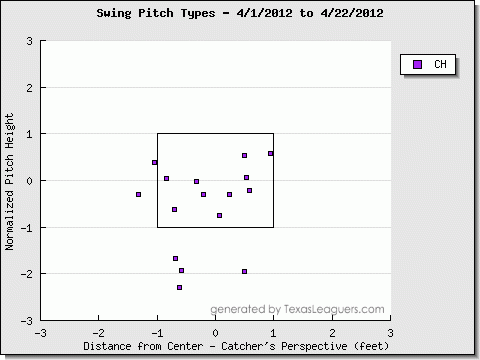
Four times, a pitcher has thrown a change-up low enough to nearly hit the ground and Smoak has swung anyway. He did manage to lay off a low change-up once, so I guess we’ll give him credit for that, but this is still an area where he regularly swings at pitches he has no chance of touching.
Now, compare that to the chart of four seam fastballs he’s swung at this year.
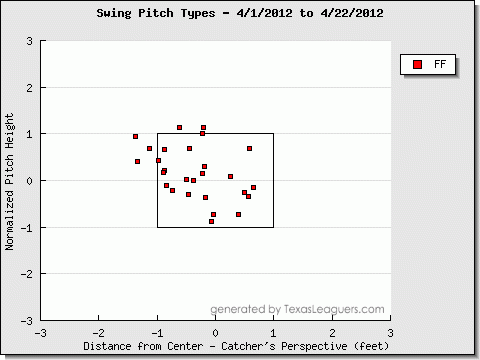
It’s hard to believe this is the same guy – when a pitcher has thrown him a four seam fastball and he’s chosen to swing, it has almost always been in the strike zone. He’s not just passively staring at strikes, either, as he’s swung at a great majority of the four seam fastballs that have been thrown in the strike zone. And remember, he’s only swung and missed at two of the 55 four-seam fastballs (as categorized by Pitch F/x, anyway) he’s seen this year.
Against the fastball, Smoak has been able to correctly identify whether the pitch is a ball or strike, recognize whether or not he should swing, and almost always put the bat on the ball when he does. Against non-fastballs, though, Smoak is as lost as an eight-year-old. If you want to get him out, you just throw something over the plate but breaking down and out of the zone, and odds are good that he’s going to swing right over the top of it.
This kind of problem is generally referred to as plate discipline, but in this case, I wouldn’t be surprised at all if it was more pitch recognition. Smoak doesn’t have the kind of swing-at-anything approach that suggests that he just doesn’t understand that getting into good hitters counts is the best way to get pitches to drive, but he simply seems unable to recognize that certain pitches that start off in the strike zone aren’t going to stay there after he starts to swing at them.
If I knew how to fix this, I’d be a Major League hitting coach and I’d make a lot of money. For all we know, it might not even be fixable. But if Smoak is ever going to turn into the hitter the Mariners are hoping for, they’re going to have to figure out how to mitigate his weaknesses against off-speed pitches down and out of the zone, because right now, he’s seeing a steady diet of sliders and change-ups down at his feet and he just can’t do anything with them. The easy answer is to stop swinging at those pitches, but the solution is almost certainly more complicated than that. The Mariners just have to hope they can figure out what it is and get Smoak to implement the changes. Right now, this version is just too easy to pitch to.
Minor League Wrap (4/16-22/12)
In the second wrap of the season, I still don’t know what to say for intros aside from thank you all for being active participants last time around. I’m trying to remember how best to go about writing these things. For now, the status quo from last week remains the same: two of the teams are awesome (it’s the middle two), two of the teams are really struggling, but Clinton is actually pitching really well. High Desert, bless their little hearts, they try.
To the jump!
Read more