
Matsuzaka’s posting request denied
We’d been hearing rumors about this, and from Kyodo News via JapanBall.com, here’s the confirmation: the Seibu Lions have denied Daisuke Matsuzaka’s request that the team post him. The posting system is the only way he’d be able to come to the major leagues this year.
Team representative Akira Kuroiwa said he told Matsuzaka that
the 25-year-old is a ”symbol” of the Seibu group and should
continue as an important member of the Lions next season, although
his wish to put himself in a more challenging situation is
understandable … [snip]After the 2004 season, Seibu suggested it would give Matsuzaka a
chance to ply his trade in the majors through the posting system on
condition that he perform well enough to make his case this year.This year, Matsuzaka was 14-13 with a 2.30 ERA, third in the
Pacific League, in 28 games. He led the league with 226 strikeouts,
15 complete games, three shutouts and 215 innings pitched.The numbers, which came one year after Matsuzaka posted a 10-6
record with a 2.90 ERA and 127 strikeouts, apparently failed to
convince Seibu front-office officials.
There appears to be an air of finality about this, although Matsuzaka says he’s going to keep trying to persuade them. Under the current situation, he wouldn’t be eligible for free agency before 2008.
Two immediate impacts here. First, top free agent pitchers like A.J. Burnett and Kevin Millwood just got more expensive due to scarcity. Second, this is a real disappointment from a major league fan’s perspective, since one of the most enticing players won’t get the chance to ply his trade in the states this year.
Frankly, I’m happy for Japanese fans that they’re not losing a talent like Matsuzaka. I don’t want to see the Japanese leagues become a de facto feeder system. But I’m bummed that I won’t get to see the gyroball in Safeco Field next year.
Chaves and Pentland hired
The M’s today announced the hiring of Jeff Pentland as hitting coach, as expected.
However, they threw everyone a curveball when they announced the hiring of Rafael Chaves as pitching coach. Most rumors had him being a long shot, but the M’s stayed in house and hired the well respected candidate who guided the Tacoma Rainiers staff in 2005.
The Best and Worst Things About the White Sox Sweep
With the ouster of the Astros — who went out with T.S. Eliot’s whimper rather than a bang — we can drop the curtain on this year. So it wasn’t exactly an epic battle. Say this about the World Series: no one was seriously injured, unless you count Roger Clemens, and who does?
Time to turn the page. To help with this endeavor, I’ve compiled a list of the five best and worst things about the World Series being over.
Best Things:
No more national exposure for that infernal buzzing whenever one of the “Killer B’s” comes to the plate. This means the end of the most annoying noise in sports (non-Tim McCarver division). I can’t believe more hasn’t been made of this. Whose idea was it to use what sounds like the soundtrack to a terrible 80s B horror movie as a point of inspiration? Is this the reason they were stingless? Give me a zillion Day-Os before I ever hear that again.
The hot stove fires itself up. Mariner fans have had a jump on more fortunate affinity groups, the ones preoccupied with their playoff-bound squads, but now the whole musical chairs process begins in earnest. Who should end up where? Who will? For those of us fascinated by roster construction, it’s a wonderful time of the year.
Televisions at my friendly neighborhood watering hole and gym are now safe. There was prior risk that I, or a like-minded Bellinghamster, might throw something heavy at Scooter, or react with similar rage to those brutal anti-steroid PSAs. Technology is exempted from this wrath, for the time being, thanks to the end of the World Series.
For those of us whose teams played like sick nuns in 2005, now is also when the kernel of hope cracks open. The calendar changes, and hopefully, fortunes do, too.
Finally, Ozzie Guillen might just retire now. I doubt he will, but it would be a fitting end to a wacky career.
Worst Things:
The inevitable “and they clinched with Freddy Garcia as the winning pitcher!” woe-is-me-isms from Seattle columnists and sports radio callers. We love our retrospectives, especially when they involve the saddest words of tongue and pen. Please, please, please, let’s just let this one go.
Behold the vaunting of the small ball, the clutch hitter and the stolen base. In the time it took me to drive to work this morning, my radio told me that the White Sox won because they always bunt runners over, never fail to get the timely hit, and play aggressively on the basepaths. Now, every baseball team is going to want to build a club in this mistaken image. (Wait, poor strategy is a gift when employed by one’s rivals — maybe that should be under “best things.”)
Piling on the Cub fans just got turned up to eleven. Thrilled as we have to be for the Pale Hose faithful, a dozen knives are about to be repeatedly stuck between the North Side’s collective ribs. Everyone in America knows it’s been nearly 100 years. Soon, deaf mutes in the Andes will know, too.
Unfortunate and unfair labels affixed to exceptional players. Mercifully, rumblings about Brad Lidge have been muted by other factors. But the first time he blows a save next year, expect to hear the names Albert Pujols, Scott Podsednik and Jermaine Dye. Remember when Mariano Rivera blew two saves against Boston in April, and he was supposed to be done? Everybody fails. April’s a great time to do it; October’s not.
Finally, the worst thing about the World Series coming to a close: the end of the 2005 baseball season. ‘Nuff said, true believer.
Relief Aces
After an extended break, I finally have some time to tackle another part of our 2006 roster reshaping suggestions. So far, you’ve seen the cases for Jacque Jones, Kevin Brown, Kenji Jojima, and the Millwood vs Burnett discussion.
Today, rather than isolating a single player, we look at the bullpen. With the rotation bound to be full of questions, the relievers are a key to the Mariners success, or lack thereof, in 2006.
The main question is what to do with Eddie Guardado. The team holds an option to bring him back for $6.25 million, and if they decline that, then Guardado has the option to guarantee himself $4.25 million. If both sides decline their options, Guardado hits the free agent market. We gave you guys a thread on this subject already, and the overwhelming response was that everyone wants to see Guardado gone. I’m not nearly as worried by his late season swoon as everyone else, but given the current makeup of the Mariners roster, I also think it would be in the team’s best interest to spend the Guardado money on filling other needs.
People may not have noticed, consdering that the team was terrible, but the Mariners bullpen is actually quite good.
George Sherrill is, quietly, one of the better left-handed relief pitchers in the game. In 19 innings with the club in 2005, he struck out nearly 31 percent of the batters he faced. That’s phenomenal. The past two years, he has established himself as a consistent performer ready for an expanded role.
Rafael Soriano has an obviously electric arm. Before blowing out his elbow in 2003, he was the best reliever in the American League. His performances this season, while rehabbing, are exactly in line with how dominant he was before surgery. There should be little doubt about how well Soriano will pitch when he takes the mound in 2006. The questions are simply about how durable he will be.
J.J. Putz, while appearing prone to give up home runs at bad times, is a solid middle reliever whose ability to induce huge numbers of ground balls makes him a valuable commodity, especially in stranding runners. He lacks the secondary pitches to be an elite talent, but as a middle reliever, he’s above average.
Those three, alone, give the M’s a solid late inning relief corps. You could win the World Series with those three as your relievers in October. However, the strength of the team’s bullpen is not only the late inning guys, but the remarkable depth the organization has to choose from to fill out the pen.
Julio Mateo, while effective again last year, has been in decline for the past several seasons. He cannot hold runners on and is best suited for long relief, where his ability to pound the strikezone allows him to soak up several innings at a time. As a fourth reliever making little money, he has value, even though there is almost no chance he’ll ever be more than what he currently is.
Scott Atchison is the forgotten man, also missing most of the season rehabbing from an arm injury, though he did not require surgery. By the time he got back to Seattle, he showed the same ability to miss bats he displayed in 2004. His stuff isn’t overwhelming, but he’s eerily reminiscent to Angels setup ace Scot Shields.
Clint Nageotte, for all his command problems in Tacoma, still managed to keep runs of the board by combining the strikeouts-and-groundballs tandem that is death to hitters. While many are ready to write him off as a right-handed Matt Thornton, there’s still potential here.
That’s a six man bullpen that, at worst, is probably league average, and has significant upside. But with inexperienced players, there’s always risk. The best way to manage risk? Have options. And when it comes to the bullpen, the M’s have many, many options.
He most likely won’t be protected on the 40 man roster, and he’s mostly flown under the radar, but Sean Green was one of the most groundball-dominant pitchers in the Pacific Coast League while posting the best strikeout rate of his career. He doesn’t have the stuff to miss bats consistently at the major league level, but his sinker is extremely heavy, and that alone can carry a reliever.
Did you know Jeff Heaverlo had a 2.65 ERA after May 15th? After the all-star break, Heaverlo was the Rainiers best reliever.
The M’s also have a group of arms who have shown significant potential in the past, including Francisco Cruceta and Jesse Foppert. Cesar Jimenez is still somewhat interesting from the left side. That’s 11 arms, not including likely holdovers Jeff Harris and Matt Thornton, both of whom I would have no problem casting overboard, metaphorically speaking, of course.
A year ago, when talking about the strength of the Oakland A’s, we pointed to their bulllpen depth. They had a group of relievers knocking on the door, and when Octavio Dotel, Ricardo Rincon, and Chad Bradford faltered, they were replaced easily by Huston Street, Justin Duchscherer, and Kirk Saarloos. The A’s bullpen was a significant part of their ability to stay in the pennant race all season, despite not having big-name experienced guys finishing out ballgames.
The Mariners have a chance to follow the model the A’s, Indians, and Angels have used to such great success recently. By eschewing the need for a proven closer and paying millions for veteran grit, the M’s could enter the 2006 season with a bullpen that projects to league average at worst with significant upside and costs all of about $2 million.
Soriano and Sherrill as the late inning relief aces. Putz and Atchison in the middle innings. Nageotte, Mateo, Green, and Heaverlo fighting for the last two spots in the bullpen. That’s a relief corps I’d love to see.
Adam Jones
Baseball America profiles Adam Jones conversion to center field in today’s AFL notebook.
Enjoy.
Slug this
Sometimes the weirdest questions get stuck in my head. Sometimes the most random queries just won’t leave me alone, like an itch that needs to be scratched, or a hungry belly that needs feeding.
So when Paul Konerko steps to the plate, I’m just not that impressed. Oh sure, he hit 40 home runs, good for 5th in the AL. But his SLG of .534 was 9th in the league. Not really impressive in my mind. And I start wondering just how normal it is for a 40-homer guy to slug less than .600. Turns out, once I start digging around, not that out of the ordinary.
Just then Konerko bruises the first offering from Chad Qualls, sending it into the left field seats – a dramatic grand slam that gives the Sox the lead.
So who has the lowest SLG of any hitter with 40 home runs?
Read more
Jojima To File For Free Agency After the Japan Series
So sayeth the Japan Times. The standout player would be the first Japanese catcher to try to play in the major leagues.
We’ve talked about Jojima, who the M’s are rumored to have interest in, here.
On the topic of Japanese players, there was previous discussion in the comments about why the Seibu Lions might or might not post Daisuke Matsuzaka. I think Ken Davidoff isolates the club’s thinking in pithy fashion here:
Speaking of Japanese players, righthander Daisuke Matsuzaka’s future is uncertain. He wants to come to the major leagues – the Yankees think highly of him – but he isn’t eligible for free agency, so he would have to be posted by his club, the Seibu Lions, the way the Orix BlueWave posted Ichiro Suzuki five years ago.
The Lions, hurting financially, are deciding whether they would make more money posting the pitcher or bringing him back for 2006.
Prince Moises
The Braves got Moises Hernandez, a 21-year old prospect, as compensation for letting Leo Mazzone sign on with Baltimore. Moises is, as you’d probably guessed by the post title, King Felix’s older brother. I would explain why the older one isn’t the king but frankly, I’m not that good at genealogy and heraldry and that kind of thing. I just thought it was an interesting tidbit.
Being For The Benefit of Mr. Guillen
In recognition of the White Sox’ trip to the World Series, here’s a trip-down-South-Side-Memory-Lane link from Barnacle Press’ online archive of vintage comic strips. I was pleased to find some selections from “You Know Me, Al,” a 1920s comic strip by Ring Lardner about the fictional Jack Keefe, who is sold to the White Sox.
I think this one is my favorite. “Well, I ain’t payin’ no eight dollars a week to be near your mother” has to rank with the greatest pick-up lines of all time.
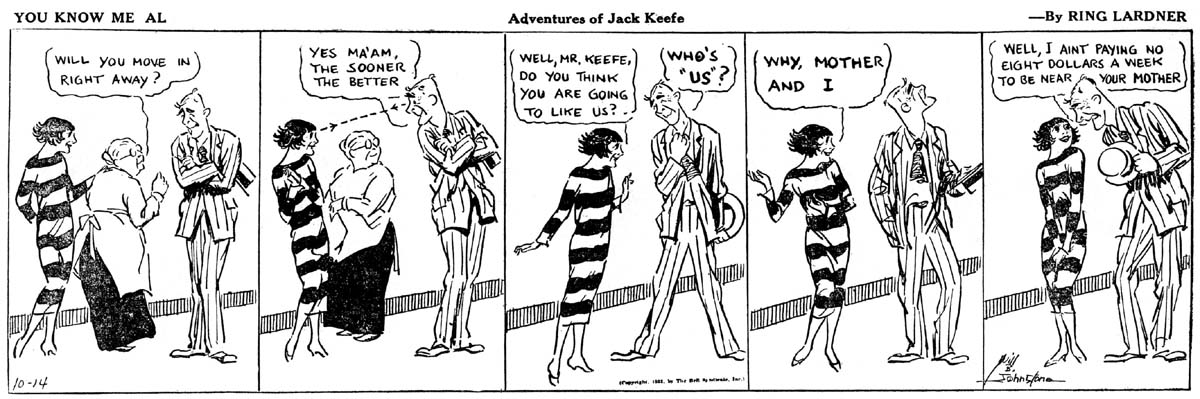
Link to Barnacle Press shamelessly lifted from Metafilter
Madritsch gone
First reported by KJR, Bobby Madritsch was designated for assignment and claimed off waivers by the Kansas City Royals.
The organization clearly believes that his injury problems are not something he can rehab from and come back to being a major league pitcher.