
Best American Sports Writing 2007 out
Featuring the Bugs Bunny piece (which runs second!) and a nice plug for USSM in the editor’s intro.
The Seeds of Success
The four teams in the League Championship Series have been set – Cleveland vs Boston, Arizona vs Colorado. If every postseason tells a story, then so far, the story of 2007 is the dominance of the new school of baseball executives.
Theo Epstein is 33 years old. Josh Byrnes is 37 years old. Mark Shapiro is 39 years old. Dan O’Dowd is the old man in the room, coming in at 47 years old. All of them are running the team that gave them their first chance to be a general manager. None of them played an inning of major league baseball. And they all came from the same tree.
In 1998, John Hart was the General Manager of the Cleveland Indians, who were winning another division title in the middle of a mini-dynasty. His Assistant General Manger was a man named Dan O’Dowd, who had worked his way up through the ranks beginning in 1988. The Assistant Director of Scouting was Josh Byrnes. And the current Cleveland GM, Mark Shapiro, was the Director of Minor League Operations that year.
John Hart had three of the four GMs in the 2007 LCS working for him in the same front office that year. It gets better. When Dan O’Dowd was hired by the Colorado Rockies in 2000 to be their GM, he took Josh Byrnes with him, giving him an Assistant General Manager role. Byrnes stayed in that job for three years before taking an Asst. GM job with the Boston Red Sox, working for Theo Epstein – the GM of the other team alive in the 2007 LCS. After several years in Boston, the Arizona Diamondbacks handed him the reins of their organization.
Byrnes worked with Shapiro and O’Dowd, then for O’Dowd, and then for Epstein. These four organizations are all intertwined by the people who they have put in charge in the last decade. And they all have one singular goal in common – to gather as much information as possible and put it to use in the best possible ways in order to win baseball games. Cleveland, Arizona, Colorado, and Boston aren’t true “Moneyball” organizations – they’re Moneyball 2.0 clubs, the ones who have successfully integrated both scouting and statistical analysis into a cohesive organization and are leveraging every good piece of information they can find into a competitive advantage.
These are the organizations who won’t settle for time honored traditions. They won’t settle for doing things the way they’ve always been done. They question conventional wisdom and they look for empirical answers. They hire the smartest people they can find and let experience take a back seat to talent.
And they win baseball games.
This isn’t stats vs scouts – this is stats and scouts working together, building an organization that blends the best of both worlds. This is the blueprint for how a baseball organization should be run. And, whether the baseball men of the 20th century like it or not, this is where baseball is going. The John Hart family tree has branched out even beyond the Billy Beane family tree – the Pirates just hired Neil Huntington from the Indians, and Shapiro’s right hand man, Chris Antonetti, can essentially pick whatever job he wants whenever he decides to run a franchise. With Andrew Friedman as something of a second cousin down in Tampa along with Kevin Towers and Doug Melvin as the crazy uncles over in San Diego and Milwaukee, this is no longer a cute theory about how the Oakland A’s are winning with a small payroll. This is the 21st century of baseball management.
If you’re rooting for an organization that isn’t adapting to the changing face of how baseball teams are run (and if you’re reading this blog, you probably are), expect 2007 to be the norm. The good organizations are going to win a lot of baseball games, and the people who rely on analysis that was handed down to them from 1970s will sit at home in October, wondering which free agent pitcher they can overpay to try to save their jobs.
We will not do a Cleveland-style rebuilding
…or whatever Lincoln said. Seems appropriate right now.
Starting with their last competitive seasons as year one:
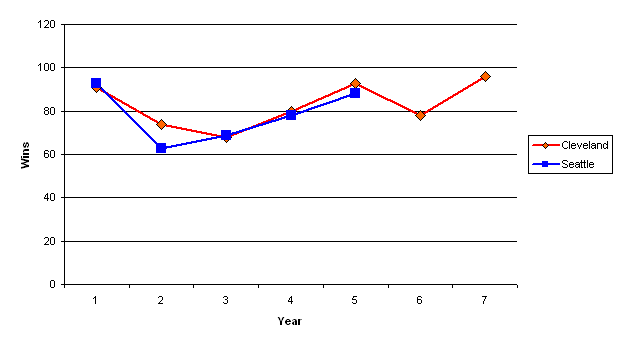
Whether the M’s got lucky this year or when which team outperformed, they both came back to putting up wins at a competitive level at about the same time.
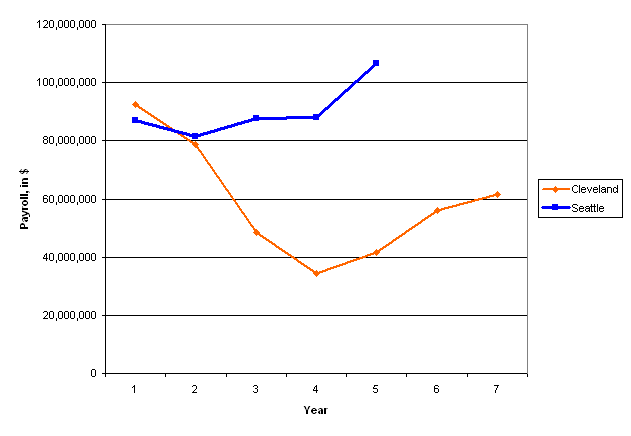
Dave and I (mostly Dave) argued all through these years that the M’s didn’t need to undergo a slash-and-burn rebuilding: their crazy revenue streams meant that they could afford to bring in quality stop-gap veterans, develop players, and sign young guys like Beltre to long-term contracts if the opportunity came up. They ended up spending a ton more money than the slash-and-burn Indians without any return on that investment.
Here’s the big one, though:
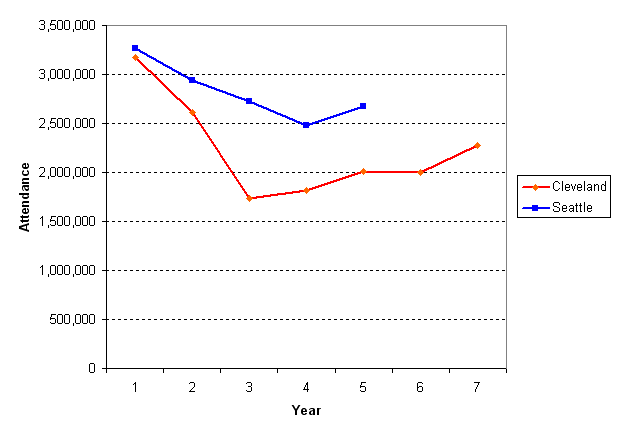
Maybe Howard Lincoln and all his people are far more savvy than we give them credit. Sure, we (and USSM readers) mocked their payroll figures, rolled our eyes at claims that the teams would be competitive, but the fans kept coming out. Maybe it’s the park, or something else at work, but they managed to keep the turnstiles spinning while putting up horrible records and some almost unwatchable teams.
Or maybe Cleveland’s just a lot smaller market with a park that doesn’t seem new and exciting anymore, so they don’t have a lot of room for error when the populace isn’t excited.
Anyway, it’s interesting to compare the Indians of 2005 with the Mariners of 2007 (hey, Broussard’s on both teams!) and think about how the Mariners match up as a franchise looking to compete.
Defining the offseason challenges
So let’s talk off-season, and what the M’s are going to face.
The big issue is that the M’s have a long ways to go if they’re going to compete against the Angels next year, and not a lot of places they can do it.
Position players
C: Johjima, Burke will likely return.
1B: Sexson’s under contract, and they’d probably like to dump him
2B: Lopez is under contract, but they’re really not happy with him and will certainly consider upgrades.
SS: Betancourt
3B: Beltre
LF: Ibanez, but even the M’s must recognize his range is destroyed and he’s killing the defense.
CF: Ichiro
RF: ?
DH: Vidro’s under contract and may be too brittle to play the field everyday. Spot 1B starts, sure, but his lateral range is too horrible for 2B. Whether they’re considering playing him at second over Lopez would depend on their opinion of whether he could handle the wear, as well, and I don’t know what their thinking is on that.
Stashed:
C: Clement’s glove isn’t ready by all reports, and his bat’s probably not ready either. No worries if he goes to Tacoma again.
1B: Broussard’s a question mark – there’s really no place for him next year either
OF: Jones has gotta, gotta start. Balentein might be able to play a decent corner, but the team’s said pretty strongly they want to avoid having two rookies in the outfield. That’s a whole other discussion, though.
And Bloomquist for the bench. Whee!
What’s up?
If they pass on Guillen, it works out pretty well. Ichiro might want to move back to right, but you can play Ichiro in CF, Jones in RF no problem — Jones has range and a great arm.
If they re-sign Guillen or they sign a different OFer, then you need to push Ibanez out of the outfield in favor of Jones.
Pushing Ibanez requires you move him to DH or 1B, which requires you to move Sexson or Vidro, with Sexson the more likely of the two.
What’s going to happen:
A 2B upgrade may not be their highest priority (we’ll get to that) but they’ll be listening. I’ll be stunned if they don’t find some veteran infielder to come in and challenge for the job. Take your pick of whoever they might be able to sign to a minor league contract or even bring in for a couple million, depending on how soured they really are.
If Guillen or an OF signs, still think Sexson gets dumped somewhere and Ibanez will move to first.
If they don’t, they’ll leave Ibanez out there to stink up the place defensively.
Starting pitching:
SP Hernandez
SP Washburn
SP Batista
SP ?
SP ?
They’ve got some candidates to start, guys like Baek, and the plan to get Morrow into the rotation may… well, it’s a possibility. They may see if HoRam can turn it around in spring training. But they’ll be looking to bring in a starter. If you don’t think they want to see two kids in the outfield, what do you think the chances are they’ll go into next year taking two gambles in the rotation?
The pressure to sign someone or trade for a name – Barry Zito! – is going to be high, and they may be willing to part with some top prospects for a Horacio Ramirez-level acquisition. Not funny? Too soon?
Bullpen:
Not a big issue. You’ve got Putz and a ton of guys like Green that can pitch on the cheap. We’ll probably see them try and pickup a veteran or two for “stability” or whatever, but that’s easy enough.
In terms of priority/what we’d be trying to fix
I know everyone’s screaming that we need starting pitching, but the best thing the team could do is to turn the defense around. It’s an easy way to make the team better and you get Jones’ bat into the lineup. That, in turn, makes it a lot easier on the pitchers, who can go deeper into games, saves the bullpen, it’s a whole cycle of awesomeness. Which means I’m arguing you try and get Jones in and upgrade again after that — so you have to move Sexson.
Or, to put this another way, moving Sexson gives the team many more ways out this offseason and more money to do it with, and they shouldn’t stop trying to make it happen, ever. They should be calling other GMs at Christmas hoping they’re loopy on eggnog. The sooner you can do it, the sooner you can tell Raul to start working out there and hope he’s passable by Opening Day.
Signing starting pitching from the free agent market’s a fool’s errand. Dave’s written about this, but your chances of getting anything approaching value form a free agent pitcher are really low, to the point it’s not worth it. Don’t do it! Go for the scrap heap! Trade for some of Tampa’s excess! Don’t lock us up to a huge, horrible deal because it’s a bad year for pitching talent! Please?
I’d be a lot more willing to take a one-year flyer on Mike Mussina, even with that dying strikeout rate (this is even more attractive if you improve the defense). But I’ll freely admit I’m a raving Mussina fan and have been for years. I may not be entirely rational – I mean, as I write this, I’m watching the Indians beat him up and I’m still thinking “pick up that 2008 year on his deal? Better than taking on Zito’s contract…”
But there’s the challenges at a high level:
– defense sucks
– starting pitching sucks
– Jones needs a spot cleared
– Sexson sucks, Ibanez sucks defensively
Be assured we’ll be getting into a lot more detail about pitching candidates and so on soon enough.
Ibanez may fill Tigers’ needs
Muwahahahaha. From the Detroit Free Press and Jon Paul Morosi:
Could there be a better solution to the Tigers’ leftfield needs than Raul Ibanez?
Detroit president/general manager Dave Dombrowski acknowledged last week that he will look for a left-handed hitter this winter. Ibanez was among the top outfield run producers in baseball this year — and he’s left-handed.
Ibanez, 35, had 105 RBIs for the Seattle Mariners this season. That’s one less than Adam Dunn, with 68 fewer strikeouts.
It’s cool, Tigers. You can have him. We don’t even need a starter in return.
Warning: The above link contains a weird, artsty sort of black-and-white picture of Ibanez, which you can re-size and move around your browser. I don’t get it.
M’s purge coaching staff
The M’s overhauled their coaching staff today, relieving everyone except for hitting coach Jeff Pentland of their duties. Gone are pitching coach Rafael Chaves, third base coach Carlos Garcia, bench coach Mike Goff, and bullpen coach Jim Slaton. First base coach Gary Thurman has been reassigned back to the minor leagues, where he’s spent most of his time with the Mariner organization before this year.
This is basically all about letting John McLaren choose his own staff. None of these guys were his hires, and it’s standard practice in baseball to let a manager surround himself with coaches of his own choosing. Some advice to the people McLaren chooses, however – rent, don’t buy, because your future is tied to that of your manager, and you better win a lot next year or this will be a twelve month gig.
Random Playoff Thoughts
Some disjointed musings from the first couple of days of playoff baseball.
1. The starting pitchers of games 1 and 2 so far: Josh Beckett, John Lackey, Jeff Francis, Cole Hamels, Carlos Zambrano, Brandon Webb, Franklin Morales, Kyle Kendrick, C.C. Sabathia, Chien-Ming Wang, Doug Davis, Ted Lilly.
Davis and Lilly are both 31 years old. Everyone else is under 30, and a third of the group are under 25.
When push comes to shove, the MLB managers who found themselves in the playoffs will take talent over experience every single time. Let’s hope John McLaren’s taking notes.
2. I’m rooting for the Indians to win it all, and I’m rooting for Asdrubal Cabrera to have a good long career, but still, every time he does something like hit a fastball 400 feet in the playoffs, there’s a part of me that wants to throw something. Thanks Bill.
3. How can anyone watch last night’s game and still think Derek Jeter isn’t the worst defensive shortstop in the American League? There were a couple of balls that are routine plays for most shortstops that he didn’t come within three feet of. That Chien-Ming Wang has been able to achieve any real success with Jeter behind him is remarkable.
4. Chip Caray showed off some righteous indignation last night when Derek Jeter didn’t lay a bunt down with runners at 1st and 2nd and nobody out trailing by two, calling this “an automatic bunt situation” in the National League. He completely failed to grasp the fact that Derek Jeter isn’t Mark Lemke, and bunting with a hitter of his caliber is rarely a good idea. Bobby Abreu followed Jeter’s non bunt with an RBI double, further showing how bad an idea bunting would have been in that situation, especially for the Yankees.
Then, a few innings later, when Chien-Ming Wang is getting rocked by the Indians as they turn the game into a blowout, Carey actually outright states that the momentum of the game turned when Jeter decided not to bunt, and that perhaps if he had laid one down, the Yankees would still be winning.
They gave up 12 runs, including four homers, and Chip Carey wants fans to believe that the Yankees lost because Derek Jeter didn’t bunt right before Bobby Abreu doubled down the left field line, rendering any theoretical bunt pointless. There’s nothing like ignoring reality to try to drive home an agenda, eh Chip? Maybe learn something about baseball strategy before you try to lecture fans who know more about the game than you do.
5. Has anyone ever stopped to think that if Ryan Howard is really as good as the media told us he was last year, and Jimmy Rollins is really as good as the media is telling us this year, why is Chase Utley still obviously the best player on that Phillies team?
Wrap Up, Part Two
Yesterday, we talked about the offensive contribution of the Mariners hitters and even worked in an adjustment for the position they played. However, we stopped there, as I wanted to give the defensive valuation its own post. So, picking up from where we left off with part one of the wrap-up, we have yet another post with me talking about defensive value.
The Mariners, as a team, allowed 813 runs this year. That’s 32 runs more than the league average despite playing half their games in the lowest run scoring environment in the American League. That’s not good, obviously, and it should come as no surprise to anyone who watched the team play that their weakness was in run prevention, not run scoring. But what parts of run prevention did the team really fail at?
Here are their performances, by outcome type, compared to league average:
Single: +65
Double: +23
Triple: +3
Home Run: -15
Walk: +10
Strikeout: -52
Hit Batter: +3
Well, we see one obvious strength of the pitching staff – they gave up 15 less home runs than league average. Of course, that’s almost all Safeco Field, but for the purposes of figuring out why the team gave up more runs than average despite playing half their games in a cavern, we can eliminate home runs from the equation. The team wasn’t particularly homer prone. And while they issued a few more walks than average, the difference isn’t huge – that’s not the culprit either.
The glaring weakness? Hit prevention. The team gave up 65 more singles, 23 more doubles, and 3 more triples than league average. That’s a lot of hits, and in turn, a lot of runs, going on the board for the other team.
Now, thanks to some inroads in statistical analysis, we’ve come to understand that hit prevention is not solely the domain of the pitcher, despite what mainstream analysis may still tell you. When a hitter makes contact and the ball doesn’t leave the yard, the outcome of that ball in play is, in part, determined by the quality of the defenders on the field. The Mariners, as a team, were terrible at turning balls in play into outs. On the season, they converted just 68.1% of their opportunities to make an out defensively, compared to a 69.6% league average. You may look at the percentage difference and say “ehh, big deal”, but each team deals with approximately 4,500 balls in play every year, and over the course of the season, that 1.5% difference adds up to about 68 plays not made.
Now, thanks to batted ball data, we can get even better accuracy. The Hardball Times, using data from Baseball Info Solutions that classifies every play as a groundball, flyball, or line drive and gives expected outs based on hit type, has the Mariners at 64 plays below average. Pretty close to our rough metric, but shows that the pitching staff did indeed give up a few more extra hard to catch balls than we’d expect. That’s not a big surprise to anyone who watched Jeff Weaver or Horacio Ramirez get torched on a regular basis this year.
Okay, so, using that 64 plays below average number, and thanks to Tango (as always), we can understand that those 64 plays the defense failed to make cost the Mariners about 50 runs. Fifty runs.
Wait a second – the team, as a whole, gave up 32 more runs than average, but we’re blaming the defense for being 50 runs worse than average? That means that we’re saying that the team had an above average pitching staff?
Well, almost. You have to remember to factor in Safeco Field. An average pitching staff that plays half their games in Seattle would give up less runs than average just thanks to the environment they play half their games in. But, yes, I am saying that the main factor in the team’s struggles at keeping runs off the board was not the pitchers, but instead, the fielders.
And, you know what, the numbers are on our side. The Mariners had a team Fielding Independant ERA of 4.48 compared to a league average of 4.51. Based on walk rate, strikeout rate, and home run rate, the Mariners had an average pitching staff, but their defense was worse than every other American League team besides Tampa Bay (whose attrocious defense also masked a pretty decent group of pitchers).
I know some of you will still want to blame the pitchers for the high ERA, because after all, it’s what everyone else in baseball does. But think of it this way? Do you really think the reality is that Felix Hernandez, Jarrod Washburn, Jeff Weaver, Horacio Ramirez, Cha Baek, Sean Green, and Ryan Feierabend all mysteriously lost about the same amount of ability to prevent hits on balls on play over the winter? All of them posted significantly worse rates of outs on balls in play than in ’07 than they did in ’06. Or, is it more likely that the common denominator behind them, their defense, wasted a lot of opportunities to create outs?
The evidence all points to the same fact – the Mariners defense was terrible this year. One of the worst in baseball. There’s no real way to argue differently – this is basically the same thing as stating that the Mariners hit for a high average or won more games than they lost.
The real question, for the purposes of player valuation, though, is which players were responsible for those 50 runs that the M’s forfeited with their defensive problems.
This is where subjectivity comes into play a bit. On a macro team level, we’ve just about got defensive evaluations nailed down. Splitting that pie up becomes a bit tougher, and the level of confidance goes down somewhat. Thanks to a lot of good work by a lot of people, we know that a great defensive player is about 20 runs better than the average for his position and a terrible defensive player is about 20 runs worse than the average for his position. Beyond those limits, teams realize that the defender is playing the wrong position and make an adjustment. It’s very rare to see a +20 or -20 player stick at one position, and everyone else falls somewhere in that range at pretty much each position.
However, as you’ve seen me talk about before, I’m still more comfortable using a +/- 5 run margin of error on both sides of the run values that the advanced defensive metrics come up with on an indvidual player basis – there are variations within teams that could affect the ratings, such as positioning of the fielders, handedness of the pitching staff, or a player “ballhogging” and always calling off all his teammates on plays that multiple players could make. This won’t affect the team’s totals, but it will affect the way we dole out credit/blame to the individual fielders, and so I’d rather use the ranges around the run values while people figure out how to solve those issues.
So, what do the numbers tell us about the Mariner fielders this year? Using a variety of inputs, we can safely come to the following conclusions:
Raul Ibanez – disastrous left fielder, -15 to -25 runs
Ichiro – above average center fielder, +0 to +10 runs
Jose Guillen – below average right fielder, -5 to -15 runs
Adrian Beltre – above average third baseman, 0 to +10 runs
Yuniesky Betancourt – below average shortstop, 0 to -10 runs
Jose Lopez – average second baseman, -5 to +5 runs
Richie Sexson – terrible first baseman, -10 to -20 runs
Kenji Johjima – who knows? – we don’t really have any idea how to evaluate catcher defense properly.
If we used the median value of those ranges, we’d come out with Ibanez at -20, Ichiro at +5, Guillen at -10, Beltre at +5, Betancourt at -5, Lopez at 0, and Sexson at -15, for a total of 40 runs below average. Toss in the part-time players (Broussard’s nothing to write home about with the glove either) and it ties pretty closely to the -50 that we see from the team wide total.
The controversial numbers, I’d expect, will be the “above average” ratings for Ichiro and Beltre, both of whom have stellar defensive reputations. Ichiro, I’m pretty comfortable with – he was consistently in the +10 to +20 range as a right fielder, and now that he’s being compared to a better crop of defenders in center, we’d expect his relative performance to decline. As good as Ichiro is defensively, he’s not head and shoulders ahead of guys like Curtis Granderson and Corey Patterson, who are also terrific defensive players in their own right. There’s nothing wrong with being a +5 center fielder – this still makes him one of the best defenders alive.
Beltre, I think, is just getting hurt by stiffer-than-normal competition at third base. Beltre’s really good, no doubt, but I’m not sure we appreciate just how good Brandon Inge and Mike Lowell are as well. You may not think of third base as a position with good defensive players, but there are some really, really good fielders manning the hot corner in the American League right now. With those kinds of peers in the group, it’s a little less surprising that Beltre’s defensive prowess doesn’t rate as well as we might expect from watching him play everyday.
This team, essentially, had two good fielders, a couple of average ones, a couple of below average ones, and two of the worst guys taking the field on a regular basis in baseball. Richie Sexson and Raul Ibanez just killed the Mariners with their gloves this year, and the rest of the team wasn’t good enough to make up for the organization putting two designated hitters behind their pitchers on a nightly basis.
Okay, that’s enough long-winded writing. If we apply the defensive run values to the position adjusted offensive run values from yesterday’s post, here are the results, and I’m comfortable using these as definitive metrics of value from the Mariners regular position players for 2007.
Stars
Ichiro Suzuki: +30 to +40 runs
Good Players
Adrian Beltre: +10 to +20 runs
Kenji Johjima: +10 runs offensively, ? defensively
Average Players
Jose Guillen: +5 to -5 runs
Below Average Players
Raul Ibanez: 0 to -10 runs
Yuniesky Betancourt: 0 to -10 runs
Jose Vidro: -3 runs offensively, no defensive adjustment
Bad Players
Jose Lopez: -15 to -25 runs
Disasters
Richie Sexson: -30 to -40 runs
Ichiro carried the position players, while Beltre and Johjima added positive value and Guillen provided league average production and consistency. Ibanez, Betancourt, and Vidro were small negatives, Lopez was a big problem, and Richie Sexson was one of the very worst players in baseball.
Add it all up and you have a group of position players that’s simply not playoff caliber. If the Mariners want to win consistently, they have to make some significant upgrades to this group – there are too many holes and not enough stars. It would take one of the best pitching staffs in the league to carry this group to a division title.
Yep, outfield defense matters
Next time I ramble on about defense (like tomorrow, for instance) and you begin to think “man, this guy really overrates defense”, watch the 6th inning from tonight’s Rockies-Padres game again, and then call me. The Milton Bradley injury didn’t help, but if Mike Cameron’s in center field for San Diego today, they’re still winning this ballgame.
8th inning update: Yea, outfield defense still matters.
Wrap Up, Part One
Well, 2007 is finally in the books. The Mariners finish the year 88-74 despite being outscored by 19 runs on the year, and, of course, we like to break things down, and occassionally, we’ve been known to use some numbers.
We’ll have more post-season analysis in the days to follow, but for now, here’s a quick look at the rankings of the offensive players in terms of runs added above average. This is not position adjusted – we’re simply look at how much value each player added as an offensive player, accumulating runs through hitting and baserunning, compard to a league average hitter. This is based on linear weights, which essentially gives each play an average run value, then sums them up the total individual contributions.
Ichiro: +24 runs
Ibanez: +19 runs
Guillen +16 runs
Vidro: +12 runs
Beltre: +10 runs
Johjima: +1 run
Betancourt: -5 runs
Sexson: -9 runs
Lopez: -22 runs
No big surprises here – Ichiro’s the best hitter on a team of above average hitters, Lopez had a disaster of a season at the plate, and Sexson was terrible as well.
Now, just for fun, let’s do some positional adjustments. Generally, statistical analysis will do position adjustments based on the average performance of hitters at that position, but the more I’ve looked at this, the less I think that’s the right way to do it. Let’s use 2007 National League middle infielders as an example, for instance.
Average NL SS: .279/.337/.420
Average NL 2B: .272/.341/.418
Second baseman and shortstops in the National League put up basically the same line this year. A normal positional adjustment would compare Dan Uggla and Hanley Ramirez to the same baseline. But think about this for a second – does that make any sense at all? We know that almost every shortstop on the planet is capable of playing a quality second base, but very few second baseman can play a credible major league shortstop. Just by the fact that they’ve been deemed able to play shortstop in the major leagues, the SS group is showing a demonstrable skill that the 2B group is not. That has real value, and comparing a batting line to the average of his peers will miss that.
So, instead, I’ve come around to the idea that we should do a position adjustment based on the defensive spectrum. We know that shortstop is harder to play than second base and center field is harder to play than left field, and there’s no reason to expect the relative difficulty of those positions to change on a year-to-year basis, so we can use fixed values to determine the positional adjustments. Tango’s done most of the legwork, and if you’re really interested in the nuts and bolts, I’d recommend checking out his blog, but here’s the overview for the rest of us:
C: +10 runs
SS/CF: +5 runs
2B/3B: +0 runs
LF/RF: -5 runs
1B: -10 runs
DH: -15 runs
This fits pretty well with what we understand about the game. Catcher’s an island unto itself, but the premium defenders play the tougher up the middle positions, the bad defenders get hid at designated hitter or first base, and some of them sneak into corner outfield spots, and the in between guys end up at second or third base. So, applying the defensive spectrum to a positional adjustments, we get the following values for the Mariners’ starting position players.
Ichiro: +29 runs
Ibanez: +14 runs
Guillen: +11 runs
Johjima: +11 runs
Beltre: +10 runs
Betancourt: +0 runs
Vidro: -3 runs
Sexson: -19 runs
Lopez: -22 runs
This gives us a pretty accurate description of how valuable the Mariners line-up was offensively. Ichiro’s the shining star, with Ibanez/Guillen/Johjima/Beltre all being about the same, Betancourt and Vidro hanging around average, and Sexson and Lopez killing rallies every day.
So, there you go – there’s the rankings of the position players as offensive contributors. Tomorrow, we’ll look at the defensive contributions and sum up the position players value in total. And yes, defense changes things. A lot.