
The Mariners Don’t Need To Extend Kendrys Morales
I’ve been planning on writing this post for a week or two now, as Kendrys Morales caught fire in May and is establishing himself as a bright spot in an otherwise miserable season, but then Shannon Drayer went and beat me to the punch. In an article entitled “Morales, Mariners a great fit; time to lock him up“, Drayer is active in her encouragement of the Mariners to engage Scott Boras in negotiations now and try to sign Morales before he hits free agency this winter. An excerpt:
Morales very well may be the guy to build around. At the very least, he could be an important building block. Don’t you have to take a run at that? Boras client or not?
Get him signed and put him on a banner alongside Felix’s in front of the gates to Safeco Field. This is the hitter they have been trying to find for a long time.
Morales has been excellent for the Mariners this year, no question. He has a 140 wRC+, a mark that would represent a career best if he could keep it up all year long. Other players who have been similarly productive hitters this year: Evan Longoria (144 wRC+), Jose Bautista (141 wRC+), and Prince Fielder (140 wRC+). Yeah, it’s driven a bit by a higher BABIP, and he probably won’t keep hitting at this level over the long haul, but he’s a good hitter who has shown marked improvement from the right side of the plate, which was a real concern heading into the year.
If Morales’ improvements against LHPs are part of a real trend — and Jeff gave us reasons to think that they might be, even before he stated crushing them this year — than it isn’t inconceivable to think that he might very well be headed towards a new, higher level of production. Maybe he’s not a 140 wRC+ guy, but 125-130 doesn’t seem out of the realm of possibility given his contact rates, power, and development as a real switch-hitter.
So, yes, the Mariners should be interested in keeping Kendrys Morales. They don’t have enough good players, he fills a need, and it’s nice that he apparently has some interest in returning. However, I don’t think the Mariners need to be too aggressive in pursuing an in-season extension, because thanks to the way free agency works, the Mariners are going to have all the leverage in the world this winter.
Assuming Morales stays healthy and keeps hitting all year, the Mariners can make Kendrys Morales a “qualifying offer” equal to the average of the top 125 salaries in MLB, which will be approximately $14 million for 2014. By making Morales that offer, draft pick compensation will attach, and Morales’ stock as a free agent will take a very large hit. In fact, Morales is exactly the kind of player that this system penalizes the most.
For a recent example, simply look at what Washington did with Adam LaRoche last year. LaRoche and Morales are very similar players, and LaRoche was a star for Washington last year, putting up the best numbers of his career (including a 127 wRC+ and +3.4 WAR) while helping carry the Nationals to the playoffs. However, he was also a non-elite first baseman on the wrong side of 30 with a bit of spotty track record and some recent health issues. Sound like anyone else you know?
Morales has been a slightly better hitter than LaRoche throughout his career, but most of that is just park adjustments, which teams aren’t notoriously great at factoring in. From a raw numbers perspective, their career lines are almost identical:
Morales: .283/.335/.491, .353 wOBA
LaRoche: .267/.333/.481, .350 wOBA
Morales is a couple of years younger, but he’s also spent a lot more time on the DL and has the continuing ankle issues that will almost certainly scare any NL team away from a multi-year contract. LaRoche’s ability to play the field everyday cancels out any advantage you want to give Morales in terms of age or offensive ability. Morales is going to be viewed, as a free agent, in a very similar manner to how LaRoche was viewed.
And LaRoche was basically ignored once Washington made him the qualifying offer. Like Morales, he was advised by Scott Boras, and Boras took LaRoche to free agency looking for a three year deal, reportedly with a $36 million asking price attached. Because teams viewed LaRoche as a good-not-great player, they simply weren’t willing to give up a first round pick in order to sign him, especially not to a three year deal. The Nationals offered LaRoche 2/24 — because they wouldn’t have to give up a pick to re-sign him — and refused to budge all winter. Finally, Mike Rizzo just told him to take it or leave it.
“I think we both were getting tired of the process,” Nationals general manager Mike Rizzo said. “We had a lot of conversations back and forth with his representative. Adam and I had a few private conversations. … I made it clear to Adam that it’s time to get this thing done. Make a decision. Our offer is what it is. It’s been on the table for a while. It’s time to think of your options and pull the trigger if you want to be here.”
LaRoche took it because he had no other choice. There just wasn’t a market for his services once draft pick compensation was attached. And it wasn’t just LaRoche either. Nick Swisher — another similar offensive player, just with more defensive value — basically got stonewalled by teams who didn’t want to give up a first round pick to sign him, and eventually landed in Cleveland for a significant discount. Michael Bourn, a significantly better player than Morales, also ended up in Cleveland after no one wanted to pony up a first round pick to sign him. Kyle Lohse sat around until after opening day before finally settling for a modest deal with the Brewers.
Major League teams showed, en masse, that they weren’t giving up their first round pick for the right to sign guys who are slightly above average players. And, for as well as Morales is hitting right now, that’s what he is. He’s a good-not-great hitter who can’t run and who has to sign with an AL team in case his ankle flares up. He might be able to pitch himself as a part-time first baseman, but he’s still an AL only player at this point in his career. Combine that with draft pick compensation, and you have all the makings of a guy who just isn’t going to be a hot commodity this winter once the Mariners make him that qualifying offer.
He can probably do better than $14 million for one year, but the Mariners probably don’t need to do better than a two year deal at something in that AAV range in order to get him signed. If they decided to offer a third year, you can probably knock the AAV down closer to $10 or $11 million per year.
The M’s should want to re-sign Morales, but they should also know that they’ll probably be able to get him back for something like 2/25 or 3/33 if they let him reach free agency, and there’s no reason to give him that kind of money now when they can just wait until the end of the season and make sure he stays healthy before they make the commitment. If he wants the guaranteed money now, you get a discount for taking on the additional risk, so maybe the Mariners should be willing to re-sign Morales now for something like 2/20. If he was up for that, I’m in. Sign me up for 2/20 or 3/27 or something in that range right now.
Want some history to support that kind of offer? The Blue Jays signed Edwin Encarnacion to a 3/29 extension last July in the midst of his break-out year, and like Morales, Encarnacion is a DH who plays the field occasionally. He was also 29-years-old last year, so he even had a slight age advantage. His career line? .264/.344/.473. His first half wRC+ last year? 156. This is what the market has established as the price for this kind of player.
If he wants more than that, though, there’s no rush. The Mariners can simply keep him for the rest of the year, make him the qualifying offer, and then let him see what the market for his kind of player really is once draft pick compensation attaches. Boras loves to shoot for the moon and prefers to take his players to market, so trying to re-sign him now is unlikely to lead to any kind of discount, especially with Morales hitting as well as he has been lately. So, there shouldn’t be any sense of urgency here. Let him prove he can play first base regularly over the rest of the season. Let him show that his improvement against LHPs can be sustained over a full year. Let him stay healthy for an entire season.
The price isn’t going to go up that dramatically, because the Mariners have the hammer here. This is no longer a situation where the M’s have to re-sign him now or trade him away at the deadline before they “lose him for nothing”. Now, with the new free agent system, keeping a player you intend to make a qualifying offer to is a significant benefit, and the Mariners should be happy to take advantage of the leverage that offer will bring them.
Game 58, White Sox at Mariners
Joe Saunders vs. John Danks, 7:10pm
The M’s return home to face Chicago, and their erstwhile innings-eater, John Danks. The M’s counter with Joe Saunders, whose coming off a successful start in a Safeco-like environment. The M’s obviously have some question marks in the pen, so it’ll be interesting to see Eric Wedge’s thought process in late game situations.
As Matthew wrote about in the series preview, Danks has reverse splits over his (fairly lengthy) career – due to his outpitch, the change-up. This isn’t merely a home-run-fueled artifact, either – Danks strikes out more and walks fewer righties. Lefties don’t exactly torch him, as he’s got a cutter and a (rare) curveball as well. Still, his swing-and-miss pitch is the cambio, with good arm-side run and sink. As a result, the Rays famously stacked their line-up with *righties* instead of lefties when they faced him. Rays fans even named it the “Danks Theory” after Joe Maddon’s slightly counter-intuitive strategy. The idea was simple: take away the opposing pitcher’s biggest strength. If the opposing starter had a great slider, then you’d use a traditional platoon line-up (opposite-handed hitters). If, like Danks, it was a change-up, then you went with a same-handed line-up to get him to throw more cutters instead. That’s all well and good for Rays fans, but we M’s fans know that when you play with sabermetrics, you’re playing with fire.
Perhaps luckily for the M’s – and to be perfectly fair, it’s not like Danks has strong platoon splits one way or the other – Wedge just isn’t able to mix and match. Injuries, and injuries that haven’t been DLed, have left the team with something of a short bench. That said, the line-up that’ll face Danks isn’t a bad one, given Danks’ weapon.
1: Chavez, RF
2: Bay, LF
3: Seager, 3B
4: Morales, 1B
5: Ibanez, Dh
6: Franklin, 2B
7: Saunders, CF
8: Sucre, C
9: Ryan, SS
SP: Joe Saunders
Danks’ return from major shoulder surgery is cool and all, but I’m going to miss this one. Brandon Maurer’s scheduled to make his AAA debut, and it’s absolutely gorgeous out, so I’ll head to Cheney. The Rainiers face ex-Rainier and ex-Mariner Justin Thomas, who’s now with the Sacramento RiverCats.
Tai Walker lost the opening game of a AA doubleheader today in Tennessee, giving up two runs in five IP, with two walks and five K’s. The offense couldn’t get him any runs, so the Generals dropped game 1 2-0. Game 2’s underway with Jimmy Gilheeney pitching.
The Jason Bay Lessons
It’s June 3, and Jason Bay is starting again tonight for the Mariners. He brings in just a .231 batting average, but his on-base percentage is more than a hundred points higher than that, and his slugging percentage is right there with Michael Morse’s and Kyle Seager’s. Through the first third of the season, Bay’s been a contributor, and a year ago he was a pile of crap. He cost the Mariners little to bring in, his placement on the roster was controversial, and now it’s time to review some lessons we all might have learned. Without further ado words:
Jason Bay isn’t toast
This, of course, is the most obvious lesson, on account of Jason Bay hasn’t played like toast. He hasn’t played like anything resembling toast. I don’t actually quite understand the expression, myself, just like I don’t understand the expression of being “on fire.” I certainly don’t understand how they can co-exist as they do. If you’re toast, you’re done. If you’re on fire, you’re performing quite ably. What does fire yield but extremely dark toast? If Jason Bay were on fire, would he not be toasty? Does “toast” refer to when you’re not on fire anymore? Does one go right from being on fire to being finished? And don’t most people enjoy toast? I don’t think these were thought through. I don’t think these were thought through at all.
Bay’s been one of the best hitters on the team. Last year, Bay was one of the worst hitters in baseball. He, for example, hit worse than Chone Figgins. He hit worse than Ramon Santiago. He hit worse than Brendan Ryan and Xavier Nady and whoever Gorkys Hernandez is. Bay was getting older and had had some injuries and there was reason to believe his days were just through, not on this planet, but at least in this league. Now he’s walking like always. He’s striking out basically like always. His isolated slugging percentage is where it was in 2008, when he clubbed 31 dingers and got himself involved in a Manny Ramirez trade. Jason Bay has bounced back. To some extent. To a productive extent. The Mariners picked up a shell and found a crab in it that looked suspiciously Canadian.
Also Bay’s defense hasn’t been bad. Or, if it has been bad, the badness has mostly escaped my attention. He seems to have been perfectly adequate, which is more than you could say of a few other frequent or semi-frequent Mariner outfielders.
Teams usually don’t make truly weird decisions for no reason
At the time, I didn’t understand the argument for Jason Bay over Casper Wells. That is, for all intents and purposes, the decision that was made. Bay was selected as a reserve outfielder while Wells was dropped and discarded. Wells was (and is!) younger, he could play center, he projected better, and he had some extra team control. On paper, choosing Wells was obvious. On paper, going with Bay amounted to lunacy, spring training be damned. It was a little thing, but it was a thing, in an offseason full of questionable things.
I still don’t quite get it. I still don’t get why the Mariners dropped a younger center fielder. Bay’s success doesn’t retroactively justify everything, any more than finding a quarter justifies my tipping over all the washing machines in a laundromat. But Bay has succeeded, and the Mariners felt like they saw something. Wells hasn’t succeeded, in large part because he’s had trouble finding steady work. Other teams didn’t care much for a freely-available Casper Wells, meaning it wasn’t just the Mariners’ evaluation. When a decision you disagree with seems to work out, it’s easy to just say “bad process, good results.” But it requires deeper examination. Probably, the process wasn’t so bad. Probably, it had better chances of working out than you gave it. Baseball teams aren’t baseball idiots. Except for sometimes.
We still haven’t learned about sample sizes
I’ll go quickly over this one since I don’t want to be perceived as a wet blanket, but Bay has 141 plate appearances. How “back” is he, really? He’s been protected from a lot of righties, and, let’s re-visit 2011. Through June 10, Adam Kennedy had a .784 OPS over 173 trips to the plate. The rest of the way, he came in at .521 and 236. We don’t know what Jason Bay’s going to do, and arriving at conclusions after a third of the season is a good way to look kind of stupid after three-thirds of the season. Bay, oddly, has twice as many homers as doubles. That probably won’t keep up. Because of Bay, there’s something of a rush of people admitting to having been wrong, or accusing others of having been wrong. It’s fine, encouraged even, to re-consider perspectives, but remember what date it is. Remember what numbers can do.
It doesn’t only happen to us
Scott Spiezio and Jeff Cirillo are among the more reviled Mariners in recent team history. Spiezio played like a total idiot and Cirillo essentially went bonkers. In Spiezio’s last year with the Mariners, he had three hits. In Cirillo’s last year with the Mariners, his OPS had three fives in it. Spiezio subsequently bounced back in a big way as a role player for the Cardinals. Cirillo found it again playing for the Brewers. It was maddening to see such aggravating busts have success somewhere else after flopping in Seattle. It felt, in some weird way, like an insult.
Jason Bay’s got an OPS near .800. Oliver Perez has an ERA closer to 1 than 2. In Perez’s last year with the Mets, his ERA was almost 7. In Bay’s last year with the Mets, he didn’t slug .300. Perez looked like a complete and utter loss, and Bay looked like a shell of a former star slugger. Mets fans, as far as I could tell, hated Perez. I don’t think they hated Bay — he’s a hard one to hate — but they weren’t sad to see him leave. He wasn’t of use anymore. He hadn’t been of use for some time. Except now, he’s of use, like Perez is, on the Mariners, who aren’t the Mets.
Neither of these guys is going to lead the Mariners to the playoffs, or come through with clutch stretch-run performances. They’re role players, and they’re non-elite ones. But, Mariners fans love to ask, “why do they always get better when they leave?” It’s a silly question, but we’re not the only ones asking it.
Mariners Limp Home and Face White Sox
| MARINERS (24-33) | ΔMs | WHITE SOX (24-30) | EDGE | |
| HITTING (wOBA*) | -9.8 (19th) | -0.1 | -79.2 (30th) | Mariners |
| FIELDING (RBBIP) | -3.9 (19th) | 0.5 | 9.9 (10th) | White Sox |
| ROTATION (xRA) | 11.1 (9th) | -0.9 | 22.3 (5th) | White Sox |
| BULLPEN (xRA) | 3.9 (8th) | -2.3 | -12.2 (29th) | Mariners |
| OVERALL (RAA) | 1.2 (16th) | -2.9 | -59.2 (28th) | MARINERS |
Oh, wow, the worst hitting team in the majors! The White Sox are posting a team slash line of about 25 points worse than the Mariners in both OBP and SLG. And the White Sox play in their joke of a park while the Mariners play in their less laughable park. Using StatCorner’s ratings, only one White Sox hitter — Alex Rios — has had a better than average bat. FanGraphs concurs unless you want to include Dylan Axelrod’s 1-for-2 performance.
In comparison, the Mariners have the following hitters with above average lines: Bay, Franklin, Gutierrez*, Ibanez, Morales, Morse, Peguero, Seager and, yeah, even Justin Smoak.
*Coincidentally funny that Nick Franklin and Franklin Gutierrez line up next to each other in alphabetical order
The Mariners aren’t a bad team, I think, they just seem to sometimes play like a horrendous team. Bonderman is an example of that. Three home runs allowed is a bad number for one start. Two of those were hitters took pitches, while behind in the count, on the outside edge of the zone and hit them over the fence the other way. That doesn’t happen very often. Is Bonderman just more hittable? It sure looked like it, but it’s hard to say after only one start. I don’t think he’ll be up for long regardless, and he wasn’t mowing down hitters in Triple-A either, but that was a weird start, from an overall stat line perspective.
Game 57, Mariners at Twins
Jeremy Bonderman vs. Scott Diamond 11:10am
When asked a few days ago who I thought would make this start, I answered Hector Noesi. Not because I have a lot of confidence in Noesi, but because Jeremy Bonderman was limping towards his contract’s finish line. Over his last four starts, Bonderman walked eight and struck out six. Oh well – welcome back, Jeremy.
Comparisons to Blake Beavan are too easy with Twins pitchers and their whiffless ways, but Scott Diamond is a lot like Blake Beavan. This year, he’s striking out less than 11% of opposing hitters while walking less than 5%. He’s a lefty with an 89mph fastball, a curveball he throws for strikes (duh) and a change for RHBs. Like Beavan, he often gets too much of the plate and serves up HRs.
1: Saunders CF
2: Bay LF
3: Seager 3B
4: Morales DH
5: Ibanez RF
6: Liddi 1B
7: Triunfel 2B
8: Sucre C
9: Ryan SS
SP: Bonderman
Erasmo Ramirez makes his first AAA start of the year today in Tacoma at 1:30. If you’re in the South Sound, that looks like a good game to attend.
Game 56, Mariners at Twins
Aaron Harang vs. Kevin Correia, too early am.
Harang v Correia. Technically, this is a match up of ex-All Star pitchers, but I just want to get back to my breakfast.
1: Chavez, RF
2: Bay, LF
3: Seager, 3B
4: Morales, 1B
5: Ibanez, DH
6: Franklin, 2N
7: Saunders, CF
8: Shoppach, C
9: Ryan, SS
SP: Harang
Go M’s!
Game 55, Mariners at Twins
Hisashi Iwakuma vs. Mike Pelfrey, 5:10pm
When Hisashi Iwakuma was posted by his NPB team back before the 2011 season, I looked at his pitch fx scouting reports by the likes of Mike Fast and tried to find a major leaguer with similar pitches. The mix and movement of his four-seamer, two-seamer, slider, the occasional curve and splitter looked a heck of a lot like one National Leaguer in particular – Mike Pelfrey. At the time, Pelfrey was coming off a solid run, racking up 6.5 fWAR in the three previous years (2008-10). Then, the Athletics (who’d won the rights to Iwakuma) couldn’t agree on a deal, and Iwakuma went back to Japan. And got hurt.
Fortunately for the M’s, he came back the next year and accepted a fraction of the money he’d have earned in Oakland, then looked pretty broken in the spring. Pelfrey was terrible in 2011 himself, then underwent Tommy John surgery and missed essentially all of 2012. The point of all this is that I thought Mike Pelfrey represented ‘Kuma’s *ceiling* way back when. Now, Mike Pelfrey is basically the extremely poor man’s version of Iwakuma. Baseball! Pitchers!
Pelfrey throws a splitter, though not as much as he used to, but he seems to use it for a very different purpose than Iwakuma. Iwakuma uses his to humiliate and dominate hitters. Pelfrey uses it to show hitters something different, not as a true purpose pitch. With two strikes, he’s still much more likely to throw a fastball than the split. As a result, he gets very few whiffs with it (kind of like Cashner’s change), and hitters don’t have much trouble putting it in play – and in his career, they’ve hit .300 when they do. Like Iwakuma, he gets a fair number of groundballs with it, but unlike Iwakuma, that’s the extent of the “pro” side of the ledger. This is paragraph is essentially a modern way to say that a pitch sucks. Pelfrey seems to intuit that, and he’s thrown it sparingly this season.
To fit in with his new team, Pelfrey’s not striking anyone out, and his GB% dropped markedly as well. His strand rate’s atrocious, so he hasn’t “earned” the entirety of his 6.85 ERA, but not much has been working for him this season. It also doesn’t help that the Twins are one of the worst fielding teams in all of baseball. Matthew’s measure has them near the bottom in fielding. UZR has them dead last (and has the M’s close by in 28th). DER has them in 29th. Whatever you use, the conclusion is pretty clear: the Twins have added ‘outfield defense’ to ‘strikeouts’ on the list of over-rated, sabermetric-puffery stats. The Twins IF hasn’t been awful, but Josh Willingham, Oswaldo Arcia, Chris Parmelee and Aaron Hicks have not impressed fielding metrics. Pairing a pitch-to-contact staff with allergic-to-leather OFs hasn’t worked out well in the Twin Cities, though I’m aware that the M’s OF may end up worse than the Twins defensively. Still, at least the M’s get strikeouts. And Pelfrey’s splitter still sucks.
This has been an uncharacteristically combative game preview. Felix plus dingers just arouses the fire that’s dormant in the innermost recesses of my soul.
Line-up:
1: Chavez, RF
2: Bay, LF
3: Seager. 3B
4: Morales, 1B
5: Ibanez, DH
6: Saunders, CF
7: Franklin, 2B
8: Sucre, C
9: Ryan, SS
SP: Iwakuma
Still no Justin Smoak, whose oblique is still a bit sore.
Robert Andino cleared waivers and accepted his outright assignment to Tacoma. That’s nice, but he’s not in line for more playing time or anything. As Mike Curto noted, he’s probably not going to move either Dustin Ackley or Brad Miller out of the starting line-up. Tacoma returns from their road trip to take on Sacramento this weekend.
Another week, another good crop of articles on pitch framing. I mean, we all knew we’d see more of it after Mike Fast’s groundbreaking article, and I would’ve purchased pitch framing futures if they were real, but it’s getting kind of crazy. Good crazy, though. Here’s Ben Lindbergh’s interview with museum-quality framer Ryan Hanigan for Grantland. Here’s Jeff Sullivan at Fangraphs looking into why we don’t see massive runs-allowed differences with ‘great’ framing catchers. Jesus Sucre’s framing looks good from what I’ve seen, but it seems to me that the M’s care much more about game-calling and leadership than framing, and I’d guess that’s where they’d say Sucre shines. I’m still sort of amazed that Sucre, a no-hit catcher they got from Atlanta essentially for free, is now the de facto starting catcher.
Mariners End Road Woes Streak and Continue to Minnesota
| MARINERS (23-31) | ΔMs | TWINS (23-28) | EDGE | |
| HITTING (wOBA*) | -9.7 (20th) | -0.1 | -26.4 (25th) | Mariners |
| FIELDING (RBBIP) | -4.4 (19th) | 6.1 | -16.3 (27th) | Mariners |
| ROTATION (xRA) | 12.0 (7th) | -1.2 | -22.7 (26th) | Mariners |
| BULLPEN (xRA) | 6.2 (6th) | -0.2 | 10.4 (2nd) | Twins |
| OVERALL (RAA) | 4.1 (16th) | 4.6 | -54.9 (28th) | MARINERS |
So close to taking three of four against the Padres which would have been more encouraging than a series split.
Carlos Triunfel might already be lost in the infield shuffle on the Mariners. Brendan Ryan has surged offensively and is putting on a defensive show as though his baseball life depended on it. And early though it is, Nick Franklin already seems ready to assume the bulk of second base playing time. I realize this will probably be the peak of how we feel about Franklin, but so what? The Mariners are 23-31. Let’s just enjoy this for as long as it will last.
What Brendan Ryan Has Done
First, a brief selection of screenshots from Brendan Ryan’s last two days:
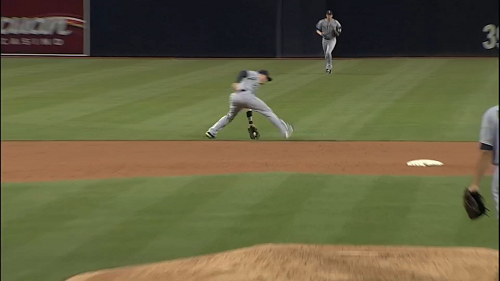
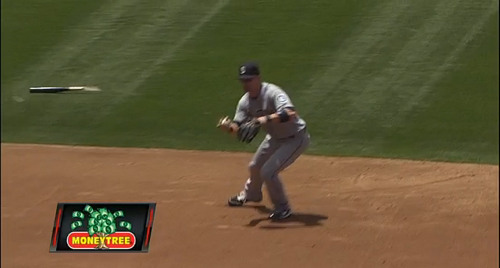
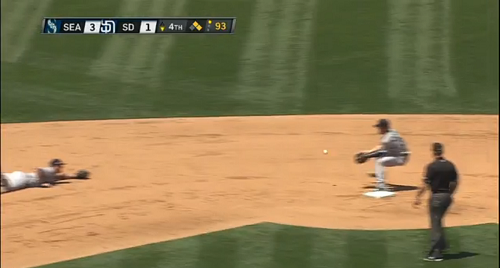
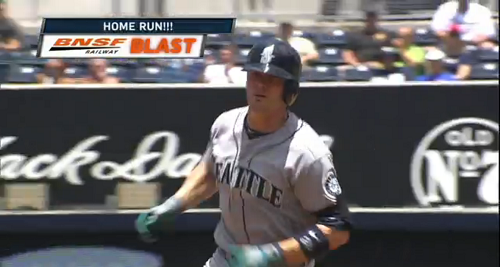
In fairness, Ryan didn’t complete the first play, as the batter reached safely, but the defensive effort still included something amazing, something few shortstops would’ve been able to do. I’ve long believed we don’t give enough appreciation to amazing defensive plays that don’t result in outs. They’re anticlimactic, but amazing’s amazing. Brendan Ryan grabbed a sharp grounder between his legs, and not in the way that you usually do, facing forward.
Now then, some slash lines. Who doesn’t like randomly selected slash lines?
- .336/.368/.523
- .340/.375/.528
- .296/.370/.556
- .312/.371/.532
One of those is Manny Machado, one of those is Mike Trout, one of those is Evan Longoria, and one of those is Brendan Ryan over the last two weeks and change. Of course, for Ryan, that’s an arbitrary window, selected to make Ryan look as good as possible. But it’s still a stretch that’s happened. For more than two weeks, Ryan has played like one of baseball’s elite. Yeah, today’s homer easily could’ve been foul, or caught in a different ballpark. Homers are homers. Ryan’s WAR is back in the black, and he’s still been terrible at the plate overall. He’s a bad hitter who can be a decent contributor, and he’s a bad hitter who’s recently hit like a superstar.
Interestingly, this stretch has immediately followed a different stretch in which Ryan went hitless over 20 consecutive plate appearances. No. 20 was an out against CC Sabathia on May 14. Then Ryan legged out an infield single, and he arrived at first base smiling. Since then, he’s been awesome, right after people most wanted him to go away and yield to Nick Franklin.
I don’t have a greater point, here. Brendan Ryan is pretty well understood, even if it isn’t understood why he isn’t better. He’s 31 years old and he’s been in the bigs long enough to play against Craig Biggio. He’s not going to be a Mariner much longer, probably, since his contract is up and this year’s Mariners will want to audition younger players. His performance is another knock against believing in the predictive value of streaks, since his hot streak immediately followed a miserable cold streak. It’s a reminder that slumping players regress, and that sometimes “regression” can be a good thing instead of a bad thing. It’s a reminder that just about anyone in the majors can play like one of the elites for a few weeks at a time. Vernon Wells had a four-digit OPS on April 21. Since then he’s made almost three-quarters outs. It’s a reminder that you shouldn’t predict this game. You shouldn’t try, and you definitely shouldn’t try with money on the line. No matter how smart you are, baseball, if you give it a chance, will make you look like an idiot. Baseball’s great in that it makes sense and doesn’t. It offers, genuinely, something for everyone.
Brendan Ryan isn’t good, now. He wasn’t bad before. He was and still is Brendan Ryan, and Ryan, sometimes, is incredible. At his worst, he’s still a rare pleasure to watch half of the time, and if we’re coming up on his departure from Seattle, I’m glad to see him no longer scuffling. I hope he leaves having left a positive impression, and his defense will be most appreciated when it’s no longer there. Ryan’s one of the fun ones. He doesn’t deserve to have people mad at him. Hopefully, from here to the unknowable end, nobody’s mad, not anymore. They don’t make many like this one.
Nick Franklin One Game Scouting Report
Player
Nick Franklin (Nicholas Edward)
Position
4
Height
“6’1”
Weight
“195”
Team
Seattle Mariners
Bats
L
Throws
R
First-impression suggested nickname(s)
Li’l, Hercules Godsmash
Date scouted
5/30/2013
Swing
Quiet, from the left side. Quick, with quick wrists; little movement. Surprising pop. Simple swing allows him to wait longer to commit, which should aid both walks and batting average. Capable of turning on an inside pitch and driving it to right or up the middle. Swings as if he has a limit — no swings wasted. Good coverage, can go out of the zone if necessary. Plenty of contact. Makes the ball carry deeper than it looks like it ought to. Most batted balls turn into home runs. Good hand control leads to frequent barreling-up.
Baserunning
Rather joggy
Speed
Didn’t notice, probably fine
Defense
Batted balls don’t get by him if they’re within his range. Good to his right, good to his left, good straight on. A capable turner of double plays; doesn’t stop and watch shortstop partner, no matter how spectacular. Will underhand to first base even if runner’s approaching, implying confidence. Confidence backed by performance.
Weaknesses
Said to switch-hit but didn’t switch-hit — is a liar. Looks funny in a big helmet.
Overall
Likely superstar, probable Hall-of-Famer. “Dustin who?” Lying is a concern, but might also convey confidence, and it’s hard to overlook all of the home runs. Player is a constant dinger threat and can hit the ball out of any ballpark. Doesn’t make defensive mistakes. Mostly hits homers. Could/should be part of dangerous offensive core with Brendan Ryan, Endy Chavez. Shot to be greatest second baseman in baseball history. Shot to be greatest player.
Comp
Prime Jeff Kent, on the moon