
Watching Hisashi Iwakuma
At points last year, Hisashi Iwakuma was good, bad, and everything in between. That’s a sentence that could apply to everyone in baseball, but Iwakuma came in with expectations, then got relegated to the hidden corner of the bullpen, then wound up as a starting rotation standout. Down the stretch, Iwakuma was fantastic, and he did enough to convince the Mariners he was worthy of re-signing. There really could’ve been only one complaint: Iwakuma took his damn time. “Pace” is a measure of the average number of seconds in between pitches. (Find it at FanGraphs!) (Find these USSM authors at FanGraphs!) (FanGraphs!) The league-average pace last year for starters was 21.4 seconds. Iwakuma’s pace as a starter was 26.1 seconds. This was the slowest pace out of every starter in baseball.
I remember Matthew and I talked about this on a small handful of occasions. I suppose you can’t have a handful of occasions. Unless they’re like bacteria occasions, or pistachio occasions. Anyway I think we reasonably concluded that we could put up with Iwakuma’s tempo so long as he was good, but if he started to go off the rails, he’d be intolerable and unwatchable. Ryan Franklin, at least, was fast when he was not good. Nobody wants a slow, ineffective pitcher. Nobody wants Miguel Batista.
Of course, pace doesn’t have much, if anything, to do with pitcher effectiveness, but if baseball’s here as entertainment, slower pitchers are less entertaining. Watchability is genuinely important, for us. Games that drag tend to be games that are less fun, and I don’t need to explain this any more to you. This is a fairly self-evident principle.
We skip ahead now. So far in 2013, Iwakuma’s been outstanding, matching a lot of zeroes with Felix Hernandez. Iwakuma and Felix have both allowed ten earned runs, and a dozen runs overall. Iwakuma has allowed fewer runs than Joe Saunders has strikeouts, if that helps, and Iwakuma’s just been a hell of a pitcher and a hell of a bargain. This year, if you care about park-adjusted ERA, FIP, and xFIP, Iwakuma’s been the same as Clayton Kershaw. Clayton Kershaw is amazing! Hisashi Iwakuma has been amazing.
But it’s not just that his performance has improved. His tempo, also, has improved, if reduction counts as improvement. Iwakuma’s pace, now, is down to 23.5 seconds, a drop of 2.6 seconds from last year. That’s the biggest drop for any starter in baseball, and I’ll show you the top five:
- Hisashi Iwakuma, -2.6 seconds
- Clay Buchholz, -2.1 seconds
- Tim Lincecum, -2.0 seconds
- Matt Harvey, -1.9 seconds
- Mike Minor, -1.8 seconds
Iwakuma hasn’t been fast. But instead of bringing up the rear, now he’s just a little slower than average. He’s less than a second slower than Felix, and nobody complains that Felix takes too much time out there doing nothing. I have to note that Iwakuma hasn’t allowed many baserunners, and pitchers work faster with nobody on. Iwakuma’s pace would be a little higher, I’m guessing, if he’d had to throw more pitches out of the stretch. But it’s not like Iwakuma allowed a ton of runners as a starter in 2012, so while these numbers will move around, it does look like Iwakuma’s a little quicker. In terms of performance, he’s increased his watchability. In terms of pace, he’s also increased his watchability.
Maybe 2.6 seconds doesn’t seem like a lot of time. And, really, it’s not. Especially if you consult with a mountain, or really any geologic process. But for one thing, that adds up over the course of a start. And this guy drank a whole beer in 2.6 seconds. Iwakuma has shaved a whole that guy’s beer off of his pace. Hopefully this is about the only comparison we can make between Hisashi Iwakuma and that guy, with the beer.
We used to joke about how Doug Fister just never stopped improbably getting better. First, he just stopped walking people. Then he started to get groundballs. Then he started to get strikeouts. It’s important for people to remember when they reflect on the trade — Fister then wasn’t what Fister is now. Iwakuma, too, has just gotten better. He built up his arm strength, he’s quit it with the home-run problems, and he’s working faster. Iwakuma is a legitimate, quality AL starting pitcher, and for a time in spring training 2012 Mariners people didn’t know how they’d even keep him on the roster. The days have gotten better for Iwakuma, and, therefore, for us.
Just as an overall closing note: Iwakuma has made 24 major-league starts. They’ve all come within the last one calendar year. Over that year, according to FanGraphs, he’s posted baseball’s fourth-lowest adjusted ERA, among regular and semi-regular starters. His adjusted xFIP ranks 17th out of 130, right around guys like Zack Greinke, Cliff Lee, Fister, Kershaw, Madison Bumgarner, and CC Sabathia. The one thing Iwakuma hasn’t shown is in-game durability, and he doesn’t log a ton of innings, but on a per-inning basis, Iwakuma’s been as good as almost anyone. Not just this season — over the last 365 days. He is making Joe Saunders’ salary.
Game 37, A’s at Mariners
Maurer vs Parker, 6:10 pm.
And now we get to the part of the rotation that is why the Mariners are not a good team. The gulf between Hernandez/Iwakuma and Maurer/Saunders/Harang is just so vast. Maurer is in for a bit of a test tonight, as the A’s can load their line-up with LHBs, who have owned him so far this year. With six left-handed hitters, and the right-handed bats including Yoenis Cespedes, this is a pretty good test to see if Maurer’s change-up is making any progress. If it’s all sliders all the time tonight, expect Oakland to put up crooked numbers early.
And the disaster OF defense makes another return, since Raul hit a home run last night and Major League managers absolutely are bound by yesterday’s performance when setting the line-up. Good thing Maurer’s not a contact pitcher who relies on his defe… oh.
1. Saunders, CF
2. Seager, 3B
3. Morales, DH
4. Morse, RF
5. Smoak, 1B
6. Ibanez, LF
7. Ackley, 2B
8. Shoppach, C
9. Ryan, SS
Game 36, A’s at Mariners
Iwakuma vs Straily, 7:10 pm.
Marc’s taking the weekend off, so prepare for three less comprehensive game previews than you normally get. To find out about the specifics of the series, read Matthew’s preview right below this.
One quick note on Iwakuma, though – he ranks second in the majors among starting pitchers in getting batters to chase pitches out of the strike zone, with a 36.4% O-Swing rate; only Tim Hudson rates higher so far this year, and wouldn’t you know it, Hudson also throws a split-finger fastball. Felix — whose change-up is basically a splitter, since he throws it at 89 mph — ranks #4 in O-Swing%. The splitter/change-up is an exceptional pitch. The Mariners have two guys who are really great at getting ahead of batters and then getting them to chase a tumbling breaking ball falling out of the zone. Iwakuma’s not going to put up an ERA below 2.00 all year, but he is a quality pitcher with a real out pitch.
Also, let’s hope his blister is feeling better and he can keep the ball on the ground tonight, because the outfield defense is going to be disastrous.
1. Saunders, CF
2. Seager, 3B
3. Morales, DH
4. Morse, RF
5. Smoak, 1B
6. Ibanez, LF
7. Montero, C
8. Ackley, 2B
9. Ryan, SS
The Mariners have Drifted Back to the Middle
| MARINERS (16-19) | ΔMs | ATHLETICS (18-18) | EDGE | |
| HITTING (wOBA*) | -11.6 (23rd) | 1.5 | 18.3 (4th) | Athletics |
| FIELDING (RBBIP) | 7.0 (8th) | 8.7 | -10.9 (26th) | Mariners |
| ROTATION (xRA) | 7.8 (8th) | 1.6 | 7.1 (9th) | Mariners |
| BULLPEN (xRA) | 0.7 (14th) | -3.8 | 1.0 (13th) | Athletics |
| OVERALL (RAA) | 3.9 (14th) | 9.4 | 15.5 (8th) | ATHLETICS |
Well that was a bad two weeks of Mariners’ baseball for me to miss as the M’s went 8-4 and climbed back to the edge of contention. They hadn’t been as bad as their record back in late April so some regression in the win-loss column is not surprising. If only they could beat the Astros as other teams do they could be above that .500 plateau right now.
A Mariners Don’t Anger Us Podcast
Well things got better. The Mariners went 8-4 since the last podcast, beating up on some fellow bottom dwellers and now they look downright forgettable instead of abjectly embarrassing. So it’s a kindlier and gentler, albeit often divergent, Jeff and Matthew podcast this time around.
Speaking of not speaking solely about the Mariners, at the end I ask about how people feel when we venture off the strict Mariners path. Please leave your feelings below on the matter.
Podcast with Jeff and Matthew: Direct link! || iTunes link! || RSS/XML link!
How Jesus Montero Caught Starling Marte Stealing
I don’t know much about the Pirates, because I’ve never had a reason to, but I know that Starling Marte is an exciting young player of theirs and he bats leadoff so I can only assume he’s a talented runner. I’m only slightly exaggerating my Pirates-related ignorance, but in just 78 major-league games coming into today, Marte had eight triples and 22 steals to his name. He’s young and he moves like you’d expect a guy named Starling Marte to move, so he’s a constant threat when he has a chance to do damage with his legs.
Also coming into today, Jesus Montero had thrown out zero of 15 base-stealers. There’s been talk that some of that has been due to pitchers not holding runners on, and that’s undoubtedly been a factor, but regardless, Montero had thrown out as many baserunners as you or me or the Queen or all of us combined, and, no, wait, hold on, let me make that better, Montero had thrown out as many baserunners as my living-room sofa that just broke last week although I think I fixed it although I don’t trust it yet. Well that didn’t make things better. Montero had thrown out as many baserunners as a cup of yogurt. Any cup of yogurt. If you’re going to the grocery store later, stop by the yogurt, and consider the containers, and consider Jesus Montero as a defensive catcher. 15. Zero.
And so, naturally, today Jesus Montero threw out Starling Marte attempting to steal second in the bottom of the eighth. It was a big play, as the Pirates were behind by one at the time, with Travis Snider up to bat. Marte thought he’d go and get himself into scoring position. Montero was like, “no don’t,” and then shortly thereafter the Mariners won. How did Montero do it, after so many weeks of not doing it? We go to the video for a screenshot breakdown.
(1) Starling Marte stopped running toward second base
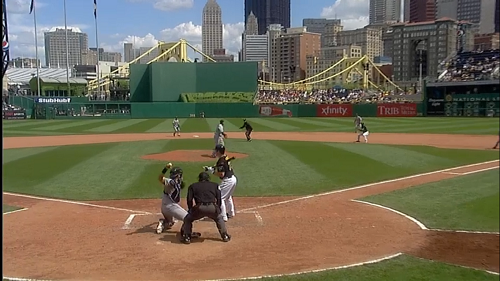
This was a big part of the play. Marte stumbled when he got his jump, and when Montero cocked to throw down, Marte stopped in his tracks. So the first step toward Montero keeping Marte from second was Marte deciding to not run to second anymore.
(2) Starling Marte actively ran away from second base
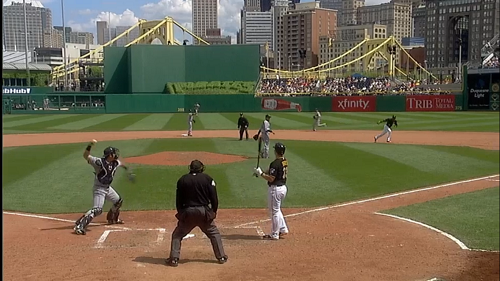
Marte didn’t just stop in his tracks. I mean, he did do that, but then he immediately began to retreat. This was another big part of the play. The second step toward Montero keeping Marte from second was Marte choosing to run away from second instead of right at it. Montero threw to first base, and Marte became involved in a short-lived pickle. He was tagged, and that’s how Jesus Montero threw out Starling Marte attempting to steal second base.
So Montero is now 1-for-16. Based on the evidence, here is how 2013 Jesus Montero prevents runners from stealing second:
- runner stops on the way to second
- runner goes in opposite direction
Congratulations to Jesus Montero for showing the rest of the league how it’s done. And to think there are people who don’t think Montero is a catcher long-term. There are lots of long-term catchers out there still looking for their first success in gunning down Starling Marte on the bases.
Learning to Pitch
This morning afternoon day, the Mariners won a game, after Felix Hernandez shut down the Pirates despite not really seeming to have his best stuff. Granted, the Pirates’ offense isn’t nearly as intimidating as actual pirates, or at least as actual pirates would’ve been a few hundred years ago, but so far they’ve been middle of the pack, and it’s not like Felix turned in this start in isolation. This was the fifth start in a row that Felix allowed one or zero earned runs, and his ERA is now exactly half his ERA from last season. His ERA last season was good! ERA is being used because this post is unscientific in nature.
There’s an old expression that gets slapped onto young guys who throw hard: they need to learn how to pitch, not throw. It’s so vague as to be completely unhelpful, and I generally can’t stand it when it’s used on phenoms and prospects, but at its core is the right message. There is an art to pitching, and it’s a hell of a lot more complicated than throwing the ball 97 miles per hour somewhere and trying to get a swing and miss. You need to have multiple pitches, you need to know how to command them, and you need to know how to mix them up in mostly unpredictable patterns. Some people are just naturally gifted at throwing, but that’ll only get them noticed, and it’s challenging to get to the bigs and stick in the bigs. The biggest idiot big-league veteran still understands better than most how to do his job.
I was asked in my latest FanGraphs chat about, I don’t know, someone, some young pitcher who throws really hard and has a famous fastball. The name escapes me and the name doesn’t matter. That pitcher, whoever he is, might have some initial success just on account of his raw stuff, but when the league adjusts he’ll have to adjust back. When he loses velocity as he gets older, he’ll have to make up for it. A gifted young pitcher still needs to develop, and we can all think of examples of pitchers who didn’t.
In the course of writing this I’ve been interrupted by several text messages, so I already hate the way this post flows, but I’m thinking about that old expression and the King, on the heels of his latest greatness. Felix, as a rookie, had immediate, outstanding success, the sort of success that led us all to believe he couldn’t possibly struggle. Seriously, that’s what I recall as we headed into 2006 — I recall thinking “Felix doesn’t have any downside.” Subsequent years would reveal that Felix still had a lot of work to do, but as his fastball deteriorated, his numbers bounced back. Felix, now, looks only a little like the guy he was in 2005. Felix, now, looks almost identical to the guy he was in 2005. There are throwers, and there are pitchers. Felix has been amazing as both of them.
This is all to set up just a few factoids. The following, courtesy of Baseball Info Solutions, won’t take you by surprise:
2005: 96mph average fastball
2013: 91mph average fastball
Every so often Felix used to rush it up there in or near the triple digits. Somewhat alarmingly, now I feel good when I see him hit 93. I say “somewhat alarmingly,” because while velocity loss is cause for alarm, it’s hard to panic when the results look like Felix’s results. He’s clearly not broken, and now for another comparison, updated to include today’s eight-inning gem:
2005: 2.67 ERA, 2.85 FIP, 2.77 xFIP
2013: 1.53 ERA, 2.16 FIP, 2.66 xFIP
Felix is all the way back to his incredible rookie results with a fraction — albeit a big fraction — of the stuff. More generally, this year stands as continuing evidence that Felix has evolved as he’s needed to as the years have gone on. No longer capable of doing what he did, Felix is doing what he did, in another way. In a more polished, intelligent way.
With less of a fastball, Felix worked on his patterns. With less of a fastball, Felix worked on his location. With less of a fastball, Felix mastered the changeup, then he mastered that mastered changeup. We aren’t to the point yet where we can say that Felix is thriving as a finesse pitcher, but what’s crazy is that such an idea isn’t wild or unrealistic. Ten years from now, that could be Felix. He’s lost five ticks off his heater — what would be five more? He’s slowed down without slowing down.
Felix is perfect. Felix has worked out perfectly. While Felix still allows hits and runs, what needs to be appreciated is that this is what it looks like when a prospect reaches his ceiling. Prospects are always being evaluated on their ceilings by idiots, and those people are idiots because prospects don’t actually reach their ceilings. Ceilings are virtually unreachable, but here’s Felix, who got there and who then figured it out. His stuff was unbelievable, and it all still moves like pitches shouldn’t. Felix has demonstrated maturity and dedication, and there’s no questioning his loyalty, and while I remember Felix getting blasted by Will Carroll for having violent mechanics, Felix to this point has stayed almost perfectly healthy. When Felix got to the majors, he was great. When he struggled in the majors, he actually made all the adjustments that he needed to make. It took him a few years, but Felix was 23 when he was the Cy Young runner-up. He was 24 when he actually won it. At just about every fork in the road, Felix has followed the right path. There’s no question he’s unusually blessed, but Felix put his work in. He actually learned to pitch, when he found out what’s what he needed to do.
I hate this post. I don’t think it conveys the idea I want it to, and I think it’s pretty poorly written. Thankfully, people seldom notice bad baseball writing, given the pool of people selected to write about baseball. Here’s a takeaway point: Felix is a pitcher, and because of that, we’re constantly worried. He’s the best pitcher on this team. He’s the best player on this team. He is this team, even though this team isn’t very good. We’re constantly worried about his health and about his ability to keep being dominant while his fastball slows down further and further. All of our worries — they’ve pretty much all been in our own heads. Felix hasn’t actually given us a reason to worry. Felix has been amazing, and he still is, despite it all. These days he’s been pitching as well as he ever has.
Roy Halladay needs shoulder surgery, and it’s an operation that involves his labrum, so there’s no telling how he’s going to come back. It’s a devastating blow to the Phillies, who previously saw Halladay as automatic. It’s something we’re all going to keep in mind, because pitchers are healthy until they aren’t. But the only worry about Felix is worry because he’s a pitcher. There’s not a single reason to worry about Felix otherwise. There’s nothing that’s Felix-specific. Felix is an ace, and he’s ours, and he’s perfect.
Game 35, Mariners at Pirates
King Felix vs. AJ Burnett, 9:35am
Happy Felix Morning!
The M’s ace faces off against the Pirates unlikely reclamation-project-turned-ace in AJ Burnett. Burnett famously slumped through three seasons in New York, but a return to the national league seems to have energized him. He posted a 3 WAR season last year at age 35, and is off to a fast start this year (he’s at 1.2 WAR through 40+ IP). Sure, you can adjust for quality of batters faced and the overall league quality, but the man has 57 strikeouts in his 42 innings and a FIP in the low 2’s. He’s still the same pitcher he’s always been – a four-seam and two-seam fastball and a big curveball. He’ll throw in the rare change-up, but primarily, he’s a a fastball/curveball guy, just as he was when he was coming up with the Marlins years ago.
He’s a bit above average in generating ground balls too, which is a bit concerning. The M’s seem to be struggling against ground-ball pitchers this year, as they demonstrated last night in flailing against spot-starter Jeanmar Gomez. This is most likely just noise, but it’ll be interesting to see if it persists.
Line-up:
1: Saunders, CF
2: Bay, LF
3: Seager, 3B
4: Morales, 1B
5: Ackley, 2B
6: Montero, C
7: Chavez, RF
8: Andino, SS
9: Felix Hernandez
Go Felix!
Game 34, Mariners at Pirates
Aaron Harang vs. James McDonald Jeanmar Gomez, 4:05pm
There are rivals, interleague “natural” rivals, and then there are teams like the Pirates, who exist solely on the ESPN crawl, in 1979-Pops-Stargell highlights, and old Barry Bonds baseball cards. I know about them – I know some of their players, I know their new ballpark looks gorgeous, know all about their 20-year plan for a winning season, and about the new-school front office that was going to instill a new culture and build a sustainable winner within 5 years. But I just don’t think about them. It’s harder and harder for teams to exist like this. With so much coverage, and with mlb.tv, mlb network, etc., you’re going to hear about it when Andrew McCutchen develops into a star. As a kid, I was fascinated by the Montreal Expos and their ‘other’ness. Their radio announcers spoke French. Their pitchers hit. They had all of these stars (the had a *catcher* who could seriously hit. Not just “not bad for a catcher” but real, actual hitting. This was more bizarre to me than the French thing, honestly) who existed in This Week in Baseball highlights and as All-Star Game ringers, but I had no sense of them as a team. That’s the Pirates for me now.*
Righty James McDonald starts tonight’s game. He’s a fastball/curve/slider pitcher who’s never quite put it all together. At one point, he had an above average fastball and a decent curve, and who looked like he could become a #3 in the Pirates rotation. He started experimenting with a slider, and got incredible results with it, so he used it as his two-strike outpitch in 2012 and raced off to a brilliant first half. Then, just as suddenly, he collapsed again. His first-half FIP of 3.00 turned into a second-half FIP of 6.37 and he was back to being the same old frustrating #4/5 starter on a below-.500 team. It’s fascinating, because his slider still got good results, even in 2012. His curve was solid too, even when hitters put it in play in the second half. His problem seemed to be that he couldn’t get into those two-strike counts, and when he’s behind, he relies heavily on his four-seam fastball. It’s a perfectly understandable, perfectly rational approach that 80% of MLB pitchers use, but it’s not working for McDonald.
Aaand now it would appear that McDonald’s been scratched and put on the 15-day DL. Huh. Taking his place is righty Jeanmar Gomez, a sinker-slider guy with a change-up against lefties. Gomez is a pitch-to-contact, groundball guy who came over from the Indians organization. He doesn’t miss many bats, has poor control, and a bit of a home run problem. If that sounds like a replacement-level starter, you’re dead on. He’s pitched about one full season over the course of his career with a FIP of about 5, good for 0.1 WAR. It’s a bit surprising that his platoon splits aren’t higher, considering his repertoire and arm-angle, but it’s just that he’s been bad against righties and lefties alike. The M’s start Aaron Harang tonight, so it’s not like this is a total mismatch on paper, but this is a game the M’s need to win. The Pirates aren’t a bad team, and they’re playing at home, but the M’s caught a break, and they should capitalize. To add to the Pirates problems, catcher/pitch-framer Russell Martin’s out with a neck injury, so the M’s get to face a B-team battery.
Line-up:
1: Saunders, CF
2: Bay, LF
3: Seager, 3B
4: Morse, RF
5: Smoak, 1B
6: Ackley, 2B
7: Shoppach, C
8: Ryan, SS
9: Harang, SP
No Morales, as the M’s lose the DH. We’ll see how many starts Morales gets at 1B in NL stadiums this year.
Reigning PCL pitcher of the week Jeremy Bonderman takes the hill for Tacoma in Oklahoma City today, and Roenis Elias leads Jackson against Huntsville.
The Rainiers won the final game of their homestand behind Andrew Carraway and homers from Corey Patterson and Carlos Peguero. Victor Sanchez lost his first decision of the year yesterday, but is still pitching beyond his years in full-season ball.
Go M’s!
* First thing I thought of when I thought about the Pirates just now: this game. The game in Safeco when Jeff Weaver shut out the Pirates on four hits, despite coming into the game with an ERA over 10, and 0-6 record, one DL trip for “tendinitis”, and generally being the worst pitcher in the league up to that point.
Keeping Things in Context
I debated whether or not to write this post, since I know that it’s just going to be fuel for the fire for those who believe that I’m constantly looking for the negative side of things, and only have bad things to say about the organization. But, I don’t really want to let perception drive what I write, and I think there’s an important lesson in the following piece of data, so I’m going to share it, even if people just take it as more Debbie Downer talk.
Over the last few weeks, the Mariners have played a lot better than they did the first few weeks. In the last 14 days, they’ve gone 8-5, mostly propelled by an offense that put up a 123 wRC+ that rates 4th best in baseball during that time frame. The moribund offense of the first 23 games has sprung to life, led by Michael Saunders, Kyle Seager, and a rejuvenated Dustin Ackley and Justin Smoak. This hasn’t just been the veterans carrying the young kids; the guys who are supposed to be part of the core have been tearing the cover off the ball.
Even just over a two week span, a .275/.344/.451 stretch fuels optimism. The Mariners spent their winter trying to upgrade the offense, and it’s finally paying dividends. Get encouraged, right?
Well, sure, it’s nice to see them swinging the bats well and scoring runs, but just looking at the raw results can be a bit deceptive. Context is everything in baseball. 10 runs at Coors Field is not the same thing as 10 runs at Safeco Field. You always have to put numbers in context. And in this case, the primary variable over the last two weeks has been the lousy quality of opposing pitching.
The Mariners last 13 games have come against the Angels, Orioles, Blue Jays, and Astros. Those four teams rank 27th, 28th, 29th, and 30th respectively in xFIP, making them the four worst pitching staffs (to date) of 2013 by BB/K/GB rates. The Mariners hit well against four teams that everyone is hitting well against. In fact, the Mariners hit almost exactly the same against those four teams as the rest of the league has.
Mariners, last two weeks: .275/.344/.451
MLB, vs BAL/TOR/HOU/LAA: .267/.345/.442
Now, hitting the league average against those teams is still a vast improvement over what the team did in the first 23 games, so I’m not trying to say that there haven’t been any positive signs for the team the last couple of weeks. Michael Saunders is showing that last year’s improvements are sustainable, and might even be a foundation for bigger and better things. Kyle Seager has more power than we’ve all given him credit for. Dustin Ackley no longer looks hopelessly lost. These are good things.
But the Mariners offensive improvement the last few weeks has been heavily influenced by facing some terrible pitching staffs, and not just bad pitching staffs, but fill-ins on bad pitching staffs.
With Jered Weaver on the DL, Garrett Richards has been forced into the Angels rotation, and he started in lieu of the Angels ace. With Josh Johnson hitting the DL right before the M’s got to Toronto, they missed out on a good pitcher and were instead able to feast on the still broken Ricky Romero, who got optioned to A-ball after spring training for a reason. The Orioles called up Zach Britton to make a spot start against the M’s, then shipped him right back to Triple-A after the game. The guy who came in to relieve Wei-Yin Chen in the final game against the Orioles was just DFA’d, cleared waivers, and is going to be turned into a knuckleball pitcher after his traditional arsenal was deemed a failure. And the Astros are the Astros.
There’s a reason the Mariners offense looked so terrible against Detroit and Texas – they had to run a gauntlet of the best pitchers the AL has to offer. Those two teams rank #1 and #2 in 2013 pitching by nearly any reasonable metric you want to use, and the M’s ran into their best pitchers. Just as you shouldn’t have been too down that the M’s couldn’t hit Darvish, Verlander, and Scherzer, you shouldn’t be too excited that the M’s could hit Romero, Britton, and Richards.
This is why so many narratives about a player or team heating up or going into a big slump are simply B.S. In reality, many of these fluctuations are just due to the quality of opposition faced, and the Mariners have followed up a run of facing elite starters with a couple of weeks against baseball’s worst pitching staffs. Of course they looked better facing guys who belong in Triple-A than guys who belong in the All-Star Game.
That’s why you adjust for context. And when you look at the staffs the Mariners have faced the last few weeks, their recent performance looks more average than spectacular. Average is still a nice step up from the first few weeks of the season, but don’t be too shocked if this new and improved line-up doesn’t keep hitting the same way against PIT/OAK/NYY. You have to recalibrate your expectations for what a good performance looks like based on the opposing pitcher, the ballpark the game is being played in, and even the month of the year. For the Mariners, they happened to get a nice gift from the schedule makers. Now, though, they’ll actually have to show that they can hit real MLB pitchers, or else another slump is on the way.