
Dave’s 2012 Off-Season Plan (Part One)
So, I’ve been rolling these posts out every winter for about a decade now, but this year, I’m actually doing two of these posts. As you’ve probably gathered from my musings over the last few months, I’m of the opinion that the M’s should target a certain first baseman from the Cincinnati Reds this winter, and make acquiring him priority #1. However, there is the potential reality that the Reds just might not be willing to trade him, even if the Mariners put together an extremely strong offer in order to try to change their minds.
The moves in this post are all predicated upon the fact that the M’s could potentially acquire Joey Votto. The roster below really only works if he’s on it, and the rest of the moves were made with the assumption that he’s now anchoring the team’s offense. If he’s not on it, different moves would have to be made. So, we’re doing two Off-Season Plan plan posts this year – one where Votto can be had and one where he can’t. In this scenario, he can be. We’ll deal with Plan B next week.
On to the moves, many of which I’ve tried to lay the groundwork for in prior posts.
Transactions
Trade RHP Michael Pineda, RHP Brandon League, OF Greg Halman, 3B Chone Figgins (with Seattle absorbing $16 of remaining $17 million on Figgins’ contract), and SS Carlos Triunfel to Cincinnati for 1B Joey Votto and C Yasmani Grandal.
Trade 1B Mike Carp to Milwaukee for 3B Casey McGehee and RHP Marco Estrada.
Trade OF Michael Saunders and RHP Dan Cortes to Florida for RHP Chris Volstad.
Trade LHP Cesar Jimenez to New York for OF Angel Pagan.
Sign Chris Snyder to a 1 year, $3 million contract.
Sign Erik Bedard to a 1 year, $4 million contract.
Sign Jamie Moyer to a 1 year, $500,000 contract.
The big move is obviously the Votto acquisition. The team pays a high price by surrendering Pineda+ to get him, but when you’re trying ta acquire MVP-caliber talent, you have to put a knockout package on the table. With the pitching staff taking a hit to bring Votto in, many of the other moves are made to replenish the depth lost in the main deal.
Carp is an expendable piece whose strong second half would likely fetch a couple of solid role players in retrun. With Prince Fielder on his way out, the Brewers could use a power hitting left-handed first baseman, and they’re not likely to let Mat Gamel come to spring training without competition for the job. Estrada is an interesting arm who Wedge may should be comfortable giving the closer’s title to out of spring training, but could potentially move into a rotation role if Tom Wilhelmsen proves ready for 9th inning duty at some point during the summer. McGehee gives the team flexibility at third base and a right-handed bat with some power that they’re lacking.
Volstad essentially replaces Pineda in the rotation, as the M’s get another young hurler with problems against LHBs, though the upside is substantially lower. The Marlins would almost certainly part with their frustrating young hurler, and Saunders and Cortes both offer enough tools to sell as change-of-scenery upside buys for Florida.
Pagan is a perfect complement to Casper Wells in left field and offers a legitimate alternative to Franklin Gutierrez if his health continues to be a problem. The M’s can offer Jimenez and his always intriguing K rates from an LHP to the Mets to convince them to tender him a contract rather than putting him out on the free agent market in December.
Finally, the team finishes with three one year contracts to health risk free agents, adding depth and some upside without parting with much cash. Snyder offers a decent approach at the plate and sets up a job-share at catcher. Bedard returns to the friendly confines of Safeco Field to once again try to spend more than half a season on the mound and rebuild some value. Moyer comes back to the place he was most successful to try to sustain his career. For relative peanuts, the team gets three guys who may not be workhorses, but offer intriguing possibilities for when they are on the field and give the team depth at positions of weakness.
That collection of moves, combined with the remaining talent already in the organization, gives us the following team.
The Roster
| Position | Name | PA/IP | WAR | Salary |
|---|---|---|---|---|
| Starters | ||||
| C | Chris Snyder | 300 | 1 | $3,000,000 |
| 1B | Joey Votto | 600 | 6 | $9,500,000 |
| 2B | Dustin Ackley | 600 | 3 | $1,500,000 |
| SS | Brendan Ryan | 500 | 1.5 | $1,750,000 |
| 3B | Casey McGehee | 500 | 1.5 | $2,500,000 |
| LF | Angel Pagan | 500 | 2 | $5,000,000 |
| CF | Franklin Gutierrez | 600 | 2.5 | $5,813,000 |
| RF | Ichiro Suzuki | 600 | 2 | $18,000,000 |
| DH | Justin Smoak | 600 | 2 | $450,000 |
| Reserves | ||||
| C | Miguel Olivo | 300 | 0.5 | $3,750,000 |
| IF | Luis Rodriguez | 200 | 0.5 | $450,000 |
| IF | Kyle Seager | 350 | 1 | $450,000 |
| OF | Casper Wells | 300 | 1 | $450,000 |
| Rotation | ||||
| SP | Felix Hernandez | 220 | 6 | $19,200,000 |
| SP | Jason Vargas | 180 | 2.5 | $4,000,000 |
| SP | Chris Volstad | 180 | 2.5 | $2,000,000 |
| SP | Erik Bedard | 120 | 2 | $4,000,000 |
| SP | Jamie Moyer | 100 | 0 | $500,000 |
| Bullpen | ||||
| CL | Marco Estrada | 60 | 0.5 | $450,000 |
| RP | Tom Wilhelmsen | 60 | 0.5 | $450,000 |
| RP | Shawn Kelley | 60 | 0.5 | $450,000 |
| RP | Charlie Furbush | 60 | 0.5 | $450,000 |
| RP | Josh Lueke | 60 | 0.5 | $450,000 |
| RP | Chance Ruffin | 60 | 0 | $450,000 |
| RP | Blake Beavan | 120 | 0 | $450,000 |
| Banished | ||||
| Chone Figgins | 0 | 0 | $8,000,000 | |
| Total | 40 | $93,463,000 |
By acquiring a lower salaried star in Votto, there was enough money left to fill various holes with useful role players and not have to expand the budget from beyond where it was last year. This roster is essentially do-able for what the team has been spending historically, and while it’s not as good as what Texas will put on the field next year, it’s not that far from being a contender.
The roster projects out right around +40 WAR, which is roughly an 83 win team. However, there’s upside here – Gutierrez, Pagan, and Ichiro were all substantially better than their projected values in the recent past, while Ackley, Smoak, and Volstad all have enough talent to surpass what is expected of them here. Potential second-half additions in Danny Hultzen and James Paxton could bolster the pitching staff, but would only be summoned if they had shown they were ready for the show.
You’d need breaks to go your way, some good luck with guys staying healthy, and perhaps a breakthrough performance from a couple of the relievers to solidify the bullpen, but contending is a possibility for this squad. At the very least, they should be able to play respectable baseball and get fans excited about coming to Safeco Field once again.
The other benefit – the team still retains most of their long term cost flexibility for the 2013 off-season. Unlike locking yourself into a free agent who will eat up a huge part of the budget for the foreseeable future, this roster gives you the ability to make adjustments going forward. It’s a path to putting a good team on the field without requiring an all-in bet on one player. It gives the Mariners the chance to be good without destroying their future if one big ticket acquisition fails to live up to his hefty contract.
For me, this would be Plan A. Go balls to the wall to get Votto, and then do what’s necessary to fill in the pieces around him to make this a respectable team who could potentially contend in 2012 and would be setup well for 2013 and beyond. If the Reds decide not to play ball when discussing their first baseman… well, we’ll get to Plan B later.
A Few Thoughts On Yu Darvish
Originally, I was hoping to have my Offseason Plan post done by yesterday. A weekend fever nixed that idea – please return soon, immune system – and I’m now going to push it back to tomorrow. But, in the meantime, I thought I’d link to three posts we did over at FanGraphs today on Yu Darvish, who is someone that the Mariners are connected to from time to time.
First off, Patrick Newman has some background on Darvish, and includes a link to the full broadcast of his final start of the season. If you’ve never seen Darvish pitch but wanted to, make sure to check that out.
Next up was Eno Sarris, who explained why Darvish is different than Dice-K. They’re just not the same pitcher, and while comparisons are inevitable due to the posting process and their backgrounds, using Matsuzaka’s career as a template for what to expect from Darvish just isn’t a very good idea.
Finally, I weighed in on the kind of contract Darvish should be able to command after he’s posted, and point out why I think the current rumored prices are something close to insane.
I’m in the camp of the M’s doing whatever it takes to improve this winter, and if upgrading the pitching staff was the best way to do it, then I’d be all in favor of bringing Darvish on board. I hope the team has at least thoroughly evaluated him and created an informed opinion on his future expected performance. Just like every other player who is available this winter, I think it’s fair to expect the M’s to weigh whether he’s a player they should pursue.
However, if the posting fee is going to be $40-$50 million and he’s going to want a Felix-like contract in order to sign, that’s just too steep for my blood, even if the posting fee comes from a separate budget and doesn’t count against player payroll. While Darvish sounds like an interesting talent, the hype here is pretty large, and the lack of viable alternatives for teams who want to acquire pitching will probably drive his price beyond reason.
My guess – and this is just a guess – is that the team could do better by spending their money elsewhere. Darvish won’t be a part of my Offseason Plan.
What A Playoff Team Looks Like
A few weeks ago, David Appelman quietly updated the leaderboards over at FanGraphs, and one of the improvements was to integrate the team and league pages into the same format, making it far easier to view various teams and units over the years. While playing around with some of the data tonight, I realized that I could give a pretty decent overview of what the organization needs to pull off this winter if they’re serious about making the 2012 team a contender.
Here’s the top 10 teams in 2011, sorted by total team WAR:
1. Texas, +60.6
2. New York, +59.9
3. Boston, +59.5
4. Philadelphia, +51.6
5. Milwaukee, +51.0
6. St. Louis, +48.6
7. Detroit, +48.0
8. Arizona, +47.4
9. Tampa Bay, +46.1
10. Anaheim, +43.8
First off, you should notice right away that WAR works pretty darn well – the eight playoff teams all rank in the top nine in baseball, and the Red Sox collapse was the only reason that it wasn’t eight for eight. Next time you think we’re just dabbling in nerd stats that don’t reflect the game on the field, just remember that the correlation between team WAR and team Win% is very high.
The other thing you’ll notice is that all of the playoff teams had at least +45 WAR, and to win a division, you generally had to be around +50 WAR. Because the system assumes that a replacement level team would win about 43 games in a season, +38 WAR is basically a .500 club – you need to get into the upper-40s to be a legitimate contender.
The 2011 Mariners posted +22.6 WAR, or basically about half of the total they would need to make any kind of serious run at a playoff spot. A large part of the team’s low overall total is due to some horrible production from players who aren’t in the organization anymore, but even dead cat bounces fro the struggling veterans and full seasons from guys like Dustin Ackley isn’t going to push this team much past +30 WAR or so. Even if you assume the best case scenarios from guys like Felix, Pineda, Ackley, Smoak, Gutierrez, and Ichiro, you’re looking at about +20 to +25 WAR from that group, and most of the rest of the current roster are fill-ins.
This is essentially the heart of the reason I’m against signing Prince Fielder. He’s coming off the best season of his career and he was worth a total of +5.5 WAR – for his career, he’s averaged just about +3.5 WAR per season. Even if you think he’s in his prime and is going to be closer to his 2011 performance for the next few years, you’re looking at a +5 win guy at best, and he’ll be taking the spot of either Mike Carp or Justin Smoak, either of whom could be expected to give you +1 to +2 WAR for the league minimum next year.
In reality, replacing Carp with Fielder nets you maybe three or four WAR, and unfortunately, this roster is not three or four wins away from being a legitimate contender. The M’s need to add something like +10 to +15 WAR this winter – a very tall order, and one that’s basically impossible if you throw your entire budget at one player. Despite all the calls for a “big bat” or a “star hitter”, this is an organization that needs to upgrade a bunch of places all at once, and that means they need to look for value. They have to get a huge return on several low cost investments, and they can’t do that if they tie up all of their resources to acquire one player.
Now, maybe you look at the gap in where the roster is and where it needs to be, and you determine that it’s too much work for one winter. I can understand that perspective, but even if you take that view, you still can’t really justify throwing something like $25 million per year at Fielder. The wins he’d add in 2012 wouldn’t be enough to make a huge difference, and you’d essentially be betting that Fielder would remain productive enough to justify his salary by the time you got around to making his teammates good enough to contend.
The Mariners aren’t one player away, even if that one player is Albert Pujols. The Mariners are 3-4 good players away from contention, and because of that reality, their offseason plan needs to consist of something besides “spend a lot of money on one premium guy.” That won’t be enough. They have to do more than just bring in one high paid star player, or else we’ll just be looking at another season as an also ran.
The Easiest Move Of The Winter
“It would be pretty easy negotiation. All I want it the opportunity to come to spring training with the chance to compete for a starting job. I want to pitch. I wouldn’t go to a team I didn’t have a chance to make.”
The Mariners finished the season by giving Anthony Vazquez the ball every sixth day. In terms of upper level pitching depth, they have a guy who has never pitched in the minor leagues and a guy who spent most of last year in low-A ball. The guy penciled in as their current #4 starter struck out just 10.4% of the batters he faced last year.
The Mariners have a massive, glaring hole at the back-end of their rotation. Danny Hultzen and James Paxton might be able to help at some point next year, but you certainly don’t want to come to camp needing them to make the team. The organization needs arms who can hold down the fort until the kids are ready, and won’t cost much to serve as placeholders until they’re ready.
All Moyer wants is a minor league contract with an invite to spring training and a chance to make a big league club. Yes, he’s 49 and he throws a fastball that averages 81 MPH, but Moyer has never stopped being a decent Major League pitcher. In 2010, his K/BB ratio was 3.15 – Felix Hernandez’s career mark is 2.98. He’s not anything close to a savior, but when he’s healthy, he’s still a viable starting picher, and Safeco Field would mask his one significant flaw – giving up the long ball.
He still lives in Seattle. He wants to pitch in the Major Leagues next year. The Mariners need pitching depth.
This should be the most obvious transaction of the winter. Sign Jamie Moyer.
It’s Not Either Or
When I rolled out a few suggestions last week for low-cost players that I’d like to see the M’s go after, one of the common responses was that guys like Casey McGehee or Angel Pagan weren’t appreciably better than the younger players that were already here, with the idea being that the team shouldn’t bother bringing in any players who aren’t likely to provide significant upgrades at the team’s weak spots. This is one of the ideas that I most strongly disagree with, as it presents roster construction as a false choice of either this guy or that guy, when in reality, good teams give themselves the ability to have both.
For instance, let’s focus on third base for a second. Kyle Seager certainly has his supporters who feel that his performance last year should be enough to earn him regular playing time at the hot corner in 2012. As a guy whose only glaring flaw is his inability to hit left-handed pitching, he offers an overall package that projects as a +1 to +2 win player, and he could fill that spot for the league minimum. Because of his presence, quite a few people think the M’s should just leave third base alone and spend their resources elsewhere.
The problem is that the choice at third base isn’t really Seager or McGehee (or any other similar type of player), but that in reality, it’s just Seager or Seager and McGehee. If the M’s decide to go into 2012 with Seager as the starting third baseman, then their options for a backup plan at the position become pretty limited. You’re not going to lure any useful role players to Seattle unless you dangle playing time in front of their face – they’re not coming for the winning atmosphere or the hitter friendly ballpark, that’s for sure – and if you give Seager the starting 3B job, you’re quickly out of carrots to get another decent third baseman onto the roster.
So, then, you’re hanging all of your hopes on Seager producing next year, and if he doesn’t, the team is basically screwed. Alex Liddi isn’t ready. I still like Luis Rodriguez, but if he’s the team’s starting third baseman for long stretches next year, something went very wrong. We could sit around hoping that Chone Figgins remembers how to hit, but I’m not holding my breath waiting for that while the coaching staff yells “AGGRESSIVENESS” at everyone who goes up to bat, and I’d imagine the team will try to move him in a bad contract swap this winter anyway.
The M’s simply have no depth at third base, so sticking with the status quo forces the team to put all of their eggs in one unproven basket. Despite the quantity of left fielders on the roster, I’d argue the team is in the same position out there, as Casper Wells is the only guy on the roster that looks like he should get any real playing time at the position next year, and he’s probably not good enough to be a full-time guy either.
The M’s don’t just need one great hitter to “transform the line-up” – they need several decent hitters to stop them from running out a line-up full of black holes again. Here’s the team’s OPS by position in 2011, and where that ranked in MLB:
Catcher: .616 (26th)
First Base: .760 (20th)
Second Base: .736 (9th)
Shortstop: .659 (21st)
Third Base: .526 (30th)
Left Field: .649 (26th)
Center Field: .532 (30th)
Right Field: .639 (30th)
Designated Hitter: .648 (14th of 14 AL teams)
If you think one good hitting 1B/DH type is going to fix those problems, I don’t know what to tell you. The team is basically locked into hoping for rebounds in CF/RF, as Gutierrez and Ichiro have established track records that suggest they should be significantly better and contracts that strongly push the team to give them another chance, but C/3B/LF are still going to be glaring holes even if you sign a guy like Prince Fielder.
A significant part of the Mariners problems the last few years have been in having inadequate backup plans for when the guy being counted doesn’t perform. When the team got rid of Milton Bradley last year, they had to turn to Carlos Peguero because they didn’t have a Major League left fielder anywhere in the organization. When Chone Figgins showed he still couldn’t hit, the team turned to Adam Kennedy, and that went about as well as expected. When Miguel Olivo posted a .250 OBP, he still played everyday because the alternatives were Chris Gimenez and Josh Bard.
The 2012 Mariners should not go into the season so unprepared. It would be great if Seager showed he can hit enough to be a full-time player, Wells established himself as more than a fourth outfielder, Carp remembered how to take a base on balls once in a while, and Gutierrez and Ichiro rebounded to prior levels, but the reality is that the team cannot count on any of those things happening. They have to have realistic alternatives in place so that we don’t get another summer of ridiculous line-ups where Kennedy and Olivo are hitting back-to-back in the middle of the order.
Bringing in useful role players like McGehee, Snyder, and Pagan would provide depth that could insulate the team from having to rely on minor league players and guys that simply don’t belong in the big leagues in the first place. By simply going from atrocious to decent at a few positions, the team could get a more substantial offensive upgrade than they could by throwing huge gobs of cash at one player, no matter how good of a hitter he is.
The Mariners can’t be an all-their-eggs-in-one-basket team anymore. They can’t count on Prince Fielder to save their offense, and they can’t count on guys like Seager, Wells, or Carp to perform as regulars without any safety net. There’s spots for some of those guys on the roster, but the team has to make sure that the 2012 offense will still be decent whether those guys perform or not. They should be viewed as upside plays who can provide value in expanded roles if they earn those positions, but should not be counted on to be regular players from day one.
It’s not either the kids or the veterans. This is a team that needs some veterans to make sure that the team doesn’t sink with the kids once again.
Another Quick Update On My Health
For the most part, we try to keep this blog focused on the baseball, and more specifically, on the Mariners. But, I also know that there’s something of a community here, and a lot of you are interested in how my recovery is going. So, since I haven’t been up to writing about baseball this week, I thought I’d give you guys a quick update on how I’m feeling.
I checked back into the hospital on Tuesday for my second round (of three) consolidation chemotherapy regimens. I’m still in remission, and there’s no evidence the leukemia has returned, but tests have shown over time that giving multiple rounds of chemotherapy even after a patient is already in remission lowers the chances of recurrence. So, even though there’s no cancer to be nuked out of my body at the moment, we’re not done with chemo just yet.
These treatments aren’t as intensive as the induction treatment I got when initially diagnosed, but they still aren’t that much fun. Over the course of six days, I get six doses of chemo, each lasting for three hours. They take a pretty big toll on my energy level, and while the side effects are mostly limited to just nausea and fatigue, it’s not exactly a fun week.
I get released on Sunday, and will then get approximately six weeks at home before my next treatment begins. Of that, I’ll likely be restricted to my house for 3-4 of those weeks while my immune system is at it’s nadir and I need to be kept away from potential sicklies wandering in the real world. It’s not complete house arrest, but it’s not too terribly far from it – thankfully, I like my house.
My final treatment will come right after Thanksgiving, and if all continues to go well, I should hopefully be done by the end of the year, and hopefully 2012 will be mostly normal. I’ll still need to go into the clinic twice-a-week for blood tests to confirm that the leukemia has not returned, but as long as it doesn’t return, then it will just be maintenance more than therapy.
Leukemia is the kind of disease that isn’t just cured overnight, so we’ve got about five years of having it not return before I’ll get a clean bill of health, but we’re encouraged that we’re about three months in and it still hasn’t returned. This journey is far from being over, but so far, so good. I’d had hoped that I’d been able to write more during treatment, but it is what it is – hopefully next year I’ll be able to return to a more full writing schedule here.
To everyone here who has been so supportive, a sincere thanks – my friends and family who have found the posts with your well wishes were truly touched, and your kind words meant a lot. Thanks for bearing with us through this time. I look forward to having another USSM gathering next year and getting to hang out with all of you again in person.
Who is Forrest Snow, and Why Is He Smiling?
Seattle native Forrest Snow got some attention by moving from single A Clinton to AAA Tacoma this year, but his arsenal was something of a mystery. How’d a guy that got shelled at the University of Washington shut down a AAA line-up? How is a guy with a poor FIP above class A shutting down the Arizona Fall League? Today offered our first nibble of pitch fx data on Snow, and while he wasn’t quite as dominant today as he was earlier in the month, and while he’ll likely be upstaged by Danny Hultzen, he showed enough stuff to prove that this isn’t purely luck. Snow’s legit, and he’s opening some eyes in the AFL.
Snow graduated from noted baseball powerhouse Lakeside then spent three years as a UW Husky. He struck out a batter an inning, but a poor walk rate and a worse HR rate made his RA look ugly (7.3!), so his draft stock in 2010 wasn’t exactly Hultzenesque. He was picked in the 36th round, and signed quickly enough to make 10 appearances with Everett the same year (all in relief). He moved into the rotation to start 2011 with the Clinton Lumberkings, and while he was effective, he was overshadowed by the breakout performances of Taijuan Walker and James Paxton. He moved up to high A High Desert where HRs again proved an issue, then came up to Tacoma in July. He made a few appearances in relief, but turned in two very solid starts including this 7-IP gem against Omaha. After starting the year facing teenagers in the MWL, his strikeout rate peaked in Tacoma (in the run-addled PCL).
The M’s sent Snow to the Arizona Fall League this year, and he’s been lights out so far, pitching 6 1/3 scoreless innings, giving up one hit, one walk while striking out eight. He had a reputation in Tacoma as a hard worker, but I still didn’t know if his stuff was fringe-y. Today, we got our first look at pitch FX data on Snow; it’s only a seven batter sample, but it’s something. Snow throws a low-90s fastball (he touched 94, but averaged 92mph with his fastball today), a change-up and a slider/slurve. In Tacoma, his change-up was reputed to be more advanced than the slider, and while he used the change more today, it’s way too early to say much about either offering.
His fastball looked very interesting however – he threw all of 15 of them today, but they showed noticeable rise thanks to well-above average backspin. His pfx z (the vertical “drop” on his pitches”) was above MLB average – closer to guys like Jered Weaver or Josh Collmenter. But while the latter gets essentially no horizontal movement thanks to an extreme over-the-top delivery, Snow gets a ton of armside break. That should help him avoid big platoon splits, as his FB will act a bit more like two-seamers (or like a cross between a ‘jumping’ fastball and a ‘rider’ in Max Marchi’s taxonomy).
His spin rate on these pitches was actually greater than pitchers like Weaver – it was in Justin Verlander’s class. This isn’t to say that he’ll be Justin Verlander; he doesn’t throw 100mph. But according to new (proprietary) data, there may be a correlation between spin rate and swinging strikes, so this will be something to watch as Snow moves through the AFL. Along with that backspin and ‘rise’ *should* come an increased fly ball rate (and thus HR rate). To date, he hasn’t really shown clear fly-ball or grounder tendencies (he was a fly-baller in his short stint in Tacoma, but a GB guy in 2010 and in the AFL so far), so it may be that his HRs stem from a combination of movement and location (shocking, I know).
All in all, Snow’s made the biggest jump of anyone in the M’s farm system, at least amongst the youngsters (the Disney-class stories of Tom Wilhelmsen and Steve Delabar are a separate case). He’s gone from an org-level reliever to a guy who’s had a bit of success as a starter in AAA, and we now know his fastball is MLB-quality in movement and velocity. This isn’t someone who’s Vasquez’d his way past low-level hitters – he may be, as Kevin Goldstein of Baseball Prospectus noted the other day, “one of the best pitching prospects nobody has heard of.”
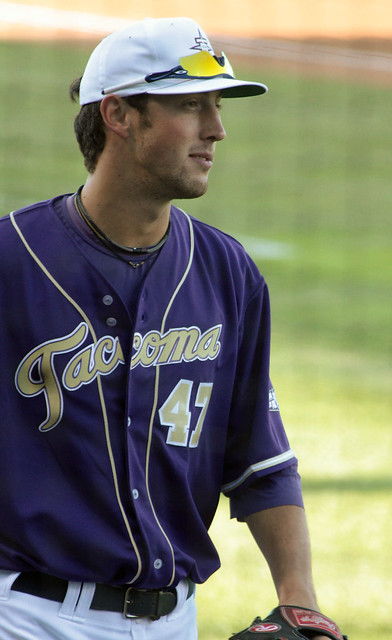
In a purple jersey one last time
Signing Godot, Part 1
Spring training.
Ichiro is sitting on the pitcher’s mound, going through his stretching routine. He bends over to grab the toe of his shoe.
It stays on.
Felix walks onto the field.
Ichiro: It’s hard to imagine.
Felix: (walking up the slope of the mound) Hard to imagine indeed. I keep trying to carry this team, telling myself to be the good guy, and it never works out, they still stink. (Pouts. To Ichiro.) What are you doing here?
Ichiro: Where?
Felix: I’m glad you’re still here, I was worried they might trade you to Cleveland like everyone else.
Ichiro: Not Cleveland!
Felix: We’re going to have a great year together. Get up so I can tickle you.
Ichiro: Only George gets to tickle me.
Felix: Well he’s not here anymore.
Ichiro: So who have they brought in this year?
Felix: The same old scrubs.
Ichiro: The same ones? Or different ones?
Felix: What does it matter?
Ichiro: Well if they were young scrubs, they would have a more positive attitude. Maybe even some potential.
Felix: What’s the good of playing the kids, I say.
Ichiro stretches again, this time pulling his shoe completely off. Reaching into his back pocket, he pulls out a small wooden stick and begins rubbing it along the bottom of his foot. After a minute, he stands up and walks awkwardly, one shoe off and the other on, off the pitcher’s mound. He reaches the grass, stops, and holds the stick up against his brow, looking over toward the dugout.
Ichiro: I’m going back to Japan.
Felix: You can’t.
Ichiro: Why not?
Felix: They’re going to sign Godot.
Ichiro: They should.
Felix: I don’t know if he’ll take their offer.
Ichiro: What if he doesn’t?
Felix: He only signs one-year contracts.
Ichiro: So was it this year he was going to sign?
Felix: I think so.
Ichiro: How do you know?
Felix: He said so.
Ichiro: So where is he?
Felix: He didn’t say he would for sure.
Ichiro: What do you mean?
Felix: It was off the record.
Ichiro: You’re sure it was this year?
Felix: He might have said it last year.
Ichiro: Did he sign last year?
Felix: I don’t know.
Ichiro: If he doesn’t sign this year, my contract will run out and I’ll go back to Japan.
Felix: I’ll probably get traded to the Red Sox.
Ichiro: We should have left in free agency instead of signing our contract extensions.
Felix: Maybe, who knows?
Ichiro: Godot.
Felix: That’s probably why he hasn’t signed yet.
Ichiro: We’ve given up our rights.
Felix: Wait, do you hear that?
Ichiro: I don’t hear anything.
Felix: Quiet.
Ichiro: I am, that’s the problem.
Felix: I thought I heard microphones for the start of a press conference.
Ichiro: For what?
Felix: Godot.
Ichiro: Probably just that woodpecker in the tree over there.
Felix: What tree?
Ichiro: The dead one.
Felix: That’s not a tree, it’s a cactus. We’re in Arizona.
Ichiro: What?
Felix: Nothing.
End of Part 1.
Credit to eponymous coward in the comments for stimulating the idea. Credit, obviously, to Samuel Beckett for the original masterpiece.
Act now!
Not literally now, since the playoffs are going on and there won’t be much roster activity until after the World Series, when free agency starts and important people start having meetings with each other and stuff. But this post is about an often forgotten reason why there ought to be a particular sense of urgency about 2012. (No, this is not an argument for the Mariners to sign Prince Fielder.)
What factor gives the Mariners a big head start on building a team that can make the playoffs, but is potentially going to disappear in the next couple of years? Let’s take a look, shall we?
Felix playing out his contract and becoming a free agent? Look, I want him to win and be happy here as much as anyone else, but is it more critical to get him his shot at a World Series than it was for any other fan favorite, whether that’s Griffey, Ichiro, or even Alvin Davis? From a budget perspective, he starts getting pretty expensive in 2012, so the real advantage has already been wasted, although he still has surplus value. Which is one reason the media will continue to gin up trade rumors regardless, so if you just want those to go away, I’m not sure even being in contention will prevent that. (Cue New York writer with, “The Mariners still need offense, so they would have a better shot at the Rangers by adding a big bat to their everyday lineup than relying on a guy who only plays once every five days. So a fair trade would involve Alex Rodriguez to plug their hole at third base, paying the difference in salary, plus throwing in a couple prospects I’ve been hyping for the past month to get warmed up for this.”)
How about the accumulated financial surplus from Safeco Field being exhausted, so that ownership hamstrings the payroll budget in the face of mounting losses and continuing attrition in fan attendance? Maybe an issue, but we don’t actually know where things stand in terms of the franchise’s internal accounting. Anyway, if the owners start crying poor from self-inflicted wounds, they’re not going to get a lot of sympathy and they know it. They’ll be under pressure to make a choice: front the cost or sell the team.
So, how about… that’s right, the AL West. That structural advantage of only having to beat out three other teams, instead of four or even five, to win your division isn’t going to last forever. It could disappear as soon as the next collective bargaining agreement, which is conveniently timed to be negotiated around the time of Jim Crane’s deadline to complete the purchase of the Houston Astros from Drayton McLane. So guess which team is the prime candidate to switch leagues in realignment. Yes, I know the Astros are terrible right now, even worse than the Mariners, but every obstacle counts and in the long term their current state doesn’t mean anything. There might be just one more season left to go, depending on what the deal is with divisions as well as potentially a different playoff structure going forward. Remember, flags fly forever, or something like that.
Upgrades That Won’t Cost An Arm Or A Leg
As we talked about last week, my perception of the roster as it stands is that the team lacks at least four solid Major League regulars – an outfielder, a third baseman, a catcher, and a starting pitcher. And, if they take my advice and dangle guys like Michael Pineda and Brandon League to get the Reds to entertain trading Joey Votto, they’ll need another starting pitcher and open up a hole in the bullpen.
Even the Yankees couldn’t fill all these holes in free agency, and the Mariners aren’t dealing with a New York sized budget, so they’ll have to bring in some players who can contribute without requiring substantial paychecks. No matter whether they end up spending on a guy like Votto, Fielder, or any other high profile star, the team needs more production from low cost guys in order to fill out the roster and keep the team from sinking due to having a few great players surrounded by a bunch of scrubs.
In this post, I’ll lay out suggestions for guys who I would target as potential acquisitions to fill needs on the roster who won’t command big paydays in 2012. They show up by order of preference, so I like the guys at the top more than at the bottom. Without further ado:
Chris Volstad, RHP, Florida
The owner of the quietest breakout season in recent memory, Volstad pulled a pretty nifty trick – in one season, he lowered his walk rate, upped his strikeout and groundball rates, and yet he still managed to see his ERA rise from where it was in 2010. The culprit – a crazy-high 25.5% HR/FB rate against left-handed batters. Volstad’s change-up is still a work in progress and he’ll always be better against RHBs than LHBs, but there’s a lot of positive regression likely to come his way in 2012, and with a bit better luck on keeping balls in the park, he could be a very useful innings eater in the middle of the rotation. He’s just 25-years-old and will be arbitration eligible for the first time, so the Mariners would control his rights for three years at discounted rates. The Marlins won’t give him away, but given that they had to watch all those home runs leave the park with their own eyes, he could probably be had for less than what he’s likely to be worth going forward.
Angel Pagan, OF, New York Mets
Perhaps one of the easiest buy-low opportunities in baseball, someone is going to get a steal with Pagan this winter. Most reports have the Mets looking to unload him and find a new center fielder, and given that he’ll likely make about $5 million in his final year of arbitration and is coming off an undoubtedly poor season, it’s not hard to see why. However, Pagan’s underlying offensive skills showed no real signs of decline, and his abysmal UZR looks like an outlier when viewed through the lens of the rest of his career. He’d be a fantastic option for the M’s, who could give him regular work in left and could use him to spell Gutierrez in center field, creating more roster flexibility by not having to carry another backup CF. He’s not a power bat kind of player, but he’s been a league average hitter over his MLB career, he’d likely be one of the league’s best defensive left fielders, and he’s a high-contact switch-hitter who could give the team a lot of flexibility in the line-up. Think of him as Randy Winn 2.0, just with a better arm. For roughly $5 million and whatever peanuts it takes to acquire him in trade, the team would be hard pressed to find a better option anywhere else.
Casey McGehee, 3B, Milwaukee
While everyone else is lusting after the Brewers first baseman, I’d take a run at the guy who plays third base instead. Or should I say played third base. McGehee’s poor season cost him his job, and he’s been displaced by Jerry Hairston in the playoffs, but like Pagan, he’s a pretty easy pick to bounce back in 2012. Nearly all of his struggles can be credited to a massive drop in his BABIP, which fell from .306 in 2010 to .249 this year. His small drop in power is slightly disconcerting, but there’s no reason to think that his ability to drive the ball just dried up at age 28. He’s not a star or anything close to it, but he’s a right-handed third baseman with some power and contact skills who could easily be a league average player in 2012, and given his poor season, won’t command a big paycheck in his first trip through arbitration. He’s also not the kind of guy who would stand in the way of future playing time for Kyle Seager or Alex Liddi if they show they’re ready for more regular playing time in the big leagues – McGehee could slide into a part-time 3B/1B/DH role without any issues. At the very least, he’d give them depth at the position so they had the option to let Seager and Liddi start 2012 back in Triple-A and evaluate further how the position will shake out long term, and they might just find that they picked up a decent third baseman for the next few years in the process.
Chris Snyder, C, Free Agent
If Snyder was left-handed, he’d be the exact opposite of Miguel Olivo. Where Miggy swings at every pitch thrown his way, Snyder brings a good approach to the plate. While Olivo is known for playing every day, Snyder has a long list of injury problems. Each are flawed players, but they’re differently flawed, and if given one job to share, it’s possible that the team could actually come up with a reasonably productive catcher platoon using them both. Snyder can’t be relied on as an everyday guy, but his offensive potential is something the line-up could really use, and Olivo’s reputation for being remarkably durable gives the team some security for those inevitable days when Snyder needs a day off. Back surgery and limited playing time will likely make all contract offers he gets very heavily incentive-laden, so there won’t be a big financial cost if he gets hurt again, but the upside is worth making him next year’s version of Erik Bedard.
There are a host of other guys who fit similar molds and would be able to fill gaps on the current roster without requiring too much of the team in terms of financial commitment or sacrifices of talent to acquire them, but these four are my favorites for the winter. By filling holes with low cost Major Leaguers who can provide significant upgrades over what the team has on hand internally, they can afford to make a push for one significant star that could improve the team dramatically. Like, say, Mr. Votto…