
Silva’s contract, free agency, my general economic pessimism
The Silva contract has brought up again the question of whether any free agent signing is a bargain in a world where free agent contracts are ever-increasing. I’ll call this the Washburn Effect: today’s overpayment is tomorrow’s good deal. One of the arguments I’ve had here with Tom Tango is that his valuation of a contract’s worth is based on a formula that, to vastly oversimplify, goes
year N expected contribution * value of that contribution in the year N market
for each year of the deal. It assumes that salaries will continue to inflate as we’ve seen the last couple of years over the value of every deal, and so it hinges on whether you think that MLB revenues can continue to grow at 10% year over year for the foreseeable future. Many people believe they can, and I disagree with the certainty of those assumptions entirely and to a lesser extent, about what we should expect of the next few years.
I see two things I see stopping that escalation.
First, as we’ve argued many times here with different players, there’s often a similar skillset available for very little money. A team can sign Silva to a massive deal or find a reasonable facsimile on the minor league free agent market for $1m or so. That price isn’t increasing with the price of free agents. At the same time, we’re slowly seeing a replacement of more traditional major league front offices with smarter personnel who understand replacement value. They’re going to take the cheap option. If nothing else, that’s going to reduce the number of bidders for guys like Silva. Certainly, it doesn’t take many to keep the prices high, but even in the next few years we should start seeing the effects — and even ownership groups who don’t get it will start asking difficult questions about why they’re paying so much for so little. Just moving Texas from dumb to smart takes a huge spender on bad FAs (Chan Ho Park!) out of the market.
That may not have a huge effect, though. The larger is economic. Major league sports are entertainment, and while they have a loyal audience, in a larger sense they compete for dollars with movies, concerts, bowling alleys, nights on the town, and so on. And their sales of super-high-revenue luxury suites depends on the local corporate economy.
You can take your economic indicator of choice against MLB payroll or revenue in the post-collusion era and you’ll see they’re pretty tightly bound (I ran payroll against the price of the S&P 500 since 1989 and it came out at .86, which is amazing considering there are labor issues included). The error I see everyone making is that they’re looking at the last couple of years and seeing MLB developing new sources of revenue, especially in the web subscription money, and drawing a straight line out forever.
And that’s where I part ways. We can’t assume the economy’s going to go up, up, up. If it doesn’t, revenues don’t go up and payrolls don’t go up, and the whole model falls apart. I can’t think of any mature entertainment business – really, any major discretionary spending category – that can sustain 10% year over year growth through an economic downturn.
To our current situation specifically — we’re seeing the real estate market decline, severely so in many parts of the country. The immediate fall out’s been in the mortgage markets, affecting liquidity, credit, taking down hedge funds, and a huge increase in the number of foreclosures. Now, whether you think it’s all going to bottom out later this year and be hunky-dory from there out (it won’t) or what, you can already see some effects. People who feel less wealthy cut back on spending, and you can watch Applebee’s and Chili’s and Whateveree’s revenues taking the hit already.
I’m no economist, but if national real estate values are headed back to 2000 levels, however slowly, it’s going to be painful and tough, and between people spending less and the banking industry trying to ride the whole thing out, baseball’s revenues won’t be going up 10% year over year the whole time.
And if that doesn’t happen, today’s overpriced contract becomes tomorrow’s overpriced contract.
I don’t think the economy’s going to do well over the next couple of years. Now, you’re free to disagree, but none of us can know for certain the direction it’ll take. Maybe we’ll all be happily serving new robot overlords in a money-free economy by the time Silva’s contract expires. If it does, and salaries stagnate, today’s free agent mistakes are still going to look bad. If the free agent market gets more rational, they look even worse.
Arguing that Silva’s deal is okay because the market’s going to continue to go up forever is at least making a set of assumptions that aren’t tenable, and certainly aren’t knowable with that degree of confidence. Washburn’s contract may look decent now, in the same way getting into a house in a booming market in 2004 might have. That doesn’t mean that deal didn’t involve risk — or that you’d be right to not take that risk again in 2007.
And the teardown continues
If you, like me, wondered if Beane was going to have the energy to tear down the A’s and rebuild this off-season, well… this just goes to show us, O we of little faith.
Gio Gonzalez is a top-tier pitching prospect, and they also got RHP Fautino De Los Santos and OF-L Ryan Sweeney.
They may move into the new park is ready to reel off another series of pennant runs.
Stone on Jim Rice’s Hall of Fame candidacy
You know here at USSM we’re fans of Larry Stone (“Official Seattle Sports Writer of USS Mariner”) so I want to point you to his piece with Phil Rogers on ESPN about Rice.
Prediction contest: Ibanez’s new contract
I joked that Raul’s comments to the Seattle Times for that Monahan refutation earned him his next deal — and maybe it did! His contract is dangerously close to coming to an end after this season, and the team is probably already talking to him about returning.
So — leave a comment with your guess. Include:
1. Years
2. Contract value (salary only)
3. Date the extension will be officially announced by the Mariners (press release or press conference, either way)
Last one was a 2y, $11m contract announced in March of 06, the last year of his previous deal.
Winner gets a lovely prize, all three answers required to be eligible.
Seattle Times on the Monahan thing
Me, when the Shane Monahan “the 98-99 M’s were rife with steroids” story broke:
It’ll be interesting to see if there’s any further investigation of this — I don’t expect the local papers to go after the story, since they’re dependent on the team’s goodwill for coverage
Boy, was that dumb of me. The Times ran a Baker/Stone piece on Sunday. Featuring Raul Ibanez!
I just wanted to call myself out for being a dork.
Shane Monahan used steroids
Steroids ran through those hockey bloodlines? What? I thought he was the essence of scrappy leadership!
“Clubhouse culture led ex-Mariner to steroids and greenies”
Monahan says he began taking steroids late in the 1998 season.
“I saw what kind of money it is going to get you,” he says. “I had great minor league seasons, but I wanted to stay in the big leagues. I know my teammates and I know guys on other teams are doing it, and they’re hitting home runs left and right. And I’m sitting there going, ‘All right, well, what I’m going to do?’
Oh, it gets better.
During his brief time in Seattle, Monahan came to believe steroid use was widespread in the Mariners’ clubhouse, although he refuses to identify those he suspects were using.
So, 98-99. I wonder how widespread widespread is. The Franklin connection’s tough to make in 99 — I’d have to go back through the transaction logs, but I don’t think there’s a huge overlap. Segui’s name has been all over the place, as you know.
I don’t know. It’ll be interesting to see if there’s any further investigation of this — I don’t expect the local papers to go after the story, since they’re dependent on the team’s goodwill for coverage. Heck, Blowers was on that 99 team, and now he’s in the broadcast booth. He’s not going to be spilling.
This makes me sad.
Brandon Morrow, Starting Pitcher
If there has been one theme to the Mariners public statements in the last week, it seems to be that they’re content to go into the season with Brandon Morrow penciled in as the team’s #5 starter. As John McLaren told John Hickey today, “”I am very high on Brandon Morrow.”
The Mariners have essentially made it known that they’re not really interested in acquiring a one year stopgap, as they aren’t impressed by guys like Bartolo Colon and expect that Morrow could offer them similar performance if needed. They’re still likely to pursue deals for a pitcher like Erik Bedard, but failing that, it’s certainly realistic to believe that the team could head to Peoria with Morrow as a member of the team’s rotation.
Personally, I think that’s borderline insane.
The difference between pitching out of the bullpen and starting a game couldn’t be any larger. Besides the fact that both involve hurling a baseball towards home plate, they have almost nothing in common. The skills needed to start are vastly different than the skills needed to relieve, and success out of the ‘pen means basically nothing when trying to figure out if a pitcher is quailfied to take a spot in the rotation.
When being used as a reliever, weaknesses can be easily minimized by managerial usage patterns, allowing players with one unique skill to be used only when that skill is the most likely to be effective. Need a groundball against a right-hander? Go with Sean Green. Need a strikeout against a lefty? George Sherrill says hello. Runner at third, one out, tie game, and you badly need a strikeout, while a walk just isn’t a big deal? Brandon Morrow’s skillset was made for that situation. Two walks and a strikeout and he’s out of the inning without the run scoring, which makes for a successful outing.
However, a successful start is wildly different than a successful relief appearance, and they require totally different skills. Essentially, to be a good major league starting pitcher, you have to be able to do four of the following things:
Command your fastball
Change speeds
Throw an outpitch with significant movement
Have pitches that tail away from both LH and RH hitters
Pitch unpredictably
If you can only do three of those, you can still be a decently effective backend starter, but to be an above average contributor, you better be able to do four of them. The all-star starters do all five.
Relievers can succeed by doing just one of those things well. Sean Green, for instance, doesn’t command his fastball very well, doesn’t change speeds, has nothing to throw left-handers, and is one of the most predictable pitchers in the majors. The only thing he does on that list is throw an outpitch with significant movement – his diving sinker is enough to help him dominate right-handed hitters, and the Mariners are able to use his one skill in situations where it’s exactly what is required, giving him good opportunities to succeed.
So, of that list, what can we say that Brandon Morrow is capable of doing right now?
Command his fastball?
Certainly not. Morrow, while pitching at max effort coming out of the ‘pen last year, essentially had no idea where his fastball was going most of the time. Assuming he doesn’t throw at 100% effort on every pitch during his move to being a starter, we can assume that his command will improve, but there’s no reason to think that it will go from being horrible to above average in one winter. It will be a success if his command isn’t a problem, but there’s just no reason to think that it will be a strength in 2008.
Change speeds?
Nope. Morrow essentially features a fastball, a slider, and a split-finger. Coming out of the bullpen, these ranged from between 86 and 96 MPH on average. We’ll knock a couple MPH off for the move to a starter, but throwing an 83 MPH splitter and a 93 MPH fastball does not count as changing speeds. Everything he throws would be considered a power pitch.
Throw an outpitch with significant movement
Morrow’s fastball was certainly an outpitch last year. His velocity and movement made it extremely tough for right-handers to pick up, and he was able to just throw the ball past hitters with some consistency, even when they knew it was coming. As a starter, he’ll lose some of that velocity, but the fastball should still be an outpitch for him when he needs it. We’ll give him this one.
Have pitches that tail away from both LH and RH hitters
This one is often overlooked when talking about reliever to rotation conversions, and it’s a pretty big deal. Much like we talked about with Carlos Silva last week, a key to being able to get through 6-7 innings with regularity is to have a pitch that keeps opposite handed hitters off balance. For most starters, this is either the curve ball or change-up. Fastballs and sliders tend to bore in on opposite handed hitters, and when they aren’t located perfectly, they get yanked over the fence for a home run. Having a pitch with tailing movement keeps hitters from being able to just setup to pull every pitch you throw them.
Morrow simply doesn’t have anything resembling a pitch that will keep left-handed hitters off balance. His slider and splitter are so similar that they can easily be mistaken for one another, and his fastball has typical movement in towards a left-handed batter. Like almost every other pitcher with these pitches and no curveball or change-up, he struggled badly against lefties last year; .287/.437/.411 with 27 walks and 22 strikeouts in 122 plate appearances. And keep in mind, that was with an ability to selectively lift him against tough lefties in high leverage situations, so those numbers are artificially deflated by removing many of the more challenging opportunities a starting pitcher would have to face. George Sherrill’s not coming in to get David Ortiz out in the third inning.
Pitch unpredictably
If we had done this one at midseason last year, it would have been a vehement no. In the first half of the year, Morrow threw almost nothing but fastballs. He just came in, chucked the ball as hard as he could, and sat down. In the second half, however, he started mixing in his slider/splitter, and became somewhat less predictable. Given the move to the rotation, you have to think that he’ll continue to pitch more like he did in the second half, so we’ll give him a little credit for this – however, we’ve never seen Morrow have to face batters multiple times in a game, so we really have no idea how well he’ll adjust to major league hitters. This is really a big question mark.
Okay, so, of the five skills needed to succeed as a starting pitcher, we can say that Morrow has one (probably, if the velocity loss doesn’t have more of an effect than assumed) and might have another one (but we won’t know for sure until after the season starts). He definitely does not have the other three.
If you can find me a pitcher that is succeeding in a major league rotation with no more than 1 1/2 of the above skills, I’ll wear an I Heart John McLaren shirt on opening day next year.
McLaren can be high on Brandon Morrow if he wants to. The Mariners can believe in Morrow’s talent all they want, and they can talk themselves into believing that his 4.00 ERA out of the pen last year means that he’s capable of pitching well in the rotation in 2008. However, if we look at what Brandon Morrow can actually do, it becomes pretty clear that this is a guy who just didn’t possess the skills to pitch in a major league rotation in 2007. If you think a few starts against Double-A quality hitters in Venezuela this winter is enough for him to develop the necessary skills, well, then you have enough faith to toss Mt. Rainier into the sea.
The Mariners fancy themselves as a contender next year. There’s not a contender in baseball going into 2008 with a guy as woefully unprepared for a starting rotation job as Brandon Morrow.
Shh
I’ve been reluctant to say anything for fear of jinxing it, but the M’s haven’t made any crazy moves since the crazy Silva signing. They haven’t even been rumored to be close to any crazy moves. It’s a Christmas miracle!
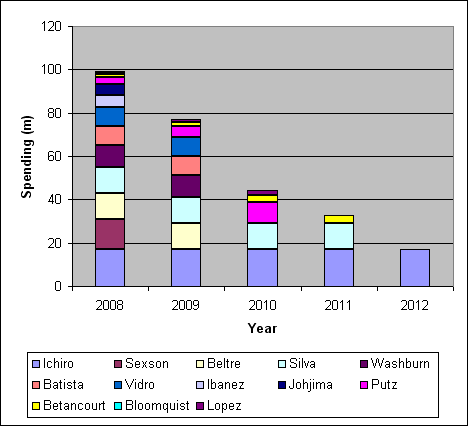
Mariner payroll commitments, 2008-2012
Drawn from CoT. Does include Vidro’s almost-certain-to-vest 2009 option he got in the trade from the Nationals. Does not (not) include mutual options, speculation about players headed into arb, and so forth.
A Paradox
So, while flying across the country today reading the 2008 Hardball Times Annual (which will get a post of its own soon), a thought hit me; the Mariners are signing Carlos Silva because they believe that his combination of no walks, no strikeouts, and some groundballs will lead to him not giving up many runs.
At the exact same time, the Mariners have built an offense that doesn’t walk, doesn’t strike out, and hits a lot of groundballs, believing that having a bunch of guys with that skillset will lead to the team scoring a lot of runs.
I wonder if they’ve even noticed that, much less tried to reconcile those two conflicting beliefs.