
M’s announce rotation order
I have no idea why you’d do this. Baker.
Also:
What’s more, the team intends to use Batista — if he’s needed — out of the bullpen in weeks where his No. 5 spot is skipped.
“He’s aboard,” manager John McLaren said moments ago. “He’s already volunteered his services.”
The M’s don’t skip their 5th starter. The only time they’ve done it is over the All-Star break, when they’ll re-organize as they go.
Anyway, it’s another fine example of the team’s obsession with roles. The #2 starter has to do something different than the #3 starter. The lineup needs a left-handed hitting power hitter with middle-of-the-lineup experience. The bullpen needs a left-handed veteran setup man. And on and on and on.
2008 PECOTA cards are out for hitters
Check ’em out if you’re a subscriber.
Selections:
If you’d like to feel happy about the M’s future.
If you’re feeling too happy and want a downer. Or this.
If you see anything else interesting, hey, drop a comment. That’s what they’re for.
Ichiro, Still Hilarious
From Baker’s blog:
“If the other corner outfielders have too much speed and too much ability and try to do too much, it’s hard for me,” he said.
This isn’t quite “If I ever saw myself saying I’m excited going to Cleveland, I’d punch myself in the face, because I’m lying” good, but it’s close.
My Thoughts on Dave
So, since about Sunday evening, I’ve been laid out either in bed or on my couch, getting beaten down by a particularly nasty version of the flu. I haven’t been particularly plugged in to much of anything; just a reality consisting of the aches and pains that the flu drags along with it.
Then, at one point this afternoon, I rolled over and caught the ticker scrolling across the bottom of ESPNews; “Mariners announcer Dave Niehaus will be inducted into the Hall of Fame as winner of the Ford C. Frick award for 2008”. A rare smile crossed my face; my body was still chilly, but my heart was a little bit warmer.
Growing up, our family didn’t have a TV. I read books – every single Hardy Boy book ever published, in fact – and listened to the radio. My parents ran their own business, and often I’d go to work with them in lieu of having a babysitter. I wasn’t particularly interested in auto repair, so I’d find the radio. And in the radio, I found Dave Niehaus. He was usually welcoming me, along with all his other friends that were apparently listening, to a beautiful day out for baseball. It was always a beautiful day out for baseball. Listening to Dave string sentences together, I learned how to love baseball, even without seeing the game be played. His words painted a vivid enough picture for me.
I learned baseball from him. I learned that Jim Presley was terrible, Harold Reynolds was fast, that Alvin Davis was Mr. Mariner, and that the team didn’t have any pitching. They never had any pitching. Through Bill Swift, he taught me what a sinkerball was. Through Scott Bradley, he taught me that catchers could be left-handed. Through John Moses, he taught me that you can give anyone a nickname by just shortening their last name. And through Ivan Calderon, he taught me that hispanic players could have Russian first names.
Dave Niehaus taught me how to be annoyed by Bip Roberts, who seemingly killed us every March in spring training. I knew the games didn’t count, but listening to him call yet another hit for a guy named Bip just got my blood boiling. He taught me how to love Erik Hansen’s curveball, Mike Jackson’s slider, and Henry Cotto’s mustache. He made sure I never called Greg Briley anything but Pee-Wee, and reminded me that Ken Griffey’s real name was just Junior. I remember hearing Dave call Junior’s first at-bat in spring training of ’89, as well as his Opening Day double in Oakland. I didn’t see either of those things happen, but you can’t convince me of that, because the call is etched in my memory stronger than any picture I could stare at.
Dave was the voice of 1994, when the M’s made a furious charge to take the lead in a division race that would never finish. And he was the voice of 1995, when I realized I didn’t care about labor stoppages or player’s unions but just wanted baseball to come back again. He was there on May 26th, when I heard him call Kevin Bass’ shot in the gap that broke Junior’s wrist. He was there on August 24th, when Junior launched a walkoff HR against the invincible John Wetteland to start the miracle run. I have these dates memorized thanks in large part to the audio of Dave’s voice that runs through my head. I can’t separate those moments from his descriptions, not that I would ever want to.
I don’t know Dave Niehaus. I’ve met him once, but I don’t pretend that gives me insight into who he is. All I know is what I’ve seen and heard; the man likes Hawaiian shirts, Lou Piniella, and the squeeze play. But I feel like I know more about him than that. I grew up with him, and he’s involved in more of my childhood memories than anyone whose last name isn’t Cameron. For me, Dave Niehaus was like that cool Uncle who always brought you something fun. He just happened to bring me baseball.
Congratulations Dave – you deserve this. You deserve to know that you taught me, and thousands of people like me, how to love this game and this team, and you did it well. Enjoy Cooperstown; I’m sure July 27th will be a beautiful day out for baseball.
Dave Niehaus, Hall of Famer
Press conference now on the team’s MLB site — after years of coming close, Niehaus won the Ford C. Frick Award and will be inducted into the broadcaster’s wing of the Hall of Fame.
Congratulations to Dave. He made many, many years of terrible Mariner baseball enjoyable for me growing up.
Examining the Alex Rodriguez screwed Seattle legend
Part two of a long series of chunks o’knowledge to be cited in the constantly arising arguments. Suggestions, thoughts welcome.
I’ll start off by saying that the title’s chosen intentionally. In the first one of these I wrote, “Refuting the Randy Johnson quit on us canard” it’s entirely clear that Johnson played as well as he could under the circumstances, and the evidence against the myth is overwhelming.
This one’s a little more complicated. Things that have happened since he left have determined the perception of Alex-the-person, Alex-the-teammate, Alex-the-Yankee… we’ll get to that.
I’ll examine first the central assertion, and then move on to the secondary issues.
Alex Rodriguez chose to sign with the Texas Rangers because they offered him the most money.
Which comes with some secondary assertions:
– He was greedy
– He lied about wanting to stay with the Mariners
– He lied about wanting to sign with a team that was competitive
Was Alex greedy to take the offer with the most money? Greed’s used because it has such a negative connotation, but really, there are two questions: was greed his only motivator, and is it bad for him to be greedy?
There is are two important decisions that show Alex made his decisions on other factors than money.
When he signed with the Mariners after being drafted in 1993, he did so against the advice of his agent (uh, “advisor”) who wanted him to hold out and re-enter the draft later. Alex wanted to play, even for the Mariners, who hadn’t finished higher than fourth in their division in franchise history, who since 1977 had finished over .500 once. Sure, they had Lou Piniella, and Griffey, but he could have held out until he was drafted by a team that would give him more money, was told by his agent to do so, and he didn’t. No matter your feelings on the draft, he made a choice that clearly demonstrated he wanted to sign and play far more than he wanted a chance at a greater signing bonus, or a chance to play on a team in a better competitive position.
Then, his extension. Same deal: Alex signed a deal with the Mariners while being advised that the path to more money and faster was to turn it down, go to arbitration every year, and seek free agency as soon as possible. He didn’t do it then, either.
It’s clear that while his desire for money was less important to him in those decisions than other factors. The worst thing we can say about Rodriguez heading into the free agent year would be “He wasn’t greedy before he had a chance at free agent riches.”
He did turn down a 1998 extension offer of 7y, $63m to start in 2001. At the time, that salary would have made him one of the highest-paid players in the time, but it didn’t take much to see that when those years came around, that wouldn’t be much (and it wasn’t — in 2001, his extension wouldn’t have put him in the top 25 salaries). And then later, he turned down eight years, $117.5m starting in 2000 (this is all coming from Thiel’s book), which must have been at least somewhat tempting.
It’s reasonable to assume then that his decision on which free agent offer to take at least took into consideration other factors, like competitiveness. Alex twice demonstrated he was willing to make deals that traded potential salary for other factors, and he’d also shown that there was a limit to how highly he’d value those things.
Which brings us to those other factors, and particularly competitiveness. He’s often mocked for his comments about Texas being a competitive franchise as a factor in his decision. But whether or not he was being sincere, which is unknowable to us, there’s nothing in the fortunes of the franchises that contradicted that. Certainly, Texas didn’t accomplish much after he joined, but in the years leading up to his free agency in the 2000-1 off-season, the contrast wasn’t at all clear.
Both had relatively new, money-generating stadiums. The Mariners had moved into spacious Safeco Field, which generally punishes right-hand hitters, while the Rangers played in hitter-friendly Ballpark at Arlington. In 2000, Alex hit .306/.414/.573 in Safeco and .366/.447/.774 on the road. Looking ahead to his career marks, that must have been on his mind.
Both had been competitive, but the Rangers were the better of the two.
2000: M’s 91-71, second in the division, went to the playoffs. Rangers 71-91, fourth in the division
1999: M’s 79-83, third in the division. Rangers 95-67, first in the division.
1998: M’s 76-85, third in the division. Rangers 88-74, first in the division.
1997: M’s 90-72, first in the division. Rangers 77-85, third in the division.
1996: M’s 85-76, second in the division. Rangers 90-72, first in the division.
In the last five years, the M’s won one division pennant and went to the playoffs twice, while the Rangers won the division three times.
In terms of ownership groups, the M’s had the Baseball Club of Seattle, the majority share held by a Japanese owner who never attended games. How much they were willing to spend fielding a team was open to question: they had, after all, lost Griffey and treated Johnson badly in his departure. The Rangers, meanwhile, had a ton of money and were itching to spend it.
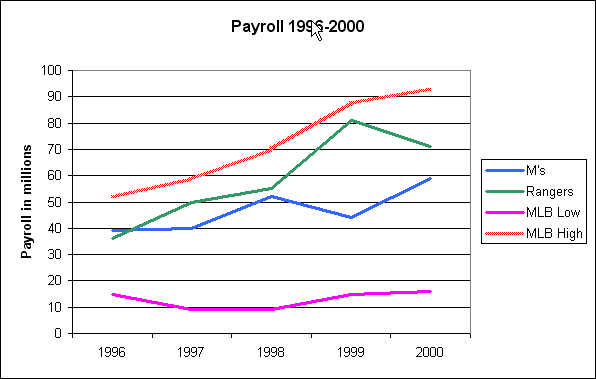
We know the M’s opened the pocketbooks that next year – their payroll went way up for that 2001 team – but at the time, it wasn’t clear that would happen.
There’s no reason to believe that Alex knew that the Rangers would spend their money horribly in the coming years, while the Mariners would not. Looking back, it’s clear that the M’s were the better choice from that point on, but to use that hindsight as evidence that Alex, armed with knowledge he had at the time, made an indefensible choice, is entirely unfair.
At the time, if Alex did value a franchise’s competitiveness, we can see why Texas at the least would have been on the same level as the Mariners.
Given that, the greed assertions are a little less damaging. If the Mariners offered him a rich three-year deal and the Rangers a much richer one, with escalator clauses, opt-outs, all kinds of fringe benefits and opportunities to make more money, and the other factors are equal, then Alex would have been weighting loyalty to the team against $170 million. The M’s offered three years, $54m, with a two year option bringing it to five years, $92m.
At that point, how greedy is it to take that deal? It’s difficult to come up with a valuation for loyalty that makes the two contracts comparable. Say Alex took the view that he liked playing in Seattle, it was great, and he’d take… 10% less. Or $5m a year. Any value you can reasonably assign to that is lost in the Texas deal.
And if that value difference was so huge as to be overwhelming, then it takes the life out of the other charges. Alex indeed talked a lot about his desire to play for his one team his whole career, and off-the-record charmed local reporters with his desire to be like Cal Ripken and other franchise players, and they were angry they fell for it when he signed elsewhere.
I’m reminded of the Office as I write this.
Would I ever leave this company. Look, I’m all about loyalty. In fact, I feel like part of what I’m getting paid for here is my loyalty. But… if there were somewhere else that valued that loyalty more highly, I’m going wherever they value loyalty the most.
— Dwight Schrute
Should Alex, knowing he would be testing free agency, have shut his yap about wanting to stay with the same team, and said nothing at all? He’d have been pilloried for his silence on the subject, and I don’t think it would have done anything to change the later perception. He said what he said. Perhaps he didn’t forsee that any team would make that kind of offer, and thought the M’s would be within shouting distance.
It did not help, though, to have the people in the Seattle media feel like he’d played them for fools, and that went a long way towards defining the narrative of his departure.
Many people say that he never had any intention of staying with the M’s. We don’t know that – we can’t know that. We can’t know what Alex was thinking that last year, or what he discussed with Boras. We can’t know what Boras told him about the potential contract offers ahead, and even then, they’d both know they were educated guesses about bidders, hopes and projections. What reason do we have to think that Alex was lying about his desire to stay, while omitting that there was of course the chance that the difference in salary and situation would be so great that he’d leave despite that desire?
This is the crux of the Alex-is-greedy argument, to me: Alex is disliked for having left the Mariners through free agency for an amazingly huge contract. He’s not credited for having signed and played for below-market value for so long, making the team ridiculous amounts of money. It’s assumed that the team, in drafting him, took the player with the most talent, who would be the most underpaid for their contributions and make the team the most money. But when the player is given the same opportunity, it’s greedy to make the choice for the most money.
The only way Alex could have escaped the greedy tag was to take their offer, and sign for much less, without the clauses, and so on. He’d have to have given up 50% of Texas’ offer right off the top.
If Alex placed a value on staying with the team and being a one-team franchise player like Cal Ripken, that value was somewhere between 0 and the difference in the two offers. He doesn’t have to place much of a value on the money before that value overrides the gap.
Which brings us to a larger issue: that the M’s offer, while dwarfed by Texas’, should have been enough. That Alex should have said “Seattle is so great, I want to be a franchise player, and the money they’re offering, while comparatively smaller, is still a huge amount, so I’ll take it.”
Yet we can here repeat the same reasoning, with more factors (how highly would Alex have to have valued playing and living in Seattle over Texas plus loyalty/franchise player mystique to make up for the gap?) but I doubt that would disprove the argument. This is really an argument about player salaries being out of line with their value, and ties into an important part of why Alex is resented: the contract he signed was so huge, so precedent-setting, that everyone who thinks it’s ridiculous that profession-of-more-societal-or-personal-value only makes x while Rodriguez signed a contract for a quarter of a billion dollars directed all their hate and resentment at him.
That argument’s outside the scope of this. We live in a world that, for better or worse, pays people with certain skill sets, particularly those in entertainment fields like top actors, athletes, and so on amazing amounts of money compared to the average salary. Whether that’s just is up for debate, but it’s a big part of the view of negative view of players. In signing that deal, Alex became the greediest of greedy.
And yet, if blogging about the Mariners suddenly became one of the most lucrative professions in the country and I had a chance to move from USSM to, say, an ESPN blog and make $quadrillion, my head would swim with all the awesome stuff I could do (buy a Lamborghini!), causes I could fund, and places I could travel. If I weighed those things and came to some private valuation that pushed me to the ESPN job, does that necessarily make me greedy for taking it?
This is complicated, of course, by Alex the person. Alex doesn’t get a lot of attention for his charity work, and certainly not as much as he’s gotten in New York for things like his penchant for redistributing wealth to working women through transactions at strip clubs (and so on). He did not come out looking good in his exit from Texas. The free agent saga this off-season was a massive PR disaster. The perception of Alex now does not put his thought processes back in 2000 in a kinder light.
Yet Mariner fans booed him at the time. I’ve never understood it. Alex was a consummate player, one of the greatest the franchise has ever seen, and played for years for almost no money, and then signed an extension to play for years for less money than he might have received.
How can anyone see Alex’s contract as an example of greed and not see his previous actions as an example of generosity?
Back to the original statement of myth.
Alex Rodriguez chose to sign with the Texas Rangers because they offered him the most money.
We don’t – and can’t – know that. We know that money was not the only factor in previous decisions, and it’s reasonable to assume that it wasn’t the sole factor then.
Which comes with some secondary assertions:
– He was greedy
– He lied about wanting to stay with the Mariners
– He lied about wanting to sign with a team that was competitive
The greed thing, we don’t and can’t know how much money it might have took to override the other factors, only that it did.
We don’t know if he was lying about wanting to stay with the Mariners, but it’s reasonable to assume that he was sincere, and that if he knew he’d leave for a sufficient difference in money, or even if he could see the future and knew that there would be offers that would overwhelm that concern, he understandably left that part out.
We don’t know if he was lying about wanting to sign with a team that was competitive, but all the evidence is that if he was telling the truth, it would might even have encouraged him to sign with Texas.
All of this leaves us in an ambiguous place. Did he lie? Was he deceptive? Is he greedy, and how much so?
There are a couple of interpretations we can take:
– Alex is a jerk, lied, and manipulated local reporters and fans to try and drive up support for the M’s to retain him, and then took the better offer
– Alex shares to some degree his critics’ values of loyalty, stability, and so on, but the value of the contract and possibilities offered by Texas outweighed them
– Alex made a choice we can’t know the reasoning behind, and made some statements we can reasonably believe were true
It’s hard to see where Alex did or might have betrayed the team. He played hard while under team control, and left when he had the chance. He didn’t hold out, or force a trade by making a stink about how underpaid and underappreciated he was, dogging it on the field, or anything like it. That the hatred for Alex has hampered the recognition of how great he was as a Mariner is disappointing, because he’s one of the true Hall of Fame talents the Mariners have seen, and was an amazing player to watch while he was here, even if he left to have a somewhat troubled and controversial career after he left.
Re-running the seasons with Oakland hobbled
After running the sims with a healthy A’s team showed them as division favorites, to much hooting, I took a suggestion and ran it again after crippling Harden and Gaudin, taking them out for the year, and re-ran the whole thing. Not because Harden and Gaudin will miss the whole season (well, Harden might if he’s traded) as much as to try and severely degrade the rotation all year.
The gap between the A’s and the Angels goes way up (average wins between them was 87 to 83, the A’s chance to win the division plunges to 17% win and 6% tied for the title).
Particularly interesting to us here in Mariner Land, though — the M’s win an extra game a year to put in an average season of 78-84. Yayyy.
PECOTA projects the 2008 season
Subscriber-only, unfortunately for those of you who haven’t shelled out for the PECOTAs.
73-89. That’s with Bedard, as Nate noted in the blog entry, though the M’s depth chart doesn’t reflect that yet. And it has “Bryan Morse” getting some playing time.
They score about 30 runs less and allow 10 runs more than the ZiPS-based sim seasons I did.
Opportunities for Improvement
Yesterday, we covered the win value of the entire roster, and came to the conclusion that this team is built to win about 82-83 games, if everything follows the projections. Well, we know that nothing ever follows the projections completely, and there is always room for variance in pretty much any statistical model. So, today, let’s look at a few of the potential opportunities the roster presents for improvement, and how those potential improvements might help push this team closer to the 90+ wins it needs to contend this year.
1. Felix grabs his crown
We have Felix projected for a 3.55 ERA in 190 innings. That’s good enough to make him a +4 win pitcher and an all-star, but I think we’d all agree that he has enough talent to make that look like a disappointing season. He’s flashed it many times before, including in his his first two starts before hitting the DL last spring. It is not hard to see him rolling off a Cy Young season where he establishes himself as an ace. If he tosses up a 2.84 ERA instead of the 3.55 I projected for him yesterday, that lops 15 runs off his total, and adds a win and a half to the pennant chase.
2. Jose Lopez finally fulfills his potential
It’s not always been evident the past two years, but Jose Lopez is a talented player. He has enough range to play a quality defensive second base while possessing enough power and contact ability to be an asset at the plate. His .252/.289/.355 performance from 2007 isn’t his true talent level, and at age 24, he still needs to be considered a player with significant potential.
The projections from yesterday had Lopez at a .305 wOBA, which translated to +1.26 wins above replacement. If we look at an optimistic projection for Lopez that is still within the realm of possibility given his skillset, it’d probably be something like .300/.340/.440. That’d be a modest improvement from his 2006 performance, but wouldn’t require a huge change in skills – he’d just have to translate some of his power into more more doubles and home runs.
If Lopez hits .300/.340/.440, that would give him something like a .348 wOBA, which translates to +2.8 wins for a second baseman. The .305 wOBA gave him +0.7 wins, so a breakout from Jose Lopez could be worth about two wins to the final tally.
3. Bedard and Felix both stay healthy, pitch 220 innings apiece.
The projections from yesterday had Bedard and Felix both at 190 innings, a realistic estimate given Bedard’s history of health problem’s and Felix’s age and career path so far. However, both pitchers are good enough to run up big innings totals if they stay healthy, and health is a very hard thing to predict. If each can rack up an additional 30 innings and we take those away from the replacement starters and the bullpen, the pitching staff would lop 12 runs off off their projected totals. That’s an extra win in the standings.
4. Jose Vidro becomes a bench player.
I won’t hold my breath for this one, but there’s room for improvement here, so I’ll list it anyway. Jose Vidro is currently projected for a .325 wOBA, and honestly, there’s almost no upside here. 2007 was the height of his production abilities given his total lack of power, and his overall line was propped up by a ridiculous total of infield hits. And, as a nice bonus, since Vidro’s occupying the DH spot, the Mariners are forced to send Raul Ibanez back out to left field to futilely chase down fly balls in the gaps. Having a DH who can’t hit force a guy who can’t field to play defense is just not how playoff teams are built.
However, if we move Vidro to the bench (where he’d actually make a solid pinch-hitter), opening up the DH spot for Ibanez, and pencil in even a +1 WAR left fielder into the mix (maybe that’s Wlad forcing his way onto the roster, maybe that’s the M’s making a trade, whatever), the team would be instantly upgrading their offense, defense, and bench with one move. New OF’s +1 win replaces Vidro’s +0.4 win, while Ibanez goes from being a +0.75 win left fielder to being a +1.4 win DH, as his defensive shortcomings wouldn’t be a factor anymore. And, as a bonus, Vidro’s bat replaces Norton’s on the bench, giving the team an additional +.1 upgrade.
All told, the we’re looking at about a 1.4 win upgrade by simply bringing in a below average left fielder (remember, league average is +2 wins) and moving Ibanez to DH with Vidro going to the bench. How hard would it be to find a +1 win left fielder? Call Corey Patterson. His .310 wOBA and above average defense make him exactly the kind of player we’re talking about, and he can’t get anyone to give him a job.
5. Adrian Beltre goes bananas, relives 2004.
This is the least likely of all the scenarios (and considering #4 is highly unlikely, we’ll call this a major longshot), but Adrian Beltre has a couple truckloads of talent. Just on raw physical ability, he’s in an elite class. As we’ve seen, though, his approach to hitting is akin to a high school hitters. The low and away slider is his kryptonite, and he has not learned to have enough patience to not get himself out way too often.
However, every year, we see him put it all together for stretches of time. He hit .306/.342/.577 in May and .314/.398/.598 in July. He just sandwiched a .190/.239/.302 June in between those two months. There is a great hitter hiding inside of Adrian Beltre, but because of his approach at the plate, we only get to see him in glimpses.
However, that .320/.380/.550 potential is still there, lurking in the shadows. Adrian Beltre is physically capable of being an MVP candidate if he could refine his approach at the plate. It’s not common, and it’s certainly not likely, but it happens from time to time. It’s possible – we’ll just put it that way.
So, what is it worth if Beltre hits .320/.380/.550? That translates to a .413 wOBA and makes him a +7 win player. Essentially, that kind of performance in Safeco Field, while also playing gold glove defense at third base, would win him the MVP award in most years. That’s a good season for A-Rod; like I said, this isn’t likely to happen. But if the stars align, and he adds +4 wins to his personal total… well, you never know.
2008 Win Values
“We have to analyze the talent we see and assign the proper value to it.” – Neil Huntington, Pittsburgh GM, in an article published yesterday.
The Pirates are the newest team to hire a GM with a strong belief in quantifying value. Not surprisingly, Huntington came out of Cleveland, an organization that has been using their intellectual advantage to win games for years. One of the basic fundamentals of the methods adopted by teams like Boston, Oakland, Cleveland, San Diego, and Arizona is the belief that all players have a quantifiable on field effect that can be summed in a win metric that allows for proper valuation. Evaluating talent is huge, but so is properly valuing performance – they go hand in hand, and doing one without the other is a wasted opportunity.
So, that’s what this post is about – valuing talent in terms of wins. I’ve taken the best approach to win analysis available and applied it to the Mariner roster, taking a projected performance for the upcoming year and converting that into a win value that factors in both run production and run prevention, with necessary adjustments for the position being played, the role the player will be used in, and the environment they call their home field. In the end, this allows us to size up the entire roster in terms of what we expect their on field contribution to be this season, how much that contribution is worth, and how much value they are adding to the franchise in 2008.
The starting spot for analysis of position players is offensive production. Every outcome of every plate appearance has an average run value that we can assign to that event, allowing us to convert an overall projected batting line into a run production number. This concept is known as linear weights, and is accepted as the best method for quantifying offensive value. If you want to read more about linear weights, here’s a three part series that covers the concept and shows how it works. There are a few different linear weight run estimators out there; I chose to use Weighted On Base Average (wOBA for short) because the math is the easiest to follow in getting from runs to wins.
Despite using On Base in the term, it’s a valuation of total hitting production. It gets its name from the fact that its scaled to look like on base percentage, so if you’re familiar with what a good/bad/average OBP is, you also know what a good/bad/average wOBA is. .300 is lousy, .340 is average, .400 is awesome. wOBA is presented in detail in The Book, written by Tom Tango, Andy Dolphin, and Mitchel Lichtman.
The formula for wOBA is wOBA = (0.72 BB + 0.75 HBP + 0.90 1B + 0.92 RBOE + 1.24 2B + 1.56 3B + 1.95 HR) / PA. Pretty simple – the multiplication is performed according to run values of each event scaled to look like OBP (in this case, the ratio of one to another is more important than the actual multiplications). Singles are worth a bit more than walks, but less than doubles, which are worth less than triples, and nothing is worth more than a home run. Nothing scary here. The only thing wOBA doesn’t account for is baserunning, so I’ve made manual adjustments for the necessary players who extract value from their legs.
So, all you have to do is have the data for those categories, and wham, you have wOBA. Once you have that, you can simply compare a player’s wOBA to the league average wOBA (AL average is .338, but I used .334 to account for Safeco) to get his offensive production above or below average. Note – this is not position adjusted – we’re just comparing hitters to hitters right now. Once you have the difference, you can divide that by 1.15 (wOBA’s relation to runs), multiply by a full season plate appearance estimate for each role (I used 700 for starters, 250 for bench players, both of which get reduced to 85% of that total later on, since we don’t project anyone to play 162 games), and then divide by 10.5 to convert from runs to wins. After you’ve done that, you’ve got an offensive win value compared to league average.
That’s step one. From there, it’s easy. You take your offensive wins and adjust for each position using what we know about the defensive spectrum. Catchers get +1.5 wins, shortstops and center fielders get +1 win, second baseman and third baseman get +0.5 wins, left fielders and right fielders get no position adjustment, first baseman get -0.5 wins, and designated hitters get -1.0 win. This positional scale adjusts for the quality of each player’s peers while also ensuring that we don’t make bad assumptions based on the league average line of any one position during a season. We can say with 100% certainty that it’s harder to play shortstop than to play second base, as almost every second baseman is a shortstop who got moved to the easier position at some point in their life, so we don’t ever want to assume that the average second baseman is better than the average shortstop. If we used league average offensive production by position as the comparing baseline, the values wouldn’t be fixed, which is why I prefer the defensive spectrum adjustments.
Okay, so now you have your position player’s offensive performance relative to league average and adjusted for position. Two steps left before we have our final win value. First, we don’t necessarily want to compare all players to league average in valuation methods. What’s a league average player worth? How easy is it to find one? These aren’t intuitive answers, so average doesn’t make for a great baseline. Instead, we want to compare the players to what we’d expect a team to be able to get from a league minimum player that could be acquired with little to no effort. For instance, yesterday the Mariners signed Greg Norton to a minor league contract. He might make the team, he might not, but guys of his quality are always available. He’s the walking definition of replacement level, so we want to compare our first baseman/designated hitter types to what they’d give us over Greg Norton type players. We know these players are worth about $400,000 (league minimum salary, basically), so it gives us a better starting spot for the final valuation.
The freely available talent guys historically perform, as a group, at a level about two wins below average over the course of the full season. Or, said another way, a team full of these league minimum guys would win about 50 games per season. It’s hard to do much worse than 50-110, even if you’re not trying to contend.
So, in addition to the position adjustments, we add a replacement level adjustment of +2 wins for each position. This means that the adjustment is now +3.5 for catchers, +3 for shortstops and center fielders, +2.5 for second baseman and third baseman, +2 for left fielders and right fielders, +1.5 for for first baseman, and +1 for first baseman. So, if you have a catcher who is a league average hitter, you’d say he’s about +3.5 wins offensively, while the exact same hitter would only be worth +1 win if he was a designated hitter. (Note – this is why moving Jeff Clement to DH/1B is not worth it until the Mariners are 100% certain he really can’t catch in the majors).
Okay, so, after all that, you’ve got your offensive win value compared to replacement level and adjusted for position. However, position players don’t just hit – they field, too. So, we have to build in a defensive performance adjustment. While the general range between the best and worst defenders at a position in any given year is about 50 runs (that is, +25 for good and -25 for bad), we want to be a lot more conservative in projecting defensive performance. So, for these purposes, I’ve set the upper and lower bounds at +15/-15, with most players falling in the -5 to +5 range. In other words, besides the exceptionally great or terrible defenders, this adjustment isn’t going to make a massive impact. Personally, since there is no defensive metric that contains all knowledge yet, I looked at UZR, PMR, RZR, Dewan’s +/- (when available), and eyeballed a realistic estimate based on inputs from all four. Then, you simply divide the runs saved/lost estimate by 10.5 to convert to wins, and add the defensive performance to the offensive performance you’ve already ascertained. And that’s your win value.
Let’s walk through it with Ichiro. I’ve got him projected for a .345 wOBA in 2008 (this is an optimistic projection, honestly, and only a slight step back from his 2007 performance), which the math then converts to +3.09 wins for a center fielder. I add in +0.5 wins for his defensive performance, and that gives us Ichiro as a +3.6 win player compared to a freely available center fielder. I’ve also added +.15 wins for his baserunning prowess, which brings him to +3.75 wins. Or, put another way, if Ichiro got hurt in spring training and was replaced by some combination of Willie Bloomquist and Jeremy Reed for 2008, we’d lower our win expectation for the team by about 3.75 wins.
How much is a win worth? Well, MLB as a whole is paying about $4.4 million per win above replacement in the free agent market, and we know a league minimum player makes about $400,000, so (Win Value * 4.4) + .4 will give you the player’s dollar value in terms of wins added for the upcoming season. Keeping with the Ichiro example, we have him as a 3.75 win player, which is worth about $16.9 million in on field performance. Ichiro just got a contract extension for $17 million per season, which included adjustments for factors beyond his baseball skills, including his marketing appeal. So I’d say the model worked pretty well here, eh?
Because Ichiro’s salary is higher than his dollar per win value, he’s listed on the chart as having a negative value of $100,000. That doesn’t mean we think Ichiro is overpaid or less valuable than Jamie Burke – it simply means that he’s a fairly compensated star, and not a major bargain. It’s rare that teams have bargains at the top of their payroll, though, so that’s not really a knock against Ichiro. However, it does mean that, if given the choice between trading Ichiro and trading Yuniesky Betancourt, I would trade Ichiro – it would be easier to replace his performance with the $17 million that became available than it would to replace Betancourt with the $1.25 million that became available if he was traded.
So, in terms of 2008 asset value (not on field value – please note the distinction), I’m comfortable saying that Yuniesky Betancourt is more valuable than Ichiro. That might sound like heresy, but considering there are only a handful of teams that can afford Ichiro’s contract and nearly every team in baseball would love to have Betancourt on their team, it reflects reality.
Okay, enough setup – let’s get to the table. Here are the position players projected wOBA, their associated win values, their dollar per win value, and the value difference between that and their actual salary. All dollar values are in millions.
| Position Player | wOBA | WAR | WAR $ | Salary | Value |
|---|---|---|---|---|---|
| Johjima | 0.320 | 2.29 | $10.48 | $5.20 | $5.28 |
| Sexson | 0.335 | 0.32 | $1.81 | $14.00 | $(12.19) |
| Lopez | 0.305 | 1.25 | $5.90 | $0.50 | $5.40 |
| Betancourt | 0.305 | 1.62 | $7.53 | $1.25 | $6.28 |
| Beltre | 0.335 | 2.67 | $12.15 | $12.00 | $0.15 |
| Ibanez | 0.345 | 0.75 | $3.70 | $5.50 | $(1.80) |
| Ichiro | 0.345 | 3.75 | $16.90 | $17.00 | $(0.10) |
| Wilkerson | 0.325 | 0.76 | $3.74 | $3.00 | $0.74 |
| Vidro | 0.325 | 0.41 | $2.20 | $6.00 | $(3.80) |
| Reed | 0.295 | -0.06 | $0.14 | $0.40 | $(0.26) |
| Morse | 0.315 | 0.05 | $0.62 | $0.40 | $0.22 |
| Bloomquist | 0.290 | 0.00 | $0.40 | $1.00 | $(0.60) |
| Burke | 0.295 | 0.20 | $1.28 | $0.40 | $0.88 |
| Norton | 0.315 | 0.05 | $0.62 | $0.40 | $0.22 |
A quick peak at those numbers before we move on to the pitchers.
Betancourt, Johjima, and Lopez, as a group, project to be just a bit below average. The M’s total cost for those three – $6.95 million. There aren’t too many other teams in baseball getting that kind of quality production for next to no money at those up the middle spots. While they’re all flawed players in their own way, they’re also three of the most valuable assets this organization has.
Hey, look, even projecting an offensive step back for Adrian Beltre, he’s still worth his contract. Hey national media – get a clue; the guy is a good player who is worth every dime he’s being paid.
Richie Sexson, even with a significant rebound projection, is still terrible, and his contract is a boat anchor. A +0.3 win player making $14 million at the easiest position on the diamond to find talent? Ouch.
Total wins above replacement for the position players? +14.1 wins. 14 wins out of 14 players who cost about $66 million in payroll? That’s… not good.
Okay, let’s move on to the pitchers. The process here is easier, so I’ll spend a lot less time explaining it. For starters, I developed a defensive-independent line (because, remember, we’re already counting defense in the position players) adjusted for Safeco, which gave me innings pitched and runs allowed. I then compared this to league average (4.60 ERA, park adjusted) and replacement level (5.52 ERA, park adjusted), divided the difference in projected runs allowed by 10.5 to convert to wins, and wham, you have your win value. For relievers, I built in a leverage factor as well, to account for the fact that every run J.J. Putz saves is more valuable than an average run saved.
Why am I using ERA when I have railed against it for so long? Because it’s easy for everyone to understand, and, because it’s already scaled to runs, we don’t need to show FIP or anything more fancy. The inputs I used to get my defensive independent ERA were more sophisticated than just looking at previous ERA and adjusting, so please don’t assume that I’m bowing to conventional pitcher analysis here. I’m just presenting it in the most palatable form I can. Okay? Good. Here’s the pitcher projections.
| Pitcher | ERA | WAR | WAR $ | Salary | Value |
|---|---|---|---|---|---|
| Bedard | 3.32 | 4.43 | $19.90 | $7.00 | $12.90 |
| Felix | 3.55 | 3.96 | $17.80 | $0.50 | $17.30 |
| Silva | 4.41 | 2.20 | $10.08 | $12.00 | $(1.92) |
| Batista | 4.57 | 1.85 | $8.56 | $9.00 | $(0.44) |
| Washburn | 4.73 | 1.46 | $6.83 | $10.00 | $(3.17) |
| Ramirez | 5.40 | 0.14 | $1.01 | $2.75 | $(1.74) |
| Putz | 2.31 | 2.63 | $11.97 | $3.40 | $8.57 |
| Morrow | 3.45 | 1.03 | $4.91 | $0.40 | $4.51 |
| O’Flaherty | 4.32 | 0.25 | $1.50 | $0.40 | $1.10 |
| Green | 4.05 | 0.53 | $2.71 | $0.40 | $2.31 |
| Rowland-Smith | 4.20 | 0.30 | $1.74 | $0.40 | $1.34 |
| Baek | 4.20 | 0.30 | $1.74 | $0.50 | $1.24 |
| Lowe | 4.80 | -0.04 | $0.23 | $0.40 | $(0.17) |
Pitching staff notes.
Bedard is really good. I’m happy to have him on the roster. Go Erik Go.
Felix is one of the biggest assets in baseball. A +4 win player making, essentially, the league minimum? I’ll take two, please.
Silva’s basically projected right at league average for a starter, with Batista a half win worse and Washburn about a win worse. For the last 60% of a rotation, it’s not bad, but man, did it come at a high price. $31 million for 5 wins? Such is the price of trying to build a rotation through free agency.
Horacio Ramirez is projected to pitch 110 innings, but he basically is a stand in for all starts made by guys not in the current rotation. That includes Baek, Feierabend, Rohrbaugh, whoever. Same thing with Mark Lowe’s 30 innings pitched at the bottom of the bullpen – he’s being used as a proxy for the reliever du jours.
J.J. Putz, still awesome. According to this, he’s the fifth most valuable player on the team and the third biggest value.
Brandon Morrow got a pretty nice projection as a setup man. I made it clear that I didn’t think he was cut out to start in 2008, but I think he’s got a good chance to become a quality 8th inning guy this year. That’s still a monumental waste of a #5 overall pick, but hey, at least he’s contributing something.
The pitching staff as a whole adds up to +19 wins above replacement. Thanks to Erik Bedard and projected improvement from Felix, the pitching staff is now the strength of this club.
Now, let’s take a big picture look at the team as a whole.
The team defensive-independent ERA comes out to 4.12. Over 1430 innings, that’s 654 earned runs allowed. Now, remember, we’re dealing with ERA, not RA, so we have to adjust for unearned runs that bump the total up, and this doesn’t account for defense either. Last year, the team allowed 60 unearned runs, and our projections have the team’s defense being worth about -15 runs, so we need to add about 75 runs to that total. That means this analysis projects the M’s to allow about 725 runs.
Offensively, if I plug my projections into a markov chain, I get about 735 runs scored. A team that scores 735 runs and allows 725 runs will post a .507 win%, or a record of 82-80 in a full season. How does this line-up with my WAR estimates?
+19 for the pitching staff and +14 for the position players = +33 for the roster. Since we’ve got replacement level set at about 50 wins, that gives the M’s something like an 83 win roster.
82 wins if you use projected RS/RA. 83 wins if you use WAR. I’d say win values work pretty well.
Tomorrow, I’ll talk about the potential opportunities for this club to beat these projections, and what we need to be rooting for if we’re going to be better than an 82-83 win club.