
Hey, turns out the M’s have a great bench
Remember when I wrote that post about how the M’s might construct their bench to help with the problems with the lineup and people said okay that’s great but none of that will happen because they’re going to take Cairo and holy mackeral is this bench going to be thin and unhelpful? Yeah? Well people were wrong!
The DH position was an offensive bright spot for the Mariners in ’07, with Jose Vidro posting the second-highest batting average (.308) among DHs in the AL. With Vidro returning and the versatile Willie Bloomquist as an option off the bench, Seattle enjoys depth.
Remember when we had Corey Brock writing the M’s content on MLB.com and it was actually pretty good, especially compared to other MLB.com content, before Jim Street came out of retirement to take his job back when Corey moved to cover San Diego?
Yeaahhhh… that was nice.
Pitchers and Catchers! Pitchers and Catchers!
Need I say more? Woooooooo – baseball is back!
And now, for something different
Yea, this post has nothing to do with the Mariners. I think we could all use a break for a day or so.
A lot of people ask us if they can send us money to help support the site. Generally, we tell them to donate it to charity instead. Well, now, I can combine the best of both worlds. My girlfriend (commence joke about bloggers not having social skills… now) is training for a marathon in June with Team In Training, who use marathons as fundraisers for research to find a cure for leukemia and lymphoma. Her mother’s first husband died from leukemia at the age of 19, and she’s dedicating the marathon to him and her brother, who lost his father when he was seven months old. She hopes to raise $5,000 in the next couple of months, and, being the good boyfriend that I am, I offered to put a note on the blog for anyone who wants to donate. Her team in training website can be found here, and you can donate securely online through the site. If you don’t like giving money through the internet, you can drop us an email and I’ll tell you where you can mail a check.
The bonus is that the marathon is in Alaska in June, so we’ll be flying into Seattle on the way up there, and there’s a decent chance we’ll host another USSM event while I’m in town. So, if you give money, you get to support leukemia research, support the site indirectly, and encourage a get together this summer. Everyone wins all around.
Update: $325.00 as of lunch time. You guys rock. $1,000 would be a tremendous starting spot for her, and it looks like it’s within reach.
Update #2: $820.00 $1,950 so far. A huge thank you to all of you who have given so far. She’s overwhelmed by the generosity of others, and had no idea you guys would come through like this. You guys are the best.
What the M’s can still do
To be entirely open, it hasn’t been fun for me here at USSM lately (just deleted-another “you faked results to advance your agenda” comment! Awesome!)(to be clear — that many-seasons thing was not a prediction, it was “hey, I spent a lot of time using DMB, and here’s the interesting stuff that came out of it”)(I suspect that train’s long left the station, though), so it’s time to geek out about one of my favorite topics, roster construction. Benches benches benches!

winter break from paul goyette‘s flickr stream, used under the Creative Commons license
What does the team still need, and how might they still improve, assuming they’re dead-set on making a run for it?
First, the hitters. Let’s assume they’re not going to make any more major moves and dump any of these guys.
DH-B Turbo
C-R Johjima
1B-R Sexson
2B-R Lopez
SS-R Betancourt
3B-R Beltre
LF-L Ibanez
CF-L Ichiro!
RF-L Wilkerson
Nine spots burned.
Burke’s the backup catcher (#10), so that solves that piece. #11 is Bloomquist. Now you have 1-3 spots left, depending on how many pitchers the M’s carry. Let’s figure on 12 pitchers, so you’ve got two bench spots left.
What do you need that you could patch for on the bench? Horrible defense at first and left, and you’re hoping to get average defense in right out of Wilkerson. And you could really use a good pinch runner for those three and Turbo too. And if Bloomquist is your backup infielder, what you really need is two more backup outfielders who can chase flies like nobody’s business. A righty if you can manage it, to sub in for Ibanez or Wilkerson against lefty starters — and they don’t have to be that great to be better than them against lefties. And you could really use another bat off the bench, particularly a decent defensive replacement for Sexson.
If they’re not willing to go shopping, I think you have to go with Reed. His offensive performance was much improved last year in Tacoma, though his projections are not particularly good looking (PECOTA: .265/.321/.385, ZiPS .259/.312/.377) it’s a fine skill set to offer as a 4th outfielder: below-average but not horrible bad, good defense, particularly in the corners, not a base-stealing threat but a decent runner. Especially considering the question of Wilkerson’s durability, it makes even more sense. So I’d take Reed with the #12 spot.
Then what? It’s an interesting question, and I’ve got a couple of possibilities:
– You take Morse as a backup corner infielder/Sexson replacement
– Jimerson as a 5th OFer and pure defensive replacement and runner.
What you really don’t have any need for is a I-can’t-believe-it’s-not-Bloomquist player like Cairo, who also can’t hit, but makes up for it by not being a good runner or fielder.
If you’re willing to spend, you’re not going to a lot better, really. None of Shawn Green/Trot Nixon/Reggie Sanders helps solve a problem you’re carrying. Corey Patterson would be a nice choice — he’s a glove, has some speed, might hit and might not, depending on which season it is. As a 4th OFer in spacious Safeco, he’s a nice choice. And likely comes with a high price tag. Kenny Lofton’s still out there, too, and you could certainly do worse.
There’s Bonds, if you want the ultimate in controversial and risky may-be-in-jail-on-perjury-charges choices. Then you push him into DH/LF as often as circumstances permit… but that’s not going to happen, so forget I mentioned it.
And surveying the field, Patterson’s a great choice if you can get him on the cheap, but beyond that, there’s not a lot to buy for your remaining bench dollar in the lineup.
So flip a coin (which will come up heads 90% of the time) and get yourself a #13 position player, and go on to the pitchers.
SP-L Bedard
SP-R Hernandez
SP-L Washburn
SP-R Silva
SP-R Batista
RP-R: Putz
We’re at 19… and then chaos fills the remaining six spots.
Let’s figure if they’re willing to punt the future, they’re willing to spend another year of Morrow in the pen. Ding! #20. Can I get Aumont, too? I mean why not, right? Then O’Flaherty, sure, that’s your first choice to get a lefty in there. #21.
Looking at that rotation, what do you need? If history’s any guide, some long relief when Silva’s defense fails him and he’s knocked out early, Washburn’s going to need a consistent bridge for the 7th-8th, and you won’t always have Morrow around (or Putz, for that matter). Take Rowland-Smith for long relief (#22), assuming Baek’s your 6th starter in Tacoma, and Sean Green for bridging as RP-R (#23). Now McClaren’ll want another short-use lefty – Rhodes may will break with the team out of spring training if he’s at all effective (#24) though I’d argue you’re better off taking a better righty option if you have one… so you might go with both Huber and Lowe here (I’d love to see Lowe healthy and effective) though they’ll likely only need one (#25 and done).
I don’t see any point on spending more on the bullpen. It’d be costly and probably wouldn’t do much better. And this throws HoRam to the minors/the waiver wire/wherever, which the org is unlikely to do, so you have to drop someone, and that’ll be a substantial downgrade.
Anyway — we know the 2008 starters. The next interesting thing is how they use the resources at hand to try and patch for the squad’s obvious weaknesses.
The 93-win team (more ZiPS fun)
If you’re already annoyed by the sim post, well first I’m not sure what you’re doing hanging around here, but anyway, this is not going to be your post. Come back later or something. I’m serious, this gets into some serious Diamond Mind geekery.
Read more
Running the 2008 season a hundred times
The results of my last couple sim seasons has been bothering me, since it diverged so far general opinion and from what I thought it would be. I decided to look at this in a lot more depth. I used the ZiPS projections for 2008 and SG’s quite useful RunDMB program, cranked up the USSM Labs Comp-u-matik 2000, and went at it.
Then I put together a likely M’s lineup, cheated a little by turning Betancourt’s defensive rating up, and ran a hundred seasons. This took a day.
Your 2008 simulated Mariners:
Average record: 77-85
Average runs scored: 716
Average runs allowed: 759
Number of times they won the division: 6
Number of times they won the wild card: 0
Best season: 93-69
Worst season: 59-103
Best offense: 804 runs
Worst offense: 607 runs
Best run prevention: 674 runs allowed
Worst run prevention: 866 runs allowed
Standard deviation for wins: 71-84
Standard deviation for offense: 674-757
Standard deviation for run prevention: 717-801
The division favorite was not the Angels but the torn-down Athletics, 47% to 42%, and Texas won the division almost as often as the M’s. The A’s-Angels thing is as much a shock as anything. General analyst-on-TV-or-radio seems to be that it’s all about the M’s-Angels, but Oakland fields the best pitching/defense combination in the AL and their offense is decent too.
Added: since this seems to be causing a lot of hostility, I’ll explain part of what’s going on here. The projection set doesn’t include known, current injuries — so when you look at a depth chart and you see that a bunch of their starters are likely to be guys like Saarloos or even Greg Smith because so many will be down for the start of the season, that’s the rub — these weren’t run with them starting off injured for x days and then coming back. You can make your own assessment of how important that is to the outcomes, but they only play two series against the A’s for five games in the first two months of the year. So even if you want to throw out their season finish, the M’s aren’t going to move up substantially in the win column by taking more games from Oakland.
Back to the M’s, though.
Here’s some graphs of the distributions:
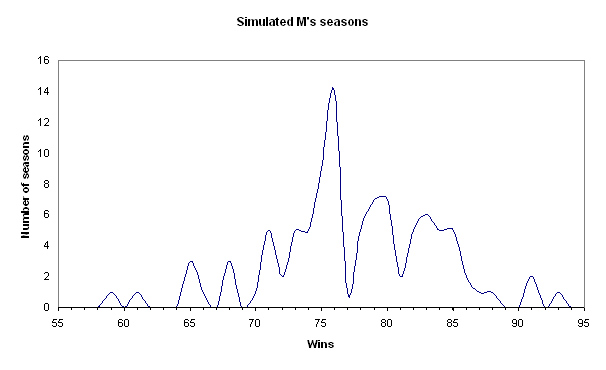
That’s a scatter with smoothed lines.
And for the people who complain about graphs without absolute axis bounds:
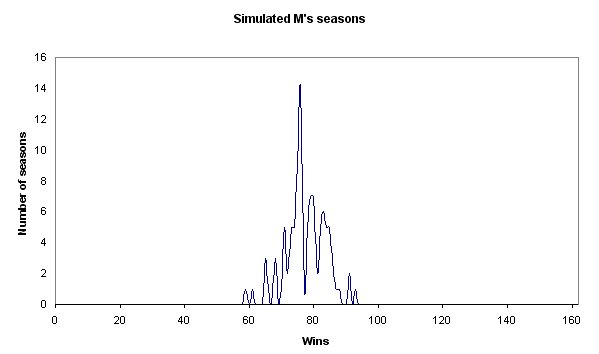
And by request, the bar graph
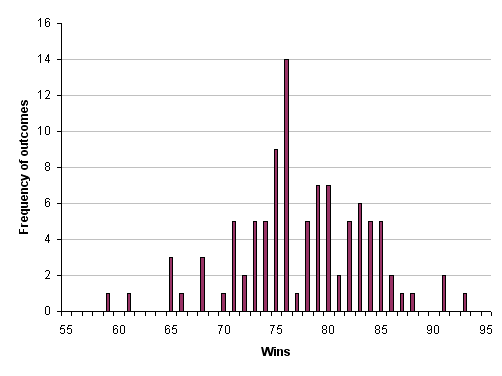
Here’s the cumulative probability:
27% of seasons were 74 wins or under
50% of seasons were 76 wins or under.
77% of the seasons were 82 wins or under
95% of the seasons were 86 wins or under
99% of the seasons were 91 wins or under
I did a projection post back in January. Pre-Bedard-trade, of course, it’s still an interesting contrast. I guessed at ~795 runs scored and ~780 runs allowed. Compared to what I got simulating, that’s too optimistic on the run prevention and way, way optimistic on the runs scored. Clearly, replacing the fifth starter with Bedard and tossing Sherill aside makes a difference in run prevention, but it’s interesting that the overall difference wasn’t all that large — I’d have thought it’d be a lot more than 20 runs. But considering that the trade meant a pretty large defensive downgrade in right plus a whole in the bullpen, it’s reasonable.
The defense is baaaaaaaaaaaaaaaaaaaaaaaad. Even assuming Wilkerson is healthy and passable in right, Ibanez makes that offense bad, and the infield doesn’t make up for it, dragged down by Sexson’s awfulness. And remember, I turned Betancourt’s defense up. The pourous defense particularly hits Washburn and Silva as you’d expect. As Dave told me, they should consider running Reed out in right field when Washburn starts just to keep Washburn’s head from exploding in frustration after giving up the seventh double of a game.
The other interesting thing to note is that DMB, in running through the whole season and simulating every game, does take into account the rotation matchups (which, as I’ve noted, don’t in practice have that much effect). So pushing everyone back a spot doesn’t help.
It’s the runs scored that really hurts. Here’s where the ZiPS differed significantly from the numbers I came up with “random guesses, hunches, wishcasting, and general skullduggery” but which was largely three-year averages:
– Ichiro’s down a little on OBP and off on SLG
– Shaves Beltre by 5 points of OBP and 10 points of SLG
– ZiPS is down on Lopez (.302/.369 versus my .320/.400)
– the Wilkerson ZiPS is lower than my Jones guess
– didn’t give Sexson as much of a bounce (.323/.441 vs my .330/.460)
– down on Johjima (.316/.405 vs my .325/.425)
Please note that when I disagreed with what an excellent projection system came up with, I was high every time, sometimes by a lot. Ponies for everyone!
Since I ran the season, I’ve stared at the results and tried to find a reason to not write this post. Some thing that would invalidate the results, or that would give me an excuse to change something and go back to do it all over with even more pro-Mariner assumptions. But there isn’t. The ZiPS projections have been excellent in the past, and if you use the PECOTA projections the team is just as bad.
If you start from last year’s team and make adjustments, it’s easy to come up with another five, ten, sixteen wins. But starting from scratch, using reasonable assumptions, the picture looks much bleaker.
And now, this pony from our sponsors.

Pony 48 from treehouse1977’s photo stream, used under the Creative Commons license
It’s Done
Press conference at two. Adam Jones, George Sherrill, Chris Tillman, Tony Butler, and Kam Mickolio for Erik Bedard in the most anti-climactic trade in the history of mankind.
So, now that’s official, and practically everything that could be written about this trade has been, I’d like to offer up one last question to those who think the Mariners have done well this off-season in revamping their pitching staff. Assuming that Erik Bedard and Carlos Silva both stay healthy and make their 34 starts, what do you expect the Mariners record to be in those 68 games?
36-32? 38-30? 40-28? I’d imagine that it’s almost certainly going to be somewhere in that range.
The Mariners record in the 68 games in 2008 that were started by Jeff Weaver, Horacio Ramirez, Cha Seung Baek, and Ryan Feierabend? 32-36.
Yep, for all the talk about how terrible the back end of the Mariners rotation was last year (and in terms of individual performance, it was), the Mariners were a .470 club when their #4/#5 starters were on the hill. Even if you believe they’ll be a .560 club with Bedard and Silva on the hill, and if you believe that neither will miss a start all season, then you’re expecting the team to go 38-30 in those 68 games. That’s a 6 win improvement.
(Bedard + Silva) – (Weaver + Ramirez + Feierabend + Baek) = 6 wins, if you assume that no one gets hurt, everyone else on the roster plays at their ’07 level, Wilkerson = Guillen, and losing Sherrill has no impact on the bullpen.
Yep, this trade still sucks.
Times: it’s done
…
Press conference soon.
Predicting the 2008 M’s fortunes
As we wait and wait for the axe to fall on the trade…

I’ve run some guesstimates, some numbers, and some simulations using projection data to see where the Mariners might turn out. Normally, those kind of exercises are interesting but kind of pointless: it’s why you play the games, right? And if I’m guessing at one thing and the sims come out a lot lower, so what — it’s not as if any of these things affects the team’s fortunes. I could tinker with the team’s lineup in DMB and run a million simulated seasons and it wouldn’t help or hurt their actual performance.
“My Little Pony” photo by Katie@! and used under the Creative Commons license.
It’s more important this season, though. The M’s have decided they’re going to take a shot at the division title and are making a potentially huge long-term sacrifice for a short-term gain. It’s the result of their assessment of the team’s potential this season. If they’re wrong, they’ve done themselves wrong. If they’re right, the rewards for getting the team to the playoffs are huge.
That’s why I look at the sims, for instance, and frown. If the trade off was Jones for a World Series, I would take it — I think any of us would. It’s not that certain, of course. But if the team’s really only going to win 88 games with Bedard and miss the playoffs, or if they’re going to finish much worse than that, the long-term tradeoff isn’t worth it.
To return to the sims, for a second — I’m as inclined as anyone to look at results like that and dismiss them, but I want to be able to have a good reason to. I don’t. ZiPS projections are pretty good — last year they ran alongside PECOTA. I can argue why I think some of them are off, but as a system, it’s tough to argue with the results.
And when I took a swing at coming up with runs scored/allowed numbers for the team and putting that into wins, there are points where I could say “there’s a pretty large margin for variation here” but it was for both good and bad, and taking only the good isn’t reasonable. Lopez might resume his growth as a hitter, but maybe Sexson doesn’t bounce back at all. Ibanez might be healthy, able to run better and hit well, and Washburn could be bothered by his elbow and have a bad year. I don’t see the team is all potential for improvement, or all candidates for collapse.
The M’s almost certainly understand that given their runs allowed and runs scored numbers last year, their W-L record should have been worse than it was. But I’d bet, as some of our commenters have pointed out, that they’ve got a whole set of reasons why the win total is for real: the disaster starts, injuries, Rick White, veteran grit and clubhouse leadership. There’s a natural tendency to justify favorable luck as the product of things they did, while dismissing bad results as circumstance.
I don’t know what they think supports their belief that they can run with the Angels this year. I would bet they’re not running Diamond Mind sims with projection data, but they’ve certainly had organizational meetings over the winter where they came to agreement about all of this. And we know that they value players much differently than I do, and measure them on different criteria.
But knowing where a team is, and how it’s likely to do, is one of the most important things they can do well. A team that knows when to try to go all out to build a championship team that year or when to look to youth and a longer timeframe will do far better than one that does those things at the wrong times (and the last few years are filled with examples of the former).
I hope, for the M’s sake and my own as a fan, that whatever they’re thinking turns out to be correct this season, because they’re betting a huge chunk of the team’s future on their belief that the short-term improvement of Bedard is worth the long-term sacrifice. That I don’t see that that’s likely doesn’t mean it won’t happen, or that I’m not hoping they’re right.