
Game 28, Orioles at Mariners
Joe Saunders vs. Zach Britton, 7:10pm
The Orioles famously won 93 games and won the wild card (while playing in the toughest division in baseball) last season despite being picked last by nearly every major baseball outlet/scribe. There were a number of reasons they outperformed their runs scored/runs allowed – an insane record in one-run games and in extra innings, for example. In related news, their cobbled-together bullpen was a force. Adam Jones broke out and Mark Reynolds was solid enough on offense. One hidden source of wins enabling them to hold off the Angels was, well, the Mariners. The O’s went 8-1 against the M’s as their starting rotation, which was in shambles after Jason Hammel’s injury, flat-out dominated Mariner hitters (a .610 OPS-against, a 3.3 K:BB ratio, etc.). Sure, sure, the M’s were eminently dominatable, but so were Baltimore’s starting pitchers. Zach Britton was hurt, Brian Matusz ended up in the bullpen, Tommy Hunter started giving up HRs in pre-game warm-ups, they ended up giving starts to Dana Eveland, because why not…. get past Wei-Yin Chen and it was ugly.
Zach Britton was responsible for some of that ugliness after coming back from a shoulder injury that plagued the end of his 2011 campaign. Since the All-Star Break in that year, Britton’s been ineffective, hurt, or both – giving up well over 5 runs per 9IP thanks in large part to poor command. As is usually the case, the picture’s a lot better looking at FIP. His velocity’s still there, and his strikeout rate’s even improved. But between shoulder woes and his patchy 2012, he began the 2013 campaign back in AAA Norfolk. There he worked on refining his sinker, which he apparently threw about 80% of the time. His ERA was great with Norfolk, but that was despite hitting/walking eight batters and getting only five strikeouts total in three starts. I don’t think he’s going to model himself after Aaron Cook in the big leagues, but this adjustment may be a good idea. He mixed in several four-seamers with his sinker last year, and that was easily his worst pitch. Five of his six HRs came on four-seamers despite the fact he threw it much less frequently. In his brief career, opposing hitters are slugging .667 on the pitch. Ditching it, and going with his slider and change to back up the sinker seems like it’s worth a try.
It’s an especially good move against Seattle. The M’s have struggled mightily against ground-ball pitchers thus far, posting only a .445 OPS. They’ve faced some decent GB pitchers (Lucas Harrell), but I don’t think I’ve been as down on the M’s as when they were absolutely throttled by Derek Lowe (whom I honestly thought had retired). Britton’s probably the most GB-heavy starter they’ve faced, too. On the plus side, he’s a lefty, and the M’s have fared better against lefty starters than righties. But it’s easy to fashion a post-hoc justification* for their awful splits: a team that relies on power so much is going to struggle when fewer balls are hit to the outfield. Mike Morse’s career splits against high grounder pitchers are terrible, and he’s a huge part of the offense.**
Michael Saunders is back from the DL and leading off tonight. As expected, the M’s sent Carlos Peguero back to AAA Tacoma to make room.
Man, Joe Saunders home/road splits are…severe. I’m glad this series is in Safeco. It’s absurdly early, but thus far, “New” Safeco’s playing pretty much *exactly* the way Jeff Sullivan predicted. Safeco’s seen 1.86 HRs per game, not too far off the league average of 2.04 – and a substantial increase over its 1.4 mark last year. But the total run environment hasn’t changed all that substantially. Mariner pitchers have been flat-out dominant at home, striking out nearly 25% of opposing batters, and posting a FIP barely over 3. Unearned runs push their RA9 to 3.57, but that’s still excellent. On the road, their K% drops to 18%, and their FIP is *5.17*. Their RA9 is basically *two full runs per game higher* on the road. Yes, this is clearly influenced by the parks they’ve played in (Texas-y ballparks), but this pattern – a so-so rotation that looks great at home, not so much on the road – was exactly what we saw last year. This was our Bayesian prior! Still, it’s kind of funny to see it play out again, just the way it did in 2012. At home, M’s pitchers are a bit like 2012 David Price. On the road, they’ve been a bit like 2012 Ubaldo Jimenez.
Line-up, now with infinitely more Canadian Content
1: M. Saunders, CF
2: Seager, 3B
3: Morales, 1B
4: Morse, RF
5: Montero, C
6: Smoak, DH
7: Bay, LF
8: Andino, 2B
9: Ryan, SS
SP: J. Saunders
Yes, so Dustin Ackley sits against a lefty. I understand the move, and if he needs a day, then I’d rather have it come against a lefty than a righty, but we’re playing BOTH Andino and Ryan again. The whole ‘The M’s hit well but just got unlucky with men in scoring position’ theory founders when line-ups stack Smoak near Andino and Ryan.
* Yes, post-hoc rationalizing of an odd statistic you come across isn’t the best way to go about things. This has been your up-front acknowledgement/warning that this isn’t terribly serious analysis. Just something I’m going to keep an eye on.
** It’s somewhat counter intuitive, I guess, but Dustin Ackley’s fared better than his overall average against GB pitchers. He tops four-seamers, but sinkers drop onto the sweet spot of his bat – his HR rate is actually higher against them than it is for fly-ballers. Kendrys Morales is essentially the same hitter against all pitcher types, as is Justin Smoak, albeit a worse one.
Quick Thoughts On The World’s Best Carlos Peguero
Carlos Peguero just got demoted back to Tacoma by the Mariners, to make room for the re-healthy Michael Saunders. It raised some stir when the Mariners selected Peguero over Eric Thames, given that Thames was out-producing Peguero in triple-A, but Peguero’s assignment lasted all of a few days and it pretty much entirely didn’t matter. Nothing people complain about in sports matters, but this selection especially didn’t matter. Peguero barely played.
When he did play, he did one notable thing: he hit this pitch for a home run.
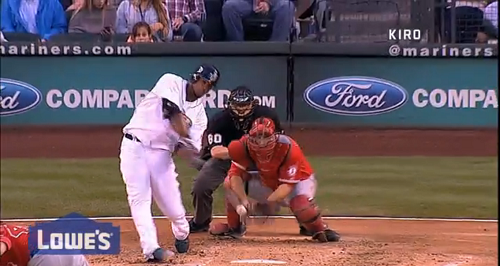
That pitch came in a full count, and Peguero swung at what would’ve been ball four. Instead of being given one base, Peguero grabbed for himself four bases, as Peguero is wont to do, sometimes. You could say that this is Carlos Peguero in a nutshell, but it isn’t, because he didn’t make an out. Peguero usually makes outs. Maybe Peguero in a nutshell would’ve been a foul home run, followed by a whiff at a pitch in the dirt. This sort of thing is probably why Peguero refuses to tighten up his own strike zone — he knows that of which he’s capable when he makes contact.
A lot of people are of the opinion that it can be fun to watch something bad. Along that vein, I’ve heard a lot of people suggest it could be fun to watch this year’s Astros. It’s not. Don’t do it. The Astros suck and you shouldn’t watch them if you don’t have to. Remember the 2010 Mariners? Remember the 2008 Mariners? remember the 2004 Mariners? Things that suck usually suck to watch, at least in baseball, when there’s so much repetition. Sometimes, though, there can be a certain charm, and I’ll admit that I like watching Peguero more than I like watching other similarly ineffective players. The rule is that bad things are bad to experience. Carlos Peguero, at least to me, is one of the exceptions.
And the Mariners are clearly intrigued. Eric Wedge is clearly intrigued, and it’s not like it takes a rocket scientist to figure out why, particularly because this isn’t a rocket scientist’s field of study. Power. Peguero’s got it. He’s probably got too much of it. An expression, when a player hits a home run, is that he ran into the baseball. Carlos Peguero could probably literally run into a baseball and send it flying 500 feet. You could say he has “stupid power”, which is a more PC way of saying you know what? Nevermind.
The first thing about Peguero is his strength. The second thing is his approach, since his approach limits his power upside. Looking at Peguero’s PITCHf/x plate-discipline statistics, available at FanGraphs, I got curious about player comparables. I’m talking about swings at pitches out of the zone, swings at pitches in the zone, and contact. What I decided to do was collect all such statistics for all players with at least 100 plate appearances going back to 2008. I then created my own similarity metric, based on the difference between each player’s stats and Peguero’s stats. Peguero’s score comes out at 0.00, since he’s exactly identical to himself. The remaining scores range from 0.15 to 1.55. The lower the number, the more similar the hitter to Peguero, in the three stats noted above.
The least similar hitter to Peguero? Luis Castillo, followed by Dave Roberts and Brett Gardner. These are patient guys who make a lot of contact. It passes the smell test. Now for what we’re actually curious about — the most similar hitters to Peguero:
- Miguel Olivo (0.15)
- Carlos Zambrano (0.19)
- Cliff Lee (0.20)
- Jolbert Cabrera (0.23)
- Aaron Harang (0.24)
Well that should tell you something. You get three pitchers, all of them undisciplined, and the closest relationship is to Miguel Olivo. Peguero really is the Miguel Olivo of the outfield, and since 2008, Olivo’s hit one home run per 25 plate appearances, with nearly eight strikeouts per unintentional walk. Peguero’s hit one home run per 24 plate appearances, with 12 strikeouts per unintentional walk. Do you wonder what a full season of Carlos Peguero might look like, at the plate? We’ve seen it. We actually really hated it.
The next thing I did was split individual seasons between 2008-2013. This could give me some idea of which players might’ve been like Peguero in the past and then improved. Here are the five closest individual seasons to Peguero’s career to date:
- 2009 Miguel Olivo
- 2009 Randy Ruiz
- 2010 Jake Fox
- 2011 Miguel Olivo
- 2012 Juan Francisco
In case you’re wondering, hovering at sixth is 2008 Miguel Olivo. Carlos Peguero is a lot like Miguel Olivo. Yet, interestingly, in 2009, Olivo posted a 103 OPS+. It isn’t completely impossible to make up for everything else with raw power. That is, if you hit for enough of it. But of course, Olivo gains value from being a catcher, so Peguero can’t very well hit like Olivo and have himself a long career.
If you want a reason to hope, consider Chris Davis. In 2009 and 2011, Davis was similar to Peguero in terms of plate discipline, and the Rangers discarded him as a power hitter who wasn’t going to catch up to enough pitches to succeed. Davis has come on with the Orioles, increasing his rate of contact while tightening his zone, and since the start of last season he’s slugged .537. He still strikes out a lot and he doesn’t draw a ton of walks, but he beats the crap out of the ball, allowing him to post a high dinger rate and a high BABIP. Chris Davis once had something similar to Carlos Peguero’s approach, and Davis seems to be making it, now.
But we don’t know if the adjustments Davis has made could be carried over to Peguero. We don’t know if they’re similarly coachable, and players usually don’t learn how to be a lot more disciplined. Peguero hasn’t shown a whole lot of progress, not that we’ve seen much of him in the majors. Chris Davis is one way this could go. This could go the way of Wily Mo Pena, or the way of Jake Fox, or the way of someone else. Or Carlos Peguero could carve out his own way. Comps aren’t fates. Comps just sort of help us mentally process and visualize probabilities.
Something key to understand is that Carlos Peguero does not need to develop good plate discipline. His easy power gives him a strong foundation, not unlike a starting pitcher who has a swing-and-miss fastball. A starter with a great fastball doesn’t need his secondary stuff to be as good, which is how Michael Pineda was able to have such success as a rookie. If Peguero simply improved to having below-average discipline, he’d take a greater rate of his swings at hittable pitches and his swings would do more damage. Peguero with good discipline would be a superstar, but Peguero with below-average discipline instead of terrible discipline could be an above-average hitter. Home runs are the best thing a hitter can hit, and this is Peguero’s natural advantage. This is why Peguero is on the fringes of the major leagues.
So it’s not like Peguero’s pitch recognition needs to take a massive step forward. It just needs to take a step forward, and that’s easier to imagine. It’s just not *easy* to imagine. The odds remain against him, and Peguero needs to be willing to make the adjustments he needs to make.
You can get it, though. Watch Carlos Peguero, and you can get it. Armed with absolutely no idea, Peguero’s slugged .380 in the bigs. What if he were to get an idea? Just any idea at all? At the least, Carlos Peguero will end up an interesting failure.
Game 27, Angels at Mariners
Hisashi Iwakuma vs. Jason Vargas, 1:10pm
Is this the day that the M’s take their first series of the year? That’d be nice, as the M’s would leapfrog the Angels and into the largely irrelevant but schadenfreudelicious 3rd place in the AL West. As angst-filled and angry as the first few weeks of the season has been for M’s fans, it’s got to be worse for the Angels – a club who acquired the top free agent hitter for the second year in a row, and fancied themselves World Series contenders heading into 2013. So far, it’s been ugly for the Halos, as Josh Hamilton’s struggled, and the pitchers they brought in to replace Ervin Santana and Dan Haren have been even worse. (Meanwhile, Santana’s been excellent for Kansas City).
Today’s Angels starter is old friend Jason Vargas, whom we all know pretty well – he’s a fly-baller, throwing a fastball, slider/cutter and, most famously, a change-up. Like every other pitcher on the Angels, he’s gotten off to a poor start, but he’s always pitched well at Safeco field. And hell, if you get largely shut down by 2013-model Joe Blanton, it obviously doesn’t matter how well/poorly a pitcher’s last few games have gone.
Hisashi Iwakuma’s platoon splits have always looked a bit odd thanks to his change-up like splitter. Over his brief MLB career, he’s given up more HRs to right-handers, but it’s not as severe as, say, Steve Delabar. Instead, Iwakuma’s problem has traditionally come on fastballs, where he tried to sneak in a 90mph FB to get ahead in the count. His four-seamer’s been the most frequently victimized, and as he throws more of them to righties, he’s given up more HRs to them. His slider should help against righties, but it remains his weakest offering. That said, his splitter remains an equal-opportunity weapon, and been effective as long as Iwakuma’s fingers allow him to throw it. I’ve been worried about his short starts leaving too much work for the bullpen, but it hasn’t been too much of a problem so far, as he’s been more efficient than he was in 2012, and in any event the bullpen’s been solid behind him.
Line-up:
1: Chavez, CF
2: Seager, 3B
3: Morales, 1B
4: Morse, RF
5: Shoppach, C
6: Montero, DH
7: Ackley, 2B
8: Bay, LF
9: Andino, SS
SP: Iwakuma
I love giving Smoak a day off and getting Montero a few more at-bats as the DH. Good spot for Jason Bay too, I suppose.
Michael Saunders is starting for Tacoma in CF in preparation for his return to the M’s tomorrow.
Game 26, Angels at Mariners
King Felix Hernandez vs. Joe Cupcakes Blanton, 6:10pm
Note the early start time for the game today – one hour early.
The M’s try to take a 2-1 series lead today in what looks like their most favorable pitching match-up since…well, since Felix’s last start. Joe Blanton signed a two-year $14m deal with a $1m option for 2015 before this year started, and he’s started off his Angels career with four atrocious starts. He’s given up 8 runs per 9 innings so far, with a FIP of nearly seven. As you might imagine with rate stats like that, every peripheral looks awful. His K%, which had edged up to about 20% in the NL, is safely under 10% so far. His HR rate, which was always a problem, is now Anthony Vasquez-ish, and when those two things happen, no one cares that his walk rate’s essentially unchanged.
Blanton relies heavily on a change-up, which is a big reason for his even-to-reverse career platoon splits. He also throws a sinker, a four-seamer and a slider, but lefties especially can count on seeing quite a few cambios. The M’s have about as left-handed a line-up as they can muster, so they obviously don’t put too much stock in Blanton’s career splits. Normally, that’s the kind of thing that I’d find annoying, but it’s defensible given the paucity of really good alternatives. Start Jason Bay over Raul Ibanez? Well, yeah, OK, I would, but that’s got less to do with Blanton than it does with Raul. Blanton’s got a better career K:BB against righties, but the FIP difference swings because righties have hit more homers off of him. That’s more volatile, obviously, but we are looking at a pretty long career. Still, if you’re regressing properly, I think you can make the case that lefties are the better bet, particularly at Safeco Field. Keeping Raul out of the outfield is a good step, but putting him at DH means you’re not choosing Raul over Bay, you’re choosing Raul over Kendrys Morales against a righty, and that’s even tougher to justify. Hit a dinger or something, Raul.
Line-up:
1: Chavez, CF
2: Ackley, 2B
3: Seager, 3B
4: Morse, LF
5: Smoak, 1B
6: Ibanez, DH
7: Montero, C
8: Peguero, RF
9: Ryan, SS
SP: King Felix
Last night’s big *positive* story in the minors was Tacoma’s Andrew Carraway flirting with a no-hitter in the hitter’s paradise of Las Vegas’ Cashman Field. He made it through 6 yielding only one walk (thanks in part to a brilliant bare-handed play by Alex Liddi on a grounder Carraway deflected), but finally gave up a clean ground ball single into the hole in the 7th to Mets’ prospect Josh Satin. The Rainiers pounded Vegas for 10 runs in a 10-1 win.
Arguably the bigger story was that LHP Danny Hultzen went on the disabled list with discomfort in his left shoulder (specifically the rotator cuff area). At this point, the club thinks it’s nothing serious, and that the rest is essentially preventative, but obviously shoulder injuries are terrifying. Hultzen’s velocity seemed to be slightly lower this year than in 2012, but it’s essentially impossible to definitively link the drop and his injury. For one, he didn’t pitch in the PCL in April last year, so I have no idea what he was throwing 12 months ago. Comparing April velo readings to July-August ones is problematic on its face. That said, velo drops are often a precursor to injury, but there’s no way to know for sure if Hultzen’s problems began before he tried warming up the other day in Las Vegas. Get well soon, Danny. Screw you, Glenoid, God of Labrums.
In today’s minor league games, Clinton scored 13 in a slugfest victory over Lake County with young 2B Timmy Lopes getting four hits. Jackson’s currently facing Chattanooga behind lefty Roenis Elias; they’re currently leading 2-1 on a pair of solo shots by Brad Miller and Abe Almonte. Tacoma faces the Las Vegas 51s tonight at 7 with Jeremy Bonderman starting.
Game 25, Angels at Mariners
Aaron Harang vs. CJ Wilson, 7:10pm
Let’s be clear: CJ Wilson isn’t a bad pitcher; he’d look great in the M’s rotation. That said, he’s pretty clearly not the guy the Angels thought they signed (for $77.5m over five years). By RA9, he was worth over 5 WAR per year in his two seasons as a starter for Texas. By FIP, he averaged just shy of 5 WAR per year. By any measure, he was a great starter, and while he posted those two great seasons in somewhat different ways, he appeared to be growing and developing – perhaps into a true ace. His best attribute was keeping the ball in the ballpark; he gave up a freakishly low number of HRs in 2010 (especially considering his home park), and while that figure rose in 2011, it was still better than average. So, remove him from the HR-aiding Ballpark in Arlington and plunk him down in one of the league’s most underrated pitcher’s parks, a park that suppresses HRs, and you’d pencil him in for 3-6 WAR, conservatively, right?
Instead, Wilson was merely so-so, thanks to a home run rate that looked like the league average, not Wilson’s career average. Strikeouts were down, contact up, walk rate back up where it had been in 2010. As a 5-6 win pitcher in 2011, he had a long way to fall while remaining good, and he used nearly that entire cushion. A 2+ WAR season is nothing to be ashamed of, and given that he made only $10m in the first year of his contract, it was arguably a bargain. But as I discussed last year, Wilson’s in for a series of pretty big raises beginning next season.* At this point, it’s become more clear that his very different peripheral stats may not have been the sign of development, they were just the product of higher-than-normal volatility.
Every pitcher is volatile, of course, and it’s magnified in Wilson’s case because he was a good reliever, then a crappy one, then a good one again at the beginning of his career. But the Angels can’t be too happy that his walk rate, which had improved dramatically in 2011, became a problem again in 2012 and has been even worse through four starts this year. His strikeout rate fell back to its 2010 level last year, but it’s fallen well past that this season, even as the league-average figure has climbed (he’s faced only four teams, of course, but the teams he’s faced run the gamut from the high-K% Astros to the contact-happy Tigers). The HR rate is still concerning, and batters stubbornly refuse to chase pitches (he has an absurdly low swing% overall). Add in long-standing platoon splits, and I’d be nervous about paying him $20m in a few years time.**
Ok, so that’s the (mostly pessimistic) context. The good signs, for Angels/Wilson fans, are that his velocity is essentially right where it was in 2012, when his FB velo average hit a career high. And he’s still able to mix six pitches – two fastballs, a cutter, a slider, a curve and a change. His slider/cutter combo has been effective for years, and seems to be just as good now. His fastball seems like a real problem, despite its 92-mph-ness. He had good (read: few homers allowed) results with the four-seamer in 2010, and while it regressed a bit in 2011, it was still a good pitch, as he notched more K’s with it than walks and HRs, despite using it more often when behind in the count. That changed last year, as his ISO rose and his strikeouts dropped. So far this year, it’s more of the same, with a continued increase in his ISO and drop in K’s (tiny sample alert, of course). The M’s need to be patient and get themselves into good counts. No one – not even the Astros – went chasing too many of his pitches out of the zone, so the M’s need to be disciplined enough to avoid that too.
The M’s start Aaron Harang, who was just terrible in his last start. Just awful. C’mon M’s: let’s talk about another good night from Kyle Seager so we don’t have to focus on Harang’s HRs-allowed.
Line-up:
1: Jason Bay, !
2: Seager, 3B
3: Morales, DH
4: Morse, RF
5: Smoak, 1B
6: Shoppach, C
7: Andino, 2B
8: Chavez, CF
9: Ryan, SS
SP: Harang
Jason Bay is leading off a big league game in 2013. Huh.
The Day of Pitching Prospects last night went fairly well, with Victor Sanchez overcoming a rough 1st inning (and a dropped fly ball behind him) to cruise through six solid innings. Taijuan Walker worked out of a couple of jams early and similarly fell into a groove in a great start for AA Jackson, easily outpitching Zach Lee (though you could nitpick about the four walks). Unfortunately, the AAA prospect match-up between Danny Hultzen and Zack Wheeler didn’t happen, as Hultzen was scratched after not being able to get loose. Mike Zunino didn’t find Wheeler to his liking, as he started 0-4 with 4Ks, but the R’s came back from a 7-1 deficit, and a 10-6 gap in the 9th to win a classic PCL pitcher’s duel, 13-12. The Rainiers made five errors. On the positive side, Nick Franklin is nearly as hot in AAA as Kyle Seager is in MLB, going 5-5 last night with two doubles, and a single that slammed off the wall in right.
Today, Tyler Pike pitches for Clinton, and sinkerballer Brett Shankin makes his second start for Jackson. Andrew Carraway get the ball for Tacoma in their second game in Las Vegas.
* It’s not just Wilson, of course. The Angels back-loaded many of their free agent deals. They have five players under contract right now for the 2016 season, and they owe those five players *$107 million.* The M’s have one player under contract for 2016, and he is just the dreamiest dreamboat that ever sailed. This is certainly manageable in the era of the irrationally exuberant TV contract, but it’d be even more manageable with an influx of cost-controlled players to replace the current group who’ll hit arbitration when the big free agent bills start coming due. Unfortunately, the Angels prospect cupboard is freakishly bare right now, with #1 prospect Kaleb Cowart off to a slow start in AA, and #2 prospect LHP Nick Maronde getting a rude welcome to the big leagues last night courtesy of Kyle Seager. Their willingness to spend, and their good fortune/good work developing a Mantle-like talent in Mike Trout make all of these challenges concerning, and not insurmountable. The Angels have been in similar positions before, and they always seem to figure out a way to grind out 85-93 wins, but I’ll admit to a few grins when I look at Wilson/Hamilton/Pujols production and what they’re owed.
** Of course, before I *got* to that, I’d be looking at the fact I owed Vernon Wells nearly $19m next season, even after the offsetting payment from the Yankees.
Game 24, Angels at Mariners
Brandon Maurer vs. Garrett Richards, 7:10pm
I’m sure everything’s going to be different now that the M’s had a closed-door meeting. Manager Eric Wedge ranted, changed color, refused to mince words, etc. The M’s return home with a much greater understanding of what it is their skipper expects from them; “playing awful baseball” isn’t in the enumerated list of expectations. So now players, manager, the front office and fans are all on the same page, and I’m pretty sure we’re going to see a completely different team going forward. (I mean, they closed *all* of the doors for their meeting. This was not a casual chat, with random people filing in and out of the room. This was a focused, controlled, information-rich confab).
Tonight’s starter, Garrett Richards, has never made much sense. Blessed with a fastball in the 95-96mph range and a visually impressive slider, Richards has disappointed at virtually every level of baseball. At the University of Oklahoma, he got strikeouts but yielded way too many walks and homers. In the minors, his command improved, but it came at a cost: his strikeout rate’s been decent but uninspiring for a guy who throws as hard as Richards does. In the majors, he’s been worse – very few K’s, mixed with too many walks and a well-deserved lack of a defined role. He appeared destined for another year as the long-man in the bullpen, but Jered Weaver’s elbow injury gave Richards another shot at the rotation, and in a couple of starts he’s been excellent.
He throws a four-seam fastball to righties and a sinker to lefties, and uses his slider as his out-pitch to both of them. While his arm angle and arsenal suggest huge platoon splits, they haven’t really shown up yet. While he doesn’t strike out a ton of lefties, he’s K’d a shockingly low number of right-handers. While it’s way too early to know if something’s really changed, he’s been sharper against both so far. Really, he’s not too dissimilar from Brandon Maurer. Maurer doesn’t throw as hard, but he too combines above-average velocity with a sharp slider, but hasn’t yet been able to put many hitters away with it. While Richards looked like he *should* have platoon splits, Maurer’s actually shown them, despite a more over-the-top delivery. Again, SSS caveats abound when we’re talking about two pitchers without much MLB experience, in April. But Maurer’s struck out only *one* of the 43 lefties he’s faced (that’d be switch-hitting Rangers utility infielder Leury Garcia), while giving up four walks, three homers and eight total extra-base hits. Lucky for Maurer, the heart of the Angels order bats right-handed, but he needs to take Matthew’s advice and not throw Josh Hamilton a strike. Literally zero sliders should be in the zone against Hamilton.
The other big story in M’s land is the fortuitous alignment of minor league rotations that offers a stunning syzygy of pitching prospects. M’s top-10 prospect Victor Sanchez makes his 2013 debut with the Clinton Lumberkings at the ripe old age of 18 (he’s the second youngest player in the league) against Indians top-10 hurler Mitch Brown. A little bit later, M’s #2 prospect Taijuan Walker takes the hill for Jackson against Dodgers #2 prospect Zach Lee. Finally, Danny Hultzen and the Rainiers are in Las Vegas to take on the 51s and #2 Mets prospect Zack Wheeler.* The game was supposed to feature the top two catching prospects in the minors in Mike Zunino and Las Vegas’ Travis D’Arnaud, but the latter’s on the shelf due to injury. If you wanted to tune out the M’s for a day and gorge yourself on hope, well, today seems like a good day for that.
Mariner line-up:
1: Chavez, CF
2: Seager, 3B
3: Morales, DH
4: Smoak, 1B
5: Ackley, 2B
6: Shoppach, C
7: Peguero, RF
8: Bay, LF
9: Andino, SS
SP: Brandon Maurer
The M’s outfield tonight is Jason Bay, Endy Chavez and Carlos Peguero. Would you like the audio link for the Rainiers game again? Sure thing.
I think the defining moment of the Astros series was Chris Carter’s home run against Saunders in the final game. It was just a solo shot, the game was clearly still in doubt, and Chris Carter’s always had light-tower power. According to hit-tracker, it didn’t even make it 400 feet (wait, seriously?), but the *sound* of that shot was unreal. Sure, it helps to have the roof closed in a deserted ballpark, but it was a neat little summary of other clubs ability to extract value from marginal players and the M’s inability to do the same. I’ve been following Chris Carter since 2009 when he arrived in AAA Sacramento in time for the PCL playoffs and basically single-handedly eliminated the Rainiers. It was a performance that still gives Mike Curto flashbacks and cold sweats. But I have never seen a player look as lost at the plate as Carter did in his cup of coffee in 2010. Not Peguero, not Brendan-Ryan-in-2013, not Wlad Balentien. He was back in 2011 and was somehow even worse, striking out in over 40% of his PAs, and just looking like the definition of a AAAA slugger (and even there, Carter’s still not put up a AAA season as productive as Peguero’s 2011 OR 2012). The A’s were a combination of patient and lacking in better options with him, but while he still struck out an alarming rate, he combined with Brandon Moss to generate Albert Pujols-level production from the 1B slot last year. This isn’t a miracle or anything. His speed, defensive problems and position meant that even with an 860 OPS in 67 games, he was worth just one win above replacement. Thus far with Houston, it’s more of the same – he’s struck out 35 times already in just 87 plate appearances – but five home runs and decent number of walks add up to, well, not a whole lot, but the Astros have a cheap 1B with some promise. I’ve been incredibly pessimistic about Carter now for years, and I think a big part of that is because, being an M’s fan, I’ve *never seen* a flawed hitter improve and become productive.** That violent crack reminded me that it actually *is* possible, and that many teams acquire flawed hitters with the idea that their staff can ameliorate some of the deficiencies and their manager can put the player in a position to succeed. That’d be nice.
I am pretty jealous of Matthew right now.
I’m also jealous of Ranger fans, not just because of all of that ‘winning’ and ‘pennants’ and stuff, but because they get to watch Yu Darvish. This gif shows five of Yu Darvish’s many, many pitches. It is amazing. (Hat tip to Lone Star Ball, everyone in my twitter feed, and LSB user ‘DShep’ for creating it).
* For the sake of completeness: High Desert plays Bakersfield in a California League game featuring several baseball players.
** Ok, Jose Lopez counts, but only for one year. If Carter is just a 2012 mirage, then I take this overwrought paragraph back.
The Most Significant Irrelevant Poll
All right, all the talk now is about how the Mariners suck again. I guess some of the talk is about people talking about how the Mariners suck again, but the rest of the talk is about how the Mariners suck again. The team could, in theory, have gotten off to a worse start than they have, but there are fewer ways they could’ve been worse than there are ways they could’ve been better, and already it’s looking like the contention ship has sailed. The Mariners, already, are seven games out of first place. They’re five and a half games out of second place, and they’re behind the Angels, who have also sucked and who are way better. This team isn’t going anywhere, and we’ve had an awful lot of Eric Wedge and Jack Zduriencik.
So now we’re acknowledging and discussing the hot seats. Dave seems pretty convinced that Zduriencik is going to be relieved of his duties. Much of the baseball industry is similarly convinced, and on the plus side, that means we’d, in turn, be relieved of Zduriencik’s duties. I think it’s pretty evident that this isn’t the same front office we all fell in love with back when it was brand new. We might’ve been hasty in expressing such affection, but the way the team was run then — it isn’t the way the team is run now, even though the same guy’s in charge. He’s changed, the people around him have changed, and the team has changed, not for the better.
It’s exciting to think about the prospect of a new general manager, because GMs lead organizations and smart GMs make smart moves that make teams into better teams. Think about the Mariners now. Now think about the Mariners in the hypothetical universe where they hire Andrew Friedman tomorrow. You’re excited! By a completely made-up and impossible hypothetical! You are desperate for Mariners excitement.
We’ve been critical of the “new Mariners” and we’ve changed our tunes as the Mariners have changed theirs. It does look like Zduriencik will lose his job and his position, barring a significant turnaround. That would leave the Mariners looking for a new guy, a new mind, a new leader, and we wouldn’t know much about the candidates even after their names are revealed. Some of you are beyond ready to see an administrative change. Some of you might still be loyal. Which is why I’m running this poll, after giving it a week or so of thought. Not a week of thought, straight. I thought of it, then I stopped, then I thought of it again, now I’m publishing it.
The Mariners are probably going to get rid of Jack Zduriencik. Do you want that to happen, or are you still personally on board with the organization and with its operating philosophies? There are, of course, arguments for both sides. That’s why this poll isn’t going to be unanimous.
For those in favor of replacing Zduriencik, well, the team sucks, and it seems to now value the wrong things, while actively not valuing many of the right things. The Mariners have become arguably the least analytical, forward-thinking organization in baseball, and while it’s possible to win that way, it’s more of a challenge and the game has simply changed. Do you trust Jack Zduriencik to build a winning Mariners roster? I have less faith in him now than I ever have at any point.
But. You knew there was a but. Zduriencik has built this team around a talented young core, and is it really his fault that Dustin Ackley, Jesus Montero, and Justin Smoak have sucked? How different would things be if they were all even simply league-average? You could call that a problem of misevaluation, but then everybody would’ve been misevaluating those guys — they were consensus top talents, and they might still blossom, who knows. You can’t blame Zduriencik for thinking they were worth acquiring. Additionally, there’s going to be more money, now, and one can’t deny that the Mariners are in far better shape than they were when Zduriencik took over. Back then, it was like a cartoonish hellscape, something you see in a post-apocalyptic blockbuster. People like the Mariners’ farm system, there’s talent on the big-league roster, and the guys can draft. Maybe they can’t develop so good, but they can draft.
And here’s an important matter: it’s fine to want change. It’s fine to be sick of the executives we have. But the point is to change for the better, not to change, just. What do we know about replacements? Who are they, and how good might they be? How certain can we be that a new general manager would be better than the current one? What are the odds that the Mariners would hire a certain improvement, especially given that we don’t even know who would be doing the hiring? Will all of the candidates be better than Zduriencik? If not, would the Mariners hire somebody worse? If someone were to devise an accurate model of general manager WAR, where would Zduriencik rank, what would be average, and what would be replacement-level? Keep in mind we all wanted the last guy fired. Now a lot of people want the current guy fired. He’s better, of course, than Bavasi, but now another step would have to be taken.
So I’m curious to see how this is going to come out, even though I think I have a pretty good idea. And I think you have a pretty good idea of where the various USSM authors stand. The tide has turned against the Jack Zduriencik front office, but how many loyalists might there still be? These are tough times to be loyal, but let’s not pretend like it wouldn’t be somewhat justifiable. Somewhat.
Mariners Possibly Await Their Doom
| MARINERS (8-15) | ΔMs | ANGELS (8-12) | EDGE | |
| HITTING (wOBA*) | -13.1 (26th) | 2.9 | 11.6 (6th) | Angels |
| FIELDING (RBBIP) | -1.7 (16th) | -6.9 | 1.9 (12th) | Angels |
| ROTATION (xRA) | 6.2 (7th) | 0.7 | -20.8 (30th) | Mariners |
| BULLPEN (xRA) | 3.1 (6th) | 2.0 | -7.6 (29th) | Mariners |
| OVERALL (RAA) | -5.5 (16th) | -1.2 | -14.9 (23rd) | MARINERS |
Welp.
If you listened to the podcast below you can gleam a general sense of mine and Jeff’s current opinion on the Mariners state of affairs. Something is rotten in the state of Cascadia and judging by the schedule, it’s not going to get any easier, even if the Angels seem weak right now. The Mariners cannot even beat the Astros so this isn’t really about the other teams. It’s about the Mariners and they need to get their house in order.
This seems like an opportune time for me to take a break. Actually, after the first two games of the season would have been the best, and hopefully I will return regretting missing some fun and exciting baseball, but oh well. I’ll be back in a few weeks.
Podcast: The Mariners are Really Upsetting
The last time Jeff and I recorded a podcast, the Mariners had just dropped a series to the Astros, a team we were confident that the Mariners should steamroll. This time is different though because this time the Mariners dropped a series to the Astros in Houston. Also, now we’ve lost most if not all expectations that the Mariners are significantly better than the Astros. The season starting Mariners probably were, but that team is already gone.
So, big time warning here on the explicitness. Really. We are displeased and since we don’t script or rehearse these beforehand our displeasure typically manifests itself in a string of curses. Do not play this over your speakers at work. Do not play this around people with fragile sensitivities. Perhaps just don’t play this. Go outside instead, it’s pretty enjoyable out there. The Mariners are not enjoyable.
Podcast with Jeff and Matthew: Direct link! || iTunes link! || RSS/XML link!
When Do People Start Getting Fired?
In my pre-season preview of sorts, I wrote the following paragraph:
And, finally, I expect everyone will be back for one more run next year. I think the young guys will show enough to keep anyone from getting fired, though the team won’t win enough to earn long term extensions for everyone in charge either. They’ll get one more shot to win with the young players they’ve acquired. 2014 is the make-or-break year. 2013 is another building-for-the-future season, or will be seen that way in retrospect, at least.
I take it back. This team is going to get people fired. The question now is more when and who than if. And given how badly the team has started, I know a lot of you are hoping to see these changes sooner rather than later.
Side note – I take no pleasure in writing about people potentially losing their jobs. These are still human beings with families to support and bills to pay, and you’d be surprised how little MLB teams pay their front office staff below the GM level. If there is a regime change and the new guy eventually cleans house, there are going to be a lot of people out of work who aren’t independently wealthy. That sucks. I have a lot of empathy for people who might be eventually unemployed because of this team, especially the ones at the lower pay grades. Please don’t take this as rooting for people to get fired.
But, before we go starting any kind of lynch mob, it’s worth remembering that emotional decisions that are solely made to make a point are often regrettable in retrospect. If the Mariners are going to make some changes at the front office or field staff level, they should be able to explain why those changes are going to help move the organization forward. Taking a pound of flesh might appease the angry horde, but the Mariners should be in the business of improving the organization, not simply bowing to public pressure. Responding to the push for “more dingers!” is part of why the 2013 Mariners put together a dreadful roster in the first place.
So, let’s start with the field staff. I’ve never made a big secret out of my disagreements with Eric Wedge, and I don’t think he’s shown that he’s a very good evaluator of talent or that he has a good grasp on what traits should be emphasized to build a winning baseball team. In short, I don’t think Eric Wedge is the right guy to be the Mariners manager long term, and I won’t be too sad to see him move on at some point. But, what good would firing Eric Wedge do right now, really?
You’re not going to go conduct a full managerial search. Those happen in the off-season, not the middle of the year when the candidates are committed to other organizations. And, unless you know for sure that you’re not changing GMs, hiring a permanent manager now just means you have an awkward situation if you do make a change in the front office, since new GMs generally want the power to bring in their own staff. If you lay the blame for this team at the feet of Eric Wedge — certainly, he deserves some of the blame, so I’m not absolving him of responsibility for this roster — all you’re really going to accomplish is removing him so that you can promote a coach that was selected based in large part on his ability to work with Eric Wedge.
Carl Willis is here primarily because of his previous relationship with Wedge. Robby Thompson and Jeff Datz were with Wedge in Cleveland, and Datz was his bench coach, the guy who usually has the most interaction with the manager during games. The only “new guy” on the bench is Dave Hansen, who came over from the Dodgers to serve as hitting coach this year, but are you really excited about promoting the team’s hitting coach right now? Is there any indication that anyone on the staff now would be doing anything any differently?
Making change just for the sake of making change is usually useless. That doesn’t mean I’m completely against the idea of replacing Eric Wedge in-season, but I’d like to see a reason for the change simply beyond “I’m frustrated and someone has to take the fall for this.”
In some ways, managers are hired to be the fall guy for when the roster goes badly, and since Wedge had a lot of input into how this particular roster was built, it’s not totally unfair for him to take the fall for the performance of this team. But, is firing him now going to actually make things any better? If not, then what’s the point? As illogical as some of Wedge’s decisions are, it’s not like the team has a bunch of talented reserves who are getting shut out of playing time right now. The Mariners got rid of all those guys over the winter. The reserves suck now. Getting a new manager to play the bench guys more often would probably make the team worse, not better.
I don’t think it really makes all that much sense to fire Eric Wedge until you’ve also decided you’re going to fire Jack Zduriencik and go another direction. And firing a GM in season comes with some complications.
The main one is the draft. We’re six weeks away from the Mariners selecting 12th overall, and there’s a lot of work that has already been done to get the staff prepared to pick another crop of young prospects. Making a change at the GM level doesn’t mean that Tom McNamara would do his job any differently, but it adds another variable to the mix. Does whoever get promoted from within to hold the job on an interim basis — the most likely candidate would be Assistant GM Jeff Kingston, though Tony Blengino is also still on the team’s payroll, and would give the team a different voice than what they have at the moment — decide to pull rank and exercise more control in the draft room in order to try and make a name for himself in hopes of landing the full time job? You’d hope not, but is that a dynamic you really want to mess with right now? If there’s one area the organization has succeeded at in the Jack Zduriencik era, it’s been drafting. I’m not sure I’d want to mess with the current organizational structure before these guys got to do the thing they’re best at.
After the draft, it’s a little more palatable to make a change, but it’s still not the easiest transition ever. At that point, you’d be looking at seven weeks before the trade deadline, so it’s a time where a lot of important decisions are going to have to be made, including some that could have some long term ramifications for the franchise. Maybe the Mariners will decide that they don’t want Jack to be the guy making those calls if they’ve already determined that he won’t be back next year, but would you feel any better with an interim GM making those decisions? Remember when Lee Pelekoudas was the interim GM of the Mariners in 2008, and he was reportedly overruled on several veterans-for-prospects trades he attempted to make? Are the Mariners really better off with a guy who isn’t empowered to make the final call than they are with a lame duck?
A few years ago, Jim Hendry was fired by the Cubs on July 22nd but stayed on until August 19th in order to help the club transition through the deadline. Bavasi was fired mid-season, as we noted. Josh Byrnes was fired by the Diamondbacks on July 1st, 2010, and then replaced by Kevin Towers a few months later. But there aren’t a lot of other examples of in-season GM changes. Baseball America has an executive database and you can go through each team’s GM history and see the date of the hirings and firings; they’re almost all in October or November.
Realistically, if you’ve gotten to the point where you think the organization is headed in the wrong direction — I reached that point this off-season — and are in need of new blood, then you’re probably going to be waiting until this coming winter to see the new GM brought in. Making a change now might guarantee that a change is made, but it doesn’t necessarily put you in a better position long term, unless you think Jack, Wedge, and company are actively undermining the development of the players on the roster with their presence. Maybe they are, I don’t know. But “maybe, I don’t know” isn’t a reason for me to throw my full support behind a house cleaning that will lead to a bunch of interim replacements.
My sense is that the guys in charge needed a non-embarrassing season to keep their jobs, to keep organizational faith in the process, and show that there were positive steps in the right direction, even if those steps didn’t result in a winning season just yet. They needed Jesus Montero, Dustin Ackley, and Justin Smoak to hit. They needed Taijuan Walker, Danny Hultzen, and James Paxton to pitch well enough in the minors to justify the hype. They needed to get Mike Zunino to the big leagues without it feeling like he was rushed to try and save someone’s job. They needed to establish that the young players were worth building around.
They needed this April to not happen. Embarrassing is the only word I can use to describe this. The team is publicly stating that they think they can win while starting Endy Chavez, Raul Ibanez, Robert Andino, and Kelly Shoppach. They traded for Aaron Harang to save the pitching staff. This roster is embarrassing. This roster is probably going to get everyone fired. This roster should get everyone fired.
But, I don’t know that it’s all that helpful if it gets them fired soon. If it happens, I’m not going to be against the decision, and I don’t think having an interim manager or GM would lead to impending doom. But, I don’t know that it would really help anything either.
During a season, there’s only so much an organization can really do. The Mariners made this bed when they let the front office try and build a winning team around dingers and voodoo. It has blown up in their faces in a comical way, and it’s probably going to cost the people in charge their jobs. But, I don’t know that it needs to cost them their jobs in a RIGHT NOW THIS MINUTE I DEMAND CHANGE kind of way.
Firing people shouldn’t just be about making yourself feel better because you fired someone. Firing people should happen because you think you have someone who can do a better job. Maybe the Mariners have those people in place and think it’s the right time to make the move. From the outside, it’s impossible to know whether or not that’s true. But we shouldn’t demand change without knowing whether there are actually better options internally.
The time for change is coming. If ownership decides its here already, I’m okay with that. If they decide to wait a while, I’m okay with that too. I’d rather have them make an informed decision after seeing all the evidence over a longer period of time than see an emotional reaction to 23 bad games. If they don’t need any more time to make a rational, informed decision, so be it, but that’s a different reason for firing everyone than “this team sucks and you’re going to pay for building it.”